New Orleans, Louisiana

New Orleans, Louisiana
New Orleans, Louisiana
New Orleans, Louisiana
There are a handful of modern sculptures scattered across the various quads on the Tulane campus in New Orleans. One I noticed the first time, more than four years ago, that we took Lee there for a visit was a construction of wood and a stack of handmade multi-colored glass blocks that stands in front of the Architecture building.
I always like to take a look at it when I visit.
Timber
Glass, Steel, and Wood, 1982
by
Gene Koss, American

Timber, by Gene Koss, Tulane University, New Orleans, Louisiana
(click to enlarge)

Timber, by Gene Koss, Tulane University, New Orleans, Louisiana
(click to enlarge)

Timber, by Gene Koss, Tulane University, New Orleans, Louisiana
(click to enlarge)
Thank You Uncle Sam
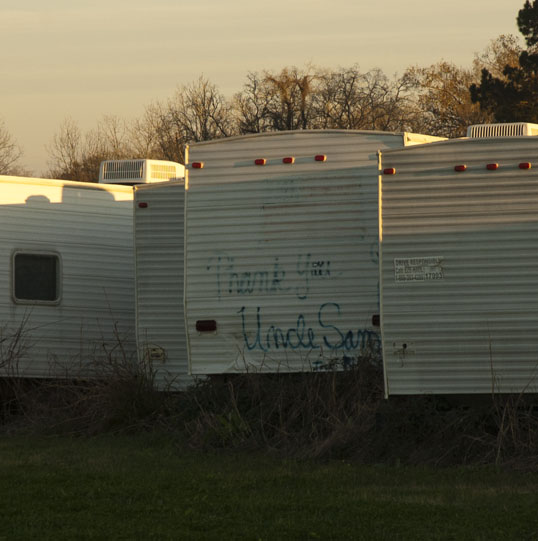
Thank You Uncle Sam, FEMA trailers, Opelousas, Louisiana
I was driving to New Orleans, moving down Interstate 49, south of Alexandria. My plan was to get on Interstate 10 in Lafayette and then go east over the Atchafalaya to Baton Rouge and on into New Orleans.
But I decided to take a look at my GPS and saw the I10 highway marked in a solid bright red line all the way from Lafayette to Baton Rouge.
If you have never driven that stretch – and you will remember it if you did – that’s an almost twenty mile long bridge high up in the air over the most desolate scary swamp, the Atchafalaya River Basin, that you will ever see. It is not the place you want to spend a few hours stuck in bumper to bumper traffic as the sun sets.
My GPS showed an alternate, older route – US190 splitting off east at Opelousas and going through a more northern section of swamp to Baton Rouge. The GPS showed that route as yellow and green. As I approached the turnoff a sign promised “Alternate Route.” That was all the encouragement I needed and I drove that way.
It was a good choice. Under normal conditions it would have been slower than the uninterrupted expanse of fast concrete belonging to the I10 bridge – but today it wasn’t jammed with stopped vehicles. I only had to wait through the shorter delays caused by stoplights, fish camps, sugarcane factories, bait shops, fireworks stands, fried fish restaurants, local casinos… and the other flotsam and jetsam of the Louisiana backlands.
One thing that did catch my eye was a huge field, just east of Opalousas filled with thousands of mouldering empty portable housing units. FEMA trailers.
There were once hundreds of thousands of these left over after Katrina. Cheaply made, even by government standards, spewing formaldehyde vapors, leaking and harboring black mold – they were a controversial response to the disaster – sometimes welcomed, often maligned.
But here they still are, eight years later. Come on down and buy one, they are for sale, pennies on the dollar. What a bargain.
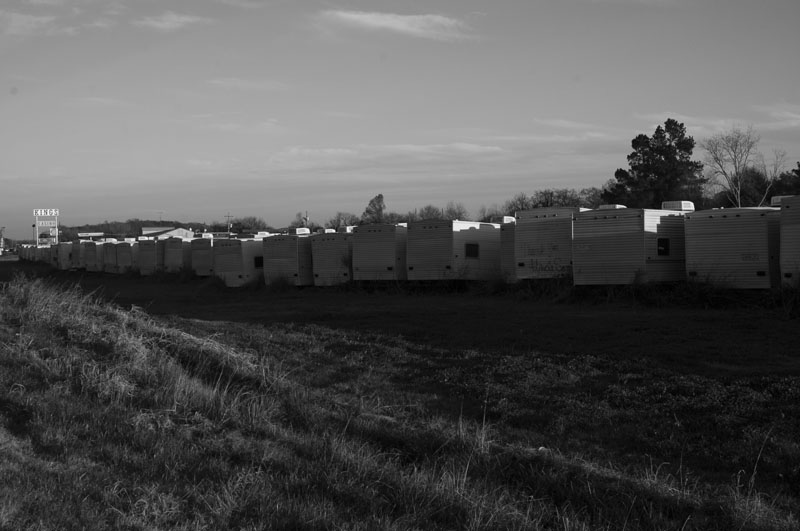
FEMA Trailers
(click to enlarge)
The 10 Most Useless Kitchen Gadgets
I’m afraid there are a couple of these I wouldn’t mind having. I will not tell you which ones.
California vs. Texas: Wild West Shootout
But behind the posturing lies a riveting drama. Two of our biggest and richest states, polar opposites on the political spectrum, are taking radically different approaches to attracting new jobs. Policymakers in Washington and beyond will be watching closely to see who comes out on top.
….
This is the Ali vs. Frazier of interstate rivalries. It promises to be the fight of the decade.
The Top Tools for Productivity
The number one tool is the Pomodoro Technique – which I’ve found to be very useful.
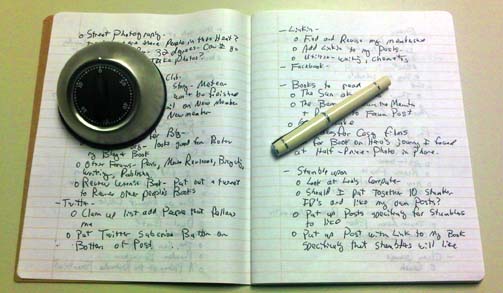
An Idea Pomodoro – timer, pen, composition book.
The federal government’s relentless expansion has made Washington, D.C., America’s real Second City.
The Washington, D.C., region has long been considered recession-proof, thanks to the remorseless expansion of the federal government in good times and bad. Yet it’s only now—as D.C. positively booms while most of the country remains in economic doldrums—that the scale of Washington’s prosperity is becoming clear. Over the past decade, the D.C. area has made stunning economic and demographic progress. Meanwhile, America’s current and former Second Cities, population-wise—Los Angeles and Chicago—are battered and fading in significance. Though Washington still isn’t their match in terms of population, it’s gaining on them in terms of economic power and national importance.
In fact, we’re witnessing the start of Washington’s emergence as America’s new Second City. Whether that’s a good thing for America is another question.
3 Hottest Real Estate Markets in Dallas for 2013
I’m surprised that they mention Richardson, where I live, as one of the hottest real estate markets – though I am partial to the inner-ring suburb.
Of course the comments consistantly talk about how awful Richardson is – so it must be a great place.

An Afternoon with Ralph Steadman
He gets out his signature fountain pen and fills it with ink.
The 12 Best Acting Performances at Sundance 2013
Pen and Ink Blog Illustrates Stories Behind Tattoos
Is Urbanism the New Trickle-Down Economics?
12 Louisiana Bands You Should Listen To
Waiting for Texas – but this is getting close.

New Orleans Cemetery – Saint Louis #1
On our last trip to the Big Easy, we signed up for a New Orleans Cemetery tour from Tulane University.
The Cemeteries of New Orleans are famous – when you visit you notice them right away on your drive away from the airport. Because of the high water table, burial in the city is above ground in crypts. If you tried to stick a coffin underground it would come bobbing up in the first hurricane and go hurtling down the street.
The dense clusters of stone crypts packed into rows give the cemeteries of New Orleans the nickname, “cities of the dead.”
All the parents piled in to the bus on the Tulane campus for the trip to St. Louis Cemetery #1. The woman sitting next to us spent her time making desperate phone calls. She was from Rockaway in New York and her house had been destroyed by Hurricane Sandy. She had decided to go ahead and make the planned trip to visit her daughter at school so she could use the Internet to register for assistance while her husband remained behind trying to salvage what he could. There was a lot of irony in a parent from New York coming to see her daughter in New Orleans as a refugee from a devastating hurricane.
The tour was very interesting – mostly because of our tour guide. A spry elderly New Orleans native of French extraction – thick with that amazing melodious Cajun accent – she spoke a lot of the unique way of looking at life (and death) necessary for survival in a place as inhospitable to polite civilization as New Orleans. She spoke of the constant friction between the attitude of the New Orleans natives and the Americans… spoken as if they were aliens from another planet.
She said she didn’t understand the Americans, even though she was glad she was married to one, because, “Darling, somebody has to do the work.” She said, not long after she was married, her husband had to go in to the office on a Saturday,
“Honey, where’re you goin’,” she asked.
“I’m going to work.”
“What do you mean? It’s Saturday. Nobody works on a Saturday!”
The concept was completely incomprehensible to her.
Then she went on to describe the details of a New Orleans internment. She said, “Ah never though this was unusual. I thought everybody did it like this. When I went to another city I was stunned. Ah said ‘You did a hole? And drop a body down there? And cover it up?’ Ah couldn’t believe it.”
You see, I always knew about the above ground crypts in New Orleans, but I never understood the process. You see, these are family crypts – or in some cases, organizational crypts. They are built in two parts, an upper chamber and a lower one. A small opening at the back of the crypt connects the two.
When you die, there is no embalming… and no fancy metal or lined casket – just a pine box. They open the crypt and you go in the top chamber. There you wait, for at least a year and a day, until the next person expires. Then they open up the tomb, secure in the knowledge that the tropical heat and humidity have done their work, and there isn’t much left of you. Any surviving pieces of casket are removed and everything else is pushed back through the opening where it falls into the lower chamber, leaving room for the next occupant.
This is repeated as long as necessary. Some of the tombs had dozens of names on them, spanning well over a century.
Some of the details are fascinating. The walls of the cemetery are lined with small “wall tombs.” These are for when, as our guide said, “Somebody dies too soon, before the year and a day. They get stuck in the wall tomb until they can get moved back into the family crypt.”

Our tour guide in front of a typical New Orleans burial crypt.

A street in the City of the Dead. Family crypts on the left, wall crypts on the right.
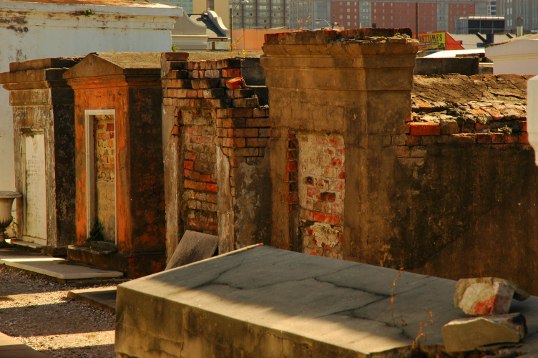
Older crypts, getting run down.

Wall crypts. Space is at a premium. Look at the tiny spaces at ground level.
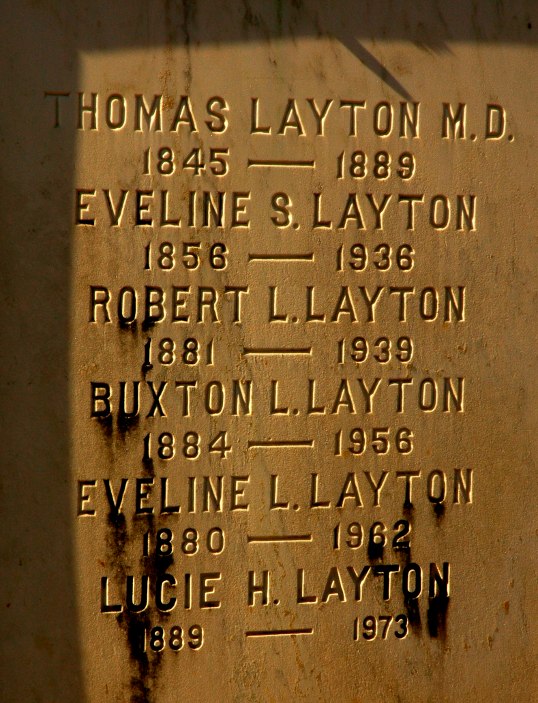
Layton family crypt. Over a century of family members.
Our guide said she was waiting for tomb space to open up and had saved money to buy in. “Space is limited, and in death like in life, it’s location, location location. I don’t want to go to my rest outside the city, I want a tomb in New Orleans.”

When a family dies out, nobody is left to take care of their crypt and it can collapse. Our guide said she had her eye on this spot in case it came up for sale.
Halloween, French Quarter, New Orleans

Tabasco, Crystal, or Louisiana
I don’t think there is such a thing as too much hot sauce, but this guy will disagree. Not even the cool Mardi Gras beads could protect him.
Notice he has all three of the Louisiana Hot Sauces… the Holy Trinity: Tabasco, Crystal, and Louisiana (Red Dot) Brand on the table in front of him. No establishment should have less.
But that means you have to choose. Life is full of tough decisions. Though I have great respect for Tabasco, and like the Red Dot, I am a Crystal man myself.

Finding a hotel in another city on the Internet is a funny thing… it’s not so much like looking for something blind as it is trying to make a decision, a choice, based on secondhand information where everyone is lying to you.
When Candy was researching a place to stay in New Orleans for our trip last week she kept coming across a place called St. Vincent’s Guest House. We’ve stayed a handful of places in the past, most notably the Prytania Park, and the Mandevilla B&B (both highly recommended BTW) but the St. Vincent was a lot (a lot!) cheaper.
I didn’t get too involved in the planning, and while we were flying to New Orleans I was really curious about what this place would be like. It was in a great location – right on Magazine Street in the Lower Garden District – close to downtown (and the quarter) and the St. Charles Streetcar.
But it was only going to cost us fifty dollars a night. What kind of Big-City hotel charges fifty dollars a night? In my mind I pictured an old run-down Motel 6, kicked out of the chain for excessive filthiness, occupied mostly by prostitutes, and a constant drug trade going on in the parking lot. Still, it’s only fifty bucks a night, we need to spend as little as possible, and all I need is a place to sleep – so I could deal with anything.
When we drove up and checked in, I quickly realized the truth could not be farther from this image. St. Vincent’s is a massive ancient brick edifice of classic New Orleans design with impossibly high ceilings, balconies with intricate cast iron railings, and one hell of a history to boot.

The imposing facade of the St. Vincent’s Guest House, facing Magazine Street in New Orleans. I had to move around a bunch of film crews and trucks to get this – they were shooting scenes for Treme. The St. Vincent must be a popular location – they did scenes for Red (the Bruce Willis film) there – now I’ll have to watch the damn thing.

The side of the St. Vincent Complex, from Race Street. We stayed on the second floor of the wing in the background, that’s the carriage house in the foreground.
From a faded clipping in the lobby:
History
St. Vincent’s was built in 1861 as an orphanage. It was founded by the Daughters of Charity order of nuns, however much of the funding was provided by Margaret Haughery. Margaret was an illiterate, Irish immigrant to New Orleans – she was a orphan herself and lost her husband and baby to yellow fever here in New Orleans. This was not unusual. Every summer up to 30.000 people here would die of mosquito born diseases such as yellow fever and malaria. Margaret’s tragic losses led her to dedicate her life to alleviating the suffering of children. She made a great fortune from her baking business and dedicated her wealth and compassion to philanthropic works. St. Vincent’s was among the greatest of these works. When Margaret died in 1882, the entire city closed down to mourn her loss and thousands followed her funeral parade, a fitting tribute to a truly great person. You will notice the clock on the roof of the carriage house at St. Vincent’s (across the courtyard) – this was willed to St. Vincent’s by Margaret as a final gift.
There is a lovely statue of Margaret between Prytania and Camp Streets, just near the 90 overpass. You may also like to visit St. Elizabeth’s orphanage, now owned by the Vampire novelist, Ann Rice. After the children turned seven, the girls were taken from ST. Vincent’s to St. Elizabeths. St. Elizabeths is in the Garden District on Napoleon Ave.
Still run by the Daughters of Charity in the 20th century St. Vincent’s became a refuge for unwed mothers. In 1901 it was discovered that mosquitoes were the cause of the summer epidemics and the city paved the streets and generally tried to eradicate the puddles of water in which mosquitoes breed. Without the annual epidemics New Orleans was in the happy situation of no longer having enough orphans for St. Vincent’s. St Vincent’s served as a refuge for unwed mothers and their children until the social revolution in the 60’s rendered such a refuge unnecessary. It remained empty for a couple of decades until brought back to life in 1994 as the Guest House you see today.

The clock on top of the carriage house, complete with cool sculpture hanging off the side.

Here’s a closeup of the sculpture on the clock on the carriage house. It’s called “New Orleans Gargoyle” by Thomas Randolph Morrison. Pretty cool, huh. You’re not going to see stuff like this hanging off the Hilton.
Now, the place was far from luxurious. It is primarily a hostel – with a constant flow of young hitchhikers and lost souls (some working at the house in one form or another for discount or free rent) and a wing of dormitories. They do have a spate of regular rooms and ours, being the cheapest, was pretty run down. The usual amenities were non-existent. The sheets had holes, the hot water sporadic, the walls were painted a bilious purple, the towels mismatched, the door key and lock of dubious quality and security, the television ancient and lacking a remote and the curtains didn’t come close to covering the entire windows. The drawers in the dresser didn’t fit, the ventilation rumbled, black sheetrock screws half-screwed into the molding provided clothes and key holders. The pool was covered in black plastic, the furniture mismatched, and empty whiskey bottles littered the common areas.
The only thing that bothered me, really, was a decidedly musty smell in the room, and it went away with a couple days of activity. To be fair, St. Vincent’s was obviously still being repaired from the damage inflicted by the last hurricane and a lot of water had gone through those old walls. We realized that, really, the whole city had that musty smell.
So it wasn’t the Hilton, it wasn’t even the La Quinta… but, my God, what history. New Orleans is a city accommodating and welcoming to spirits and everyone spoke about the ghosts of the orphans and their parents – yellow fever victims – still floating around the place. The hallways were lined with fine polished bronze sculptures. It seems a New Orleans sculptor – Thomas Randolph Morrison – displays all his bronze work in St. Vincent’s. Art – paintings or interesting old photographs – covered the walls.

The sculpture-lined hallway at St. Vincent’s.

A sculpture facing a mirror.

A view out a hallway on the third floor. Like a lot of old buildings built in tropical climates it has very high ceilings (I estimate 20 feet high), balconies, and an open plan for ventilation.
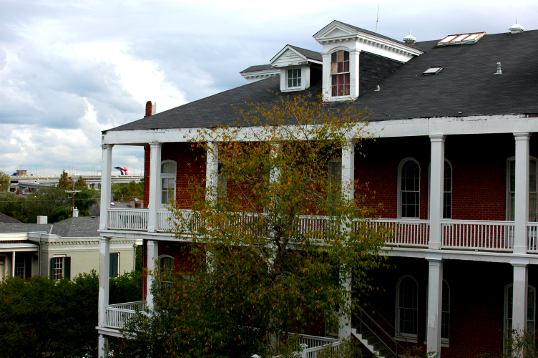
Our wing at St. Vincent’s. If you look closely on the horizon you can see the winged stack of a Carnival Cruise Ship on the Mississippi river.
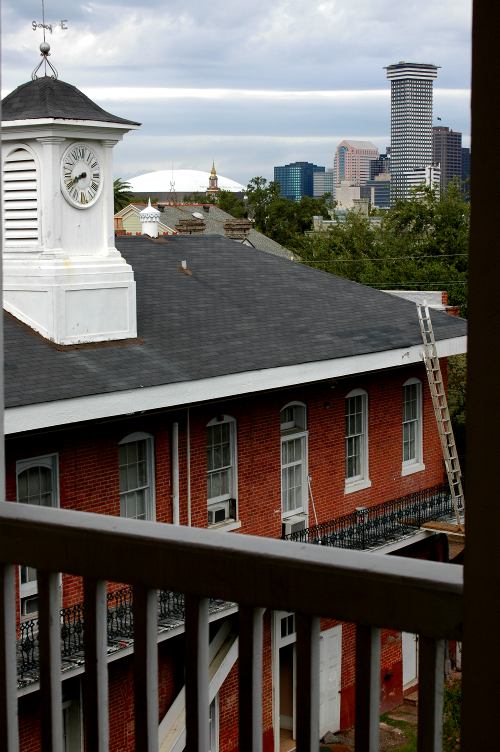
The carriage house at St. Vincent, with downtown New Orleans and the Superdome in the background.
Now, I certainly can’t recommend the place – it sure has its share of bad Internet reviews – but if you have a little imagination, a sliver of adventurous spirit and, most of all, an open mind, it’s a pretty damn cool place.
Plus, it’s in a great location and it’s only fifty dollars a night.

An old photo on the wall at St. Vincent’s Guest House, showing the original tenants, the young orphans that lost their parents to yellow fever, posed on the stairs.

The same spot, on the same stairs, today.

A tomb from Lafayette Cemetery #1
Everywhere in New Orleans you run into the ghosts of the yellow fever. This is a tomb from the Lafayette Cemetery #1 (not far from St. Vincent’s). I had to mess with the image, the top part was in deep shade. It reads:
Died of Yellow Fever
Sercy,
Born Aug. 29th 1878,
Died Aug. 30th 1878.
Mary Love,
Born Oct. 7th 1876,
Died Aug 30th 1878.
Edwin Given,
Born Dec. 3rd 1873,
Died Aug. 31st 1878.
Such is the Kingdom of Heaven.
In two days that family lost three children, age newborn, three, and five years old.
On our visit to Lafayette we could not help but notice the beauty of all the azaleas blooming across south Louisiana. No matter how humble your little cottage might be, you can have all the color you want exploding outside.

Azalea in Lafayette, Louisiana
I stepped out of a little restaurant and walked around back to take this picture. As I was raising the camera a couple of guys tumbled out of the business next door. They looked a little mixed between confused and upset and one said, “Is there anything I can do to help you?” – and not in a tone of voice that implied he really wanted to help me with anything.
“Nope, I’m just taking pictures of the flowers.”
“He’s just taking pictures of the flowers,” the guy said to his buddy, in a disgusted tone, and they went back inside without another glance at me.
Azaleas don’t do very well in Dallas, where I live. The soil is not acidic enough – right under the surface is a thick layer of limestone (caliche) that keeps the soil basic. A lot of people do plant them and fight the acidity. Some pour swimming pool acid (hydrochloric) into a trench before planting – the best thing is to dig a big hole and fill it with peat moss. Still, no matter what you do, eventually the caliche will infiltrate the soil and your flowering bushes are toast.
East Texas has beautiful azeleas. I remember, years ago, doing a bicycle ride along the Azalea Trail in Tyler. It was gorgeous. Maybe a road trip this spring would be an idea.
Dallas is right on the edge between two areas of vegetation. To the east, it’s all piney woods, dogwood, and azaleas. To the west – mequite and prickly pear.
None of it is like what I saw in South Louisiana, though. The things seemed to grow like weeds.

Old Barn (click to enlarge)
Another picture of another old barn. This one is from pretty much the same spot as the one I posted the other day, taken only a few seconds later in another direction. It was processed with the same software, but going for a different effect.

Old Barn (click to enlarge)
Messing around with a RAW image using HDR and the Luminance HDR (formerly Qtpfsgui) program. I know everybody is sick of these overprocessed, oversaturated, unrealistic digital photographs, but let me have a little fun.
It looks like this is an old, rustic, overgrown barn out in the middle of the swampy bayou, but it’s actually on the campus of the University of Louisiana Lafayette, in the middle of Lafayette, Louisiana.
 Bill Chance