A Clean and Clever Wrestler

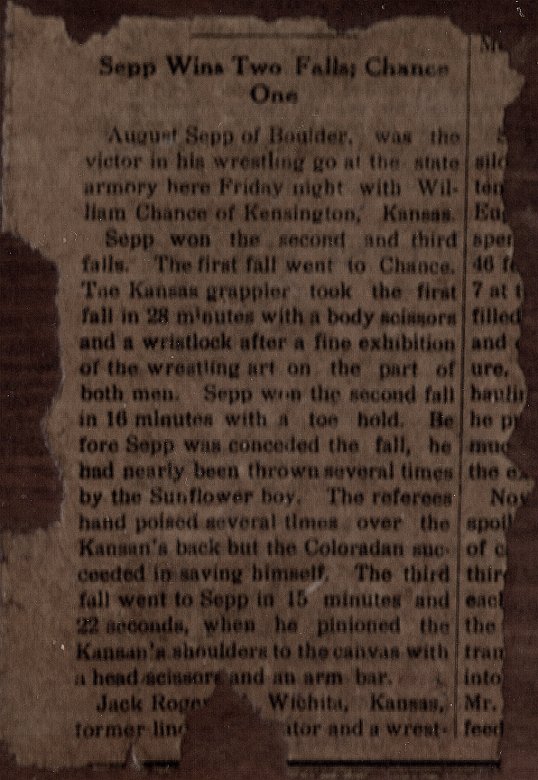
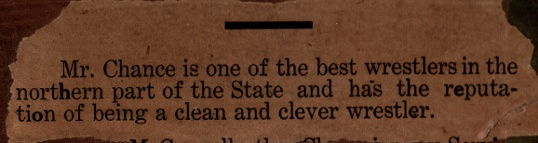
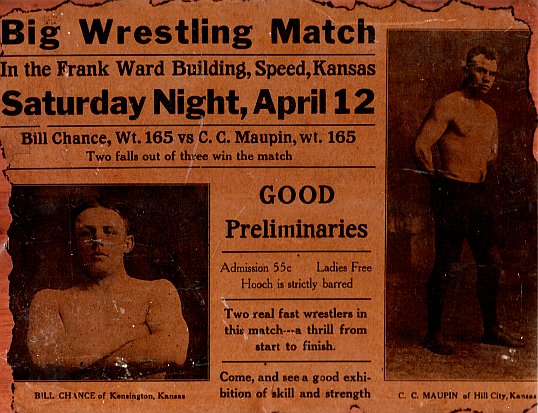
I wrote yesterday about a play I saw here in Dallas called The Elaborate Entrance of Chad Deity and mentioned that, although I feel nothing of it, there was some wrestling in my blood. These posters and clippings are of my eponymous grandfather.

They speak for themselves – however I’d like to point out a couple interesting phrases from the posters, due to the lack of attention span on the internet.

“Winner Takes All The Gate Receipts” (If you lost, you didn’t eat)

“Hooch is Strictly Barred” (1924 was right in the middle of prohibition)

From the article, the wrestling match lasted 38 seconds short of an hour. That’s a long time to wrestle.

The admission ranged from 55 cents up to a dollar for a ringside seat – which was a lot of money in 1920’s Western Kansas. However, ladies were admitted free.

(Click for a larger version on Flickr)

Six Flags

If someone says “Six Flags” or even “Six Flags Over Texas” most people will think of the amusement park(s). Few outside of the Lone Star State know the historical implications of the six flags. There really have been six different flags flying over the state – a couple of them twice each.

First was the flag of Spain. From 1519-1685 and again from 1690-1821 most of Texas was a Spanish colony. In between, for the five years from 1685 to 1690, the area was under French rule. For more than a decade, from 1821 to 1836, Texas was a part of the newly-independent country of Mexico.

For ten years, from 1836 to 1845, Texas was a Republic… its own country. Some people think it was the only state to be independent, but that’s not true.

Then, in 1845, Texas joined the US as the 28th state, only to secede and join the Confederate States in 1861. Finally, in 1865, after the Civil War (or The War Between the States, as it is still called in the South) it rejoined the US.

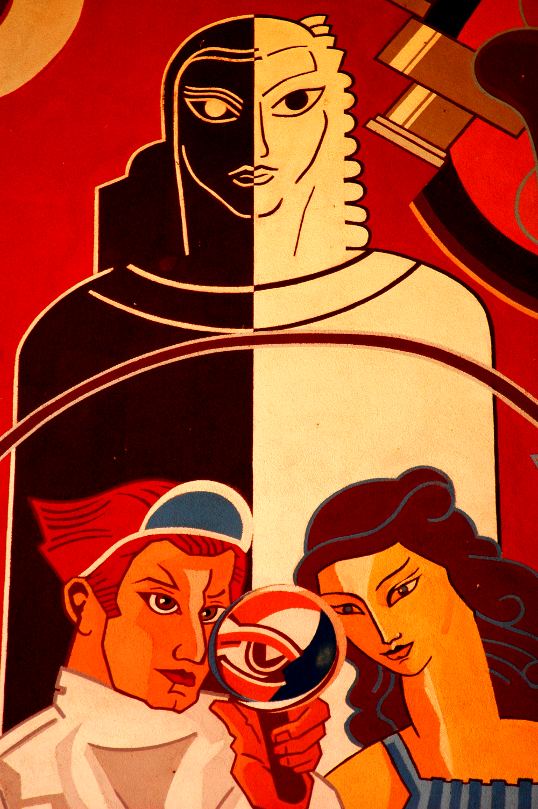
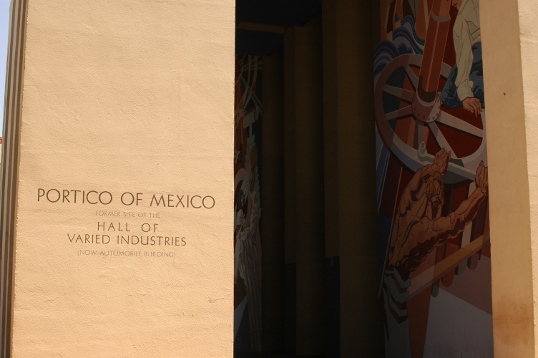
Along the Esplanade, in Dallas’ Fair Park, are six huge porticoes lining a massive pool… three on the north and three on the south. Each portico represents one of the flags that flew over the state. There is a huge female statue outside each representing each country… I’ll look at them another time. What I want to show you is what is inside each portico.

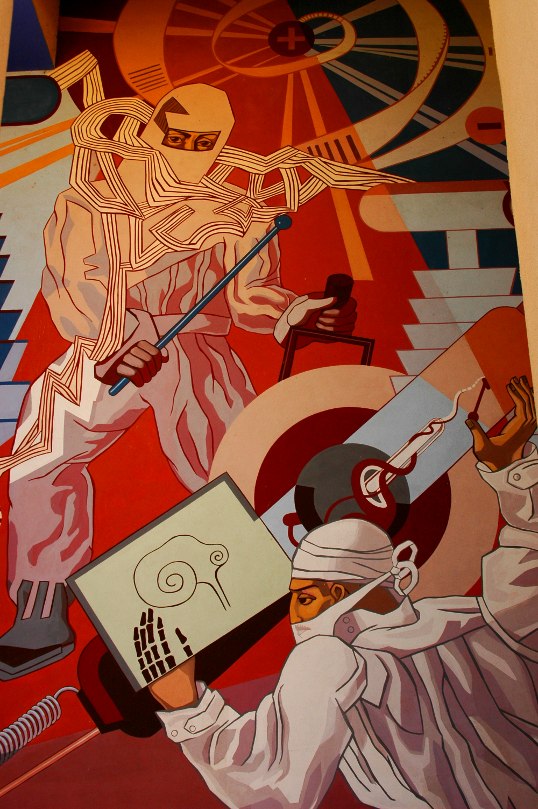
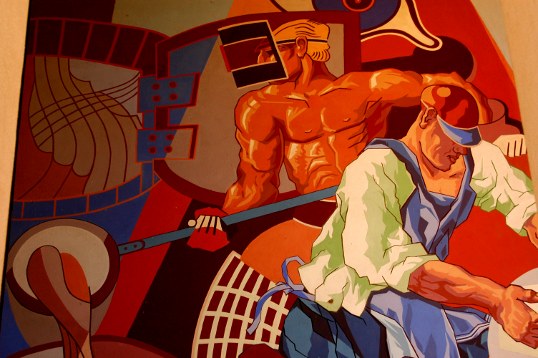
Every entry boasts a massive mural painted on the wall. They are done in a beautiful, powerful, art deco style. I think they are among the coolest things in the city.

And they are virtually unknown. Each fall, millions attend the Texas State Fair and wander around eating their corny dogs, riding the ferris wheel, or looking at the newest car models or the fattest livestock and nobody bothers to peek inside the porticoes at the artwork – even though they are about forty feet tall.

I love to walk the mostly deserted park on non-fair days and look at the paintings. The ones on the south side, facing the north, have been beautifully restored. The ones on the north side, facing south – where the burning sun reaches in – are in worse shape and are very difficult to see because they are behind protective screens. I hope they are restored some time… I’m sure someone is working on it.

The murals are very difficult to photograph. They are in shade and reach up tall and wide in alcoves where you can’t get any distance away for a good shot.

So I did the best I could. If you have the time and are in town – go down and take a look for yourself. Otherwise… here you go.

The Esplanade pool at Fair Park in Dallas. You can see the huge porticoes on the south side on the right.

Art Deco mural from Fair Park in Dallas

The huge murals are tucked inside the massive porticoes and are very difficult to photograph.

The northern three porticoes are facing the sun and their murals are badly faded.

I hope these are restored – they would be beautiful. This one includes a space ship – painted in 1936.

Blacksmith Lessons

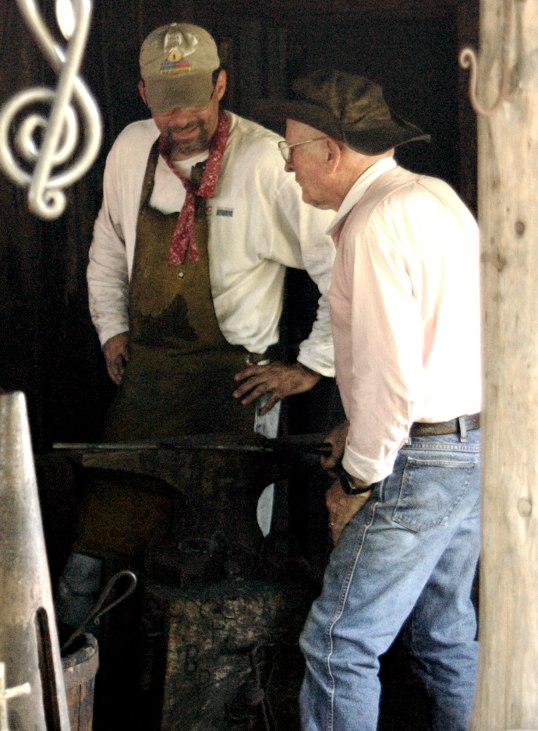
When I went down to the Dallas Heritage Village and the Cedars Food Truck Park I took a little walk around the village. Back in the corner is a blacksmith’s shop. The master blacksmith was giving lessons to two students.

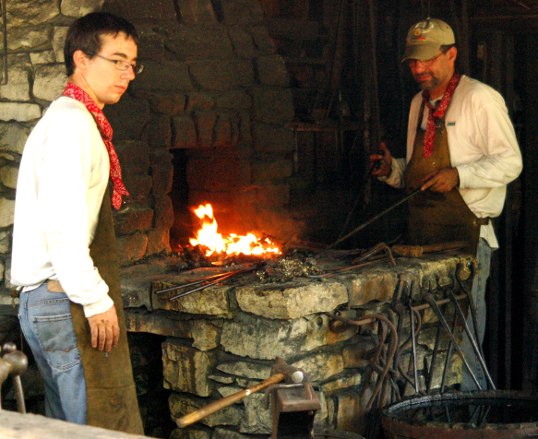
I stood and watched for a while. They had a coal fire going and would reach overhead and pump a huge pair of bellows to feed the fire and get the heat they needed. The students would pull their iron out of the fire and hammer it red-hot against an anvil.

This was really interesting. Maybe I’ll save some money up and buy myself a blacksmith lesson some time. It wouldn’t be very useful, but might be an interesting experience.

A blacksmith student hammering his work.

The teacher and the student.

Working at the forge.

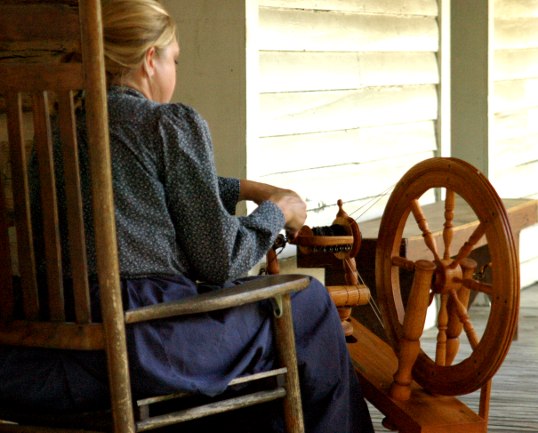
Near the blacksmith’s shop -a woman running a spinning wheel.

I was reminded of the blacksmith shop when, a couple weeks later, I was riding my bike around Fair Park. I was looking at and trying to photograph the series of amazing art deco murals on the six porticos along the Esplanade (I’m working on a blog entry… patience).

One of the murals shows a bare-chested smith hammering a piece of iron against a huge anvil. He is holding his hammer over his head, while next to him a helmeted welder is working away. A little more dramatic and artistic than the little blacksmith’s shop – but it’s the same general idea.

Art Deco mural from Fair Park in Dallas

Routh Cemetery

North of where I live is a patch of thick creek-bottom woods known as the Spring Creek Nature Area. I’ve been going there for years – to walk around or ride my bike on the complex of paved trails that loop through the forest. It’s a nice spot… a place to forget that you are in the middle of a giant city.

The looping trails through the Spring Creek Natural Area converge on a little footbridge over the creek. There is a nice bench there – a good place to rest and get away from the city for a few minutes.

I had read rumors that there were a couple of old cemeteries within this woodland stretch. A little bit of web searching and careful observation of the Googlemap aerial view of the area and I was pretty sure I had spotted the locations. I am not obsessed – but I find old cemeteries to be interesting. They are the only remaining mark that a lot of the early settlers left on the land here.

I had stopped off at one in the middle of a Plano neighborhood a month or so ago and now I thought I’d take a look at the one in Spring Creek.

So the other day, once my bike ride had been cut short by an unexpected flat, I left my car at Renner and 75 and walked down to where I figured the graveyards might be. It was a hot day and walking was not easy, even though I had brought a bottle of cold water. The cemeteries are not in the Nature Area exactly, but on private property, but judging by the trails and dirt roads penetrating the scrub and trees, I was not the first to venture back there.

After a short hike I came across a small family plot, with a rusting iron inner fence and a new black wrought iron palisade around that. This was the burial place for the scion of the Routh family, Jacob Routh, his wife, Lodemia, and two unmarried daughters. The plot is overgrown with vegetation and I didn’t feel like climbing the fence, so I never was able to see the daughter’s tombstone. The Routh name is still heard all over the Metroplex, especially now that Routh street pierces right through the heart of the uptown entertainment district.

It’s a very peaceful spot, perched right above a steep, deep, dropoff of native limestone down to the creek below. I can picture it over a hundred years ago, part of a ranch made of rolling hills rising up from the creek bed. It’s where a pioneer would choose to spend the rest of eternity. Somehow, I don’t think they would mind the fact that the plot is being overgrown, slowly returning to the way it used to be.

Around to the side of the tombstones of the four family members are two small markers. I could barely see these through the underbrush – couldn’t make out the dates. One had three names, Sharon, Rinnet, and Theda. The other simply said “Fluffie.” These are obviously pet graves… horses and a dog, probably. In those times, a family’s animals would have been very important, worthy of a carved stone in the main cemetery plot.

Jacob Routh’s tombstone in the family plot deep in the woods at the Spring Creek Nature Area in Richardson, Texas.

Pet grave marker.

I couldn’t get a good shot without climbing the fence… but it says “Fluffie.”

I left the small cemetery and followed an old road down through a little creek and up a hill, almost emerging onto a new road that winds through the glass and granite high-rise office buildings of the Richardson Telecom Corridor. Shielded from civilization by a thick grove of trees is a larger cemetery, containing about a hundred or so graves. It was fenced – I did not enter even though there were some gaping holes in the wire. Near the locked gate was a couple of crumbling benches and an official historical marker.

It reads:

Marker Number: 14532

Marker Text:

Brothers Jacob, George Washington, Joseph and Thomas Jefferson Routh, and their sister Elizabeth Routh Thomas, were cousins of the Vance Family which held the original land grant that encompassed this site. Jacob Routh (1818-1879), a Baptist minister, acquired the 440-acre J. V. Vance survey in 1851, and brought his mother and other relatives from Tennessee to Texas. The Routh family were instrumental in the establishment of the community surrounding their land. Routh family members helped to organize a school, church, and store in addition to the family cemetery.

Early Collin County settlers Nancy De Lozier Beverly (1806-1851)and seven year old William Klepper, along with an unknown child whose parents were camping nearby at the time of his death, were already buried on this site when Jacob Routh set aside one acre as a family burial ground. Jacob’s mother, Elizabeth Mashman Routh (1788-1852), died soon after her arrival in Texas and was the first family member to be interred here.

Jacob Routh, his wife Lodemia Ann Campbell, and two unmarried daughters, Rose and Clara Routh, are buried several hundred yards north of the cemetery in a private plot. Of the approximately two hundred graves here, fewer than one hundred are marked. The last burial to occur here was that of Serefta Ellen Campbell Miller, who was born in 1836 and dies in 1922. The Routh cemetery continues to serve as a record of the pioneers of north Texas. (1998)

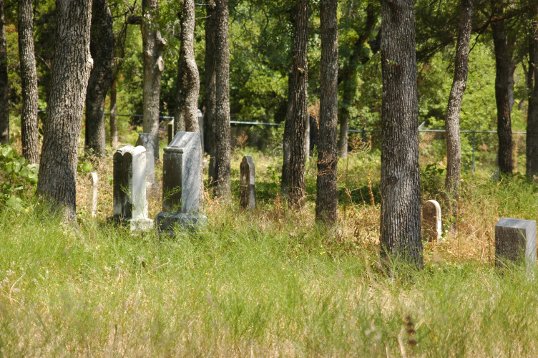
I walked around the fence and snapped a couple shots through the wire. Like the smaller plot this one was overgrown, with large mature trees grown up between the crumbling markers.

The sun was burning down and I had seen what I wanted and returned the way I came, taking time to explore a couple side trails that meandered through the woods down to the creek in a couple different spots. I hope that land doesn’t get developed any time soon, I’d like to see the the Spring Creek Nature Area expand… I’d like to see those cemeteries both protected and also, paradoxically, continue to return to the wild state they started from.

Old School

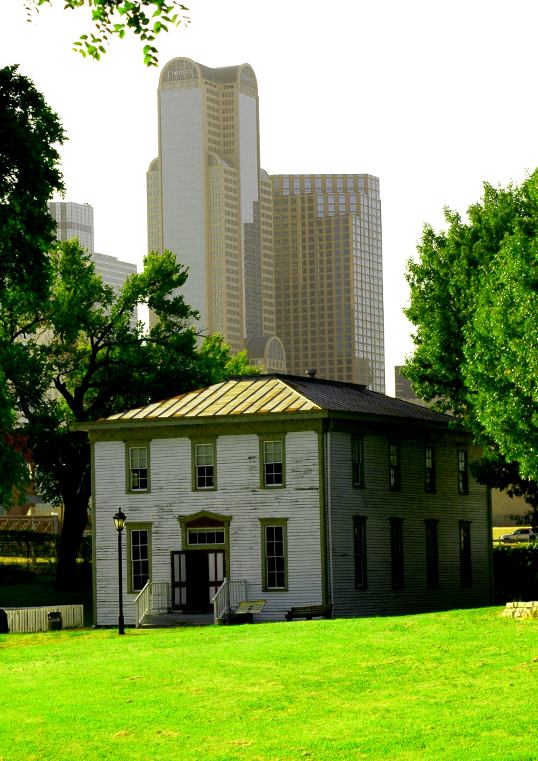
Renner School House, Dallas Heritage Village

I was wandering around, looking into the historic buildings that have been moved from all over North Texas into Old City Park, now Dallas Heritage Village. Some kid walked into the Renner School House at the same time I did.

“Can you imagine going to school in a room like this?” I asked.

“I’ve been here before, I think. I think it was a field trip,” he answered.

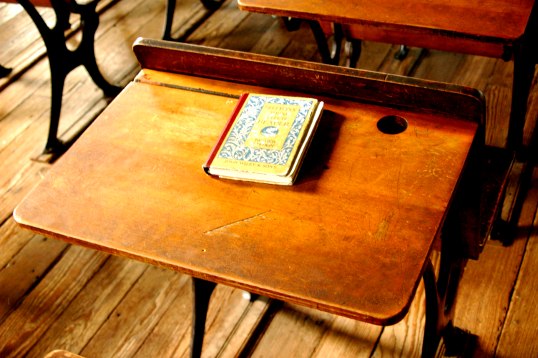
“Look at how each chair holds the desk for the person behind them. Oh, do you know what the little holes are for?”
“For the inks!” he said.

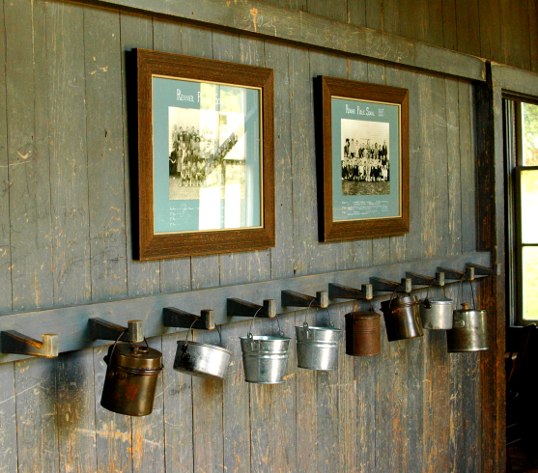
“It’s a shame we can’t go upstairs or play in the playground,” the kid said. “Do you know what all these cans hanging on the wall are for?”

I said, “Those are what the kids brought their lunch to school in. See, they are little metal buckets. They called them lunch pails.”

I kept running into the kid as I walked around the place and he would leave his family, walk up to me and point out something. In the historic barnyard he was looking around, trying to find the rooster that was crowing.

“I think it’s a recording,” I said. “They are playing that sound over and over.”

“It sure sounds real,” he said.

The historic Renner School House, in Dallas Heritage Village, with the skyscrapers of downtown rearing up in the background.

Lunch pails hung on the wall pegs at the Renner School House.

Daily Reader.

Renner School House desks.

Bowman Cemetery

I braved the heat today and went on a bike ride up at the Oak Point Park and Nature Preserve in Plano – riding down to Bob Woodruff park and out west along Plano’s Santa Fe trail (every city here has one of these). It’s a fun little route I rode last year and it’s a vaired one – some wooded creek bottoms, some open prairie, and a couple of nice hills.

About halfway out the Santa Fe trail branch of my route, along Oak Grove road, I had noticed a sign that said, “Santa Fe Park and Bowman Cemetery.” Looking up the hill I saw an open stretch of grass with some old monuments peeking over the crest. On the way back, I pumped up an alley and found the old cemetery – took a break to look at the stones and snap a few pictures.

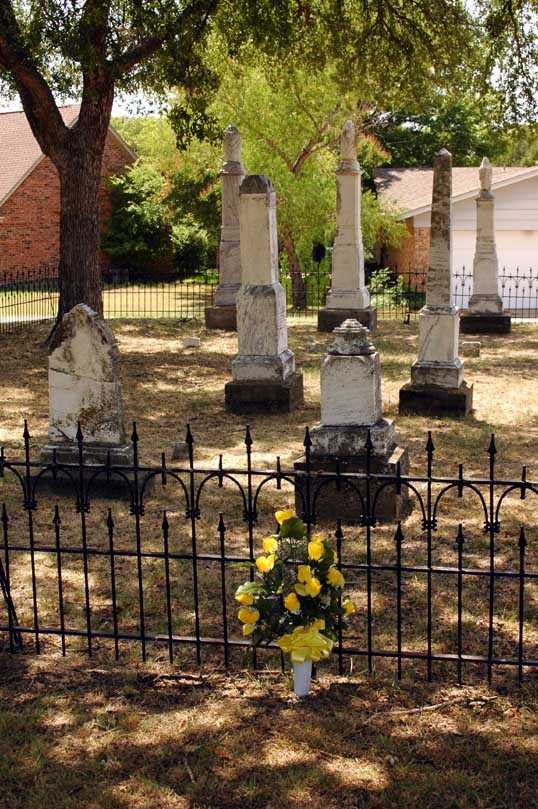
The cemetery is in the middle of a neat, modest suburban neighborhood. Somehow, it fits there.

Someone is still putting flowers out on some of the graves – a century later.

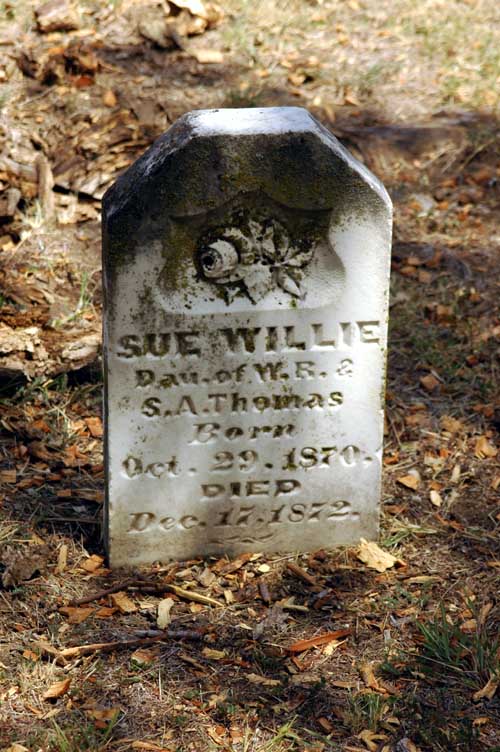
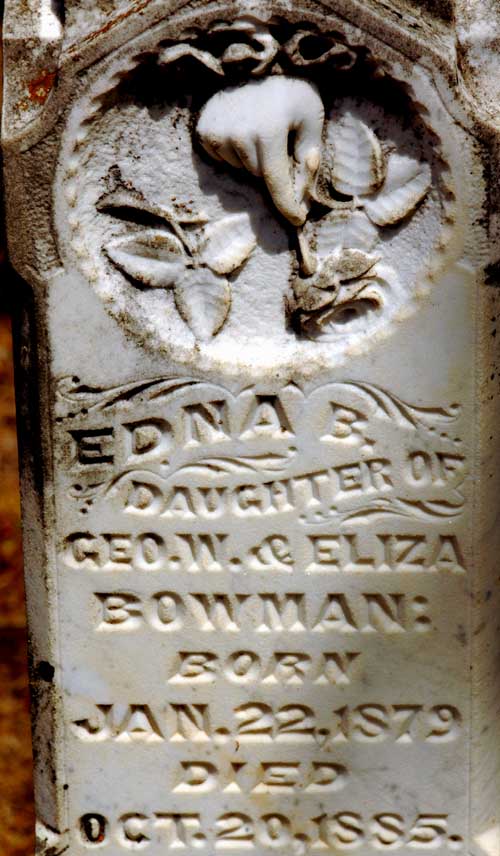
Not all the markers are grand monuments. Some, like these were no bigger than a small paperback book.

The cemetery sits right in the middle of a middle class suburb, but you can picture it on a knob of a hill with wilderness all around without much trouble. There is a historical marker – but the plastic is faded and crazed and I couldn’t read it.

From a historical website (they seemed to have trouble reading it too – thus the ellipses):

John D. Bowman established Bowman Cemetery with the burial of his daughter, Julia Ann Bowman Russell, who died on September 5 1858. The cemetery contains two fenced family lots. The large, more elaborate lot with wrought iron fencing, contains the burial of several members of John D. Bowman family, and their immediate in-laws. Among these are Joseph Russell, a Peters Colony (Republic of Texas land grant given to investors led by William S. Peters) settler, and Dr. Henry Dye, an early…..physician. The smaller, wire-fenced lot contains members of the Brown family, who were related to the Bowman and Russell families through marriage. Several marked and unmarked burials of both early African Americans and European American residents of Plano surround these fenced lots. A variety of gravestone types are represented in Bowman Cemetery. These range from the prominent marble tablet stones and a few….modern granite markers. Many of these stones are adorned with symbols and fancy….such as fraternal organizations….and religious or philosophical beliefs typical of the time period. The most recent marked burial in the cemetery is for John D. Bowman’s son, George W. Bowman, who died in June of 1921.

Whenever I see an old cemetery like this I can’t help but be reminded of how many folks died young. Half the graves are of children, half of the rest are less than thirty years old. When you find yourself down and worrying about the latest “crises” or feel the world is going to hell in a handbasket, think of these pioneers and how tough their life used to be.

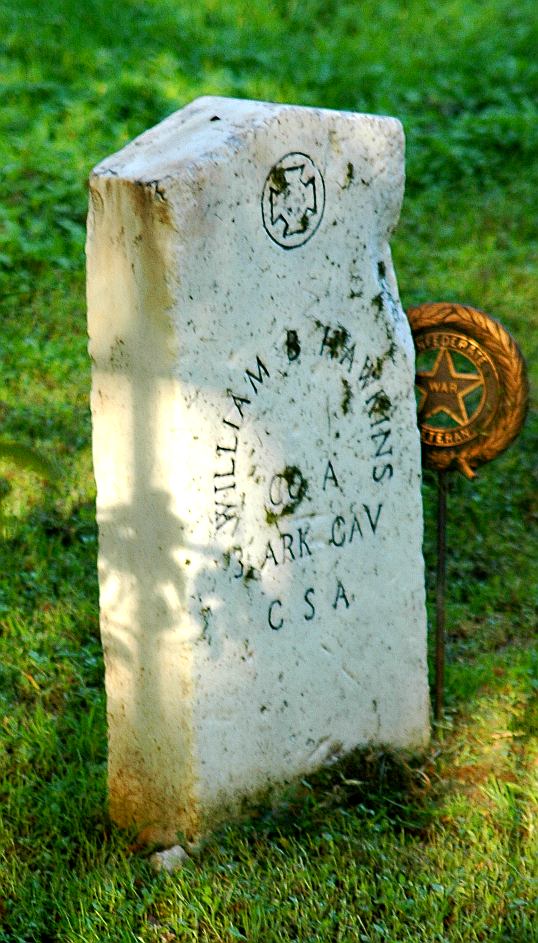
William Hawkins CSA

The other day Candy and I were walking through Uptown Dallas on our way to the DART station at Citiplace when we passed by an old cemetery. It’s Greenwood Cemetery. Like most old cemeteries it’s a peaceful historic place.

As we walked by, I turned and shot a simple photo of a simple veteran’s tombstone.

Everybody is used to seeing old cemeteries and everybody is used to seeing veteran’s graves. But unless you live in the southern states you aren’t used to seeing tombstones marked CSA.

Here, of course, Confederate graves are all too common.

McKamy Spring

Somehow, surfing around the web, looking for information on the area near where I live and work, I stumbled across a tiny little article about a place called McKamy Springs, Richardson, Texas. The page told about a historic spring that was once used by the Native Americans as a reliable water source while hunting buffalo on the open prairie. There was a crude black and white photograph of a spring inclosed in a brick dome. Below the dome a small stream of bright water poured out.

McKamy Spring - historical photo

The spring had been bricked over sometime in the past and a commemorative stone placed beside it. The stone said, “The Yoiuane tribe of the Caddo group of Indians lived here as early as 1690 to 1840. They hunted buffalo and deer on the prairie. They used McKamy Spring as a watering place. It was from these friendly Tejas Indians that Texas got her name.”

Well, there isn’t much open prairie in these here parts nowadays – so I wondered if the spring was still there. I noticed that there was a small park called McKamy Springs Park in the middle of a new transit oriented development called Brick Row in Richardson along my way to work. I rode my bicycle there once while working out a bike route to work.

I remembered a nice, peaceful, little park in the place – I stopped there to rest and drink a water bottle. I didn’t notice a spring… but I wasn’t looking for one. Could the little McKamy Spring still be down there?

While I was out and about, it didn’t take much to stop by and take a look. Sure enough, the spring was there, exactly as it was in the photo (only now it was in color). Only a pitiful dribble of water trickled out, but I know how wonderful a trickle like that can be in a dry country. Green algae was growing over the stream and I had to climb down to fish out a discarded water bottle and a shopping bag.

Still, it seems cool to me that the little spring is still there, spitting out a bit of groundwater, even if it is surrounded by kids on a playground, locals walking their dogs, and folks sneaking out for a smoke. The open plains, the deer and the buffalo are long gone, but little McKamy Spring is still hanging in there.

McKamy Spring today.

The spring is in a nice little park in the center of a big mixed-use development.

Digital Nostalgia

I was talking to Nick and Lee about digital technology, history, and advancement, trying not to be so much of an old fart – “When I was a kid we had to walk fifty miles to school through twenty feet of blowing snow….”.

They were messing with their IPhones and imagining what the state of digital electronics would be in ten, twenty years from now; when the IPhone will be as clunky and obsolete as a hand-cranked telephone. I talked a bit about when I was young – back then you were not allowed to own your own phone – you rented it from the phone company. They were usually hard-wired into the wall (when I was in college, our city of Lawrence, Kansas, was a pilot program for the now-ubiquitous cube taps – it seemed revolutionary [which it was, more than we imagined at the time]) and very, very few folks had more than one phone in the house.

The kids said that the smartphone was the most important digital invention in their lifetime (so far) and that it had changed the way they lived. They are right – the fact that you are now able to tap into the far-flung digital word from any spot (pretty much) on the planet at any time. They were especially adamant about being able to access the web at a moment’s notice is revolutionary – not only communications, but information, maps, social networks…. it really is amazing… here in this, the best of all possible worlds.

I think of going to high school in Central America…. I felt so isolated and out of touch. If the Internet existed then (forget about smart phones) I would have been able to stay up with things…. A few years later – single, back in the US, it was so easy to lose contact. Social Media, a smart phone – what a difference that would have made. I think of all the time I spent searching for pay phones, trying to keep up.

I started thinking of the moments of digital history that affected me. Not so much the technology itself, but the split seconds, the flashes of epiphany, when I realized that things were changing irrevocably – that new worlds of possibility were opening up.

Nick and Lee really didn’t understand what I was getting at, but I still thought about it-

I remember when I first understood the power of using a computer with a graphical interface. I’d been using the early Windows programs and the mouse and all was cool – but I didn’t see what the big deal was. Until one day, sort of at random, I realized I could cut from one program and paste the data, pretty much intact, into a completely different application…. I could do complex calculations in a spreadsheet, for example, and simply cut the whole mess out and paste them into a word processing document without any extra typing. And do that again and again and again until the report was done in a tenth of the time it would have taken me before.

That was a moment when I knew things had changed.

I remember, long before that, before the Internet, even when I discovered digital bulletin boards. I’d stay up late and use my computer to dial in (remember the sounds of dialup and modem negotiation, the tones, the hissing – like Pavlov’s dogs my fingers would itch whenever I heard that sound) and trade ideas and information with total strangers over the phone lines. Once the Internet arrived a couple years later, I was ready for it – it seemed like a single world-wide bulletin board (which it was).

There are hundreds of such moments… all clear as a bell with the perverse lucidity of nostalgia.

One moment stands out for me, however. In and of itself, it wasn’t a big deal, but something about it…. It was the first time I saw a laser printer spit out a document. I had been working for years with Daisy Wheel Printers and then with the Dot Matrix ones. The loud buzzing of the print heads, whopping of the paper, and the crash of the carriage return were ingrained in my ears, brain, and soul.

Of course, I had heard of Laser Printers, but they were somehow an exotic vision of expense and extravagance, something that worthless peons like myself would never have access to. I was visiting another company, one significantly more advanced than mine, and working on some joint reports. When we finished, the little box started spitting out documents with nothing more than an insignificant little whir. That is what amazed me, the silence. You want it? Here it is. No big deal.

My jaw dropped.

Things had changed; things would never be the same again.

Thunderstruck

Marconi antennas at Wellfleet

Marconi antennas at Wellfleet

Creative nonfiction is the use of fictional techniques, such as characterization, conflict, foreshadowing, in the service of a factually accurate narrative. To me, the most important aspect that separates creative nonfiction from, say, journalism or scholarly writing, is the use of scenes. The story is broken up into scenes of varying length and detail, carefully crafted and arranged to affect an emotional result in the reader, while staying strictly within the known facts.

In the many years since In Cold Blood there have been many masters of Creative Nonfiction… Mailer, Wolfe, McPhee spring to my mind immediately… but right now the current master of the genre, in my humble opinion, is Erik Larson.

I read “Isaac’s Storm” a few years ago and was absolutely enthralled. Of course, the fact that I am very familiar with Galveston and the Bolivar Peninsula made the story even more harrowing and effective. For years we vacationed at Crystal Beach on the Bolivar Peninsula and I would imagine the horror of the storm surge inundating the island. I would look at the black iron lighthouse and imagine the poor souls huddling inside as the water rose and the winds howled. I read the book before Hurricane Ike struck and wiped our old vacation haunts off the face of the earth.

Then I read “The Devil in the White City” – which didn’t have the same emotional effect on me – but was actually a better book. It was fascinating in its story (which I knew nothing about) of the fantastic Chicago World’s Fair. This story of man’s best creations on display was contrasted with the darkest depths of human depravity in the parallel story of H.H. Holmes, the country’s “first” serial killer, who set up shop in his “murder castle” constructed only a few blocks from the fair.

The book is mesmerizing.

I went to a lecture by Erik Larson at the Eisemann Center here in Richardson and loved it. He talked a lot about the research he did for his non-fiction. I remember he discussed one sentence in Isaac’s Storm where he described what Isaac Cline saw, heard, and even smelled while he walked from his office to his home the day before the hurricane hit. “People ask me how I know what he experienced on his walk over a hundred years ago,”  He went on to explain that he knew from Cline’s letters he walked home and Larson learned from the maps of the city that there were stables and workshops on the way, and Cline would smell the horses and hear the workers.

It was very impressive.

So now I’ve finished a third Larson non-fiction book, published a few years ago, Thunderstruck. This, like Devil in the White City contrasts a famous accomplishment – Guglielmo Marconi’s successful “invention” of wireless communication, with a horror – Hawley Crippen, the most unlikely of murderers. The two stories are told separately, until the unexpected coincidences of history brought the two together in an unexpected way.

I found the Marconi story the more interesting of the two. The murder was horrific in its details – but the murderer was portrayed as almost a sympathetic character. Marconi was especially interesting in the fact that he didn’t actually invent anything – he never really even understood how radio worked – but he had the single-mindedness, courage, and business acumen to put other people’s inventions to work in a way that made sense and was successful.

And isn’t that the most important thing… really?

Any criticism of the book is merely picking nits. Larson is famous for layering on detail and here, especially in his description of the murderer’s daily life, it piles up pretty thick and gets a little tedious. I would like to have had less information on Crippen’s love life and more on the fantastic, gigantic, wireless installations that Marconi built on both sides of the Atlantic – spending millions of dollars and risking his entire company trying to get Morse code across the sea – never mind that nobody thought it was possible, that undersea cables could already do the job, and Marconi had no idea what he was doing in the first place.

The ultimate irony is that, in an odd way, the murderer was responsible for Marconi’s ultimate success.

So, in short, very good book, put it on your reading list – enjoy yourself and learn something at the same time.

Larson has another book out that I haven’t read – “In The Garden of Beasts: Love, Terror, and An American Family in Hitler’s Berlin.“ Oh, man, that sounds good, doesn’t it?

Early Marconi Radio

Early Marconi Radio