Beauty Is In The Eye

Beauty is in the eye of the beer holder.
—-Kinky Friedman

Deep Ellum, then and now.

I am old enough and have lived in Dallas long enough to have seen Deep Ellum rise, fall, and now rise again. When I first moved here in 1981 it was an urban industrial wasteland – known only for cheap space for marginal businesses.

Yet, even then, the neighborhood had a long and famous history. The music from the 1920’s, lead by Blind Lemon Jefferson, Huddie “Leadbelly” Ledbetter, Texas Bill Day and Bessie Smith paved the way for modern jazz, blues, and rock and roll as much as any other place. But in 1969 a giant elevated freeway choked off the urban oxygen and the vibrant area fell into decay.

Then in the 1980’s fueled by cheap funky space and the punk revolution in music Deep Ellum regained its reputation as a spawning ground for music and nightlife. I was there for that – and it was something.

But again, the city zoning laws, rising crime, and the fact that the wealthy edge of the city was vomiting out over the cotton fields over an hour north threw Deep Ellum back into disrespect and disrepair.

Now, though, the population is moving back in and Deep Ellum is coming back with a vengeance. This time it is different, the rebirth is fueled by people actually living in and around the area. This time it feels like it might last.

The last Friday of the month is Dallas Critical Mass. I always enjoy these, a lot, even though it took all my will power to get my stuff together and catch a train downtown – work wore me out so much, the siren song of the couch was almost irresistible. This is a rare sweet spot in Dallas weather – and a big group showed up in the park for the ride. One of the fun things about the Critical Mass Ride is that nobody knows where it is going. This month we wound around downtown, then headed out Main Street through Deep Ellum.

When we crossed Exposition the bicyclists were clumping up in a big group right in the middle of the street, and I realized we had reached our destination. It was the Cold Beer Company – a new bar/restaurant/place to hang out on the edge of Deep Ellum.

I realized that I had seen this little building before, and had even photographed it and posted a blog entry. It was once the rundown and abandoned spot that used to hold Vern’s Kitchen until it closed in 2009. I liked the place, even with the broken windows and graffiti, but didn’t think that Deep Ellum would grow enough to resurrect a business on such a wayward spot.

I was wrong. We stayed at the Cold Beer Company for a couple of cold beers (Peticolas Velvet Hammer to be exact) and I pronounce the location to be back and back for the better. The room is small, but they have done a great job with their patio and garden areas. They even have a cool custom bike rack out in front.

The building that would become The Cold Beer Company, in March of 2013

The building that would become The Cold Beer Company, in March of 2013

The Cold Beer Company today... from about the same angle.

The Cold Beer Company today… from about the same angle.

Clover Street

Clover Street, Deep Ellum, Dallas, Texas

Clover Street, Deep Ellum, Dallas, Texas

This looks like a back alley somewhere, but it is actually a street – with a name and signs and everything. It is Clover Street, in Deep Ellum, Dallas, Texas.

Although it is little known outside Dallas, Deep Ellum has a long and illustrious, often infamous, history. The rise and development of today’s music owes as much to Deep Ellum as it does to New Orleans, Chicago, California, or Nashville.

Riding my bicycle down Clover Street I see these old steel rails rise up for a couple blocks before disappearing back below the tarmac and concrete. What story do they tell? Was there a streetcar line running down a narrow lane? Or were the buildings factories and the rail line built to bring in raw materials and to haul out product?

That was probably it. Looking at Googlemaps, Clover starts at Trunk Avenue (a railroad name, of course), runs down and ends behind the Adams Hats Lofts. These are urban living spaces converted from an old hat company. But the building’s original use, built in 1914, was one of Henry Ford’s original assembly plants for the Model T.

So you can imagine trainloads of parts going down that line a hundred years ago, and completed automobiles rolling back out to all over everywhere. These would be any color you wanted… as long as it was black.

The Muncey Incident

It was a nice day today, the first really warm day (over 90) of the year. I wanted to get in a bike ride, so I sat down with Google Maps to figure one out.

Recently, the city of Plano has built a nice connector trail that runs from Oak Point Park in the east, across and under Highway 75 to connect with the Bluebonnet Trail and the rest of the trail system. I had stopped to explore this the other day on my way back from a visit to Frisco. That’s the nice thing about keeping my folding Xootr Swift in the back of my car – I can stop whenever I feel like it and explore.

I drive a tiny car - a Toyota Matrix. I always liked it because I could fold the rear seats down and get a bike (barely) into the back of the car (never liked exterior bike racks).  I was surprised at how small the Xootr Swift folded down. I was able to fit it easily in the small space behind the rear seat. Now I have a four-passenger car again.

I drive a tiny car – a Toyota Matrix. I always liked it because I could fold the rear seats down and get a bike (barely) into the back of the car (never liked exterior bike racks). I was surprised at how small the Xootr Swift folded down. I was able to fit it easily in the small space behind the rear seat. Now I have a four-passenger car again.

So I put together a fifteen mile ride (that linked map is backward – I decided at the last minute to ride the route in the opposite direction). I’d start in the north parking lot at Collin Creek Mall and take fifteenth street east and then P street north until I caught the trail that runs down to Oak Point. Then north through the park, and west on the new trail to the Bluebonnet Trail. I could it to the intersection with the Southeast heading Chisholm Trail which would take me back to my car.

It was a nice ride – with a lot of varied scenery. It stared in a real urban high-traffic area, then the woods and meadows of Oak Point, the odd urban pasture under high tension wires of the Bluebonnet trail, and finally a quiet suburban neighborhood.

Going through the park was interesting. First, in a wooded section, a bobcat ran across the trail right in front of me with a mouse in his jaws. I know they are there, but you don’t see too many bobcats, especially in the bright of the day.

As I worked north, I started coming across crowds of people walking along the trail. There was a huge music festival – the first Suburbia Music Festival – set up – giant stages, tents, rides – in the big open field that covers the hill at the park. It looked cool – but I don’t have the cash for admission so I rode on.

Finally, a little north of the festival (but close enough that I could still hear amplified music booming in the distance, I took a break at a picnic table along the trail. I had almost a gallon of iced water in a soft cooler attached to the CrossRack on the back of my Xootr Swift. I’ve found that carrying cold water like that makes riding in the Texas heat bearable and I wanted to get a jump on the season.

The spot was really nice. Even though it is in the middle of a giant tony Texas suburb, with miles of massive brick homes cheek-to jowl sprinkled with gas stations and chain restaurants… all this was hidden behind the riparian forest that followed Rowlett Creek and its tributaries. All I could see was my little strip of smooth concrete, a large expanse of tallgrass pasture (hopefully, they are trying to recreate a habitat that once covered the entire center of the country) and bordered by the thick bottomland woods.

Next to the table was a tilted sign – a historical marker. Protected by plexiglass was a big poster outlining a terrible event – the Muncey Massacre – that had occurred near the spot a long time ago. I read it, took a photo of it, and typed it out here for you to read – save you a trip out onto the trail.

It wasn’t hard to imagine the wildness and hardships of that time. Even with the music reverberating in the background.

The Muncey Incident

The promise of free land offered by the Republic of Texas for the purpose of colonizing the unappropriated lands of the Republic resulted in conflicts with American Indians due to encroachement on their way of life.

The first Anglo-American settler in the Plano area is believed to have been Mr. McBain Jameson, who received his conditional certificate (land grant) from the Republic of Texas on January 2, 1840. The next family to settle in the area was that of Jeremiah Muncey, his wife and four children. Muncey received his grant on January 3, 1842. In 1844 Jameson, an older man, settled with the Muncey family rear Rowlett Creek. The chosen site was situated near the intersection of Legacy Road and Highway 5/Avenue K today. The homestead was at the edge of the densely wooded creek bottom near a spring. The Muncey family and Jameson reportedly were living in a temporary shelter while constructing a log cabin.

According to traditional accounts, in the fall of 1844, Leonard Searcy, his son, William Rice and his son went on a hunting trip down Rowlett Creek. They set up camp about ten miles from their home, near the Muncey homestead. The next morning, when Leonard Searcy went in search of the Muncey family, “…he discovered a heartrending sight.”

Mr. and Mrs. Muncey, their young child, and Jameson had been murdered. The three Muncey boys were gone. It was later discovered that the 15-year-old had gone to another settlement for provisions, but the 17- and 12-year old boys appeared to have been taken captive.

There was evidence the attack had occurred that morning, only a few hours before Searcy’s arrival. Believing the perpetrators might still be near, Searcy quickly returned to camp to warn the others. When he arrived, only the elder Rice was at the camp, as their two sons had ridden off to hunt. The two fathers immediately went searching for them and soon found the body of Mr. Rice’s son. They loaded his body onto a horse and with no sign of young Searcy, rode the ten miles home. They arrived to find Searcy’s son already home. The young Searcy had been with Rice’s son when they were attacked and told them the story of his narrow escape.

A party of men was gathered to pursue the suspects who “traveled fast and were not overtaken.” The two missing Muncey boys were never heard from again, but remains believed to be that of the boys were later found on the “flats” along the retreating trail. The true identity of the assailants was never known. Oral history attributes the attack to American Indians on the basis of young Searcy’s account of the death of the Rice boy. Such a confrontation would not have been unexpected, for the incoming Anglo settlers were taking away the homeland of the American Indians and threatening their very existence. Nevertheless, we will never know the true story of who was actually involved, for the telling of the story from generation to generation has likely introduced assumptions and biases that do not reflect the original event.

The Muncey incident, however, had no impact on the continuing influx of settlers, for Texas became a state in 1845 and Collin County was established the following year. Reputedly the Muncey confrontation was the last violent episode between settlers and American Indians in this area. Nevertheless, as one account noted “it…struck cold fear into the hearts of the early settlers and they lived with this fear for years to come.”

Produced by The Plano Conservancy for Historic Preservation, Inc.
Funded by a grant for the City of Plano Heritage Commission.

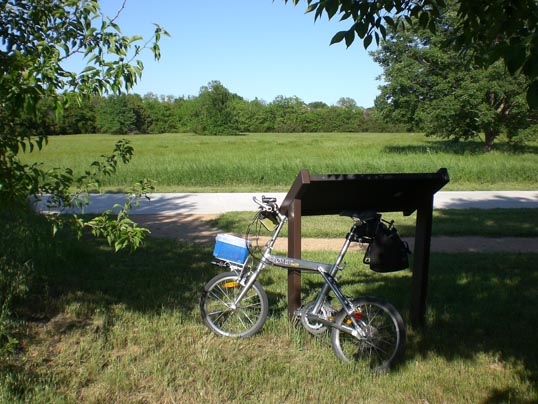
My Xootr Swift along the trail near the site of the Muncey Massacre, Plano, Texas.

My Xootr Swift along the trail near the site of the Muncey Massacre, Plano, Texas.

The view of trail, meadow, and trees. You would never know you were in the middle of a gigantic city. The historical information was in the sign my bike is leaning on. Plano, Texas.

The view of trail, meadow, and trees. You would never know you were in the middle of a gigantic city. The historical information was in the sign my bike is leaning against. Plano, Texas.

Blacksmith Shop and a Decorative Knot

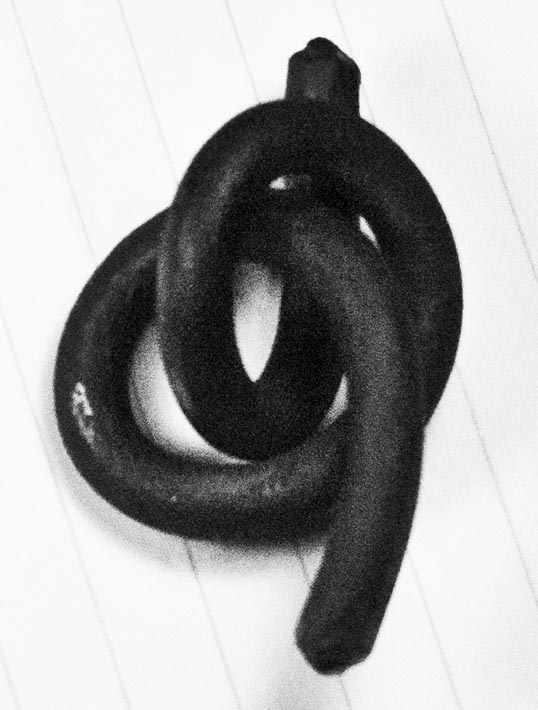
Decorative Knot, made by a blacksmith at Frisco Heritage Museum, Frisco, Texas

Decorative Knot, made by a blacksmith at Frisco Heritage Museum, Frisco, Texas

Last Sunday I made the long drive up north to Frisco. A friend of mine had told me about an open house at the Frisco Heritage Museum and Village. All the historical buildings would be open to the public. It sounded like a bit of fun, so I was there.

As I walked out of the Railroad Station I heard a series of loud metallic clangs. I turned toward the sound and there was a shower of orange sparks from a healthy flame sprouting up in the darkness of a metal shed. I recognized these as the telltale signs of a Blacksmith at work.

I walked down there and settled in, talking to the smithy at work. He was forging square nails by heating and pounding iron rods. He took special pride in his work, talking about how he had placed in some recent blacksmithing contests. Someone asked him about taking lessons and he said that Brookhaven college has a number of blacksmithing courses. After a couple of nails, he said he was done, and went over to sit down. A younger man came into the shop and began to set up his work.

“That’s one guy that learned at Brookhaven,” the original smithy said.

I walked out to see the rest of the buildings on display – the church was especially cool. Then I returned to see what the new guy was doing.

“I’m making decorative knots,” he said. He was heating rods, then bending them into a series of small loops. Finally he’d cut the knot off… and start on another. It was mostly practice in heating, forging, and bending metal – but it was pretty interesting.

He cooled one knot off in a wooden bucket of water and handed it to me. “Here’s a souvenir,” he said.

For some reason, I really like the thing.

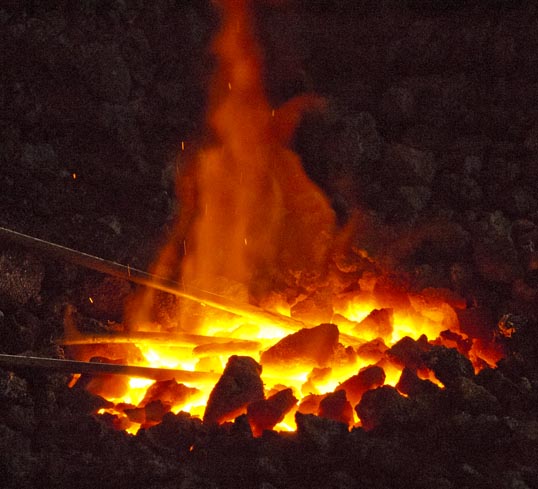
Blacksmith fire from coal and coke. You can see a knot heating in the lower left.

Blacksmith fire from coal and coke. You can see a knot heating in the lower left.

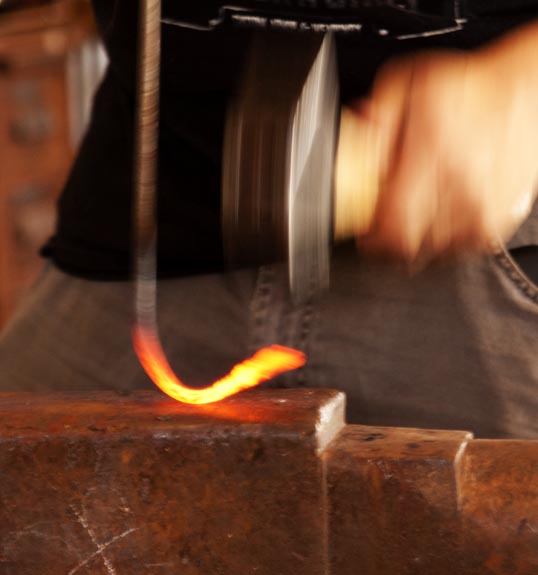
Hammering a heated knot.

Hammering a heated knot.

Hammering a heated knot.

Hammering a heated knot.

The blacksmiths sitting around, talking shop.

The blacksmiths sitting around, talking shop.

Coal and coke fire, Frisco, Texas.

Coal and coke fire, Frisco, Texas. They explained how if you put too many of those irons in there, you would lose the one you needed to work on – thus – “too many irons in the fire.”

Decorative Knot, made by a blacksmith at Frisco Heritage Museum, Frisco, Texas

Decorative Knot, made by a blacksmith at Frisco Heritage Museum, Frisco, Texas

Blacksmith

“ARMOR, n. The kind of clothing worn by a man whose tailor is a blacksmith.”
― Ambrose Bierce, The Unabridged Devil’s Dictionary

I walked around the Dallas Heritage Village during the Jazz Age Sunday Social. I always like seeing the blacksmith shop. It was the same, with the same blacksmith as it was when I saw it almost two years ago.

I never have taken lessons there like I wanted to. Something I need to think about. Looks like fun.

Blacksmith forging a cross, Dallas Heritage Village (click to enlarge)

Blacksmith forging a cross, Dallas Heritage Village
(click to enlarge)

In this world a man must either be anvil or hammer.
Henry Wadsworth Longfellow

It is better to be the hammer than the anvil.
Emily Dickinson

If you only have a hammer, you tend to see every problem as a nail.
Abraham Maslow

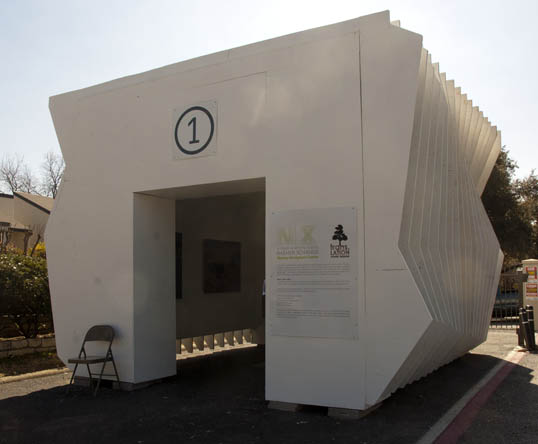
Trans.lation: Vickery Meadow, Nasher XChange, Entry Ten of Ten

Previously in the Nasher XChange series:

  1. Flock in Space, Nasher XChange, Entry One of Ten
  2. X , Nasher XChange, Entry Two of Ten
  3. Fountainhead , Nasher XChange, Entry Three of Ten
  4. Moore to the Point, Nasher XChange, Entry Four of Ten
  5. Buried House, Nasher XChange, Entry Five of Ten
  6. dear sunset, Nasher XChange, Entry Six of Ten
  7. Music (Everything I know I learned the day my son was born), Nasher XChange, Entry Seven of Ten
  8. Black & Blue: A Cultural Oasis in the Hills, Nasher XChange, Entry Eight of Ten
  9. Curtains, Nasher XChange, Entry Nine of Ten

I know the Vickery Meadow area of Dallas very well. When I showed up in Dallas in 1981, unemployed and with twenty-five dollars to my name (Texas was the only place in the country you could find a job in 1981) I stayed with some friends in the Timbercreek Apartments on Melody Lane (they have since been torn out) for a short time. Moving there from the rural plains of Kansas seemed like the height of big city living – and they were pretty cool at the time. We soon moved to Oak Cliff, and then I came back to Lower Greenville when I found a job and saved enough for a deposit.

I loved living down there (especially in the 80’s) but my social life was mostly in Vickery Meadow (and The Village across Northwest Highway). You see, it’s hard to imagine now, but in 1982 interest rates hit sixteen percent. At that rate nobody… and I mean nobody, could afford to buy a house. So all these apartment complexes sprouted up like mushrooms and hordes of young people, and a few not so young people, moved in.

It was a wild social scene. One complex was full of a combination of strippers and Dallas Cowboy Cheerleaders. That was a popular swimming pool on a hot summer afternoon. It was a good time.

But good times never last and this one fell faster than anyone thought possible. When the interest rates came down, many fled the rental complexes for the northern suburbs and the endless expanses of single family homes that were vomiting out across the cotton fields of North Texas. Then, in 1988, the Federal Government started enforcing the Fair Housing Act (making it illegal to exclude families from rental properties) – which doomed the singles apartment complexes that were the lifeblood of the area. That was the death knell. Occupancy rates fell. Rents dropped. And soon the owners couldn’t get enough from their rents to maintain the properties, which fell into disrepair – and the cycle repeated until it fell into a spiral of catastrophe.

Within a few short years the whole area was crack city. Sometimes I would drive through on my way to the Big Main Half-Price Bookstore and I would feel sad – the echoes of such good times gone to bad.

But then Vickery Meadow made a comeback of sort. Not one of wealth – quite the opposite – but one of culture. The area had fallen so far that the only people that would live there were the ones that could not afford to live anywhere else – the immigrant, the tired and poor, the huddled masses, yearning to breathe free.

The Remaking of Vickery Meadow

And now Vickery Meadow is a dense package of diverse humanity. It is still dirt poor, but it feels different. It feels like there might be a little hope in the most unlikely of places.

The tenth, and, for me, the last exhibition of the Nasher XChange works was a pop up market called Trans.lation by Rick Lowe. I had missed the first few dates and February 22 was my last chance. As always, I had my commitment to visit all ten sites without using a car. This one was easy. I rode my bike down to the Arapaho and caught the Red Line down to the Park Lane station and fought my way across Greeville Avenue and on into Vickery Meadow.

I was immediately struck by that odd layering of strong old memories with the present that has changed – but not enough that it does not stir ancient echoes. Many of the apartment buildings that contained some of my best friends, places I spent a lot of time, have been torn down and replaced by sprawling school campuses to accommodate the children of the new residents. I rode up to the heart of Vickery Meadow – a complex bustling intersection called “Five Points.”

My memory isn’t as good as it should be and I took the wrong one of the five roads and pedaled out down Park Lane instead of Ridgecrest. By the time I realized my error and looped back up another memory was brought back to me – the streets there can be very steep. I remembered exercising my way up these hills on a road bike back in the day. Unfortunately, I’m not twenty-five years old any more, and I had to wait a bit to catch my breath.

Finally, I picked the right road and found the market. I locked my bike up to a fence and went in – enjoying the arts and crafts for sale… I especially loved the music coming from the stage. There were a lot of people of every age and nationality you could imagine and everyone was having a great time.

That was something I will remember for a long time.

Trans.lation Market: Vickery Meadow

Trans.lation Market: Vickery Meadow

Trans.lation Market: Vickery Meadow

Trans.lation Market: Vickery Meadow

Trans.lation Market: Vickery Meadow

Trans.lation Market: Vickery Meadow

Trans.lation Market: Vickery Meadow

Trans.lation Market: Vickery Meadow

Trans.lation Market: Vickery Meadow - There were three pop up art galleries along the street featuring local art and concerns.

Trans.lation Market: Vickery Meadow – There were three pop up art galleries along the street featuring neighborhood artists and concerns.

Arcady

“In the beginning, God created the earth, and he looked upon it in his cosmic loneliness.

And God said, “Let Us make living creatures out of mud, so the mud can see what We have done.” And God created every living creature that now moveth, and one was man. Mud as man alone could speak. God leaned close to mud as man sat, looked around, and spoke. “What is the purpose of all this?” he asked politely.

“Everything must have a purpose?” asked God.

“Certainly,” said man.

“Then I leave it to you to think of one for all this,” said God.

And He went away.”
― Kurt Vonnegut, Cat’s Cradle

4320 Arcady, Highland Park, Texas - a few months ago

4320 Arcady, Highland Park, Texas – a few months ago

Candy and I sometimes like to go to estate sales. Midweek we receive emails with lists of various sales throughout the city and, if I have time, I’ll go through the list, looking for interesting sales.

I don’t go to the sales so much to buy anything other than the occasional art object (I have enough useless crap already) – I go for the stories. You see, an estate sale – especially one where the owner has passed away after a long and interesting life – is a mirror into the past. It’s a museum displaying a person’s… a complete stranger’s entire collection of heart-ache and the thousand natural shocks that flesh is heir to. These timeless treasures are arranged and papertagged with a string and a price so the slouching horde can shuffle through, pawing at the lot.

It’s an afternoon’s entertainment.

A few months ago, I was clicking through the emails, looking at the collections of photos, trying to find something a little more curious and compelling than the ordinary run-of-the-mill when a certain address caught my eye.

4320 Arcady

I knew where Arcady street was. That’s the heart of the most expensive neighborhood in the most expensive town in the Metroplex – Highland Park. That’s where the rich and famous cavort in their multi-million dollar mansions. Plus, it is mostly old money – the rarefied world of the bloated upscale opulent set – a world I will never see, a life I will never lead. Maybe a glimpse.

I printed a map.

When we arrived, the place was not quite what I expected. The house was beautiful, an old Mediterranean Style two story with a red tile roof. And it was old. For Dallas, it was very old. It was like stepping back into a time machine.

There wasn’t much for sale and that was ancient and worn out. Still, I loved the old house, loved the high ceilings, loved the original windows – opened by metal hand-cranks with cracked ropes leading to sash weights inside the walls, loved the tiny white hexagonal tile in the bathrooms and kitchen (sometimes called “Dallas Tile”) loved the formal staircase, loved the deep wood of the floors… I even loved the thick old dust that coated everything like a blanket of compressed time. I wanted to find out more, so I headed to the huge bookcase that lined one wall of the living room.

There were University of Texas Yearbooks from 1942 and 1943. There were a couple of scrapbooks filled with old cartoons clipped from magazines in the 1950’s along with jokes written in a careful, elegant script (the kind everyone used to write in). Now, I wish I had bought the scrapbooks, but I put them back. Nothing else gave a clue.

I went out to the garage to talk to the person putting on the sale. He said, “The house has already been sold, I heard it was for three million. After this sale, it’s going to be torn down. The buyer is going to put up a new house on the lot.”

That made me sad. I looked down the street at the rows of fake Gothic mansions – all intended to look like English Manor homes shrunk down a little and plopped down right next to each other in the blistering heat of Texas. They all looked the same.

Now, I understand a little. The Arcady house had a tiny kitchen, and only a couple of miniscule bathrooms. That would never do. But it could be saved… a cleverly designed addition… a modern attached kitchen….

No, it would never work. People that live on Arcady street in Highland Park don’t understand uniqueness or preservation. It is an exclusive club they desperately want to join and to fit in you have to live in the proper house.

At home I did some searching. I found that the property had been bought by a builder and he had a replacement already designed by an architect named Wilson Fuqua. Ok.

I also found out who had lived in the house. It was a woman named Catherine Duls. Her father was a well-known Harvard educated attorney named William H Duls. I believe he built the house and moved his family there when his daughter was three. She lived there her entire life until she passed away at the age of 89.

Catherine played tennis at the University of Texas and worked at the SMU law library. Her friends called her Kitty. In her obituary, someone wrote, “ I loved her beautiful voice and Southern drawl, her gorgeous hair and complexion, and her fabulous sense of humor. She was complicated, intelligent, and wise. I appreciated her so very much. She will truly be missed.”

The other day, I had some work not too far away and because the traffic was lighter than I thought, arrived early enough to take a short detour down Arcady.

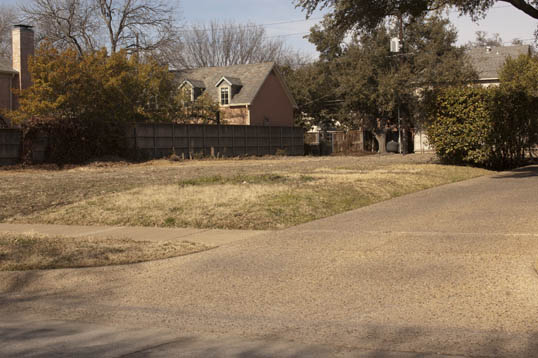
The house is now a vacant lot.

4320 Arcady, now

4320 Arcady, now

Carrollton Collages

To get to the Carrollton Festival at the Switchyard I rode my bike to the Arapaho Red Line DART station – hung my bike on the transit hook and rode downtown (as always, I was a minute late, missed my train, and was twenty minutes late downtown – I need to cut that crap out), met a friend, and we then rode the Green line out to Carrollton. It would have been quicker to drive my car down Beltline (to get anywhere in Dallas you start out driving down Beltline Road) – but then I would have had to find a place to park, plus there is a lot of freedom and flexibility in having a bicycle. With a bicycle and a DART pass – I can go anywhere.

At any rate, heading back downtown, waiting for the train, I had the time to look around at the artwork on the Carrollton station. To my uneducated, ignorant, and untrained eye, DART has done an admirable job of adding artwork to its train stations – at least as far as a giant government bureaucracy can be expected to go. Maybe I should do some blog entries on some of my favorites….

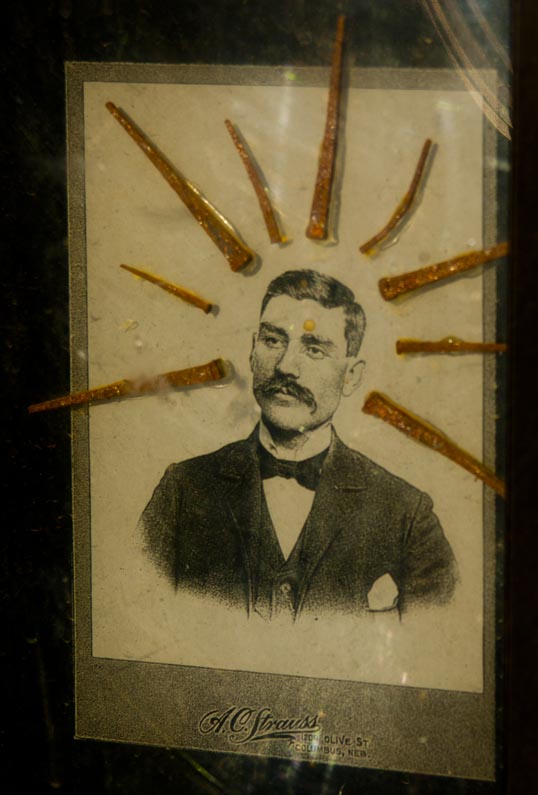
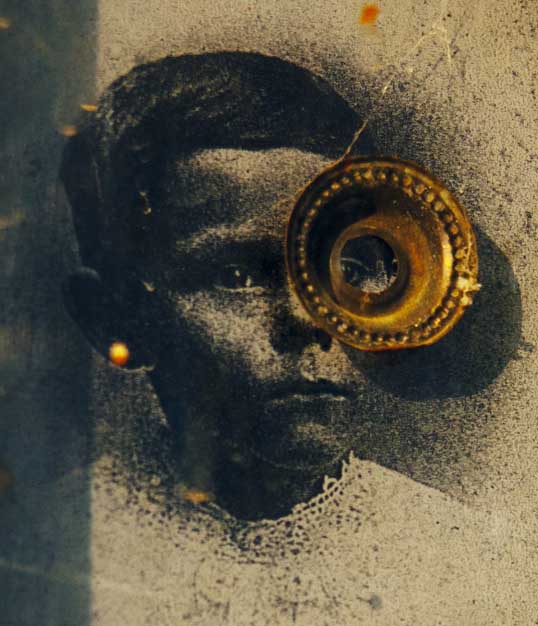
At the Carrollton station – elevated high in the air (cool view from up there) over where I suppose the old switching yard might have been, I noticed all these little windows cut into the concrete pillars supporting the roof structure. In each window was an old photograph combined with, or framed by, pieces of found metal. It made for a series of interesting and entertaining collages. The time spent waiting for the train was reduced by me dashing up and down, looking into the little windows at the parade of aged faces and arranged fragments of history.

Later, at home, an internet search led me quickly to the artist, James Michael Starr. Although, he seems to be unhappy with the initial installation – everything seems to have worked out and his collages are there for the enjoyment of the unwashed masses. The bits of metal seem to be mostly artifacts that the artist was able to dig up around the area, now on display, high in the air… forever waiting for the next train.

Collage by James Michael Starr, Carrollton DART station.

Collage by James Michael Starr, Carrollton DART station.

Collage by James Michael Starr, Carrollton DART station.

Collage by James Michael Starr, Carrollton DART station.

Collage by James Michael Starr, Carrollton DART station.

Collage by James Michael Starr, Carrollton DART station.

Collage by James Michael Starr, Carrollton DART station.

Collage by James Michael Starr, Carrollton DART station.

Astral Flower

Astral Flower, by Jose Luis Sanchez, Dallas, Texas

Astral Flower, by Jose Luis Sanchez, Dallas, Texas

Astral Flower, by Jose Luis Sanchez

Astral Flower, by Jose Luis Sanchez

There is something special about downtown parks. The tiny bits of public green carved out of the pavement become precious jewels cast about the vast three dimensional expanse of office buildings. The few trees struggling for their share of light and water become alien creatures of wonder – flecks of forest, transplanted.

When I first moved to Dallas in the early 1980’s and was working down in the Kirby Building there was Thanksgiving Square – a carefully created triangle of grass and water in the heart of the business district. One of my favorite things was to eat lunch in the square on a sunny spring day… there was a greasy take out Chinese place in the underground – Mr. Kim’s Eggroll. This was a branch of the better known, almost infamous, Texaco Lunch Box out on Ross avenue. I won’t say the food was good… but it has good memories.

From a 1984 Newspaper Article, in The Victoria Advocate, “In Praise of the Immigrant,” by William Murchison.

My own favorite immigrant is Mr. Kim, a South Korean. He came to Dallas in the late 70’s, legally, I should point out, worked hard at a convenience store, saved most of what he earned and established an eggroll joint across the street from the courthouse. In those days I patronized him with some frequency.

But Mr. Kim wasn’t sure he couldn’t do better elsewhere. A short time later he opened the inimitable Texaco Lunch Box on Ross Avenue. The Lunch Box sells gasoline and marvelous egg rolls, whichever or both. From the start it prospered, owing partly to Mr. Kim’s ebullient, somewhat wacky, personality, partly to a quality product. Mr Kim always had a cheery smile and a few quips for his customers. To my children he commonly would hand out an extra fortune cookie, sometimes even a can of Coke.

One place wasn’t enough, so Mr Kim opened more, staffing them all, as far as I am aware, with fellow Korean immigrants. A devout Presbyterian who plasters Christian slogans on his wall, Mr. Kim also set up bible study classes for Koreans. Many were the times I’d go by the Lunch Box and ask for him, only to be told, “He’s teaching bible class.”

One of Mr. Kim’s outlets is downtown, more or less underneath Thanksgiving Square. That is where I now catch him when he isn’t teaching the bible or helping some Korean family.

I was glad to find that article – I hadn’t thought about Kim’s Eggroll for a long time and was glad to find out my memories (I remember the eccentric man and the religious tracts taped to the wall… as well as the taste of the greasy rolls and sweet sauce) were real and not some remnant of a fever dream.

Kim’s Eggroll and the Texaco Lunch Box are long gone. In addition to some legal adventures, Mr. Kim seems to have been involved in the local restaurants Wok & Roll, which I have eaten at too.

In the decades since, Thanksgiving Square is getting long in the tooth, but the city has carved out some more parks – more ambitious and more contemporary. There is the big trinity of Main Street Garden Park, Belo Garden Park, and of course, the crown jewel, Klyde Warren. There are also a handful of smaller place, some of them really nice, like Lubben Plaza… (I’m going to have to go downtown and shoot some pocket parks… aren’t I).

And there are more in the works.

One of the biggest proposed projects is Pacific Plaza Park. This would join together a number of small parks and desolate parking lots into one of the largest remaining open areas in the City’s Center. It’s been delayed and delayed and I hope they get going and get the thing built while I’m still alive.

One concern, though. Right in the middle of the proposed park, is an old, forgotten park that used to have a fountain with an old, forgotten sculpture. If you live in Dallas, you’ve driven by it a million times, and even though it’s pretty darn big you’ve never seen it. I, however, ride a bicycle, and I notice things like this.

It’s called Astral Flower, by Jose Luis Sanchez. It was placed in the Pacific Plaza “Vest Pocket Park” in 1968 by Junior League Garden Club. The tiny park was developed by the Greater Dallas Board of Realtors along with the City Parks & Recreational Department.

I hope they preserve this little bit of history. In Dallas, history is as scarce as green space downtown.

Astral Flower, by Jose Luis Sanchez (click to enlarge)

Astral Flower, by Jose Luis Sanchez
(click to enlarge)

St. Vincent’s Guest House

Finding a hotel in another city on the Internet is a funny thing… it’s not so much like looking for something blind as it is trying to make a decision, a choice, based on secondhand information where everyone is lying to you.

When Candy was researching a place to stay in New Orleans for our trip last week she kept coming across a place called St. Vincent’s Guest House. We’ve stayed a handful of places in the past, most notably the Prytania Park, and the Mandevilla B&B (both highly recommended BTW) but the St. Vincent was a lot (a lot!) cheaper.

I didn’t get too involved in the planning, and while we were flying to New Orleans I was really curious about what this place would be like. It was in a great location – right on Magazine Street in the Lower Garden District – close to downtown (and the quarter) and the St. Charles Streetcar.

But it was only going to cost us fifty dollars a night. What kind of Big-City hotel charges fifty dollars a night? In my mind I pictured an old run-down Motel 6, kicked out of the chain for excessive filthiness, occupied mostly by prostitutes, and a constant drug trade going on in the parking lot. Still, it’s only fifty bucks a night, we need to spend as little as possible, and all I need is a place to sleep – so I could deal with anything.

When we drove up and checked in, I quickly realized the truth could not be farther from this image. St. Vincent’s is a massive ancient brick edifice of classic New Orleans design with impossibly high ceilings, balconies with intricate cast iron railings, and one hell of a history to boot.

The imposing facade of the St. Vincent’s Guest House, facing Magazine Street in New Orleans. I had to move around a bunch of film crews and trucks to get this – they were shooting scenes for Treme. The St. Vincent must be a popular location – they did scenes for Red (the Bruce Willis film) there – now I’ll have to watch the damn thing.

The side of the St. Vincent Complex, from Race Street. We stayed on the second floor of the wing in the background, that’s the carriage house in the foreground.

From a faded clipping in the lobby:

History

St. Vincent’s was built in 1861 as an orphanage. It was founded by the Daughters of Charity order of nuns, however much of the funding was provided by Margaret Haughery. Margaret was an illiterate, Irish immigrant to New Orleans – she was a orphan herself and lost her husband and baby to yellow fever here in New Orleans. This was not unusual. Every summer up to 30.000 people here would die of mosquito born diseases such as yellow fever and malaria. Margaret’s tragic losses led her to dedicate her life to alleviating the suffering of children. She made a great fortune from her baking business and dedicated her wealth and compassion to philanthropic works. St. Vincent’s was among the greatest of these works. When Margaret died in 1882, the entire city closed down to mourn her loss and thousands followed her funeral parade, a fitting tribute to a truly great person. You will notice the clock on the roof of the carriage house at St. Vincent’s (across the courtyard) – this was willed to St. Vincent’s by Margaret as a final gift.

There is a lovely statue of Margaret between Prytania and Camp Streets, just near the 90 overpass. You may also like to visit St. Elizabeth’s orphanage, now owned by the Vampire novelist, Ann Rice. After the children turned seven, the girls were taken from ST. Vincent’s to St. Elizabeths. St. Elizabeths is in the Garden District on Napoleon Ave.

Still run by the Daughters of Charity in the 20th century St. Vincent’s became a refuge for unwed mothers. In 1901 it was discovered that mosquitoes were the cause of the summer epidemics and the city paved the streets and generally tried to eradicate the puddles of water in which mosquitoes breed. Without the annual epidemics New Orleans was in the happy situation of no longer having enough orphans for St. Vincent’s. St Vincent’s served as a refuge for unwed mothers and their children until the social revolution in the 60’s rendered such a refuge unnecessary. It remained empty for a couple of decades until brought back to life in 1994 as the Guest House you see today.

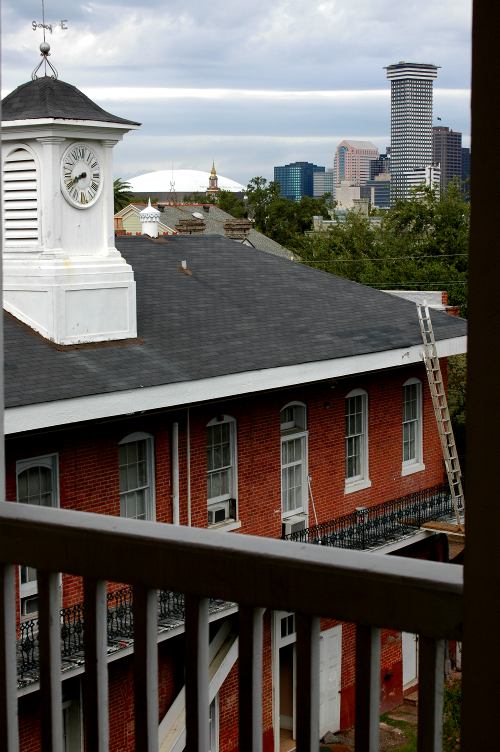
The clock on top of the carriage house, complete with cool sculpture hanging off the side.

Here’s a closeup of the sculpture on the clock on the carriage house. It’s called “New Orleans Gargoyle” by Thomas Randolph Morrison. Pretty cool, huh. You’re not going to see stuff like this hanging off the Hilton.

Now, the place was far from luxurious. It is primarily a hostel – with a constant flow of young hitchhikers and lost souls (some working at the house in one form or another for discount or free rent) and a wing of dormitories. They do have a spate of regular rooms and ours, being the cheapest, was pretty run down. The usual amenities were non-existent. The sheets had holes, the hot water sporadic, the walls were painted a bilious purple, the towels mismatched, the door key and lock of dubious quality and security, the television ancient and lacking a remote and the curtains didn’t come close to covering the entire windows. The drawers in the dresser didn’t fit, the ventilation rumbled, black sheetrock screws half-screwed into the molding provided clothes and key holders. The pool was covered in black plastic, the furniture mismatched, and empty whiskey bottles littered the common areas.

The only thing that bothered me, really, was a decidedly musty smell in the room, and it went away with a couple days of activity. To be fair, St. Vincent’s was obviously still being repaired from the damage inflicted by the last hurricane and a lot of water had gone through those old walls. We realized that, really, the whole city had that musty smell.

So it wasn’t the Hilton, it wasn’t even the La Quinta… but, my God, what history. New Orleans is a city accommodating and welcoming to spirits and everyone spoke about the ghosts of the orphans and their parents – yellow fever victims – still floating around the place. The hallways were lined with fine polished bronze sculptures. It seems a New Orleans sculptor – Thomas Randolph Morrison – displays all his bronze work in St. Vincent’s. Art – paintings or interesting old photographs – covered the walls.

The sculpture-lined hallway at St. Vincent’s.

A sculpture facing a mirror.

A view out a hallway on the third floor. Like a lot of old buildings built in tropical climates it has very high ceilings (I estimate 20 feet high), balconies, and an open plan for ventilation.
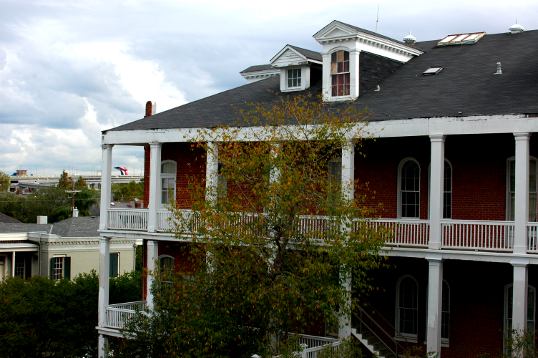
Our wing at St. Vincent’s. If you look closely on the horizon you can see the winged stack of a Carnival Cruise Ship on the Mississippi river.

The carriage house at St. Vincent, with downtown New Orleans and the Superdome in the background.

Now, I certainly can’t recommend the place – it sure has its share of bad Internet reviews – but if you have a little imagination, a sliver of adventurous spirit and, most of all, an open mind, it’s a pretty damn cool place.

Plus, it’s in a great location and it’s only fifty dollars a night.

An old photo on the wall at St. Vincent’s Guest House, showing the original tenants, the young orphans that lost their parents to yellow fever, posed on the stairs.

The same spot, on the same stairs, today.
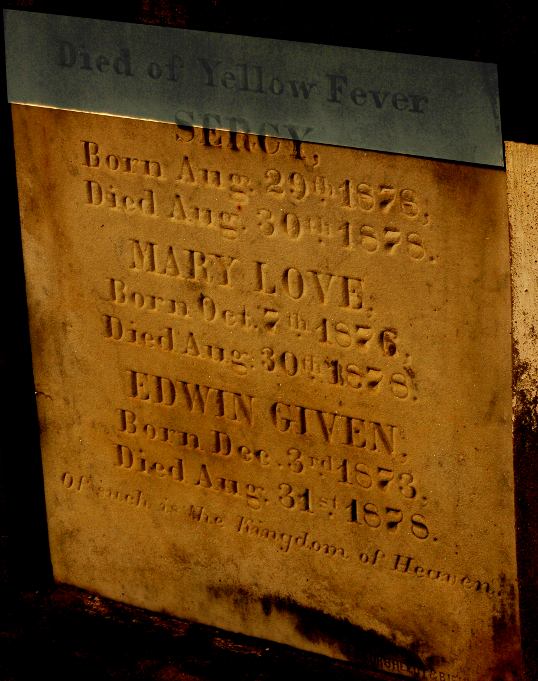
A tomb from Lafayette Cemetery #1

Everywhere in New Orleans you run into the ghosts of the yellow fever. This is a tomb from the Lafayette Cemetery #1 (not far from St. Vincent’s). I had to mess with the image, the top part was in deep shade. It reads:

Died of Yellow Fever
Sercy,
Born Aug. 29th 1878,
Died Aug. 30th 1878.
 
Mary Love,
Born Oct. 7th 1876,
Died Aug 30th 1878.
 
Edwin Given,
Born Dec. 3rd 1873,
Died Aug. 31st 1878.
 
Such is the Kingdom of Heaven.

In two days that family lost three children, age newborn, three, and five years old.