The city at night sounded like his ribs when they broke, his body as it caved in on itself and snapped in half so loudly they heard it downstairs and thought it was a gunshot, another bullet hitting its mark, eating into the flesh of another broken soul, unwanted — unwanted, yes, disowned, in a room no warmer than the frigid air outside, shivering under layers, skin stretched too tight across bones.
—-Monica Robinson, “anatomy of a burning thing”
Time Exposure, Night, Downtown Dallas, Ross and Olive
Point of View – Stream of Consciousness – Reliability of Narration
You can play with this stuff… if you have the chops.
Flay everything open. Pry free the heart. It takes some nerve. What I mean is, it’ll hurt, but you can get at what you crave if you want it badly enough.
—-Kristen Arnett, Gator Butchering For Beginners
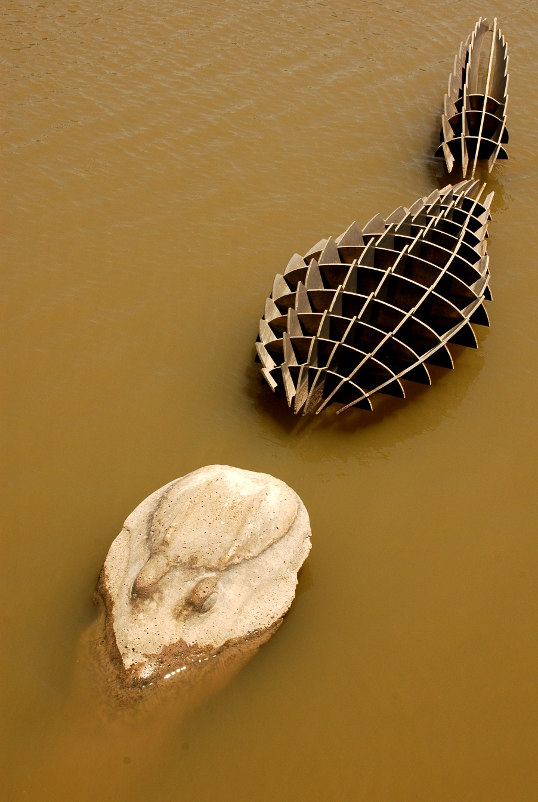
Alligator, Robert Tabak, Frisco, Texas
Sometimes fiction is about one thing but really about another thing. Today’s flash fiction is obviously about butchering an alligator but even more obviously not about butchering an alligator.
Also… when it comes to butchering an alligator – what is it like to be a beginner? More importantly what it is like to not be a beginner – to be, for example, the person that writes the instructions?
Afterward, our protestations of love poured forth simultaneously, linguistically complex and metaphorically rich: I daresay we had become poets. We were allowed to lie there, limbs intermingled, for nearly an hour. It was bliss. It was perfection. It was that impossible thing: happiness that does not wilt to reveal the thin shoots of some new desire rising from within it.
—-George Saunders, Escape from Spiderhead
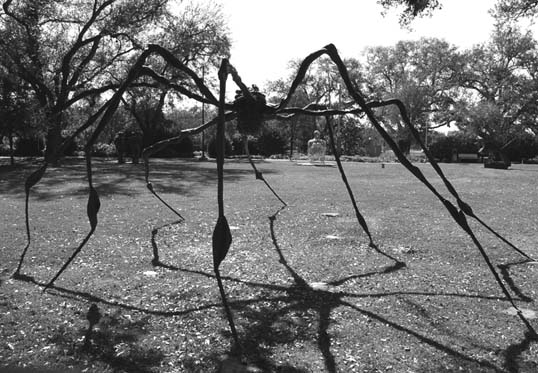
Louise Bourgeois, Spider, New Orleans
Trying to get through the isolation by reading more. Another short story today – a very good, if more than a little harrowing.
This story is touted as a famous example of dystopian fiction. It’s a peculiar type of dystopia… a personal hell… maybe a penance, maybe deserved. Still, even under those circumstances the important thing is that some humanity and some sympathy for your fellow man remains. Still remains. Even if it doesn’t do anyone any good.
Excellent read. One plus – it’s definitely not safe for work.
While she was stacking dishes, she turned abruptly, dried her hands, and took the package from the bottom cabinet. Opening it, she set the button unit on the table. She stared at it for a long time before taking the key from its envelope and removing the glass dome. She stared at the button. How ridiculous, she thought. All this furor over a meaningless button.
Reaching out, she pressed it down. For us, she thought angrily.
—-Richard Matheson, Button, Button
The button on the Maestro’s shirt – detail from “The Storm” a mural on Ace Parking Garage at 717 Leonard Street, Dallas, Texas
Sunday, I came out into the living room to eat some eggs that I had scrambled with a few beans and some sausage. The television was on and a series of old Twilight Zone episodes were playing from the Syfy channel. Right when I sat down I Sing the Body Electric – which was written by Ray Bradbury and adapted into a short story of the same name (I was familiar with it) was on.
(2 minute preview)
I love the old anthology television shows – Twilight Zone, The Outer Limits… especially Alfred Hitchcock Presents. First, it’s fun to spot famous actors – Twilight Zone was the Law and Order of its time. I Sing the Body Electric had Veronica Cartwright in it.
But what I really like are the stories. So many of these were written by famous and extremely skilled short story writers. I am amazed at the work.
Sure enough, the next episode was Mute, by Richard Matheson. He was an amazingly prolific pulpy writer and you have seen his work everywhere (probably best known for I Am Legend – made into several movies) – he wrote sixteen episodes of The Twilight Zone alone.
I looked for a copy of the short story Mute online, but couldn’t find one. I did find another Richard Matheson story however:
This is a famous story – the basis for a shitty Cameron Diaz move called The Box.
It was also made into an episode of The Twilight Zone – this time the 80’s incarnation.
The ending of the television is very different than the short story – not sure which I like better… at any rate, Richard Matheson wasn’t happy the Twilight Zone Version and used a pseudonym as the author. So read the story and watch the show. Which one do you prefer?
Actually, in looking around, I found something that I really liked… probably the most realistic take on the story.
“But, in the end, joy cannot fend off evil.
Joy can only remind you why you fight.”
― Jeff VanderMeer, Dead Astronauts
(click to enlarge) Mural, Deep Ellum Dallas, Texas
OK, it was Monday, the end of work, I was so very tired, I didn’t have my car with me, I had to get clear across town, if I really wanted to go there, it was cold, it was raining, it was dark, I thought about not going, I would get back home so very late, here’s how I would have to travel:
Maybe I shouldn’t have gone, today is the next day and I’m tired I didn’t get enough sleep last night
But I realized I had to go because the book was so difficult and so WEIRD that I had to find out what the others thought about it. Also, I had fought my way to the end of a tough read – I had earned the trip and the meeting.
I asked the group, “Would you have finished this if you weren’t in a reading group? If there weren’t other people shaming you into plowing ahead and getting to the end?” Everyone (and I mean Every-One) replied enthusiastically “Hell No!”
What do I think about difficult books? What do I think about WEIRD books? What do I think about books that stretch the envelope of what text can do? What do I think about books that play with illustration and typography in odd and confusing ways? (think House of Leaves)
I did say that, usually, I judge difficult and WEIRD books… in the end… by an emotional connection. I don’t care if the plot makes no sense I don’t care if there is a conventional resolution I don’t care if the theme is obscure(d) – but I prefer it if I have some kind of emotional connection or some sort of inner payoff at the end
With Dead Astronauts there was some (but not a lot) especially in the Sarah section and at the very end. Was there enough? Is Batman a transvestite? Who knows
Now, the next big question is should I read more VanderMeer? (I did really like The Situation – a protoBorne novella) Should I read Borne? (set in the same world as Dead Astronauts but different – the people in the group that had read it said it was character-driven) Should I read Annihilation?( I saw the movie without knowing it was from a book and thought it was very cool) Should I read the whole Southern Reach Trilogy (A guy sitting next to me said he really liked Annihilation but the sequels left him cold because they resolved too much of the mystery of Annihilation)
So Maybe I’ll read Annihilation and skip the rest of the Trilogy. I think I will read Borne.
But first… I have to read L’Assommoir – Have to keep troopering through my Zola project – and then, in March there’s another Wild Detectives Difficult Book Club project – we’re going to tackle The Brothers Karamazov (about six weeks of work)………………….
The oven was thick with grot and whenever you opened it to get your food, it would flood the room with smoke. I’d long ago taken the battery out of the fire alarm to stop that fucker going off whenever I made anything. And then it was back up to my room, to my games.
—-Jim Gibson, the jungle banshee
Old School Video game inspired graffiti, Deep Ellum, Dallas, Texas
In the last thirty-odd years I’ve only had two jobs. I only remember once going on an interview and not being offered a job (it turned out they were interviewing me simply to gain information on the company I was working for). But, then again, I never spent that much time shut in playing video games. Of course, Pong showed up my freshman year of college and it cost a quarter and a quarter was a lot of money then. I remember you could get a pint of milk from the dorm vending machine machine for a quarter – I remember that because it was faulty and thought nickles were quarters – for a nickle you’d get a milk and a dime back (which you could take to the front desk and get two nickles for two more milks and two dimes… in theory you could be rich, especially if you could find someone to buy all that milk)… but I digress. I guess my point it that it was tough to get addicted to video games if all you could do was play Pong for a quarter. Pong was fun and in 1974 it was pretty amazing – but it wasn’t exactly addicting.
By the time video games became addicting I was grown and old and had kids and my memory was fading and my fast-twitch abilities were shot. I guess I was lucky.
When I was young people played Poker, Monopoly, or Chess. I did play a lot of chess, but I would get a headache if I played too much – it was never what I’d think of as fun – it was too serious. As I became more than a fairly good chess player I had to quit because it was stressing me too much. I never had enough money to play poker. And Monopoly – well, you couldn’t get addicted to that – that’s like getting addicted to watching paint dry.
The guy in the story has a video game problem. Or maybe it’s something else and the video gaming just falls into the hole.
It’s surprisingly affecting – I really feel sorry for the guy and wish him well. Probably more than I would if I knew him in real life. And I guess that’s a sign of a good story – if you care more about the character than you would if he was actually a real person.
I enjoyed this simple little piece of unique fiction. Like all good flash fiction it asks many more questions than it answers. Maybe I liked it because I feel like that all the time.
The Author’s Note is interesting too – he talks of writer’s block and bringing abandoned work back to life.
“They were watching, out there past men’s knowing, where stars are drowning and whales ferry their vast souls through the black and seamless sea.”
― Cormac McCarthy, Blood Meridian, or the Evening Redness in the West
Transcendence, on the first night.
Today’s “short story” isn’t really a short story… it’s a satirical Chili’s Menu, written in the style of my (right now – though he has competition) favorite author, Cormac McCarthy.
So, not really fiction… I’m not sure what the literary term for “literature written in the form of a fast-casual chain restaurant menu” is… whatever it is, this is it. And I enjoyed reading it.
If you don’t get where it is coming from, you haven’t read enough Cormac McCarthy. And you need to rectify that.
Félicité kissed Marthe on the forehead as if the latter were still sixteen. She then extended her hand to Mouret. Their usual mode of conversation had a sharp edge of irony.
‘Well,’ she asked with a smile, ‘have the police not been to arrest you yet, you old revolutionary?’
‘Not yet,’ he replied, also with a laugh. ‘They are waiting until your husband gives them the order.’
‘Oh, very funny, ‘ Félicité replied, her eyes blazing.
Marthe appealed to Mouret with a pleading look; he had certainly gone too far. But he was off and there was no stopping him.
Then, after that was finished, I suffered from some allergy-related conjunctivitis and discovered that the inability to see puts a serious crimp in ones reading schedule. But now, my eyes are full of acceptable levels of goo and I turn back into the Zola books. I didn’t really like the last one, The Dream, and am happy to report that this one, The Conquest of Plassans is back in line with most of the other books in the series.
It feels like a return to a comfortable home. Plus, while a twenty volume French series from about a century and a half ago doesn’t sound like light reading – compared to Gravity’s Rainbow... it’s like reading the Sunday Comics. Will be done with this one in a couple days.
I haven’t done that for a while, but have been thinking about it. That doesn’t keep me from reviewing them one at a time. Last year, I wrote about Driven Snow by Nancy M. Mitchel. The author commented on my blog entry (with the surprising revelation that the story was true and the woman survived). She mentioned that she had another story on the Akashic book website, Sea Change.
Go read it – a short, pithy read. Then you can come back and read the rest of what I wrote.
It’s of an interesting construction in that the protagonist isn’t directly involved in the action. Stories like that are cool because there are two stories – the main, observed action… and the reaction of the observer. It’s quite a feat to accomplish this in so few words.




 Bill Chance