Poetry is the language in which man explores his own amazement . . . says heaven and earth in one word . . . speaks of himself and his predicament as though for the first time. It has the virtue of being able to say twice as much as prose in half the time, and the drawback, if you do not give it your full attention, of seeming to say half as much in twice the time.
—-Christopher Fry
Woman listening to a poetry reading by Mad Swirl – at The Independent Bar and Kitchen, Deep Ellum, Dallas, Texas
Modern Poetry
There is a poetry to daily modernlife so empty of everything else. The staccato rhythm of the traffic reports off on the shoulder one lane only eastbound westbound backup clearing Or the shouts of the Barista as he calls out the orders (actually, I think he’s making most of that stuff up).
And though my lawn has gone to weeds there is still a bird that kawarbles at me as I put the key in my car to drive to work.
If I read a book and it makes my whole body so cold no fire can ever warm me, I know that it is poetry. If I feel physically as if the top of my head were taken off, I know it is poetry. These are the only ways I know it. Is there any other way?
—-Emily Dickinson
Woman listening to a poetry reading by Mad Swirl – at The Independent Bar and Kitchen, Deep Ellum, Dallas, Texas
Bad Poetry Tonight
Craig arrived early and promptly fell asleep in one of the old overstuffed chairs in the reading area. He woke up drooling on himself when the reading began.
This month’s reader, Harriet Von Snapple, was introduced as not only a poet but an amateur hard rock singer and harpist that had recently come out with a solo CD, Smeebage and Mung, after a stint with bands Creamy Blue Cheese Undressing and Schlitz the Prophet. She was different than the usual poets in that she was attractive and confident.
Her poetry was awful, but Craig liked what she said before she read her first work, “I work long hours for this awful man and I look busy and stressed but I live with it because I’m really sitting there writing bad poetry all day.”
The reason lightning doesn’t strike twice in the same place is that the same place isn’t there the second time.
—-Willie Tyler
Dallas, Texas
From my old online journal The Daily Epiphany – Sunday, November 24, 1996
The weather gets nasty
A tremendous storm blew in last night, the harbinger of our first cold front of the winter. We had high winds, and violent lightning, unusual for this time of the year. About five years ago we were hit by lightning. We had only been in this house a couple of months, Nicholas was an infant, Candy was pregnant with Lee. It was about eleven at night, Candy was asleep, I was out in the living room puttering around when the storm hit. I heard about five crashes of lighting, each one closer than the last. It was, “crash, Crash, CRAsh, CRASH—BOOM!” The last one hit the house. It was odd, I was almost expecting it, the bolts seemed to be zeroing in one us, closer and closer, until finally one hit. The bolt burned out everything electrical in the house (except my old XT which was running at the time), you don’t realize how many light bulbs you have until they all burn out at once. It burned some ducts in the attic, and burned a hole in the roof of Nick’s room above him while he slept (I didn’t tell Candy about that for several days, I knew it would spook her).
Ever since this happened, we have been afraid of lightening, so neither Candy or I slept much last night.
“It is what you read when you don’t have to that determines what you will be when you can’t help it.” ― Oscar Wilde
(click to enlarge) Book With Wings, Anselm Kiefer, Modern Art Museum of Fort Worth
As I said the other day after I finished La Terre I wanted to evaluate my reading – set up a reading plan. I watched some YouTube videos on setting up a Reading Journal and on reading plans – and did some general web searches on the subject.
What I decided to do was to make some lists of books to read in several categories (I decided to stick, for now, to what’s on my Kindle – there are more books there than I could read in the few years still allocated to me) and then go from there. I chose six fiction novels that looked like the next six I wanted to read. I also started on lists for Self-Help (don’t judge) and for Writing categories. Next, I want to do lists of short story collections and general non-fiction. That should be a good start – I plan on having at least one current book from each category and I can pick and choose depending on my mood.
There is a reason I picked six fiction novels. I have been experimenting with dice... and I wanted to choose the order by roll of the die (six is better than eleven, the numbers from two die, because the odds of each number are the same and I didn’t want to mess around with ranking the books… maybe next time). So I went through my Kindle, listed out six that jumped out at me, and started to roll.
And, here we go:
1st book – Desperate Characters – Paula Fox – 152 pages
2nd book – Mobius Dick – Andrew Crummy – 320 pages
6th book – Elect Mr. Robinson for a Better World – Donald Antrim – 192 pages
You will notice a plethora of short, modern books on this list. I wanted a change from Zola… though The Debacle is on the list (almost done with the series).
And yesterday, I started in on Desperate Characters – reading a third of it in one day. It is a jump from the grand scope (in space and time) of Zola’s naturalistic social prose to the focused crystalline details of the more modern novel. It is so compressed, so focused on seemingly random details and thoughts of the characters. Very modern, very New York.
Fun.
“If you only read the books that everyone else is reading, you can only think what everyone else is thinking.” ― Haruki Murakami, Norwegian Wood
Some say the world will end in fire, Some say in ice. From what I’ve tasted of desire I hold with those who favor fire. But if it had to perish twice, I think I know enough of hate To say that for destruction ice Is also great And would suffice.
—-Robert Frost
It isn’t necessary to imagine the world ending in fire or ice – there are two other possibilities: one is paperwork, and the other is nostalgia.
—-Frank Zappa
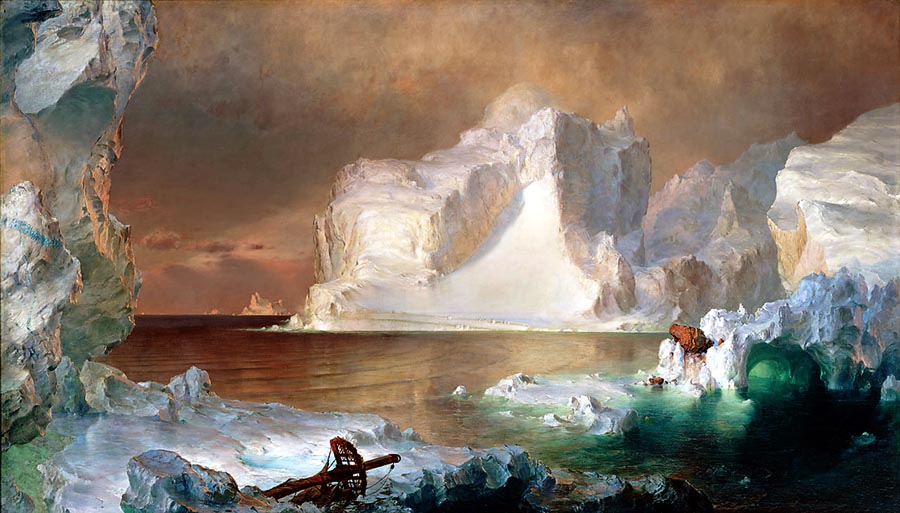
(click to enlarge) “The Icebergs” by Fredrick Church, Dallas Museum of Art
Warm Weather Icebergs
There was a big ice storm last week which brought the city to a halt. But this is the South and it immediately turned hot. Once the temperature rose above freezing and the sun poked its way out, the ice melted with incredible rapidity. In a couple of days it was warm and dry.
Today, though, Craig was driving down Town East Boulevard wearing shorts, sandals, and a T-shirt and noticed as he went by a big parking lot near the mall that boasted giant still unmelted mounds of ice, pushed into the corners by plows after the ice storm. No streets and few parking lots had been graded (the roads all have these reflective bumps that snowplows will shear off) but this lot contained a big commercial hardware-lumberyard thing, and maybe they intended to be sure and sell a lot of sand and materials to repair the many carports that tumbled under the weight of the ice.
It was odd on a warm, sunny, Texas day to see the huge, angular, filthy icebergs moored along the periphery of the tarmac. They were melting fast – a torrent of water coursed across the lot. Like a glacier leaving a terminal moraine as it retreats, clumps of flotsam and jetsam remained after the ice melted – gravel and trash embedded in the deep layers of sleet and scooped up from the lot.
“And then there was pain and blood and tears, all those things that cause suffering and revolt, the killing of Françoise, the killing of Fouan, vice triumphing, and the stinking, bloodthirsty peasants, vermin who disgrace and exploit the earth. But can you really know? Just as the frost that burns the crops, the hail that chops them down, the thunderstorms which batter them are all perhaps necessary, maybe blood and tears are needed to keep the world going. And how important is human misery when weighed against the mighty mechanism of the stars and the sun? What does God care for us? We earn our bread only by dint of a cruel struggle, day in, day out. And only the earth is immortal, the Great Mother from whom we spring and to whom we return, love of whom can drive us to crime and through whom life is perpetually preserved for her own inscrutable ends, in which even our wretched degraded nature has its part to play.” ― Émile Zola, The Earth (La Terre)
La Débâcle (1892) (The Downfall/The Smash-up/The Debacle)
Le Docteur Pascal (1893) (Doctor Pascal)
La Terre was a long (500 plus pages) book, but not too difficult – there were fewer characters and their relationships were a lot less complicated than in, say, Nana or Au Bonheur des Dames.
The connection to the rest of the Rougon-Macquart novels is Jean Macquart. He is the brother of Gervaise from L’Assommoir and Nana’s uncle. Jean is a drifter, an army veteran, who gives up being a carpenter to work as a field laborer in a vast wheat-growing area known as La Beauce. He stays for a decade and becomes part of the territory, although the people there never view him as one of their own. It reminded me of Germinal where a Macquart (Etienne Lantier, Jean’s nephew) show up and in desperation finds work and tries, unsuccessfully to become part of the community.
Most of the plot revolves around the family of the elderly farmer Fouan who is forced by age to divide his meager lands among his three children. There is a fourth, young daughter, Françoise, who becomes involved with Jean Macquart. The plot is obviously inspired by King Lear where jealousy, greed, and treachery among siblings leads to madness, disaster, and death.
Things do not end well.
And hanging over everyone in the book is the fear of vast quantities of cheap American Wheat starting to flow across the Atlantic and reduce the price of agricultural products so much the French farmers are facing doom. My family comes from wheat farmers in Kansas – to me that was an interesting fear and description of the vast Midwest plains of endless grain and mechanized agriculture.
The book is not as well known as some of Zola’s other work – but it is unquestionably a masterpiece. It took me too long to start and too long to get through, but it was very good, although depressing and not very kind to the idea of man’s ultimate goodness. There are no heroes in the book, not really even Jean himself – though he may be the only character that the reader won’t decry as evil.
So on to the next… only two to go. I do think I’ll take a break from Zola for a bit…. My Kindle is filling up, I need to sit down with pen and paper and work through a reading plan – organize my fiction and non-fiction… I’m be back to you with what I decide.
“Certainly in the topsy turvy world of rock and roll, having a good solid piece of wood in your hand is quite often useful.”
― Ian Faith, Spinal Tap
Toad Corners, Dallas Arboretum
Terror From the Sky
Without any warning the night sky opens up. A huge black rectangle, taking up fully a third of the heavens, swings upwards. The world shivers in terror. Quickly a giant human hand and arm plunges down out of the black sky. You and your friends scatter.
The hand gropes with hideous speed. No hiding place is free from its flashing, powerful probes. First one of your compatriots is grabbed from behind a rock and lifted into the air. Then your other friend is caught behind a tree and he too disappears skyward. You crouch shivering in the pond but the giant hand returns and inexorably traps you in a corner. You try to leap to safety but are trapped against the cold, smooth walls. The hand closes in on one ankle and you are pulled into space through the hole in the sky itself, jiggling, dangling, upside down, held by one thin leg with irresistible force.
What has caused this horror? Where are you going? What awful fate lies beyond the top of the very world. You seem to remember it happening before, but everything is so hazy now.
This morning Craig was rushing around the house looking for his keys and he noticed that the water in the toad’s terrarium was almost dried up. There was only a thin damp layer left in the little double blue plastic dish that they kept for them to swim in. He should have at least stopped to pour a little distilled into their pond, but he was late for work… as always.
“Sorry, guys, I’ve got to run. Get through the day and I’ll take care of you when I get home.”
All day Craig felt guilty for not giving up the few seconds it would have taken to give them some water. He knew there was enough dampness left for them to survive, but still, they depended on him taking care of them. So he resolved to clean out their world when he came home from work. They were always happy with a clean cage.
So that evening, Craig went through the drill. The hardest part was catching the three toads and putting them in the portable cage so he could wash the aquarium. They didn’t like getting caught so he had to chase them around and grab them, they were pretty fast, they could jump, and once he had them, they were very squirmy and hard to hold.
Eventually (well, actually pretty quickly, Craig was getting better at catching them faster than they were getting better at getting away) K’nex, Mortimer (pronounced More-Timer), and Runaway had been grabbed and hauled over to the little portable cage with the white gravel and the lid firmly locked down.
Craig’s son helped clean the thing out. While Craig scrubbed the water dish, the three rocks, the flowerpot, and the two plastic plants, his son filled the aquarium with water from the hose. He skimmed a couple of live crickets off the water and put them in the little cage so the three toads could have a quick snack while they waited. Then Craig poured the water out and rinsed the gravel to get rid of all the toad shit and cricket carcasses.
Out went the chlorinated hose-water; in went the little bowl with distilled water along with the furniture (rocks, flowerpot, etc.). Craig made completely sure the lid was locked down tight (it has suction cups) before he put the three guys back in (Craig never could figure out how that one got out that one time, let alone how he survived unseen in the kitchen for a week).
And now the three toads were happy as larks. They hopped around, looking for crickets, or floated lazily in their little dish-pond as relaxed as can be.
“Certainly in the topsy turvy world of rock and roll, having a good solid piece of wood in your hand is quite often useful.”
― Ian Faith, Spinal Tap
Wood grown into the fence.
Solid Piece of Wood
“This plan of yours, Shelly, is getting too damn complicated,” Mabel said as she gazed with her two friends at the maze of scribbled papers now almost covering the kitchen table.
“Uh, Shel, not only that, but where did you get this Cab? It’s delicious,” said Alice as she sipped her third glass, stared at the liquid, then took a full gulp.
“Alice, you won’t believe it, but it’s from Aldi. It’s dirt cheap but mostly drinkable. And Mabel, I know it’s complicated, but that bastard Craig is not going to get away with this and it will take a careful plan to pull it off.”
“We won’t be able to do this ourselves,” Mabel said.
“We have to keep it secret,” said Shelly. “We will put the plan in motion and people will help us without even knowing they are.”
“Hey, pour me another glass,” said Alice.”I can’t believe this is from Aldi.”
“What if it doesn’t work?” said Mabel.
“It’ll work. That rat bastard Craig is into so much stuff, stealing money, dealing drugs, lying, cheating and everything else. We know that better than anyone because he did all that and more to all three of us.”
“Hey, the bottle’s empty,” was Alice’s only answer. “How late is Aldi open?”
The rack held nine Cricket bats at one time, all held vertically. Craig had one, so there were eight left. He could feel the blood running down his leg as he stared into the dim glow from the store’s emergency lighting system. Water dripped from the suspended ceiling in a dozen spots and something electrical was buzzing. The wet floor must be shorting out some sort of extension cords because Craig felt an occasional shock from his one bare foot soaking in the damp. He tried to stand on the foot that still had an insulating shoe, but that was the leg he was cut on and he’d wince at the pain from the extra weight.
Craig had no idea who had jumped him after luring him down to this third rate sporting goods store. He ran his list of enemies through his head – drug deals gone bad, real estate scams left in tatters, plenty of women left with broken hearts and negative bank accounts – and realized it was too long to recall. He had borrowed the money to buy the failing shop, specializing in European sports equipment (no wonder it was going broke), spent a quarter of the loan, then declared bankruptcy and was ready to turn the now-worthless real estate back to the bank – pocketing the balance. Someone had called him down to the store, and he would never have come, but she sounded sexy and desperate – and Craig had always been able to deal sexy and desperate to his advantage. Instead, this.
There was a crash from the darkness off to his right and Craig held the solid chunk of British wood as firmly as he could. He couldn’t imagine what kind of game was played with this damn thing, but it was all he had. Whimpering in pain and fear, he limped off in the quietest direction he could find.
Paul walked down the sidewalk on his way home from working a double shift when he came across the shattered windows of the sporting goods store. The glass across the sidewalk looked fresh and smashed out from the inside. He knew he should have kept going, gone home to get a good night’s sleep, but he had always been curious so he stepped through the broken threshold. He immediately stumbled into the rack of Cricket bats, knocked over. Looking down, he saw there were five in a jumble on the floor. He picked one up, feeling its firm strength. He swung it a bit and liked it’s balance and heft.
He had played baseball for decades and still had the shoulder muscles and fast-twitch nerves to move a heavy piece of wood through the air at high speed and pin-point accuracy. The feeling made him smile. Paul heard a noise off to his left and, swinging the Cricket bat back and forth with both hands, strode off to find out what it was.
“A withered maple leaf has left its branch and is falling to the ground; its movements resemble those of a butterfly in flight. Isn’t it strange? The saddest and deadest of things is yet so like the gayest and most vital of creatures?”
― Ivan Turgenev, Fathers and Sons
Caterpillar
Monarchs
After work Craig drove over to the health club and had a good, tough workout. It was a gorgeous day and he felt like staying outside for awhile so he drove across Sunnyvale to Lake Ray Hubbard and a little park at the end of Barnes Bridge road. He had been there before… often, really… this is the place with the two wooden crosses.
The two crosses were still there. He was glad to see that someone had repaired Jason Farmer’s cross. From the look of how it was done, it might be the same people working on the other cross.
Michelle Lemay Self’s cross was still kept up with a little plot of plastic flowers. The white wood was covered with messages written in what looked like black magic marker.
There was a little line drawn about eighteen inches up from the ground. It was labeled, “Austin’s height when She left him.”
At about three feet there is another line. “Austin’s height, 7/9/98, 2 1/2 years old.”
I Love U always Your Husband Chris Self
Nearby, in crude but legible hand,
I love you MOMA Austin 7/19/98
Along one side was a longer, more ominous message.
For those of U that come and see this 1 and Lonely cross I hope u all have took the time and understand are pain & are loss. This 1 man I’d Love too c out here 1 sunny summer day. So I can end his sorry LIFE, AND then be on my happy way to go & tell my loving wife that he has finally paid. u know who u are I’m coming soon. Gregg
The park was as poorly-developed as always. Some run down playground equipment and an arc of shoddy grass, a bit of woods along the shore of the lake. Craig walked on down a path away from the parking lot.
All the lakes in North Texas were threatening to dry up with the summer’s drought. The recent deluge had helped, but the lake was still down. Instead of these little cliffs of mud-rock along the shore, there was a thin ribbon of sand which used to be lake bottom. Craig sat along this poor man’s beach and watched the gold sunset sky, the hazy distant opposite shore with its expensive homes and developments. A lone sailboat fought against the waves, a flock of white seabirds dove for fish.
The wind was blowing stoutly and that was enough to build waves from across the big lake. They came rolling in, miniature breakers. With a bit of imagination Craig felt it was like being at the ocean. It even smelt a little like the sea, mostly because of a mat of drying and rotting seaweed.
He walked on down the curl of the park ’til the stretch of public property ended in a steel barrier and “No Trespassing” signs. Away from the water was a thick grove of trees and a path. Craig walked back into a little grotto, his legs brushing away the night’s spider webs, nobody had been there all day. He looked up into the trees, still illuminated by the afterglow of the set sun and saw motion. The trees were full of Monarch Butterflies.
It was a beautiful sight. The green and yellow trees, orange sky, red and black flapping wings. The branches were lousy with them, many came fluttering down, disturbed by his approach. They flew in a cloud around him, close enough to reach out and touch.
They must have been stopping over on their annual migration. It was an unexpected treat, a special pleasure, to have them decorate this remote speck of shabby forest.
Craig needed to get home so I walked back to my car. The return drive was slow and fun, he was stuck behind a peloton, maybe thirty riders. A local club was finishing up a ride, trying to get back before dark. He especially liked slowing down on the uphills, watching them all come out of the saddle, black shorts and colorful jerseys, pumping legs and bobbing helmets.
It had been a long, tough enough day that Craig was content to sit in the bucket seat and steer, listen to a tape, let them all do all the work for once.
“Honestly, if you’re given the choice between Armageddon or tea, you don’t say ‘what kind of tea?”
― Neil Gaiman
Deep Ellum, Dallas, Texas
From my old online journal The Daily Epiphany – Saturday, February 19, 2000
Too much ice cream
Nicholas had a basketball game today. They played an undefeated first place bunch of third grade kids.
The overall tenor was set when one kid showed up with only one shoe. I had noticed the fancy basketball shoes he wears before. I could hear him talking with his dad. “Are you sure it’s not in your bag?” “Sure Dad, I checked.” “He had it out last night to show Aunt Cecilia,” his mother interjected. “I told you to put it back!”
There it is, he is so proud of his shoes he pulls one out of his bag to show his favorite aunt and then forgets to put it back. His father told him to be sure and put it back without checking it personally, which is a sure disaster, as anyone with children should know. Still, you say out loud, I told you to put it back, knowing how useless and silly it sounds. The trip home to fetch the shoe took ’til halftime.
Then, about halfway through the first quarter another player on Nick’s team stumbled away from the action bent over clutching his gut. The coach and ref walked over to talk to him and suddenly the poor kid started puking all over the court. I was sitting up way high in the bleachers but still was surprised how red the barf was. I found out later that the kid was up all night eating strawberry ice cream; that explains it.
I am amazed at the speed in which a child can go from a laughing, grinning good time to “I don’t feel so good” to spewing vile vomit. It is definitely less time than it takes to pull a car over or to get a kid out of bed and to the bathroom.
They led the kid away but he still managed another good retch right in the path where folks were piling in to watch the girl’s game on the other side of the divided gym. One of the scorekeepers had to be stationed there to warn of the vomit pool and make sure they stepped around it.
The referee and the coach collected some paper towels from somewhere and started some tentative daubing at the mess. The manager of the center disappeared for awhile before returning with a yellow bucket and mop. The three started an inefficient, clumsy attempt at cleaning things up. I was relieved when Candy left the low bench where she was sitting with Lee and properly organized the work.
Men, as a rule, simply don’t deal with puke very well. Blood, they can handle, but not barf. The coach and ref were white as sheets, Nicholas, on the bench had his shirt pulled up over his mouth to stifle the stench. With Candy helping and directing it didn’t take too long before a trashcan was full of paper towels and the court was pristine again.
I saw Lee down on the bench sketching away with his crayons. After the game I checked and was disappointed that he had only drawn some dogs and aliens and hadn’t tried to capture the kid throwing up.
Nick’s team shook off these distractions and played really well. Despite some bad luck shooting they ended up winning 16 to 13.
We stayed awhile to watch the next game, a good friend was playing in it. I told him, “You missed a great game.” “Who won?” “Nick’s team did, but that wasn’t the best part.” “What was that?” “A kid on Nick’s team ate too much ice cream and puked right on the court.” “No, you’re kidding… really?” “Really.” “Cool!” was his enthusiastic opinion.




 Bill Chance