Most near-future fictions are boring. It’s always dark and always raining, and people are so unhappy.
—-Haruki Murakami

(click to enlarge)
Most near-future fictions are boring. It’s always dark and always raining, and people are so unhappy.
—-Haruki Murakami
(click to enlarge)
There are but two things worth living for: to do what is worthy of being written; and to write what is worthy of being read.
—-Ross Perot
Taken from the Perot Museum, Dallas, Texas

Looking back towards Klyde Warren park – and the Eye of Sauron.

Entrance Plaza for the Perot Museum

Downtown Dallas
Trinity River Bottoms, Dallas, Texas. Taken from the Santa Fe Trestle Trail, near the Dallas Wave.

Trinity River, Dallas, Texas
(click to enlarge)

Astral Flower, by Jose Luis Sanchez, Dallas, Texas
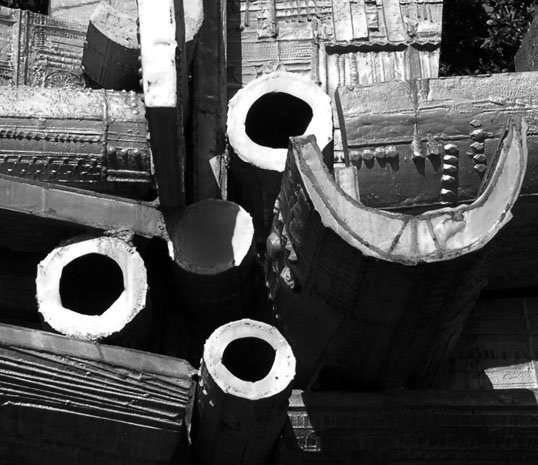
Astral Flower, by Jose Luis Sanchez
There is something special about downtown parks. The tiny bits of public green carved out of the pavement become precious jewels cast about the vast three dimensional expanse of office buildings. The few trees struggling for their share of light and water become alien creatures of wonder – flecks of forest, transplanted.
When I first moved to Dallas in the early 1980’s and was working down in the Kirby Building there was Thanksgiving Square – a carefully created triangle of grass and water in the heart of the business district. One of my favorite things was to eat lunch in the square on a sunny spring day… there was a greasy take out Chinese place in the underground – Mr. Kim’s Eggroll. This was a branch of the better known, almost infamous, Texaco Lunch Box out on Ross avenue. I won’t say the food was good… but it has good memories.
From a 1984 Newspaper Article, in The Victoria Advocate, “In Praise of the Immigrant,” by William Murchison.
My own favorite immigrant is Mr. Kim, a South Korean. He came to Dallas in the late 70’s, legally, I should point out, worked hard at a convenience store, saved most of what he earned and established an eggroll joint across the street from the courthouse. In those days I patronized him with some frequency.
But Mr. Kim wasn’t sure he couldn’t do better elsewhere. A short time later he opened the inimitable Texaco Lunch Box on Ross Avenue. The Lunch Box sells gasoline and marvelous egg rolls, whichever or both. From the start it prospered, owing partly to Mr. Kim’s ebullient, somewhat wacky, personality, partly to a quality product. Mr Kim always had a cheery smile and a few quips for his customers. To my children he commonly would hand out an extra fortune cookie, sometimes even a can of Coke.
One place wasn’t enough, so Mr Kim opened more, staffing them all, as far as I am aware, with fellow Korean immigrants. A devout Presbyterian who plasters Christian slogans on his wall, Mr. Kim also set up bible study classes for Koreans. Many were the times I’d go by the Lunch Box and ask for him, only to be told, “He’s teaching bible class.”
One of Mr. Kim’s outlets is downtown, more or less underneath Thanksgiving Square. That is where I now catch him when he isn’t teaching the bible or helping some Korean family.
I was glad to find that article – I hadn’t thought about Kim’s Eggroll for a long time and was glad to find out my memories (I remember the eccentric man and the religious tracts taped to the wall… as well as the taste of the greasy rolls and sweet sauce) were real and not some remnant of a fever dream.
Kim’s Eggroll and the Texaco Lunch Box are long gone. In addition to some legal adventures, Mr. Kim seems to have been involved in the local restaurants Wok & Roll, which I have eaten at too.
In the decades since, Thanksgiving Square is getting long in the tooth, but the city has carved out some more parks – more ambitious and more contemporary. There is the big trinity of Main Street Garden Park, Belo Garden Park, and of course, the crown jewel, Klyde Warren. There are also a handful of smaller place, some of them really nice, like Lubben Plaza… (I’m going to have to go downtown and shoot some pocket parks… aren’t I).
And there are more in the works.
One of the biggest proposed projects is Pacific Plaza Park. This would join together a number of small parks and desolate parking lots into one of the largest remaining open areas in the City’s Center. It’s been delayed and delayed and I hope they get going and get the thing built while I’m still alive.
One concern, though. Right in the middle of the proposed park, is an old, forgotten park that used to have a fountain with an old, forgotten sculpture. If you live in Dallas, you’ve driven by it a million times, and even though it’s pretty darn big you’ve never seen it. I, however, ride a bicycle, and I notice things like this.
It’s called Astral Flower, by Jose Luis Sanchez. It was placed in the Pacific Plaza “Vest Pocket Park” in 1968 by Junior League Garden Club. The tiny park was developed by the Greater Dallas Board of Realtors along with the City Parks & Recreational Department.
I hope they preserve this little bit of history. In Dallas, history is as scarce as green space downtown.

Astral Flower, by Jose Luis Sanchez
(click to enlarge)
I took the DART train downtown to a Beer Festival and made my train on time. Because of this, I was an hour early and sat down in Klyde Warren to hang out and wait until the festival opened. The sun was near setting and the sky was glowing – the skyscrapers sharp and elegant.
Looking at the collection of crystal towers, my attention was drawn toward six in particular. Thinking about why these meant something to me; I realized I had watched these (and many others) while they were built. I worked in Downtown Dallas in the early eighties – for a couple years in the Kirby Building (now converted into condominiums) and for a couple more in the historic Dallas Cotton Exchange (I loved that building – unfortunately, it was dynamited in 1994 to make room for a parking garage for the 1st Baptist Church).
The early eighties were a time of frantic building in Texas, especially in downtown Dallas. The giant construction crane was considered the state bird. This all came to a spectacular stop in the Savings and Loan crash of the late eighties – but at the time nobody could see that disaster coming.
I was young and a recent immigrant to the big city and was absolutely fascinated with watching the towers going up. In those pre-internet days detailed news was unavailable to the unwashed masses – so the construction was always a surprise to me. Since it would take, say, two years or more to build these it was like a slow-motion reveal, a mystery unveiled piece by piece, day by day.
A block would be cleared and then a gigantic hole slowly carved deep down into the chalky bedrock. Then the steel, concrete, or combination skeleton would rise, floor by floor, emerging from the scurrying crowds of hard-hatted workers like a living thing.
Finally, the skin would be hung and, only then, would the real shape and color of the building revealed. It was never really what it looked like while it as going up – the architects played with shapes and forms, adding extra corners and geometric sleights of hand. The final form was always a gigantic pleasant surprise.
Those were exciting, innocent days. Now, looking at the buildings bring back those memories. I can see, in my imagination, beyond the glass and stone cladding to the hidden skeleton of these skyscrapers, remember when the supporting framework was fresh and exposed.

Three skyscrapers from Klyde Warren Park, Dallas, Texas
The Chase Tower
2200 Ross – 1987 – I recently took photos of a helicopter making a delivery here.
People call this one the building with a hole in it. On the 40th floor is a skylobby that offers good views of the Uptown area of the city – I haven’t visited this, but would like to. I watched it get started but was working out in Garland before it was finished. The skyscraper was designed by SOM and is 738 feet tall with 55 stories, making it the 4th tallest building in Dallas.
San Jacinto Tower
2121 San Jacinto – 1982
This is the tan triple building in the center. I watched this one go up in detail. While it was being built it was not obvious that it would have that unique, triple structure – the effect was made with add-ons at the end. The building is 456 feet tall and is 33 stories, making it the 20th tallest building in Dallas.
Trammell Crow Center
2001 Ross – 1985
This one was really cool to watch. It was very close to where I worked and was clearly visible outside a window near my cube. Although I left downtown before it opened, I did see all the visible construction right in front of my eyes. The skyscraper is Post Modern in styling and is 686 feet tall with 50 stories. The Trammel Crow Center is the 6th tallest building in Dallas and is named after its principal tenant.
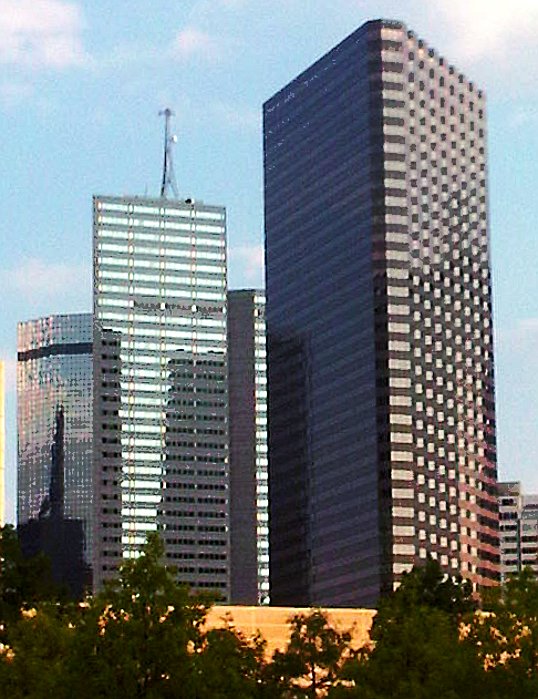
Three more skyscrapers from Klyde Warren Park, Dallas, Texas
To the west are three more:
Lincoln Plaza
500 N. Akard – 1984
This triangular building went up on the site of the old YMCA – I watched them implode that building. It has a cool upper-crust restaurant (Dakota’s) in the basement – you go into an elevator sticking up in the sidewalk to get down to it. Lincoln Plaza is 579 feet high with 45 stories, and is the 13th tallest building in Dallas.
These last two flank Thanksgiving Square – one of my favorite spots back in the day. It’s getting a little run-down and forgotten now – but in the early 80’s it was the place to hang out for lunch on a warm spring day.
Energy Plaza
1601 Bryan – 1983
This is another building that I watched with interest – it ended up looking a lot different than I thought. I.M. Pei & Partners designed this 49 story building located on the north side of Thanksgiving Square. On top of the tower is a triangular communications tower that is modeled after the Eiffel Tower — only smaller and three sided. Energy Plaza is the 9th tallest building in Dallas and with a height of 629 feet.
Thanksgiving Tower
1601 Elm – 1982
The rearmost of these three is Thanksgiving Tower. This was was almost finished when I started working in Dallas – I was there when it opened. This 50 story all glass skyscraper faces into Thanksgiving Square. Thanksgiving Tower is 645 feet high and is the 8th tallest building in Dallas. If you look at it you can see the the distinctive reflection of Republic Center Tower – a skyscraper that has been there since 1954 – ancient by Dallas Standards.
Graffiti, Deep Ellum, Dallas, Texas
“The Guide says there is an art to flying”, said Ford, “or rather a knack. The knack lies in learning how to throw yourself at the ground and miss.”
― Douglas Adams, Life, the Universe and Everything

“When we started the show, ‘Dallas’ was known as the city where JFK was assassinated. By the end it was known as JR’s home town.”
—-Larry Hagman

“But there is so much more to do for the city we love… a Dallas with roads as strong as our businesses, parks as beautiful as our children, a downtown as tall as our imagination.”
—-Laura Miller
Trying to integrate bicycling into daily life – using a bike as transportation rather than a child’s toy – here in Dallas, the worst city in the country for cycling, I have become very sensitive to the barriers that cross potential cycling routes. Barriers… that leave chokepoints. All the trails in the world are merely outside exercise paths if they don’t have a way through the barriers. Barriers like highways, or railroads, or worst of all, rivers.
The Trinity River, as rivers go, isn’t much to write home about. In dry weather it’s not much more than a muddy green strip of particularly wet swamp. However, as a barrier, it’s more than river enough. Until recently, there has been no safe way to get across this riverbottom no-man’s land.
The City constructed a trail over an old railroad trestle (next to a failed attempt at a whitewater canoe feature) but they neglected to connect it to anything and it is useless for transportation. There are grand plans for the future, but I’ll believe those when I see it.
But now, there is something… something pretty good. There has always been twin roads over the Trinity, connecting downtown with Oak Cliff – the Houston and Jefferson viaducts. Built at different times, with different designs, they have been twinned, with one going in and the other going out.
Money has been found and now, the Houston Viaduct has been closed for construction of a Streetcar Line that will run from the Convention Center in Downtown across the river and over to the edge of the Bishop Arts District. In the meantime, both in and out traffic has been routed over the Jefferson Viaduct.
And, wonder of wonders, one lane has been blocked off and marked out for bicycle traffic, one lane going each way. There is now a safe and reliable route from Oak Cliff into downtown on a bicycle.

Bicycle Lanes on the Jefferson Viaduct from Oak Cliff into downtown, Dallas.
It’s been there for a few weeks now, but I haven’t had a chance to ride it until Sunday. I took the DART train down to the Convention Center with my commuter bike hanging from a hook in the middle car. A little girl in a stroller stared at me, sitting there holding my bike’s rear tire to keep it from swaying with the train’s motion, wearing a helmet and sunglasses, the entire way. Meanwhile, a con man with a little shell game monte played with tiny red plastic cups on a newspaper folded across his knees relieved her mother and a friend of a quick ten bucks.
I left the train in the parking garage under the Convention Center and wound my way up into the daylight by the new Omni Hotel, then looping around to the viaduct. I rode across, visited a little gateway park, then came back, pausing to take a few photographs here and there.
The bike route was nice – the bridge had a bit of a hill to it, but nothing too difficult. The views in all directions are pretty spectacular – you never notice how impressive when you are in a car.
The only downside is that the approaches to the bike lanes are very awkward on both ends. Since this is a converted one-way bridge, with both bike lanes on one side – there is no good way to get cars and bikes on and off without a lot of confusing and difficult signage and odd routing.
One odd thing is that there is an old deserted parking garage in the middle of the span. It had been built to service long-gone Reunion Arena and it now sits abandoned – acres of bare concrete and sweeping ramps. Surely something useful (maybe a rooftop park?) could be done with this monstrosity.
I didn’t spend too much time – I was meeting Candy for lunch at Lee Harvey’s in Southside and then I had about twenty five miles to get home. That’s a long way on the heavy, inefficient commuter bike… but the day was nice and I was in no hurry.
Welder outside the Plaza of the Americas, Dallas, Texas

Always overlooked is the beauty of work. Every day we walk, move, and live on, under, and around steel welded by unknown men wearing heavy dark masks to protect them from the rays of the arc.
He wields the power that melts steel, joins the strong, flickering and cracking in blinding plasma, high voltage, matter reduced to its most elemental stage.
And all he wants is his paycheck and to go home. And high above, the skyscraper grows higher and higher.

The other day I came across an article: 5 landmarks you probably didn’t know about in Downtown Dallas. I knew four of the landmarks well, but had never heard of or been to Lubben Plaza outside the Belo building in downtown.
Last Saturday, after I did a group bike ride on Exposition Avenue and Deep Ellum that visited a number of fashion boutiques in the area (but before I came across the car fire) I wanted to ride a few more miles so I crossed downtown Dallas along the Sharrows on Main Street and jumped over to the park.
There were three cool sculptures there:
LUBBEN PLAZA
Belo Corp. developed Lubben Plaza in 1985 to commemorate the centennial of The Dallas Morning News. It was given to the City of Dallas in honor of Belo’s long-time employees, past and present.
It is named for John F. Lubben and his son Joseph A. Lubben, who together completed 101 years of combined service to the Company.
Belo commissioned three Texas artists to produce the sculptures installed here. “Harrow” by Linnea Glatt and “Journey to Sirius” by George Smith were installed in 1992 in commemoration of Belo’s sesquicentannial. “Gateway Stele” by Jesus Bautista Moroles was installed in 1994, when Belo developed the current Lubben East parking lot.
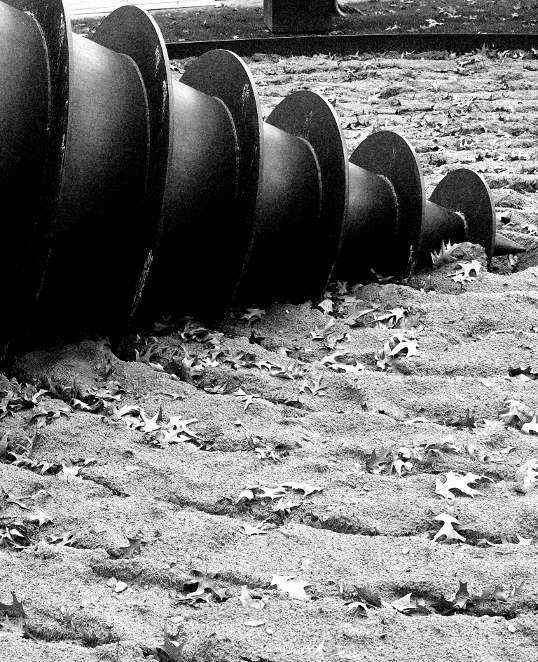
The most obvious piece was “Harrow”. It’s a giant steel spiral that rotates slowly around a circular bed of sand, cutting a series of concentric eponymous harrows and it goes.

The Harrow, in Lubben Park, Dallas, Texas
HARROW
1992
by Linnea Glatt
Dallas, TX
Combining elements of time, motion and place, “Harrow” is an installation of many materials and elements. The motorized cone of Cor-Ten steel turns on a circular track completing one revolution in 24 hours. As the cone turns, its bands travel through a bed of sand forming concentric rings, Seats of Cor-Ten and wood are placed in informal groups amidst trees outside the circle of sand.
James Cinquemani designed and produced the mechanical elements of “Harrow”.
Linnea Glatt:
“I am interested in the idea of placemaking, of which this is my most obvious manifestation. Of my works, ‘Harrow’ is the most active and on the contrary the most serene and contemplative. The repetition and constancy of the bands of the cone drawing in the sand symbolize for me the cyclical nature of life and the balancing of life’s events. The gesture is meant to embrace, to settle and to provoke thought. As with my previous pieces, ‘Harrow’ implies a human presence and dialogue.”
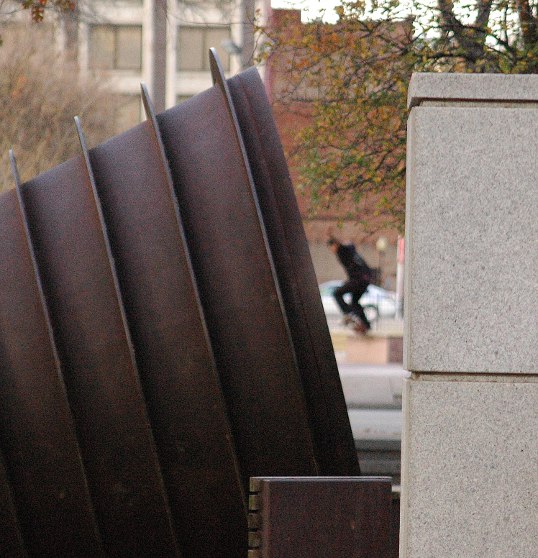
A distant, out of focus skateboarder jumps across the street from The Harrow.

The Harrow, by Linnea Glatt
I sat and looked at it for a while, but it didn’t seem to be moving. Maybe they shut it off on the weekends. I’ll have to check it out again, see if I can see it roll.
 Bill Chance