The Interior of the Soul

“There is one spectacle grander than the sea, that is the sky; there is one spectacle grander than the sky, that is the interior of the soul.”
― Victor Hugo, Les Misérables

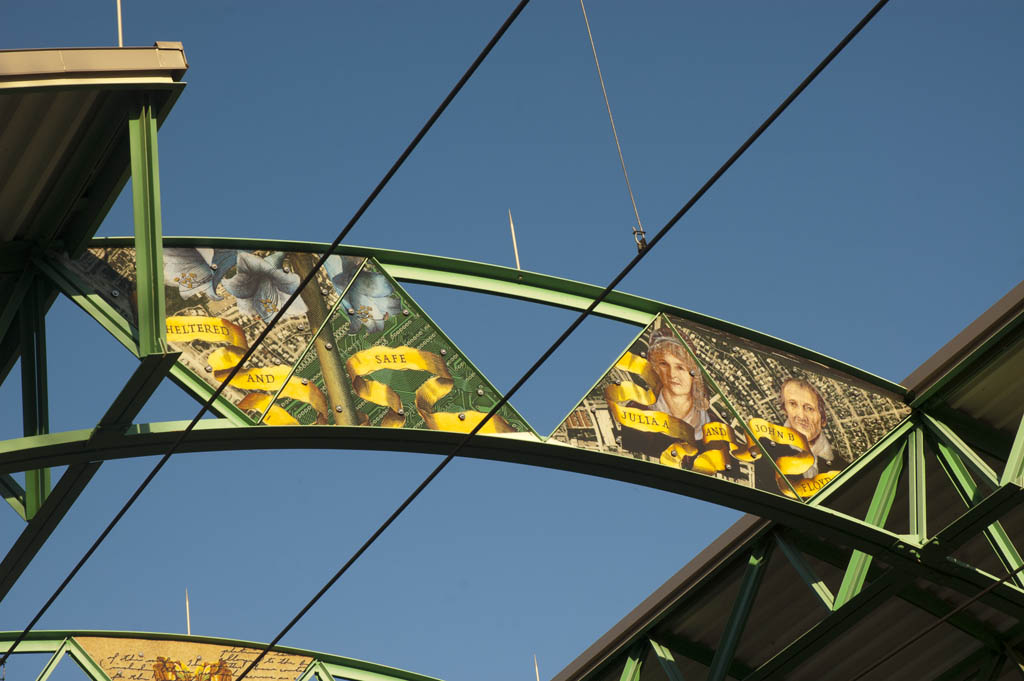
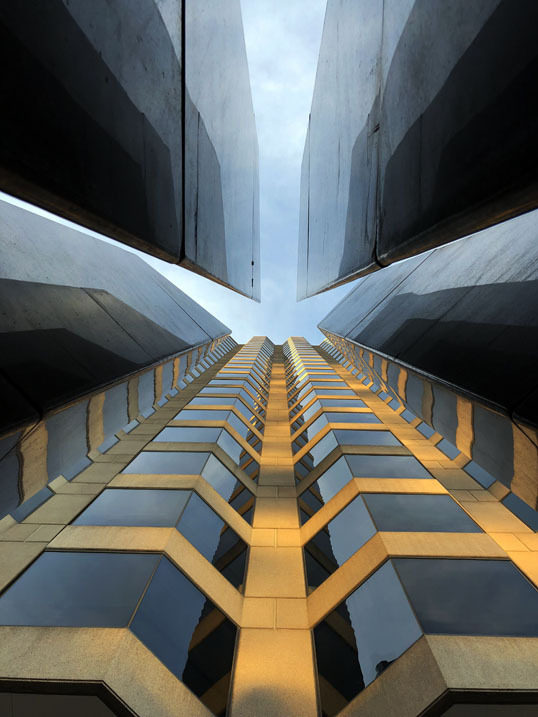
View Skyward, near the Pearl/Arts District DART station, Dallas, Texas

And what the same spot looks like from the side:

The Pearl/Arts District DART station, Dallas, Texas

The Abyss Will Gaze Back

“Whoever fights monsters should see to it that in the process he does not become a monster. And if you gaze long enough into an abyss, the abyss will gaze back into you.”
― Friedrich Nietzsche

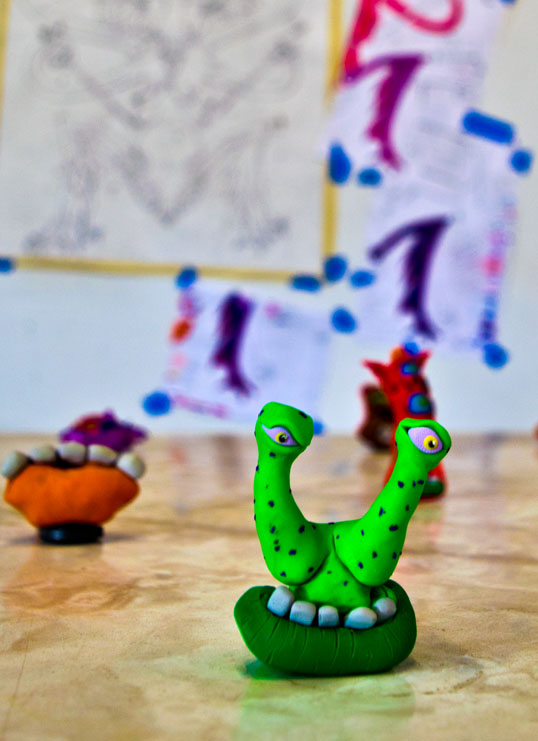
Table of tiny monsters, Clarence Street Art Collective, The Cedars, Dallas, Texas

Oblique Strategy: Question the heroic approach

Yesterday was a long and tiring day (though it was fun) and my head felt like it was full of cotton. I kept forgetting things all day – until late at night when I realized that we had left Candy’s car parked at the train station. I didn’t want to leave it there all night and didn’t want to have to deal with it in the morning. So there was nothing to do but to move my lights over onto my Xootr folding bike and ride to the train station. I made sure I had the right station and that I had Candy’s keys in my bag and set out.

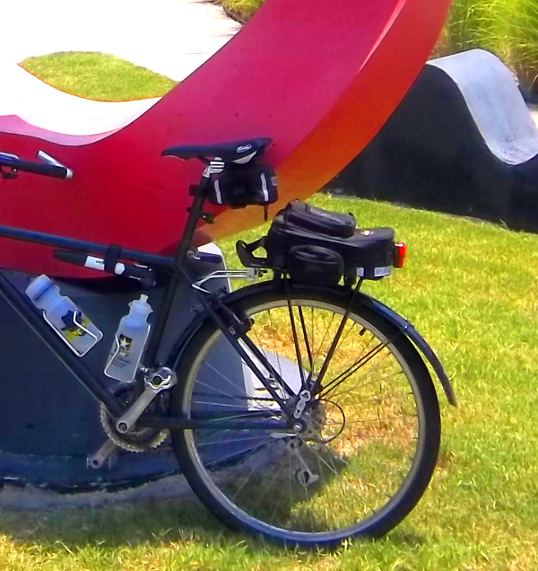
My folding bike, Stock Xootr Swift – I only added the seat bag and bottle cage
(click to enlarge)

I immediately realized that a front had blown through and, although it had been windy all day, the north wind had kicked up a notch, and it was cold. I had not dressed for it. But it is only three miles to the DART train station, so I just soldiered on.

Once I get off my lazy ass and get going, I enjoy riding my bike at night. The traffic is so much less, the trails are mostly empty (of people… there are a surprising number of various critters that come out even in the city) and everything is so quiet and still. I understand that it is dangerous, but my lights are good, I keep my eyes out and my ears open… nothing is safe… nothing worthwhile, at least.

As I rode farther, my efforts warmed me up and I felt better. I fell into the Zen mode of bicycling. If I think of the distance that I have to ride, it feels daunting, like I might never make it to my destination. The key is to only think about the next few feet in front of your handlebars and look around and enjoy every second. The miles drop away.

Before I could really think about it I was at the station. I rode around until I found Candy’s car and popped the trunk. That’s one big advantage of a folding bike – yank a couple of quick releases, pull out the seat, fold the wheels together and the bike goes into the trunk. It’s really handy for going and fetching a car.

I drive a tiny car – a Toyota Matrix. I always liked it because I could fold the rear seats down and get a bike (barely) into the back of the car (never liked exterior bike racks). I ways surprised at how small the Xootr Swift folded down. I was able to fit it easily in the small space behind the rear seat. Now I have a four-passenger car again.

My Xootr Swift folds differently than most. You undo two quick releases and pull the seat post up. Then the bike folds front to back (most fold side to side) until the two wheels are together. If you need more space, the seat can come out completely and another quick release lets the handlebars slide out. It doesn’t fold as compactly as, say a Brompton, but it has the advantage of being strong (a big rider like me needs the strong frame) and it uses standard bike parts – which is a great thing over the long term.

So I drove Candy’s car home and stowed everything away in the garage.

Tomorrow’s another day.
LBJ/Central Station

There is art where you least expect it. There is beauty in the most mundane.

The scenes you see every day, the dreary landscape of grinding drudgery is too often not seen. Take a look.

LBJ/Central StationDART Red Line

LBJ/Central Station, providing easy access to Texas Instruments’ main campus, links nature and technology with cast stone columns with circuit board designs imbedded as insets. Built on the historic John B. Floyd farm acreage, the station also features a trellis gateway to the station platform. Station design team artist Frances Merritt-Thompson also produced the translucent panels in the overhead truss openings depicting images of the area.

DART LBJ/Central Station Frances Merritt-Thompson (click to enlarge)

DART LBJ/Central Station
Frances Merritt-Thompson
(click to enlarge)

Circuit Board Details in support columns DART LBJ/Central Station Frances Merritt-Thompson (click to enlarge)

Circuit Board Details in support columns
DART LBJ/Central Station
Frances Merritt-Thompson
(click to enlarge)

DART LBJ/Central Station Frances Merritt-Thompson (click to enlarge)

DART LBJ/Central Station
Frances Merritt-Thompson
(click to enlarge)

Other entries/photos from DART Stations:
Carrollton Collages
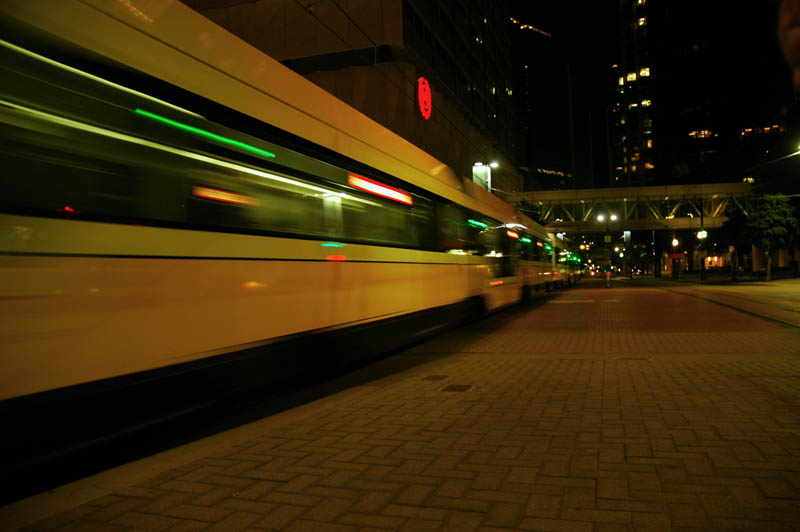
Plaza of the Americas, DART Station at Night
Gateway
Bike Lids
Next Stop
Dart Sunset

Train in the Rain

Most near-future fictions are boring. It’s always dark and always raining, and people are so unhappy.
—-Haruki Murakami

(click to enlarge)

(click to enlarge)

The Scene – Waiting for a Train

The Bank of America Plaza Building (the giant green thing) reflected in the mirrored sides of the Dallas Hyatt Regency. Taken from the Union Station DART platform while I was waiting on a train home from the Tweed Ride.

Bank of America Tower reflected in the Hyatt Regency, Dallas, Texas

Bank of America Tower reflected in the Hyatt Regency, Dallas, Texas
(click to enlarge)

Carrollton Collages

To get to the Carrollton Festival at the Switchyard I rode my bike to the Arapaho Red Line DART station – hung my bike on the transit hook and rode downtown (as always, I was a minute late, missed my train, and was twenty minutes late downtown – I need to cut that crap out), met a friend, and we then rode the Green line out to Carrollton. It would have been quicker to drive my car down Beltline (to get anywhere in Dallas you start out driving down Beltline Road) – but then I would have had to find a place to park, plus there is a lot of freedom and flexibility in having a bicycle. With a bicycle and a DART pass – I can go anywhere.

At any rate, heading back downtown, waiting for the train, I had the time to look around at the artwork on the Carrollton station. To my uneducated, ignorant, and untrained eye, DART has done an admirable job of adding artwork to its train stations – at least as far as a giant government bureaucracy can be expected to go. Maybe I should do some blog entries on some of my favorites….

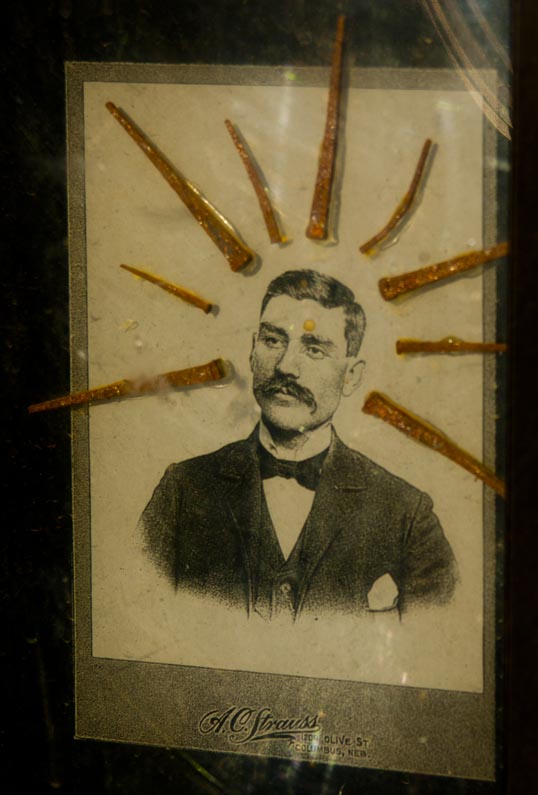
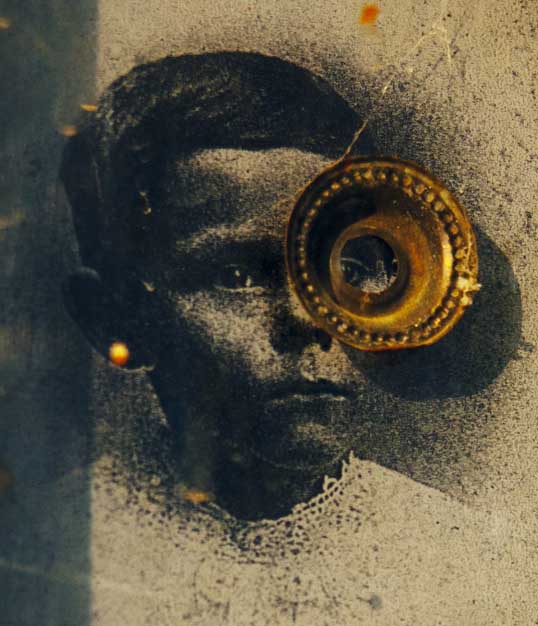
At the Carrollton station – elevated high in the air (cool view from up there) over where I suppose the old switching yard might have been, I noticed all these little windows cut into the concrete pillars supporting the roof structure. In each window was an old photograph combined with, or framed by, pieces of found metal. It made for a series of interesting and entertaining collages. The time spent waiting for the train was reduced by me dashing up and down, looking into the little windows at the parade of aged faces and arranged fragments of history.

Later, at home, an internet search led me quickly to the artist, James Michael Starr. Although, he seems to be unhappy with the initial installation – everything seems to have worked out and his collages are there for the enjoyment of the unwashed masses. The bits of metal seem to be mostly artifacts that the artist was able to dig up around the area, now on display, high in the air… forever waiting for the next train.

Collage by James Michael Starr, Carrollton DART station.

Collage by James Michael Starr, Carrollton DART station.

Collage by James Michael Starr, Carrollton DART station.

Collage by James Michael Starr, Carrollton DART station.

Collage by James Michael Starr, Carrollton DART station.

Collage by James Michael Starr, Carrollton DART station.

Collage by James Michael Starr, Carrollton DART station.

Collage by James Michael Starr, Carrollton DART station.

Mass Transit

J.G. Ballard wrote a short story named “The Concentration City” (you can read the PDF HERE) about a city that has grown to encompass the entire universe… theoretically and practically – whether it is actually is another question.

The protagonist tries to find the edge of the city, to find “free space” – to find an area where he can build and use a flying machine, by hopping a supersonic express sleeper train and riding it west for weeks.

Unfortunately, he discovers that no matter where you go, there you are.

Here in Dallas – which is shaped sort of like a bulls-eye, with concentric rings of highways and radial connectors – all the trains run out of the center and stop. There is no endless loop. They make you get off the train at the end, before it switches track and heads back in.

Otherwise it would be tempting to get on and never exit. Ride the endless electric rails – watch the city go by, circuit after infinite circuit, the commuters come and go. Everything would slide past forever.

Maybe it’s best that you can’t do that.

transit1

transit2

(click to enlarge)

[…]
“The surgeon hesitated before opening the door. “Look,” he began to explain sympathetically, “you can’t get out of time, can you? Subjectively it’s a plastic dimension, but whatever you do to yourself you’ll never be able to stop that clock”- he pointed to the one on the desk-“or make it run backward. In exactly the same way you can’t get out of the City.”
“The analogy doesn’t hold,” M. said. He gestured at the walls around them and the lights in the streets outside. “All this was built by us. The question nobody can answer is: what was here before we built it?”
“It’s always been here,” the surgeon said. “Not these particular bricks and girders, but others before them. You accept that time has no beginning and no end. The City is as old as time and continuous with it.”
“The first bricks were laid by someone,” M. insisted. “There was the Foundation.”
“A myth. Only the scientists believe in that, and even they don’t try to make too much of it. Most of them privately admit that the Foundation Stone is nothing more than a superstition. We pay it lip service out of convenience, and because it gives us a sense of tradition. Obviously there can’t have been a first brick. If there was, how can you explain who laid it, and even more difficult, where they came from?”
“There must be free space somewhere,” M. said doggedly. “The City must have bounds.”
“Why?” the surgeon asked. “It can’t be floating in the middle of nowhere. Or is that what you’re trying to believe?”
M. sank back limply. “No”
The surgeon watched M silently for a few minutes and paced back to the desk. “This peculiar fixation of yours puzzles me. You’re caught between what the psychiatrists call paradoxical faces. I suppose you haven’t misinterpreted something you’ve heard about the Wall?”
M. looked up. “Which wall?”
The surgeon nodded to himself. “Some advanced opinion maintains that there’s a wall around the City, through which it’s impossible to penetrate. I don’t pretend to understand the theory myself. It’s far too abstract and sophisticated. Anyway I suspect they’ve confused this Wall with the bricked-up black areas you passed through on the Sleeper. I prefer the accepted view that the City stretches out in all direction without limits.””
[…]
—-The Concentration City (1957). James Graham Ballard. The Complete Short Stories

Gateway

I find myself working towards an art which includes a spiritual dimension. I have become increasingly aware of art as a dialogue between matter and spirit. In recent works, I have emphasized myth, symbol and dream to evoke an atmosphere in which the sculpture and its environment speak to the subconscious to make the observer aware of the dreamlike nature of life, of which we all are part.
—-Hans Van de Bovenkamp

Not too far, not very far at all, from the pile of steel boxes I wrote about yesterday, is the Arapaho DART station with another sculpture. This is a good one, by a famous sculptor, Hans Van de Bovenkamp, that you have never seen.

I’ve seen it, though. Richardson’s Central Trail – a hike-and-bike strip of concrete that runs through the city, parallel to the DART tracks and Highway 75, now being extended to the south – goes right by it. Otherwise, commuters on the bus or train never get more than a glimpse. It is exposed to the traffic going by on Greenville Avenue – but everyone is driving too fast to notice.

I didn’t look too hard and didn’t see a label or plaque. This is a public sculpture, though, so there is information on the internet. The sculpture is called Gateway, and, as I’ve said is by Hans Van de Bovenkamp. It’s painted aluminum (begining to fade a bit – might need a recoat) and is a variation of a theme of Bovenkamp – there is a bigger version in Oklahoma City.

The sculpture "Gateway" at the Arapaho DART station, Richardson, Texas.

The sculpture “Gateway” at the Arapaho DART station, Richardson, Texas.

A DART train pulls in. Arapaho Station, Gateway Sculpture

A DART train pulls in. Arapaho Station, Gateway Sculpture

Gateway, by Hans Van de Bovenkamp

Gateway, by Hans Van de Bovenkamp

Gateway, by Hans Van de Bovenkamp, Richardson, Texas

Gateway, by Hans Van de Bovenkamp, Richardson, Texas

Gateway sculpture and commuter bike

Gateway sculpture and commuter bike

Airstream 2 – Old and New

“Time goes faster the more hollow it is. Lives with no meaning go straight past you, like trains that don’t stop at your station.”
― Carlos Ruiz Zafón, The Shadow of the Wind

airstream2

“The train bore me away, through the monstrous scenery of slag-heaps, chimneys, piled scrap-iron, foul canals, paths of cindery mud criss-crossed by the prints of clogs. This was March, but the weather had been horribly cold and everywhere there were mounds of blackened snow. As we moved slowly through the outskirts of the town we passed row after row of little grey slum houses running at right angles to the embankment. At the back of one of the houses a young woman was kneeling on the stones, poking a stick up the leaden waste-pipe which ran from the sink inside and which I suppose was blocked. I had time to see everything about her—her sacking apron, her clumsy clogs, her arms reddened by the cold. She looked up as the train passed, and I was almost near enough to catch her eye. She had a round pale face, the usual exhausted face of the slum girl who is twenty-five and looks forty, thanks to miscarriages and drudgery; and it wore, for the second in which I saw it, the most desolate, hopeless expression I have ever-seen. It struck me then that we are mistaken when we say that ‘It isn’t the same for them as it would be for us,’ and that people bred in the slums can imagine nothing but the slums. For what I saw in her face was not the ignorant suffering of an animal. She knew well enough what was happening to her—understood as well as I did how dreadful a destiny it was to be kneeling there in the bitter cold, on the slimy stones of a slum backyard, poking a stick up a foul drain-pipe.”
― George Orwell, The Road to Wigan Pier

Next Stop

Spring Valley Station, DART

””And we are put on earth a little space,
That we may learn to bear the beams of love,”

William Blake From SONGS OF INNOCENCE