Robots on the Walls

“You mean old books?”
“Stories written before space travel but about space travel.”
“How could there have been stories about space travel before –”
“The writers,” Pris said, “made it up.”
― Philip K. Dick, Do Androids Dream of Electric Sheep?

Hickory and Trunk Streets, Dallas, Texas

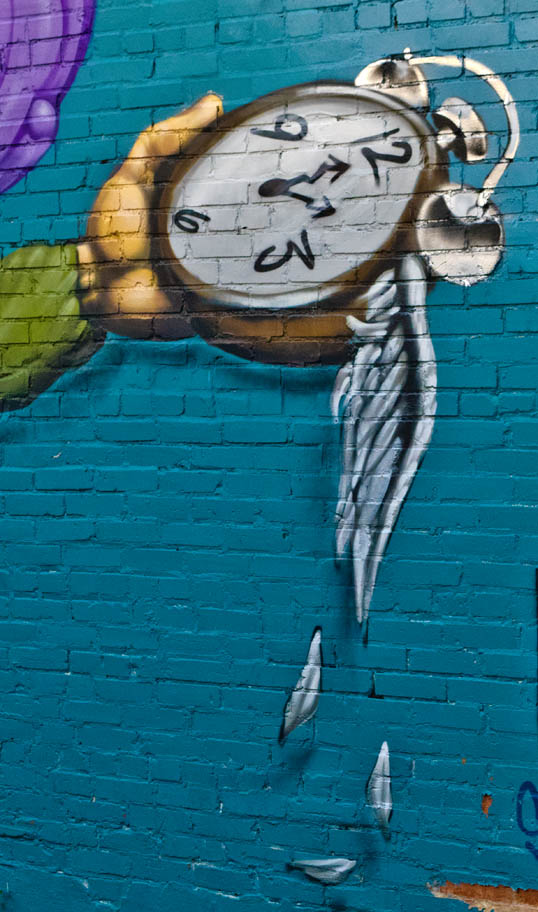
On our Hidden Art Bicycle Ride today we came across a building with robots painted on it. A very large building, but one on a street you don’t drive on very often. I had been there before, many times, on a bicycle, but the robots weren’t there. It was cool to see.

That Time of Year Again

Trinity River in the Fall, December, three years ago
Dallas, Texas

“But when fall comes, kicking summer out on its treacherous ass as it always does one day sometime after the midpoint of September, it stays awhile like an old friend that you have missed. It settles in the way an old friend will settle into your favorite chair and take out his pipe and light it and then fill the afternoon with stories of places he has been and things he has done since last he saw you.”
― Stephen King, ‘Salem’s Lot

Riding my bicycle to the Dallas Farmer’s Market from the DART train station for September’s Critical Mass bike ride I felt a sensation as the breeze blew by me. For a minute, I was confused, “What is this?” I knew I had felt it before, but I didn’t remember it right away. Then, it popped into my mind.

I was cold.

It has been so long, I didn’t remember what it felt like to be cold.

Now this is the end of September/beginning of October… in Texas that’s really the tail end of summer, so it shouldn’t… I shouldn’t be cold. But it has been raining for days, that cold fall rain, leaving the air, if not frigid, at least comfortably cool.

Nothing to worry about, the Texas sun will fight through the cloud remnants and warm things up a time or two before the fall really arrives.

Bluetooth Keyboard and iPhone – another portable way to write stuff.

I’m struggling to get all my vacation time taken before the rapidly approaching end of the year – so I took a few hours off and came downtown a bit early. In my eternal quest for a method of writing that I can carry on my bicycle, I’m using this Bluetooth keyboard – torn out of an iPad case that I bought at a church rummage sale for six bucks. It has a slot that I can drop my phone in and I use an app called Compo to type into. Once I’m done I’ll email what I write to myself.

Fall Colors, November, three years ago
University of Texas at Dallas
Richardson, Texas
(click to enlarge)

A Month of Short Stories 2017, Day 5 – Pending Vegan, by Jonathan Lethem

The Wyly Theater in the Dallas Arts District

Over several years, for the month of June, I wrote about a short story that was available online each day of the month…. It seemed like a good idea at the time. My blog readership fell precipitously and nobody seemed to give a damn about what I was doing – which was a surprising amount of work.

Because of this result, I’m going to do it again this year – In September this time… because it is September.

Today’s story, for day 4 – Pending Vegan, by Jonathan Lethem
Read it online here:

Pending Vegan, by Jonathan Lethem

And, after the insipid triumphalist overture of music and video and prancing androgynous spandex, when the orcas finally entered the arena and began their leaping, SeaWorld was overwritten by their absolute and devastating presence. By their act of stitching two realms together, sky and water, merely for the delight of a stadium full of children—children who, in response, leaped, too, and vibrated in their seats, and gurgled incoherently, practically speaking in tongues. Other kids, older and more intrepid than his own, raced down to the plastic barrier to be splashed, to stand with their arms flapping. The killer whales, with their Emmett Kelly eyes, were God’s glorious lethal clowns. Their plush muscular bodies were the most unashamed things Pending Vegan had ever seen. Like panda bears redesigned by Albert Speer.

—-Jonathan Lethem, Pending Vegan

A few years ago, my son Lee and I went down to the Dallas Theater Center’s Wyly Theater to see a new musical, The Fortress of Solitude, adapted from Jonathan Lethem’s eponymous novel. It was Pay What You Can Night (pretty much the only way I can see quality live theater on an ongoing basis) – which is cool, though what we saw was essentially a dress rehearsal open to the public. Because of this, there was a bit of confusion and we discovered that our assigned seats weren’t there (the Wyly is infinitely reconfigurable and they had configured our seats out of existence). No problem, the box office had alternate seats which were better anyway (not that the Wyly has any bad seats) – we were placed in a line of vacant seats right up front. Two men sat next to us at the last minute.

The play was excellent, very enjoyable. I never read the novel, so I don’t know if it followed or did justice, but as a night of live musical entertainment, it fit the playbill. As the play ended, the man sitting next to Lee started asking him a series of questions, “Did you like the musical?” “What songs did you like?” – the inquiry seemed more pointed than curious. I looked at the man and at the Playbill folder in my hand and realized this was the author (of the play, not Jonathan Lethem, alas). The idea was to premiere the musical in the hinterlands (Dallas), iron out the rough spots, them move to Off Broadway (Public Theater) then, eventually, to the Great White Way.

It looks like the momentum has stalled and it probably never will make it to Broadway… but at least I saw it.

Today’s story, also by Jonathan Lethem, is a chronicle of a family’s trip to Sea World in San Diego. The protagonist is struggling with a sudden attack of giving a damn about animals and, possibly more importantly, just now coming off his prescription to anti-depressants. His doctor warns him he might, “see bums and pickpockets.” Worried that he might hallucinate, the doctor assures him that he won’t imagine them, he may simply notice them.

I, of course, have been to Sea World (the San Antonio version) with unruly children a couple of times. I dealt with it a little bit differently than the father in the story – I didn’t think about it. It was a day for the kids and all I was responsible for was trying my best they didn’t get eaten by sharks or destroy an expensive exhibit. All other thoughts were put on hold.

For about a quarter century.

—–

In the interview below, Lethem says, “I’d also have trouble imagining a fiction writer who, after visiting the place, wouldn’t start fooling around with story ideas.” When I first read this I disagreed – I couldn’t think of any story ideas from SeaWorld.

Then I remembered seeing the Shamu show one year. The Orca wasn’t in a good mood and basically stayed at the bottom of his tank and refused to do any tricks. He was the male in the pod and the two females were in the lake outside of the arena. They kept surfacing and making these loud sounds. There is no doubt they were laughing at him.

The neoprene-wet-suited show people tried to get on with the act. They even brought a volunteer from the audience out to try and coax him into getting to work. I thought, “Man, if I had a humiliated, cranky, and uncooperative killer whale at the bottom of a tank, the last thing I’d want to do is lean out and wiggle a fish over him.”

Hmmm. I guess that is an idea for a story.

Interview with Jonathan Lethem about this story:

This week’s story, “Pending Vegan,” follows one family, a husband and wife and their four-year-old twin daughters, on a trip to San Diego’s SeaWorld. When did you start thinking about using SeaWorld as the setting for a story? Did you ever consider inventing the theme park and fictionalizing everything, or was it important that the story be set in a real place?

This story really began with a class I taught, called Animals in Literature. I assigned Jack London, William Faulkner, Franz Kafka, Olaf Stapledon, Lydia Millet, J. R. Ackerley, and a bunch of other stuff, including some essays and theory. (Animals are actually pretty “hot” in theory now.) In the spirit of due diligence, I also read a bunch of animal-rights and vegan manifestos, which is how I blundered into the realm of “Fear of the Animal Planet” and so forth—books I purchased, and which sit staring at me from the shelf, even if I failed to assign them or, in many cases, even to read them. I suppose some of this bad faith leaked into the characters: What would it be to think you’ve gone about halfway, or not even halfway, down some irreversible ethical path, then got stuck there?

Of course all this remained inchoate until suddenly I visited SeaWorld. I can’t imagine anyone setting a story there who hadn’t visited. (I’d also have trouble imagining a fiction writer who, after visiting the place, wouldn’t start fooling around with story ideas.) Long ago, I’d have been certain to disguise it as “Fathomverse,” or “Poseidon’s Playhouse,” or “Orcasm,” or something. But that wouldn’t really be likely to fool anyone, would it? A lot of fiction—most?—derives some of its effects, and energy, from its hybrid nature: half documentary, or half confession or argument or whatever, and full of references outside itself, whether obvious to the reader or not. I’ve made my peace with this. Besides, I’d have had to give up “Sea World, Eat World.”

The story’s protagonist, Paul Espeseth, is going through a crisis of sorts, which he has hidden from both his family and his shrink. He’s renamed himself Pending Vegan as a way of acknowledging his increasing uneasiness with the relationship between man and beast, yet he’s acutely aware of his daughters’ ability to reconcile “their native animal-love and the pleasures of eating.” What’s it like to imagine a child’s version of the animal world versus an adult’s?

Forget “animal world” —what about just “world”? Where’s the script for breaking the news, to a kid, of reality’s roaring wackness? Its moral bankruptcy? Imagine a scene from the breakfast table with a six-year-old listening to an NPR report on the firing of nine air-force commanders over cheating on the tests to qualify as officers for oversight of nuclear missiles.
Six-year-old: “What did they cheat on?”
Father (already in trouble): “Well, see, they were in, like, ‘soldier school’…”
Six-year-old: “Don’t they know it was wrong?”
Father: “———”
Six-year-old: “What are nuclear missiles?”
Father: “———”
Six-year-old: “Why would they cheat? Don’t they want to be good at fighting?”
Father (suddenly impassioned, intense): “Well, actually, the reason this matters so much is that nuclear missiles are these weapons we don’t want anyone ever to use…” (He stops at brink of disaster.)
Six-year old: “—?!?—”
Father: “Uh, eat your pineapple.”
Six-year old: “My teacher told me that pineapple was bad for your skin.”
Father (with relief): “She’s definitely wrong.”

A dog bounds into the story in its final page. It’s not the first time dogs have shown up in your work (“Ava’s Apartment,” for example, an excerpt we published from your novel “Chronic City,” features a memorable three-legged dog). Do dogs hold a particular place in your imagination? Can you imagine a cat exercising as much power?

Cat person or dog person? Funny about that. I grew up with cats; I’m more familiar with them, more fond of them, and I identify with them more. My parents bred Siamese cats for a while, and in a lot of baby pictures I’m seen swimming in a mass of kittens. Dogs were in stories, first: “Nobody’s Boy,” “The Incredible Journey,” Jack London’s and—especially—Albert Payson Terhune’s work. I was probably the last boy in the history of boys to drink deep at the well of “Lad: A Dog” and “His Dog.” Meanwhile, real dogs terrified me. This lasted a while. Even after we got a dog, other people’s dogs terrified me. I was 33clear to me. As in the case of my character, dogs are a problem I can’t solve; they throw me back into the question of self and other. For a writer, that’s good. Writing a story about a cat would be like writing a story about my arm or my ear.

—- Interview with Jonathan Lethem in The New Yorker
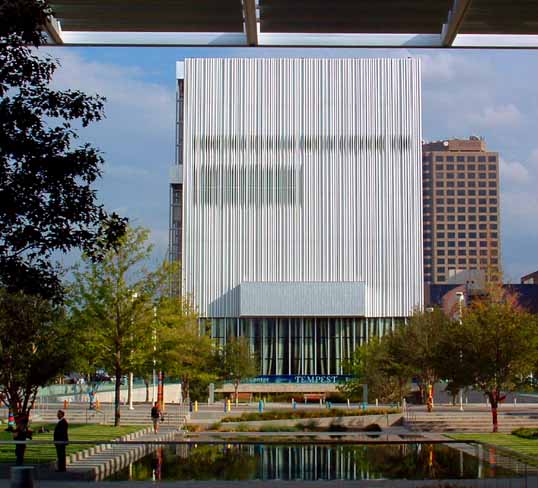
The Wyly Theater.

Who Loved Chopin

“Q: What genres do you especially enjoy reading? And which do you avoid?

A: I love reading anything about gigantic animate blobs of molten iron who secretly long to be concert pianists. It’s not a particularly well-populated genre, but in particular I’d mention, “Grog, Who Loved Chopin,” as well as the somewhat derivative “Clom, Big Fan of Mozart.”
― George Saunders

Downtown Dallas, Texas

Your First… Your Worst

“Your first 10,000 photographs are your worst.”
― Henri Cartier-Bresson

Half-Price Books, Dallas, Texas

Half-Price Books, Dallas, Texas

“Wild Books, Homeless Books”

“Second hand books are wild books, homeless books; they have come together in vast flocks of variegated feather, and have a charm which the domesticated volumes of the library lack.”
― Virginia Woolf

Display at main Half-Price Books, Dallas, Texas

Everybody has their addictions; I think an important part of life is to constantly take a brave look at what you are addicted to and try and choose better ones.

I used to be addicted to buying used books. My dealer of choice was Half Price Books here in Dallas. When I first moved to the area in the early 80’s, I lived on Lower Greenville and their main store was on Mockingbird, next to Campisi’s Egyptian. It was a short walk to the old-school used book store – with its labyrinthine passages. I bought too many books.

Then they moved to Northwest Highway and an old Captain’s Cargo store. It retained the odd sailing-ship style staircases and had an strange open plan. I moved too to a spot that was too close. I kept buying too many books.

One day I drove there and found the store closed. Confused and disappointed, I turned and saw that they had opened up into a gigantic warehouse-style space across the street. This was very bad. I went in and found a book of quotations I had been looking for for years. My addiction blossomed into full-fledged hopelessness. It’s funny, I only bought used books – never new. There was something about the feeling that other, unknown hands had moved over these pages before. Something about the faint smell of mold. I preferred books that had a few notes in the margin, a handful of bent corners, evidence of someone having been here before me.

Nobody ever held an Intervention for me, but when we moved to Richardson the moving company charged us a hefty upfee because of all the books. What finally broke me was the arrival of the Kindle – now I can carry a library in my pocket. I have more books in my Kindle than I can read over the rest of my pitiful life.

Jeff Koterba color carton for 7/21/09
“Mars”

Now, I have two large and one small bookshelf. This is my limit. To buy a new book, something has to go.

Is my addiction gone?… of course not. It may be under control. I do check way too many books out of the library… but that is really an addiction that I can live with.

Today, I went to Half-Price to look for a particular book that was too expensive in its ebook form. I found it in the Clearance Section for two dollars. You can be a very well-read person and never leave the Half-Price Books Clearance Rack. I suspect that the employees sometimes put really good books into Clearance as a favor to society.

At any rate, my classic book by a famous author that has helped keep society from completely (so far) running off the rails was two dollars. I also bought a blank book (my bullet journal is almost full) and it was ten.

So, I guess that putting wonderful, skillful, important words on paper reduces the value of a book by eighty percent.

Display at main Half-Price Books, Dallas, Texas

The Future Recedes

“Unfortunately, the clock is ticking, the hours are going by. The past increases, the future recedes. Possibilities decreasing, regrets mounting.”
― Haruki Murakami, Dance Dance Dance

Mural, Deep Ellum, Dallas, Texas

What I learned this week, August 19, 2017

Solar eclipse of April 8, 2024

I really, really wanted to drive north next week and see the solar eclipse. Unfortunately, I can’t get off of work, so won’t witness the totality. I was bummed. But now, I feel better, because I discovered there will be another one in seven years and the path of totality will pass right over Dallas. Now I only have to survive seven more years.

Something else to live for.


Chemists Say You Should Add A Little Water To Your Whiskey. Here’s Why


12 Authors Share What it Takes to Make it as a Writer in Dallas


The front desk entrance to the Art Deco Belmont Hotel, with Smoke in the background.

10 Best Spots to Snap an Instagram in Dallas

Travelling Man – sculpture east of Downtown Dallas

People from the Seersucker Ride at Klyde Warren Park, Dallas, Texas


7 World-Famous Landmarks That Are Hiding Something From The Public


7 Wonders of the Horror Movie World


This week’s short film:

Fading Away and Vanishing

“It’s funny, but certain faces seem to go in and out of style. You look at old photographs and everybody has a certain look to them, almost as if they’re related. Look at pictures from ten years later and you can see that there’s a new kind of face starting to predominate, and that the old faces are fading away and vanishing, never to be seen again.”
― Alan Moore, Watchmen

Inverted image from tintype camera. Dallas Library

In 2014 I ran into Scott Hilton of Project Barbatype at Cobra Brewing where he was shooting tintype photographs of Beard Contestants – it was pretty cool.

A while back, I ran into him again at the Dallas Library, where he gave a fascinating lecture on his project an on tintype photography in general. I took a shot of Mark Snaps and Mr. Holga from the Dallas Photowalk Thing standing behind his camera. Yes, the photo is upside down.

What I learned this week, August 12, 2017


The Brutal Saga of One Extremely Evil Railroad Crossing


That’s part of what motivated Cherry and company to conduct what they call the nation’s first “empirical analysis of rail-grade crossings and single-bicycle crashes.” To them, the problem wasn’t with the cyclists. It was with the roadway design and the fact nobody knows, scientifically speaking, the best way to bike over railroad tracks.

This footage is amazing and very, very hard to watch. It is beyond my imagination that a city could put in a dedicated bike lane that includes a railroad crossing at an angle of less than 30 degrees, and then take so long to try and correct it. Imagine someone building a road that wrecks a good percentage of the cars that drove on it. It would be on the national news.

Nobody gives a damn.


Restaurant Workers Reveal Their Personal Food Hacks And Tips


Brian Eno Explains the Loss of Humanity in Modern Music


In music, as in film, we have reached a point where every element of every composition can be fully produced and automated by computers. This is a breakthrough that allows producers with little or no musical training the ability to rapidly turn out hits. It also allows talented musicians without access to expensive equipment to record their music with little more than their laptops. But the ease of digital recording technology has encouraged producers, musicians, and engineers at all levels to smooth out every rough edge and correct every mistake, even in recordings of real humans playing old-fashioned analogue instruments. After all, if you could make the drummer play in perfect time every measure, the singer hit every note on key, or the guitarist play every note perfectly, why wouldn’t you?

One answer comes in a succinct quotation from Brian Eno’s Oblique Strategies, which Ted Mills referenced in a recent post here on Miles Davis: “Honor Your Mistakes as a Hidden Intention.” (The advice is similar to that Davis gave to Herbie Hancock, “There are no mistakes, just chances to improvise.”) In the short clip at the top, Eno elaborates in the context of digital production, saying “the temptation of the technology is to smooth everything out.”

The man is a genius.


To avoid traffic, this guy swims to work

Munich, Germany resident Benjamin David hated sitting in traffic on his way to his job at a beer garden. So instead of hopping in a car or on a bike, he now puts on a wetsuit and jumps into the River Isar for his daily commute.

This guy is my new hero – I whine so much about riding my bike to work… and this guy swims.

Not only that, but he works in a Munich beer garden.


Dining in a time machine: Couple tours Dallas eateries that have made it for four decades


I moved to Dallas in 1981 – the restaurants I fondly remember from that time that are still open include Campisi’s, The Grape, Spaghetti Warehouse, and, especially, Snuffer’s.


I Ride KC


In this blog, the author sets out to ride every street in Kansas City. What an interesting quest. I don’t think it would be possible to ride every street in Dallas, but it would be fairly straightforward to ride all the residential streets in Richardson. Something to think about.


Paying the price for breakdown of the country’s bourgeois culture

Returning to the American cultural values of the 1950s — thrift, gratitude, temperance, continence, among others — would “significantly reduce society’s pathologies,” says Penn Law School professor Amy Wax in an op-ed published Thursday on Philly.com and co-written with Larry Alexander of the University of San Diego School of Law.


Not all cultures are created equal’ says Penn Law professor in op-ed


This very interesting and needed op-ed will either create a shit-storm of argument… or, more likely, be completely ignored.

Penn Prof Faces Backlash for Saying “Not All Cultures Are Created Equal


This week’s short film….