Sunday Snippet – Pickpocket

I have to be careful with what I’m reading. It influences what I write. I distort what comes out of my pen by what goes in my eyes.

Lately, I’ve been reading too much lurid pulp fiction.

Whip Hand

Whip Hand

W. Franklin Sanders is a pen name for Charles Willeford… Ebook Here. Whip Hand was also published under the title, Deliver me from Dallas. In this heat… I know the feeling.


I needed something to take to our writing group, so I punched up a writing prompt generator and what came up was: Nonchalantly she reached into the other woman’s handbag and whipped out her purse.

Using this prompt, I wrote out a quick four pages…. this is what I came up with, Raw First Draft.


Pickpocket

The book she had read was nothing more than a pamphlet, printed long ago in blue mimeograph ink on office paper and crudely stapled into a small, rough book form. Loralee remembered the smell of fresh mimeo from grade school. The pamphlet paper was brittle, the blue fading, and crisscrossed with yellowed cellophane tape repairs but it was all still readable.

Loralee had bought the pamphlet at a strange little bookstore she had stumbled into while on a trip to a business conference in New Orleans.

Her boss had called and set up a meeting on the second day of the conference in a private hotel room. It seemed a little odd to Loralee, but she figured there was a new program to launch or some reorganization she had to help smooth over.

Instead she was laid off.

“Well,” her boss said, “At least you have two more days in New Orleans to enjoy yourself. Don’t worry about the meetings; and your hotel is paid for.” Her face seemed to creak as she forced out a frightening smile.

Thanks a lot.

Loralee spent the rest of the afternoon at the hotel bar, hitting it hard, charging the tab to her room. But when the meetings finished and she saw her coworkers returning to the lobby, gathered into conversational clots like old spilled blood, she couldn’t stand it and staggered back up to her room. As soon as she entered, she had to tumble into the bathroom and barely had the time to stick her head into the toilet before she heaved and puked up what seemed like a lot more than she had drank that afternoon – which was a lot. She continued to convulse even after she was empty until her diaphragm ached.

Finally spent, she tumbled onto the sagging hotel bed and fell into an uneasy sleep full of terrifying dreams.

When she awoke she saw a half-light splayed across the sheer curtains of the room. The digital clock had six fifteen glowing in red numbers. Loralee didn’t know if it was AM or PM and curled on the bed, staring at the curtains until she was sure that it was getting lighter, rather than darker. Six AM it was.

Hungover, wearing sunglasses despite the overcast sky, Loralee stumbled the uneven brick and cracked concrete of the French Quarter looking for… she didn’t really know. As she walked she chanted, “Laid Off – Let Go – Laid Off – Let Go” over and over like a Mantra. Almost everything was closed this early in the morning, street sweepers pushed filthy piles of cups, bottles, and beads down the middle of the street. Each block seemed to have an unconscious person still snoozing up against a building or beside a stoop. The smell of last night’s old beer and piss hovered over the still air like a filthy umbrella.

Finally she spotted the open door of the old bookstore. It actually opened out into an alley, with the entrance barely visible around the corner from the sidewalk. The alley had a rusty streetsign – the letters were faded, but it was barely legible, “Rue Deday.”  A red neon light glowed PEN – the “O” was burned out. Without knowing why, Loralee turned the corner and went in.

The stacks smelt like old mold. Loralee thought that most used bookstores were musty like that – but this was one step beyond. Maybe it was just New Orleans, maybe the French Quarter, maybe the ghost of Katrina. There was a lot of evil old water around.

The books were not marked, no prices. Loralee wanted to stick it to her company so she asked the ancient, bent proprietor, “What’s the most expensive shit you got.”

He did not flinch – simply peered over his thick glasses at her with eyes that were surprisingly bright and clear for someone of his age – otherwise he looked to have one foot in the grave. “Well, dear, we have a drawer of very expensive shit right here.” He pulled a massive key chain off a nail by the register and removed a padlock from a small metal filing cabinet.

The cabinet was full of old manila folders, each marked across the front with a scrawled red marker. The marker showed various prices – all over one hundred dollars each. The folders contained various bits of paper: single yellowing crumpled sheets, folded maps, handwritten notes.

Only one folder had anything that was thicker that a few sheets. That one had a folded and stapled booklet with the label, “How to be a Pickpocket, Guaranteed!

The price on the pamphlet was one hundred and twenty five dollars – which seemed really steep, but Loralee still had her company credit card. Somehow, her boss had neglected to confiscate it in her “exit interview.” She knew it would be deactivated any minute and wanted to waste anything still left in the account.

“I’ll take this one,” she said to the old man. “Here charge this card,” she said as she extended her company card for the last time.

Back home she fell into a languid life of half-hearted job searching. She ventured out to a big warehouse store and bought a case of frozen fried chicken dinners and several of ice cream. She would send out enough letters and resumes, apply online when she could, enough to keep an unemployment check coming, but her heart wasn’t in it.

One thing that did interest her was the old pamphlet she had stuck her company with back in New Orleans. For something so short it was surprisingly complex. She kept noticing something new every time she picked it up.

Different paragraphs were written in different styles, all jumbled together. Some were in a modern, hip, joking style, talking about “Stealing for Dummies,” and such. Others were in an arcane style, full of old-fashioned spellings and extinct phrases. The text seemed to be one third cold, dry instruction, one third psychology lessons on how a mark thinks and what he will and won’t notice, and one third strange incantations designed, as the pamphlet said, “To reste the spirit and calme the blood.

She read and re-read the thing. When she would put it down to try and watch TV or to get something to eat, she would feel it growing in her mind until her hands would actually quiver and itch for the feel of its aged paper between her fingers.

Some of the pages contained simple exercises meant to improve dexterity and quickness. She set up some little stations around her apartment. Everything was laid out exactly as the pamphlet called for, bits of cloth, small metal weights (she used some old hexagonal steel nuts she pried off the bottom of her coffee table), and shapes folded from shirt cardboard as diagrammed in the pamphlet.

Loralee would practice over and over again. First she would mumble the words prescribed on the pages; she felt an odd urge to try and get all of it exactly right – no matter how silly it seemed. Then she would go through the motions of snatching the metal nuts from whatever cradle they were hidden in. At first she would make her move while looking directly at the setup, but – as the instructions dictated – after a while she would work with her head turned, and then, finally behind her back. She was amazed to find that, with enough practice, she could snatch the prize without even touching the cloth or cardboard. She felt she could almost see her goal in sort of a glowing mist inside her head, see it clearly, even though it was behind her back.

After three months of preparation and practice, she decided she was ready.

There was a Starbucks near her apartments and as she entered she immediately picked out a matronly woman in a faded print dress at the end of the queue of customers looking confused at the lighted menu overhead. Loralee sidled into line directly behind her as the woman began to ask questions of the barista, “But I don’t understand… are you telling me the Venti is bigger than the Tall?” Loralee muttered one of the incantations under her breath. This steadied her nerves as she leaned over, pretending to look into the case of pastries.

Nonchalantly Loralee reached into the other woman’s handbag and whipped out her purse.

She then calmly pulled the money out, leaving a single five and the change so the woman could pay for her coffee. Without taking her eyes from the pastries she then replaced the purse, sighed quietly, turned and walked out. She could hear the woman going on behind her, “Oh, tell me again, what’s the difference between a latte and an espresso?”

It became easier and easier as her marks became larger and larger. Loralee began to frequent spots – casinos, expensive nightclubs, the racetrack, where customers would be carrying a lot of cash and might be drinking a little. She made enough money to begin buying expensive clothes. That enabled her to sidle her way into parties and receptions of the highest levels of society, where she could accumulate jewels and watches in addition to the mounds of cash she was quickly developing. Luckily, the pamphlet had advice on fencing those goods, and on the methods to safety and surreptitiously convert her ill-gotten gains into diamonds and gold coins – portable efficient receptacles of growing wealth.

She didn’t pay any taxes and couldn’t trust any bank, of course, so she bought a heavy safe and disguised it as a pedestal for her new wide-screen television.

She began to travel. She went to Las Vegas, Atlantic City, Palm Springs… anywhere that the marks might congregate with the cash.

She even returned to New Orleans to push her way through the huge dense drunken crowds at Mardi Gras. That was almost too easy. She could reach out and grab whatever she wanted without even thinking about it. For old time’s sake she returned to the street where she first saw the old book store, but it was gone. She moved along the alley running her hands over the rough brick, but there wasn’t even any evidence of where the door used to be.

Loralee decided she must have been mistaken about which street it had been off of. Even the street sign was missing, so she must have been lost.

After a year of work, her safe was bulging with gold and diamonds, three dresser drawers were stuffed full of hundred dollar bills. Loralee began taking it a little easier. She felt her skills begin to slip. Once, for the first time, a mark turned and shouted at her. She dropped the man’s wallet and fled. She decided to stop, at least for a while. She had enough to last, possibly for the rest of her life.

She liked to treat herself to a nice dinner at an upscale Italian restaurant around the corner. She received the best food and the best service, the waiters like her generous, cash tips. This night she stayed a little longer than usual, sipping on a particularly nice brandy after dinner; thinking about a European trip. It would be her first non-working trip to the old country, and she smiled, mentally planning it.

When she returned home and pressed her key into the lock, her door swung open freely. With a rising tide of fear choking her throat, she quickly pushed on inside. The apartment was a shambles. Everything was tossed about – not a stick was undisturbed. Her television sprawled face down on the floor. Looking at the stand, she saw the bulging cloth covering and knew the safe was open. Pulling the cover aside, she verified what she already feared. It was empty.

She dashed into her bedroom where the dresser drawers were tossed on to her bed, cash all gone. In a rising panic she rushed about the place looking in corners and hiding spots. Everything of value had been found and stolen. Even her old pamphlet on how to be a pickpocket was stolen. She realized she was doomed, there was no way to get this back without her instructions.

Finally, standing in the center of the room, fighting back panic and tears, she noticed something new. On her dining table was an old, dirty, and worn manila file folder. She approached the folder and saw, scrawled across the front, “One Hundred Seventeen Dollars,” in red marker. Shaking, she opened the folder. Inside was a single, torn, worn piece of paper covered with faded typing. At the top it said, “How to be a Burglar, Guraranteed!

The Sound of his Horn – by Sarban

The lurid cover art from The Sound of his Horn by Saban

The lurid cover art from The Sound of his Horn by Saban

I finished Erik Larson’s Thunderstruck and wanted something light and easy to read – so I looked through my collection of pulp ebooks and came up with Sarban’s The Sound of his Horn. This was an odd bit of fiction that I had found recommended here and there across the interwebs.

It’s an interesting amalgam – told as a story-within-a-story… it has time-travel science-fiction aspects, alternate history, a possibly unreliable narrator (one of my favorite literary devices), themes akin to a reverse Island of Dr. Moreau, a bit of an unlikely love story, while at the heart it is a “Most Dangerous Game” tale on steroids.

What’s odd about the book is that it is told in a slightly archaic, literary style (I had to use the dictionary quite a bit as I read) but the story is full of lurid, shocking elements that would be at home in the most modern trashy paperback. In the story, the protagonist finds himself thrown a hundred years into a future where the Germans have won World War II. A Teutonic lord rules a massive forested estate where his decadent guests hunt half-naked women costumed as deer or birds. They are captured alive by the hunt and served as after-dinner entertainment trussed up and delivered under giant silver serving-domes.

See what I mean. And that is not the worst of it, by any means.

I really don’t know if I’ve read anything as strangely sophisticated and sleazy at the same time.

In summary – it’s a short novel and more than entertaining enough. It’s well worth reading – if that’s the sort of thing you want. It’ll stretch your mind more than a bit. You can get an ebook copy here or here.

The author, who chose the pen name of Sarban, was John William Wall, a British Diplomat for over thirty years and a published writer for about two. Other than The Sound of his Horn he has a couple collections of fantasy short stories (some ebooks here). He must have been an interesting man, a combination of a sharp mind and a sordid imagination.

What I learned this week, July 22, 2011

Hakuna Matata

Hakuna Matata

Goals are important, but they are only metrics. A goal is useful for making sure you are on the right track, but it doesn’t work very well for motivation. To get where you need to go, you need to concentrate on the journey. If all you look at is the final goal, you will be overwhelmed and will fail. Look at the next step. If you enjoy the journey and are able to make yourself take that next little baby step, always, no matter what, then you will be unstoppable.


If you put the water bladder in your hydration pack upside down, you will get thirsty very quickly.


A prime lens on an SLR produces a picture that is sharper than one from a zoom.


With today’s tools, the idea of waiting for approval from the minions of a multinational sounds as lazy and self-defeating as a band that won’t burn CDs until they get a major label record deal. Just as musicians have to know their way around a sound board, writers need facility with the layout and design software used to create books, the ins and outs of formatting for ebooks; they need design sense enough to guarantee that their book looks good inside and out.

We used to wait passively for the pearly gates to open and then gratefully pass our manuscripts through to hallowed ground. In music and in books, those days are gone forever. And good riddance.

—- With Traditional Publishing Dies the Passive Writer-Victim by Leonce Gaiter in the Huffington Post


The problem is that these are all goods and services, …, and goods and rights are not the same things. People tend to concur upon rights …, and they do not depend upon others to supply and pay for their rights. With goods, there is always a political argument: about the value of the good, who is to get it and who is to pay.

from A Fling with the Welfare State, by Noemie Emery


If you want to be on the cutting edge – you have to be prepared to bleed.

Man Between the Ponds

Man between the ponds

Man between the ponds

There are these two flood control ponds down in the park at the end of my street. Every day, every damn day, I drive to work down my alley, facing the ponds, and then make a left turn over a little bridge and past them. Every day.

In the evenings the ponds are popular with walkers, picnickers, and fishermen (though I have never seen anyone actually catch anything). But during the day, the area is pretty much deserted, save an occasional walker on the trail.

A while back as I was making my left turn, I thought I caught a lone figure out of the corner of my eye. I was not paying much attention, though, I was thinking about work, so I put it out of my mind quickly. But the next day, I saw the same thing.

The next day, I paid a little more attention. Sure enough, there was a black-clad figure out in the middle of the ponds. The two ponds are separated by a concrete apron – during wet seasons the water flows over this spillway. Lately, however, under drought conditions, this area is as dry as a bone. There is still some water leaving the ponds, not much more than a trickle, it must be seeping through under the concrete.

But why would someone be standing out there? I thought I saw a city truck down by the road, maybe it was a workman digging out algae or repairing a pipe or something.

Then the man disappeared. I didn’t know if he was gone for good, or simply making his appearance during some time other than my morning commute.

And then he was back. This time I could see clearly enough to realize that this was a black-clad person out between the ponds doing some exercises, probably Tai Chi Chuan or some variation. I could see him progressing smoothly through his set of exercises and movements.

It was an arresting sight. The dark figure, clear, yet distant enough that I could not make out any details, moving, mysterious. There are a lot of people that practice various martial or meditative arts, usually in small groups, in the park or around the ponds, but nobody has chosen such a dramatic location as the apron between the ponds.

I started carrying my camera in the passenger’s seat in the morning in hopes of getting a picture. For a week the man didn’t show, but then this morning, there he was. I must have caught him at the end of his routine, he was standing motionless. I snapped a couple of shots and drove on. I don’t know how long he stayed there in that position.

I wonder if he is there on the weekend, on a day that I don’t have to rush out to work. I might walk a little closer, wait until he is finished, ask him details of what he is doing and why.

Or maybe I’ll let him remain a mystery – a distant dark figure out between the ponds, a monument to discipline and relaxation to be glimpsed for a second through a car window on days while I’m hurrying off to the rat race.

Thunderstruck

Marconi antennas at Wellfleet

Marconi antennas at Wellfleet

Creative nonfiction is the use of fictional techniques, such as characterization, conflict, foreshadowing, in the service of a factually accurate narrative. To me, the most important aspect that separates creative nonfiction from, say, journalism or scholarly writing, is the use of scenes. The story is broken up into scenes of varying length and detail, carefully crafted and arranged to affect an emotional result in the reader, while staying strictly within the known facts.

In the many years since In Cold Blood there have been many masters of Creative Nonfiction… Mailer, Wolfe, McPhee spring to my mind immediately… but right now the current master of the genre, in my humble opinion, is Erik Larson.

I read “Isaac’s Storm” a few years ago and was absolutely enthralled. Of course, the fact that I am very familiar with Galveston and the Bolivar Peninsula made the story even more harrowing and effective. For years we vacationed at Crystal Beach on the Bolivar Peninsula and I would imagine the horror of the storm surge inundating the island. I would look at the black iron lighthouse and imagine the poor souls huddling inside as the water rose and the winds howled. I read the book before Hurricane Ike struck and wiped our old vacation haunts off the face of the earth.

Then I read “The Devil in the White City” – which didn’t have the same emotional effect on me – but was actually a better book. It was fascinating in its story (which I knew nothing about) of the fantastic Chicago World’s Fair. This story of man’s best creations on display was contrasted with the darkest depths of human depravity in the parallel story of H.H. Holmes, the country’s “first” serial killer, who set up shop in his “murder castle” constructed only a few blocks from the fair.

The book is mesmerizing.

I went to a lecture by Erik Larson at the Eisemann Center here in Richardson and loved it. He talked a lot about the research he did for his non-fiction. I remember he discussed one sentence in Isaac’s Storm where he described what Isaac Cline saw, heard, and even smelled while he walked from his office to his home the day before the hurricane hit. “People ask me how I know what he experienced on his walk over a hundred years ago,”  He went on to explain that he knew from Cline’s letters he walked home and Larson learned from the maps of the city that there were stables and workshops on the way, and Cline would smell the horses and hear the workers.

It was very impressive.

So now I’ve finished a third Larson non-fiction book, published a few years ago, Thunderstruck. This, like Devil in the White City contrasts a famous accomplishment – Guglielmo Marconi’s successful “invention” of wireless communication, with a horror – Hawley Crippen, the most unlikely of murderers. The two stories are told separately, until the unexpected coincidences of history brought the two together in an unexpected way.

I found the Marconi story the more interesting of the two. The murder was horrific in its details – but the murderer was portrayed as almost a sympathetic character. Marconi was especially interesting in the fact that he didn’t actually invent anything – he never really even understood how radio worked – but he had the single-mindedness, courage, and business acumen to put other people’s inventions to work in a way that made sense and was successful.

And isn’t that the most important thing… really?

Any criticism of the book is merely picking nits. Larson is famous for layering on detail and here, especially in his description of the murderer’s daily life, it piles up pretty thick and gets a little tedious. I would like to have had less information on Crippen’s love life and more on the fantastic, gigantic, wireless installations that Marconi built on both sides of the Atlantic – spending millions of dollars and risking his entire company trying to get Morse code across the sea – never mind that nobody thought it was possible, that undersea cables could already do the job, and Marconi had no idea what he was doing in the first place.

The ultimate irony is that, in an odd way, the murderer was responsible for Marconi’s ultimate success.

So, in short, very good book, put it on your reading list – enjoy yourself and learn something at the same time.

Larson has another book out that I haven’t read – “In The Garden of Beasts: Love, Terror, and An American Family in Hitler’s Berlin.“ Oh, man, that sounds good, doesn’t it?

Early Marconi Radio

Early Marconi Radio

A Little Farther

After my little trip down the Glenville trail and on to Memorial Park Saturday I was all stoked Sunday for another bicycle ride. I wanted to ride the same route but push on farther. I’m starting to obsess about the possibility of commuting to work on my bicycle so I thought I’d see if I could figure out a route that would bypass the most dangerous stretches of road.

I rode on to the Brick Row Urban Village. This is a new, not-nearly-finished transit oriented development next to the DART station on Spring Valley road just East of Highway 75. A few months ago I spoke at a city council meeting in favor of a new, huge, transit-oriented development proposed for some vacant land (and another DART station) at Highway 75 and the George Bush Tollway. A lot of the speakers that were opposed to that development were complaining about the Brick Row. I don’t know what their problem is – the thing is nowhere near finished. How can they judge at this point?

brick row park

The little park in the center of the Brick Row Village. A nice place to stop, rest, and drink some water.

Maybe the progress is slower than promised – but the economy (especially real-estate development) is in the dumper… some delay is to be expected. Brick Row isn’t near occupied, the retail hasn’t arrived yet, and there is still a lot of vacant land – but otherwise, it looks pretty nice to me.

Brick Row

The front of the Brick Row along Spring Valley Road. You can see the elevated DART train tracks in the background. When I rode up, a train was passing - that would have made for a nice picture, but I didn't have the time to wait for the next train.

One of the nice things about bicycling is that it is the best way to learn a neighborhood. You will see things you never notice from a car, and you cover so much more territory than when you walk. I spotted a little hole-in-the-wall Pakistani Restaurant, The Silver Spoon, that I want to come back to and try. An odd name for a Pakistani place – apparently they bought a Cajun restaurant and never changed the name.

One other thing you notice on a bike that you don’t in a car are hills. Or even slight slopes. To most people the place where I live is absolutely flat. And it is pretty flat – but on the way back I sure noticed a long, slight, unrelenting uphill stretch that I sure never noticed in a car. It’s all good, though – I need the exercise… and it is nice going the other way.

I had a busy day ahead, so I didn’t dawdle more than necessary. I had ridden within a mile of my work. The rest of the route is easy – there are parking lots and sidewalks – I’d barely have to deal with cars. I’m going to keep riding… every day if I can, until I get in shape enough to start biking to work.

Wish me luck.

Today’s Route. 7.4 miles. It was hot again today, but I felt pretty good. Let’s see how this goes. Thanks for your support.

Fish Fry

Last week I cooked up a bunch of Kingfish that Nick brought back from a deep-sea fishing trip off Galveston. I had no idea on how to cook Kingfish, so I cut some into steaks and grilled them and fried the rest up Cajun-Style, dredged in spicy cornmeal. The steaks weren’t great, but the fried stuff was fantastic.

Kingfish

Nick and a Kingfish caught in the Gulf of Mexico

This week is the kids’ softball team’s last game so I fried up another frozen batch of the Kingfish. Since there were so many hungry kids coming by I needed to stretch the fish as far as I could, so I decided to make hush puppies and fritters to go along with the fish, and to make po-boy sandwiches to serve up the fried Kingfish, if anyone wanted one.

Frozen Kingfish

One of the packages of frozen kingfish Nick brought back. This is a big mess of fish.

Skinning the fish

The Kingfish has a tough skin. Cleaning it and cutting it into fry-sized pieces is a job. It takes a couple sharp knives and patience.

Frying

I like to use a cast-iron Dutch Oven on the stove for frying. It takes a while, but gives good control over the frying temperature. The fish is dredged in seasoned cornmeal and fried.

Plate

Last week we ran out of fish so I made a bunch of cornmeal hushpuppies, corn fritters, and served fish po-boy sandwiches.

I cooked up a big mess of fish and a big pile of hush puppies. We had plenty of leftovers… y’all should have come over to eat.

Pocket Park

Though it was fantastically hot today, I decided to go for a bicycle ride. I resurrected my Camelback hydration pack and filled a couple extra bottles with iced water and set out. I wasn’t going to go very far or too push myself too much… just get a little exercise in.

The other day I rode a bit of the Glenville trail over to Duck Creek and then a bit up the Owens trail under the power lines. Today, I decided to go the other way and ride the length of the Glenville trail there and back.

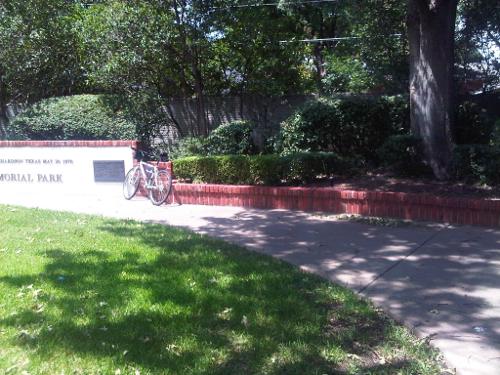
The heat was plenty hot but I felt fine and without further ado I was at the south end of the trail. The Glenville trail stops in the middle of a neighborhood – I understand the original plans were to extend the trail farther and link up with some other routes but the railroad wouldn’t grant a right-of-way. I wanted to go a bit more so I wound around on some sidewalks, crossed the railroad, and went to an alley to take a rest at the Memorial “Pocket Park” at Centennial and Grove.

I go by this little park every day on the way to work and it confuses me. It a very nice tiny park (the city says it is 0.84 acres) and has extensive landscaping and nice little curving brick walls that are the perfect height to sit on. There is a flagpole and a large bronze plaque that honors the city’s war heroes. The city must spend a lot of time and money on landscaping work to keep it looking so good.

Memorial Park, Richardson, Texas

Memorial Park, Richardson, Texas

If you look in one direction, you see the pretty little isolated park.

Centennial Street

Centennial Street

But the other direction is all busy street, fast food, gas stations, liquor stores.

The thing is, I never see anybody actually in the park. Nobody uses it. That isn’t surprising because there is no way to get to it. It is bordered by busy streets on two sides, with a high wall enclosing the third. No parking, no through path, no access from the neighborhood… nothing. Why did they build this? Why do they spend the money on upkeep?

Across Grove street is Woodhaven Park with a small parking area and a playground. I’m sure it is useful to the folks in the neighborhood with children. But to get to Memorial, you have to walk across at the light and then… there you are.

I guess that’s fine with me. I had the place to myself and I settled down in the shade to finish off my ice water and rest a bit, then packed up and headed home. Maybe I’ll ride there again, take my kindle and my Alphasmart with me and settle in for a while. I don’t think I’ll be disturbed.

Memorial Plaque

Memorial Plaque

This is the bronze memorial plaque from the little park. You can see it in the picture above right in front of my bike.

Detail from Memorial Plaque

Detail from Memorial Plaque

If  you are not from the South, you might be a bit surprised to see the C.S.A. by the names of the Civil War heroes. If you can’t guess, that stands for Confederate States of America. The Huffhines family is very prominent in Richardson to this day. You might even be surprised to see that it isn’t even called “The Civil War” but “The War Between the States.” Welcome to Texas.

As I was sitting there thinking I realized that the route I had chosen was on my way to work and I had ridden more than halfway. Can I ride my bike to work?

The route past that point is more treacherous – there are no trails and at rush hour there will be a lot of traffic. There is one spot on Buckingham Road that curves through a wooded area with no sidewalks – I’ve always been afraid of that spot – it would be dangerous for a slow bike rider like me. But maybe I can find a different route. There are some alleys and a new development to the north… let me see.

What would it take to be a bicycle commuter? I threw away the rack for my bike years ago, I should get a new one to hold a change of clothes. I could get a light for the winter time. Other than that… If I could work on it a bit, improve my fitness, lose some weight… I could get to work on a bike almost as fast as I can in a car.

It’s funny, I don’t live very far from work… maybe six miles. But the thought of being able to ride to work two or three days a week – it sounds to me like climbing Everest or getting Hannibal’s elephants over the Alps.

Something to think about, though. Something to work on.

 My route today… only 5 and a half miles, but a nice way to get out of the house.

Big Man Japan

Another review of a movie you (probably) will never see.

Why do I do this? Everyone in the world is out waiting in line to see the last Harry Potter film (I’ve only read one of the books and seen two and a half of the films) while I’m holed up with my laptop when I should be asleep and here I am watching another WTF stranger than strange bit of Netflix Streaming. The last two movies I’ve seen (and, more important, written about) have been Quintet (a candidate for worst movie ever) and now, Big Man Japan.

I know its a cult hit – but I’ve never met anyone that admitted to actually seeing Big Man Japan. I don’t even know how I came across it – probably fell into some webpage that mentioned that it was on Netflix and I couldn’t resist.

Now, I used to see a lot of film and read a lot of movie reviews. The problem is that too many reviews, especially written ones, simply outline the plot of the film in detail and that ruins the whole thing, doesn’t it? So I quit reading reviews until after I had seen a film. My idea is to go in blind, sit there knowing nothing, my brain an empty vessel to receive the cinematic genius unfettered by previous knowledge or expectation. The only problem is that about the time I decided on this course of action I ran out of money and time and hardly ever get to see anything anymore. Anything except when I lose my mind and stay up all night to watch weird stuff like “Big Man Japan.”

Therefore, I don’t want to talk too much about plot details. It would be interesting to see this film without knowing anything at all. It would be interesting, but you’d be pissed at me because I made you waste almost two hours of you precious life on this weird shit. So I guess, as a public duty, I should provide fair warning.

You see, the first third of the movie is a documentary-type exploration of Masaru Daisato, a middle-aged long-haired Japanese loser. His wife has left him and he scrapes by in a cluttered place eating rice and dehydrated seaweed. He carries one of those little folding umbrellas everywhere. Cryptically, he says he likes the umbrella and the seaweed because, “It only gets big when you want it to.”

Everybody hates this guy, they stare, they throw garbage into his yard, and spraypaint insulting graffiti wherever he goes. His wife has left with his daughter, there is a rusting swing set peeking out from the bags of trash outside his house.

He talks about his job. He makes about 5,000 a month (five thousand what… I don’t know) and wishes he made 8,000. He says that there isn’t as much business as there used to be. Though he doesn’t work much, he can’t travel. He has to be on call all the time. He seems to have a problem with the United States for some reason.

About a half-hour in we find out what his job is. He is a hero. They clamp electrodes to his nipples and shoot thousands of volts into his body and he grows into a huge, hairy, chubby guy with a bad haircut and a piece of pipe for a club. Then he goes out and fights giant monsters.

These monsters are tearing up Japan like Godzilla, except that nobody seems to care much about it and nobody seems to get hurt. The monsters are strange, disgusting, bizzaroids with strangely human faces (one has to keep flipping his combover as he tears buildings up by their foundation). The fights are filmed, but they air on television at two in the morning and the ratings are terrible. His agent tries to find sponsors to plaster advertisements on his chest and back to bring in an extra income – but he is so incompetent, cowardly, and unattractive the sponsors are hard to find and harder to keep.

The Strangling Monster

The Strangling Monster

Okay, this sort of thing goes forward, getting odder and odder (I’m leaving a lot out, trust me), until the final climax occurs and then, I’m warning you about this, the whole thing really veers off into truly WTF (and I don’t mean Win The Future) land. It’s pretty stunning, really. I’ve never seen anything even remotely like this. All through the movie you can’t help but wonder how serious the movie maker is. Is this a somewhat serious exploration of Japanese Culture, Capitalism, Monster Movies, Religious Ceremony, Ramen Noodles, Asian Pop Culture, Ozu, our treatment of the Aged, Reality Television, Fame, Heroism, and many other issues… or is this simply a big joke thrown in our face.

The last part of the film leaves no doubt.

It’s sort of genius, really, in a sort of sick, ridiculous, and annoying way. The only problem is that by that point I had actually come to care about Masaru Daisato. The scene where he takes his pixelated daughter to the zoo is heartbreaking. I wanted him to find redemption. I wanted him to defeat his enemies and win the girl.

And that is what the film ultimately skewers – the viewer’s expectations.

Does watching strange stuff like this stretch the mind, or is it only a lonely excuse for killing some time when I should be sleeping, waiting in line at Harry Potter, or out drinking?

Oh, one last thing. Peggy wrote the other day about remakes. It appears that a Hollywood studio has bought the rights to remake Big Man Japan. Or will it be a reboot?

Big Man Japan

Big Man Japan, ready to transform.

The movie answers one long-nagging question. When the hero grows to monster size, where does his clothes come from? In Big Man Japan it is answered. A trunk with a pair of giant purple nylon underwear inside follows the hero around. Before he is juiced up to giant size, the shorts are raised up by a winch onto two poles and the hero stands inside these, so when he grows, he he attired.

What I learned this Week, July 15, 2011

While I don’t share her enthusiasm for a certain morning cable talk show (though I did enjoy this bit of hilarity very much) I really like Peggy‘s Friday blog entries – Things I Learned This Week. Imitation is the most sincere form of flattery. I have no problem in blatantly ripping off her idea.

The Wave that Washes us all

The Wave that Washes us all

What I learned this week:

Procrastination caused by fear… I thought I was done with that, but I’m not. I still must say to myself:

I must not fear.
Fear is the mind-killer.
Fear is the little-death that brings total obliteration.
I will face my fear.
I will permit it to pass over me and through me.
And when it has gone past I will turn the inner eye to see its path.
Where the fear has gone there will be nothing.
Only I will remain
— Dune

Markus Zusak saidFailure has been my best friend as a writer. It tests you, to see if you have what it takes to see it through.


With proper hydration, the most brutal heat can be dealt with.


Too much habanera sauce – while not a good thing in all respects – will clear out your sinuses very quickly.


From a Blog Entry – Global Weirding Coming At Us All, by Walter Russell Mead (read the whole thing)

Except for some entrepreneurs, mavericks and renegades, our technocratic elites are mostly a bunch of rule followers and incrementalists.  They got where they are by scoring well on tests, manipulating the platitudes of conventional wisdom a little better than the next guy and by pleasing their supervisors.

This is almost exactly the wrong way to raise leaders for tumultuous times. …  We are producing legions of promotion-hungry bureaucrats and narrow specialists with no knowledge of or interest in the tumult and chaos that inevitably rises up in times like ours.  We then place them in large, bureaucratically run institutions and expect them to deal creatively with the unexpected, the revolutionary and the totally new.

I can not say it better.


Kingfish is better fried than grilled.

Wankelfish

Wankelfish