I regularly go to three of these: White Rock, Pearl Cup, and Espumoso… and have eaten at Oddfellows (didn’t have the coffee). As far as coffee goes, I don’t drink espresso much anymore – I prefer French Press.
Have to try out some all of the others. Any advice… or anyone wants to meet at one, get with me.
As far as a place not on the list… let’s see… if they are going to put a “more resturant than coffee spot” place like Oddfellows on there, how can they leave off Cafe Brazil?
Yesterday “Skyfall,” Adele’s theme song to the upcoming James Bond film of the same name, was officially released, and it’s a doozy. The song is the latest in a long line of fantastic tracks from the series; Bond music is just as iconic and essential to the series as 007’s sharp suits and cool cars are. Here are the 10 best James Bond themes—so good, they’ll leave you shaken AND stirred.
In a desperate and assuredly ultimately futile effort to get something useful accomplished I have been cleaning, de-cluttering, and organizing my office room. To that effect, I bought something from an estate sale – it was marked a dollar, but I bought it on half-off Saturday… so I paid fifty cents.
It’s a bilious cube of cheap turquoise green plastic, with four clear lucite drawers. I have a vision of organizing small parts in these drawers and setting the unit within reach of my work table… when I need some tiny something or other, there it is – rather than spending a tired wasted evening looking in vain, digging through tangled piles of crap, and uncovering, too late, items that I had pursued weeks ago and now find useless while my grail quest goes forever ungratified.
A useless and hopeless vision, I know, but such is life.
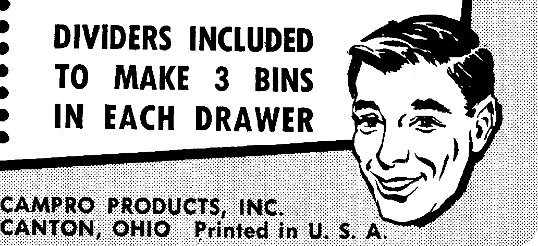
One unexpected bonus, though – easily worth the four bits I paid. Inside the thing I discovered an original sales label touting the virtues of the purchase.
It’s a Handi-Chest – made in the U.S.A. By Campro Products, of Canton Ohio. There are four helpful illustrations indicating possible uses:
On the dresser for jewelry, notions
Mighty handy for sewing supplies and accessories
For the office a real “organizer”
In the workshop “a place for everything and everything in its place”
So maybe my delusions of adequacy aren’t unique – the thing was designed and constructed (from my best guess, about the time I was born) to meet the same fantasy that still flits around all these long decades later.
I love old postwar advertisements. It was a simpler time – a time of smiling men and women, a time without snark, a time made up of line drawings. It was Mad Men time – the advertising executives thought up this stuff right after their three martini lunches (that might help explain the surreality lurking below the surface) and sent it all off to the Midwest to be extruded, printed, boxed up, and set out on the shelves.
“Desire is suffering. A simple equation, and a nice catchphrase. But flipped around, it is more troubling: suffering is desire.”
—- Charles Yu, “How to Live Safely in a Science Fictional Universe”
I was looking for something fun and not too heavy to read so I paged through the books I’d bought (mostly during Amazon sales) for my Kindle and settled the cursor over “How to Live Safely in a Science Fictional Universe” by Charles Yu – clicking it into my “READING” folder.
It’s an odd, postmodern bit of strangeness. You know, right away, when you find out that the protagonist’s name is Charles Yu, the same as the author. You suspect that the protagonist claims to have written the book that you are reading… and you would be right… sort of.
Yu (the protagonist) works as a time machine repairman. For the last ten years he has lived in his own time machine, a TM-31 Recreational Time Travel Device. Though there isn’t any extra space in the thing, he does have two companions – TAMMY, his love interest – an attractive bit of programming, and Ed, his non-existent, ontologically valid dog.
He works in Minor Universe 31 (not a coincidence that it has the same model number as his machine) – which is a pretty grim stretch of time-space continuum. It is broken, never really finished, and cobbled together from New York and Los Angeles scrunched together, with half of Tokyo thrown in for leavening.
Protagonist Yu gets himself in a real jam. He returns to his time machine after it gets some needed maintenance and sees himself climbing out of it. He panics, shoots himself, then jumps into the time machine and escapes into the past.
He is now stuck in a time loop. His only hope is to write a book that will tell his future self how to escape from the trap. The book that he is writing is “How to Live Safely in a Science Fictional Universe,” and you are reading it.
There are, obviously, many twists and turns of space and time and many turns of phrase and twists of fate. Physics enters into it too. And hypertext.
The book has links in it – including a link to a YouTube video on the famous Libet experiment on free will.
So I don’t know if I really decided to read this book… or simply went along with the flow when I discovered that I had already moved it into my READING folder on my Kindle – then fooled myself into believing that I had chosen it – and now am lying to y’all about deciding…. or something like that.
So, all well and good. Food for thought. But, the big question is, do you give a damn?
And the answer is, surprisingly, yes. The beating heart of the book is the relationship between Charles Yu and his father. I can say with pretty strong confidence that the grip of emotion is present in both the author and his eponymous protagonist. The story is the search for his father, who has also become lost in time, and an examination of the father and son’s life together. This is the meat of the story. There are a few passages that will rip your heart out… and that is the reason to read the book.
The science fictional pyrotechnics are just added dessert.
“I don’t miss him anymore. Most of the time, anyway. I want to. I wish I could but unfortunately, it’s true: time does heal. It will do so whether you like it or not, and there’s nothing anyone can do about it. If you’re not careful, time will take away everything that ever hurt you, everything you have lost, and replace it with knowledge. Time is a machine: it will convert your pain into experience… It will force you to move on and you will not have a choice in the matter.”
—- Charles Yu, “How to Live Safely in a Science Fictional Universe”
“There must be some kind of internal time distortion effect in here, because when I look at myself in the little mirror above my sink, what I see is my father’s face, my face turning into his. I am beginning to feel how the man looked, especially how he looked on those nights he came home so tired he couldn’t even make it through dinner without nodding off, sitting there with his bowl of soup cooling in front of him, a rich pork-and-winter-melon-saturated broth that, moment by moment, was losing – or giving up – its tiny quantum of heat into the vast average temperature of the universe.”
—- Charles Yu, “How to Live Safely in a Science Fictional Universe “
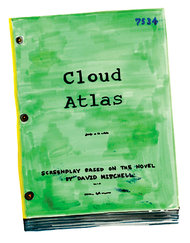
Cloud Atlas author David Mitchell tells the New York Times what it was like seeing his novel come to life: “Wherever the ‘Cloud Atlas’ screenplay differed from ‘Cloud Atlas’ the novel, it did so for sound reasons that left me more impressed than piqued.”
It was a quarter-century ago today that the world was introduced to Inigo Montoya, Fezzik, Miracle Max, the albino dungeon keeper with a frog in his throat and an impressive clergyman with a speech impediment. To celebrate we bring you 25 Great Quotes from ‘The Princess Bride.’
Partly because of jerks like me. But it’s mostly your own illogical mind.
Walter Russell Mead is one of my favorite political writers. He is very wise and his columns are well written and thought out. He has a point of view, but is not overly dogmatic about it. For example – this column on student college loans is burdened with a very provocative title, but has a lot of truth within:
The student loan program is a shining example of the blue social model in the midst of decay. It’s a program that used to work pretty well, but over time has morphed into a nightmare. Conceived at a time when college costs were low, a relatively limited number of mostly pretty qualified young people went to college and full employment made the transition from college to the workforce a straightforward process, the student loan program helped a generation of young people to a good start in life.
….
A sensible and helpful initiative gradually turned into a devouring beast. ….. They borrow more money than they can repay, or their school experience goes bad and the credential doesn’t work or they fail to earn it and President Obama’s hired debt collectors are turned loose on them to hound them into the grave.
Those who get in trouble, by the way, are disproportionately from poor and minority families, are immigrants, and are the first in their families to attempt higher ed. The young people that President Obama’s debt collectors are hounding most relentlessly are exactly the kind of people he hoped most to help.
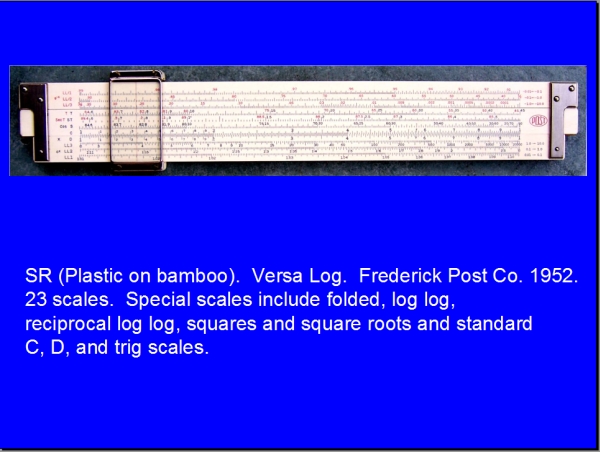
I was talking the other day about slide rules – I was a freshman in college when the switch from slide rules to calculators occurred. For my first… say, three semesters I always carried a slide rule to exams in case my calculator failed. A lot of strong, pleasant memories of my youth are associated with slide rules. I must not have gone out much.


















 Bill Chance