Beer and Batuman

“I found myself remembering the day in kindergarten when the teachers showed us Dumbo, and I realized for the first time that all the kids in the class, even the bullies, rooted for Dumbo, against Dumbo’s tormentors. Invariably they laughed and cheered, both when Dumbo succeeded and when bad things happened to his enemies. But they’re you, I thought to myself. How did they not know? They didn’t know. It was astounding, an astounding truth. Everyone thought they were Dumbo.”
― Elif Batuman, The Idiot

The Idiot, by Elif Batuman

Oblique Strategy: You are an engineer

In my struggle to live life outwardly, I spotted an event on Facebook that looked interesting. There was going to be a Book Club discussion at The Wild Detectives in Bishop Arts. I love that place – named after a Roberto Bolaño novel – it has a carefully curated collection of books, coffee and beer. What else do you need? On the weekends, they turn the wifi off – so people will be forced to talk to each other.

What could be better than to meet in a place like that and talk about a book?

The selected tome was The Idiot by Elif Batuman. The book is a bildungsroman about a ninteen-year-old woman attending her first year at Harvard.

I only had a little over a week before the meeting so I set up a spreadsheet with the number of pages per day I had to read. I have a terrible confession to make. I had a nice heavy hardback copy and the Kindle version. I never picked up the physical book. The new Paperwhite is simply too good.

I’m sorry.

The book was very interesting. Terribly well-written, it was unique in that the protagonist, Selin, was the most passive main character I have ever read in a novel. She drifts along, only slightly buffeted by life. Reading about her, I had the image of a person sliding down a featureless sheet of ice, silently observing the scenery go by (in very great and subtle detail).

So my feelings on the novel were mixed. It was interesting in that this woman’s life in her freshman year was incredibly different than mine (in a bildungsroman you can’t help but compare the protagonists experiences to your own) – for example: sex, drugs, and rock and roll make no significant appearance in her life at all.

One interesting aspect of the novel is that it takes place at the very beginning of the internet age: Selin is confused at first by this email thing – until she embraces it and has the most significant relationship with a slow email conversation with someone she met in Russian class.

The Wild Detectives is way across town from my ‘hood and I fought through the traffic after work, arriving early enough for a preliminary beer (Texas Ale Project‘s Fire Ant Funeral – if you are interested).

I really enjoyed the discussion. We started talking about the cover (I never even noticed there was a rock on the cover). Talking about the email, someone brought up that it was like letter writing in the time of classic Russian Novels (like Dostoevsky’s own version of The Idiot) people would write letters to each other, the distance and time separating the two adding a surreal aspect to a relationship.

A very nice way to wile away an evening.

The next novel we will discuss is The Seventh Function of Language by Laurent Binet. I bought a hardback copy at the bookstore – I’ll avoid temptation and not buy the Kindle version. We won’t meet until January, so I won’t need a spreadsheet to egg on the pages.

Sunday Snippet – The Spirit Duplicator

There is no limit to the extension of the curious mind. It reaches to the end of the imagination, then beyond into the mysteries of dreams, hoping always to convert even the dreams into reality for the greater well-being of all mankind.
—-The Outer Limits, Control Voice, Keeper of the Purple Twilight [2.12]
Yell

Oblique Strategy: Only a part, not the whole

The Spirit Duplicator

Trout Slobber had many reasons for hating his parents. Somewhere in the middle of the pack was, of course, his name. It was an old family name, they explained. He thought it was a tradition that should have been abandoned long ago.

Trout’s favorite thing was to read in his bed at night, under the quilt. The thick, soft fabric tented up over his knees, squinting at the slowly fading yellow circle of a flashlight. His parents rationed his supply of batteries – the sort of thing he hated them for even more than his name. They always admonished him not to “waste things.” For a long time he would steal batteries from the foreign man that ran the gas station. Trout hated to steal, hated the idea that he was a thief, but until Aurora helped him out he felt he had no choice.

He was in love with Aurora Schoner, a tall, skinny girl that caught the school bus at his stop. She wore a silver headgear that looped out from her braces and bent around to hook into an elastic band on the back of her head. Trout knew she hated how the headgear made her look, but he thought it was charming. Aurora had been riding the bus for almost a year and the two of them slowly became friends, as close as awkward kids could be. Trout wondered if Aurora loved him as much as he loved her, but could never uncover the courage to ask.

Aurora gave him batteries. Her parents never seemed to ask questions.

If other kids were around Aurora always referred to Trout as “Master Slobber,” because she thought it was cute – but if the two of them were alone she called him Trout. Aurora was bookish, like Trout, though they never read the same books, other than their school assignments. She liked to read woman’s books full of romance and adverbs.

Their neighborhood was divided by a heavily wooded creek. Years before a road cut through the creek and connected the two halves but the bridge was decrepit and unsafe and nobody wanted to spend the money to rebuild it. The road petered out on each side of the creek with concrete barriers blocking traffic from the crumbling bridge.

The bridge, the creek, and the overgrown vacant floodplain lots behind the housing development were the playgrounds for all the kids in the neighborhood. There was the creek, brown and green with dirt and algae, trickling over rocks and hunks of old concrete. There was an old molding pile of hay up in the lot from when someone had tried to have a horse. There were the thick tangles of riparian trees and vines. This was the geography of the children’s world – inflated and colored by their imaginations into a mystical and mysterious land of canyons, jungles, and ancient ruins.

There was always an ebb and flow across this landscape, groups of boys throwing rocks from the creek, older kids poking their heads up from the piles of hay, shouts and insults, mean laughter and sniffles. Trout didn’t like this aggression and bragging (it always reminded him of his parents and their friends) so he imagined himself a scout, a spy, a lone agent, flitting unseen along the edges. He would slink through the tangled woods, following faint trails that he imagined only he could see, and hid behind bundles of vegetation to spy on the caterwauling clots of rowdy kids.

One day while exploring a wide loop of the creek he stumbled across a brown paper bag wedged down in a corner of abandoned concrete. The spot was bent far enough out to be within a few feet of a busy alley and Trout had found mysterious stuff thrown away into the brush there before.

Trout picked up the bag and realized it had something heavy and rectangular concealed within. He braced himself and slid a deep steel tray out onto his lap. It was a covered with white porcelain and filled with some amber material. He carefully reached out and touched the smooth surface and realized that it was some sort of firm jelly. It was stiff enough to stay steady in the tray, but still jiggled a bit when he tapped on it. He tipped the tray a bit to let a shaft of sunlight fall into the jelly, and he realized that there was some sort of ragged purple stuff running through the mass, an irregular pattern, lines, curves, bits here and there.

He shoved the thing back into the bag, and, heart pounding, headed for home. He had to snake around to avoid a group of kids that were chasing each other with dried shafts of weeds attached to round balls of dirt pulled from the ground. They would club each other or throw the things whistling through the air.

Trout was able to escape unseen and slid the bag under a thick bush on the side of his house. Later, after dark, at chore time, he trundled two bags of trash out to the cans in the alley. On his way back he retrieved the bag and hustled it up to his room hiding it under his bed.

That night he hid under his blanket and carefully examined his prize with his flashlight. He could not imagine what it was, the cool metal tray, the firm jelly and the purple squiggles. His mind filled with exotic possibilities, but nothing seemed to make sense. Trout would slip the tray back into its bag and hide it under his bed, but he would toss and turn and then fetch it out for another look. He barely slept.

The next morning, at the bus stop, he pulled Aurora aside and told her what he had found. She kept asking him for details.

“How big was it again?” she asked.

“I don’t know, maybe as big as my notebook.”

“It was full of jelly? Up to the top.”

“Almost, not quite to the top.”

“What did the jelly taste like?”

“God! I didn’t eat any of it! Do you think I’m crazy?”

“Okay. Now. Tell me again about the purple stuff.”

“It was like marks, all over the jelly.”

The bus pulled up and they piled on. They didn’t want to talk about the tray on the bus, afraid someone would overhear them. Trout kept glancing sideways at Aurora, who was silent and looking down the entire bus ride, serious, like she was thinking hard about something.

Finally, as they were walking up to the big double doors of the school building, Aurora said, “I want to see this thing. Don’t tell anybody else about it. Meet me an hour after school down at the playground. Bring the bag.”

Trout nodded and slipped into class. All day he struggled to pay attention to his teachers and his work. He was too excited. He would stare at the big clocks at the front of the rooms. The red second hand seemed to creep around the dial and the tiny jumps the minute hand would make seemed miniscule and rare.

On the way home, Aurora and Trout didn’t sit together on the bus. They didn’t want to raise any suspicion. Trout’s parents were watching television and they only nodded when he said he was going down to the playground. He quickly sneaked the bag out from under his bed, piled his leather glove and a baseball on top, and flew down the stairs and out of the door.

Aurora was late. Trout hid the bag in the gravel under the slide and tried to look relaxed as he threw the baseball in the air and tried to catch it coming down. He felt his stomach would bust until he finally saw Aurora walking up the sidewalk. She was carrying some loose blank sheets of typewriter paper and a little bottle. It had a rubber bulb on it and a nozzle – Trout thought it was what girls sometimes kept perfume in.

“What’s that?” he asked, gesturing.

“Oh, it’s only water,” Aurora said. She paused for a moment and said, “I know what the thing is.”

“How…”

“My parents knew.”

“You told your parents?”

“Of course, dummy. They don’t care. My dad knew exactly what it was and told me what to do.”

Trout couldn’t speak. He was torn between the horror of knowing his mystery had been revealed to Aurora’s mom and dad and the excitement of finding out what it was. Aurora whistled for a minute and he realized she was enjoying his consternation and impatience.

“Well, what is it?” he finally said.

“My dad says it’s called a hectograph. He says they also call it a jellygraph. It’s used to copy stuff.”

“Copy?”

“Yeah. Those purple markings? That’s a special ink. It goes into the jelly and then you put a piece of paper over it. The ink comes out. You can make a bunch of copies that way.”

“But I looked at the purple things. They didn’t make any sense.”

“That’s ‘cause it’s backward. It’s like a mirror. You can’t read it like that. That’s why I brought the paper.”

She wriggled the sheets in her hand.

“What about the water?”

“Dad says that it might dry out, the water will help pull the ink out. Well, what are you waiting for? You brought it didn’t you?Let’s get the thing.”

Trout fished the tray out from under the slide. They crouched over the jelly surface and Aurora gave it a few spritzes of water from the bottle. Once the surface was glistening, he carefully slid a page of paper on top of the jelly and gently smoothed it over the surface.

“How long do we have to wait?”

“Don’t know,” said Aurora, “My dad didn’t say.”

Trout picked at a corner of the paper.

“Let’s see,” he said and raised it up. They turned it over and spread it out on the grass. Clear, bright purple letters covered the sheet.

“Yeah, I can read it,” said Aurora, and the two of them started in.

Collage #1

Stressed and strained by constant drilling of ultrasonic beams, the concrete face of the dam cracks and falls. Ten million tons of pressure build towards ultimate collapse…
—-Control Voice, The Outer Limits, Tourist Attraction [1.13]

Oblique Strategy: Use `unqualified’ people

Collage #1
(Click to Enlarge)

For a reason, I was out walking all over the neighborhood last night, really late. It was amazingly quiet. I only saw two people – one man was in his back yard, still sitting and staring at the sparking remains of a fire pit. That house usually holds large sports-watching parties, I don’t know why he alone was still out there. There was another man running laps around the track at the middle school across the street and down the block a bit. I don’t know why he was running so late – but it was a pleasant time to get in some laps – if you didn’t have to get up early.

Not Giving a Damn

“Style is knowing who you are, what you want to say, and not giving a damn”
― Orson Welles

Neiman Marcus Window, Downtown Dallas, Texas

Window reflection, Dsquared2 Clothing, and the Dallas Eye.

Oblique Strategies: Don’t be frightened of cliches

I am not their target kind of customer. Even though I’ve lived in Dallas close to forty years now, and spent a lot of time downtown, I’ve only been in the big main fancy Neiman Marcus store a couple of times… and I only remember it once.

That was before I moved here – I was only visiting – so I must have been young. I went in with a friend that wanted to look at the fashions and I followed her. Right at the entryway we were waylaid by a couple of women demonstrating nail care products – some sort of abrasive sanding thing (to remove ridges) and a set of various strong-smelling types of polish. I was the only one without colored nails so they demonstrated on me. I stood as stoically as I could while they sanded the ridges off a couple of my nails and then put polish on them. A good-sized group of women gathered to watch and to ooh and aah at the miracle product. It wasn’t too bad… actually, it was kind of interesting. I was mostly glad that, for once, my hands were clean.

But I didn’t buy anything.

Faster and Faster Every Day

“I am now 33 years old, and it feels like much time has passed and is passing faster and faster every day. Day to day I have to make all sorts of choices about what is good and important and fun, and then I have to live with the forfeiture of all the other options those choices foreclose. And I’m starting to see how as time gains momentum my choices will narrow and their foreclosures multiply exponentially until I arrive at some point on some branch of all life’s sumptuous branching complexity at which I am finally locked in and stuck on one path and time speeds me through stages of stasis and atrophy and decay until I go down for the third time, all struggle for naught, drowned by time. It is dreadful. But since it’s my own choices that’ll lock me in, it seems unavoidable–if I want to be any kind of grownup, I have to make choices and regret foreclosures and try to live with them.”
― David Foster Wallace, A Supposedly Fun Thing I’ll Never Do Again: Essays and Arguments

Oblique Strategy: Make a blank valuable by putting it in an exquisite frame

(click to enlarge)

I have always liked this photo that I took at the Invasion Car Show, in Deep Ellum. I’m not sure, but looking through my archives, I don’t think I have used it in a blog entry before. I might be wrong.

Think about how everybody used to – especially when cars had hood ornaments like this – viewed speed. Travel was going from props to jets and life was speeding up. Think of how wonderful it must have felt. Think of riding in a metal tube thousands of feet in the air moving at hundreds of miles per hour, in comfort, in luxury, while a beautiful woman served you food and drinks. It is a miracle.

Of course, we all know how this speed thing has turned out. The speed increases, props, jets, and now the speed of light through a device held in your hand to every corner of the world, instantaneously. We move so fast now, we don’t go anywhere.

It reminds me of a quote from a book I just read. When the railroads were first built, people believed that they would suffocate if they travelled faster than 30mph as they would not be able to breathe due to the surrounding air rushing past them. Engines were throttled so they couldn’t go over thirty.

They were afraid of a speed that we take for granted. I think they may have been right.

Thrived Like an Advanced Species of Machine

“A new social type was being created by the apartment building, a cool, unemotional personality impervious to the psychological pressures of high-rise life, with minimal needs for privacy, who thrived like an advanced species of machine in the neutral atmosphere. This was the sort of resident who was content to do nothing but sit in his over-priced apartment, watch television with the sound turned down, and wait for his neighbours to make a mistake.”
― J.G. Ballard, High-Rise

Downtown Dallas, Texas


Oblique Strategy:
Short circuit (If eating peas improves virility, shovel them into your pants)

The city as mirrored crystal.

Here in the crystal city it is more unpleasant to be destroyed by gratification than by pain. The best things are its junk… as long as you understand what is junk. But the most dangerous of all is truth. A mirror can protect you from Medusa but the truth will stone you even in its reflection.

Creep By Daylight

“It is the same woman, I know, for she is always creeping, and most women do not creep by daylight.”
― Charlotte Perkins Gilman, The Yellow Wallpaper and Other Stories

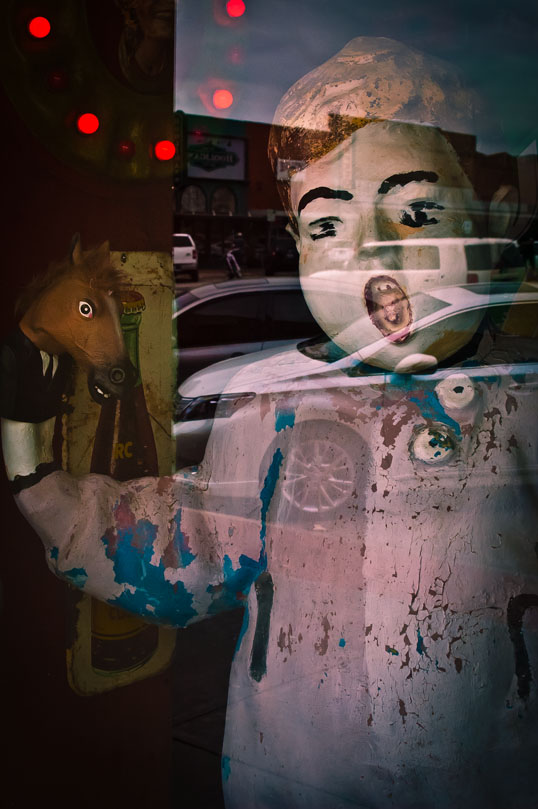
Creepy scene through a shop window, Denton, Texas

Oblique Strategy: Retrace your steps

Why do we all like creepy stuff? I think it is because to be scared of something creepy – which means odd, eerie, and macabre, without being overtly dangerous – implies that there is at least something else out there. There is something in this world beyond staff meetings, stuck in traffic, and idiotic talking heads blathering on the television.

Because if there is really nothing else – that is really frightening.

Seven in Seven

Where are we going? Life, the timeless, mysterious gift, is still evolving. What wonders, or terrors, does evolution hold in store for us in the next ten thousand years? In a million? In six million? Perhaps the answer lies in this old house in this old and misty valley…
—-Control Voice, The Outer Limits, The Sixth Finger

Oblique Strategy: Use Fewer Notes

I am not a fan of internet memes, challenges, viral videos, cat images, or Rick Ashtley.

However, when I was invited to do the “Seven ‘Days, Seven Black and White Photos” on Facebook, I decided to do the thing.

Because I wanted to.

Day 1

Day 2

Day 3

Day 4

Day 5

Day 6

Day 7

A Full Moon, Gravel, and S’mores

“Great artists make the roads; good teachers and good companions can point them out. But there ain’t no free rides, baby. No hitchhiking. And if you want to strike out in any new direction — you go alone. With a machete in your hand and the fear of God in your heart.”
― Ursula K. Le Guin, The Language of the Night: Essays on Fantasy and Science Fiction

The moon rising over cyclists and the Dallas skyline. From the October Full Moon Ride. (click to enlarge)

Oblique Strategy: Assemble some of the elements in a group and treat the group

The moon rising over the Dallas skyline and the pond at Trammell Crow Park. From the October Full Moon Ride.

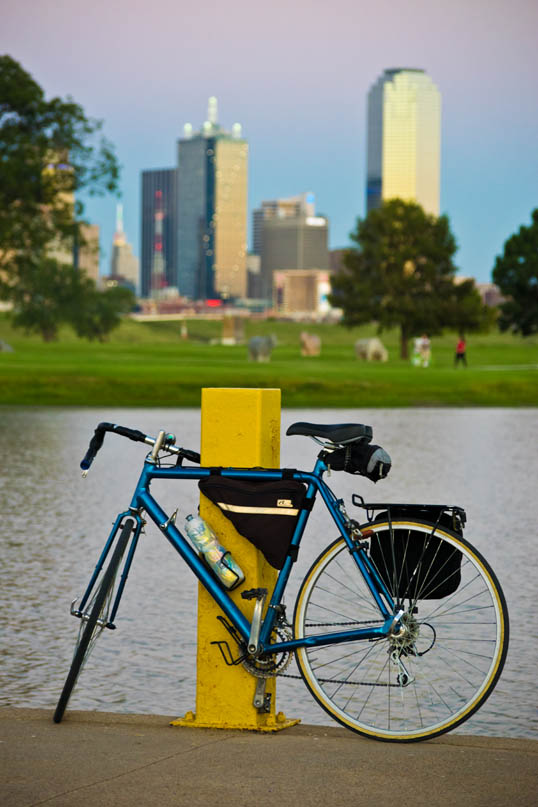
My Cannondale road bike at Trammell Crow Park. From an early part of the October Full Moon Ride.

There is a monthly bike ride held at dusk on the first day of each full moon. It starts in a park in Downtown Dallas and heads out into the wilds of the Trinity River Bottoms where we can watch the moon rise over the city.

I had a blast on the October ride and was looking forward to the next one. It was a little more ambitious. We would head out on the gravel roads that line the levees along the river. Because of the crushed rock, I wouldn’t be able to ride my vintage Cannondale and would have to use my heavy, fat-tired commuter/cargo bike.

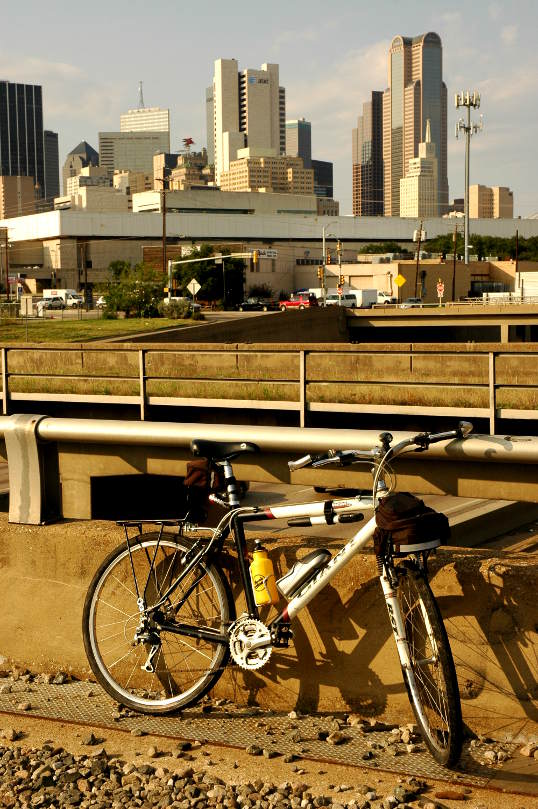
My heavy Commuter Bike with Dallas skyline in the background

We would ride ten miles to an abandoned golf course where we would have a campfire and make s’mores before riding back. I was a bit concerned – twenty miles, much of it off-road, is a long way for me to ride on my heavy, thick tired repurposed mountain bike. Despite all my despirte fanfaronade I am the world’s slowest bicycle rider, especially on an inefficient vehicle. Even riding the best of bicycles – the engine is old and worn out.

I rode the DART train downtown, as the sun was setting, met up with about a dozen folks, and set out. The gravel wasn’t too bad, but it was jarring and a job to control the handlebars, especially in the dark. I have a good headlight on my bike and the world was reduced to a pool of small rocks moving toward me while all around was invisible, inky blackness. It was fun. I slowed to the back of the pack and realized that if I cut my speed a little bit the ride became smoother.

The gravel road in the Trinity River Bottoms
(click to enlarge)

So, I was slow, but not too much. There is a bridge about every mile through the river bottoms and we would stop so everyone could catch up. We made our destination on time, and the s’mores were delicious.

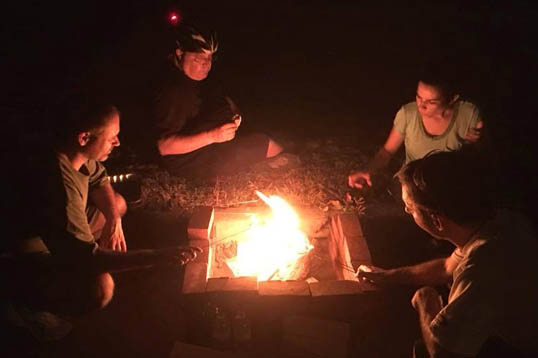
Roasting marshmallows for s’mores. (Photo from Bike Friendly Downtown Dallas)

The only hitch was that I didn’t get any photos. I had brought my camera, a small Gorillapod, and a remote shutter release. I spent too much time having fun, and had to rush setting up my camera. I put the tripod on an old air conditioning unit, and before I could shoot, the release fob slipped out of my hand and disappeared inside. I took that as an omen, and packed it all back up.

We rode concrete back – by then the traffic was light. Only when we neared the American Airlines Center (the Dallas Stars were playing hockey and the game let out at the same time we passed) did we run into angry, aggressive drivers.

So, now I’m looking forward to next month. I need to put my nighttime photographic, time exposure kit together and practice, so I’ll be ready.

Fear the Futuro

“When did the future switch from being a promise to being a threat?”
― Chuck Palahniuk, Invisible Monsters

Oblique Strategy: What are the sections sections of? Imagine a caterpillar moving

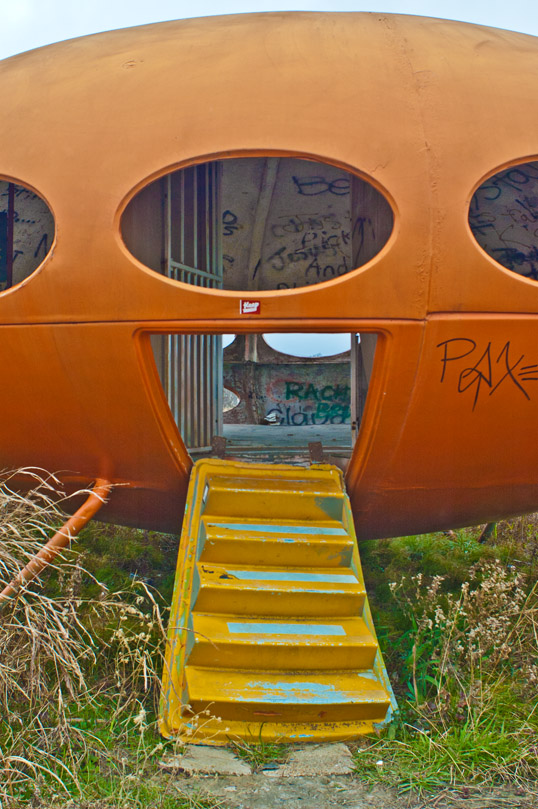
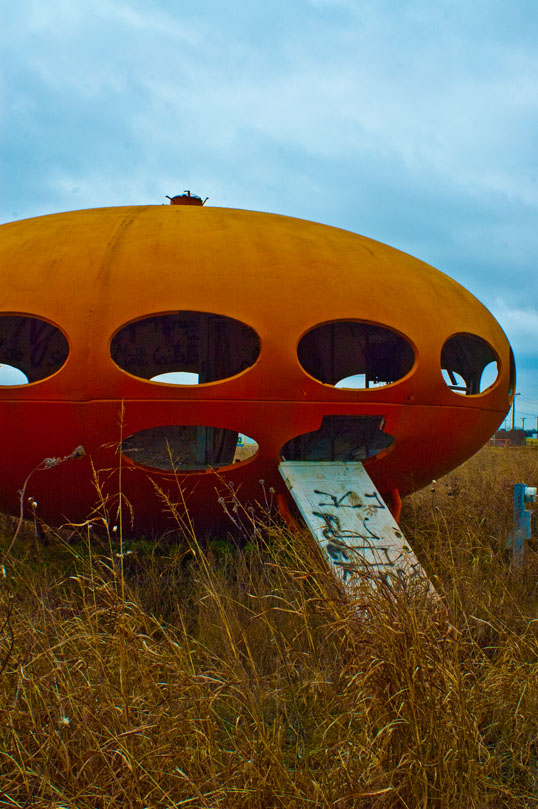
The Futuro House

Futuro House, Royse City, Texas

How the Futuro House came to Royse City

Futuro House, Royse City, Texas

There is so much out there, great and small – along the highways or off small country roads, or along rugged trails. What must be in the unreachable, unvisited, unexplored tracts?

It really doesn’t matter because so few people stop, anyway.