Clover Street

Clover Street, Deep Ellum, Dallas, Texas

Clover Street, Deep Ellum, Dallas, Texas

This looks like a back alley somewhere, but it is actually a street – with a name and signs and everything. It is Clover Street, in Deep Ellum, Dallas, Texas.

Although it is little known outside Dallas, Deep Ellum has a long and illustrious, often infamous, history. The rise and development of today’s music owes as much to Deep Ellum as it does to New Orleans, Chicago, California, or Nashville.

Riding my bicycle down Clover Street I see these old steel rails rise up for a couple blocks before disappearing back below the tarmac and concrete. What story do they tell? Was there a streetcar line running down a narrow lane? Or were the buildings factories and the rail line built to bring in raw materials and to haul out product?

That was probably it. Looking at Googlemaps, Clover starts at Trunk Avenue (a railroad name, of course), runs down and ends behind the Adams Hats Lofts. These are urban living spaces converted from an old hat company. But the building’s original use, built in 1914, was one of Henry Ford’s original assembly plants for the Model T.

So you can imagine trainloads of parts going down that line a hundred years ago, and completed automobiles rolling back out to all over everywhere. These would be any color you wanted… as long as it was black.

Blacksmith Shop and a Decorative Knot

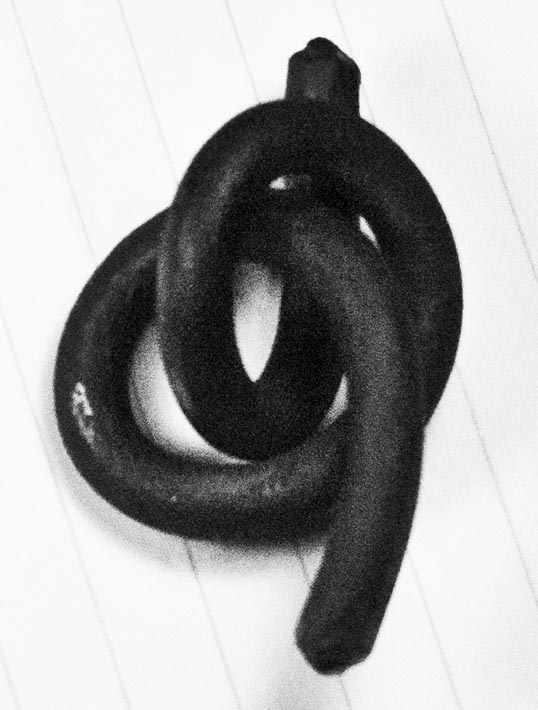
Decorative Knot, made by a blacksmith at Frisco Heritage Museum, Frisco, Texas

Decorative Knot, made by a blacksmith at Frisco Heritage Museum, Frisco, Texas

Last Sunday I made the long drive up north to Frisco. A friend of mine had told me about an open house at the Frisco Heritage Museum and Village. All the historical buildings would be open to the public. It sounded like a bit of fun, so I was there.

As I walked out of the Railroad Station I heard a series of loud metallic clangs. I turned toward the sound and there was a shower of orange sparks from a healthy flame sprouting up in the darkness of a metal shed. I recognized these as the telltale signs of a Blacksmith at work.

I walked down there and settled in, talking to the smithy at work. He was forging square nails by heating and pounding iron rods. He took special pride in his work, talking about how he had placed in some recent blacksmithing contests. Someone asked him about taking lessons and he said that Brookhaven college has a number of blacksmithing courses. After a couple of nails, he said he was done, and went over to sit down. A younger man came into the shop and began to set up his work.

“That’s one guy that learned at Brookhaven,” the original smithy said.

I walked out to see the rest of the buildings on display – the church was especially cool. Then I returned to see what the new guy was doing.

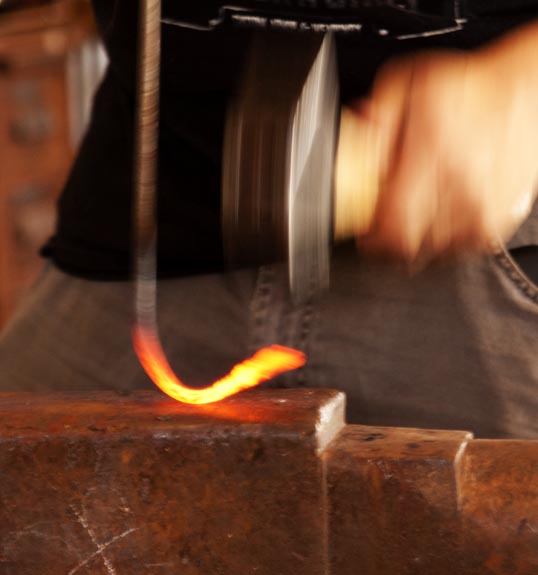
“I’m making decorative knots,” he said. He was heating rods, then bending them into a series of small loops. Finally he’d cut the knot off… and start on another. It was mostly practice in heating, forging, and bending metal – but it was pretty interesting.

He cooled one knot off in a wooden bucket of water and handed it to me. “Here’s a souvenir,” he said.

For some reason, I really like the thing.

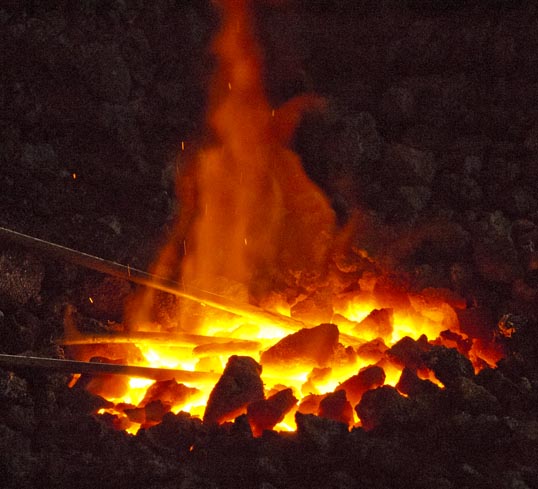
Blacksmith fire from coal and coke. You can see a knot heating in the lower left.

Blacksmith fire from coal and coke. You can see a knot heating in the lower left.

Hammering a heated knot.

Hammering a heated knot.

Hammering a heated knot.

Hammering a heated knot.

The blacksmiths sitting around, talking shop.

The blacksmiths sitting around, talking shop.

Coal and coke fire, Frisco, Texas.

Coal and coke fire, Frisco, Texas. They explained how if you put too many of those irons in there, you would lose the one you needed to work on – thus – “too many irons in the fire.”

Decorative Knot, made by a blacksmith at Frisco Heritage Museum, Frisco, Texas

Decorative Knot, made by a blacksmith at Frisco Heritage Museum, Frisco, Texas

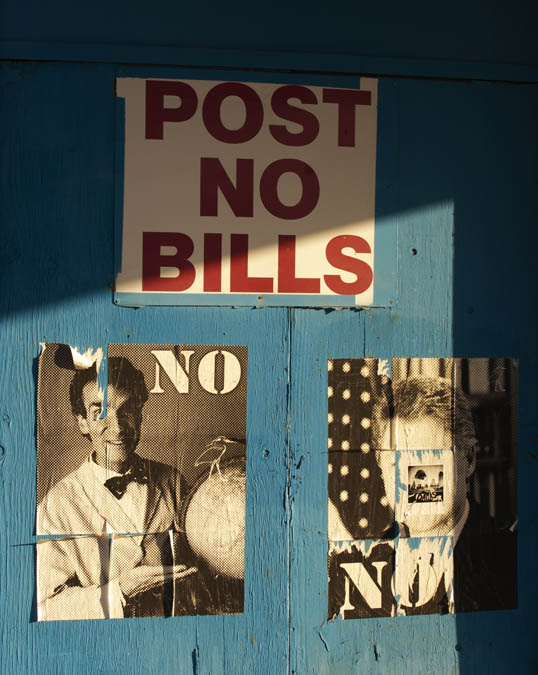
Post No Bills

Deep Ellum
Dallas, Texas

Deep Ellum, Dallas, Texas

Deep Ellum, Dallas, Texas

Deep Ellum, Dallas, Texas

Deep Ellum, Dallas, Texas

Joanie on a Pony

New Orleans, Louisiana

New Orleans, Louisiana

New Orleans, Louisiana

joanie2

More Murals

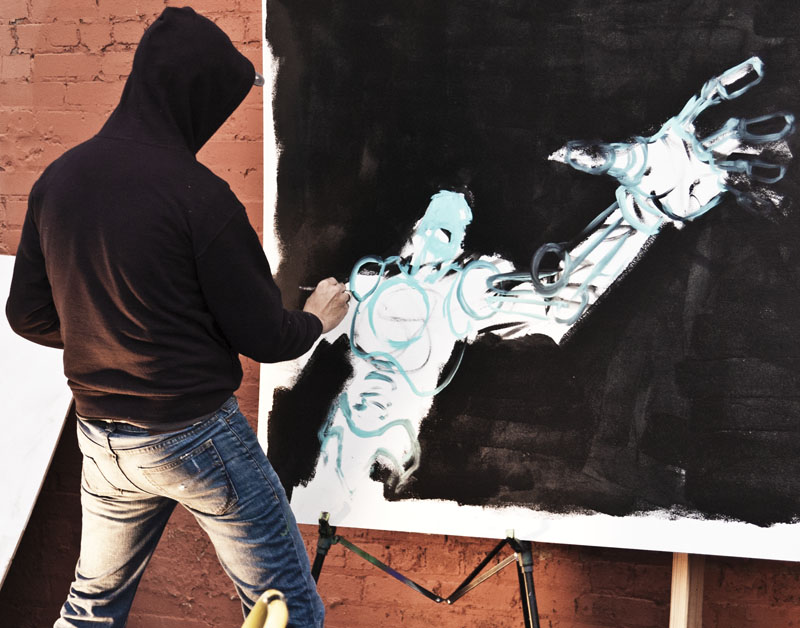
Artists at work
More entries in the Tunnelvisions mural contest
Deep Ellum Arts Festival
Dallas, Texas

Deep Ellum Arts Festival, Dallas, Texas (click to enlarge)

Deep Ellum Arts Festival, Dallas, Texas
(click to enlarge)

Deep Ellum Arts Festival, Dallas, Texas

Deep Ellum Arts Festival, Dallas, Texas

Tintype

This last weekend, at the Cobra Brewing Company event, there was a complex apparatus set up in one corner of the brewery. Scott M Hilton of Camera~Absurda was there taking tintype photographs on-site of the contestants in the beard contest.

The process was interesting to everyone – but to me; professional chemist, wannabee photog, enthusiast of the obsolescent, devotee of the unusual, and aficionado of the useless – it was irresistible. What an amazing collection of toxic chemicals, explosive reagents, antiquated equipment, and bright lights.

We were there early enough to be able to talk about the process before the crowd became too thick (though I’m guessing here about the exact chemicals used). They start out with a small aluminum plate and coat it with a collodion (basically gun cotton dissolved in ether – not too safe) solution and silver nitrate. That is exposed with a bright light in a camera.

They were using a powerful electronic strobe. I asked him why he didn’t go whole-hog authentic and use a tray full of flash powder. The reply was, “There are plenty of dangerous chemicals involved already, no need to add more hazard.”

Some magic is done inside a light-proof booth and then the print is developed in an acid solution. That’s the most amazing part, watching the image appear from a frosty cloud. In the age when this process was current, it would have appeared to be magic. Today, it’s still pretty damn amazing. The image is fixed (probably in a cyanide solution of some kind) coated and done.

The image is a prime positive on a metal plate – the image is therefore reversed. The tonality of the print is amazing. There is something about the contrast, tint, the detail, and the lack of grain that gives it an aura of primordial beauty. The portraits have that ancient dignity that you always see in historical photographs. I always assumed that people have changed – but it seems that is is only their snapshots.

There is no dignity in digital.

Here are the photos they took at the Cobra Brewing Event.

A guy standing next to me happened to work at Texas Instruments (on the same campus where I work for… somebody else) and we discussed the similarity of what the photographers were doing and modern semiconductor manufacturing. We speculated what we could do with metal plates and some sophisticated photoetch solutions.

One interesting thing was that the photographers were having the beard contestants sign a model release so that they could use their images in their projects. Instead of ink on paper they were signing an electronic release by swiping across an iPhone screen. If someone wanted to buy a print – they used a Square to swipe a credit card. Here you were using the most modern of wireless portable e-commerce machinery to facilitate the work of taking tintype photographs with technology out-of-date a hundred years ago.

The contrast was palpable.

The camera is focused with the ground glass

The camera is focused with the ground glass

A big electronic flash is used for the exposure.

A big electronic flash is used for the exposure.

Adjusting everything takes a lot of work.

Adjusting everything takes a lot of work.

Some sort of photographic chemical wizardry - kept from mortal eyes.

Some sort of photographic chemical wizardry – kept from mortal eyes.

The plate goes into the acid bath.
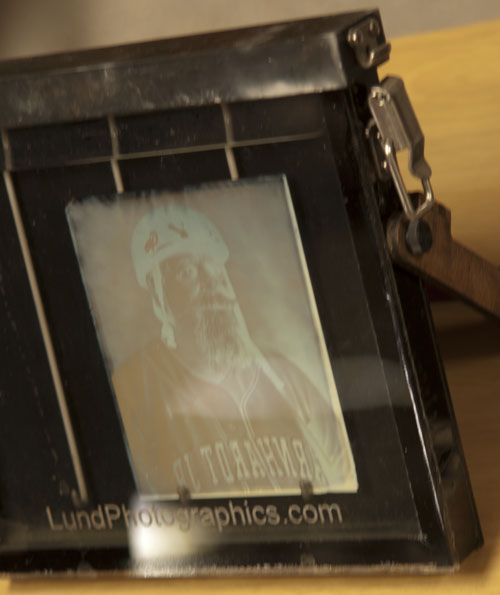
The plate goes into the acid bath.

Everything goes cloudy.

Everything goes cloudy.

And the final image emerges. Notice that it is reversed.

And the final image emerges. Notice that it is reversed.
Blur

There is more to life than increasing its speed.

—-Mahatma Gandhi

Superdrome, Frisco, Texas

Superdrome, Frisco, Texas

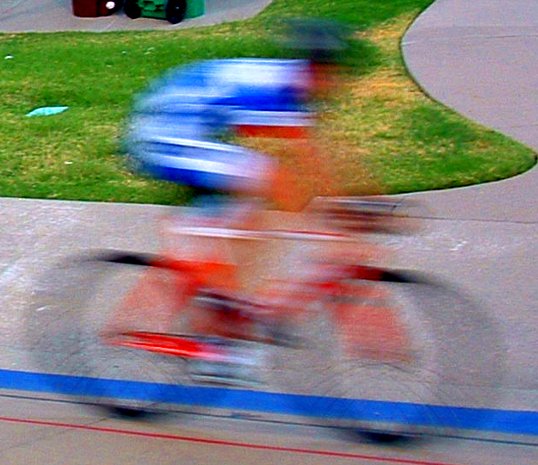
Maybe there is, maybe there isn’t. At least there is the fact that once you increase its speed past a certain point, all is a blur. There is a comforting mystery in a blur. Like a hummingbird’s wing – you can forget the delicacy and fragility… seduced and confused by the motion.

An object in motion tends to move out of the frame. Unless you manage to move the frame. Maybe the world deserves to be smeared across the concrete. It is softened but also obscured. Detail disappear; unseen patterns emerge. Is the truth better seen unfocused?

But who wants a clouded truth?

Dead End

Frisco, Texas

“Quite possibly there’s nothing as fine as a big freight train starting across country in early summer, Hardesty thought. That’s when you learn that the tragedy of plants is that they have roots.”
― Mark Helprin, Winter’s Tale

(click to enlarge)

(click to enlarge)

“Swerve me? ye cannot swerve me, else ye swerve yourselves! man has ye there. Swerve me? The path to my fixed purpose is laid with iron rails, whereon my soul is grooved to run. Over unsounded gorges, through the rifled hearts of mountains, under torrents’ beds, unerringly I rush! Naught’s an obstacle, naught’s an angle to the iron way!”
-Herman Melville, Moby Dick

(click to enlarge)

(click to enlarge)

“The train bore me away, through the monstrous scenery of slag-heaps, chimneys, piled scrap-iron, foul canals, paths of cindery mud criss-crossed by the prints of clogs. This was March, but the weather had been horribly cold and everywhere there were mounds of blackened snow. As we moved slowly through the outskirts of the town we passed row after row of little grey slum houses running at right angles to the embankment. At the back of one of the houses a young woman was kneeling on the stones, poking a stick up the leaden waste-pipe which ran from the sink inside and which I suppose was blocked. I had time to see everything about her—her sacking apron, her clumsy clogs, her arms reddened by the cold. She looked up as the train passed, and I was almost near enough to catch her eye. She had a round pale face, the usual exhausted face of the slum girl who is twenty-five and looks forty, thanks to miscarriages and drudgery; and it wore, for the second in which I saw it, the most desolate, hopeless expression I have ever-seen. It struck me then that we are mistaken when we say that ‘It isn’t the same for them as it would be for us,’ and that people bred in the slums can imagine nothing but the slums. For what I saw in her face was not the ignorant suffering of an animal. She knew well enough what was happening to her—understood as well as I did how dreadful a destiny it was to be kneeling there in the bitter cold, on the slimy stones of a slum backyard, poking a stick up a foul drain-pipe.”
― George Orwell, The Road to Wigan Pier