“America has only three cities: New York, San Francisco, and New Orleans.
Everywhere else is Cleveland.”
—-Tennessee Williams
Fish on the sidewalk, Governor Nichols Street New Orleans, Louisiana
Every day I have to select what I will be handwriting for the day. I carry a burlap zippered bag that used to hold five pounds of Basmati Rice that I bought from the local Indian market (a great bag, by the way) and into this bag I put one, two or three journals. I also select a couple of fountain pens, usually of contrasting ink colors, which I put into an Otterbox armored cigar case (two cigars) for protection.
Pens – I usually have about 5 in rotation – I may put a new one into or take one out (clean it of old ink, place it back in storage) rotation.
Things to think about:
Value – Don’t want to carry an expensive pen someplace risky.
Age – The older pens are fragile and won’t carry one if I’m going somewhere active (like on a bike)
Line Width – If I am going to write a lot I’ll want a pen with a narrow line – wider lines are fun for short writing
Ink Color – I like to vary this – for the heck of it
Reliability – how long will I be gone? If more than a short time, I need a reliable pen.
Amount of ink held – again, how much writing?
Journals:
Bullet Journal – go to, usually carry
Idea Journal
Goals Journal
Straightening Journal
Fiction snippets journal
… several others
This has to be done every morning before I leave the house. The rice bag will fit in my work backpack if I’m going to work.
I don’t know how to carry extra ink (bottle, cartridges, syringe?) – need to work on that.
“Leaving New Orleans also frightened me considerably. Outside of the city limits the heart of darkness, the true wasteland begins.”
― John Kennedy Toole, A Confederacy of Dunces
waiting for a parade Nola Brewing New Orleans, Louisiana
“there was something about
that city, though
it didn’t let me feel guilty
that I had no feeling for the
things so many others
needed.
it let me alone.”
― Charles Bukowski
waiting for a parade Nola Brewing New Orleans, Louisiana
“Yes, a dark time passed over this land, but now there is something like light.”
― Dave Eggers, Zeitoun
waiting for a parade Nola Brewing New Orleans, Louisiana
“Times are not good here. The city is crumbling into ashes. It has been buried under taxes and frauds and maladministrations so that it has become a study for archaeologists…but it is better to live here in sackcloth and ashes than to own the whole state of Ohio.”
― Lafcadio Hearn, Inventing New Orleans: Writings of Lafcadio Hearn
“Sometimes life is merely a matter of coffee and whatever intimacy a cup of coffee affords.”
― Richard Brautigan
Everyone I talk to about New Orleans says they went to Cafe du Monde for chicory coffee and beignets. That’s fine if you want to do the touristy thing, I suppose – but there is better coffee and there are much better beignets.
My favorite is the New Orleans Coffee and Beignet Company, in Uptown, off St. Charles, about halfway to Tulane. You’ll never eat beignets on Decatur again.
“The industries were there because of the river. They had come for its navigational convenience and its fresh water. They would not, and could not, linger beside a tidal creek. For nature to take its course was simply unthinkable. The Sixth World War would do less damage to southern Louisiana. Nature, in this place, had become an enemy of the state.”
—-The Control of Nature, Atchafalaya, John McPhee
Levee strengthening, New Orleans, Louisiana
“The Unites States Congress, in its deliberations, decided that ‘the distribution of flow and sediment in the Mississippi and Atchafalaya Rivers is now in desirable proportions and should be so maintained.’ The Corps was thereby ordered to preserve 1950. In perpetuity, at Old River, thirty per cent of the latitude flow was to pass to the Atchafalaya.”
—-The Control of Nature, Atchafalaya, John McPhee
While in New Orleans for Lee’s Tulane Graduation I rode my bicycle to Bayou St. John for the Bayou Boogaloo. There is always a festival going on in The Big Easy and they are always fun. This was a particularly good one.
I bought a beer and found a shady spot on the shore of the Bayou. I sat there chatting with the locals about cycling, music, and aging hippies. We watched the watercraft plying the waves. It was a beautiful day.
A small group of people arrived on the far shore (not very far away) towing something on a trailer. They proceeded to extract a large, homemade barge consisting of a wooden platform with plastic barrels strapped underneath for floatation. We wondered how they were going to launch the ungainly contraption.
The guy had it going on. He directed his motley crew with efficiency and before you could swallow your gumbo they flipped it neatly into the water – using ropes to control the weight.
Then the guy proceeded to start hauling out prefabricated railings, benches, and an umbrella – screwing everything into place with a portable drill. It was an efficient and impressive display of carpentry. He soon had his own portable floating party barge, right in the middle of the bayou.
“Get that guy’s name,” one of the folks sitting next to me said between gulps of Abita Amber and bites of muffuletta. “I need a new deck and that’s the best carpenter I’ve seen in New Orleans.”
As I watched he extracted a full-blown steel anchor and dropped it into the mud at the bottom of the bayou.
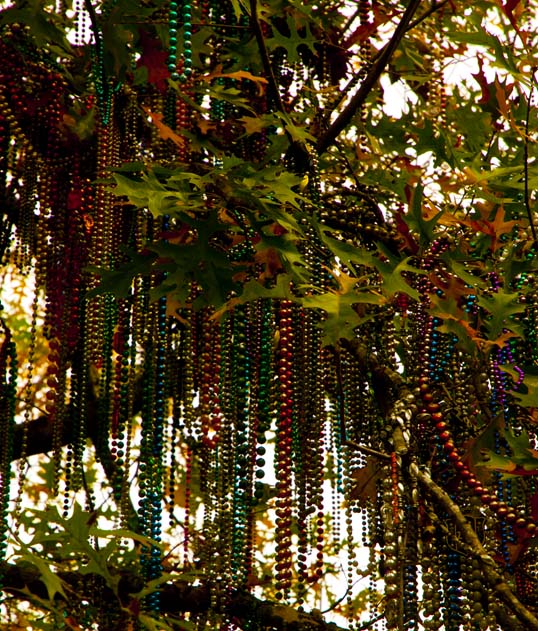
“To encapsulate the notion of Mardi Gras as nothing more than a big drunk is to take the simple and stupid way out, and I, for one, am getting tired of staying stuck on simple and stupid.
Mardi Gras is not a parade. Mardi Gras is not girls flashing on French Quarter balconies. Mardi Gras is not an alcoholic binge.
Mardi Gras is bars and restaurants changing out all the CD’s in their jukeboxes to Professor Longhair and the Neville Brothers, and it is annual front-porch crawfish boils hours before the parades so your stomach and attitude reach a state of grace, and it is returning to the same street corner, year after year, and standing next to the same people, year after year–people whose names you may or may not even know but you’ve watched their kids grow up in this public tableau and when they’re not there, you wonder: Where are those guys this year?
It is dressing your dog in a stupid costume and cheering when the marching bands go crazy and clapping and saluting the military bands when they crisply snap to.
Now that part, more than ever.
It’s mad piano professors converging on our city from all over the world and banging the 88’s until dawn and laughing at the hairy-shouldered men in dresses too tight and stalking the Indians under Claiborne overpass and thrilling the years you find them and lamenting the years you don’t and promising yourself you will next year.
It’s wearing frightful color combination in public and rolling your eyes at the guy in your office who–like clockwork, year after year–denies that he got the baby in the king cake and now someone else has to pony up the ten bucks for the next one.
Mardi Gras is the love of life. It is the harmonic convergence of our food, our music, our creativity, our eccentricity, our neighborhoods, and our joy of living. All at once.”
― Chris Rose, 1 Dead in Attic
Bead Tree, Gibson Quad, Tulane, New Orleans, Louisiana
“I dust a bit…in addition, I am at the moment writing a lengthy indictment against our century. When my brain begins to reel from my literary labors, I make an occasional cheese dip.
~Ignatius J. Reilly”
― John Kennedy Toole, A Confederacy of Dunces
Bead Tree, Gibson Quad, Tulane, New Orleans, Louisiana
“Leaving New Orleans also frightened me considerably. Outside of the city limits the heart of darkness, the true wasteland begins.”
― John Kennedy Toole, A Confederacy of Dunces
While I was going on my little bike ride in New Orleans I made a quick stop on the river side of Audubon Park, next to the Zoo. There is a cool tree there – an ancient (planted circa 1740) and enormous live oak. Locals call it the “Tree of Life” – its official name is the Etienne de Boré Oak. It’s a beautiful spot – very popular for wedding photographs – and was worth a look even on a rainy and overcast cold day.
My commuter bike by the Etienne de Boré Oak – Audubon Park, New Orleans (click to enlarge)
I noticed a work crew with a highlift and a series of ladders working around the tree – laying down plywood for stability in the muddy soil. A van pulled up and discharged a couple of women drinking hot coffee. They walked over to the workmen and began to plan a project.
Walking around, I found a large collection of finely detailed birdhouses. Most were still in a pile off to the side, but a bunch of them had already been hung off the branches, mixed in with the Spanish Moss.
Birdhouses waiting to be installed, Audubon Park, New Orleans (click to enlarge)
Birdhouses in the Tree of Life, Audobon Park, New Orleans (click to enlarge)
Birdhouses in the Tree of Life, Audobon Park, New Orleans (click to enlarge)
It was pretty cool – I wished that I could stay and see them all hung up there – but I had places to be so I peddled on.
If you have the open mind, patience, and spirit of exploration there are few things as fun as watching a city bloom. It doesn’t happen everywhere, all at once, but springs from many tiny seeds – all over the place – especially where you least expect it.
All these cool places spring up. I’ve been watching it here in Dallas for years. Sometimes it’s in a spot where I remember fast times from long ago and sadly watched fade until a miraculous Renaissance appears – places like Deep Ellum or Lower Greenville. Or maybe its an area that has never been hip – or at least has been forgotten for generations – like Bishop Arts, or The Cedars. It may be an area conceived in high places and supported by big money like the Dallas Arts District or Uptown. Or it may be someplace bootstraping itself up out of a blasted industrial wasteland like Trinity Groves or the Design District.
Use your internet connection and your feet and your bicycle and get to know these places… before they are too hip and unaffordable. It’s a roller coaster ride and you need to get off before the crash… but in the meantime – it can be a fun ride.
All cities go through ups and downs – but nowhere has higher ups or lower downs than New Orleans. It, more than anywhere else is a city of unique neighborhoods – every one worth exploring, learning, and immersing.
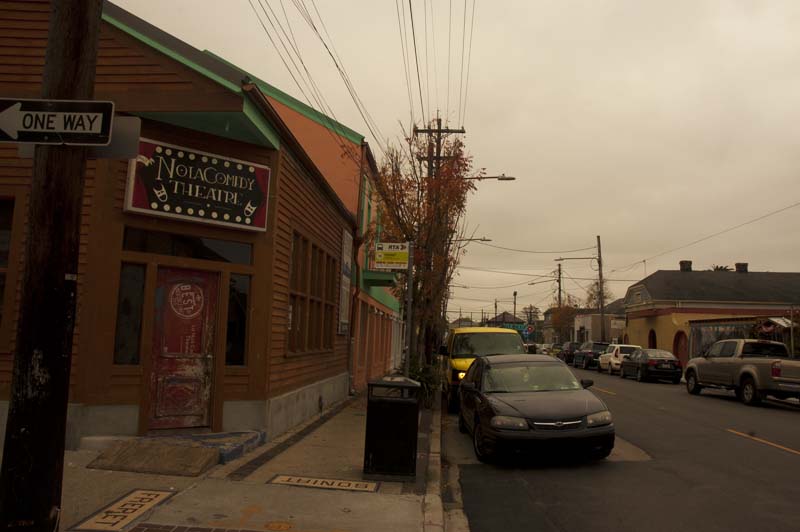
Freret began as a commercial area for people who were left out of New Orleans’ most powerful social groups: the French Creoles, who governed old society, and the wealthy “English” traders and business owners, who dominated the CBD and built their homes in the Garden District. Instead, the neighborhood, named for brothers William and James Freret, became a refuge for Italian and Jewish residents, who shared the commercial district.
But population shifts took place in the 1950s, driving middle class residents to the suburbs, and by the 1980s, when bakery owner Bill Long was shot and killed in the doorway of his store, Freret was disintegrating.
Help came in 2001 when the National Trust for Historic Preservation adopted Freret Street under its Main Street program. Yet, the neighborhood took a body blow from Katrina, whose damage can still be seen, and its comeback never seemed farther away.
But seven years after the storm, Freret is a symbol of the New New Orleans, where a handful of business pioneers and long time stall warts provided the nucleus for its growth to take place. Bars, restaurants, businesses, and a monthly fair have popped up in a few short years, and the sounds of construction resonate as cars and pedestrians ply the bumpy street between Tulane and Loyola Universities.
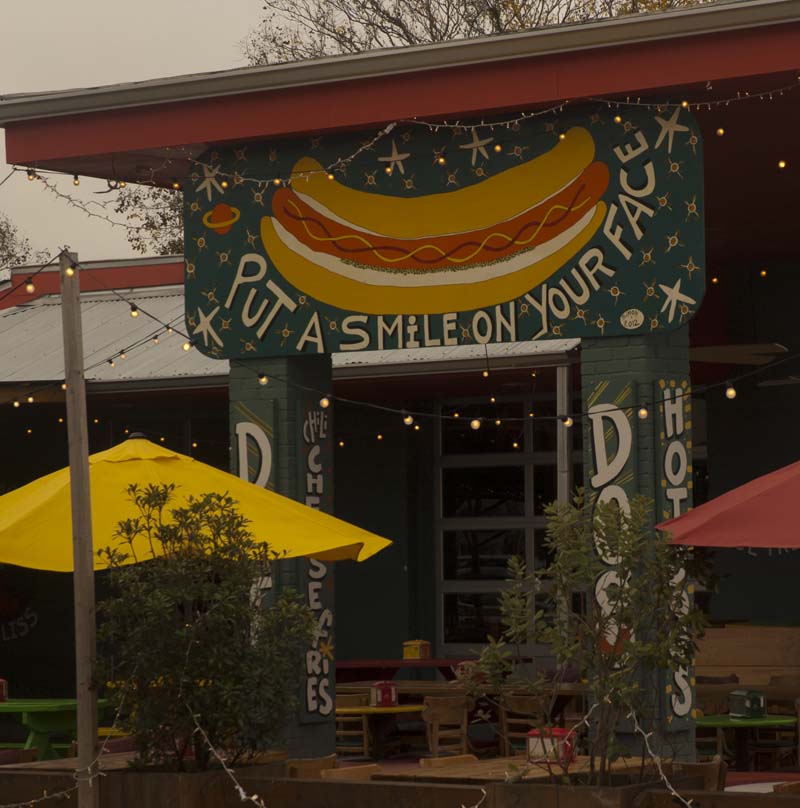
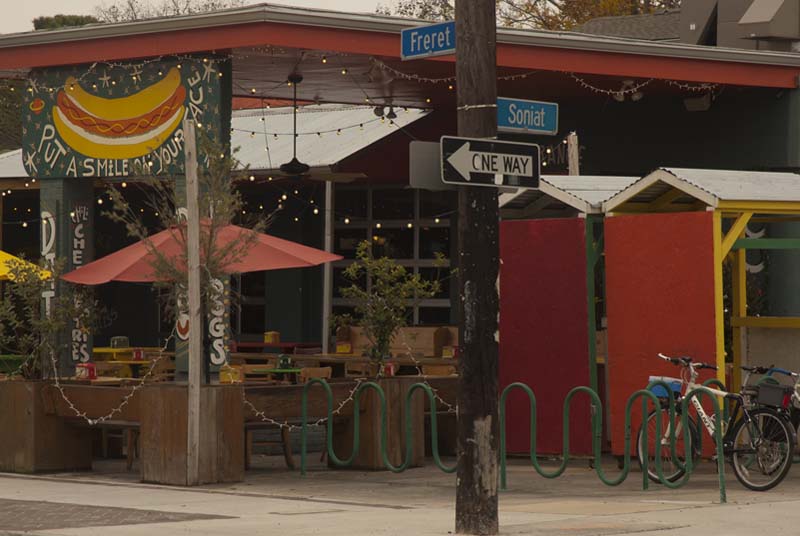
Lee was working and I needed to find some place to eat… and I had seen on Thrillist that a hot dog place called Dat Dog was listed as one of the “Coolest Restaurants in Town.” So I rode my bike down there.
It is a special, cool little stretch of street – it stands out in variety and quality even in a city as full of options like New Orleans. Restaurants, bars, specialty shops – even a couple of small theater spaces… Every night there was a young, hip crowd spilling out onto the sidewalks… and even filling overhead balconies with mirth and conversation.
Unfortunately, I had to settle for an excellent hot dog (local spicy dog, with bacon and sauerkraut – next time I need to be more adventurous on the toppings) before it was time to head back. But if you are looking to get out of the French Quarter (and you should be) Freret might be a place to look for.
Dat Dog, Freret Street, New Orleans (click to enlarge)
“There is darkness inside all of us, though mine is more dangerous than most. Still, we all have it—that part of our soul that is irreparably damaged by the very trials and tribulations of life. We are what we are because of it, or perhaps in spite of it. Some use it as a shield to hide behind, others as an excuse to do unconscionable things. But, truly, the darkness is simply a piece of the whole, neither good nor evil unless you make it so. It took a witch, a war, and a voodoo queen to teach me that.”
― Jenna Maclaine, Bound By Sin
I have been working my way back through some older(er) photographs I have stashed away, intending to process and write something about eventually.
I’m a little disappointed because we had to cancel a vacation trip to New Orleans this October (we simply don’t have the money). I’ve been to the Big Easy many times – for work, for vacation, and because my son goes to college there. Of course, Mardi Gras is something for everyone’s bucket list, but otherwise, I think that Halloween is the best time to visit New Orleans. It’s a party, it’s pretty crazy, but you don’t have the logistical nightmare that Mardi Gras brings.
Last October we went for Tulane’s parent’s weekend and I’ve put up some blog entries from that trip.
In particular, I wrote about a tour we took of one of New Orlean’s famous cemeteries, St. Louis #1. In that blog entry, however, I skipped the most interesting tomb in the place, that of the Voodoo Queen, Marie Laveau.
Saint Louis Cemeter #1, New Orleans
Marie Laveau’s Tomb, the XXX marks are for people that want their wishes granted.
From the plaque attached to her tomb:
This Greek revival tomb is reputed burial ground of notorious “Voodoo Queen” . A mystic cult, Voodooism, of African Origin, was brought to this city from Santo Domingo and flourished in 19th century. Marie Laveau was the most widely known of many practitioners of the cult.
I had heard of Marie Laveau, of course – the first time probably from the the old Redbone song, “Witch Queen of New Orleans” – but didn’t know of any details.
Back in Texas, I checked a book out from the library and found the whole story, the real story to be more complicated than the legend.
First, there were two women we now know as Marie Laveau – mother and daughter. The legends of each are mixed up with the other. New Orleans at that time was a dangerous, tough place to live, especially for a woman of mixed race. The book I read portrayed Marie Laveau as a beautiful, brilliant, ruthless woman that would do what it took to live and prosper in the swirl of difficult times. She cultivated her legend and used it to her advantage – both to rise as a leader in her own culture and as a path to reach, frighten, and dominate the upper crust of New Orleans Society.
She was a well-known hairdresser to all the wealthiest women in the city – and from that vantage point learned everybody’s secrets… and was not afraid to use that to her advantage.
Over the years, her story has grown… but even in the day it was something. From her Obituary in the 1881 New York Times (Read the whole thing):
THE DEAD VOODOO QUEEN
The New York Times
June 23, 1881 MARIE LAVEAU’S PLACE IN THE HISTORY OF NEW ORLEANS The early life of the beautiful young Creole – the prominent men who sought her advice and society – her charitable work – how she became an object of mystery.
New-Orleans, Jun 21 – Marie Laveau, the “Queen of the Voudous” died last Wednesday at the advanced age of 98 years. To the superstitious Creoles Marie appeared as a dealer in the black arts and a person to be dreaded and avoided. Strange stories were told of the rites performed by the sect of which Marie was the acknowledged sovereign. Many old residents asserted that on St. John’s night, the 24th of June, the Voudou clan had been seen in deserted places joining in wild, weird dances, all the participants in which were perfectly nude. The Voudous were thought to be invested with supernatural powers, and men sought them to find means to be rid of their enemies, while others asked for love powders to instill affection into the bosoms of their unwilling or unsuspecting sweethearts. Whether there ever was any such sect, and whether Marie was ever its Queen, her life was one to render such a belief possible. Besides knowing the secret healing qualities of the various herbs that grow in abundance in the woods and fields, she was endowed with more than the usual share of common sense, and her advice was oft-times really valuable and her penetration remarkable. Adding to these qualities the gift of great beauty, no wonder that she possessed a large influence in her youth and attracted the attention of Louisiana’s greatest men and most distinguished visitors. She was the creature of that peculiar state of society in which there was no marrying or giving in marriage; yet they were not like the angels in heaven.
……
Marie Laveau, one of the most wonderful women who ever lived, passed peaceably away. Her daughter Mme. Philomel Legendre, the only survivor of all Capt. Glapion’s children, who possessed many of the characteristics of her mother, Mme. Legendre two pretty daughters, ministered to the old lady’s last wants. She died without a struggle, with a smile lighting up her shriveled features. She was interred in her family tomb, by the side of Capt. Glapion. In the old St. Louis Cemetery, and with her is buried the most thrilling portion of the unwritten records of Louisiana. Although Marie Laveau’s history has been very much sought after, it has never been published. Cable has endeavored to portray her in the character of Palmyre in his novel of the “Grandissimes.” The secrets of her life, however, could only be obtained from the old lady herself, but she would never tell the smallest part of what she knew, and now her lips are closed forever and, as she could neither read nor write, not a scrap is left to chronicle the events of her exciting life.
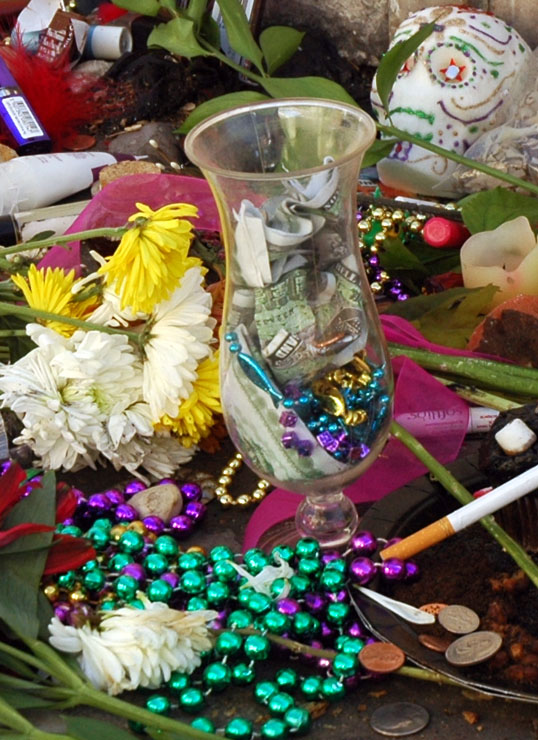
We were seeing her (purported) tomb on the day after Halloween, and it was obvious there had been many visitors the day before. Not only was the crypt freshly festooned with a thick collection of triple XXXs (if you scratch three Xs into the stone, your wish will be granted) but there was a healthy pile of offerings to the Voodoo Queen piled up at the foot of the crypt. Empty liquor bottles, Mardi Gras Beads, money, hotel key cards, cigarettes, candles, plastic skulls, flowers, apples, golf balls, lipsticks, travel sized shampoo, partially unwrapped (but unbit) candy bars… on and on.
It was such a motley assortment – I can only guess at the desperate desires of some of the people that left the stuff behind – what is it that they need? Or want?
I hope that the Voodoo Queen’s spirit has enough Mojo left to help at least some of them… at least a little bit.
Halloween Offerings at Marie Laveau’s tomb. New Orleans. (click to enlarge)
Halloween Offerings at Marie Laveau’s tomb. New Orleans.
Marie Laveau’s Tomb
Offerings to Marie Laveau
“The Earth is beautiful, and bright, and kindly, but that is not all. The Earth is also terrible, and dark, and cruel. The rabbit shrieks dying in the green meadows. The mountains clench their great hands full of hidden fire. There are sharks in the sea, and there is cruelty in men’s eyes.”
― Ursula K. Le Guin, The Tombs of Atuan










 Bill Chance