Brewery Ride

I been warped by the rain, driven by the snow
I’m drunk and dirty don’t ya know, and I’m still, willin’
Out on the road late at night, Seen my pretty Alice in every head light
Alice, Dallas Alice
—- Willin’ – by Lowell George

There was an event scheduled this Sunday that I had been really looking forward to. It was a bike ride, organized by the good folks at Bike Friendly Oak Cliff that started at the Klyde Warren Park in Downtown Dallas and went to tastings at a couple of local breweries, ending up at The Foundry/Chicken Scratch in West Dallas.

These local craft microbreweries are cropping up all over town. Dallas may be a bit behind the curve, but when it does something, it does it seriously. The Brewery Tours are very popular – you go to the place, pay a small fee, get a glass, sample beer. There is often live music, and there are always a bunch of cool people. I’ve been to Deep Ellum Brewery for their tours a few times… but this was the first one on a bicycle… with a bunch of people.

The day promised to be one of those preternaturally warm Texas Winter Weekend Afternoons – whick was perfect. My plan was to ride downtown to the park, twenty five miles or so, and then pick up the folks there. I futzed around a bit and left later than I intended, plus there was a strong wind from the south and I realized I would have to pedal hard to get there on time.

As my route passed near the Spring Valley DART station, I decided that I wanted to have fun today and riding against a deadline is not what I wanted so I hopped on the train downtown. I waited on the platform on the little rise in the pavement – knowing that was where the doors to the center car would open. These cars are tall and open – few seats – designed for wheelchairs, strollers, and bicycles. There are two hooks for hanging bikes – it works pretty well.

When the train pulled in and the doors opened I saw the car was packed. There were a half-dozen bicycles (and three strollers) jammed in there. Everybody shoved back as far as they could and I squeezed in for the ride downtown.

The crowd of bicyclists grew at Klyde Warren park until it was time for everyone to haul out down Harwood street. I’m estimating about a hundred and fifty riders packed past the Art Museum and down Ross to the West End, then turning north through Victory and under I35 into the design district.

Riding along Harwood – The Nasher on the left, Dallas Museum of Art on the right

Everybody stacked their bikes up and went into the first brewery, Community Beer Company. A big, shiny new facility, it has only been open a few weeks. They were sampling a couple of beers – a Vienna Lager and a Pale Ale. Both were very good – the ale had more bite, the lager was very smooth. We milled around, talked beer, talked bikes, talked routes (especially how to get home). The Community folks were really nice, their facility looked great, and I hope they have a long and successful run in the city.

Another brewery to go, we saddled up and headed across the Trinity River on the old Continental Viaduct next to the Calatrava Bridge. The Continental span is supposed to be redone as a park – hopefully with a good bike/pedestrian path (there is a lot of controversy on this – the Trinity remains a tough cross on a bicycle).

It is a blast to ride in the city in a group of over a hundred bicycles. Scouts shoot ahead and temper the traffic at intersections so the pack can go through. It might anger a driver or two – but we were moving quickly on streets that don’t get much use on a Sunday and the cars didn’t have to wait long.

The views of a city are so cool on a bike. I still haven’t worked out a way to take pictures while riding – especially in a pack like this (it’s easy riding, but you have to pay close attention to the bikes all around you). That’s just as well, it helps me enjoy my day.

Over the river and down into West Dallas. This is a part of town that nobody dared venture into a few years ago – now it’s hip and rapidly coming into its own from The Belmont to Bishop Arts and beyond. Right at the end of the Calatrava span sits Four Corners Brewing – another craft brewery that offers tours, live music, and food trucks. They’ve been around a bit longer and offer a big selection and cool graphics. A fun place.

I had a dark porter and a red ale – both excellent.

It was cool to look around at all the bikes. There were so many different kinds of pedalled transport – from expensive carbon fiber road bikes to fixies to a Brompton folder. Most common was probably beat up old mountain bikes converted into tough urban commuters – which is exactly what I building up at home. My ancient Raleigh Technium “vintage” (there is a thin line between vintage and old/cheap/poor) bike worked great, but the roads are a bit rough in a few places (when I made it home I discovered I had broken a spoke).

After an hour or so at Four Corners everybody split up. Most folks headed back over the bridge to Fair Park and a final stop a Craft and Growler and on home – but Candy was waiting at The Foundry/Chicken Scratch, where the riders from Oak Cliff were mostly headed to get something to eat.

The jam session group that plays on Sunday were at The Foundry, so we were able to get something to eat and listen to some music before packing my bike in the trunk for the drive home.

All in all, a pretty good day.
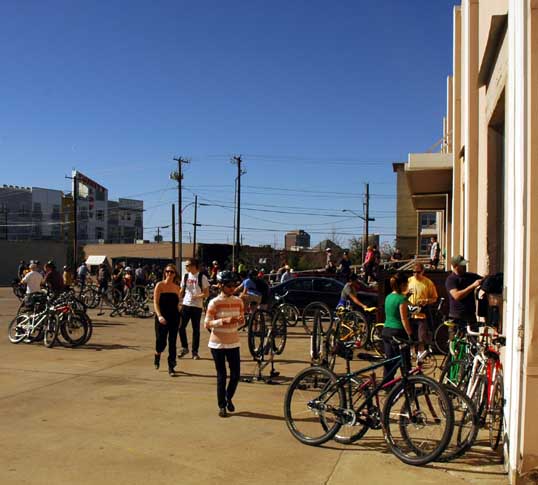
Image

Outside Community Beer Company… a lot of bikes.

Image

Pouring beer at Community

Image

Arriving at the Community Beer Company, with the Dallas Skyline in the background

An Article about the ride – Craft beer scene spawns bike and bus brewery tours in North Texas

What I learned this week, February 15, 2013


I re-watched this and noticed that Candy and I walked in back of the Tattoo guy at 5:58. It’s pretty odd when you watch a youtube video you like and notice that you are in it. This isn’t the first time.


50 Sure Signs That Texas Is Actually Utopia

Texas is the best place on Earth, and real humble about it to boot. Here are 50 of the 10,000 things that make it special.


The 30 Best Dwight Schrute Quotes


Inside the Battle of Hoth

From a military perspective, Hoth should have been a total debacle for the Rebel Alliance. Overconfident that they can evade Imperial surveillance, they hole up on unforgiving frigid terrain at the far end of the cosmos. Huddled into the lone Echo Base are all their major players: politically crucial Princess Leia; ace pilot Han Solo; and their game-changer, Luke Skywalker, who isn’t even a Jedi yet. . . . When Vader enters the Hoth System with the Imperial Fleet, he’s holding a winning hand. What follows next is a reminder of two military truths that apply in our own time and in our own galaxy: Don’t place unaccountable religious fanatics in wartime command, and never underestimate a hegemonic power’s ability to miscalculate against an insurgency.

From the Comments:

Have you even served with the Imperial forces? Sure it’s easy to take potshots from your military blog in some no-name star system while the fleet and its legions fight the rebel insurgents, but combined space/air/ground operations are a lot messier than any infographic could ever portray.

Even with the Empire’s full spectrum dominance of the battlespace, you can’t just leverage fleet assets which are optimized for ship-to-ship combat into a large scale ground invasion force. A Star Destroyer might have more firepower than the entire militaries of less advanced worlds but you still need a proper ground assault ship to support infantry landings.

Unfortunately, the do-nothing blowhards in Coruscant couldn’t get funding for the promising alternative designs from Sienar Fleet Systems and we ended up (as usual) with Kuat Drive Yards’ overpriced, overdue, and underperforming AT-AT mess.

Camera and Film

I noticed, while milling around the Bishop Arts District before the Mardi Gras Parade, a little piece of cardboard box down an alley, with two disposable cameras sitting on it.

Camera in the wild.

Camera in the wild.

The box said:

I may not have mega-pixels
But I’m still pretty awesome
Facebooke.com/camera.bishop.arts

I thought about grabbing a camera and taking a shot, but hesitated and some other folks grabbed it first. You snooze, you lose. The idea of leaving a cheap film camera sitting around for people to use is pretty cool….

And now the pictures from the Mardi Gras Parade are up on the facebook page.

As far as the note goes… I have no idea about the misspelled URL.

I’ll keep checking back though, see what develops.

Black Swallows the Red

“There is only one thing I fear in life, my friend: One day, the black will swallow the red.” – John Logan, from Red

Red

It was time for another “Pay What You Can” night at Dallas Theater Center’s Wyly theater. I have seen King Lear and The Elaborate Entrance of Chad Deity at rock-bottom prices and now watch the web site for any new opportunities.

This go-round is the Tony Award winning play Red, by John Logan. It’s a two man play based on the artist Mark Rothko, set in Rothko’s studio in 1958, during the time he is working on a group of large murals for the new Four Seasons Restaurant in the Seagram Building in New York. Rothko and his fictional assistant, Ken, work and talk about art and life. The overarching conflict between the two is the very acceptance of the commission to decorate the walls of a restaurant frequented by the wealthiest people in the world. Rothko insists it is a subversive act, that he wants to paint, “something that will ruin the appetite of every son-of-a-bitch who ever eats in that room.” Ken counters that Rothko simply wants to feed his ego with the money and fame the prestigious commission offers.

At any rate, I was going alone, and went to catch the train downtown. Since I left from work, I felt underdressed – but that was fine; the crowd for “Pay What You Can” night was motley and wearing all sorts of styles at various levels.

I was interested in the staging of Red. King Lear is still running at the Wyly in the main stage above the lobby (the Wyly is revolutionary in its stacked structure – the lobby is at the bottom, the stage area above, with the support spaces higher up). For Red, they converted the rehearsal hall on the ninth floor into an artist’s studio.

While the patrons attending Lear were entering on the right side of the Lobby, we were divided into groups and sent up elevators to the ninth floor. The tickets had no seat assignments, so the crowd wandered around the edges of the studio, finding chairs lined against the wall on low risers. After I settled in, I noticed the actor playing Rothko silently sitting in a comfortable chair in the center of the room, staring and contemplating one of his in-progress color fields. Finally, the last patron came in looking around, looking lost – I noted his clothing was curiously dated… like something out of the fifties. Suddenly I realized that this was the actor playing the assistant, he spoke to Rothko, and the play began.

The play was simple – only two characters, one set, no intermission. Very intimate – you are there in the studio with the two characters. It was more intellectual than passionate – the only real moments of raw emotion was generated by Ken talking about the death of his parents… and that felt a bit forced. Still, it was enjoyable – the character of Rothko is a grand pompous bully – and a brilliant one. Ken was more of a blank canvass where Rothko would paint with his powerful personality and stubborn ideas, but Ken’s point of view somehow kept winning out in the end.

One highlight was a long, wordless passage where Rothko and Ken together slather the dark crimson undertone on a giant canvas, both working hard, slinging heavy brushfulls of paint in different sections of the wall-sized work, their breathing hard and passionate in the small space. To Rothko his paintings are living things… and he feels responsible for and concerned about their ultimate fate.

There is a lot of talk of the art of the time. It was fascinating how Rothko boasted of how he and the abstract expressionists dethroned Picasso and Matisse (“Nobody even thinks of painting cubism anymore, it’s dead”) and how Ken feels that Pop Art is now overthrowing Rothko.

Ken namedrops Warhol, Johns, Rauschenberg, and Lichtenstein – and Rothko asks, “Lichtenstein, who’s that?”

I was happy when, in my mind I thought, “Comic Books,” and then Ken says, “Comic Books.”

There is a lot of namedropping here, and it helps to know a thing or two about a thing or two – but not so much that it gets in the way of the entertainment.

After the play we rode the elevators back down to the lobby. It was full of patrons from King Lear, which was in intermission. They were all very nattily dressed, formal, seeing and being seen in that Dallas way while we cheapskates skittered away at the edges.

Outside, the glittering canyons of the city were shining at night while torn scraps of low cloud skimmed by overhead, illuminated by the lights below. It was beautiful and a bit of a shock – while the play was going on it was easy to think you were really in a dingy art studio and forget that you were really nine stories in the air in a huge aluminum cube-theater-machine.

Down Flora Street, between the hulking rows of the Arts District public edifices stood the Dallas Museum of Art. Inside, I knew, there was a Rothko painting. I’ve seen it before – but now I want to go back and stare at it for a while, watch it pulse, see it live, think about what the artist was thinking in that dark place where it was painted.

Mark Rothko, Orange, Red and Red, Dallas Museum of Art

Mark Rothko, Orange, Red and Red, Dallas Museum of Art

What I learned this week, February 8, 2013

The 10 Most Useless Kitchen Gadgets

I’m afraid there are a couple of these I wouldn’t mind having. I will not tell you which ones.


California vs. Texas: Wild West Shootout

But behind the posturing lies a riveting drama. Two of our biggest and richest states, polar opposites on the political spectrum, are taking radically different approaches to attracting new jobs. Policymakers in Washington and beyond will be watching closely to see who comes out on top.

….

This is the Ali vs. Frazier of interstate rivalries. It promises to be the fight of the decade.


The Top Tools for Productivity

The number one tool is the Pomodoro Technique – which I’ve found to be very useful.

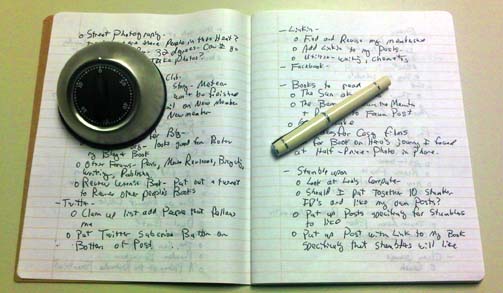
Pomodoro

An Idea Pomodoro – timer, pen, composition book.


Hail Columbia!

The federal government’s relentless expansion has made Washington, D.C., America’s real Second City.

The Washington, D.C., region has long been considered recession-proof, thanks to the remorseless expansion of the federal government in good times and bad. Yet it’s only now—as D.C. positively booms while most of the country remains in economic doldrums—that the scale of Washington’s prosperity is becoming clear. Over the past decade, the D.C. area has made stunning economic and demographic progress. Meanwhile, America’s current and former Second Cities, population-wise—Los Angeles and Chicago—are battered and fading in significance. Though Washington still isn’t their match in terms of population, it’s gaining on them in terms of economic power and national importance.

In fact, we’re witnessing the start of Washington’s emergence as America’s new Second City. Whether that’s a good thing for America is another question.


3 Hottest Real Estate Markets in Dallas for 2013

I’m surprised that they mention Richardson, where I live, as one of the hottest real estate markets – though I am partial to the inner-ring suburb.

Of course the comments consistantly talk about how awful Richardson is – so it must be a great place.


Gonzo
 

An Afternoon with Ralph Steadman

He gets out his signature fountain pen and fills it with ink.


The 12 Best Acting Performances at Sundance 2013


Pen and Ink Blog Illustrates Stories Behind Tattoos


Is Urbanism the New Trickle-Down Economics?


12 Louisiana Bands You Should Listen To

Waiting for Texas – but this is getting close.

Check Out Your State Here


What I learned this week, February 1, 2013

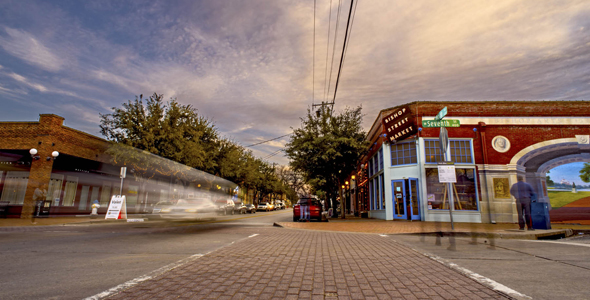
History: Boarded-up on Bishop

I love the Bishop Arts District – one of the things that is making Dallas a different, better place. It’s easy to forget how delicate something like this is and how much it needs everyone’s support.

Bishop Arts in 1985 -photo by Jim Lake Cos.

Bishop Arts in 1985 -photo by Jim Lake Cos.

Bishop Arts Now

Bishop Arts Now


Asking the important Questions-

Where are the Bicycles in Post-Apocalyptic Fiction?


Tulane, New Orleans, and the Super Bowl. I give a damn about two of these three…


I need a small, thin wallet to carry while I ride my bike. Something for a little cash (like I have any) ID and a card – something that won’t take up much space in my seat bag. I could buy an expensive sports wallet but I won’t. I have at least two rolls of raw wallet material.


How Dallas is Throwing Away $4 Billion
The more I think about this, the better I like it. It is a great idea. …And it will never happen. When all you have is a hammer – everything looks like a nail.


My son Lee recommended the book Moonwalking with Einstein. I already knew a lot of the memory techniques he talks about (my problem with memory is the huge hole in my brain labeled “don’t give a shit”) – but there are some very interesting concepts in the book.

Some money Quotes:

“I’m working on expanding subjective time so that it feels like I live longer,” Ed had mumbled to me on the sidewalk outside the Con Ed headquarters, a cigarette dangling from his mouth. “The idea is to avoid that feeling you have when you get to the end of the year and feel like, where the hell did that go?” “And how are you going to do that?” I asked. “By remembering more. By providing my life with more chronological landmarks. By making myself more aware of time’s passage.” I told him that his plan reminded me of Dunbar, the pilot in Joseph Heller’s Catch-22 who reasons that since time flies when you’re having fun, the surest way to slow life’s passage is to make it as boring as possible. Ed shrugged. “Quite the opposite. The more we pack our lives with memories, the slower time seems to fly.”

Monotony collapses time; novelty unfolds it. You can exercise daily and eat healthily and live a long life, while experiencing a short one. If you spend your life sitting in a cubicle and passing papers, one day is bound to blend unmemorably into the next—and disappear. That’s why it’s important to change routines regularly, and take vacations to exotic locales, and have as many new experiences as possible that can serve to anchor our memories. Creating new memories stretches out psychological time, and lengthens our perception of our lives.

Indeed, most of who we are and how we think—the core material of our personalities—is bound up in implicit memories that are off-limits to the conscious brain.


Life After Blue: The Middle Class Will Beat The Seven Trolls


Janeites: The curious American cult of Jane Austen

Faulkner House Books

When I’m lucky enough to visit New Orleans I try to avoid the more obvious tourist traps. I see nothing special about the bitter Joe and greasy dough at Cafe Du Monde, rarely set foot on Bourbon Street, and try to walk out of the Quarter (or at least skirt the edges) whenever possible. Still, there is cool stuff even in the heart of touristland.

One special little spot is Pirate’s Alley. It’s a narrow passage that runs alongside the St. Louis Cathedral, connecting Jackson Square with Royal Street. History drips onto the cobblestones like Spanish Moss from an iron balcony.

Usually I like to aimlessly drift through and see what there is to see. There is usually something interesting. Once, I stumbled across a fashion shoot in the alley.

Fashion Shoot in Pirate's Alley (click to enlarge)

Fashion Shoot in Pirate’s Alley (click to enlarge)

On our last trip – I walked down Decatur from Canal, headed for Pirate’s Alley. This time I was going somewhere in particular – an unusual state for me in the Big Easy. I had realized that I had never visited Faulkner House Books – a tiny bookstore located in the alley.

What makes this store so famous is that it occupies an apartment on the lower floor where William Faulkner once lived. There, in that very space, he hammered out his first novel Soldier’s Pay, begining the transition from unknown poet to Nobel prize winning novelist.

So I crossed Jackson Square – ignoring the thick crowd of artists, musicians, tourists, and fortunetellers – strolled down the alley past the Absinthe House and pushed the doors open to the bookstore.

It’s a small place – not hard to imagine it as a tiny apartment for a young, struggling writer. It’s packed with bookcases, every inch of wall covered, plus a collection of free-standing cases.

“Can I help you?” a woman asked.

“Umm, I’m just looking.”

“Well, the rare and first editions are around the corner, and ask me if you need anything.”

I glanced and saw a well-dressed elderly gentleman delicately thumbing through the case. The woman walked over to him and began to talk about the history of each volume he was examining. I heard him talking about which editions he already had in his collection and what holes he was trying to fill.

Those books were obviously not in my price range so I moved back toward the entrance and began to peruse the ordinary mass market offerings – after all, I had to buy something. I considered picking up a Faulkner novel but decided instead on Same Place, Same Things, a book of short stories by Tim Gautreaux. A South Louisiana writer, I had read another collection of his, Welding With Children, and really liked it.

We had talked about Tim Gautreaux while walking around on our New Orleans Writing Marathon the day before. I had discovered that he had written a story, Waiting for the Evening News, (contained in the book I chose) based on a train derailment in Livingston, Louisiana in 1982. I wanted to read that story because I had worked that train derailment when I was a consultant to the Emergency Response Division of the EPA.

Paperback in hand, I waited while the other man paid for his purchases – two beautiful, large books. His bill came to just under a thousand dollars. After he left, I handed my little trade sale paperback to the woman.

“Sorry, my purchase isn’t quite as big as his,” I said.

She ignored this. “This is very good work, have you read him before?”

I said I had and told her a quick version of the story of the derailment. She smiled and rang me up.

The entrance to Faulkner House Books

The entrance to Faulkner House Books

faulkner2

Right after I took a photo of the plaque, this guy did the same thing.

Right after I took a photo of the plaque, this guy did the same thing.

He and his wife never went in the store - he just moved along, not even taking his eye out of the viewfinder.

He and his wife never went in the store – he just moved along, not even taking his eye out of the viewfinder.

An old video of the train derailment at Livingston. I worked there for a couple weeks – providing technical assistance and taking samples to help determine when the residents could return home. I’m in the video, though unrecognizable, at about the nine minute mark.

What I learned this week, January 25, 2013

Dallas Tweed Ride

Save the Date: The Official Dallas Tweed Ride, February 9th **Updated Date**

Be there or be square. I’m stoked.


Tabasco Gumbo Recipes


10 Beautifully Designed Beer Products


It’s the Little Things:
5 Ways to Spend Less & Reduce Clutter

I was at Target the other day, and standing in front of me in line was a gentleman buying a plunger. That’s it. A plunger. While I really should have been feeling bad for him, because after all, the poor guy was out on a plunger run, I found myself staring at him in wonder, dazzled by his ability to get out of Target with only one darn thing.


Raise a glass at Dallas-area craft breweries, where tours are like little parties


Composer Duncan Sheik Gives New Information About American Psycho: The Musical


15 Remakes Worthy of Your Time


October is so far away. This should be cool.

The Aurora Project


Shane Pennington is one of the founders of Aurora. He did this amazing sculpture/installation in the Arts District.

http://vimeo.com/46009408

I wrote about it…
Here – Piedras en el Hielo
Here – The Next Day
Here – Ice Melts in the Rain
Here – Ice Melts in the Sun
and here – A Week and a Day


30 of the Best Beer Can Designs


As Flies to Wanton Boys

King Lear, Dallas Theater Center, Wyly Theater

King Lear, Dallas Theater Center, Wyly Theater

“As flies to wanton boys are we to the gods. They kill us for their sport.”
—- Shakespeare, King Lear

As I’ve said before – I was excited to watch the fantastic new venues go up in the Dallas Arts District. I especially was fascinated by the Wyly theater. Designed by Pritzker Prize winner Rem Koolhaas and associates it was a unique building, resembling nothing more than a Borg Cube. I distinctly remember thinking that it was such a cool place that it was a shame I could never afford to see a production there.

The Wyly Theater.

The Wyly Theater.

“When we are born we cry that we are come
To this great stage of fools.”

I was wrong. It is quite easy to find affordable tickets to most of the productions. Especially on “Pay What You Can Night.” Most productions have one performance (actually, you might call it a dress rehearsal – but it’s the full thing) that they sell the tickets for whatever the audience wants to pay.

These can sell out quickly, of course. But I have the site bookmarked and the dates on my calendar, and I can jump in there and buy them quick. We have seen The Tempest on a cheap day and The Elaborate Entrance of Chad Deity on a Pay What You Can night.

I snagged two tickets to King Lear on Pay What You Can Night. I won’t say what I could pay… right now, it’s not very much, I’m afraid.

“Through tattered clothes small vices do appear.
Robes and furred gowns hide all. Plate sin with gold,
And the strong lance of justice hurtless breaks.”

Candy couldn’t go, though, and I ended up going by myself. On Friday morning I thought about bailing, things were so complicated. I didn’t have a car, would have to ride my bicycle in the cold to work, and then get to the theater. Thursday night I rolled all the possibilities in my head, where to ride, where to lock up my bike, what to take, all the timing.

“I am tied to the stake, and I must stand the course.”

I decided to give it a go when the day turned out to be sunny and warmer than I expected and I actually enjoyed my commute to work. Afterwards, I had to ride around to a couple DART stations looking for an open bike locker – I didn’t want to leave my road bike locked up outside for fear of finding it relieved of vital parts.

“We are not the first
Who with best meaning have incurred the worst.'”

I have only seen King Lear once. Decades ago, I took Lee to see a production outside at the Dallas Shakespeare Festival – I’m not sure of the year, but I guess he was ten or so. Lear is such a dark and complex work, I worried that he would be bored – but there was enough sword fighting and action that he was enthralled, even if he didn’t really understand what was going on. In the infamous eye-gouging scene, an actor actually threw two grapes on the stage and then stomped on them. Lee perked up.

“Hey, what just happened?” he asked.

“Oh, nothing, Lee.” A father has to lie a little now and then.

“I want that glib and oily art
To speak and purpose not; since what I well intend,
I’ll do’t before I speak.”

He especially liked the army scenes where they had a large crowd (probably every stagehand and a lot of local volunteers) moving through the trees around the outdoor venue with lamps and rattling swords. It was pretty impressive – he was a tiny bit afraid… just the right amount. He used to really love going to the Shakespeare plays and I wish I could have done more. We were so busy.

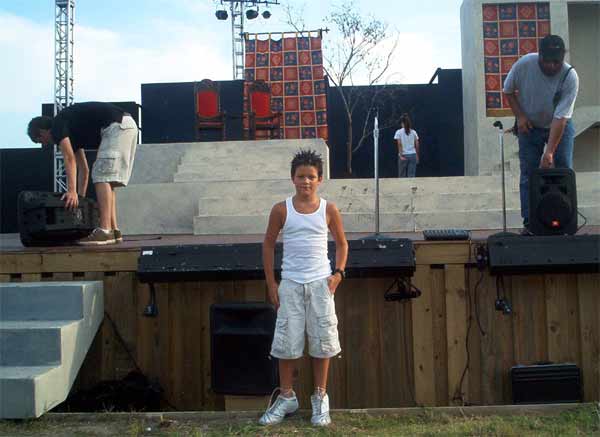
Lee, at the Dallas Shakespeare Festival's production of Hamlet, a few years ago.

Lee, at the Dallas Shakespeare Festival’s production of Hamlet, a few years ago.

“How sharper than a serpent’s tooth it is
To have a thankless child!”

So, on Friday, I rode the DART train downtown and walked to the Wyly for the performance.

It started out with a very spare stage – a wooden wall, a door, a heavy chair, and a candelabra. I noticed before the performance a couple of stagehands on hands and knees, carefully wiping the stage down, as if they were worried about bits of slippery water.

“Time shall unfold what plaited cunning hides.”

The play started very formal and stiff. The actors stood arranged around the seated king in symmetric positions and delivered their lines. It was all very good, but not very exciting. King Lear is an avalanche of a play; it delivers its punches full-bore – heavy and hard. It doesn’t fuck around.

Still, to entertain a modern audience, you need something more than a static composition, no matter how talented. You need a gimmick, something to entertain the masses. I worried that they had decided to go all old-school, plain, simple, and it was starting to get a little boring. I thought it might be a long night of interesting but not very passionate storytelling.

I was wrong.

“Oh, that way madness lies; let me shun that.”

When I think of King Lear, I don’t usually think of the play itself… or even a film of the play. I think of Ran – the incredibly powerful film by Kurosawa. I saw it in a theater when it first came out and it affected me as much as any film ever did. Based on Lear, set in samurai-era Japan, it captures the tragedy and hopelessness of Lear in an amazing, colorful… Kurosawa style. A work of genius.

“Have more than thou showest,
Speak less than thou knowest,
Lend less than thou owest.”

Still, to this day, when I watch Lear, the back of my mind flashes to the battles and pathos of Ran. It is engraved there forever… I’m afraid.

“This is the excellent foppery of the world, that,
when we are sick in fortune,–often the surfeit
of our own behavior,–we make guilty of our
disasters the sun, the moon, and the stars: as
if we were villains by necessity; fools by
heavenly compulsion; knaves, thieves, and
treachers, by spherical predominance; drunkards,
liars, and adulterers, by an enforced obedience of
planetary influence; and all that we are evil in,
by a divine thrusting on: an admirable evasion
of whoremaster man, to lay his goatish
disposition to the charge of a star!”

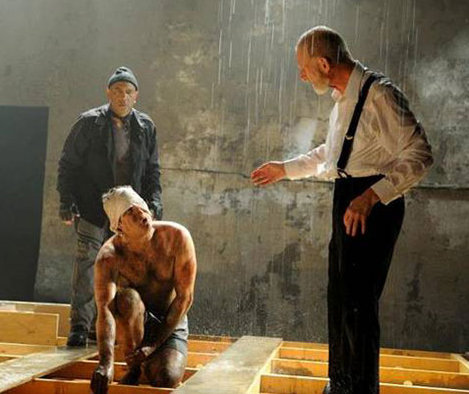
Then, suddenly, about a quarter way through, the formal stylized play ended. As Lear was thrown into the storm of madness the wooden walls that formed the back of the stage fell forward into a tumbledown confusion, huge doors swung down from above and a gigantic torrent of water waterfalled down (sort of Flashdance style – on steroids) onto the King.

And all Hell broke loose.

The rain comes down and madness conquers all.

The rain comes down and madness conquers all.

“Blow, winds, and crack your cheeks! rage! blow!
You cataracts and hurricanoes, spout
Till you have drenched our steeples, drowned the cocks!
You sulphurous and thought-executing fires,
Vaunt-couriers to oak-cleaving thunderbolts,
Singe my white head! And thou, all-shaking thunder,
Strike flat the thick rotundity o’ the world!
Crack nature’s moulds, all germens spill at once
That make ingrateful man!”

The formality gone, torn to the four winds, the rest of the play was a tsunami of a powerful madness, a foil for the Kings insanity and despair. The fourth wall was broken, with actors fighting in the aisles and lightning screaming through the theater. I noticed that even the sound effects added to the disconcerting craziness – every time the King’s mind took a turn for the worst, a crackling buzz came from hidden speakers above the seats – a subtle effect that enforced the impression of insanity and doom.

“Rumble thy bellyful! Spit, fire! Spout, rain!
Nor rain, wind, thunder, fire, are my daughters:
I tax not you, you elements, with unkindness;
I never gave you kingdom, called you children,
You owe me no subscription: then, let fall
Your horrible pleasure; here I stand, your slave,
A poor, infirm, weak, and despised old man.”

And then, the tragedy. As the inevitable doom unfolds, the tragic events set in motion by the Lear’s egocentric arrogance in the first scene come to their conclusion, the horror sets in.

“The worst is not,
So long as we can say, ‘This is the worst.”

This is a play written four hundred years ago by a mysterious man living in a world that is so different than ours. I always wonder what Shakespeare would think, seeing his work performed in a place such as the Wyly theater – which is essentially a huge theater machine, a reconfigurable, hydraulic, giant metallic cube, able to morph into whatever shape is needed. It is thick with electrical wiring; looking up you can see wireless routers laced with tangles of blue Ethernet cables blinking yellow and green in the darkness. Shakespeare would shake with fear at this mechanism which has swallowed his actors and audience whole.

“Come not between the dragon and his wrath.”

Still, it is his words. The same words he must have scratched out with a quill on thick paper four centuries ago. It is a miracle that they are still so effective after all this time… and space.

“Who is it that can tell me who I am?”

Those of us in the audience must know what to expect. It is a tragedy. There is a warning on the sign out in the lobby that the play contains nudity. This story is not going to end well. Everyone is going to die.

“He’s mad that trusts in the tameness of a wolf, a horse’s health, a boy’s love, or a whore’s oath.”

But we have all been spoiled… softened and weakened by Hollywood Films and Television Productions that must have happy endings. The hero will be rescued at the end, despite all odds, and the villain will get his just comeuppance, after he repents and is forgiven. The performance will end with sweet music, with the hero kissing the girl, while a Technicolor sunset flares behind the closing credits.

Shakespeare plays with us. He always adds a little tiny bit of hope – the soldier is dispatched to stop the execution, the poison doesn’t seem to work at first, the bad guy seems to realize the folly of his ways. It is a ruse.

We should know better, but we don’t. When doom descends, we are shocked, shocked even though we knew it was coming, shocked even though we have seen this before, shocked even though we know this is how the world works.

“Poor naked wretches, wheresoe’er you are,
That bide the pelting of this pitiless storm,
How shall your houseless heads and unfed sides,
Your looped and windowed raggedness, defend you
From seasons such as these?”

So stunned we sit there. Then we realize what we have seen. A work of genius.

“The weight of this sad time we must obey;
Speak what we feel, not what we ought to say.
The oldest hath borne most: we that are young
Shall never see so much, nor live so long.”

So now I have set a mark on my calendar for February 1. That’s when the Pay What You Can tickets go on sale for Red – a play about the artist Mark Rothko. If you want to go, contact me and I’ll see if I can get an extra ticket or two.

What I learned this week, January 18, 2013

Earlier this year, I saw the new Wes Anderson film Moonrise Kingdom and really liked it.

moonrise_kingdom

Now that it has received a nomination for Best Original Screenplay, Focus Pictures has made the entire script available on their website. Check it out – it’s illustrated and colorful and a lot of fun.

It’s also available in PDF here.


babes1

30 Essential Texas Restaurants to Visit Before You Die

I’ve eaten at over half of these (including Babes Chicken Dinner House). I was not overly impressed by the list. Most of these restaurants are not very good – they are touristy and over-hyped. They probably were excellent at one time but have jumped the shark and now exist as a caricature of themselves. Some may be excellent, such as, say, The Mansion on Turtle Creek, or Fearing’s  but these are so famous you don’t really need an article to tell you that.

Give me an interesting new place over these hoary old chestnuts anyday.


Life After Blue

At the heart of the enduring liberal ideal is a truth that is often forgotten in today’s political debates: the relationship between order and liberty does not have to be zero sum. More government can mean less freedom, and more freedom can mean less government—but things don’t always work out that way.

At one level this is obvious; people don’t so much surrender their liberty by forming a government and agreeing to live in an ordered society as they defend it. Life in an anarchy governed only by the law of the jungle is less free than life as a member of a democratic commonwealth. But this non-zero sum relationship holds in other ways. To have the freedom to drive at 65 miles per hour on an interstate highway, I must accept a lot of rules and restrictions. But the end result of all the requirements about driver’s licenses, insurance, registration and traffic laws is that I can go much faster and farther than I could in a state of nature. There is more order and more liberty in a modern industrial democracy than there is in the forest where our ancestors lived.

The secret of Anglo-American civilization has been its ability to combine the two elements of order and liberty at successively higher levels of both. To think constructively about our future we shouldn’t be thinking about a zero sum tradeoff between order and freedom; we should be thinking about how to build the kind of order that extends our liberty in new and important ways.


bike love: feels like flying