The Point Where Imaginative Seeing And Outside Seeing Meet

“In a lucid dream, you have a sharper sense of color and lucidity than with your eyes open. I’m interested in the point where imaginative seeing and outside seeing meet, where it becomes difficult to differentiate between seeing from the inside and seeing from the outside.”
—-James Turrell, The Other Horizon

From the Houston Museum of Fine Arts website:

In the mid-1960s James Turrell pioneered a new concern with the phenomena of space and light, often referred to as the Light & Space Movement. Turrell sought not to depict light but to use light itself as his material, and his earliest works investigated the effects of artificial light. He also developed a number of installations that heightened the relationship between light and the architectural frame.

The MFAH commissioned Turrell’s The Light Inside for the underground tunnel linking the museum’s Caroline Wiess Law Building with the Audrey Jones Beck Building when the latter opened in 2000. The Light Inside turns the walls of the tunnel into vessels for conducting light. An expanded version of his earlier explorations of light in his Shallow Space Construction series, Turrell’s The Light Inside is an all-encompassing environment.

Transcending the traditional confines of built spaces, The Light Inside acts as both a passage and a destination. The raised walkway guides visitors forward and gives them the sense of floating in space, while the changing cycle of illumination (which shifts from blue, to crimson, to magenta) further invites contemplation. The Light Inside makes the experience of moving between the Law and the Beck Buildings not only an exploration of light and space, but also a profound and awe-inspiring experience.

JAMES TURRELL  American, born 1943  The Light Inside  1999  Neon and ambient light

JAMES TURRELL
American, born 1943
The Light Inside
1999
Neon and ambient light

I have been a big fan of James Turrell for over a decade, ever since a certain day in 2004. That was the day near the opening of the Nasher Sculpture Center – when I took Lee down there to visit the sparkling spanking new museum. I wrote about it in a blog entry that was eventually published in a local magazine.

My favorite piece might have been the installation Tending (Blue) by James Turrell. We walked into a little opening lit by odd, shifting colors into the wall at the north end of the garden. The passage made a right turn and opened into a small room lined with dark stone benches. The walls on the upper half were featureless and smooth. A gray skylight lighted the whole chamber. The effect was strange and very peaceful. I liked it a lot.

Lee and I left the chamber and walked back up the garden and inside the building. We wandered downstairs and into the auditorium where a film was showing. It told the story of Raymond Nasher and his late wife, how they started out building Northpark Mall, acquired a fortune, and then became premiere collectors of modern sculpture. Mr. Nasher talked about his life, his wife, and his passion for the new sculpture center. The film then showed the construction of the center, how a handful of visionary architects and a few thousand men in hard hats converted a grimy downtown parking lot (I’ve parked there many times, put my quarters or dollar bills into a rusty numbered slot) into a thing of great value and beauty. They talked a lot of how it will be there forever. The film was fun and interesting – it really helped me appreciate the place.

On opening day Raymond Nasher said, “I put Patsy (his wife, the collector, who had passed away a couple years before) in charge of the weather today, and, as you can see, it’s beautiful.

One thing was odd, though. On the part of the film that covered opening day, Nasher and Turrell themselves went into the Tending (Blue) chamber that Lee and I had walked out of only minutes before. The benefactor and the artist sat on the benches and looked around. The skylight rectangle in the ceiling wasn’t gray like we saw it, but a deep cerulean blue.

“What’s up with that?” I asked.

“Let’s go back and check it out,” Lee said.

We hiked back down and entered the chamber again. The skylight was still gray. Something didn’t look right, though. I stood under it, looking up, trying to figure out what I was seeing and how it could change colors so dramatically. I was halfway convinced that it was a rectangle of light projected on the ceiling by some hidden apparatus (the upper walls are washed in subtle changing color from hidden computer controlled LED’s) when I was suddenly struck between the eyes with a big, cold drop of water. I wiped my face in surprise and looked down at some small pools of water at my feet.

“That’s weird, Lee,” I said, “I can’t believe it, but this roof is leaking.”

I looked back up, trying to find the telltale discoloration of a water leak, when, with a sudden shock, I realized what the hell I was actually looking at. That wasn’t a skylight, that wasn’t a projected rectangle at all, it was simply a big hole in the ceiling. I was looking directly at the sky. Once my eyes and my brain were in sync I could see the subtle variation of the clouds passing by overhead. The edges of the hole must have been cut back like razors – there was no visible frame around the opening, simply a featureless rectangle of light. It was amazing.

That’s why the rectangle looked blue in the film – it was a cloudless day. Now I want to go back. I want to go at sunset… I want to figure out how to go at dawn. The city sky at night… will it be brown? I want to sit in there during a rainstorm. I especially want to go there on that rarest of Texas days, a snowstorm.

Now, of course, Tending (Blue) is no more, destroyed in a paroxysm of greed and corruption.

JAMES TURRELL  American, born 1943  The Light Inside  1999  Neon and ambient light

JAMES TURRELL
American, born 1943
The Light Inside
1999
Neon and ambient light

When I went to Houston over the holidays to visit my family there I wanted to visit the Turrell work at the Museum of Fine Arts, The Light Inside. It’s a tunnel under the street between two buildings, festooned with Turrell’s signature unreal lighting and surreal experience.

A really cool thing, though the experience is a little lessened by the museum guard constantly barking out, “Stay on the walkway! Don’t touch the sides!” It’s beautiful and memorable, though it does lack the pure esthetic simplicity and connection with nature that the late Tending (Blue) offered.

JAMES TURRELL  American, born 1943  The Light Inside  1999  Neon and ambient light

JAMES TURRELL
American, born 1943
The Light Inside
1999
Neon and ambient light

I can’t write about Turrell without mentioning Roden Crater. Since the 1970’s he has been hollowing out an extinct volcano in a desolate and isolated stretch of Arizona – converting it into a giant gallery for his manipulations of light, space, and expectations. Visiting this place in at the top of my bucket list.

I only hope I’m able to live long enough.

Video of James Turrell and Roden Crater

Think Before You Speak

“Think before you speak. Read before you think.”
― Fran Lebowitz, The Fran Lebowitz Reader

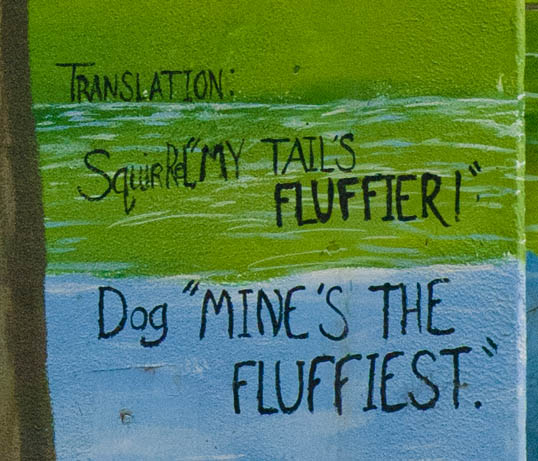
Mural on column at Deep Ellum Dog Park, Dallas, Texas

Mural on column at Deep Ellum Dog Park, Dallas, Texas

fluffy2

The Glint Of Light On Broken Glass

“Don’t tell me the moon is shining; show me the glint of light on broken glass.”
― Anton Chekhov

Saturday was the annual Cedars Open Studios Tour and Bike Friendly Cedars had organized a bike ride to the various studios and galleries. I had been looking forward to this for months and was concerned as the day approached that there was a prediction of violent thunderstorms. Still, I was up for giving it a shot.

As a compromise, I did drive down in my car instead of taking the train – that way I had a refuge and means of transport if the weather turned really bad. I also took my commuter bike instead of my folder – the big tires, weatherproof cargo box, and fenders are designed to get through any weather. I parked at Lee Harvey’s, dragged my bike out of the back, and pedaled down to the Bowler Hat to meet up with the other folks.

We gathered together and rode off, touring a large number of artists, their spaces, and their work. It was a big variety, from ceramics, jewelry and paintings to gigantic sculptures and architectural works. Everybody was very friendly and there was even a good bit of food and drink set out too.

The weather held out until the middle of the afternoon when it turned cold and rainy. I bailed on the bike tour and hid out under the awning at Lee Harvey’s for a bit. It helped that there was an excellent band, Shoot Low Sheriff, finishing out a set. Clay Stinnett – the artist that painted the work I bought at For the Love of Kettle – was there showing off some paintings.

About that time the sun was setting and the heavens really opened up. I wanted to go to the finale of the evening at Bowman Hot Glass, so I unpacked my rain gear and headed out.

Despite the weather, there was a big crowd at Bowman. A lot of the folks I had seen here and there during the day also ended up at Bowman. I bought a glass Christmas Ornament and carefully packed it into an extra pannier that I brought along.

The highlight was the molten glass Christmas tree. A large structure of wood and iron was brought out and placed in the rain, surrounded by a safety zone demarcated by yellow police tape. A sound system boomed out an appropriate accompaniment. Two women dressed as glow-in-the-dark angels came out and garnished the structure with rolls of paper tape. Then a man in a silver heat suit and a torch lumbered from the building and set the paper and wood on fire.

The glass furnaces inside the building were opened and the bright orange glow bathed the cold and wet crowd outside. Then three glassblowers began grabbing giant blogs of glowing glass on the ends of long blowpipes, carrying them out to the tree, and dribbling the thick liquid all over the tree. In an intricate and dangerous hot dance they took turns running out with their molten burdens, holding them over the tree, then returning for another load.

The hot glass ignited all the remaining unburned wood, flooding the entire sculpture with flame. After a number of trips, the iron armature within was completely covered with strands of glass. It really did end up looking like a Christmas tree – festooned with a thick layer of crystal icicles.

Finally, they finished and everyone cheered. I packed my bike up and set out in the rain and dark to ride the few blocks to my car. I was very grateful for my fenders and Gore-Tex rain gear.

As I pedaled out I took one last look at the tree. Unfortunately, the falling rain was too much of a thermal shock and it shattered most of the glass tree – but it was incredible watching its creation.

Christmas tree made of fire and glass, Bowman Hot Glass, Dallas, Texas

Christmas tree made of fire and glass, Bowman Hot Glass, Dallas, Texas

They Say You Die Twice

“I mean, they say you die twice. One time when you stop breathing and a second time, a bit later on, when somebody says your name for the last time.”
― Banksy

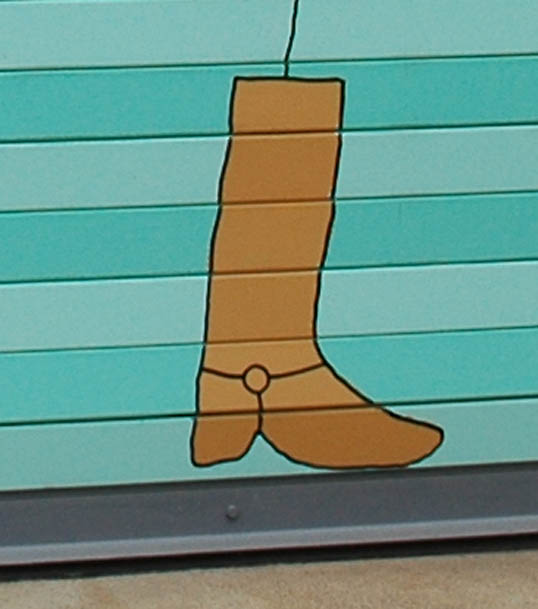
Roll Up Door Tony Bones, 2008 Deep Ellum Dallas, Texas

Roll Up Door
Tony Bones, 2008
Deep Ellum
Dallas, Texas

2008 Artwork by Tony Bones

Tony Bones detail

Tony Bones
detail

“Once upon a time, there was a king who ruled a great and glorious nation. Favourite amongst his subjects was the court painter of whom he was very proud. Everybody agreed this wizzened old man pianted the greatest pictures in the whole kingdom and the king would spend hours each day gazing at them in wonder. However, one day a dirty and dishevelled stranger presented himself at the court claiming that in fact he was the greatest painter in the land. The indignant king decreed a competition would be held between the two artists, confident it would teach the vagabond an embarrassing lesson. Within a month they were both to produce a masterpiece that would out do the other. After thirty days of working feverishly day and night, both artists were ready. They placed their paintings, each hidden by a cloth, on easels in the great hall of the castle. As a large crowd gathered, the king ordered the cloth be pulled first from the court artist’s easel. Everyone gasped as before them was revealed a wonderful oil painting of a table set with a feast. At its centre was an ornate bowl full of exotic fruits glistening moistly in the dawn light. As the crowd gazed admiringly, a sparrow perched high up on the rafters of the hall swooped down and hungrily tried to snatch one of the grapes from the painted bowl only to hit the canvas and fall down dead with shock at the feet of the king. ’Aha!’ exclaimed the king. ’My artist has produced a painting so wonderful it has fooled nature herself, surely you must agree that he is the greatest painter who ever lived!’ But the vagabond said nothing and stared solemnly at his feet. ’Now, pull the blanket from your painting and let us see what you have for us,’ cried the king. But the tramp remained motionless and said nothing. Growing impatient, the king stepped forward and reached out to grab the blanket only to freeze in horror at the last moment. ’You see,’ said the tramp quietly, ’there is no blanket covering the painting. This is actually just a painting of a cloth covering a painting. And whereas your famous artist is content to fool nature, I’ve made the king of the whole country look like a clueless little twat.”
― Banksy, Wall and Piece

Be Content With Silence

“When words become unclear, I shall focus with photographs. When images become inadequate, I shall be content with silence.”
― Ansel Adams

Silence Antoine-Augustin Préault Dallas Museum of Art

Silence
Antoine-Augustin Préault
Dallas Museum of Art

Dallas Museum of Art
Dallas, Texas

(label text)

Antoine-Augustin Préault
French, 1809-1879

Silence
c. 1842
Patinated plaster
Anonymous gift and General Acquisition Fund, 2014.10

French sculptor Antoine-Augustin Préault created eerie contrasts of shadow and light in this composition featuring merely a face and a hand. Linear drapery enshrouds the androgynous figure’s face, drawing attention to its gaunt features, half-closed eyes, and skeletal hand. A finger lifted to the lips is a gesture commonly found in ancient funerary sculptures that glorified the dead. Portraiture or reliefs bearing images of the deceased performing this gesture were intended to conjure pleasant memories, but Silence, with its brutal evocation of frailty and death, breaks from the well-established canon.

Préault designed Silence for Jacob Roblès’ tomb at Père Lachaise Cemetery in Paris, which is the city’s largest and most famous burial ground. The medallion’s compositional elements combine to convey a somber nature perfect for the purpose of a tomb. Its superb round, dark hardwood frame with a deep ogee, or S-shaped molding, enhances the sculpture’s dimensionality and melancholy theme.

“Does not everything depend on our interpretation of the silence around us?”
― Lawrence Durrell, Justine

When the Pretty Women Walk Over My Grave

“It’s not what I’d want for at my funeral. When I die, I just want them to plant me somewhere warm. And then when the pretty women walk over my grave I would grab their ankles, like in that movie.”
― Neil Gaiman, American Gods

Funerary Figure (tau-tau) Dallas Museum of Art Dallas, Texas

Funerary Figure (tau-tau)
Dallas Museum of Art
Dallas, Texas

Dallas Museum of Art
Dallas, Texas

(label text)
Funerary figure (tau-tau)
Indonesia: South Sluawesi, Sa’dan Toraja People
19th century or earlier
Wood
The Eugene and Margaret McDermott Art Fund, Inc. 1980.2 McD

The Toraja carve tau-tau, smaller than life-size funerary figures, to commemorate the deceased when a high-ranking funeral is held. Only members of the highest-ranking aristocracy are permitted to have permanent tau-tau. This unusually small funerary figure appears to be archaic in style and probably predates even the oldest effigies seen beside Toraja tombs today.

The bun or hair knot at the back of the head of this tau-tau indicates that it represents a female. Her mouth is open and may remind one of The Scream, a modern painting by Edvard Munch. The expression is not precisely understood, but it may have been meant to capture bearing of an authoritative aristocratic woman accustomed during her lifetime to public speaking and giving orders, as this tau-tau appears to be doing

Cortex of the Brain as a Mosaic of Tiny on/off Elements

“Like his master I. P. Pavlov before him, he imagines the cortex of the brain as a mosaic of tiny on/off elements. Some are always in bright excitation, others darkly inhibited. The contours, bright and dark, keep changing. But each point is allowed only the two states: waking or sleep. One or zero.”
― Thomas Pynchon, Gravity’s Rainbow

Irving Arts Center, Irving, Texas

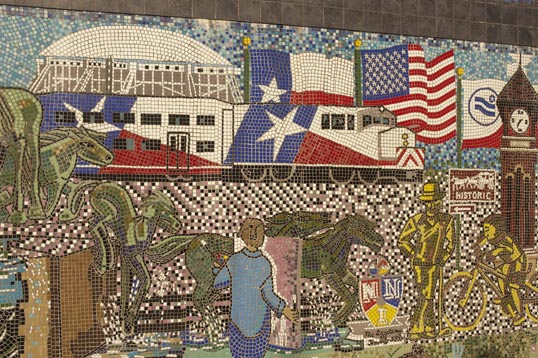
Mosaic, Irving Arts Center, Irving, Texas

Mosaic, Irving Arts Center, Irving, Texas

In college, I took Art History – mostly in a hopeless, vain attempt to meet women. I really fell into it, though. I think I learned more useful knowledge in that course than in any other. The problem is, I came to the class, in a dark, quiet dungeon under a Fake Romanesque stone building – the darkness only pierced by the beam of the slide projector, the silence only broken by the instructor’s drone – after four hours of advanced organic chemistry laboratory. Sometimes I would forget to remove my goggles and would frighten the other students.

The difficulty was making that left-right brain switch during a quick hike across campus. I remember looking at some Byzantine Mosaics from Ravenna and trying to understand and appreciate the art… but all I could think was, “I wonder what dyes they used to get that blue?”

Mosaic, Irving Arts Center, Irving, Texas

Mosaic, Irving Arts Center, Irving, Texas

The mural at the Irving Arts Center pays tribute to some of the best-known icons of the city. You can see the TRE Train, The Las Colinas Mustangs, and the long-imploded Texas Stadium (now replaced with Jerry’s Death Star).

“She may know a little, may think of herself, face and body, as ‘pretty’…but he could never tell her all the rest, how many other living things, birds, nights smelling of grass and rain, sunlit moments of simple peace, also gather in what she is to him.”
― Thomas Pynchon, Gravity’s Rainbow

Birds, Eyeballs, and the Second Mouse

“The early bird gets the worm, but the second mouse gets the cheese.”
― Willie Nelson

Mural, Deep Ellum, Dallas, Texas

Mural, Deep Ellum, Dallas, Texas

It is late in the day – later than I thought – too late… though I have no idea what it is too late for. I am on my bicycle and worn out – long since dropped down into my emergency gear so I can get home alive. Everyone else has given up and I should be waiting on my train, but I am anxious and can’t help finding some murals and taking some pictures.

Close to our bows, strange forms in the water darted hither and thither before us; while thick in our rear flew the inscrutable sea-ravens. And every morning, perched on our stays, rows of these birds were seen; and spite of our hootings, for a long time obstinately clung to the hemp, as though they deemed our ship some drifting, uninhabited craft; a thing appointed to desolation, and therefore fit roosting-place for their homeless selves. And heaved and heaved, still unrestingly heaved the black sea, as if its vast tides were a conscience; and the great mundane soul were in anguish and remorse for the long sin and suffering it had bred.
—-Moby Dick

Detal, Mural, Deep Ellum, Dallas, Texas

Detal, Mural, Deep Ellum, Dallas, Texas

The reality is in this head. Mine. I’m the projector at the planetarium, all the closed little universe visible in the circle of that stage is coming out of my mouth, eyes, and sometimes other orifices also.
–Thomas Pynchon, The Crying of Lot 49

Valuable Things Are Never Easy To Understand

“I am the twentieth century. I am the ragtime and the tango; sans-serif, clean geometry. I am the virgin’s-hair whip and the cunningly detailed shackles of decadent passion. I am every lonely railway station in every capital of Europe. I am the Street, the fanciless buildings of government. the cafe-dansant, the clockwork figure, the jazz saxophone, the tourist-lady’s hairpiece, the fairy’s rubber breasts, the travelling clock which always tells the wrong time and chimes in different keys. I am the dead palm tree, the Negro’s dancing pumps, the dried fountain after tourist season. I am all the appurtenances of night.”
― Thomas Pynchon, V.

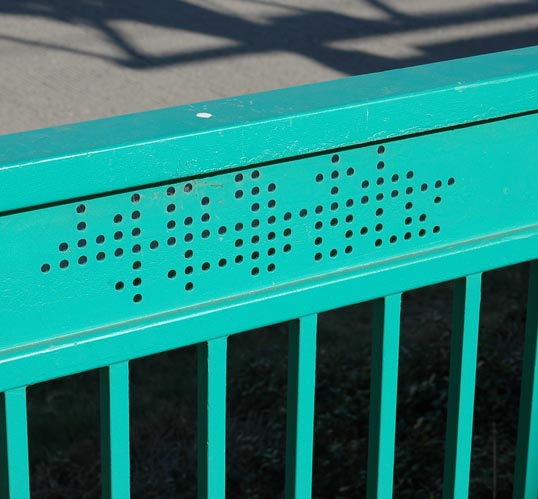
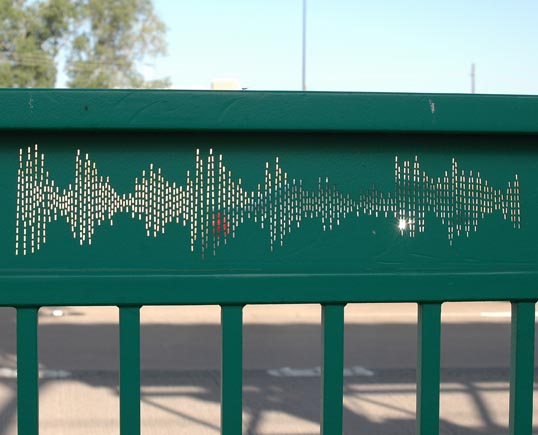
I was waiting with my bicycle at the Galatyn Park DART train station for some friends to arrive when I noticed patterns, codes obviously, cut into the steel of the railing by the station artist, Jim Cinquemani.

Galatyn Park DART Station, Richardson, Texas

Galatyn Park DART Station, Richardson, Texas

The first one was easy. That’s Morse Code. I don’t know it by heart, but I know how it works. It spells out the name of the place, Galatyn Park.

Galatyn Station, DART, Richardson Texas

Galatyn Station, DART, Richardson Texas

So I confidently dove in to the puzzle of the second missive. It’s obviously some sort of Teletype Code. Since I already knew what it probably said, I thought it would be easy. A seven bit code (ASCII is usually seven bits) – but what is that one bit that is always on? And the message is twenty-six characters long… There are so many different codes, with strange encoding patterns and a lot of mysterious control codes.

I’m old enough to have worked with paper tape – back when kilobytes of information were all we had to work with. This looks like computer paper tape – but it might be an even older technology.

I never was able to figure it out. I’ll work on it awhile – and then maybe email the sculptor and see if he will tell me.

Finally, the last two codes:

Fence at Galatyn Park Sation.

Fence at Galatyn Park Sation.

Galatyn Park DART Station - with car passing behind.

Galatyn Park DART Station – with car passing behind.

These are obviously analog output. Maybe voice recordings? No way to decode – but they do look cool.

“It’s been a prevalent notion. Fallen sparks. Fragments of vessels broken at the Creation. And someday, somehow, before the end, a gathering back to home. A messenger from the Kingdom, arriving at the last moment. But I tell you there is no such message, no such home — only the millions of last moments . . . nothing more. Our history is an aggregate of last moments.”
― Thomas Pynchon, Gravity’s Rainbow

Year of the Rooster

Year of the Rooster Dallas Theater Center Upstart Productions

Year of the Rooster
Dallas Theater Center
Upstart Productions

I’ve been a fan of the Dallas Theater Center’s Wyly Theater ever since it first opened. I’ve seen a double handful of plays there, and enjoyed every one.

I was excited when I heard about the Center’s new initiative, the Elevator Project. This gives six local theater groups: African American Repertory Theater, Cara Mia Theatre Co., Dallas Actor’s Lab, DGDG: The Danielle Georgiou Dance Group, Second Thought Theatre and Upstart Productions – an opportunity to stage one play each in the Wyly over the next year.

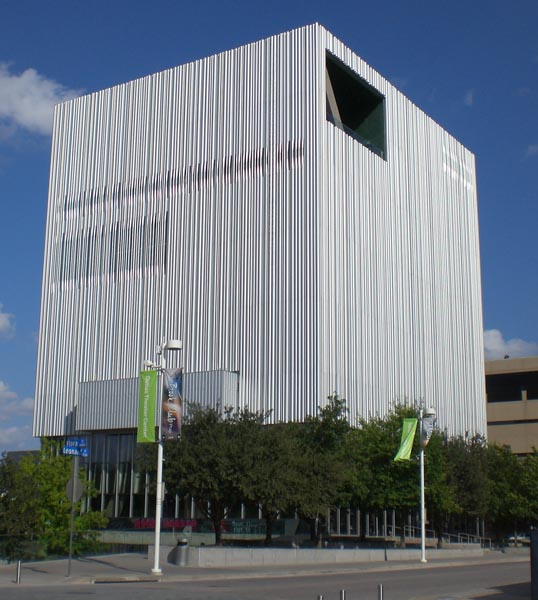
These plays won’t be in the large main auditorium, but in smaller spaces on the sixth and ninth floors of the giant Borg-Cube like building. And yes, you do ride an elevator from the below-grade lobby to reach the shows.

Dallas Theater Center Wyly Theater Dallas, Texas

Dallas Theater Center
Wyly Theater
Dallas, Texas

I had seen one show, Red, in the ninth floor space (completely redone – you had no idea where you were – it felt like a New York artists’ studio). While it was running on the ninth floor, King Lear was going on downstairs.

The first production in the Elevator Series is done by Upstart Productions and is a work called Year of the Rooster. It is presented in the sixth-floor black box theater area – where I had never been. I wanted to go on one of the first nights, but work has been kicking my ass and I wasn’t able to get there until today, for a Sunday Matinee performance. I thought about riding my bike down there, but it was too hot (and ungodly humid) so I settled for a train ride.

I made a particular effort to not read anything about the play beforehand – to leave an element of surprise. I only knew that it involved at least one chicken.

The play was crackerjack. It was a harrowing tale of a struggling McDonald’s clerk, trying to keep his elderly mother supplied with stolen honey mustard packets without getting fired – who has only one chance at success, escape, and redemption – his fighting cock, Odysseus Rex.

The protagonist chicken is played by Joey Folsom as a spring-steel tight PED drugged bundle of avian rage and hate flashing a folding knife like it is his only hope in the world. Steph Garrett plays dual roles as an over-ambitious McDonald’s manager and as Odysseus Rex’s love interest – an overweight, cage-raised, soon-to-be-fried hen.

It’s not always a pleasant tale – full of salty language and Oklahoma doom. The fight scenes are exciting and a bit frightening in the small space of the sixth floor black box. In the end it’s an unforgettable entertainment – you can’t make an omelet without breaking a couple of eggs.

There are a few performances left – so if you are in the North Texas area, get your tickets before they are sold out.

The odd thing about a matinee performance is that you emerge from the darkness of the play into the unexpected and almost forgotten fiery light and withering heat of the late afternoon. The world is still there – though somehow always changed by the entertainment you have sat through. And that’s the mark of a good play – because of what you have seen – what you have lived through – you now see the world a little differently. You know something you didn’t before.