All I can do is reply on my own behalf, realizing that what I say is relative. Accepting the absurdity of everything around us is one step, a necessary experience: it should not become a dead end. It arouses a revolt that can become fruitful. An analysis of the idea of revolt could help us to discover ideas capable of restoring a relative meaning to existence, although a meaning that would always be in danger. —-Albert Camus
Gustave Caillebotte
French 1848-1894
Portrait of Paul Hugot
1878
Houston Museum of Fine Arts
Impostor syndrome isn’t always a voice of unwarranted self-doubt that you should stifle. Sometimes, it is the voice of God telling you to stand down. —-Walter Russell Mead
A skill I learned in school – unfortunately, that was a half-century ago and it’s a skill I’ve lost. Should I work and regain it? I’m kicking up my reading and most of the books I read (fiction and non) would benefit from some marginalia.
There could be a psychopath sitting next to you right now.
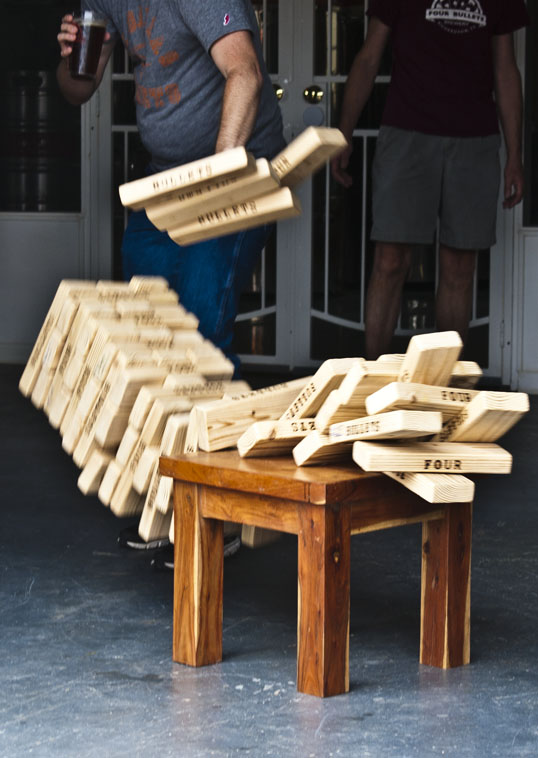
But it fell later as they tried to move another piece. Note the rare “suspended section” of blocks. I’m not sure of the physics of leaving a few behind for a handful of microseconds.
“It’s like when you put instant rice pudding mix in a bowl in the microwave and push the button, and you take the cover off when it rings, and there you’ve got ricing pudding. I mean, what happens in between the time when you push the switch and when the microwave rings? You can’t tell what’s going on under the cover. Maybe the instant rice pudding first turns into macaroni gratin in the darkness when nobody’s looking and only then turns back into rice pudding. We think it’s only natural to get rice pudding after we put rice pudding mix in the microwave and the bell rings, but to me, that is just a presumption. I would be kind of relieved if, every once in a while, after you put rice pudding mix in the microwave and it rang and you opened the top, you got macaroni gratin. I suppose I’d be shocked, of course, but I don’t know, I think I’d be kind of relieved too. Or at least I think I wouldn’t be so upset, because that would feel, in some ways, a whole lot more real.” ― Haruki Murakami, The Wind-Up Bird Chronicle
“Life is like gathering berries into an apron with a hole. Why do we keep on? Because the berries are beautiful, and we must eat to survive. We catch what we can. We walk past what we lose for the promise of more, just ahead.”
There are only two kinds of people who do not experience painful emotions. The first kind are the psychopaths. The second kind are dead. There is a false understanding or expectation that a happy life means being happy all the time. No. Learning to accept and even embrace painful emotions is an important part of a happy life. —–Tal Ben-Shahar, The Happiness Paradox
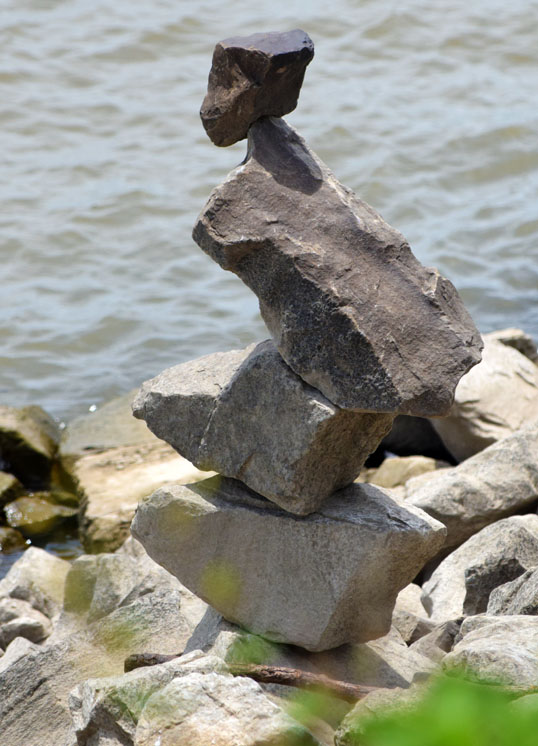
Riverbank Sculpture, Mississippi River, French Quarter, New Orleans
A growing body of research shows that the pursuit of happiness actually makes us miserable. This paradoxical finding likely results from people setting impossibly high standards, excessively monitoring their happiness, and misunderstanding what will make them truly happy. Positive psychologist Tal Ben-Shahar says that to be happier, we must find ways to pursue it indirectly while also accepting painful emotions.
Skateboarders regularly fail at their chosen activity. But that doesn’t make it a meaningless task of Sisyphean proportions
In the US talk show Comediansin Cars Getting Coffee (2012-19), the host Jerry Seinfeld remarks in a conversation with Chris Rock that ‘Those skateboard kids … are going to be all right.’ Rock expresses his agreement with Seinfeld, and they quickly move on to other topics. Their discussion about the value of skateboarding is quite brief (lasting about 20 seconds). But they agree that skateboarding provides skaters with a means of learning a life lesson. The lesson follows from the success of the skater in executing a manoeuvre after repeatedly failing (and falling). While some may nod their heads in agreement, it is worth considering whether Rock and Seinfeld are right. Does skateboarding teach a life lesson? If it does, is it a valuable lesson? Going further, why should we think that skateboarding is not, in fact, a meaningless activity that lacks any value?
“I hide my distress, just like the blessed birds hide themselves when they are preparing to die. Wine! Wine, roses, music and your indifference to my sadness, my loved-one!” ― Omar Khayyám, Rubaiyat De Omar Khayyam…
“It is a cruel, ironical art, photography. The dragging of captured moments into the future; moments that should have been allowed to be evaporate into the past; should exist only in memories, glimpsed through the fog of events that came after. Photographs force us to see people before their future weighed them down….” ― Kate Morton, The House at Riverton
I’ve been walking more, trying to average at least three miles per day. Once the daily horror lessens a bit (if it does) we want to be able to get out, take the Casita on trips – and I will be substituting a lot of hiking for my bike riding. I have enjoyed my walks – sometimes listening to podcasts, sometimes stopping for coffee, sometimes stopping for writing in my journal.
I haven’t been using my DSLR lately; any photographs I take have been done with my phone. I miss the heft, the sound, and, most of all, the versatility of the big camera. But who has time to mess with shit like that?
Today, I figured out how to combine all three. I rode my Giant cargo bike (which is very slow, yet useful during the winter months) about three miles to a parking lot at the trailhead for the Spring Creek Greenbelt in Garland. Then I locked my bike up and went for a walk (only managed a couple miles, but that’s OK) with my camera, looking for photographic opportunities.
I enjoyed it. Looking at the maps, I found another trailhead within biking distance that offers a more extensive trail system. May try that tomorrow, before the nasty weather has a chance to get here.
Manhole Cover, Spring Creek Greenbelt, Garland, Texas
“My message to you is this: pretend that you have free will. It’s essential that you behave as if your decisions matter, even though you know they don’t. The reality isn’t important: what’s important is your belief, and believing the lie is the only way to avoid a waking coma. Civilization now depends on self-deception. Perhaps it always has.” ― Ted Chiang, Stories of Your Life and Others
“Towards thee I roll, thou all-destroying but unconquering whale; to the last I grapple with thee; from hell’s heart I stab at thee; for hate’s sake I spit my last breath at thee” —-Herman Melville, Moby Dick
Deep Ellum
Dallas, Texas
Combs in Blue Water
Lieutenant Sampson looked across the heavy table at the armored screens, blinking lights, heavy duty keyboards, growling speakers, all connected with a tangle of cables. Right in the middle was a paper map of the area, worn on the edges, stained by spilled coffee, and obscured by layers of pencil and Sharpie scribblings. No matter how high-tech the electronics can be, people like him still had an affinity for paper maps – they conveyed the situation in a way no digital scan could.
At times of extreme stress, Sampson’s mind would always go back to strange, seemingly random memories, usually of his childhood.
Today he felt himself siting in a rural barber shop, nervous. This was from a time that people cared what your hair looked like – it was a statement of where you stood in the world. Sampson was too young to understand this exactly, but he knew that this was something important and that he didn’t really have any control over how it came out.
His father sat in the barber’s chair, covered in a checkered drape and his face lathered with white foam. The barber scraped away with a huge, deadly razor, the beard beneath giving up with a rasping sound. Sampson worried that the barber would use that razor on him… the buzzing electric scissors were scary enough.
He looked into the huge mirror that covered the entire wall behind the barber chairs. This was the twin of another on the wall behind the folding chair he waited in. The two parallel mirrors bounced off each other, creating a series of copies of the room, each smaller and slightly darker that the one before, falling off into a cave of infinity. This confused and fascinated the child – How does this work? -When does it end? Why does it do that?
But of all the things in the room, what intrigued and confused Sampson the most were the glass cylinders of blue liquid along the ledge in front of the mirror. Black rubber combs bobbed in the mysterious fluid, like the were waiting for something…. But What?
When he and his dad entered the barber shop he saw one of the vessels up close. It had the mysterious label, “Sanitized For Your Protection.” This confused, confounded, and frightened the boy. What danger was he in that the blue liquid and black combs were protecting him from?
The Lieutenant shook his head and the half-century old memory dissolved like grains of sugar in hot tea. “It’s time,” he said to the other shadowy figures moving around the room.
He lifted a plastic shield that covered a round red button inside a yellow protective ring. Without hesitation he pushed the button sending tons and tons of screaming metal death through the air, raining fire and pain down on thousands of (mostly) unsuspecting human beings he didn’t know and would never meet.
After he received conformation of the successful launches, Lieutenant Sampson sat down to await the reports of how much destruction had been successfully dealt out. He tried to stir up the memory again, to retreat back into the past, into the quiet isolated barber shop.
But the memories would not come. They were gone, forgotten, probably forever.
“The truth will set you free. But not until it is finished with you.” ― David Foster Wallace, Infinite Jest
Renner School House desks.
I’m plugging away with my thirty pages (minimum) per day on The City and Its Uncertain Walls by Haruki Murakami. The book is interesting in that it is written in very simple and straightforward language, yet contains a wildly unusual, complex and subtle story.
On the other hand, today’s short story tells a very simple and straightforward story in a wildly unusual, complex and subtle way. It takes place in an elementary classroom (more or less) in 1960 – only a couple years before my own experience in same. There are a lot of similarities… and a lot of differences. It makes me think of what I remember… which are odd snips of memory – unrelated and seemingly random.
The story is not very short and is not all that easy to read… but take your time, keep at it – see what it brings back for you.








 Bill Chance