“It makes me sad, sad inside, to see a warrior without his pride. ”
―

Micro Macro Mojo sculpture (detail), by Ed Carpenter, Greenville & Alma, Richardson, Texas
“It makes me sad, sad inside, to see a warrior without his pride. ”
―
Micro Macro Mojo sculpture (detail), by Ed Carpenter, Greenville & Alma, Richardson, Texas
“I come to a red light, tempted to go through it, then stop once I see a billboard sign that I don’t remember seeing and I look up at it. All it says is ‘Disappear Here’ and even though it’s probably an ad for some resort, it still freaks me out a little and I step on the gas really hard and the car screeches as I leave the light.”
― Less Than Zero

Pinstripe Skull, Car Show, Denton, Texas
“Well, there’s this passage I’ve got memorized that sort of fits this occasion. Ezekiel 25:17. The path of the righteous man is beset on all sides by the iniquities of the selfish and the tyranny of the evil men. Blessed is he who, in the name of charity and goodwill, shepherds the weak through the valley of darkness, for he is truly his brother’s keeper, and the finder of lost children. And I will strike down upon thee with great vengeance and furious anger those who attempt to poison and destroy my brothers. And you will know my name is the Lord when I lay my vengeance upon thee!”
—-Pulp Fiction

Deep Ellum, Dallas, Texas
“A well-known scientist (some say it was Bertrand Russell) once gave a public lecture on astronomy. He described how the earth orbits around the sun and how the sun, in turn, orbits around the center of a vast collection of stars called our galaxy. At the end of the lecture, a little old lady at the back of the room got up and said: “What you have told us is rubbish. The world is really a flat plate supported on the back of a giant tortoise.” The scientist gave a superior smile before replying, “What is the tortoise standing on?” “You’re very clever, young man, very clever,” said the old lady. “But it’s turtles all the way down!”
― A Brief History of Time

Delta Duck-Potato (Sagittaria platyphylla), Leonhardt Lagoon, Fair Park, Dallas, Texas
“The ambiguous role of the car crash needs no elaboration—apart from our own deaths, the car crash is probably the most dramatic event in our lives, and in many cases the two will coincide. Aside from the fact that we generally own or are at the controls of the crashing vehicle, the car crash differs from other disasters in that it involves the most powerfully advertised commercial product of this century, an iconic entity that combines the elements of speed, power, dream and freedom within a highly stylized format that defuses any fears we may have of the inherent dangers of these violent and unstable machines.”
― The Atrocity Exhibition
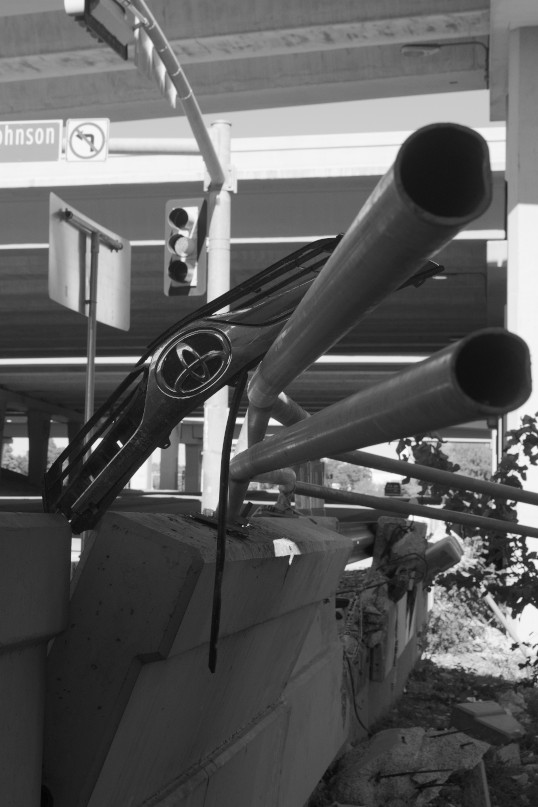
Lyndon Baines Johnson Freeway and Texas Instruments Boulevard, Dallas, Texas
“I believe when life gives you lemons, you should make lemonade…and try to find someone whose life has given them vodka, and have a party.”
―

Four Corners Brewery, Dallas, Texas
“What are you?’
‘I’m the Turtle, son. I made the universe, but please don’t blame me for it; I had a bellyache.”
― It

Delta Duck-Potato (Sagittaria platyphylla), Leonhardt Lagoon, Fair Park, Dallas, Texas
The first time I brought a date over she said: what’s with your dad and that pole? and I sat there blinking.
—- George Saunders, Sticks
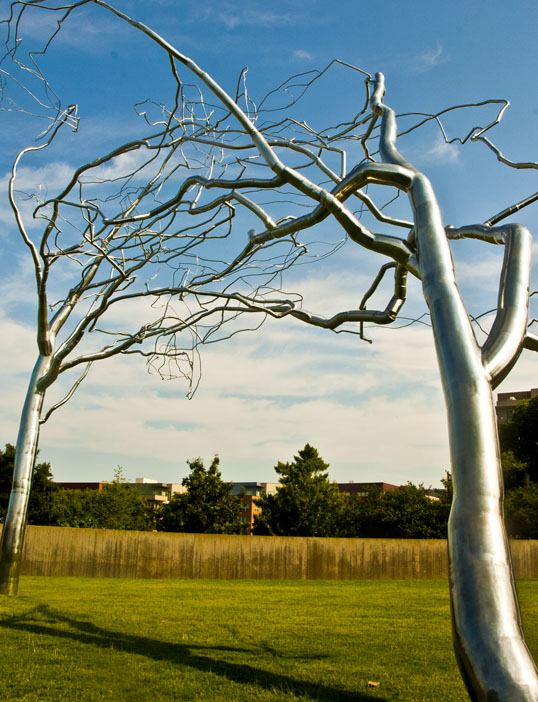
Modern Art Museum of Fort Worth
Conjoined, Roxy Paine
George Saunders is a writer that amazes me. If I could write like any one person I would want to write like him (though I have said the same thing about Raymond Carver… so, well, maybe it’s a tie).
I’ve written about stories by Saunders before:
Today’s short story is a one minute piece of flash fiction that contains an entire life full of frustration and regret. It’s funny and sad, in the terrible way that only funny things can be so sad. It’s called Sticks.
You can read it here: Sticks, by George Saunders
In the introduction to the published version in “Story” magazine he explains how he developed the idea for the story (if you follow my link above you can find out for yourself). That short explanation is as amazing as the fiction itself. We all see things along the road, especially along our commute to work, that become part of our lives so intimately that they disappear. Still, your imagination is filled with these things and the stories they generate. Only a genius like George Saunders can imagine something so poignant and unforgettable, so buoyant and unforgivable.

Modern Art Museum of Fort Worth
Men liked her, and she took it for granted that the liking of many men was a desirable thing. Popularity seemed to her to be worth all the work that had to be put into its achievement. Men liked you because you were fun, and when they liked you they took you out, and there you were. So, and successfully, she was fun. She was a good sport. Men like a good sport.
—- Dorothy Parker, Big Blonde

Deep Ellum Brewing Company – Dallas Blonde
Big Blonde is considered Dorothy Parker’s best, most literary work – as opposed, I guess, to her usual stuff that is considered witty.
You can read it online here: Big Blonde at Project Gutenberg Canada. It’s still under copyright in the US, so don’t print or distribute it.
Under the thin veneer of Dorothy Parker’s signature sparkling prose – this is a very sad story of a very sad and very hapless woman. It is a well-known work (it won the O. Henry award as the best short story of 1929) with a lot of discussion about it on the internet. A lot of modern discussion is about the story’s criticism of traditional female roles and, of course, its harrowing description of alcoholism (or at least drunkenness) and depression. It is these things in spades, but I think it is more.
Hazel Morse is a hopeless drunk that is used and abused by men – but I don’t think she is an idiot and I think she had some choices. She is depressed to the edge of suicide, but is she depressed because of her life or does she live that life because of her depression? Probably a little of both. It’s also more than a little autobiographical – though I don’t think Hazel Morse would inspire so many people after all these years as Dorothy Parker does. Hazel’s parties aren’t quite up to the intellectual quality of the Algonquin Round Table.
I have been reading a bit about how struggle gives meaning to life… to the extent that life is the struggle. A corollary of this is how having happiness as the main goal of life is a recipe for disaster. Hazel and all the people in her life seem to have moment to moment happiness as their only reason for getting out of bed in the morning and as a consequence sometimes don’t even do that. They avoid struggle at all costs and end up in a hopeless struggle against the ever-present void.
The story was written and is set in 1929 – the last year of the roaring twenties. I can’t help but think about how different the story would be if it took place a couple years later. How is the Big Blonde going to make it through the Great Depression? It’s not a pretty thought.
Here’s mud in your eye.
“Country life has its advantages,’ he used to say. ‘You sit on the veranda drinking tea and your ducklings swim on the pond, and everything smells good. . . and there are gooseberries.”
― Gooseberries

Deep Ellum, Dallas, Texas
 Bill Chance