Mardi Gras, Bishop Arts District, Oak Cliff, Dallas, Texas


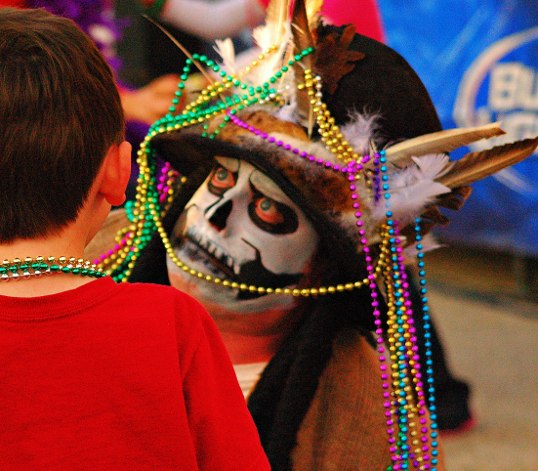
Mardi Gras, Bishop Arts District, Oak Cliff, Dallas, Texas
New Orleans, French Quarter
.
 .
.
I noticed, while milling around the Bishop Arts District before the Mardi Gras Parade, a little piece of cardboard box down an alley, with two disposable cameras sitting on it.

Camera in the wild.
The box said:
I may not have mega-pixels
But I’m still pretty awesome
Facebooke.com/camera.bishop.arts
I thought about grabbing a camera and taking a shot, but hesitated and some other folks grabbed it first. You snooze, you lose. The idea of leaving a cheap film camera sitting around for people to use is pretty cool….
And now the pictures from the Mardi Gras Parade are up on the facebook page.
As far as the note goes… I have no idea about the misspelled URL.
I’ll keep checking back though, see what develops.
Mardi Gras Parade, Bishop Arts, Oak Cliff, Dallas, Texas

Fight for the beads.
I have this thing about Mardi Gras beads. I love to catch parade throws – yelling “Beads! Beads!” or “Big Beads!” – making eye contact with the Krewe member on the float – the cheap bilious plastic string floating through the air – the jump – the catch – and finally, adding the string to the growing collection around my neck. It’s stupid, but I love it.
Two years ago, in New Orleans, we went out to a night of smaller parades on Thursday or something… sort of a warm-up for the big Super Krewes that were coming up on the weekend. I like these smaller Krewes – they have an irreverent sense of humor that the big, expensive parades can’t match.
At any rate, after a day and night of catching, my neck was festooned with a thick collar of plastic beads – especially the smaller ones thrown by the less-well-financed Krewes of that afternoon and evening. We were hungry so at two in the morning or so we ducked into an Italian Restaurant out on St. Charles past Tulane.
As we sat there I became a little self-conscious about the beads and decided to take them off. That’s when I realized that they were terribly tangled around my neck and that I was trapped, slowly choking in a noose of bright plastic spheres strung on string. I sat there trying to work on the beads while fighting back panic.
“Just cut them off, here I have scissors in my purse,” said Candy.
“No, I can’t,” I said.
“Why not?”
“They’re Mardi Gras Beads! I can’t cut them.”
“They’re just cheap plastic. Cut ’em off.”
But I couldn’t. I have no idea why, but the fact they were thrown through the air and caught made them special, somehow. It took me an hour of careful, patient untangling to get them off.
Now, I’ve accumulated a big plastic tote full over the last few years. It sits in the bottom of a closet and I should throw them away… but I can’t do it. What I need to do is find a parade and walk – throw them myself – return them from whence they came. Back into the wild – catch and release.
That I could do.
Well, for the last two years we are way too broke to go to New Orleans for Carnival. The best we could do, last year and this, is go to Oak Cliff for the Bishop Arts Mardi Gras parade.
It isn’t New Orleans… but it will do . It has to.
Bishop Arts Mardi Gras Parade, Oak Cliff, Dallas, Texas

Laissez les bons temps rouler
The Girl With Many Eyes
One day in the park
I had quite a surprise.
I met a girl
who had many eyes.
She was really quite pretty
(and also quite shocking!)
and I noticed she had a mouth,
so we ended up talking.
We talked about flowers,
and her poetry classes,
and the problems she’d have
if she ever wore glasses.
It’s great to know a girl
who has so many eyes,
but you really get wet
when she breaks down and cries.
—- Tim Burton
The real voyage of discovery consists not in seeking new landscapes, but in having new eyes.
—-Marcel Proust
I think the eyes flirt most. There are so many ways to use them.
—-Anna Held
The tree which moves some to tears of joy is in the eyes of others only a green thing that stands in the way. Some see nature all ridicule and deformity… and some scarce see nature at all. But to the eyes of the man of imagination, nature is imagination itself.
—-William Blake
When a woman is talking to you, listen to what she says with her eyes.
—-Victor Hugo
Men are born with two eyes, but with one tongue, in order that they should see twice as much as they say.
—-Charles Caleb Colton
When you are old and gray and full of sleep, and nodding by the fire, take down this book and slowly read, and dream of the soft look your eyes had once, and of their shadows deep.
—-William Butler Yeats
The hardest thing to see is what is in front of your eyes.
—-Johann Wolfgang von Goethe
Wicked thoughts and worthless efforts gradually set their mark on the face, especially the eyes.
—-Arthur Schopenhauer
So if you’re down on your luck, I know you all sympathize
Find a girl with far away eyes
And if you’re downright disgusted
And life ain’t worth a dime
Get a girl with far away eyes
—-Mick Jagger/Keith Richards
I am not a demon. I am a lizard, a shark, a heat-seeking panther. I want to be Bob Denver on acid playing the accordion.
—-Nicolas Cage

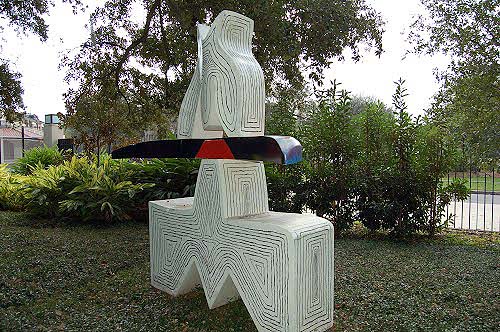
Ida Kohlmeyer, Rebus 3D-89-3
The Sydney and Walda Besthoff Sculpture Garden, New Orleans Museum of Art, New Orleans
Rebus 3D-89-3, Ida Kohlmeyer
“The lizard brain is hungry, scared, angry, and horny.
The lizard brain only wants to eat and be safe.
The lizard brain will fight (to the death) if it has to, but would rather run away. It likes a vendetta and has no trouble getting angry.
The lizard brain cares what everyone else thinks, because status in the tribe is essential to its survival.
A squirrel runs around looking for nuts, hiding from foxes, listening for predators, and watching for other squirrels. The squirrel does this because that’s all it can do. All the squirrel has is a lizard brain.
The only correct answer to ‘Why did the chicken cross the road?’ is ‘Because it’s lizard brain told it to.’ Wild animals are wild because the only brain they posses is a lizard brain.
The lizard brain is not merely a concept. It’s real, and it’s living on the top of your spine, fighting for your survival. But, of course, survival and success are not the same thing.
The lizard brain is the reason you’re afraid, the reason you don’t do all the art you can, the reason you don’t ship when you can. The lizard brain is the source of the resistance.”
― Seth Godin
Born in New Orleans in 1912, Ida Kohlmeyer has been called one of the best Abstract Impressionist painters of the South. Her career as an artist did not begin until her 30s, after she graduated from Newcomb College at Tulane University with a degree in English literature. In 1934, she traveled to Mexico City and was inspired by Central and South American folk art, which would remain an influence throughout her life. Several years later she began taking painting and drawing classes at Tulane with Pat Trivigno, who encouraged her to pursue her study of artwork. Upon receiving her master’s she showed her first paintings at the Fifty-Fourth Annual Spring Exhibition at the Isaac Delgado Museum of Art in New Orleans.
In 1956, Kohlmeyer moved to Provincetown, Massachusetts to experiment with Abstract Expressionism alongside Hans Hoffmann. That same year she traveled to Paris and met Joan Miró, who also inspired her abstract work. However, by the mid 60s she tired of abstraction and moved on to create sculptures with wood and Plexiglas. After experimenting briefly with figurative painting, she returned to abstraction in the 70s. Kohlmeyer died in her hometown of New Orleans in 1997.
“It comes from a very ancient democracy, you see…”
“You mean, it comes from a world of lizards?”
“No,” said Ford, who by this time was a little more rational and coherent than he had been, having finally had the coffee forced down him, “nothing so simple. Nothing anything like so straightforward. On its world, the people are people. The leaders are lizards. The people hate the lizards and the lizards rule the people.”
“Odd,” said Arthur, “I thought you said it was a democracy.”
“I did,” said Ford. “It is.”
“So,” said Arthur, hoping he wasn’t sounding ridiculously obtuse, “why don’t people get rid of the lizards?”
“It honestly doesn’t occur to them,” said Ford. “They’ve all got the vote, so they all pretty much assume that the government they’ve voted in more or less approximates to the government they want.”
“You mean they actually vote for the lizards?”
“Oh yes,” said Ford with a shrug, “of course.”
“But,” said Arthur, going for the big one again, “why?”
“Because if they didn’t vote for a lizard,” said Ford, “the wrong lizard might get in. Got any gin?”
“What?”
“I said,” said Ford, with an increasing air of urgency creeping into his voice, “have you got any gin?”
“I’ll look. Tell me about the lizards.”
Ford shrugged again.
“Some people say that the lizards are the best thing that ever happenned to them,” he said. “They’re completely wrong of course, completely and utterly wrong, but someone’s got to say it.”
“But that’s terrible,” said Arthur.
“Listen, bud,” said Ford, “if I had one Altairian dollar for every time I heard one bit of the Universe look at another bit of the Universe and say ‘That’s terrible’ I wouldn’t be sitting here like a lemon looking for a gin.”― Douglas Adams, So Long, and Thanks for All the Fish
“There is only one thing I fear in life, my friend: One day, the black will swallow the red.” – John Logan, from Red

It was time for another “Pay What You Can” night at Dallas Theater Center’s Wyly theater. I have seen King Lear and The Elaborate Entrance of Chad Deity at rock-bottom prices and now watch the web site for any new opportunities.
This go-round is the Tony Award winning play Red, by John Logan. It’s a two man play based on the artist Mark Rothko, set in Rothko’s studio in 1958, during the time he is working on a group of large murals for the new Four Seasons Restaurant in the Seagram Building in New York. Rothko and his fictional assistant, Ken, work and talk about art and life. The overarching conflict between the two is the very acceptance of the commission to decorate the walls of a restaurant frequented by the wealthiest people in the world. Rothko insists it is a subversive act, that he wants to paint, “something that will ruin the appetite of every son-of-a-bitch who ever eats in that room.” Ken counters that Rothko simply wants to feed his ego with the money and fame the prestigious commission offers.
At any rate, I was going alone, and went to catch the train downtown. Since I left from work, I felt underdressed – but that was fine; the crowd for “Pay What You Can” night was motley and wearing all sorts of styles at various levels.
I was interested in the staging of Red. King Lear is still running at the Wyly in the main stage above the lobby (the Wyly is revolutionary in its stacked structure – the lobby is at the bottom, the stage area above, with the support spaces higher up). For Red, they converted the rehearsal hall on the ninth floor into an artist’s studio.
While the patrons attending Lear were entering on the right side of the Lobby, we were divided into groups and sent up elevators to the ninth floor. The tickets had no seat assignments, so the crowd wandered around the edges of the studio, finding chairs lined against the wall on low risers. After I settled in, I noticed the actor playing Rothko silently sitting in a comfortable chair in the center of the room, staring and contemplating one of his in-progress color fields. Finally, the last patron came in looking around, looking lost – I noted his clothing was curiously dated… like something out of the fifties. Suddenly I realized that this was the actor playing the assistant, he spoke to Rothko, and the play began.
The play was simple – only two characters, one set, no intermission. Very intimate – you are there in the studio with the two characters. It was more intellectual than passionate – the only real moments of raw emotion was generated by Ken talking about the death of his parents… and that felt a bit forced. Still, it was enjoyable – the character of Rothko is a grand pompous bully – and a brilliant one. Ken was more of a blank canvass where Rothko would paint with his powerful personality and stubborn ideas, but Ken’s point of view somehow kept winning out in the end.
One highlight was a long, wordless passage where Rothko and Ken together slather the dark crimson undertone on a giant canvas, both working hard, slinging heavy brushfulls of paint in different sections of the wall-sized work, their breathing hard and passionate in the small space. To Rothko his paintings are living things… and he feels responsible for and concerned about their ultimate fate.
There is a lot of talk of the art of the time. It was fascinating how Rothko boasted of how he and the abstract expressionists dethroned Picasso and Matisse (“Nobody even thinks of painting cubism anymore, it’s dead”) and how Ken feels that Pop Art is now overthrowing Rothko.
Ken namedrops Warhol, Johns, Rauschenberg, and Lichtenstein – and Rothko asks, “Lichtenstein, who’s that?”
I was happy when, in my mind I thought, “Comic Books,” and then Ken says, “Comic Books.”
There is a lot of namedropping here, and it helps to know a thing or two about a thing or two – but not so much that it gets in the way of the entertainment.
After the play we rode the elevators back down to the lobby. It was full of patrons from King Lear, which was in intermission. They were all very nattily dressed, formal, seeing and being seen in that Dallas way while we cheapskates skittered away at the edges.
Outside, the glittering canyons of the city were shining at night while torn scraps of low cloud skimmed by overhead, illuminated by the lights below. It was beautiful and a bit of a shock – while the play was going on it was easy to think you were really in a dingy art studio and forget that you were really nine stories in the air in a huge aluminum cube-theater-machine.
Down Flora Street, between the hulking rows of the Arts District public edifices stood the Dallas Museum of Art. Inside, I knew, there was a Rothko painting. I’ve seen it before – but now I want to go back and stare at it for a while, watch it pulse, see it live, think about what the artist was thinking in that dark place where it was painted.

Mark Rothko, Orange, Red and Red, Dallas Museum of Art
The 10 Most Useless Kitchen Gadgets
I’m afraid there are a couple of these I wouldn’t mind having. I will not tell you which ones.
California vs. Texas: Wild West Shootout
But behind the posturing lies a riveting drama. Two of our biggest and richest states, polar opposites on the political spectrum, are taking radically different approaches to attracting new jobs. Policymakers in Washington and beyond will be watching closely to see who comes out on top.
….
This is the Ali vs. Frazier of interstate rivalries. It promises to be the fight of the decade.
The Top Tools for Productivity
The number one tool is the Pomodoro Technique – which I’ve found to be very useful.
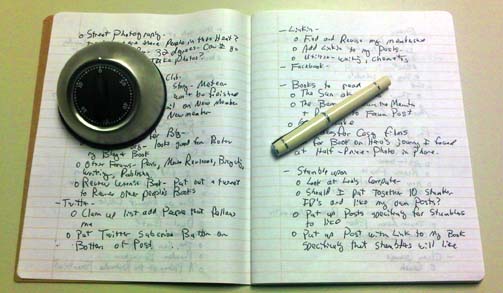
An Idea Pomodoro – timer, pen, composition book.
The federal government’s relentless expansion has made Washington, D.C., America’s real Second City.
The Washington, D.C., region has long been considered recession-proof, thanks to the remorseless expansion of the federal government in good times and bad. Yet it’s only now—as D.C. positively booms while most of the country remains in economic doldrums—that the scale of Washington’s prosperity is becoming clear. Over the past decade, the D.C. area has made stunning economic and demographic progress. Meanwhile, America’s current and former Second Cities, population-wise—Los Angeles and Chicago—are battered and fading in significance. Though Washington still isn’t their match in terms of population, it’s gaining on them in terms of economic power and national importance.
In fact, we’re witnessing the start of Washington’s emergence as America’s new Second City. Whether that’s a good thing for America is another question.
3 Hottest Real Estate Markets in Dallas for 2013
I’m surprised that they mention Richardson, where I live, as one of the hottest real estate markets – though I am partial to the inner-ring suburb.
Of course the comments consistantly talk about how awful Richardson is – so it must be a great place.

An Afternoon with Ralph Steadman
He gets out his signature fountain pen and fills it with ink.
The 12 Best Acting Performances at Sundance 2013
Pen and Ink Blog Illustrates Stories Behind Tattoos
Is Urbanism the New Trickle-Down Economics?
12 Louisiana Bands You Should Listen To
Waiting for Texas – but this is getting close.
New Orleans, French Quarter, Halloween

There is something inherently cool about a bicycle with a plastic milk crate strapped to the back.
Klyde Warren Park, Dallas
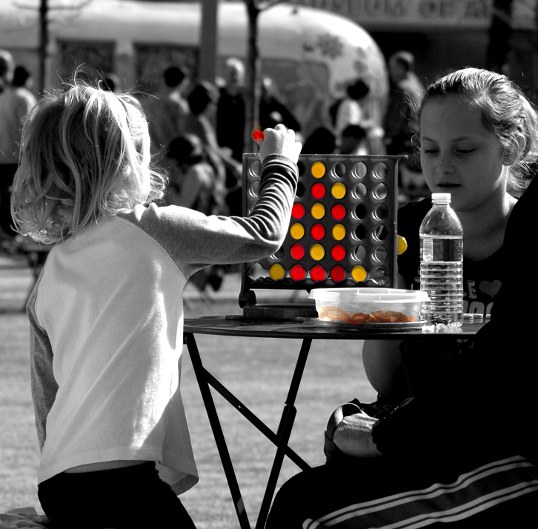
I’m afraid yellow is about to win in two turns.
 Bill Chance