

(click to enlarge)
“My Curves Are Not Mad” by Richard Serra
“Squares with Two Circles (Monolith)” by Barbara Hepworth
“Eve” by Auguste Rodin
“Little Johnny the Troublemaker” by Mrs. Smith
(click to enlarge)
“My Curves Are Not Mad” by Richard Serra
“Squares with Two Circles (Monolith)” by Barbara Hepworth
“Eve” by Auguste Rodin
“Little Johnny the Troublemaker” by Mrs. Smith
I have been reading about a park constructed in the heart of Downtown Dallas, in a spot where an old parking garage had been torn down. Called the Main Street Garden Park, it was designed both as a tiny bit of open green space in the vast expanse of concrete, glass, and steel in downtown, but also as a place to host gatherings and events. It was a block-long open spot lined by various amenities, a stage, and an organic restaurant. I was downtown running around, and decided to take a look at the park.
The grass was brown and in need of some growing, but otherwise it was a nice enough spot. Its main use seemed to be a patch of grass for the residents of the high-rise condo towers to walk their dogs and allow them to do their business. There was a steady stream of mutts and their owners coming and going, and picking up dog shit in plastic bags. I tried to sit for awhile in a nice little covered area but the smell of dog crap from the nearby trash can was overpowering.
I liked the park, though. It seemed like a cool place to hang, as long as the weather wasn’t too bad (I’ll bet it gets really hot in the summer).


The main lawn of the Main Street Garden Park, with the permanent stage at the far end. The signs say, “Please Keep Off The Grass – We Are Growing Our Roots.”
The Beaux-Arts style building in the background is the old Dallas City Municipal Building. At the present time, the building is being renovated into the first public law school in North Texas the University of North Texas at Dallas College of Law. It’s a well known landmark, something infamous happened in the basement parking garage of that building almost fifty years ago.
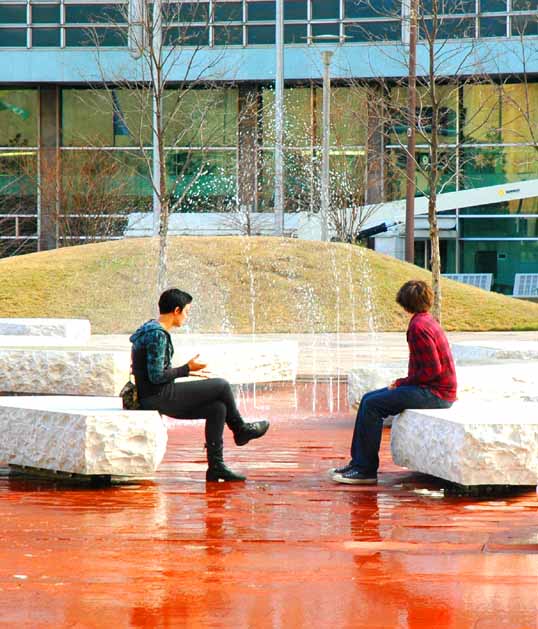
Down at the other end of the park there is a nice little fountain and some rocks to sit on. A nice place for a conversation – maybe the water will cool it off a bit in the summer.


Give homeless in downtown Dallas’ Main Street Garden long-term housing
When I first moved to Dallas, over thirty years ago, I lived with some friends in Kessler Park, in Oak Cliff for a while until I saved enough money to get an apartment. I was working downtown and rode the bus to work. Living in the city was a big deal for me and I remember the quiet excitement of the bus ride to work. It came across the Commerce Street Viaduct into the canyons of skyscrapers after passing through the triple underpass and Dealy Plaza. To get to Commerce, the bus would drive up Sylvan Avenue.
In 1981 this was a very distressed area. That was a real shame because this part of “The Cliff” has a lot going for it. It’s close to downtown and is really the only part of the city with any kind of hills at all. It’s an old, beautiful part of the city. But thirty years ago, looking out that bus window, it was obvious that a long walk on those sidewalks might very well be fatal.
At Sylvan and Fort Worth Avenue there was a hotel called the Belmont. It was barely visible from the street because it sat up on top of a steep little rocky hill. It had a cool-looking retro deco office and a string of bungalows snaking across the crest of the hill. I never drove up there, but it was obvious that the place would have the best view of downtown in the city. It was run down and I wasn’t sure if it was even open. At any rate, it would not be a place anyone would want to stop – the neighborhood was frightening.
I remember thinking that it was a shame that little hotel was wasting away in such a state. I would fantasize about how smart and hip a property it could be with a little updating and a strong and visible security force. I was always thinking and talking about trashed out places that I thought should be fixed up. People used to make fun of me when I would talk about stuff like that. Nobody understood the potential I saw in those run down places. I felt like an idiot.
Now as I tumble into oldfartdom I realize I was right all along (the realization comes too late to do any good, of course). Oak Cliff is now the hot place to be in Dallas, and with the impending opening of the Margaret Hunt Hill Bridge that Renaissance/development/gentrification is only going to gain speed.
At the forefront of this change is that little hotel I used to stare at out of the bus windows. The Belmont has been rebuilt into a cute little boutique hotel and everybody who is anybody stays there. An upscale bar-b-que joint that specializes in local foods, called Smoke, is attached to the hotel and has become one of the most buzzworthy eateries in the city.
I really wanted to see this place.
On Sunday, Candy and I ate lunch in the Bishop Arts District and then driving back we planned on stopping at the Belmont and checking out the Bar Belmont and its view of downtown. The Belmont did not disappoint. They have done a fantastic job of updating the property while maintaining the the Art Deco retro-cool feel about the place.
The bar has a great patio. Part of it is covered and part is outside. It would be a fantastic place to hang out on one of the three or four days of good weather that Dallas gets every year. Today it was too cold, so we went into the comfy indoor part of the bar.
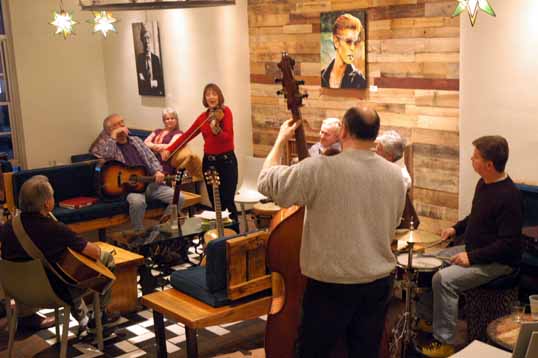
There was a knot of folks in the lower part of the bar unpacking guitars and arranging chairs and benches. While we sat up by the bar the crowd slowly began to grow with more and more musicians showing up and setting up. There were a half-dozen guitars, a few dobros, a banjo, a standup bass, a couple drummers, and a fiddle player. They started playing and singing.
It was fantastic. These people were very, very good. It was the best time – there were maybe ten musicians and about six of us listening. A free concert in an intimate setting with more performers than fans.
During a break, we found out what was going on. This was the Sunday Afternoon Charli’s Jam. Charli Alexander had founded this acoustic jam about thirty years ago. It has moved around from location to location and has now settled into the Bar at the Belmont. It is very well known and people have traveled from all over the world to play with these folks. There is a core of folks but Charli said it really varies from week to week, with different instruments, players, and styles of music. Today it was mostly traditional Texas honkey-tonk, with some folk and pop-folk thrown in (I’d love to hear some blues).
I loved listening to the jam. The core was arranged in a rough square and they would move around the square with each musician in turn choosing what they wanted to perform with the others filling in. During a part of each song they would take turns playing solos, with the original performer calling out the solo players in turn. They were very good, surprisingly tight. It was obvious that most of them were very used to each other and were able to anticipate what was coming next.
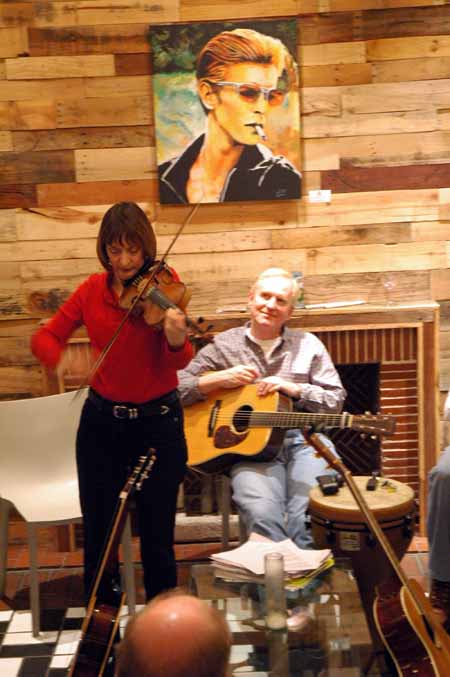
The room was filled with portraits of musicians, with David Bowie holding court over the mantle. Willie Nelson was on the opposite wall, a rough, glaring, black and white portrait. Everybody teased one singer (with an amazing bass voice) after he sang “Crazy” – telling him that it took some courage to sing that song with Willie looking on. “He’s happy as long as he gets his royalties,” was the answer.
They talked about a particularly difficult chord on the dobro. “That’s hard on the guitar, but even tougher on this,” the dobro player said. “At least Nancy doesn’t have to deal with that,” he said, referring to the fiddle player. “Yeah, but she has to worry about her own problems, like no frets,” someone else pointed out.
Candy and I had such a good time, we sat there and listened for three hours. Charli said they liked having people come out to listen, “It makes us play a lot better.” She said they are there every Sunday at three o’clock. I guarantee we will be going back.
I think we were the only fans to stay for the whole time. A few people came and went – some friends of the musicians. A few guests came to the Belmont desk to check out and stayed for a drink and a few songs. One scraggly looking guy stood by the desk for a couple of minutes. He looked familiar, but I didn’t pay much attention. When the song ended, he was gone, but the guitar player said, “Hey, that was Kinky Friedman standing there.”
So I think of that run-down old fashioned string of shabby bungalows up on that hill thirty years ago and what it has become today. I think of a young kid excited about riding a bus through a bad neighborhood in a big city. Now, it’s changed, but it’s still the same. Everybody had such a good time – the musicians in the jam, the hotel guests, even the folks working at the hotel. Sometimes it can come back.
The great Dallas bluesman, Mick Tinsley, playing his killer version of a Mark Curry number – “Raining All Over Me”. Recorded at Charli’s Sunday Jam at the Belmont Hotel in Dallas, Texas June 2010
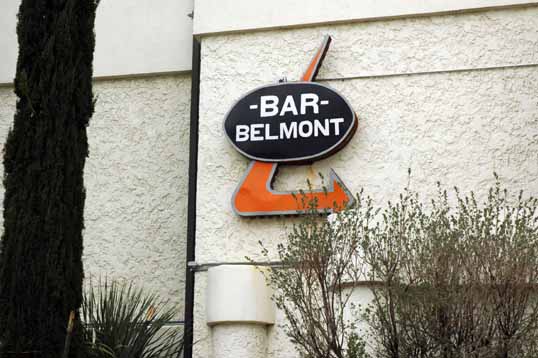
The street entrance to the Bar Belmont

Charli's Sunday Afternoon Acoustic Jam

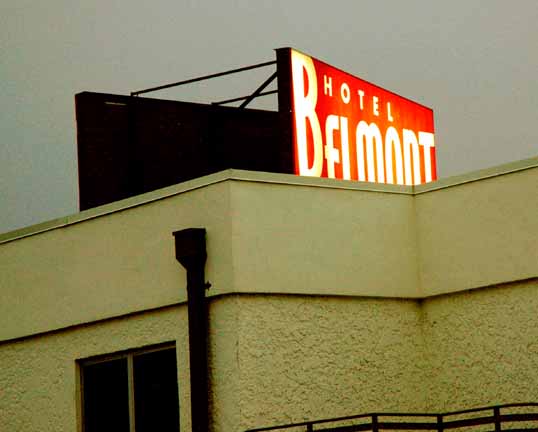

The front desk entrance to the Art Deco Belmont Hotel, with Smoke in the background.
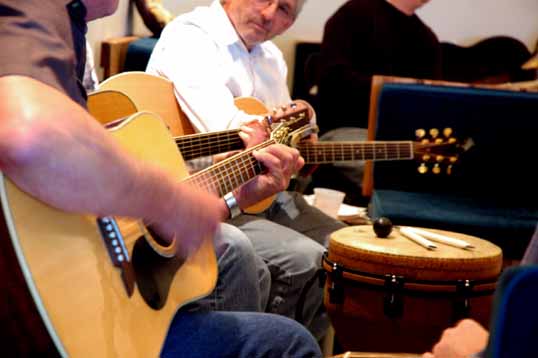

Playing the Dobro

The view of Downtown Dallas from the Belmont Hotel
I have ridden and written about three of the McKinney Avenue Transit Authority trolley cars – Petunia, Matilda, and Rosie. There was one more that I had never ridden (or at least didn’t remember riding) – The Green Dragon (MATA does have one more car – but it’s used for maintenance. They have several more being restored).
The Green Dragon is an unusual looking car. The driver’s station at each end looks like it was tacked onto a regular car. Its roof is flat and sort of sticks out and even looks like it dangles down a little bit.
It was built in 1913 (it will be a hundred years old next year) and ran in Dallas for 46 years. It ran on McKinney avenue and the SMU students gave it the nickname “Green Dragon” back in the day. She was retired in 1956 and used as a hay barn in North Dallas for a few decades. For a while it was used to display Roger Staubach’s Jersey in a sports museum in Grand Prairie.
I was happy to see the Green Dragon pull up to the Central Expressway Trolley stop. She is a large car and has a very smooth ride. From the inside, you can see the wooden bulkhead that marks the transition from the curved roof of the car to the flat roof of the cab. It doesn’t look as odd inside as it does when the car is clanking down the track.
The Green Dragon is a sweet ride and a great way to get around Uptown.


Night (La Nuit)by Aristide Maillol
On the free family days at the Nasher, it’s tough to get people not to touch the sculptures. Also, a lot of folk like to pose by the statues in mocking or strange positions. It’s a little aggravating, though I have to admit, I’m guilty of that myself.
From Heidi’s Do-All Blog – Strange Day at the Nasher
According to my calculations, this Wednesday, February 15, at 6:13 PM will be this spring’s Dallashenge moment. That is when the setting sun will be aligned with the canyons of Dallas’ downtown streets, which do not run exactly east-west (if they did, Dallashenge would occur on the equinox). Of course, it’s called “henge” in reference to Stonehenge, another man made arrangement of objects aligned with the heavens. Manhattanhenge seems to be a pretty big deal in the Big Apple, but I have not found anyone other than me working out the date for Dallas.
Unless the weather makes this impossible, I plan on heading downtown to take pictures on Wednesday (If you are interested in meeting down there, contact me). I had a couple of questions, though – how hard would it be to grab a photograph while crossing at the light and which street would be the best canyon to photograph.
Test shots were in order.
I was downtown last weekend so I walked across the street grid, taking photographs at each intersection. My first question was easily answered – there is plenty of time during the time the little walking guy appears on the crossing light to dash out into the center of the lane, snap a couple pics, and then dash back before the cars are unleashed.
There are four major east-west canyon streets in downtown Dallas. From south to north: Commerce, Main, Elm, and Pacific.
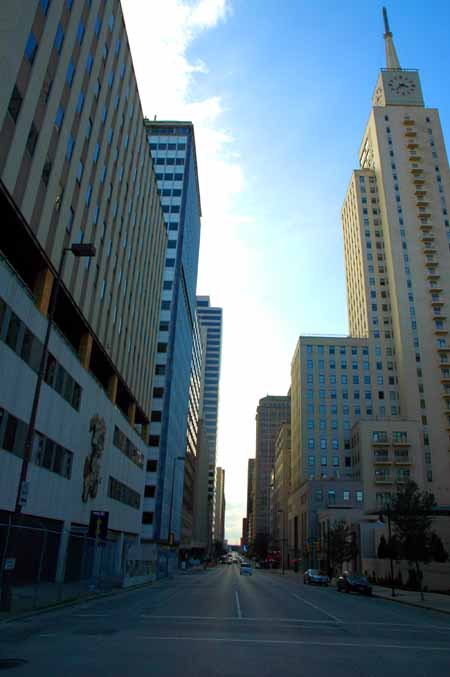
Looking west from Commerce and St. Paul Streets in downtown Dallas.
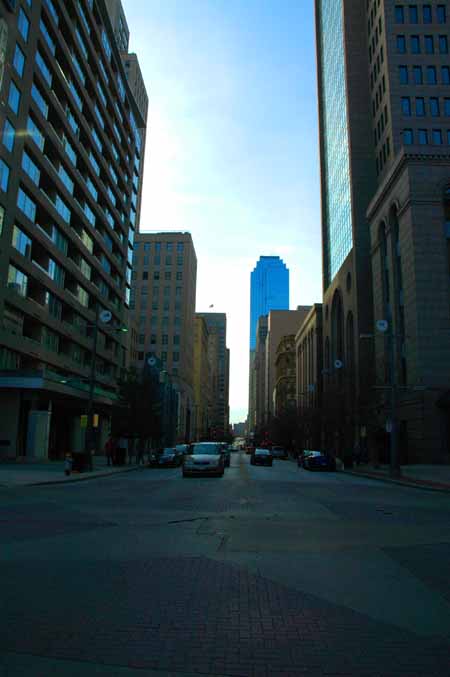
Main Street and St. Paul

Elm and Harwood Streets. I like this view. I'm not sure if the pedestrian bridge will ruin the shot. Also, the Lew Sterrett jail is at the end of the street and may block the sun's orb..

Pacific and St. Paul, at the end of LIve Oak. This location has the advantage that it isn't in the street and I can set up a tripod and take photos on my schedule instead of rushing out when the light changes.
Of the four, I like Elm a lot. I tried to get up into that pedestrian bridge, but it is closed to the public. A shot from street level would be cool, especially with the Majestic Theater there to the right.
My favorite is the Pacific shot, though. There is a big advantage there, too. At the end of Live Oak street (Pacific/St. Paul/Live Oak) there is a bit of sidewalk that juts out into the middle of the street. I can set up a tripod there and take photos at my leisure.It has a nice canyon in the middle and they the sky opens with some glass mirrored ‘scrapers sticking up – if there is a nice sunset, it will look cool.
I’ve never done this kind of shooting before… any advice would be appreciated.
So, weather permitting, I plan on taking the DART train downtown and setting up on the sidewalk there at Pacific and St. Paul (I might dash on over to Elm too, I’m not sure how the timing will go) to get some pictures of the sun setting down that man-made canyon.
I’m not an expert on this and I may be reading the ephemeris tables wrong. Friday might actually be a better evening – the sun’s orb will be a little higher up and might make for a better photo. I could go back again, Friday would be easy. Again, if the weather is bad – too much cloud cover – I won’t even bother to go down there.
So we’ll see. I’ll keep you appraised.

Yet more food trucks open in Dallas-Fort Worth
Fred’s Cafe Truck Wagon
Facebook
Twitter
Little Vessel Grill Food Truck
Facebook
Twitter
Tin Star Taco Taxi
Facebook
Twitter
Cajun Tailgators
Facebook
Twitter
Dos Paisanos (Salvadorian! – To roll out during the Bishop Arts Mardi Gras Parade)
Facebook
Website
The inevitable march of Open Source, low cost or free, books, especially e-books continues.
If it were up to me Sigur Rós would play the halftime show at the Super Bowl. I guess that shows why it isn’t up to me.
I have always tried to avoid using the generic “They” in my speech and writing. As in, “They say that mauve is the new black” or “They want us all to pay more taxes this year.”
150+ Valentines From Your Childhood
What started out as a simple google image search resulted in this giant collection of Valentines from the past. Send them to your friends!
These are a hoot! Most of them are product-oriented, and I’m a bit too old for most of those. My memories of Valentines’ Day Cards are from the Mid-60’s, from Elementary School. Everybody would buy Valentines for everybody else in the class. You would stuff them in a big box and then they would get passed out. Everybody ended up with a big pile of cheap paper. This really confused me – if everybody gave and received them, what was the value?
I’m trying to remember what these looked like… I think it was something like this.
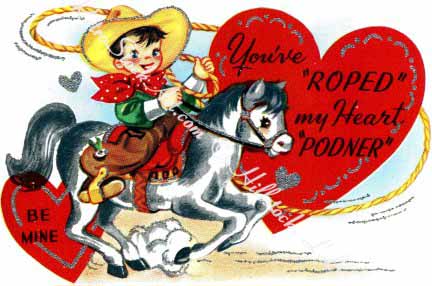
“There is also the story about Tyrone Slothrop, who was sent into the Zone to be present as his own assembly–perhaps heavily paranoid voices whisper, ‘his time’s assembly’–and there ought to be a punchline to it, but there isn’t. The plan went wrong. He is being broken down instead and being scattered. His cards have been laid down, Celtic style, in the order suggested by Mr. A.E. Waite, laid out and read, but they are the cards of a tanker and feeb: they point only to a long and scuffling future, to mediocrity…-to no clear happiness or redeeming cataclysm.”
― Thomas Pynchon, Gravity’s Rainbow


There are four operating passenger streetcars in the McKinney Avenue Transit Authority‘s fleet of trolley cars. I had ridden (and written about) two of them – Matilda and Rosie. I decided to take a shot at getting on another of them and sat down at the trolley stop next to the Dallas Museum of Art and pulled out my Kindle to read a bit and wait for the car.
I was rewarded when a little streetcar named Petunia pulled up. I had not ridden this one yet.

The old streetcar next to the Art Museum and the glass towers of downtown.
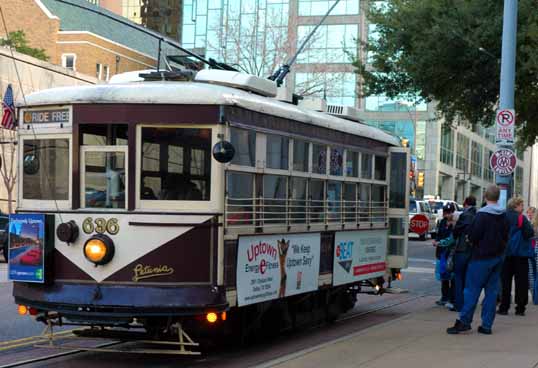
Petunia was built in 1920 and is a “Birney Safety Car” named after her designer, Charles O Birney. Birneys were known for their bouncy ride. Petunia ran in Dallas until 1947. For the next 30 years, she was stripped of her running gear, then equipped with a stove, sink, bed, refrigerator, easy chair, and blue curtains, and used for a residence. She was acquired by MATA and rebuilt – with shock absorbers added to even out the ride.
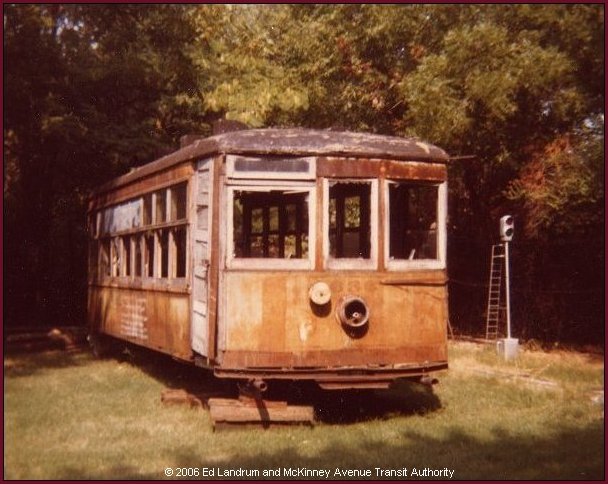
MATA Photo - Petunia before restoration.
She was packed with shoppers, commuters, and tourists (and me) and off we went across Woodall Rodgers and up McKinney Avenue. I chatted with some folks about child-raising and looked at all the folks eating in the restaurants and walking from bar to bar. Some young tourists kept going up to the streetcar engineer with a map on an iPad and tried to show him where they were trying to get to, but nobody could figure anything out.
The added shocks must work because Petunia has a much sweeter ride than the similarly sized Rosie. It was a fun and comfortable trip uptown.

There is something really cool about a trolley – whether it’s clanking through the crowded streets of Dallas or the misty neutral ground of New Orleans. There are plans for a real expansion of the trolley in Dallas… through the new park nearing construction on across the river into Oak Cliff. I wish they would hurry up – nobody lives forever.

Petunia in Uptown, at the other end of the line.
The Streetcar Renaissance in Dallas
The On-Line Birney Safety Car Museum

eyes that run like leaping fire - Elliott Hundley
You have a glib tongue, as though in your right mind, Yet in your words there is no real sense.
Wretched man, how ignorant you are of what you are saying! Before you were out of your mind-but now you are raving mad.
—-Euripides, The Bacchae
A while back, this guy, Euripides, wrote this play, The Bacchae.
It’s a story of Dionysus, a vain, jealous and vengeful god and the horrible revenge he exacts on mere mortals that refuse to worship him. It’s a story of Pentheus, the vain, stuck-up, and arrogant king who wants order, lawfulness, and absolute attention to his iron rule. It’s a story of women running wild in the woods, ecstatic with passion, blinded by lust and wine. It’s a tale of voyeurism, with the victims pulling the spy down and tearing him limb from limb. It’s the story of a mother returning triumphantly home carrying the disembodied head of her own son under her arm thinking it to be a hunting trophy.
The play was considered too grotesque to be seriously studied until Nietzsche wrote in praise of the genre. Now, of course, the flamboyant themes, aberrant scenes, and bizarre excesses are the cat’s meow, and the play has become fashionable, especially as an opera, where the outlandish aspects fit in well with the dramatic chorus.
The great theme of The Bacchae is a fascinating and important one. It is the constant, eternal struggle between freedom and control. Can an organized, rational society survive if it allows the irrational passions of the human heart to exist and express themselves? How can it survive if it does not? Where is the line to be drawn? What is the healthy limits to ecstatic pleasure? Are there any? The two forces: authority and freedom, rational and irrational, the head and the heart, duty and joy, moderation and excess, wisdom and instinct, self-control and human passion, restraint and release – are forever locked together wrestling in a death-grip struggle, each unable to defeat the other because, without its opposite, neither can survive.
Recently, the Nasher Museum in the Dallas Arts District crated up the Tony Cragg exhibition and sent it back to where it came from. I really enjoyed this one and was sad to see it go. It was replaced by a group of sculptures called The Bacchae by Elliott Hundley, a young Los Angeles based sculptor. I saw some photographs of the work and was disappointed. It looked junky, simple, and nothing special.
I was wrong.
Photographs can not do justice.
I took the DART train down to the Nasher on a Target First Saturday event, where I could stroll in and out and take it all in at my leisure. I was stunned. The stars of the show are the large flat assemblages that take up huge swaths of museum wall space. These are incredibly complex masses of kaleidoscopic images, from found objects to cut out photographs, from comic-book word balloons to paragraphs of newspaper-ransom-note-cut-outs – all suspended in various ways in front of giant billboard-like images. The closer you look, the more detail jumps out. You could spend a year in front of a single one of these and not be able to tease out all the passion and information contained within.
More traditional 3-D sculptural works occupy the center of the space and I found these interesting and well-done, but I, like everyone else in the crowded room was drawn back, again and again, to stand right against the little foot-ropes holding the mob back, and stare at the square inch of work that was right in front of my eyes until I could look at each little paper figure impaled on a wire pin or read the little quotes or try to decipher the galaxy of little objects that are presented sticking out from the wall.
The artist calls these “bulletin boards” and I can see why. They are enormous collections of a universe of detail and, like a lot of art, change tremendously with perspective and distance. Standing away (or looking at a photograph) you can see a landscape of large images partially obscured by clouds of smaller details. Once you approach, these details become apparent and you stare at them. If you want to get even closer, on certain works the artist provides magnifying glasses attached to a matrix of wooden sticks and you can peer through into an even smaller, almost microscopic world, of printers dots splayed across the mounted magazine advertisements and ink-jet printed paper objects.
As I looked I could listen to the comments of the other patrons around me – especially the children. This was a free admission with family activities day so there were a lot of kids. They were, of course, instantly drawn to the collages and it was a struggle for their parents to keep them from touching anything. The little ones would comment constantly. “Oh, that’s gross!” was a common reaction, said in that kid way that doesn’t necessarily mean that they didn’t think it was cool. A few parents would try to explain, in that condescending “I have brought my spawn to the art museum now I must get them to understand how important this is and how great a parent I am” tone and attitude but their voices would trail off, overwhelmed by the sheer mass of stuff that was stuck up on the wall in front of them.
Now, writing this, I want to go back and look at it all again. I want to try and break some of it down and see if I can relate it to the Euripides play now that I know a little more about it. I know I will. I can see a few hours stolen here and there to waste standing against that low rope staring at all that stuff stuck to all those pins.

detail from the LIghtning's Bride - Elliott Hundley
Review: ‘Elliott Hundley: The Bacchae’ at the Nasher
Art Review: Is Elliott Hundley’s Work More Suited For A Tim Burton Film Than the Nasher?
Elliott Hundley The Bacchae Exhibit at Nasher Sculpture Center
 Bill Chance