A&P

One of my favorite short stories of all time is John Updike’s A&P. If I could do anything – I wish I could write like this:

Text of A&P

Go ahead – read it now. It’s not very long – it won’t take up much time.

I read this story in college. For a chemist, I took a lot of literature classes. Most of them were honors level courses – and looking back, I didn’t get much out of them. They were very intellectual and were interested in ferreting out symbolism and deconstructing the text… and now, decades later, I realize they completely missed the point of what we were reading. My fiction writing classes were worse than useless; they set my writing ability back so far I’m only now, in my fifties, beginning to unlearn the false dreck violently stuffed into my young head.

After having exhausted my allotted supply of honors courses, I tacked on an ordinary English class – The Art of the Short Story. Basically, we cranked through a textbook that contained one hundred classic stories and wrote three papers or so a week. Our instructor was intimidated by the classroom setting so we met in a bar, talking about literature while we drank cheap yellow 3.2 beer from schooners, listening to each other’s conversation, and watching rivulets of condensation run down the thick glass.

This was a revelation. There was none of the vicious oneupmanship of the honors classes or the viscous boredom of the scholarship. It was true, lively banter where everyone was able to bring a different point of view along with some fresh ideas.

I’m sure I wrote an essay on A&P, but don’t remember what my angle was. I was working at a gas station over break back then and I remember really liking the paragraph where Updike writes about the sounds an old-fashioned cash register makes. He had it exactly right.

I go through the punches, 4, 9, GROC, TOT — it’s more complicated than you think, and after you do it often enough, it begins to make a lttle song, that you hear words to, in my case “Hello (bing) there, you (gung) hap-py pee-pul (splat)”-the splat being the drawer flying out.

The other day, after all these years, I discovered a short film version of the story. You should be able to watch it at this link – courtesy of SPIKE TV of all things:

A & P

I’m a little ashamed to admit that I stumbled across  this short looking up information on the new Three Stooges Movie. The guy in the short will play Larry in the Stooges movie, and, of course, you remember the actress that plays the girl, Queenie, from Road Trip.

I’m glad that they made this short. I am very glad I saw it. However, like any time a visual representation is made about a piece of literature that was important to you, I’m disappointed at some of the changes they made in the presentation.

The video doesn’t really fit my impression of the story… I think it’s the cutsie music. Or maybe the Ipswich accents.

The short story is edgier than the video suggests.

I didn’t like the scene where he imagines meeting Queenie at the party (though I suppose they had to pad it out somehow). It makes the story more of a romance fantasy, or a poor boy/rich girl story… which it is not. It is a much more fundamental conflict at work here – an elemental question of values.

And worst of all, all though the short has no qualms about presenting the protagonist’s internal dialog in voice over, it leaves out the last, most powerful bit. I’m talking about the last half of the last sentence of the story. The internal dialog that contains the horror of the story. The voice over says his stomach fell, but it doesn’t say why.

The story does.

I look around for my girls, but they’re gone, of course. There wasn’t anybody but some young married screaming with her children about some candy they didn’t get by the door of a powder-blue Falcon station wagon. Looking back in the big windows, over the bags of peat moss and aluminum lawn furniture stacked on the pavement, I could see Lengel in my place in the slot, checking the sheep through. His face was dark gray and his back stiff, as if he’djust had an injection of iron, and my stomach kind of fell as I felt how hard the world was going to be to me hereafter.

how hard the world was going to be to me hereafter.” I still remember reading these words in college and the fear that they struck in me.

What I learned this week, November 18, 2011


Are you worried about the Mysterious Structures in the Chinese Desert?

Fear no more, there is a simple explanation.


Do you need writing motivation? Do you like Kittens?

Here it is – Written?Kitten!


On of the essential techniques of art is to be able to reduce complex reality to its bare essential truth. Minimalism.

A master of this is the artist Gregoire Guillemin. I really love some of his work.

Take a look at this – famous people reduced to their bare minimum. How many can you identify? The groups are especially fun.

Here’s some more, divided up, some identified. I wish I could do that.


Why Does McDonald’s Keep Bringing McRib Back?

I have never ordered or eaten a McRib in my life. I don’t think this article is going to change my mind. I especially like this paragraph:

McDonald’s relationship with the pork industry goes back to the McRib’s conception. In 1972, Roger Mandingo, a University of Nebraska professor, received a grant from the National Pork Producer’s council to develop a technology that bound small “umarketable parts of the animal” into a formation that looked more appetizing. In other words, he figured out how to mold tripe, heart or stomach bits into something that looked like a choice cut of meat. Let’s say, the ribs.

MMMM, sounds like some gosh darn good eatin’

What’s the McRib made of, anyway?


The 10 Types of Writers’ Block (and How to Overcome Them)

  1. You can’t come up with an idea.
  2. You have a ton of ideas but can’t commit to any of them, and they all peter out.
  3. You have an outline but you can’t get through this one part of it.
  4. You’re stuck in the middle and have no idea what happens next.
  5. You have a terrible feeling your story took a wrong turn a hundred pages back, and you only just hit a dead end.
  6. You’re bored with all these characters, they won’t do anything.
  7. You keep imagining all the reasons people are going to say your story sucks, and it paralyzes you.
  8. You can’t think of the right words for what you’re trying to convey in this one paragraph.
  9. You had this incredibly cool story in your head, and now you’re turning it into words on a screen and it’s suddenly dumb.
  10. You’re revising your work, and you can’t see your way past all those blocks of text you already wrote.

I think the blonde dancer is Terri Garr.


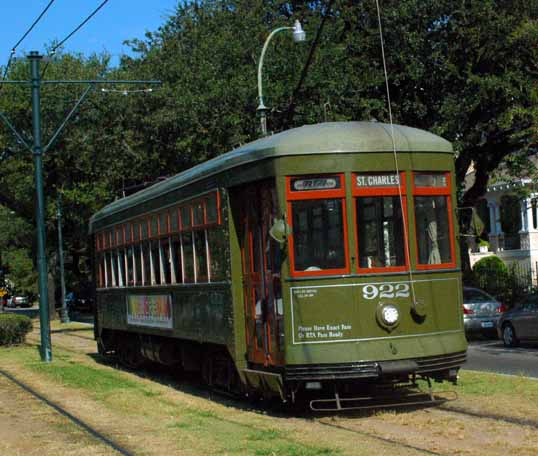
New Orleans – St. Charles Streetcar

The grandest ride in America was the St. Charles streetcar. You could catch the old green-painted, lumbering iron car under the colonade in front of the Pearl and for pocket change travel on the neutral ground down arguably the most beautiful street in the western world. The canopy of live oaks over the neutral ground created a green-gold tunnel as far as the eye could see. On the corners, black men sold ice cream and sno’balls from carts with parasols on them, and in the winter the pink and maroon neon on the Katz & Besthoff drugstores glowed like electrified smoke inside the fog.

—– from The Tin Roof Blowdown By James Lee Burke

The St. Charles streecar in New Orleans is one of my favorite things in the whole world. If you have never ridden it, put it on your bucket list. Now.

The best time to ride the streetcar is at sunset on a hot late summer evening. The windows open and the breeze from the motion sweeps the sweltering afternoon away as the purple sky darkens beyond the southern mansions and ancient oaks. You sit on the wooden seats jostling as the machine tumbles down the neutral ground. The lights flicker mysteriously and each new section of track is greeted with a flash of lightning, a clacking cacophony, and a whiff of ozone from under the wheels.

The streetcar becomes a time machine… no… not that… it is a timeless machine. The streetcar is exactly as it was ages ago, the floods, Katrina, countless Krewes from countless parades gone except for the risible plastic beads hanging from the trees, the mansions, the music, the food… all are distilled into a parallel pair of rails and high voltage overhead that lumber from the edge of the French Quarter way out past Tulane and Audubon park.

The streetcar is not only a tourist attraction – you share your ride with office drones from downtown banks, lawyers from big firms, and dishwashers nodding off after a long day – the heartbeat of a city brought cheek-to-jowl together. It isn’t very fast – waiting for riders making change at the old-fashioned boxes, drivers bracing themselves to swing heavy levers, stopping at lights while the cross traffic fights out of the way. You can almost walk this fast. But you get there and the getting is everything.

When we are in town we usually stay in a bed and breakfast on St. Charles not far from Tulane and when I wake up in the morning I always like to lay in bed and listen for the streetcars. When you ride them they are all jangling and jump but somehow, from outside, they are smoother, slick steel wheels and sliding commutator sparking along. A bell at the intersections if the cars don’t move fast enough.

Like all of New Orleans, it’s hard to figure out why there aren’t more fatalities along the route, with the traffic, walkers, runners all thrown together with few signs and fewer rules. But they get along, somehow. They always do.

Inside the St. Charles Streetcar

One of my favorite spots is this unassuming little coffee shop at St. Charles and St. Andrews. I like to sit out front, sip my coffee, and watch the streetcars go by.

What I learned this week, November 4, 2011

Maybe I should take this list and try to get through it  before I die (probably right before). So far, before reading the article, I’ve been to five (that I can remember).

The 15 Spots for the Best Drunk Food In New Orleans


I’m sorry…. but this is simply too stoopid to pass up:

Something has exploded in a spectacular fashion on Uranus


Sometimes I look ahead and read a book because there is a movie coming out at some future date made from the book. Thus it is with Hunter Thompson’s The Rum Diary.

I enjoyed the book more than it deserved. That whole Caribbean Ex-Pat wasting away in Margaritaville, almost getting killed by the government dictator’s thugs thing is very attractive to me. Probably better read (and written about) than lived.

The movie is out now and it looks good. At least to me.

It is interesting that this is the second time Johnny Depp has played Hunter S. Thompson in a film. I always thought that Fear and Loathing in Las Vegas was unfilmable… and the film proved me right. This one should be very different.


Here’s Why No One Reads Your Blog

  • You’re Boring
  • You’re a Waffler
  • You’re not a Controversialist


How Blogging Taught Me to Be a Writer

  • Discipline: writing on a schedule
  • Discipline: writing even when you don’t feel like writing
  • First drafts don’t have to be perfect
  • In fact, it’s okay to write first drafts that are so bad they end up in the trash
  • I’ve learned to hone in on the details and connections in daily life so I can write about them
  • I know how crucial it is to let a piece rest
  • I’ve also learned that sometimes good enough has to be good enough
  • A career in writing involves mandatory, non-writing activity
  • Sometimes a blog post launches into the internet … and nobody cares
  • The best part: every one of the above lessons has carried over into other forms of writing


Sunday Snippet, Corner Kick

I was playing half the games. I’d play the first half, and then I’d sit down so that Wilma could get her turn. Wilma was a big girl; sort of shapeless. Nobody else could ever remember her name. I don’t know if she was a little slow in the head, or maybe only really, really, shy. At our age there isn’t much difference between the two. I don’t know why she played soccer. Probably her parents made her – like most of us. During the games she never even kicked the ball. She would stand around looking miserable, usually with her arms crossed. I guess it should have made me mad that I had to sit on the bench while she stood out there, useless, but I didn’t care. That’s probably why the coach always made me sit instead of any of the other girls.

You see, this was a recreational league. The rules said that everybody got to play at least half of the game, no matter what. Our team really sucked. All the girls that were any good had left a year earlier – they had gone off to play in the select leagues. That is where the teams get to choose who they wanted and the girls’ parents paid thousands of dollars so they could practice every day and go to tournaments in Europe and stuff like that. That’s not what we did. We were the girls nobody wanted.

We played on terrible fields in some rundown city park in some scary neighborhood. The girls on the select teams got the good fields, the ones with lights and smooth, level, grass.

The weather was always awful. It would be cold and rainy at first, then in the summer it would be so hot you couldn’t even think straight. The ground would dry out and split open like a tomato in the sun. There would be these big cracks and if you stepped in one, even if you didn’t break your ankle, all these crickets would come swarming out. It was really gross.

One game, the first one of the spring season, was really cold. It had been raining for days, the field was a muddy mess and the temperature wasn’t much above freezing. There was this big brown puddle in one corner of the field and Brenda tried to kick the ball when she slipped and fell in. It was weird – she completely disappeared. Who knows how deep that puddle was but for a few seconds there was no Brenda, only that brown water. Suddenly she came out, shooting up and out like a rocket. Brenda was a tough girl, never took anything from anybody, but she came out of that cold water crying like a baby. Her mother wrapped her in a blanket and took her away sobbing. She went home.

Some of the girls teased her about it the next week, but I didn’t like the look of that cold brown water and I knew how she felt.

Our coach last year, coach Barracha, would make us roll around in the mud before the games. He said, “I don’t want you girls afraid to get your uniforms muddy.” He had named the team River Plate. The other girls couldn’t understand why we were named after a plate. It seemed like an odd name to me too, but Coach Barracha was from Uruguay and I found that was the name of a famous river, and soccer team, from down there, so I guess that was OK. Coach Barracha was way too serious for our team. We lost every game and only scored two goals all season. At first he would get madder and madder every week until he finally gave up. When the season ended he didn’t even come to the Pizza party.

I was happy because I figured with no coach, there would be no team and I wouldn’t have to play this year. But then all the parents got together and convinced Eleanor’s Dad, Mr. Wiggins, to be the coach. That was terrible. Mr. Wiggins, like Eleanor, to tell you the truth, is kind of crazy. He renamed the team The Blue Squealers, which has to be the most embarrassing thing in the world. After giving us that terrible name, he pretty much did nothing. I guess that was all right; we weren’t going to get any better no matter what he did, and I guess he figured he might as well cut his losses.

With all the good players going to the select teams you would think that the other teams in our recreational league would suck as much as we did but no such luck. You see there were all these poor kids, these Mexican girls, who couldn’t afford to join the select league but still they lived for soccer. Their teams had Spanish names with the word futbol in them. They would beat the crap out of us, week after week.

Actually, when I was setting on the bench in the second half of these games I like to watch some of these girls play, even when they were thrashing my team. A lot of them were just small and fast and relentless, swarming and pushing, but a few were real artists. They could run and move and make the ball spin this way and that without even looking at it. Their game was a thing of beauty and for a second you could forget that you were sitting on a splintering bench in a run-down park watching kids trying to give a damn about a game that meant nothing.

Believe it or not, that year we had a good player. Really, her name was Missy Higgins. She was tall and fast and she said she had been playing soccer since, “I was in diapers.” Missy had been on a select team but now was faced with the humiliation of playing with us.

The girls talked about her all the time when she wasn’t around. They all said that she had been kicked off her select team because she had been caught drinking with some college boys while they were out of town on a tournament. That seemed to make sense to me, but I listen to the parents talk when I sit on the bench and I heard her mother say she had to quit select soccer because was having knee problems after a growth spurt and needed to get stronger before she could try it again.

At first I thought this was an excuse, because her parents must have been ashamed because of the drinking, but I watched her play and even though she was really good, a ten times better player than anyone else on the team, she was obviously in pain. She would grimace and groan, though nobody other than me seemed to notice. One game, she tried to make a sharp cut right in front of me on the bench, to keep the ball from rolling out of bounds, and her knees gave out and she tumbled onto the ground. I heard her mutter, “I’m a cripple,” as she pulled herself back up.

You would think that our team would be good with a girl like that but it didn’t really make any difference. First of all, soccer isn’t that kind of a sport. One player can’t make up for a whole team of suck. None of us could ever really make the ball go where we wanted it to. When we kicked it the ball would go squirting off somewhere else, usually spinning like crazy. It was kind of fun, trying to guess where the thing was going to end up. So we couldn’t actually pass the ball to Missy, even though we wanted her to have it and we tried all the time.

It didn’t take the other teams long to figure it out too. The other coaches would put two girls on Missy all the time, usually one big girl pushing on her from behind and a little quick one darting around in front. It must have been really frustrating for Missy, especially since that meant somebody else didn’t have anyone defending them, but good luck with that. When Wilma was playing the other teams would ignore her completely.

Missy tried really hard on defense, too, but it didn’t do much good. If the other team had the ball they would always kick it wherever Missy wasn’t at.

Still, Missy would usually score one goal almost every game. I remember her getting the ball and kicking a spinning arching shot that bent around the other team and sneaked in a top corner of the goal. The goal keeper stood there with her mouth hanging open. It was a thing of beauty.

In the end, though, all Missy could do is get us so we would lose, say, seven to one,

The time I sat on the bench I’d watch the girls on the other team, I’d watch Missy, and I’d watch the parents – our parents and the ones on the other team. Every game they would come trooping out of their trucks lugging their folding chairs and line up along the field. The other teams’ parents would bring air horns or wooden clacker things to make noise to cheer on their girls. They would jump up and yell at the referees and cheer for their kids. Our parents looked like they were waiting to get dental work done. They would clap halfheartedly at the beginning of the game but once the inevitable slaughter began they would go calm.

Sometimes, I would spot a little metal flask moving between some of the parents. Coach Wiggins hardly ever said a thing, though he would at least stand and pace through the game. He looked lost. I think I saw Brenda’s dad pass him that little flask once or twice, but I’m not really sure about that.

Wilma’s stepmother brought her to the games. Since Wilma played while I sat, I could watch her. I thought that her stepmother would at least watch or cheer a little, but she never did. She was a lawyer and would talk on her bright red cellphone or text away on her little Blackberry during the whole game. Some times she would do both; wedge her phone against her shoulder under her ear while she texted away with both thumbs.

Finally, it was the last game of the season. It was against the other team from the suburbs. They were called the DeeFeeters and they sucked almost as much as we did, though you would never know it from how cool they thought they were and how loud their parents would yell. They even had a father that would bring this big apparatus that had a tripod and a pole that he would crank up into the sky with a video camera on top. He had to film every minute like it was the Super Bowl or something. I hated those people.

Like I said, though, that team sucked almost as much as we did and even though they had scored two quick goals, they must have got lazy and Missy scored a goal and then Brenda tried to kick a pass and it spun and wobbled and bounced into the goal. The game was almost over and I was sitting on the bench getting excited that if we were lucky we might get out of there with a tie. You can have ties in soccer and it would be cool to not lose for once.

Well, there were only a couple minutes left and Missy was trying really hard and the other team kicked it past the line so we had a corner kick. Missy always took the corner kicks; she was the only one that could kick the ball all the way to in front of the goal. Missy went out and set everything up, Coach Wiggins always let her; she knew lots more than he did about what to do and what was going on.

From the bench I watched her take Wilma by the arm and move her away from everybody else, far away from where the ball sat by the little flag in the corner. It sort of made me mad; it looked like Missy was moving Wilma away from the action so she couldn’t screw anything up more than it already was. This wasn’t fair, no matter how bad and weird Wilma was she still deserved to be in the middle of things. It was strange though, nobody else was paying attention, they were all moving around and pushing against each other but I saw Missy saying something to Wilma, whispering in her ear. She was shorter and had to stand on her tip toes to get her lips close to Wilma’s ear.

Then Missy took Wilma’s shoulders and moved her – sort of almost pointing her in a certain direction, and then pulled her crossed arms down and making her hold them down at her sides. Then Missy walked across to the corner and took her kick.

I had noticed all year that Missy was getting stronger and her knees were hurting her less as the weeks went by. She ran up and kicked the crap out of that ball.

The kick arced up like a rainbow, going higher and farther that anyone had guessed, flying completely over the bunch of girls shoving at each other in front of the goal. It came curving down and, like a sniper shot, hit Wilma square in the chest. It fell to the ground right in front of her and for a split second Wilma stood there petrified, staring at the ball, but then she seemed to shake for an instant and stepped forward and kicked the thing.

Of course, nobody was anywhere near her and the goalie was completely out of position so the ball bounced a couple time and ran up against the back of the net. Everyone looked stunned except Missy who was jumping up and down and screaming. I couldn’t believe it, she knew exactly what she was going to do and she did it… perfectly.

I turned on the bench to Wilma’s stepmother, who hadn’t seen a thing. She was looking away and was talking into her phone.

“Um, Mrs…. Um… Wilma’s Mom?” I didn’t know her last name. “Wilma just scored a goal.”

She said something sharp into the phone, snapped it closed and then frowned and turned to me, “Oh God! What has she done now?”

“Oh, no, ma’am. It was a good thing. She scored a goal. I’m afraid you missed it.”

She stood there with her mouth hanging open, holding her phone in one hand and her Blackberry in the other, turning and staring at all the girls jumping and hugging Wilma in a big clump. I don’t think she ever really figured out what happened.

It would be a better story, I guess; if we had gone ahead and won the game, that Wilma had kicked the winning goal in our only victory. I’m afraid, though, there was too much time left and the goal really pissed the other team off and they scored three goals in the last five minutes and we lost five to three. I don’t care though, that goal was a thing of beauty.

I will always remember watching that goal from the bench. I think I would rather watch something like that than actually score an ordinary goal myself. It’s good to know that every now and then there is a perfect thing in this world. Also, as long as I live, I’ll think about and wonder what Missy said to Wilma when she whispered to her, standing there holding her shoulders, right before she kicked the corner. I wish I knew; I wish I had heard it.

That was my last soccer game. After the season I thought about what would be the best time to hit them up and one afternoon, when they were in a good mood, I went to my parents and begged them not to make me play another season. They went along with it, but I had to promise to sign up for band next year.

I’m thinking, maybe the flute.

Ignatius J. Reilly

 When a true genius appears, you can know him by this sign: that all the dunces are in a confederacy against him.

—-Jonathan Swift

Ignatius J. Reilly

Ignatius J. Reilly

“My life is a rather grim one. One day I shall perhaps describe it to you in great detail.”

—- John Kennedy Toole, A Confederacy of Dunces

When Lee first decided to go to Tulane I became reinterested in everything New Orleans. I had always been interested… how can you not be? I had visited and worked there and in the surrounding swamps, and always thought of it as an amazingly unique city – the culture, location and architecture making it a special place – a city that will find a place in your heart if you have to courage to let it.

I have felt that way for decades, and still feel that way, stronger than ever – nothing has ever happened to change my mind.

So I started to read anything New Orleans that I could lay my hands on. There is a lot, by the way. One book I picked up right away – one that is often referred to as the quintessential New Orleans novel, is A Confederacy of Dunces, by John Kennedy Toole.

The book has a sad and amazing publishing history. The author, a graduate of Tulane, wrote A Confederacy of Dunces after a stint in the army but could never convince a publisher of its merit. Partly due to his failure as a novelist he fought depression and paranoia and killed himself at the age of 31.

He would have been long forgotten except that his mother found a smeared carbon of the manuscript and started fighting to get publishers to look at it. She kept pestering author Walker Percy (who wrote The Moviegoer, another classic novel of New Orleans – I read it right before A Confederacy of Dunces) – then an instructor at Loyola University – until he read it, mostly to get her to leave him alone. He wrote:

“…the lady was persistent, and it somehow came to pass that she stood in my office handing me the hefty manuscript. There was no getting out of it; only one hope remained—that I could read a few pages and that they would be bad enough for me, in good conscience, to read no farther. Usually I can do just that. Indeed the first paragraph often suffices. My only fear was that this one might not be bad enough, or might be just good enough, so that I would have to keep reading.

In this case I read on. And on. First with the sinking feeling that it was not bad enough to quit, then with a prickle of interest, then a growing excitement, and finally an incredulity: surely it was not possible that it was so good.”

The novel was published by LSU press eleven years after the author’s suicide and won the Pulitzer Prize in 1981.

The book is a touching picaresque comedy – memorable for its outrageous and colorful characters. Of course, the city of New Orleans is a main character – possibly the most outrageous and colorful. The protagonist is Ignatius J. Reilly, a large lumpin monstrosity that is convinced, probably accurately, that he does not belong in the twentieth century. He stumbles through his beloved city (he has only left New Orleans once – on an abortive bus trip to Baton Rouge, which he remembers with horror) like a bull through a china shop, leaving a wake of confusion and consternation – somehow coming out alive and intact – though barely.

Ignatius J. Reilly is not easy to like. He is pompous, self-important, lazy, slovenly… pretty much an all-around loser. You can’t help but love him, though. He is all of us, really. We simply don’t have the courage to admit it.

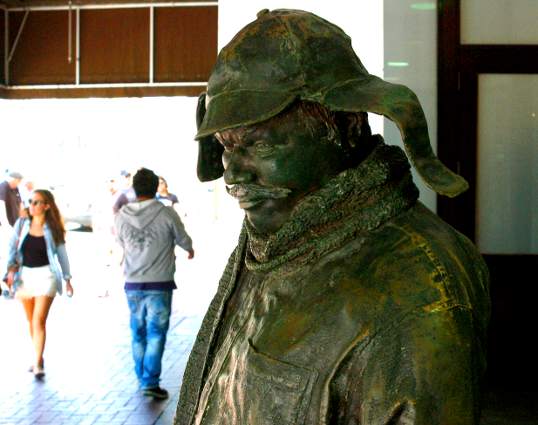
At any rate, I read that there was a statue of Ignatius J. Reilly on Canal Street in New Orleans. In the opening scene of the novel he is standing on Canal underneath the clock outside the D.H. Holmes department store holding a sack and waiting for his mother. The store is long gone, but the building is occupied by the New Orleans Chateau Bourbon Hotel. They found and replaced the clock and put up a life-sized bronze statue under it.

I had to find the statue. It wasn’t hard. The Saint Charles streetcar let me off across Canal and there he was, stupid floppy hat and all. Thousands of people walk by every day on their way to work or around the corner to the attractions of Bourbon Street… not many notice him.

So I salute you Ignatius J. Reilly, forever wearing a bad hat, and worse fashion, standing there with your shopping bag, waiting for your mother to come out of an extinct department store. She will never show, but still, you look like you know things the rest of us will never dream about.

Under the Clock

Under the Clock

“I am at this moment writing a lengthy indictment against our century. When my brain begins to reel from my literary labors, I make an occasional cheese dip.”

—- John Kennedy Toole, A Confederacy of Dunces

Sunday Snippet – Abandoned Hamburger

To catch the train home from work, Wilbur Jamison had to walk through an underpass beneath a busy thoroughfare to reach the platform. A train pulled in as he started down the stairs into the urine scented concrete tunnel – he knew he would just miss this one and have to wait for the next. A handful of young men vaulted the fence – baggy pants and all – and dashed through the honking cars to make the train. Wilbur wouldn’t… couldn’t vault and dash – he would have to wait.

There were two metal seats at the place where the train doors would open in a half hour. Wilbur plopped down on one to catch his breath after struggling up the steep concrete stairs from the underpass tunnel.

The other seat had a hamburger on it. Wilbur looked around to see if it belonged to anybody – there was no one on his side of the platform (the train had left only seconds before, after all). He was alone except for some man in a P-Diddy T-shirt and the most ridiculous pair of embroidered and bejeweled denim shorts he had ever seen. The man was screaming into a cell phone on the other side – across the tracks – waiting for a northbound.

The hamburger on the seat next to Wilbur sat in the exact center of a round foam plate. It had one generous, neat, semi-circular bite taken out of it. Wilbur figured it had been abandoned when a train pulled up – eating is not allowed on public transport. It appeared to be a plain hamburger. Nothing, no lettuce, tomato, pickles – not even a stain of ketchup or mustard – was visible in the exposed edge of the missing crescent. Wilbur thought that there could, however, be a thin careful application of unknown condiments in the center, hidden by the bun.

Wilbur considered getting up and throwing the food into the trash container a few feet farther down the platform. He thought of himself as being socially reliable and liked to think about doing small acts of responsibility and kindness unacknowledged by the rest of the world.

He thought about this, but before he could gather the momentum to get up and move another commuter, a large man accompanied by a young girl, pushed the plate and the hamburger off the metal seat, swatted the air a few times and then sat down with a grunt. Wilbur was surprised; he had not seen the man and girl walk up.

Wilbur frowned. The man had not properly disposed of the hamburger and plate – it was now wedged under the frame of the large advertising sign behind the little seat. He didn’t like this lack of concern on the part of his fellow commuter, but he didn’t say anything. He pulled a dog-eared paperback out of a jacket pocket and began to read until his train came and he boarded.

Two train stops down the line, a woman climbed on board and sat down on the bench next to Wilbur. She was wearing thin, ill-fitting black slacks and some sort of ratty brown striped Rayon uniform/smock. She had a black plastic visor with the white initials “WH” painted on it. Her large yellow plastic badge said “WAFFLE HOUSE – MARLENE.”

She had been smoking on the platform when Wilbur had spotted her out of the train window. She had leaned over and snuffed the cigarette out on a light pole and now that she was seated on the train had pulled out a weathered pack of Camels from somewhere and was carefully replacing the half cigarette back in the pack.

She had to concentrate to get the Camel into the package while the train was accelerating away from the platform and starting to sway. She scrunched up her face paying attention to her task and that brought out a tight maze of small wrinkles framed by her thin short blonde hair and the black plastic eyeshade. Wilbur felt he could read this labyrinth – thought he could see the echoes of decade after decade of struggle – of desire and disappointment – of unwilling denial that mirrored his own.

Wilbur had never spoken to a stranger on the train before, but after five minutes the pressure became too great. He became deathly afraid that she would get off at the next stop and he would never see her again.

“Uhh, Hi Marlene… I’m Wilbur,” was the best he could muster.

“Oh, How did you know my name? Do I know you?” She looked confused.

“No,” he said, gesturing to her badge.

“Of course,” she said with a little chuckle, “I forgot. Pleased to meet you.”

So they chatted until Wilbur’s stop. She was getting off the night shift, he was starting the day. They shook hands as Wilbur stood to leave.

It wasn’t hard for Wilbur to find the Waffle House close to Marlene’s train stop. It was even easier to learn her schedule and to time his commute so he was on the train waiting for her. He started getting to the station extra early, letting a train or even two go past, waiting for the proper time. He would make sure the seat next to him was open, no matter how crowded the car was.

Marlene began looking forward to seeing Wilbur waiting on the car. Every now and then she would be late getting out of work or the schedules would slide and Wilbur would catch the wrong train and they would miss each other. Wilbur would go through the day in a dark funk and Marlene would have a hard time sleeping that day, though she had worked third shift for most of her life, whenever that happened.

They traded favorite paperbacks, Marlene started bringing Wilbur lunches from the Waffle House, and finally Wilbur summoned enough courage to ask her out to a movie. He had a car, a nice one, really, though it had a lot of miles on it. He only took the train to work to save on parking.

Marlene slept while Wilbur worked so their schedules worked out pretty well together. They would go to a couple of movies on the weekends and try for a nice dinner on Wednesdays.

Wilbur decided to ask Marlene to his house for dinner after a movie one weekend. His only son lived in Japan and had stopped even writing to him years before and nobody other than himself had set foot in his house in the decade since his wife had passed away. He asked a neighbor for a recommendation and hired a woman to come in to clean the place. He kept a simple, neat house, that fit in with all the others in the suburb, but not one that was spotless. He had never learned how to do that.

He drove to Marlene’s second floor studio apartment to pick her up. She appeared at the door carrying a small overnight bag. Wilbur was so nervous and excited during the movie that he never could remember what they saw.

Later that night, not long after he had brought her to his house, Marlene silently removed her clothes.

“Well, here it is,” she said with a combination of regret, excitement, and acceptance.

Wilbur gasped. She looked as if a bite had been taken off the top part of her body – a pink arc from one shoulder across the tops of her breasts on up to the other shoulder. Another arc cut across her legs – from one hip down to mid-thigh and then curving back up to the other hip. Everything else between these two arcs, her entire torso, was completely covered in complex colorful, dense, intertwined tattoos.

“Oh my God!” It escaped his lips before he could get control of his amazement.

“I’m sorry – I should have said something… I should have.”

“No, no, Don’t apologize. I think they… it’s… you’re the most beautiful thing I’ve seen… in a long, long time.”

“I’m sure you’re wondering where, why… well… it was like….”

“No! Stop! Don’t tell me. I don’t want to know. I don’t ever want to know. Don’t ever tell me.”

Marlene shrugged. She seemed more than a little relieved.

“Fine with me,” she said.

Eventually, Marlene quit her job at the Waffle House and gave up her apartment, moving in with Wilbur. The neighbors barely noticed. It took her a while to get used to a usual schedule, sleeping at night, after having worked third shift for so long, but she was glad to work at it.

Wilbur had saved up a lot of vacation over the years and they began to travel. They started out with weekend driving trips close to home and gradually worked up to international voyages. They particularly liked traveling by cruise ship – Marlene enjoyed the shore excursions and Wilbur preferred the luxury on the boat.

Wilbur liked to lie next to Marlene and trace the intertwined designs across her skin, to try and separate each one out. He would make up little silly stories about each one and Marlene would laugh at his imagination. A few times she wanted to tell him the real story about her tattoos but Wilbur would not let her say anything. They were a mystery and he wanted to keep it that way. They were his mysteries and he liked the thought of having something so wonderful and strange belonging to him alone.

Marlene was almost as alone as Wilbur, but not quite. She had a beloved old aunt that lived in Toledo, Ohio. Marlene received word that her aunt had fallen sick and she went up there to tend to her. She was gone for two months and Wilbur missed her terribly, but they talked on the phone every night, and that made it better.

Finally, Marlene’s aunt regained her strength and she flew back home. Wilbur met her at the airport and they drove home. Wilbur carried her luggage into the house.

“I’ve got something to show you,” Wilbur said.

“Oh, you didn’t have to.”

“I’ll give you the present I bought for you later, but this is different, it’s something I did while you were gone.”

“Something you did?” Marlene was confused, and a little nervous.

Wilbur turned his back on Marlene and pulled his shirt off over his head. There, angling across his back, was a large, complex red dragon. Marlene knew ink like that could not be done in one visit, knew that Wilbur must have been waiting for her to be gone for an extensive time to get this dragon done. She also knew how much it must have hurt.

It was an expert job; the colors were bright and the detailing crisp. The dragon was a Japanese design, she had seen it before. The dragon was long and scaled, with several pairs of legs, and it was curved around, almost tying itself in knots. It seemed to pulse and seethe across Wilbur’s back. She moved in to look closer and snapped on a bright lamp to see better. The dragon was holding something – something clamped firmly in its foremost claws.

“The dragon is holding something,” she said.

“It sure is.”

She looked even closer. “Is that a hamburger? A hamburger with a bite out of it?”

“It sure is,” Wilbur said.

What I learned this week, October 21, 2011

16 Tips to Simplify Your Life (and Increase Your Productivity)

from Tom.Basson

  1. Turn off all technology for 60 minutes a day
  2. Don’t check your email first thing in the morning.
  3. Start your day with exercise.
  4. Be obedient to the sabbath!
  5. Learn to say no.
  6. Plan your week ahead.
  7. Don’t answer your phone every time it rings.
  8. Get up early.
  9. Go to bed early.
  10. Eat a big healthy breakfast.
  11. Clean out your closets. Get rid of things you never wear or don’t use anymore.
  12. Stop watching TV.
  13.  Make sure you plan a decent holiday break once a year.
  14. Learn to protect your time.
  15. Do your banking online.
  16. Use Evernote.

Building Three-Dimensional Characters

  • Spine
  • Supporting Trait
  • Fatal Flaw
  • Shadow

I may be a loser and an idiot, but at least I’m not like this:

Family calls 911 when they get lost in a corn maze.

Isn’t that the point of a maize maze? Aren’t you supposed to get lost? I went to one once, with two kids, and it was a little disconcerting – but I was also aware that at any time I could walk through the corn if I had to.


OK, I hate Martha Stewart as much as you do… actually I hate her more, because I actually have a reason to be pissed at her. If you ask me nice, some day I’ll tell you about it.

In the meantime, she may be a nasty little piece of work, but she does know how to:

Make the perfect Macaroni and Cheese


Uncertainty, Innovation, and the Alchemy of Fear

  • Single Task
  • Exercise Your Brain
  • Reframe
  • Pulse and Pause
  • Drop Certainty Anchors

One of Lee’s friends told us about a pet that I had never heard about. Micro-Pigs.

video

Seems like a good idea, I suppose…. Isn’t that where Bacon Bits come from?


Energy, Focus, and Courage

“The energy of the mind is the essence of life.”

—-Aristotle

“Goals provide the energy source that powers our lives. One of the best ways we can get the most from the energy we have is to focus it. That is what goals can do for us; concentrate our energy.”

—-Denis Waitley

I don’t have a belief problem, I have a focusing weakness. I focus on what’s loudest instead of what feels best.

—-Abraham-Hicks

Focus on where you want to go, not on what you fear.

—-Anthony Robbins

For man’s greatest actions are performed in minor struggles. Life, misfortune, isolation, abandonment and poverty are battlefields which have their heroes – obscure heroes who are at times greater than illustrious heroes.

—-Victor Hugo

I must not fear.
Fear is the mind-killer.
Fear is the little-death that brings total obliteration.
I will face my fear.
I will permit it to pass over me and through me.
And when it has gone past I will turn the inner eye to see its path.
Where the fear has gone there will be nothing.
Only I will remain.

—- Dune, Frank Herbert

Energy, focus, and courage.

I have a giant frightening project and deadline coming up at work. It has me scrambling. Even though the weather has been beautiful outside, as rarely beautiful as it ever is here in Texas, I have been cooped up in my office cube wishing I was somewhere or someone else.

As I fight my way toward the finish three words keep coming up in my mind. These three words, the more I think about it, are what I need — are what I’m looking for. The three words are

  • Energy
  • Focus
  • Courage.

Energy, Focus, Courage. I’m not sure where the words came from – they didn’t really pop into my mind… it’s more like they grew there, like from little imaginary seeds. I have been thinking about these three words, repeating them to myself like a mantra, until I think I’m beginning to have an idea what they mean.

I have come to the point where I think they all three mean the same thing… no, that’s not it… obviously the words don’t mean the same thing. What I mean is that the three words represent a view of something larger, or more complex, or crystalline – something that a single word can’t describe. That thing, that unnamed thing, is what I am trying to understand – but I don’t have the tools to view it directly. I can only see its shadow – a shadow that looks different when viewed by a light that shines in a different direction.

The shadow, from three different directions, spells out energy, focus, and courage.

Energy is power, power from exercise, cardiovascular and strength. Energy is passion, both the wild random volcanic passion of youth and the desperate focused passion of age, tempered by the terrible knowledge that time is running out. Energy needs its opposites – sleep and rest – to recharge. Without rest there is no energy. Energy is clear clean powerful and focused.

Focus is organization, planning. I think of Steven Covey and his four quadrants, of the important but not urgent.This is focus from a satellite, the view from far above and far away. Then there is getting things done, the minute by minute management of a day. Life itself can be thought of as a string of seconds (an average life is, what? 2,207,520,000 seconds long, a little over two billion), every one a tiny decision, “what do I do now?” Add these up and you have your life. Focus is a laser pointer. Focus is like a lens that takes the light from the sun and burns a little brilliant dot onto the sidewalk.

Focus is saying “no.” Focus is priorities. Focus is saying “yes.” Focus is making a choice. Making a choice takes courage.

Courage is not the opposite of fear, like most people think. Without fear there is no courage. The brave must face their fear, swallow it, feel it, and keep on doing what they need to do. Fear is that gnawing in your gut. Courage is looking at the point of no return and stepping right into it.

There is that moment when you have faced your fear, ignored your doubts, and stepped ahead. That moment when everything is set in motion, but nothing has moved yet. You have bought your ticket, opened your mouth and started to speak (the heads are all turning toward you), taken that step, dialed that number, hit send, swung the bat, released the Kraken, or whatever it is that you chose to do… that calm feeling of excitement – the sudden extermination of fear (how can you be afraid now, now that nothing can be done, now that your fate is decided) – that is the moment of pure courage, of focus, of energy.

That is the moment that life is lived in.

But Jeez, I sure have a lot of work to do.

Sunday Snippet – The Iceberg

(click to enlarge) "Approaching Storm" by Claude-Joseph Vernet, Dallas Museum of Art

The river was teeming with plump fish. Today would have been a good catch. The storm blowing in from the sea will put an end to that. Dorothy came down with baby Aaron to warn us, wearing her favorite red dress. She’s holding him as he squirms, he wants to play with the fish. John and I are down on the rocks working, trying to get the day’s catch gutted and put up before the rain starts, while the rest pull in the nets. A stray dog is barking as Donna fights with the mule, the animals know what’s up and want to go home now, instead of helping us with our load.

A sudden flash startles me and I look up to see a giant bolt of lightning scream down at an angle from the glowering cloud. It strikes the city, golden in the distance. The sky has darkened leaving the cream limestone of the city’s domes and towers to almost glow in the last free rays of sunlight. A while later the thunder careens down the valley, distant booming echoes coming off the giant rocky crag of Gray Mountain behind the city and from the walls of the canyon itself.

Above me, high on the canyon walls is the Duke’s estate. New luxurious stone buildings built around the ancient ruins of a ruined castle. Since the Duke built the new tollbridge by the city, his fortune has increased tenfold. A lone figure, one of the Duke’s men, looks down, high overhead from the old ivy-covered tower. He is probably watching the boats; some nobles were out for a day on the river and were caught by the sudden wind. They are heading back in their carriage, leaving the boatmen to struggle with their craft.

The storm is building, piling up upon itself, towering overhead like an angry giant. The wind whips even wilder, I can smell hard rain approaching, the flashes of lightning come faster now. My excitement is beginning to be tainted by fear; the old highway back to the city runs along the canyon bed, under the stone arch; and even with the mule helping with the nets the storm will be strong upon us before we reach the bridge. The tumbling cataracts here in the last stretch before the sea can rise up quickly, many travelers have been engulfed, with their destination in plain sight.

I look at Dorothy and little Aaron, Donna and the mule, the netmen; all looking to me for guidance. I should have known this storm was blowing up, should have stopped work sooner, should….


Jim was jolted out of his reverie my something moving across his field of vision. Something thin, dark; something slinky, something sexy. He felt her in his gut even before he even really figured out what had startled him. The young woman walked by between his bench and the painting; his head turned to follow as she passed on by the big oils of landscapes and ocean scenes down the room and back several hundred years to painted scenes of Christ on the cross.

She was wearing a short black dress, black stockings, and her long dark hair poured over her shoulders. Her face… her skin was as pale as a cold egg. She carried a little notebook and a thick textbook; she must be here with a college class. She was young and thin and tall, moved with a nervous jumpy weightless ease, flitting along from painting to painting like a colt.

Jim stood from the bench and let out an audible sigh. It was time to go findShelby. He preferred the old masters, paintings that looked like something, art that told a story. He had been sitting on a padded bench in front of a Claude-Joseph Vernet painting, “Approaching Storm” for over half an hour.

His wife liked the modern stuff. He knew what gallery she’d be in. With another sigh he set off.

………………………………………………………..

MODERN AMERICAN ARTS DIGEST —– AUGUST 13, 2013

ELMORE SPENCER – AN ARTIST WATERS HIS ROOTS

—————————————————

Elmore Spencer has climbed the mountain of the art world. From a child prodigy that startled adults with his sketching skills at the age of six to a celebrated student of the Paris art schools to a meteoric rise to the jet-setting toast of the New York Art Society, Spencer has had it all.

Instrumental in founding the “New Realism” school, he then rejected this return to “Painting that looks like something” and veered off into innovative artistic experiments that challenged the border between art and observer, maintaining his success and popularity through it all.

Now, he struggles with a return to his roots, to maintain the connection with his audience that he feels his decades of success have cost him. The conflict of the avant-garde and the traditional, realistic and symbolic, is at the heart of what Spencer is up to now.

“It’s been a long road, but I’ve been lucky,” Spencer said in a recent interview, “To others its seems like a climb, a rise, but to me it feels like a spiral, the further I go, the more times I return to the same places.”

His newest installation in the Checkwith Gallery of the Kooning museum communicates that duality in Spencer’s own way. A large room in the gallery has been darkened, a dual-sided screen has been installed in the center of the room, along with two digital television projectors and a powerful sound system.

A film plays on this screen; a man walks from the murky distance, approaching the screen in slow motion. The man stands for a minute, then, on one side of the screen a small flame appears at his feet. The flames slowly grow until the man in engulfed. Finally he disappears in a massive wall of fire.

On the other side of the screen the same man is assaulted by drops of water falling from high overhead which increase in frequency and volume until they become a torrent falling. The water slows and stops and the man is gone.

Meanwhile the speaker system booms out the sound of water falling, the sound of roaring flame. It is interesting to note that both sounds are the same.

The film installation is work of art in itself, many, if not most, visitors assume that it is the artwork. With his playful genius, Spencer has visualized this darkened room as a controlled setting for his real art. He has constructed a series of twelve sculptures, to be placed into the area on a rotating basis.

One sculpture is a pair of lovers, constructed of modern materials, rugged and realistic. They sit on a bench in the darkest corner of the film room, they are only visible during the peak of the flame portion of the film, illuminated by the fire on the screen. They are locked in a kiss, an embrace, his hand is slipped inside her shirt, hers rests on his thighs. The museum receives dozens of complaints on the days this sculpture is set out.

Another sculpture is a mechanical museum guard. He stands inside the room. When the guard is present the film is turned off. Infrared proximity sensors pick up any patron that enters the room; and after a delay, the ersatz guard plays a recording, “I don’t know, they’re supposed to have turned the film on by now.”

Some of the sculptures placed in the room are designed to look at home there, others, such as the murder victim, placed in the corner with a knife protruding from his back like from a cheap detective movie, are obviously intended to shock or annoy. On certain days nothing is placed in the room, leading to a scene where patrons in the know walk around examining each other, trying to determine what is real and what isn’t.

Spencer has even been known to spend a day in his own installation, sitting on a bench with his famous sketchpad, drawing the reactions of the observers. This has been so successful; he has taken to walking around the museum sketching patrons looking at art.

“As artists we live for the people that look at our work, really. We never think about them, or study them, or try to incorporate their lives into the art itself. I want to change that…….”

………………………………………………………..

“Shelby,Shelby!”

She turned from the painting, a huge panel covering most of the wall, hand painted with extreme skill to look like a blow-up of an article from a art magazine, to see her husband standing there.

“What do you want?”

“It’s time to leave.” Her husband looks at his watch. She thinks he always is looking at his watch.

“I’m not finished reading this.”

“What the hell is that? What’s it supposed to mean? Might as well go home and read the paper.”

“It’s by Spencer, My Life, it’s called. I haven’t decided what it means yet.”Shelbyfelt anger welling up in her throat. She’s known James, her husband, her love, since they were children and had been angry many times over the many years, but nothing like lately. She could feel a fight coming on, a mean and nasty fight, and one with no resolution.

When they were young, when they were first married they would argue, like all newlyweds, like all friends. It would end quickly, though, with both giving in. The next day the argument would seem so silly.

Now, though, they fight, and the fights never end. They taper off into silence and simply flare up again at the next conflict, the next insult. She could feel the heat rising, like a hot nut right under her sternum.

“Come on!” Jim said, placing his hand on her arm, “We have things to do.”

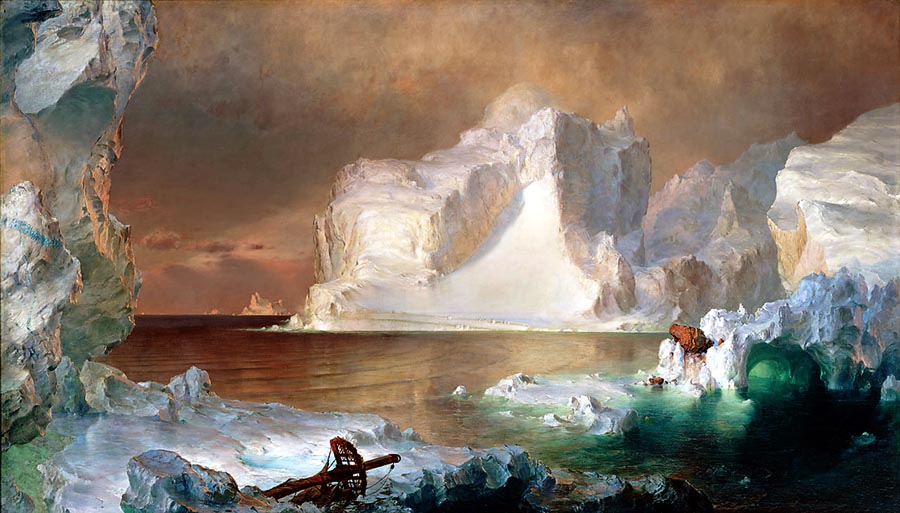
Shelbywanted to explode, but the twentieth century gallery at the Kooning museum was not the place to have a knock-down, drag-out, so she walked stiffly in silence, stewing. They passed through room after room, moving back in time towards the rear entrance until they reached an area dominated by a huge landscape painting; the most famous work in the museum. It was a scene of icebergs, a giant white slope, begging for footprints, a brown and purple timeless sky. The ice in the foreground was littered with debris, a shattered mast, a glacier torn boulder. The ice rose in craggy veined cliffs all around pierced by an emerald green frozen tunnel, a mystery. The calm sea was disturbed only by circular waves radiating out from some unseen event.

She could not stand it any more, she was so furious.Shelbypulled away and sat quickly down on the circular bench. Jim sat down beside her, staring wide-eyed. Pulling in her anger, she started to speak.

“Jim I…”

“Excuse me, folks,” said a man they hadn’t noticed. He was gray-haired, wearing old jeans and a long-sleeved shirt. He was sitting on the floor, leaning against the wall under a Thomas Dougherty landscape, a large sketchpad resting on his knees. “Do you mind sitting there for a while, I’d like to draw the two of you. If you don’t mind.”

Jim stammered, “Well, we have…”

“Sure, go right ahead,”Shelbyinterrupted.

“Alright then, umm. turn toward each other a little, now look at me…. Fine, why don’t you hold her hand a little…. That’s right.”

He started in drawing right away. Working with colored pencils and some charcoal and a bit of an eraser. Jim and Shelby felt nervous; the fight, their day quickly forgotten.

“Ummm… try to relax, why don’t you tell me a story. Tell me about when you first met.”

“Well,” Jim started.Shelbywas surprised that he spoke up so soon. She was getting ready to talk, but he beat her to it.

“We met in junior high school, seventh grade, we were both thirteen. She sat if front of me inEnglish class. I remember, I loved her from the first moment I saw her. I thought she was the most beautiful thing I had ever seen. Our teacher was old, he would lean on a podium and lecture us all class long. The room was too small, our desks were crammed together, her seat backed right up against my desk. All I would do is sit there and stare atShelby’s hair. Her blonde hair. Sometimes she’d wear it down and it would fall in cascades right in front of me. Sometimes she’d wear it up, like a golden seashell, a yellow spiral. Sometimes in one ponytail, sometimes two, it didn’t matter. That was my favorite hour of every day, to sit in that hot crowded room and look atShelby’s hair. I felt like I could do this forever, for the rest of my life.”

Shelby and Jim sat there then and talked. They talked of old times, when they were young and when they started dating. They talked of old friends. They talked of their first apartment, of their first house, of the cars they had bought together, of the meals they had cooked, of the vacations they had taken. They forgot about the artist, ignored him until he finished. He put his pencils back into a little wooden case.

“Done.”

“Well, can we see it?” they asked together.

“See it? You can have it.”

“Really?”

“Really”

He handed them the paper and thanked them simply. The artist walked around the corner and was gone.

The drawing had the iceberg painting in the background. Carefully done in colored pencil and pastel chalk it was amazingly detailed and accurate. He must have been working on it for hours. The painting, or, rather the drawing of the painting faded in an oval spot near the center. He drew only around the edges, leaving a blank spot, waiting as he drew for someone to come along and fill it.

Shelby and Jim now occupied the oval. She gasped as she saw it. It was a life-like drawing, done mostly in pencil and charcoal, cross-hatch and shades of gray, only a hint of color added. Detailed. It was realistic except that they both were drawn naked.

Jim looked at the drawing of his wife’s breasts, at their intertwined hands. Shelby, at her husband’s naked body. She was shocked when she noticed that the artist had drawn in the patches of hair across Jim’s chest exactly right. The lower right corner had a quickly scribbled “ES.”

They suddenly noticed that over a dozen people surrounded them. They must have walked up to watch the famous artist work, but Jim and Shelby had not even noticed. Embarrassed by the gathering crowd pointing to details on the sketch, they rolled up the drawing, and headed out to their parked car. They held hands as they walked,Shelbyleaned her head on Jim’s shoulder as he drove.

They spent some money to have the print professionally framed and mounted at a shop across town that handled fine art works. Never really comfortable with the nudity, they couldn’t hang it in their living room. The framer recognized the signature, told them it would bring in tens of thousands of dollars, especially with the story of the sitters. He recommended a gallery. Even though they could really use the money, Jim and Shelby couldn’t sell it. It meant too much to them. They did hang it, in their bedroom, next to the closet.

For many decades, until the days of their death it was the last thing the saw at night when they went to sleep, the first thing in the morning when they woke up.
 

(click to enlarge) "The Icebergs" by Fredrick Church, Dallas Museum of Art