All Nature Has Is a Potential

“That’s all the motorcycle is, a system of concepts worked out in steel. There’s no part in it, no shape in it, that is not out of someone’s mind […] I’ve noticed that people who have never worked with steel have trouble seeing this—that the motorcycle is primarily a mental phenomenon. They associate metal with given shapes—pipes, rods, girders, tools, parts—all of them fixed and inviolable., and think of it as primarily physical. But a person who does machining or foundry work or forger work or welding sees “steel” as having no shape at all. Steel can be any shape you want if you are skilled enough, and any shape but the one you want if you are not. Shapes, like this tappet, are what you arrive at, what you give to the steel. Steel has no more shape than this old pile of dirt on the engine here. These shapes are all of someone’s mind. That’s important to see. The steel? Hell, even the steel is out of someone’s mind. There’s no steel in nature. Anyone from the Bronze Age could have told you that. All nature has is a potential for steel. There’s nothing else there.”
― Robert M. Pirsig, Zen and the Art of Motorcycle Maintenance: An Inquiry Into Values

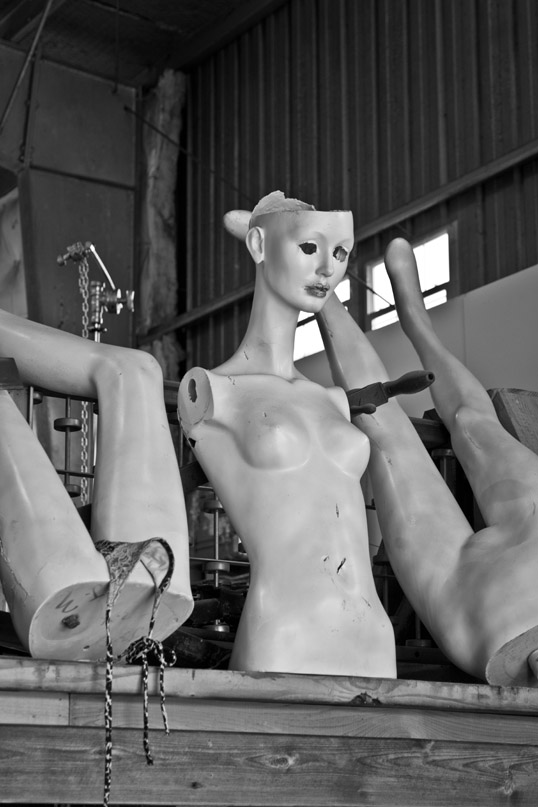
Future Sculpture, Clarence Street Art Collective, The Cedars, Dallas, Texas

Oblique Strategy: Is the intonation correct?

After a really rough day I needed a little victory so I made a sweet potato casserole to take to a potluck tomorrow. Is a well-cooked casserole a work of art? Probably not. Especially when its destiny is a long table already groaning under other casseroles also full of sweet potatoes (at least mine does not feature marshmallows – it has goat cheese and walnuts) or green beans mixed with oversalty industrial mushroom soup and canned fried onions. I’m sure mine will be ignored, no matter how delicious. Such is the ultimate destiny of all art.

P.S. After having written the above, I went to the kitchen to put my cassarole, which had been cooling on a rack, into the fridge to take to the potluck tomorrow. While transferring it, I dropped it, flipping it onto the kitchen floor.

The day continues.

The Marriage of Reason and Nightmare

“The marriage of reason and nightmare that dominated the 20th century has given birth to an ever more ambiguous world. Across the communications landscape move the spectres of sinister technologies and the dreams that money can buy. Thermo-nuclear weapons systems and soft-drink commercials coexist in an overlit realm ruled by advertising and pseudo-events, science and pornography. Over our lives preside the great twin leitmotifs of the 20th century – sex and paranoia…In a sense, pornography is the most political form of fiction, dealing with how we use and exploit each other, in the most urgent and ruthless way.”
― J.G. Ballard

Tony Collins Art, Dallas, Texas

Oblique Strategy: Make a sudden, destructive unpredictable action; incorporate

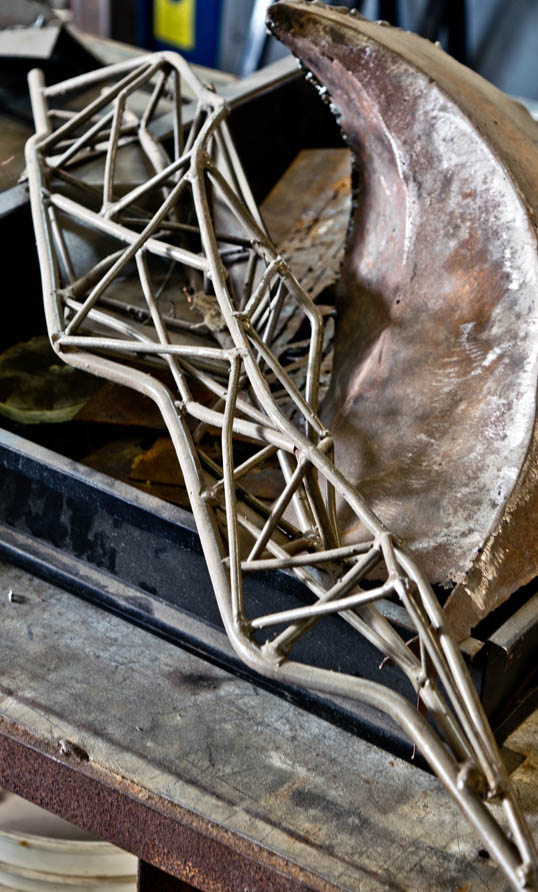
Is it a bomb?
Or simply a disposable fuel tank.

Does it matter? Now, anyway, it’s just a sculptural form.
A piece of shaped steel, sexy somehow. It pulls the eye to it.
You wonder about its story. Where did it come from?
Why is it hanging there?

Does it matter?

Just Grip Your Handlebars

“Ever bike? Now that’s something that makes life worth living!…Oh, to just grip your handlebars and lay down to it, and go ripping and tearing through streets and road, over railroad tracks and bridges, threading crowds, avoiding collisions, at twenty miles or more an hour, and wondering all the time when you’re going to smash up. Well, now, that’s something! And then go home again after three hours of it…and then to think that tomorrow I can do it all over again!”
― Jack London

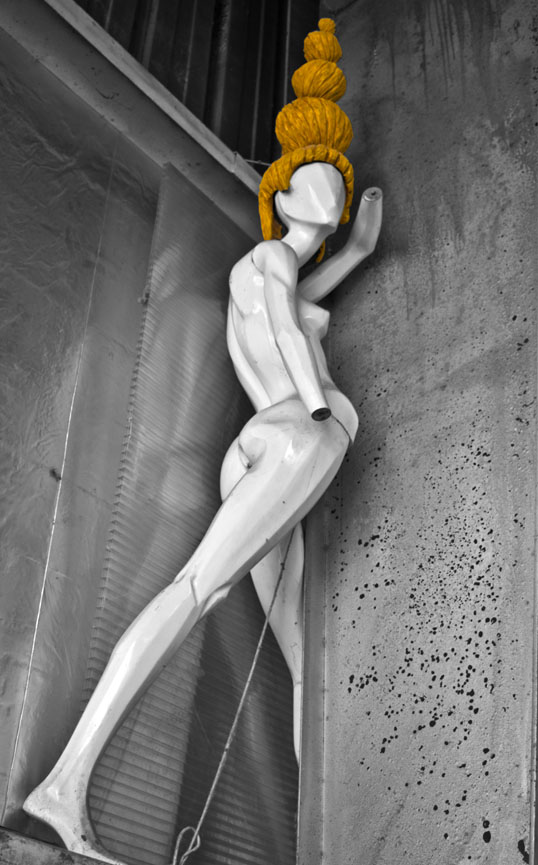
Clarence Street Art Collective, The Cedars, Dallas, Texas

Oblique Strategy: Use `unqualified’ people

My Xootr folding bicycle, Trinity River Bottoms, Dallas, Texas

I went on two bicycle rides today. Was outside from eleven in the morning,’til nine at night. Had a lot of fun, but now I’m exhausted and I’ve got a very busy week at work ahead.

War Minus the Shooting

“Serious sport has nothing to do with fair play. It is bound up with hatred, jealousy, boastfulness, disregard of all rules and sadistic pleasure in witnessing violence. In other words, it is war minus the shooting.”

― George Orwell, The Collected Essays, Journalism and Letters of George Orwell 1903-1950

Dallas Arts District. Kids love the reflecting pool. The water is less than a quarter inch deep.

Oblique Strategy: Turn it upside down

Again, I was exploring the depths of my hard drive archives. I found this entry from October 16, 2002. It concerns my youngest son, Lee, who was nine years old.

Lee called me at work – he was home from school and a friend, G. was at our house. He wanted to know how to type on my computer. I gave him quick instructions on how to start up Word, how to save his work, and how to print it out when he was done. It turns out he and G. have an idea for a new sport, which they call Foondball, and they wanted to type out a list of rules.

When I came home I found my desk littered with sheets of notebook paper covered with crude drawings of athletic fields and different dimensions, markings, and goal layouts.

On the screen was their rules for Foondball:

Foondball

  • The game can only be played with 6 to 12 players.
  • You may use your hands to throw the ball and your feet to kick the ball and the goalie may use a hockey stick to block shots taken by the strikers.
  • The goals are at opposite ends of the playing field the field is 75 yards in length and is about 25 to 30 yards in width
  • The winner of the most rounds wins the match there are three rounds lasting 20 minutes and 5 minutes of rest between rounds
  • In the case of a tie the winner will be decided by a 10 minute overtime if no winner is decided then it is a draw
  • The goals are about- 6 to 7 feet high and 10 to 11 feet wide
  • The game begins with the thrower throwing the ball and the whacker hitting the ball the seekers catch the ball if the seeker on the whackers team catches the ball he may keep running to the goal if the seeker on the throwers side catches the ball he may run it back and try to score
  • Each goal is worth two points
  • If there is a foul the ball goes to the place where the foul was committed and thrown from there.
  • If a foul is committed within ten yards of the goal the person whom the foul was committed against gets to take a free shot he can throw the ball into the goal or he can kick the ball into the goal
  • If one team wins the first two rounds of the game then they automatically win the game
  • At no time during the game is play ever supposed to stop unless a foul is committed
  • There is a ten minute half time in between the 2nd and 3rd round
  • If a person scores on a foul then the goal only counts as one point
  • After a goal the team that scores is to throw the ball and play resumes
  • Helmets are to be worn
  • For each team – 1 goalie, 2 whackers, 1 seeker 2 throwers
  • The goalie may never come out of his 10 foot box
  • If a player is on concrete he may dribble the with his hands
  • The player may throw or kick the ball to one of his fellow teammates

Someday, maybe, kids will dream of glory on the foondball field, and trade photos, cards, and stories of who their favorite whackers, throwers, and seekers are.

I Am Not Mad

The only difference between me and a madman is that I am not mad.
—- Salvador Dali

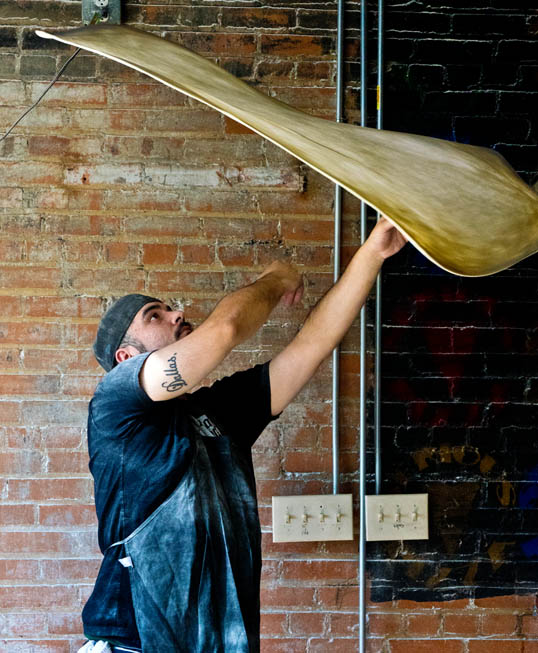
Cook throwing dough at Serious Pizza, Deep Ellum, Dallas, Texas

Oblique Strategy: Overtly resist change

This is adapted from something I wrote twenty years ago – updated it a bit.

As I left work to run an errand over my lunch hour the “low gasoline level” alarm went off in my car. It’s a gentle, yet jolting alarm; a soft, insistent “bo-ing” and accompanying orange light in the shape of a symbol of a gas pump. I drove a block down and filled up the car with gas.

The gas station was one of the new ones that offer everything under one roof. Twenty pumps, cold drinks, car wash, hot food, air and water, pizza, oil and washer fluid, magazines and lottery tickets, toys and office supplies, maps and pornography. An entire modern civilization springs up in this little store with its spreading shade-wings across the oily tarmac. An oasis, a tacky colorful monument to gaudy garish American Vulgar Capitalism founded, owned and operated by a family of Pakistanis.

I finished pumping and walked to the store to grab some juice. As I was walking I could see through the glass door a sign hanging from the ceiling. It was bright red neon; near the back of the building, yet very visible and obvious. It said:

ZEN FOOD

I was tired and cold and my brain was fuzzy. I allowed my thoughts to believe the evidence of my eyes. Why would a cheap-ass convenience store offer Zen Food? What is Zen Food anyway?

A momentary fantasy floated through my brain of exotic, delicious, far-eastern culinary delights. Spicy colorful mixtures, displayed on steam tables, savory herbs and succulent vegetables prepared with ancient recipes and exotic skills. I allowed myself the luxury of imagining for a moment I had stumbled on something special, a precious mystery hidden away in the most common of locations – a gas station.

As I, with a spring in my step, eagerly entered the store it was suddenly obvious that an advertisement hanging from the ceiling, an inflatable pack of cigarettes, had concealed the first three letters of the sign:

FRO

I pulled a V-8 out of the cooler. The day suddenly seemed colder, barren, a little more bleak and a lot more ordinary.

Disoriented At the End

By the end of a poem, the reader should be in a different place from where he started. I would like him to be slightly disoriented at the end, like I drove him outside of town at night and dropped him off in a cornfield.
—– Billy Collins

Clarence Street Art Collective, The Cedars, Dallas, Texas

Oblique Strategy: The inconsistency principle

Found Poetry

A taste for pure pork fat, long restricted to a furtive devouring of the white nubbin in the can of baked beans, can now be worn as a badge of honor.
(Julia Moskin, New York Times, 5/7/03, article on pork fat in high-class restaurants)

Under 6 years: 1 pastille as required. Maximum 5 pastilles in 24 hours
(Meggezones 24x)

…on a long bus ride, you should always choose to sit next to Mrs. Robinson, for example, rather than Benjamin.
(Roger Ebert, from a review for Death to Smoochy)

Daisy, the this pretty sea, and the wind.
(Bablefish translation of the first line of a Ruben Dario poem I have stuck in my head… the Spanish is: Margarita, esta linda la mar, y el viento.)

Dolly, Good, Hernia, Bad
(big block letters on the side of a Budget rental truck in my neighborhood)

When I cruise, I’m an adventurer, eager to try new experiences. So on the second day of my first Carnival vacation, I found myself lying on a massage table wrapped in a crisp, clean sheet.
(From Currents, a magazine for people taking Carnival cruises)

Often Imitated, Never Duplicated-Great for Men and Women-As Seen on TV-It’s not magnetic, not copper…it’s the Q-Ray Ionized Bracelet designed to help balance your body’s Yin-Yang. Worn by professional athletes striving for energy, strength, flexibility and endurance, it’s also worn by people looking for natural pain relief. According to the oriental theory of Yin-Yang, we remain in good health when our negative (Yin) and positive (Yang) ions are in balance.
(from an ad for the Q-Ray bracelet, $49.95, in Dr. Leonard’s America’s Leading Discount Healthcare Catalog)

Like Burning Tears

“And now, my poor old woman, why are you crying so bitterly? It is autumn. The leaves are falling from the trees like burning tears- the wind howls. Why must you mimic them?”
― Mervyn Peake, Titus Groan

Fall Colors
University of Texas at Dallas
Richardson, Texas
(click to enlarge)

Oblique Strategy: Revaluation (a warm feeling)

The trees along my drive to work have exploded into flame.
Their conflagration tinted according to their species from a sodium flame yellow, through orange, on to a deep blazing crimson.
Except for the cemetery, monocultured with live oaks, all their usual dark spinach.

I knew someone once, a long, long time ago. She said she liked the fall better than the spring. She liked the sense of foreboding, the knowledge that a cold storm was coming – the excitement of onrushing doom.

It took me decades to understand what she was talking about and how important it was.

Sunday Snippet – from “Toesucking in Albania”

“Jealousy is a disease, love is a healthy condition. The immature mind often mistakes one for the other, or assumes that the greater the love, the greater the jealousy – in fact, they are almost incompatible; one emotion hardly leaves room for the other.”
― Robert A. Heinlein, Stranger in a Strange Land

St. Vincent’s, New Orleans

Oblique Strategy: You can only make one dot at a time

Snippet from a novel I’ve worked on off and on – originally from Nanowrimo
Working title – Toe Sucking in Albania


Sanibar crawled up over the ridge, watching the handheld tracker that indicated the position of Boromech’s flyer. He had placed a remote bug on the machine a week before and now it was time to see it pay off.

He knew that Boromech and Wenwiki had landed somewhere not too far over the edge and he would be able to see them once he cleared the crest. He folded his flyer and wedged it behind a rock and pulled out the powerful pair of stabilized digital tele-binoculars that he had ordered from offworld.

Down on his belly, Sanibar wiggled across the scree and cleared the ridge between two rust-red ragged boulders. The rock was warm from the bright sun; Sanibar wiped the sweat from his eyes and looked down into the valley past the ridge. His eyes were shocked with the bright green he spotted there, and it took a minute to recognize the valley as Area 51B25, a spot he himself had discovered and explored a year earlier.

This part of the planet, surrounding the dessicated edge of the drying salty inland sea, was, for the most part, lifeless and barren. Only small pockets, like Area 51B25, were able to support verdant vibrant life. The last sliver of an ancient dying glacier nestled up between the high peaks to the south, sent a constant dribble of meltwater down into the valley where it pooled into a turquoise lake, protected by the rugged ridges on either side. The lake slowly leaked water into the shattered rock valley where the roots of the strange alien forest drank it up. This little isolated pocket of forest was an orphaned echo of the vast jungles that were killed off along the toxic edge of the wasteland they created with the mining.

Sanibar had found this verdant valley during his initial survey of the sector. Between the steep and rugged ridges on either side and the high peaks to the south, it was hidden and would never be spotted by anyone not going right down into the gorge itself. He recorded it on the official maps, then made sure it had been buried deep in the central reports and he never told anyone about it. He knew the Rest and Recreation Corps would go nuts about it. They would build a rec facility on the shore of the little lake, blast trails through the woods, and put up some cabins in the most beautiful spots. They would give out weekend passes to people that had put in the most overtime, shipped the most product, or, more likely, kissed the most asses. Sanibar didn’t want this – he wanted to keep the hidden little green valley to himself.

After plotting for a month, he finally managed to get Wenwiki to go there with him. He had everything planned to the smallest detail – he had hauled in some stolen furniture, making a nice table and a couple comfortable chairs – up on a flat, rocky spot with a drop-dead beautiful view. He had paid the cook off to make a special meal for two, complete with rare off-world ingredients smuggled in on a mail run from home. Sanibar lied to Wenwiki and said he had prepared the picnic feast himself. He was even able to procure a bottle of fine old vintage – something unheard of on a remote mining base.

When he asked Wenwiki to go on a picnic with him and she committed to an afternoon three days away, she seemed honestly and truly excited. The three days of waiting were both hellish and heavenly for Sanibar. Both enervated with fear and ecstatic with anticipation, time clicked by in endless slow slivers. Finally the chosen appointment day and hour creeped up.

His extensive, expensive, and exhausting preparations complete, Sanibar flew his cleaned and polished flyer, complete with sidecar over to Wenwiki’s quarters and rang and rang. She wasn’t there. A neighbor cracked her door and said she had seen Wenwiki down at the cleaning station, doing her weekly laundry. His heart sinking, Sanibar flew over to the station and there she was. Wenwiki had forgotten. Sanibar was reduced to pleading, and after finishing a load of clothing, Wenwiki finally agreed to go with him after all.

But the day was ruined. Wenwiki seemed distant, her mind elsewhere. Sanibar’s careful preparations were for nothing. She picked at her food, refused the vintage, and simply nodded when Sanibar pointed out the rare beauty of the spot. Though the forecast had been for perfect weather, a small rogue storm tumbled down the steep slopes of the high peaks and dumped a sudden, cold, sodden shower onto the picnic. They abandoned the outing after only a short stint and Wenwiki was adamant about finishing her laundry when they returned and insisted on finishing it alone.

Sanibar was devastated. Back in his quarters he was racked with compulsive sobs of disappointment. He hurled the vintage against the bathroom sink and cut his feet on the shattered shards of the bottle. A long, sleepless night, and the next day Wenwiki was at breakfast laughing and acting as if nothing had happened. Now, thinking back about it, Sanibar realized that was the first morning he had seen Wenwiki sitting in the cafeteria with Boromech.

And now she had brought Boromech to his personal spot. A cold, bitter, sharp lump began crawling up from his gut as he wiggled his way into a hidden spot along the ridge crest and feeling sharp shards of rock digging into his propped elbows brought his digital binoculars up to his eyes and started to scan.

There they were. Boromech’s flyer landed and the two of them standing in each other’s arms along the light rippled shore. They were both barefoot, their four black work boots leaning against the flyer. Sanibar couldn’t see any supplies except for a large padded packing blanket spread out between the flyer and the lake and what looked like a small pile of soft folded towels. After a few minutes Wenwiki pushed Boromech away they began laughing about something. Sanibar wished he had put a sound transmitter on the tracking bug he had concealed in the flyer… but he gritted his teeth… thinking they were laughing at him.

The Fence

One death is a tragedy, a million deaths is a statistic.
—Joseph Stalin

Oblique Strategy: The most important thing is the thing most easily forgotten

I started my first “blog” (this was before anyone had thought of the name blog – we called them “online journals”) In 1996 or so. Mine was called “The Daily Epiphany.” As far as I can tell mine was the 13th online journal/blog on the internet. I wrote in it every day for more than ten years.

Tonight I was looking through my files, doing some organizing, and found an entry I had typed while driving back to Dallas from my uncle’s funeral in Kansas. It was almost exactly 20 years ago- November 30, 1997 – four years before 9/11, when our reaction to such things changed, when it became commonplace.

The entry was called “The Fence.” I printed it out and entered it into a writing contest once- It won a prize – ten dollars cash, sealed in a little envelope.

A cold, leaden day. That midwestern wet cold, a little above freezing; with wind that cuts. The sky had no blue, no indication of where the sun actually was. Only ripples, waves of lighter and darker gray.

Interstate 35, between Wichita and Dallas is mostly a straight shot. There is only one jump to the left, and a step to the right, in Oklahoma City. You have to get on I40 going west for an instant and then exit to the left, picking up southward again. Sixteen years ago, when I first moved from Hutchinson to Texas, this little jog shook me up. I hadn’t really been driving very long and had no experience with big city expressway killer traffic. The thought of quickly merging across three busy lanes to an exit filled me with dread and stress.

I was such a geek.

Now, of course, after all these years bumping and grinding through Dallas highways and byways this is second nature. I can merge and exit without a thought. Confidence, aggression, and peripheral vision.

But this time I didn’t exit. I wanted to take a break from the drive, go see something; so I continued West on I40, right into the heart of downtown Oklahoma City.

It’s not much different than downtown Wichita, or Tulsa, or any of the middle-big midwestern cities. A new baseball stadium is going up, new glass office buildings, some older brick hotels. It was Sunday, there was almost no traffic. As a matter of fact, there was some sort of BMX racing going on at the Convention Center. I saw more kids on bikes, jumping curbs, hot-dogging up and down stairs, than cars on the streets.

I didn’t know exactly how to get there, only that I was going between fourth and fifth streets, but it didn’t take long to find my way. I parked next to an older, large dark tan brick building. A typical neo-something older public place. It wasn’t until I got out onto the sidewalk I noticed that the glass had been broken out in all its windows. I knew it had been blown out.

I really didn’t know what to expect; didn’t even know why I had driven there. It has been over two years and I wasn’t even sure what had been done to the site recently. I only wanted to stop and rest for a minute, visit a piece of history, maybe try and fix the actual place that it happened in my mind.

The Murrah building itself is, of course, long gone. The planned memorial hasn’t been started yet. All that’s left is a rectangular grassy field, the lawn was yellow for the winter, that smooth professionally planted turf, put in to cover things up. To the south are some concrete remains of the foundation and parking garage. The entire city block is encircled with a high chain link fence.

And it was that fence that really packed the emotional wallop. You can watch the news stories, read the survivor’s accounts, but it doesn’t seem possible. That something so horrible could occur, not by accident, but on purpose, in the forgotten center of the country, is beyond belief. But walk up to that fence, and it’s all too real.

The worst is the toys. Hundreds of toys stuck into or tied to the bare wire. Teddy bears, stuffed animals, balls, birthday presents for children that will never grow up. A baby’s pacifier.

“Look, Mom! another Beanie Baby!” exclaimed a small girl, poking at a little toy dog on the fence with delight, too young to understand.

Other things too. Poems, letters, pictures, most laminated in plastic. One unprotected sign had run in the rain. The only legible part was the word “crying” in big, thick, colored letters. It too was fading, running, dripping down the ragged poster board. Someone had made little red felt Christmas stockings, each one with a jolly cloth Santa face. I didn’t count them, but I’m sure there were 168.

Many people seemed to go there without plans and put up what they had on hand. There were a lot of keychains. Hundreds of little crosses made of sticks.

There were quite a few people, but thankfully nobody selling anything. Many were obviously tourists, some taking pictures. Many appeared to be locals, though; alone, slowly, solemnly working their way around the fence, reading the notes, looking at the wreaths and the pictures. I wondered how many of these people had lost husbands, wives, children, friends in the blast; how many had actually been there , wondering why it hadn’t taken them; how often they went down there on cold, windy winter days to walk that stretch of chainlink.

The day was dark, but I was glad that I was wearing my sunglasses, I didn’t really want to show my eyes.

I drove on, and stopped for lunch at a Wendy’s south of town. I don’t eat fast food hamburgers any more, but I remembered being there seven years earlier with Candy and Nicholas, when he was an infant. I remember holding him, spooning a little Frosty into his mouth.

I sat at a table typing on the laptop for a bit. A crowd of kids, a ball team or bible class, boiled around me. They all had little plastic toys from their Happy Meals or whatever. They were all laughing, showing each other what they had, seeing who had the coolest toy. They were loud and a bit wild, bumping into me as I typed, but for some reason, I didn’t mind.
Die of a Sort of Creeping Common Sense

“Nowadays most people die of a sort of creeping common sense, and discover when it is too late that the only things one never regrets are one’s mistakes.”
― Oscar Wilde, The Picture of Dorian Gray

Sculpture, Tree welded from cable, DCCCD Bill J. Priest Institute for Economic Development, Dallas, Texas

Oblique Strategy: Honor thy error as a hidden intention

After a long day of not getting much done I found myself bereft of ideas. My computer has thousands of text files that I have typed up to remember things, going back twenty years, and I decided to peruse them and see if I could find something useful.

I came across this quote about a Chekhov short story by one of my favorite writers, Tobias Wolff:

There’s a wonderful story of his about a soldier who’s returning from Manchuria, dying on a troop ship, but too ignorant to realize he’s dying. He was a brute, and that comes through, but he also has a very tender side. So he dies, in this state of longing and unredeemed ignorance, and most stories would end there. But Chekhov has the burial at sea, and then he follows the body, the weighted body going down and down and down. And a shark comes up, and nudges it, and swims away. And then he moves the vision back up to the sea and the sky where just at that moment the sun is breaking through the clouds and he talks about the light dancing on the water — and I’m trying to get this right — with a sort of joy for which there is no word in the language of men. So you get this tragic thing, this man dying in complete ignorance, a man with all the goodness in his heart that was never realized, so you have that incredible focus on the individual. And then suddenly he opens it up so we can see where we fit into this and how small it is. It doesn’t diminish your feeling for the character, but it gives you a sense of the finitude of our duration here and our problems. He’s an amazing writer. I love Chekhov. I could go on all day about him.

What an amazing story review. I, too, love Chekhov, but I doubt that the story will be as good as this review.

I don’t know, maybe it’s better. A quick Google search and I found the name of the story is Gusev.

It’s readily available online. Here’s one translation:

Gusev by Anton Chekhov, translated by Constance Garnett

I’m going off to read it now – I suggest you do likewise.