Audubon Park,
New Orleans, Louisiana
I have always been fascinated by the ragged cross-hatch patterns of trimmed fronds on the trunk of palm trees. Here’s one from New Orleans.
A few months ago, I posted this one, from Fair Park, here in Dallas.
During the killer summer heat here in Texas one bit of beauty that survives are the bright colors of the Crape (or Crepe) Myrtle trees, blooming on the warmest of days.
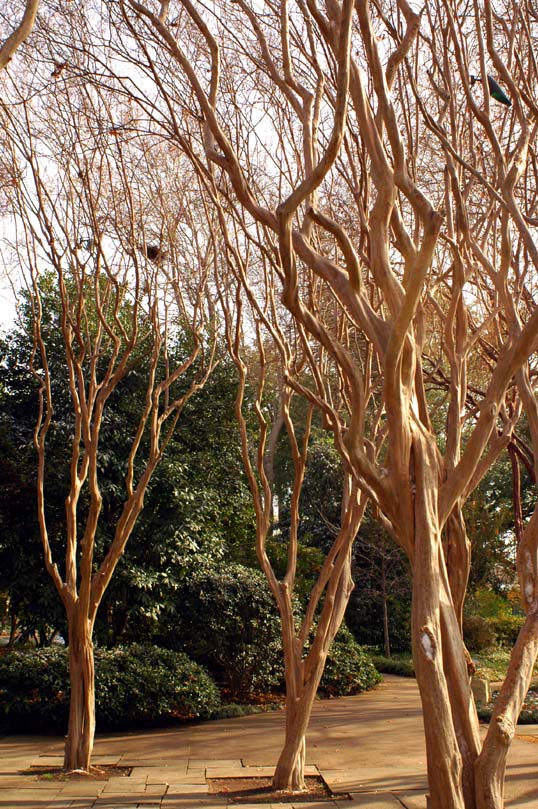
They also have these amazing limbs, covered in smooth bark.
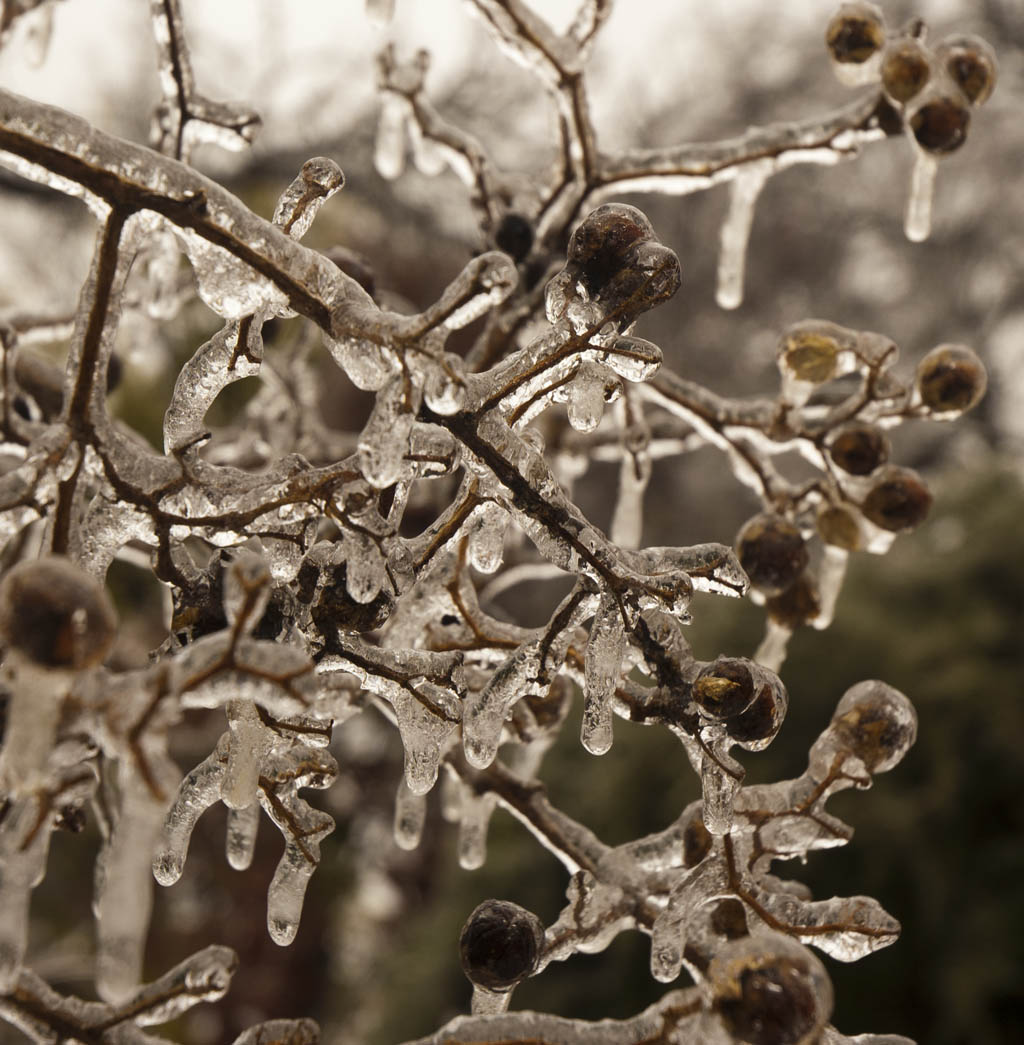
This winter, the ice storm showed another side of their beauty, glowing like crystal in the faint sunlight filtering through the clouds.
“No mistake about it. Ice is cold; roses are red; I’m in love. And this love is about to carry me off somewhere. The current’s too overpowering; I don’t have any choice. It may very well be a special place, some place I’ve never seen before. Danger may be lurking there, something that may end up wounding me deeply, fatally. I might end up losing everything. But there’s no turning back. I can only go with the flow. Even if it means I’ll be burned up, gone forever.”
― Haruki Murakami, Sputnik Sweetheart
My old chainsaw quit working a year ago, so we had to go down to the hardware store and buy a new one. I was afraid they would be out of stock – a lot of people around here must be buying them right now – but they had two left. We bought the smallest, least expensive, least powerful, corded electric one. It’s only for trimming and, like now, clearing fallen limbs – not a lumberyard – plus, the smaller the saw… the safer the saw (in my opinion).
It was cold work, but quick work, to cut up the limbs of the red oak in the front yard and move them to the curb. It took a little more time to chop up the thicker pieces into chiminea sized chunks of firewood, but waste not want not.
Actually, our old chiminea has bit the dust too, so we need to get down to Amigos Pottery and buy a new one. This is the season of renewal – new chainsaw, new chiminea to burn the old limbs while we wait for the new ones to grow back. It is a shock to see how much wood the weight of the ice tore off the tree – there are still some detached limbs suspended high up, waiting for a thaw and a good breeze to fall – but there are a lot left and the old tree keeps growing.
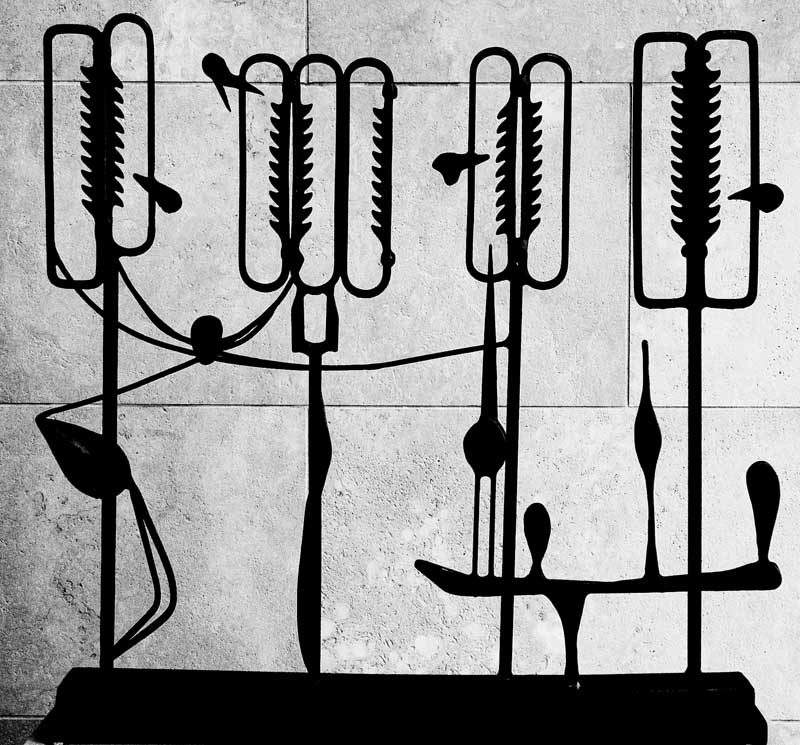
David Smith, The Forest, Nasher Sculpture Center, Dallas, Texas
From The Estate of David Smith – David Smith’s Statements
The Question—What is Your Hope
Original version, Smith notebook 28 (c. 1940s) final version c. 1950
I would like to make sculpture that would rise from
water and tower in the air–
that carried conviction and vision that had not
existed before
that rose from a natural pool of clear water
to sandy shores with rocks and plants
that men could view as natural without reverence or awe
but to whom such things were natural because they were
statements of peaceful pursuit–and joined in the
phenomenon of life
Emerging from unpolluted water at which men could bathe
and animals drink–that
harboured fish and clams and all things natural to it
I don’t want to repeat the accepted fact,
moralize or praise the past or sell a product
I want sculpture to show the wonder of man, that flowing water,
rocks, clouds, vegetation, have for the man in peace who
glories in existence
this sculpture will not be the mystical abode
of power of wealth of religion
Its existence will be its statement
It will not be a scorned ornament on a money changer’s temple
or a house of fear
It will not be a tower of elevators and plumbing with every
room rented, deductions, taxes, allowing for depreciation
amortization yielding a percentage in dividends
It will say that in peace we have time
that a man has vision, has been fed, has worked
it will not incite greed or war
That hands and minds and tools and material made a symbol
to the elevation of vision
It will not be a pyramid to hide a royal corpse from pillage
It has no roof to be supported by burdened maidens
It has no bells to beat the heads of sinners
or clap the traps of hypocrites, no benediction
falls from its lights, no fears from its shadow
this vision cannot be of a single mind– a single concept,
it is a small tooth in the gear of man,
it was the wish incision in a cave,
the devotion of a stone hewer at Memphis
the hope of a Congo hunter
It may be a sculpture to hold in the hand
that will not seek to outdo by bulky grandeur
which to each man, one at a time, offers a marvel of
close communion, a symbol which answers to the holder’s vision,
correlates the forms of woman and nature, stimulates the
recall sense of pleasurable emotion, that momentarily
rewards for the battle of being
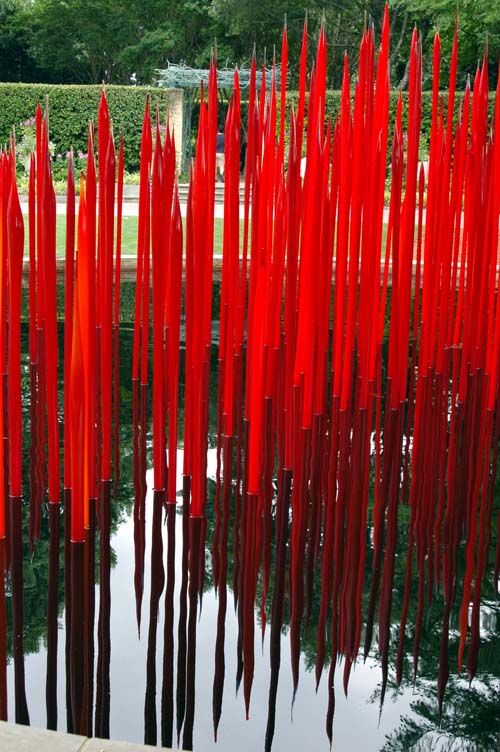
A second version of a photograph I did the other day. One of my most overused and trite photographic techniques – taking a photograph of a reflection and then inverting it. This is one of trees reflected in the pond of Chihuly’s Red Reeds, at the Dallas Arboretum. So overused… I’ve done it again.
I think I like this one better, though I like the floating leaves in the other.
I never get tired of looking at the Crape Myrtle trees here in Texas. They are the Texas State Shrub (I’m sure you were wondering what the Texas State Shrub Was). They are about the only plant that blooms in the killer desert burning summer heat… and in the winter the bare branches make beautiful patterns (If you don’t do like so many folks do and cut the crap out of them – that bugs the hell out of me).
At the Dallas Arboretum there is the Crape Myrtle Allee (sometimes it’s Crepe Myrtle – I’m not sure which is preferred) which I’ve photographed here and here. An incredibly cool long massing of mature trees, a cool tunnel in summer – a tangled tube in winter.
But I like the shape of the individual trees too. The bark peels off and leaves the wood looking almost like skin, the branches twist and turn, and multiply into a thick, fractal towering forest of twigs.
They are so ubiquitous, it’s easy to take them for granted. You have to stop every now and then and simply look at the things.
And maybe take a picture.
One of my most overused and trite photographic techniques – taking a photograph of a reflection and then inverting it. Here is a favorite of mine. Here is another. And a third. This is one of trees reflected in the pond of Chihuly’s Red Reeds, at the Dallas Arboretum.
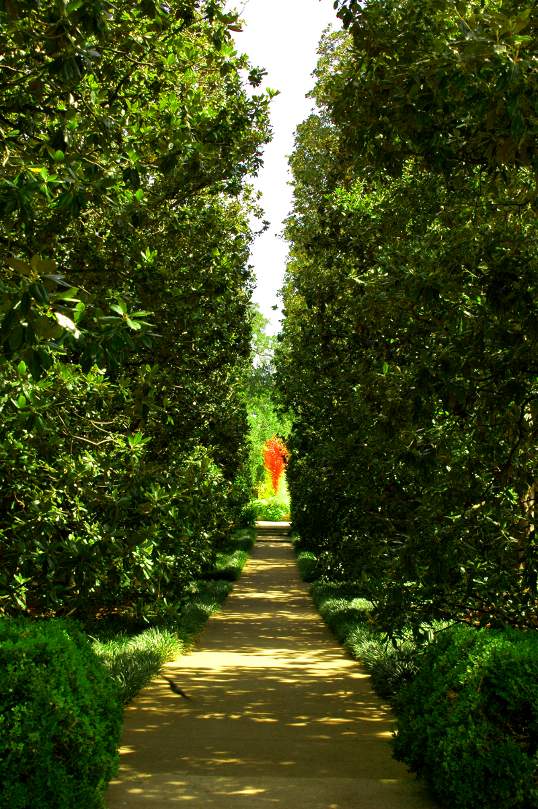
One of the most impressive sights in the Dallas Arboretum is the Magnolia Allee (along with the different, but equally gorgeous, Crape Myrtle Allee). A long, straight, and narrow path runs between two walls of ancient giant Magnolia trees. This year, the fountain at the end is replaced by one of the larger Dale Chihuly works.
It’s something to see, and even more amazing to walk down.
For a larger and higher quality version Visit the Flickr Page
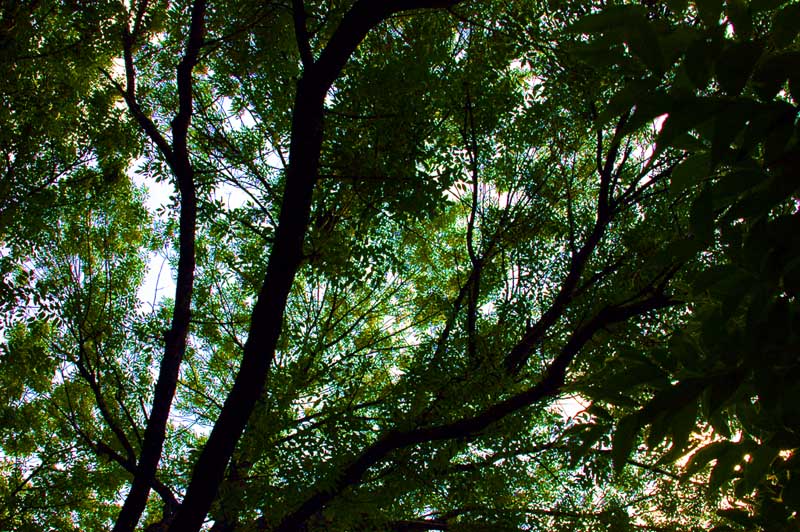
There are few things as beautiful as dappled sunlight meandering down through a grove of trees.
–Me, 1998
Even on the hottest, brightest, summer days an overhead canopy of old trees makes for shade and comfort.
The air is still and hot and innervated with the sounds of cicadas desperately trying to find their mate before they die, too soon. Their song is desperate – they have waited for over a decade in the dark, hard ground and now have only days in the sun. Their abandoned skins, dry and hard on the barks of trees, their gray blue dead bodies, spent, line the concrete paths.
Everyone has a grove of trees that brings back some sort of memory – you should revisit it and walk around. It looks different… the trees grow slowly, but they grow, the weeds are trimmed in a changing shape – like a slow wave. But it also looks the same, as all shaded groves of trees look the same.
I love taking a rest, lying down and looking up through the trees at the sun peeking through from above.
Does anybody really look at anything?
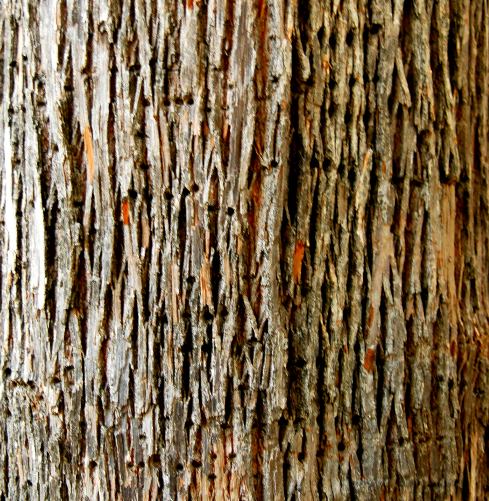
I was waiting outside for the day to get going and noticed the tree next to me had been drilled by a woodpecker in a long series of horizontal rows of holes – hundreds of them, all over the tree. The woodpecker must work the same hours as I do, because I had not heard him out there, pecking away.
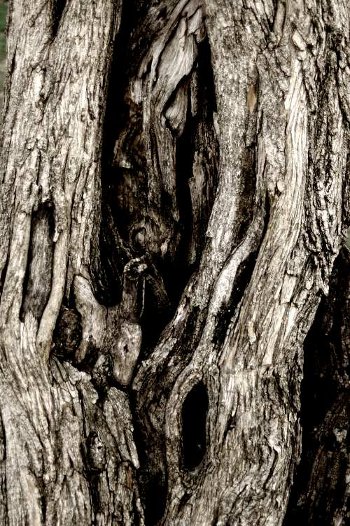
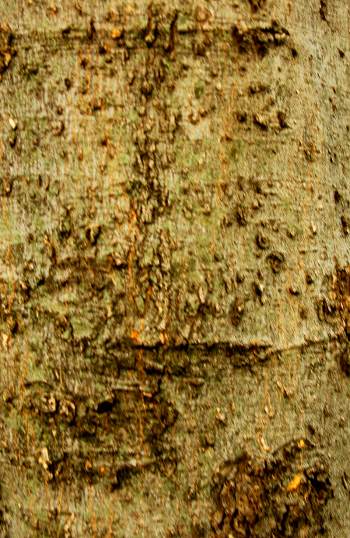
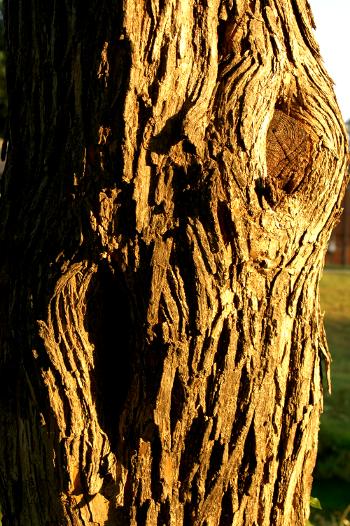
All the trees tell stories in their bark. I didn’t have to move more than ten feet to get these pictures, but look at the variety of the tree skin, from tough and rugged, to torn and wounded, to almost soft and curvaceous.
But nobody ever looks at them… not closely, not like that.

The woodpecker has left a line of holes in this tree like Al Capone’s gunners on Saint Valentine’s day.
The torn-up looking trees are all Bois d’ Arc – which I have written about before.