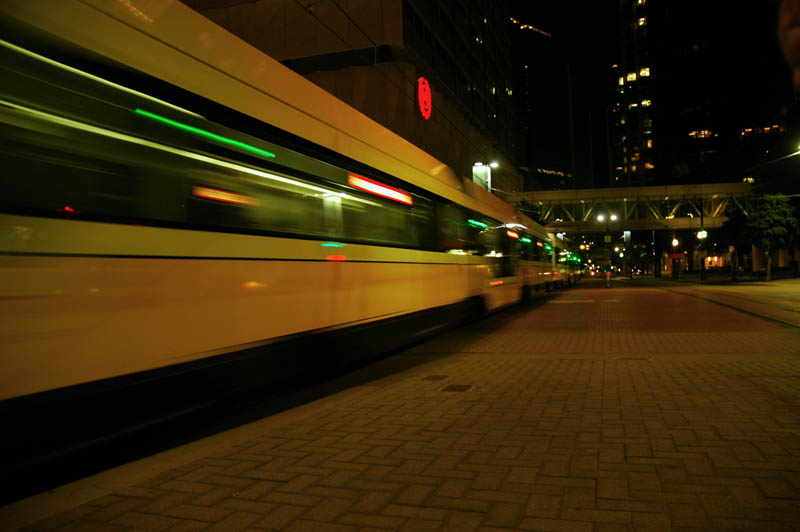
The Only Right Thing to Do

“I dream. Sometimes I think that’s the only right thing to do.”
― Haruki Murakami, Sputnik Sweetheart

Oblique Strategy: A line has two sides

I rarely remember my dreams. When I am able to grasp the wispy end of something as I’m waking up it is always some form of daily frustration, like my car won’t start or my key won’t fit. I guess that’s why I can’t remember my dreams – they are simply more boring versions of my daily life.

This morning, though, as I crawled out of bed, I remembered. I was hitchhiking through Japan with two other people, a young couple. Why we were three was hazy, though there seemed an adequate explanation somewhere. At the time of the dream we were wading through a rice paddy, each clutching a train ticket. The tickets were paper and plastic, white and bright yellow, and valuable.

Ahead, rising out of the rice, was a track on a levee and a simple station. The biggest passenger train in the world was stopped there, vibrating and smoking. As we approached, it blew its whistle and slowly pulled off, just as we arrived. I was frustrated at the fact we had missed the train, and clutched at my ticket in frustration.

A minute later, we realized that this massive transportation system was too large for one single train, and a second, identical one came huffing into the station. Suddenly elated, I had my ticket stamped and boarded the nearest car. My two companions followed close behind me.

The rest of the dream consisted of me exploring the various cars up and down the line. They were laid out in a linear cornucopia of delights, each car more opulent and fascinating than the one before.

My alarm went off – time to get up and go to work. I hit snooze to see if I could drop off again and visit a car or two more, but the train had sped off to somewhere unknown.

https://youtu.be/-TnA9dSVv9Y

The Abyss Will Gaze Back

“Whoever fights monsters should see to it that in the process he does not become a monster. And if you gaze long enough into an abyss, the abyss will gaze back into you.”
― Friedrich Nietzsche

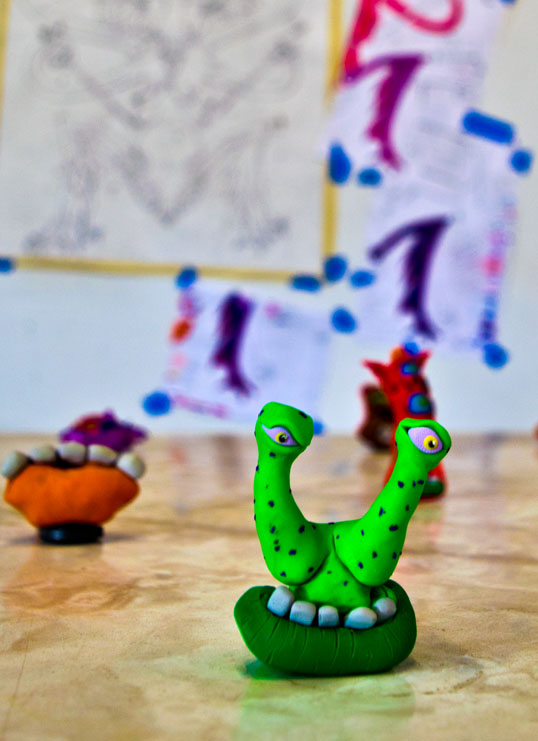
Table of tiny monsters, Clarence Street Art Collective, The Cedars, Dallas, Texas

Oblique Strategy: Question the heroic approach

Yesterday was a long and tiring day (though it was fun) and my head felt like it was full of cotton. I kept forgetting things all day – until late at night when I realized that we had left Candy’s car parked at the train station. I didn’t want to leave it there all night and didn’t want to have to deal with it in the morning. So there was nothing to do but to move my lights over onto my Xootr folding bike and ride to the train station. I made sure I had the right station and that I had Candy’s keys in my bag and set out.

My folding bike, Stock Xootr Swift – I only added the seat bag and bottle cage
(click to enlarge)

I immediately realized that a front had blown through and, although it had been windy all day, the north wind had kicked up a notch, and it was cold. I had not dressed for it. But it is only three miles to the DART train station, so I just soldiered on.

Once I get off my lazy ass and get going, I enjoy riding my bike at night. The traffic is so much less, the trails are mostly empty (of people… there are a surprising number of various critters that come out even in the city) and everything is so quiet and still. I understand that it is dangerous, but my lights are good, I keep my eyes out and my ears open… nothing is safe… nothing worthwhile, at least.

As I rode farther, my efforts warmed me up and I felt better. I fell into the Zen mode of bicycling. If I think of the distance that I have to ride, it feels daunting, like I might never make it to my destination. The key is to only think about the next few feet in front of your handlebars and look around and enjoy every second. The miles drop away.

Before I could really think about it I was at the station. I rode around until I found Candy’s car and popped the trunk. That’s one big advantage of a folding bike – yank a couple of quick releases, pull out the seat, fold the wheels together and the bike goes into the trunk. It’s really handy for going and fetching a car.

I drive a tiny car – a Toyota Matrix. I always liked it because I could fold the rear seats down and get a bike (barely) into the back of the car (never liked exterior bike racks). I ways surprised at how small the Xootr Swift folded down. I was able to fit it easily in the small space behind the rear seat. Now I have a four-passenger car again.

My Xootr Swift folds differently than most. You undo two quick releases and pull the seat post up. Then the bike folds front to back (most fold side to side) until the two wheels are together. If you need more space, the seat can come out completely and another quick release lets the handlebars slide out. It doesn’t fold as compactly as, say a Brompton, but it has the advantage of being strong (a big rider like me needs the strong frame) and it uses standard bike parts – which is a great thing over the long term.

So I drove Candy’s car home and stowed everything away in the garage.

Tomorrow’s another day.

To the Vanishing Point

“Freedom is just chaos with better lighting”
― Alan Dean Foster, To the Vanishing Point


Waco, Texas

I Venture a Long Long Way For a Waffle

Unless you live in North Texas – you have no idea how horrifically big the Dallas/Fort Worth Metroplex is. The entire complex of cities is seventy miles across… side to side or top to bottom… from Rockwall to Benbrook, or McKinney to Cleburn, or Denton to Waxahachie.

That’s a lot of territory. Miles and miles of Texas. That’s almost five thousand square miles of urban landscape.

That’s too much city to cross by bicycle. Or at least by bicycle alone. So, as always, I combined the bike with mass transit – specifically the web of train tracks that once took cattle back to the eastern slaughterhouses… but now shuttle city denizens around the concrete vastness.

Last week, I was surfing the web, checking out facebook, when I was confronted by a photo of a restaurant menu. The restaurant was Brewed – a craft beer/coffee/gastropub in Fort Worth – and they were offering a Temptress-Topped Waffle, paired with a special keg of French Quarter Temptress Stout.

Tempress is a milk stout produced by the Lakewood Brewing Company, located only a couple miles south of my house. I consider Temptress to be one of the best things on earth. Not beers… Things.

So on Saturday I set up my Xootr Swift Folding bicycle and set off for Fort Worth. That is too far for me to ride, so I would combine the bicycle with the local trains. My departure was delayed for an hour after I discovered a thorn in a tire – but I set off nevertheless for the nearest DART station and took the Red line to downtown Dallas. There I boarded the TRE Line for distant Fort Worth.

The only problem was that they were doing some bridge maintenance west of the airport, so the train stopped, everybody piled off and onto a brace of waiting buses, and rode to the next stop where we reboarded another train. The bus had a bike rack on the front; I had never used one of those before. It worked fine, but I felt a nervous jolt in my stomach every time the bus bounced over some pothole or ditch. I could imagine my bike bouncing off, crushed under the wheels.

Of course, the people that designed and built the rack knew much more than me and the trip was fine. Still, the unboarding, boarding, moving, and reboarding took a lot of time and it seemed like forever before I left the train at the T&P station in Fort Worth.

I used Google Maps bicycling directions to find a route to Brewed, locked my bike up outside, and found a seat at the bar.

My Xootr Swift locked up outside Brewed, Fort Worth, Texas

My Xootr Swift locked up outside Brewed, Fort Worth, Texas

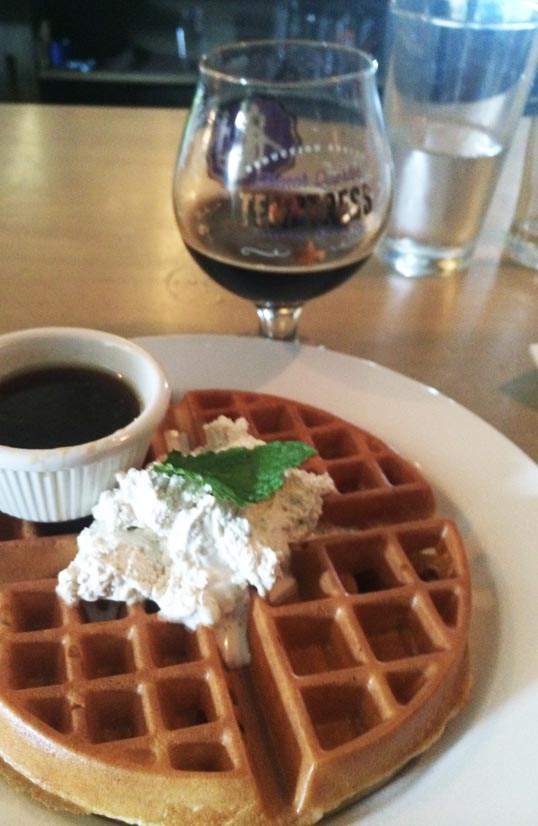
Lakewood Brewing Company, French Quarter Temptress, Special Glass, Brewed, Fort Worth, Texas

Lakewood Brewing Company, French Quarter Temptress, Special Glass, Brewed, Fort Worth, Texas

Temptress-Topped Waffle, Brewed, Fort Worth, Texas

Temptress-Topped Waffle, Brewed, Fort Worth, Texas

The French Quarter Temptress was excellent – the waffle with Temptress laced syrup and whipped cream was even better. I really like Brewed – coffee, craft beer, and good food – what can be better than that? The restaurant has a fun, eclectic décor (including a “Seventies Room”) and would be a regular place for me, for sure, if it wasn’t so darned far away. I sat at the bar, chatting with the staff and customers for a lot longer than I intended, but it was fun.

We talked about local beer, about coffee, about New Orleans, and about the asymmetrical rivalry between Dallas and Fort Worth.

I left the restaurant later than I had planned, but still wanted to get a few miles of bike riding in before I headed home. The French Quarter Temptress came in a special souvenir glass – I carefully wrapped it up so I could get it all the way back unbroken. Again, using Google Maps I wound my way to the west, past the Fort Worth Zoo, and along the trails along the river back into downtown.

I wanted to visit the Water Gardens and get some photographs but I felt the pavement grow ragged under me and I realized I had another flat (another thorn) and had to take the time to fix the leak. As I sat on a bench and worked the tire irons and portable pump I kept glancing across the street at something on the sidewalk. It looked like a photorealistic sculpture of a homeless man standing there, holding his shoes, staring into the distance.

During the entire time, maybe twenty minutes, I worked on my tire, the thing never moved, not a fraction of an inch. It must be a sculpture, I thought, I even kept an eye on one little stray lock of hair – which never budged. Testing out my new tire, I rode across the street, and the sculpture turned and looked at me. It was a real homeless person, semi-catatonic, standing stock still until something moved near him.

That shook me a bit – and it was time for a train, so I rode into the T&P station. The trip back included the same train-bus-train dance. So it was TRE train-bus-TRE train-DART Red Line Train-three mile bike ride to get back to my house. I was well after dark when I reached home.

A fun day – but a long way to go for some waffles.

The Old Railroad Trestle

(click to enlarge)

(click to enlarge)

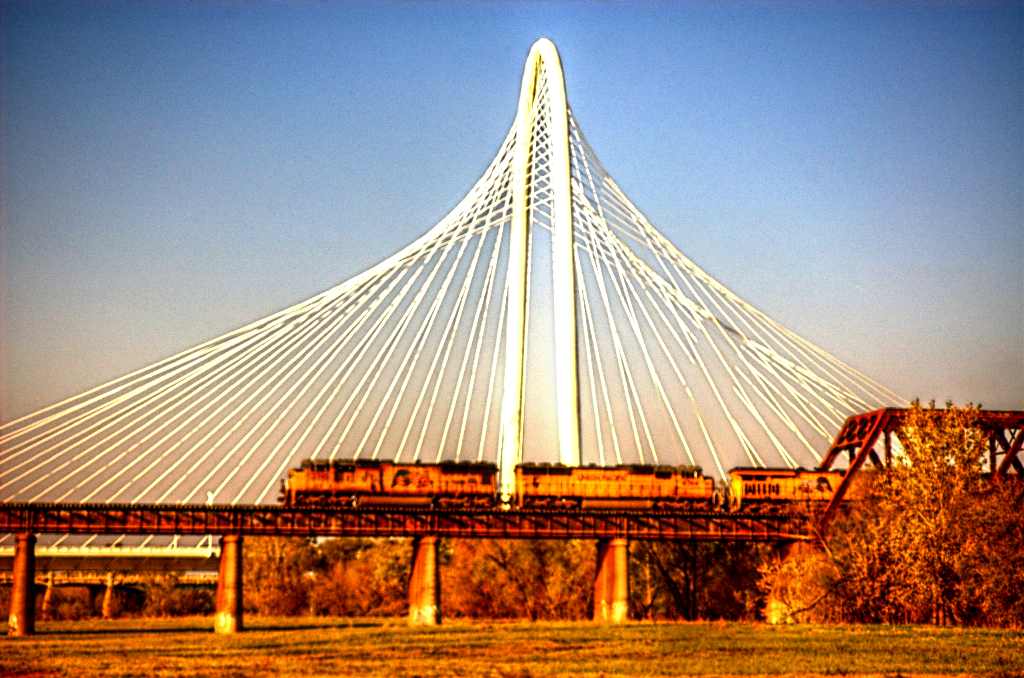
Almost three years ago, while the Margaret Hunt Hill Bridge was still under construction, I took a photo of a train going by on an old railroad trestle next to the new bridge. Now, the city has opened up the beginning of a network of trails in the river bottoms, and I was able to pass underneath that old trestle.

I never realized how old it really was.

(click to enlarge)

(click to enlarge)

(click to enlarge)

(click to enlarge)

Dead End

Frisco, Texas

“Quite possibly there’s nothing as fine as a big freight train starting across country in early summer, Hardesty thought. That’s when you learn that the tragedy of plants is that they have roots.”
― Mark Helprin, Winter’s Tale

(click to enlarge)

(click to enlarge)

“Swerve me? ye cannot swerve me, else ye swerve yourselves! man has ye there. Swerve me? The path to my fixed purpose is laid with iron rails, whereon my soul is grooved to run. Over unsounded gorges, through the rifled hearts of mountains, under torrents’ beds, unerringly I rush! Naught’s an obstacle, naught’s an angle to the iron way!”
-Herman Melville, Moby Dick

(click to enlarge)

(click to enlarge)

“The train bore me away, through the monstrous scenery of slag-heaps, chimneys, piled scrap-iron, foul canals, paths of cindery mud criss-crossed by the prints of clogs. This was March, but the weather had been horribly cold and everywhere there were mounds of blackened snow. As we moved slowly through the outskirts of the town we passed row after row of little grey slum houses running at right angles to the embankment. At the back of one of the houses a young woman was kneeling on the stones, poking a stick up the leaden waste-pipe which ran from the sink inside and which I suppose was blocked. I had time to see everything about her—her sacking apron, her clumsy clogs, her arms reddened by the cold. She looked up as the train passed, and I was almost near enough to catch her eye. She had a round pale face, the usual exhausted face of the slum girl who is twenty-five and looks forty, thanks to miscarriages and drudgery; and it wore, for the second in which I saw it, the most desolate, hopeless expression I have ever-seen. It struck me then that we are mistaken when we say that ‘It isn’t the same for them as it would be for us,’ and that people bred in the slums can imagine nothing but the slums. For what I saw in her face was not the ignorant suffering of an animal. She knew well enough what was happening to her—understood as well as I did how dreadful a destiny it was to be kneeling there in the bitter cold, on the slimy stones of a slum backyard, poking a stick up a foul drain-pipe.”
― George Orwell, The Road to Wigan Pier

LBJ/Central Station

There is art where you least expect it. There is beauty in the most mundane.

The scenes you see every day, the dreary landscape of grinding drudgery is too often not seen. Take a look.

LBJ/Central StationDART Red Line

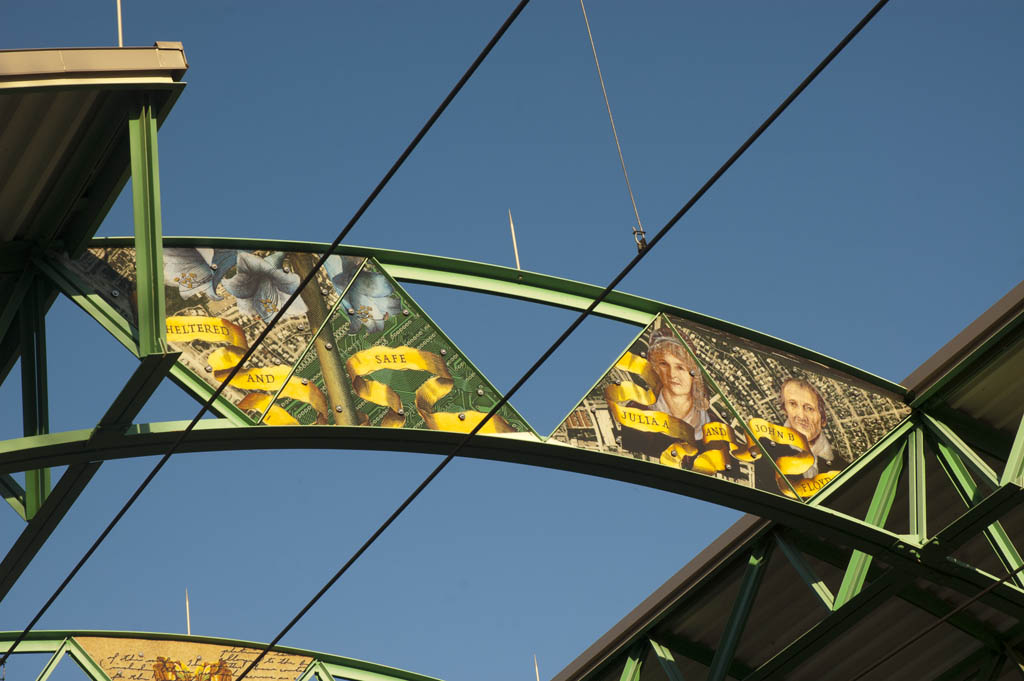
LBJ/Central Station, providing easy access to Texas Instruments’ main campus, links nature and technology with cast stone columns with circuit board designs imbedded as insets. Built on the historic John B. Floyd farm acreage, the station also features a trellis gateway to the station platform. Station design team artist Frances Merritt-Thompson also produced the translucent panels in the overhead truss openings depicting images of the area.

DART LBJ/Central Station Frances Merritt-Thompson (click to enlarge)

DART LBJ/Central Station
Frances Merritt-Thompson
(click to enlarge)

Circuit Board Details in support columns DART LBJ/Central Station Frances Merritt-Thompson (click to enlarge)

Circuit Board Details in support columns
DART LBJ/Central Station
Frances Merritt-Thompson
(click to enlarge)

DART LBJ/Central Station Frances Merritt-Thompson (click to enlarge)

DART LBJ/Central Station
Frances Merritt-Thompson
(click to enlarge)

Other entries/photos from DART Stations:
Carrollton Collages
Plaza of the Americas, DART Station at Night
Gateway
Bike Lids
Next Stop
Dart Sunset

Train in the Rain

Most near-future fictions are boring. It’s always dark and always raining, and people are so unhappy.
—-Haruki Murakami

(click to enlarge)

(click to enlarge)

The Scene – Waiting for a Train

The Bank of America Plaza Building (the giant green thing) reflected in the mirrored sides of the Dallas Hyatt Regency. Taken from the Union Station DART platform while I was waiting on a train home from the Tweed Ride.

Bank of America Tower reflected in the Hyatt Regency, Dallas, Texas

Bank of America Tower reflected in the Hyatt Regency, Dallas, Texas
(click to enlarge)

Mass Transit

J.G. Ballard wrote a short story named “The Concentration City” (you can read the PDF HERE) about a city that has grown to encompass the entire universe… theoretically and practically – whether it is actually is another question.

The protagonist tries to find the edge of the city, to find “free space” – to find an area where he can build and use a flying machine, by hopping a supersonic express sleeper train and riding it west for weeks.

Unfortunately, he discovers that no matter where you go, there you are.

Here in Dallas – which is shaped sort of like a bulls-eye, with concentric rings of highways and radial connectors – all the trains run out of the center and stop. There is no endless loop. They make you get off the train at the end, before it switches track and heads back in.

Otherwise it would be tempting to get on and never exit. Ride the endless electric rails – watch the city go by, circuit after infinite circuit, the commuters come and go. Everything would slide past forever.

Maybe it’s best that you can’t do that.

transit1

transit2

(click to enlarge)

[…]
“The surgeon hesitated before opening the door. “Look,” he began to explain sympathetically, “you can’t get out of time, can you? Subjectively it’s a plastic dimension, but whatever you do to yourself you’ll never be able to stop that clock”- he pointed to the one on the desk-“or make it run backward. In exactly the same way you can’t get out of the City.”
“The analogy doesn’t hold,” M. said. He gestured at the walls around them and the lights in the streets outside. “All this was built by us. The question nobody can answer is: what was here before we built it?”
“It’s always been here,” the surgeon said. “Not these particular bricks and girders, but others before them. You accept that time has no beginning and no end. The City is as old as time and continuous with it.”
“The first bricks were laid by someone,” M. insisted. “There was the Foundation.”
“A myth. Only the scientists believe in that, and even they don’t try to make too much of it. Most of them privately admit that the Foundation Stone is nothing more than a superstition. We pay it lip service out of convenience, and because it gives us a sense of tradition. Obviously there can’t have been a first brick. If there was, how can you explain who laid it, and even more difficult, where they came from?”
“There must be free space somewhere,” M. said doggedly. “The City must have bounds.”
“Why?” the surgeon asked. “It can’t be floating in the middle of nowhere. Or is that what you’re trying to believe?”
M. sank back limply. “No”
The surgeon watched M silently for a few minutes and paced back to the desk. “This peculiar fixation of yours puzzles me. You’re caught between what the psychiatrists call paradoxical faces. I suppose you haven’t misinterpreted something you’ve heard about the Wall?”
M. looked up. “Which wall?”
The surgeon nodded to himself. “Some advanced opinion maintains that there’s a wall around the City, through which it’s impossible to penetrate. I don’t pretend to understand the theory myself. It’s far too abstract and sophisticated. Anyway I suspect they’ve confused this Wall with the bricked-up black areas you passed through on the Sleeper. I prefer the accepted view that the City stretches out in all direction without limits.””
[…]
—-The Concentration City (1957). James Graham Ballard. The Complete Short Stories