Procrastination with Google Maps

I have been suffering from a terrible case of writer’s block and have been spending too much time staring at a blank screen, waiting in vain for some sort of a useful idea to come bubbling up from… well, from wherever useful ideas bubble up from. Of course, the staring doesn’t last very long until it is replaced by silly web-surfing. You know how that goes.

So I was wasting time by GoogleMap StreetViewing (I’m no fan of the current fashion of converting tech nouns into verbs, such as in the phrase of “Netflixing through Mad Men,” but this is what life is in this best of all possible worlds with) places that I used to live and I came up with this shot:
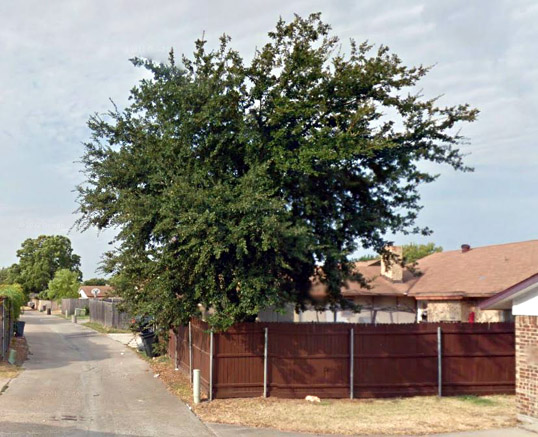
Live Oak in back of the house I used to live in.

Live Oak in back of the house I used to live in.

First, it’s interesting that in my old neighborhood they even have GoogleMaps StreetView in the alley. Let that sink in for a minute. Not only did the Google car drive down the street taking photos willy-nilly to post for all to see, but then it proceeded to creep down the alley in back of the houses, doing the same thing. The alleys there were extra-wide (the kids used to cone them off at the end of the block and play roller hockey on the concrete) but… just sayin’.

What I thought was cool is that tree there. The big one in the corner of what used to be my yard.

My son Nick (now in his final classes at Duke University) was a toddler. He was born in East Dallas, a few miles north of this spot, and we moved before our second son, Lee (now a financial analyst in New Orleans) was born eighteen months later. I’m pretty sure the tree was planted before Lee was born, so Nick would have been about a year old.

I took Nick down to the Dallas Arboreteum for a Saturday afternoon. When we arrived, I discovered they were giving out free trees. I picked up a Live Oak planted in a recycled coffee can and brought it home, intending to plant it in the yard of our then-new-to-us home.

It looked substantial in the can, but after digging the hole and getting rid of the container the tree was only about an inch and a half high. It was dwarfed by the weeds that surrounded it. Everybody thought it was ridiculous and that I was an idiot for planting such a tiny sprig.

Still, despite the ridicule (probably because of the ridicule) I stuck it out. I carefully marked out the area around the twig to make sure it wasn’t mowed over or trampled upon. I watered it faithfully and tended it as best I could.

And, wonder of wonders, it grew. Fast. It grew like a weed. I talked to a friend that is a landscape architect and he said, “The smaller a tree is when you plant it, the bigger it will be in ten years.” Something that small doesn’t suffer the shock of transplantation, which sets a tree way back.

A few years later, it was already as high as my head. Putting in a new fence, the wind caught a panel and yanked it out of my hands. It landed on the tall, but still thin tree, smashing it flat. I was horrified.

I carefully raised the reedy trunk back up and staked the tree in position. I expected it to die, but, surprise, it didn’t miss a beat.

And now look at it. It’s one of the largest trees in the neighborhood. When we moved in, the block was thick with fast-growing “junk” trees – put in by the original developer to give quick green. Those have all now (mostly) succumbed to disease and are either gone or skeletal ghosts.

The sturdy oak is still growing.

I’m proud of the fact that I planted that tree (also proud that I got it for free). We moved out about ten years ago, when our kids were in Middle School. Nobody in the neighborhood knows this story, but I do, and that’s what’s important.

It’s also cool that the tree is the same age as my kids. If you have little ones – go out and plant a tree in your yard, or a park, or somewhere that needs one. The decades go by faster than you imagine is possible and a sturdy oak will rise to mark the passage of time with some welcome shade.

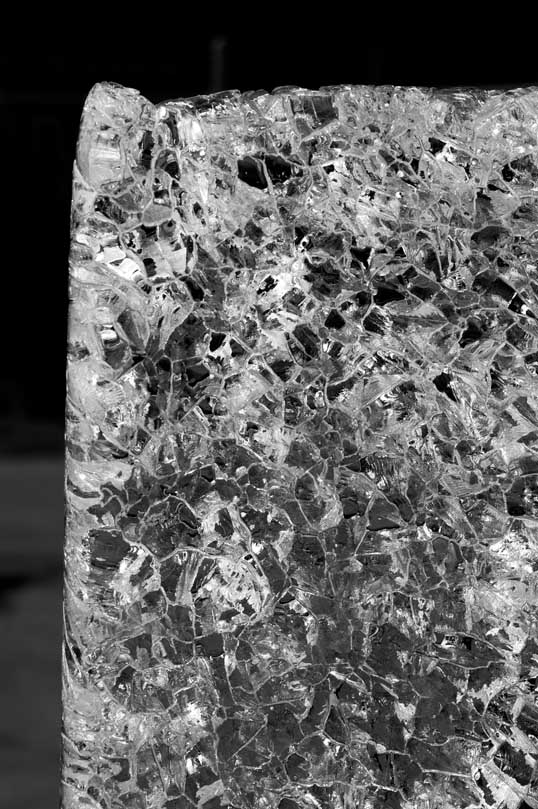
SCABhenge

Closeup of the crazing in the ice sculpture at the Dallas Contemporary

Closeup of the crazing in the ice sculpture at the Dallas Contemporary

The ice sculpture at the Dallas Contemporary

The ice sculpture at the Dallas Contemporary

The last moments of the ice sculpture at the Dallas Contemporary

The last moments of the ice sculpture at the Dallas Contemporary

I have always been fascinated by ice as a sculptural medium. It is cheap, versatile, and, most importantly, temporary. It is fixed in time. What you see now is totally unique, it will never be repeated.

The coolest ice sculptures were Dane Pennington’s Transcendence – from the Arts District a couple years ago. Larger than life figures and monoliths slowly melted – releasing stones that were imprisoned within. I kept going downtown day after day to watch them melt.

Transcendence, on the first night.

Transcendence, on the first night.

Transcendence, on the first night.

Transcendence, on the first night.

After a day of melting in the rain

After a day of melting in the rain

A few weeks ago, I went on (and wrote about) a fun bike ride organized by Dallas Cycle Style. It started at, and was part of, The Dallas Contemporary 35th anniversary celebration. Out in front of the Contemporary was an ice sculpture called SCABhenge, built by the Socialized Contemporary Artists Bureau.

It had been out all night and the ice had crazed and was falling apart. I was there for its final demise, melting in the Texas afternoon.

If you watch this time lapse video closely, you can see a few bicycles from our group go by.

The Geometry of Nature

To be interested in the changing seasons is a happier state of mind than to be hopelessly in love with spring.
—-George Santayana

geometry1

Though his health and family had been broken in the process, he’d found his purpose in life — to share the ancient key discovered anew in the garden: if we feed the earth, it will feed us.
I see that is the secret, too, to living. Though the earth demands its sacrifices, spring will always return.
—- Melissa Coleman

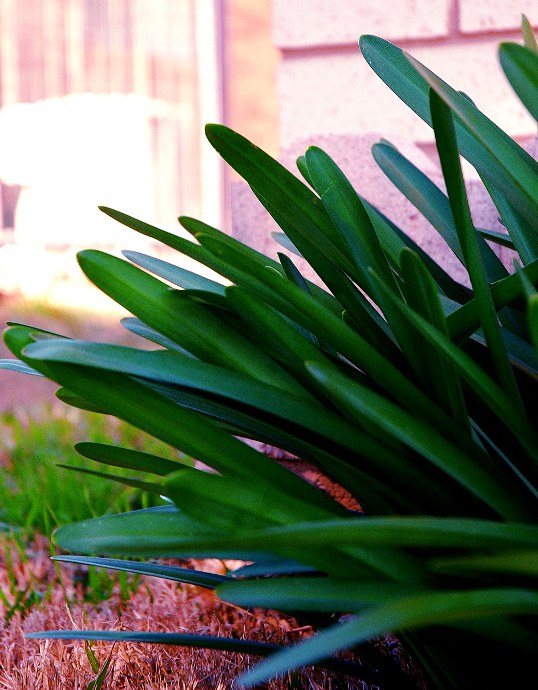
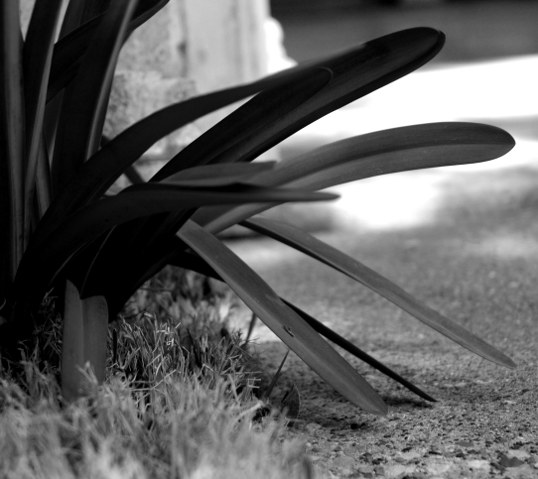
Spring comes early in Texas. Spring comes in the middle of winter. The green shoots that will collect the energy, energize the chlorophyll, store the sugar needed for this season’s flowers are already pulling themselves up out of the black soil.

The curve of the leaves is still pristine – not yet tattered by the windstorms to come or eaten by the insects still sleeping in their eggs. On my way to work I watch the green tips poke up, multiply, and spread out to catch the fire of the morning sun peeking over the horizon.

The dead heat, yellow straw and the dry dust is still a long way off, but it will come. Let them grow when they will – while they can.

geometry2

April is the cruelest month, breeding
lilacs out of the dead land, mixing
memory and desire, stirring
dull roots with spring rain.
—- T.S. Eliot, The Waste Land

The Great Dunes

A blogger, surroundedbyimbeciles that has stopped by here has a picture of himself at the Great Sand Dunes National Park as his avatar. He wrote a blog entry about it, check it out.

I knew I had two scanned photographs of Nick at the same spot, one taken in 1996 and one taken in 2001.

I dug around and found the photos and the blog entry I wrote in 2001 to go along with them.

Here’s the eleven year old entry from my archives…. July 3, 2001.


I’ve been to the Great Sand Dunes before, twice. Once, six years ago or so, a year before I started my journal the whole family stopped on the way from Santa Fe to Buena Vista. In 1997 I came here alone, on a solo trip around Colorado. I spent a couple days and camped here, and wrote about it.

Medano creek, this late in the summer, is barely a trickle, and right after we arrived we crossed it and immediately started climbing the dunes. Even when we were walking the wide expanse of level sand before the dunes actually start I had my doubts about whether I could make the seven hundred foot climb up the piles of sand. It’s tough walking and at over eight thousand feet, the altitude doesn’t help much when you’re old and fat and out of shape like me. As soon as the steeper slopes started and Nick and Lee coursed ahead, shooting up the dunes like active ten-year-olds I knew there was no way I could make it all the way. My lungs were burning and my legs felt like Jello.

I decided that I could try to get as far as I could, though. I’ve done this before so I remembered how painful and discouraging uphill walking on sand can be – so I thought I’d be patient, walk a while, rest a while, and see what happened. The day was getting hot, too.

Nick and Lee pushed on ahead and pretty quickly they disappeared. Once you get into the dune field closer ones hide the highest dunes. One good thing about dune hiking is that you can’t really get lost and it’s a lot easier coming back down than going up – so it’s hard to get stranded in the sand.

Each dune I’d climb I divide into three sections in my mind. I’d climb the first third, then pause to try and catch my breath. The second third would be tougher, I’d have to stare at my feet and force them to take little baby steps until I reached my interim goal, exhausted, so I would sit down and rest until I felt my pulse return to normal. The third third would be easy after that long rest, and I’d settle in when I reached the top so I could enjoy the view.

By patiently munching through each set of dunes, higher and higher, I soon found myself walking the last slope to the highest dune, and not feeling too bad. I was worried that Nick and Lee would be impatient and head back down before I reached them, but they were there, digging around in the sand.

There was a gaggle of teenagers with sophisticated hiking gear – daypacks with integrated hydration systems and carbon fiber hiking poles- already there. They referred to Nick or Lee, who had been up there with them for a while before I arrived, as “the kids.” One of the teenagers was trying to impress his girl by talking about Lawrence of Arabia.

“No,” Nicholas said, “This isn’t like that, this is like Dune.”

We posed for a photo, then Nick headed back down to check on Candy.

I had a tough time getting Lee to go. There is another high dune, maybe five miles away, and Lee pitched a fit when I told him we couldn’t walk to it.

The teenagers left, then some guy from Switzerland walked up and we talked a bit while Lee dug holes in the sand.

Lee digging in the high dune

“A beeg sander-boxer,” the guy said, in his thick accent, “Een Switzerland, children haf only small boxen wit sander.” He was on a driving trip from Santa Barbara and I think the distances in the American West threw him a little. “Too far for little time,” he said. I said I was from Dallas and he asked if that was over a hundred miles from there. When I told him it was seven hundred miles he looked perplexed.

Meanwhile, Lee had walked over the next dune and was stomping out a giant, “LEE WAS HERE,” in the sand. The dunes are dry and hot on the surface, but surprisingly, are wet only an inch or two down. If you drag your feet it makes a dark line of wet sand, only to disappear a few seconds later.

A cloud blew down from the mountain and it began to rain. “Rain in zee desert!” the guy from Switzerland exclaimed. I convinced Lee to head down then, I was afraid of lightning up on the exposed dune.

“That’s more sand than I’ll ever have to play in,” said Lee.

“Don’t worry, you can play in more at the bottom.”

“Not as much as up here.”

The walk down was a lot easier than the one up. The hot day was suddenly cool from the rain, the dry yellow sand at first mottled, then dark from the falling water. By the time we reached Medano creek it was over and the sun came out again.

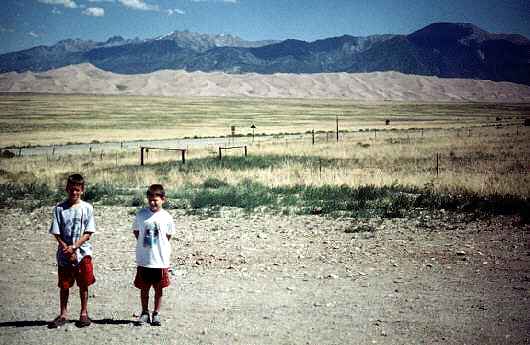
Nick and Lee in the parking lot at the edge of the Monument. 2001

Nick and Lee standing in the parking lot of a gas station right outside the Great Sand Dunes National Monument. The dunefield is a lot bigger than it looks, the tallest dune is seven hundred feet high or so. The mountains behind are the Sangre de Cristo range, several are over fourteen thousand feet high.

Lee busied himself in the creek, making a dam. While he worked I chatted with a Park Ranger – he had brought down a special sand wheelchair for a park guest. It had huge red balloon tires so it could be pushed across the soft sand. The Ranger said that the sand was twice as hard to walk in or to climb as firm ground.

Lee getting help with his dam in the creek.

Meanwhile, Lee’s dam was stretching in a ragged arc across a portion of the creek. Medano creek is odd because of the load of sand it carries (the creek is what helps corral the dunes in place, it carries escaping windblown sand back around to the upwind side of the dunes) the stream is constantly moving around in little pulses and rushes as the sediment raises the bed of the creek itself. It was a good lesson in hydrology for Lee, with several lessons:

1: Don’t make a dam out of sand.

2: Little leaks soon become very big leaks.

3: The more you patch the little leaks the higher the dam gets and the faster the little ones get bigger.

4:Eventually, your dam is toast.

Nick in 2001

I posed Nick in this picture at that spot because I wanted to compare it to this picture.

Nick in 1996

This was taken in early June 1996. There is a lot more water in the creek due to spring melting snow. This picture was taken a couple weeks before I started this journal.

This is Nick, Lee, and I, taken at the top of the highest dune at The Great Sand Dunes National Monument. The thing is a lot taller than it looks in this picture – we had to climb seven hundred feet of sand to get there.

The three of us on the highest dune in 2001.


One good thing about keeping a blog (notice I still called it a “journal” – blogs were pretty new in 2001, though I’d been writing online every day in a journal for five years by then) is the preservation of memories. Until I reread this from my archives I had forgotten so many details – the Swiss Tourist that was flabbergasted at the sheer size of the American West, the teenagers with their high-end camping gear, the fact that at ten years old Nick knew what Dune was. In 2001 the Great Sand Dunes was still a National Monument – it became a full fledged National Park in 2004.

This is more than ten years old. Nick and Lee are both well into college now. I would love to go back there with them, pose Nick in the creek again as an adult. But there is so much to do now, so much to do and so little time to get it done in. Everything is so difficult.

Is Reading a Waste of Time?

Digging around in the archives of my old online journal... I found this entry from June 28, 2002. When I put it out in public – a lot of people had a strong opinion on this question – nobody thought that reading was a waste of time.  Despite this public consensus,  I still haven’t answered the question to my own satisfaction.

For example, despite the fact I’m a third of the way through a Hemingway novel, I haven’t had the time to pick up my Kindle in the last three days.

Nick reading Harry Potter.

Nick reading Harry Potter. Is this the first one?


There’s a kind of comfort in returning at the end of the day to the same people and watching them enter their lives more deeply.

—-Tobias Wolfe, on the novel

I came across this quote… about novels. After reading and thinking about it I realized how true it was.

For the last few months I’ve been reading collections of short stories or slim novellas, exclusively. Time has been very short. Plus, I’m working on a handful of stories myself – trying to get them ready to send off – and wanted to read the form and keep my mind and pen open to the myriad possibilities.

I felt the urge to bite into something more substantial, so I scanned my case of recently purchased, but unread, tomes and pulled out The Corrections, by Jonathan Franzen. I’m not interested in the media hoo-ha concerning this book and the author’s relationship with Oprah Winfry. I read some glowing reviews, though, so I thought it might be worth the read.

I’m maybe two-thirds through and the book is good. It started better than it is right now – Franzen seems to be repeating themes and situations, plus the center section feels a little padded – but it is well-written, with compelling characters. You can’t ask for much more.

What has taken me off guard is how much I’m enjoying reading the book. I catch myself looking forward to getting home, getting my stuff done, spending some time with Nick and Lee, getting in my daily writing, then settling down with the book (if I’m not too exhausted to stay awake). It feels like a deserved reward at the end of a long day.

It feels like a second life. I never thought about how the characters in a full-blown novel come, over the time it takes to get through the book, to occupy your imagination, your life of the mind. They become imaginary friends, shadow family members – unreal characters that, because they exist only within your own personal gray matter, share an odd intimacy with you.

The best thing is that, because they are only shadows of text and imagination, they are harmless. This second family can be as colorful as they want to be without causing problems in the real world. The more outrageous, dysfunctional, and insane, the better.

You can have flawed, unfaithful, even evil friends and relatives – with all the amusement that entails – but without them showing up at all hours to call in an old favor and demand you hide them from the police/mob/irate former lovers.

I used to buy books based on bulk. I’d dig through the used bookstores looking for massive tomes at low prices – sort of a cost per page value basis. I guess I was thinking about how much enjoyment – maximizing the time would I get from each book.

Over the years, I moved away from this philosophy of reading as my life became busier and busier and my time on earth becomes shorter and shorter.

I know a lot of successful people, type “A” personalities that are always rushing around getting things done, making lots of money, or fighting back the entropy that constantly attacks their living spaces. Most of them don’t read much. They view reading as a useless, frivolous, and wasteful activity.

Is reading a waste of time? It doesn’t accomplish anything. I consider watching television a waste of time (though I do watch too much, of course) – how is reading any different? How about going to films? Is that a waste? How is that different than TV?

If reading is a waste of time why do we work so hard to get our kids to do it? Fret so much when they would rather play with their friends – interact with real people rather than stick their solitary nose in a book?

Is reading a waste of time?

Are fish sticks considered seafood?

The Idea Pomodoro

For a while now I have been working on using the Pomodoro Technique to improve the amount of work I can get done in a period of time, help control stress, and reduce procrastination.

The basic idea of the Pomodoro Technique is to break a workday up into set units of time using a simple kitchen timer or equivalent:

1. Choose a task to be accomplished

2. Set the Pomodoro to 25 minutes (the Pomodoro is the timer)

3. Work on the task until the Pomodoro rings, then put a check on your sheet of paper

4. Take a short break (5 minutes is OK)

5. Every 4 Pomodoros take a longer break

The real benefit of the technique comes when you get in the habit of examining the Pomodoros and see what you were able to accomplish. You can set up a feedback loop where you see what you are getting done, improve your implementation of the technique, apply the improvement, and then see how it works.

I have a way to go before I am a master of the technique. The most vexing difficulty is managing interruptions. But I’ll keep experimenting and plugging away.

What I want to talk about today is the idea of a Specialty Pomodoro. This is a Pomodoro sized and timed chunk of time… 25 minutes, that are set up and used for a specific purpose, rather than simply trying to peel stuff of off the daily todo list.

There might, for example, be a Brainstorm Pomodoro, where a problem has presented itself and you sit there for one Pomodoro and pump out and write down as many possible or harebrained solutions as you can, with no self-editing until the timer has dinged. There might be a Writing Pomodoro – obviously used to pump out text. Or maybe a Plot Point Pomodoro where possible plot points are generated, or a Character Pomodoro… or a Character Name Pomodoro, or a Setting Pomodoro – the list can grow very quickly.

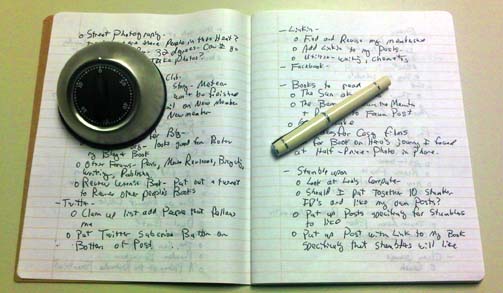
I have come up with a concept of what I call an Idea Pomodoro – which is where I sit down with a Staples Bagasse Composition Book, start the timer going, and simply write down what I want to do, as quickly and with as little thought as possible, until I get the ding.

The purpose of this is to clear my head. There is that feeling of too many ideas bouncing around, too many plans, too little time. This helps clear everything out so I can get back to work. Once an idea is in the book, it is safe, I won’t lose it, it won’t float off to be stolen and used by somebody else. Of course, I have always carried 3×5 cards or a notebook to record sudden ideas, and that’s a good thing (they can be transferred into the Pomodoro) but I found it wasn’t enough. Doing this for a full, intense, Pomodoro feels like a spring cleaning in my brain.

Pomodoro

An Idea Pomodoro - timer, pen, composition book.

My Pomodoro timer is a metal kitchen timer – it feels more substantial and accurate that the tomoto-shaped ones so many people use. I do recommend using the physical timer rather than a computer program – the ticking of the timer seems important and having a real object in the place of a string of bits adds a certain gravitas. The paper in the composition book is thin and you can see the ink on the back side through the paper. Sometimes I use both sides, sometimes I don’t. It doesn’t seem to be important one way or the other. That’s a Pilot Prera fountain pen in the picture.

I like to use the composition book instead of a lined form because I can keep going as long as I need, keeping the limit being time, rather than space. I do find that I can easily fill four or five pages of stuff. Also, I can keep my “book of ideas” with me – all in one place, so I can look at them later and evaluate, act, or discard as need be.

I do use a little code for a hierarchy. Big, top-level ideas are marked with a tick “-“. Smaller, sub-ideas under the big one are marked with an “o”. If I have to go to a third level, I use a hand-drawn asterisk… which doesn’t happen very often.

Later, after my five-minute break or even days later, I can look over the ideas and start building projects or to-do lists. Of course, a lot of the ideas are too ambitious, or too much work, or just plain stupid – and have to be discarded. But that’s cool; I have written it down and can come back to it in the future if the situation changes.

How often do I do an Idea Pomodoro? As often as I need to. It is a spring cleaning of my brain so I do one whenever things begin to feel cluttered. When I find myself jumping from idea to idea and having trouble settling down I know it’s time to carve out the half-hour (including the five minute break) and dump the excess brain dust bunnies out onto a piece of paper.

Does this seem anal – too much work, too much navel gazing? Much ado about nothing? It really isn’t. Once you’ve set everything up it works smoothly and without very much attention. You do get like Pavlov’s dog – the ticking of the timer becomes associated with doing the work.

Speaking of which… there’s the ding. Time for me to take a little break.

Talk to ya later.