What the Pho?

Lee bought a shirt at Bistro B.

Oblique Strategy: Revaluation (a warm feeling)
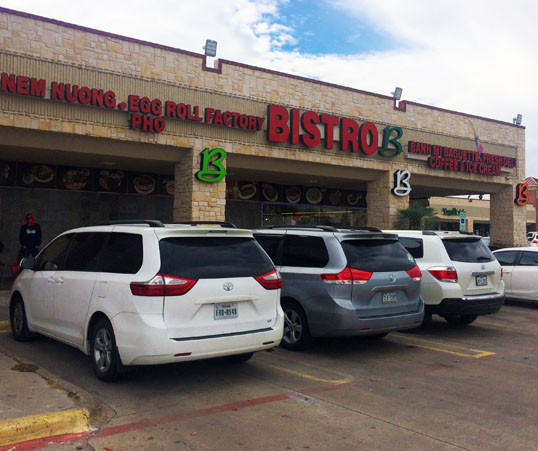
Bistro B

Everybody has their Christmas traditions. Ours is to have lunch at Bistro B. I checked my blog archives, and I wrote about Christmas at Bistro B six years ago. You can read it here. It hasn’t changed much and my 2011 description is still good:

The place, as always, was packed. We waited for a few minutes, which I enjoyed. I stood by the little altar with the burning incense spiral, the electric-powered prayer wheels, and the little shrines decorated with offerings of change. I looked around at the tables to see what other folks were ordering. There were a lot of butane portable table burners heating hot pots that were being shared by a whole family – three generations or more – packed around the big round tables. I love watching a family eat, the heads bent, concentrating on the food, with a ballet of chopsticks dancing in a circular chorus while everyone picks up their food, talks, and laughs.

Its a noisy, happy place, with an army of black-clad waiters rushing, cleanup crews pushing a big square cart, a thick crowd at the registers – some clutching inscrutable bills, but most there for take-out. Some odd genre of electronic dance music pulses… loud but barely audible over the conversations, and a phalanx of flat-screen televisions incongruously simultaneously shine out an NFL documentary. The kids reported that the restroom was, “Like a nightclub.”

We were earlier than we usually were – so the place wasn’t completely packed. The menus were new – the numbers only going up to 494. And in the last six years the restroom extravaganza has been toned down more than a bit.

As always, the Christmas-day service was a little rough. There is a new “Taco” section in the menu – Candy ordered one of those. “Oh, I’m sorry, that’s new, we haven’t learned how to cook those yet,” was the answer from the waiter. Candy ordered chicken, Nick, Lee, and I ordered Pho. The chicken arrived quickly, but no Pho. A while later, the waiter came by and asked how everything was. “No pho,” we answered. He looked flustered and our three enormous bowls of soup came out in a minute. That’s cool – usually we don’t even get what we order – a busy place with a book for a menu and 494 items – you have to chill a bit.

Spring Rolls and dipping sauce

My soup as it arrived. What mysteries await in these warm waters?

The soup after I added sprouts and other vegetables. Those little eggs were hiding down in a little nest of rice noodles. I don’t know what creature they originally came from

After our food we drove across the city for our second Christmas Tradition – to see a movie. It’s getting so that we will only see films at the Alamo Drafthouse (their no phone-no talking-no arriving late or you will be thrown out is a game-changer) and we took in I,Tonya at the Alamo in the Cedars. They have a nice bar upstairs with a killer view of downtown Dallas.

A nice way to wile away a Christmas day.
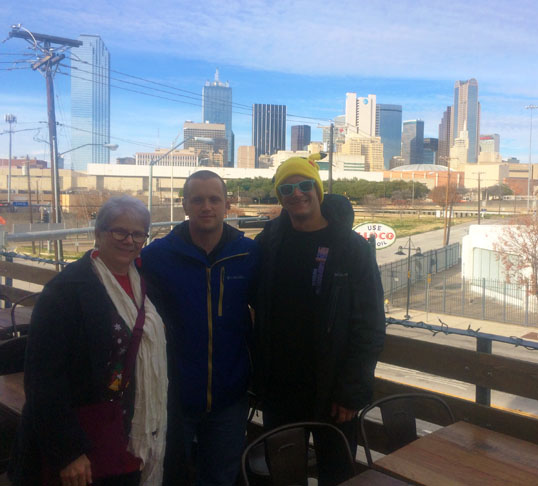
The family on the balcony at the Alamo in the Cedars, Dallas, Texas

What I learned this week, December 23, 2017

45 years ago, early this morning

I remember I was opening a drawer to get some paper out to write a letter when the floor moved so violently I fell to the floor. I remember it like it was yesterday. I forgot it was “only” a 6.3 – but because of the volcanic ash soil and such it had much greater ground movement.


If they act too hip, you know they can’t play shit


My commuter/cargo bike along the Duck Creek Trail. Taking a break while riding a circuit of grocery stores, looking for Banana Ketchup.

More Dallas Bike Lanes Are On The Way

We lost about half the ride at Lee Harvey’s – but here’s the rest at the Santa Fe Trestle Trail.

The new bridge from the Santa Fe trail into The Lot


I have never been able to do this:

Man’s Guide to Wrapping Christmas Presents


Moebius

Art is the big door, but real life is a lot of small doors that you must pass through to create something new


No Intention of Revisiting Any Galaxy

Alec Guinness
“A refurbished Star Wars is on somewhere or everywhere. I have no intention of revisiting any galaxy. I shrivel inside each time it is mentioned. Twenty years ago, when the film was first shown, it had a freshness, also a sense of moral good and fun. Then I began to be uneasy at the influence it might be having. The first bad penny dropped in San Francisco when a sweet-faced boy of twelve told me proudly that he had seen Star Wars over a hundred times. His elegant mother nodded with approval. Looking into the boy’s eyes I thought I detected little star-shells of madness beginning to form and I guessed that one day they would explode.

‘I would love you to do something for me,’ I said.

‘Anything! Anything!’ the boy said rapturously.

‘You won’t like what I’m going to ask you to do,’ I said.

‘Anything, sir, anything!’

‘Well,’ I said, ‘do you think you could promise never to see Star Wars again?’

He burst into tears. His mother drew herself up to an immense height. ‘What a dreadful thing to say to a child!’ she barked, and dragged the poor kid away. Maybe she was right but I just hope the lad, now in his thirties, is not living in a fantasy world of secondhand, childish banalities.”
― Alec Guinness, A Positively Final Appearance

Metal Ostrich Sculpture, downtown McKinney, Texas

Oblique Strategy: Not building a wall but making a brick

The whole family is now here, one son in from New Orleans, his cat ensconced in one bedroom, the other son from Houston, his black Labrador retriever settled into another.

Our Ring smart doorbell makes our cellphones tinkle in a delightful way every time the delivery man brings another present, the new Internet of Things Santa Claus.

We were up at eight; I had to drag myself – feet hurting, mind reeling – from bed; to see a morning showing of The Last Jedi at the local Alamo Drafthouse (the best place in the world to see a movie). I love the no talking/no texting or you will be thrown out policy. I love the fact that at nine in the morning they will bring a milkshake with alcohol in it to your seat. I love the stuff they put on the screen before the movie.


(on this snippet – if you get the joke “A talent agent is sitting in his office, a family walks in…” you should be ashamed of yourself)

I liked the film a lot better than I was expecting.

There is something wonderfully odd about seeing a movie early in the morning, other than the discount tickets. I’m so used to going at night – to emerge to sunlight and the realization that you still have another day to live – is almost wonderful.

Zastrozzi

“My name is Ozymandias, king of kings:
Look on my works, ye Mighty, and despair!”
― Percy Bysshe Shelley, Ozymandias

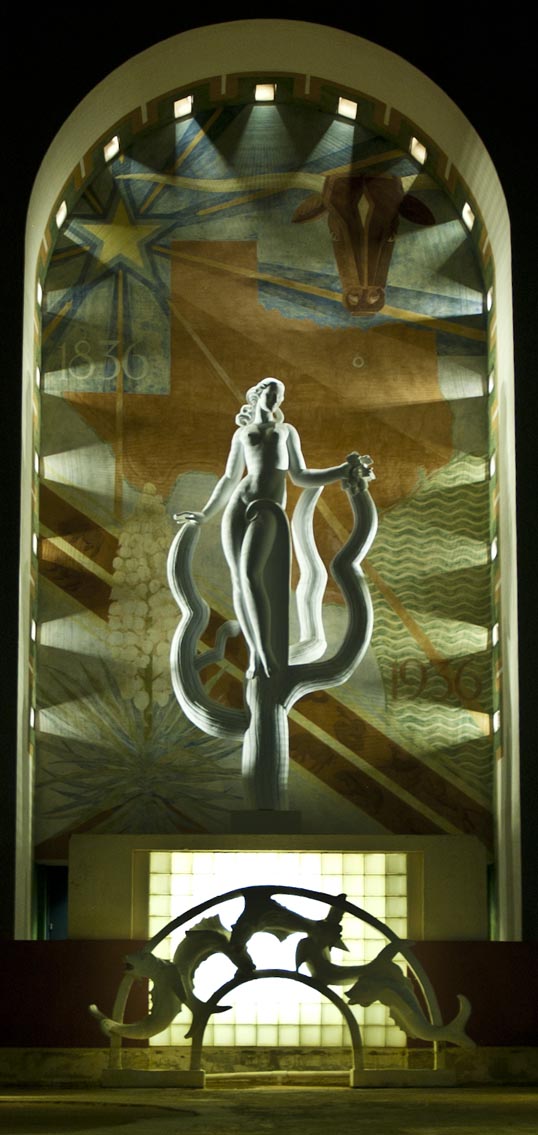
Spirit of the Centennial, Woman’s Building, Fair Park, Dallas, Texas

Oblique Strategy: Is it finished?

The sky was unusually obscured, the sun had sunk beneath the western mountain, and its departing ray tinged the heavy clouds with a red glare.–The rising blast sighed through the towering pines, which rose loftily above Matilda’s head: the distant thunder, hoarse as the murmurs of the grove, in indistinct echoes mingled with the hollow breeze; the scintillating lightning flashed incessantly across her path, as Matilda, heeding not the storm, advanced along the trackless forest.

The crashing thunder now rattled madly above, the lightnings flashed a larger curve, and at intervals, through the surrounding gloom, showed a scathed larch, which, blasted by frequent storms, reared its bare head on a height above.

Matilda sat upon a fragment of jutting granite, and contemplated the storm which raged around her. The portentous calm, which at intervals occurred amid the reverberating thunder, portentous of a more violent tempest, resembled the serenity which spread itself over Matilda’s mind–a serenity only to be succeeded by a fiercer paroxysm of passion.
—-Percy Bysshe Shelley, Zastrozzi

Two down, ninety-eight to go.

A few days ago, while working on my goals for 2018 I decided to set a goal of reading a hundred books in the year. Thinking about it, I decided the only way to pull this off was to read short books. I made a list of 66 short novels and wrote about it. Thinking more about it, I was excited enough to jump the gun and start the 100 books immediately. The first one I read was Shirley Jackson’s We Have Always Lived in the Castle.

How I chose this one, I have no idea. While I have nothing against real books, I knew that to read a hundred books I’ll have to put a lot of them onto my Kindle. So I started perusing the various sources of free ebooks online (especially Project Gutenberg) and downloaded Percy Bysshe Shelley’s first novel, Zastrozzi, from Project Gutenberg Australia.

It is a true Gothic Novel – a revenge tale of overwhelming lust and evil. There is nothing subtle here, but who is in the mood for that? I liked it a lot more than I expected. It is short – about a hundred pages or so, and a quick read.

A wood engraving by Cecil Keeling from the 1955 Golden Cockerel Press edition of Zastrozzi

It is interesting how many similar scenes there are in this book to Frankenstein – written by Shelley’s wife Mary. That reminded me of the terribly wonderful and extremely entertaining (if fatally flawed) over-the-top film of that fateful weekend where Mary Shelley wrote her tale The Modern Prometheus, basically on a dare – Gothic directed by the mad genius Ken Russell. I’d like to watch that thing again.

Looking around, I see that an updated Zastrozzi was also made into a British mimi-series (also from 1986) starring Tilda Swinton as Julia. I’d love to see that, but it’s pretty obscure. Have to keep my eyes out.

Best Part of a Holiday

“After all, the best part of a holiday is perhaps not so much to be resting yourself, as to see all the other fellows busy working.”
― Kenneth Grahame, The Wind in the Willows

Zen-like Christmas decorations, Waxahachie, Texas

Oblique Strategy: Do something boring

Went in to work today for the last time this year (not entirely true – thanks to our government and their thoughtful regulations I will have to stop by a couple more times, but that doesn’t really count). It was surprisingly not-unpleasant despite the fact that I finally had to to all of the stuff I had been putting off all year.

Oh, sorry, can’t help myself – I stumbled across one last quote:

“The main reason Santa is so jolly is because he knows where all the bad girls live.”
― George Carlin

Man, I miss George Carlin. Actually, now that I think about it – as far as I’m concerned (I never met him and never would anyway) he is as much still here as he always was.

We Have Always Lived in the Castle

“No live organism can continue for long to exist sanely under conditions of absolute reality.”
― Shirley Jackson, The Haunting of Hill House

Dealey Plaza, Dallas, Texas
(click to enlarge)

“My name is Mary Katherine Blackwood. I am eighteen years old, and I live with my sister Constance. I have often thought that with any luck at all, I could have been born a werewolf, because the two middle fingers on both my hands are the same length, but I have had to be content with what I had. I dislike washing myself, and dogs, and noise. I like my sister Constance, and Richard Plantagenet, and Amanita phalloides, the death-cup mushroom. Everyone else in our family is dead.”
― Shirley Jackson, We Have Always Lived in the Castle (opening paragraph)

One down, ninety-nine to go.

A couple of days ago, while working on my goals for 2018 I decided to set a goal of reading a hundred books in the year. Thinking about it, I decided the only way to pull this off was to read short books. I made a list of 66 short novels and wrote about it. Thinking more about it, I was excited enough to jump the gun and start the 100 books immediately. On my way home from work I stopped at the Richardson Library and, walking through the fiction stacks with my list in hand, chose six: The Department of Speculation by Jenny Offill, The Room by Jonas Karlsson, Heartburn by Nora Ephron, We Have Always Lived in the Castle by Shirley Jackson, The Neon Bible by John Kennedy Toole, and The Reluctant Fundamentalist by Mohsin Hamid.

I chose We Have Always Lived in the Castle (214 pages) as the first – read it last night and this morning. As I go through the books I plan on writing a blog entry – a little about each, as spoiler-free as possible.

I have, as has everyone, read Shirley Jackson’s most famous short story, The Lottery. I remember the horror and surprise when we read this in class, in maybe sixth grade, when we realized that this wasn’t going to be the usual school-bored approved feel-good literary treacle we were used to being served up to us. It was also a thrill as our young minds began to comprehend the potential and possibilities of literature.

There is a lot of The Lottery in We Have Always Lived in the Castle. The style and setting are very different, but the overall themes are related. The fear and horror of the village and the evil that people, set in their ways, can wring. We Have Always Lived in the Castle is told in the first person of an eighteen year old girl and has a classic “unreliable narrator” – there is no doubt from the beginning that things are not quite as she sees them.

The book is touted as a “mystery” – though that’s misleading. There is really no doubt in the reader’s mind who is behind the “mystery” – the real question is what’s going to happen about it. Another interesting quirk is that the evil villagers – reviled throughout the book, are given a little bit of redemption towards the end. I liked that, I am a sucker for redemption.

I didn’t know much about the author or her life. Not surprising… her husband wrote about her: “she consistently refused to be interviewed, to explain or promote her work in any fashion, or to take public stands and be the pundit of the Sunday supplements. She believed that her books would speak for her clearly enough over the years” (from Wikipedia). That sounds pretty refreshing to me.

When you read about her married life in Wikipedia:

According to Jackson’s biographers, the marriage was plagued by Hyman’s infidelities, notably with his students. He controlled most aspects of their relationship. … He controlled their finances (meting out portions of her earnings to her as he saw fit), despite the fact that after the success of “The Lottery” and later work she earned far more than he did. He insisted that she raise the children and do all the mundane household chores. She felt patronized in her role as a faculty wife, and ostracized by the townspeople of North Bennington. Her dislike of this situation led to her increasing abuse of alcohol, tranquilizers, and amphetamines, and influenced the themes of much of her later work

We Have Always Lived in the Castle is her last novel and these themes are front and center in the novel.

One other bonus to reading this short novel – It looks like it is about to be made into a film. Alexandra Daddario, Sebastian Stan, and Crispin Glover. I always like to read the book before the movie comes out.

Now, on to the next. What should I choose….

Music Has Always Been a Matter of Energy

“Music has always been a matter of Energy to me, a question of Fuel. Sentimental people call it Inspiration, but what they really mean is Fuel. I have always needed Fuel. I am a serious consumer. On some nights I still believe that a car with the gas needle on empty can run about fifty more miles if you have the right music very loud on the radio.”
― Hunter S. Thompson

Dowtown Square, McKinney, Texas

Oblique Strategy: Intentions -nobility of -humility of -credibility of

Is there anything cooler than a good street musician? Unexpected notes floating on an evening breeze, like angel trumpets and devil trombones. The air is transformed into something superior, lighter, art becomes part of the fabric of the world, like it should.

Is there anything more annoying than a bad street musician? A strolling violin player in an Italian restaurant – you want to hear what your companion is saying, you must pay the guy to go away. Headache – inducing cacophony at a train stop, you are trapped until your transport arrives. The talent-less kid that drags his instrument case somewhere that he shouldn’t.

Which is one and which is the other? It’s more up to you than to the strummer.

The Only Right Thing to Do

“I dream. Sometimes I think that’s the only right thing to do.”
― Haruki Murakami, Sputnik Sweetheart

Oblique Strategy: A line has two sides

I rarely remember my dreams. When I am able to grasp the wispy end of something as I’m waking up it is always some form of daily frustration, like my car won’t start or my key won’t fit. I guess that’s why I can’t remember my dreams – they are simply more boring versions of my daily life.

This morning, though, as I crawled out of bed, I remembered. I was hitchhiking through Japan with two other people, a young couple. Why we were three was hazy, though there seemed an adequate explanation somewhere. At the time of the dream we were wading through a rice paddy, each clutching a train ticket. The tickets were paper and plastic, white and bright yellow, and valuable.

Ahead, rising out of the rice, was a track on a levee and a simple station. The biggest passenger train in the world was stopped there, vibrating and smoking. As we approached, it blew its whistle and slowly pulled off, just as we arrived. I was frustrated at the fact we had missed the train, and clutched at my ticket in frustration.

A minute later, we realized that this massive transportation system was too large for one single train, and a second, identical one came huffing into the station. Suddenly elated, I had my ticket stamped and boarded the nearest car. My two companions followed close behind me.

The rest of the dream consisted of me exploring the various cars up and down the line. They were laid out in a linear cornucopia of delights, each car more opulent and fascinating than the one before.

My alarm went off – time to get up and go to work. I hit snooze to see if I could drop off again and visit a car or two more, but the train had sped off to somewhere unknown.

The Things You Don’t Do

“The voice says, maybe you don’t go to hell for the things you do. Maybe you go to hell for the things you don’t do. The things you don’t finish.”
― Chuck Palahniuk, Lullaby

Oblique Strategy: Always first steps

It’s tough being a carhop. You have to remember what car has what order. You have to be able to skate balancing a tray groaning with food and milkshakes. You have to be able to hook in onto the window… just right. You have to endure and handle the nuts and assholes.

The hours are long and the tips are small.

Poor Ethel. The only good thing about being a carhop is that at the end of the day you get to go home. But she doesn’t. She has to stand there, looking as beautiful as ever.

Is beauty its own reward? You exist mainly in the foggy yet electric haloed memories of teenagers long grown old and gray. Is it worth the effort to represent an age long gone by – an era of rollerskates and rootbeer in this age of smartphones and Spice?

Is there an app for that?

Tex-Mex Food – History and Ingredients

“your body is not a temple, it’s an amusement park. Enjoy the ride.”
― Anthony Bourdain, Kitchen Confidential: Adventures in the Culinary Underbelly

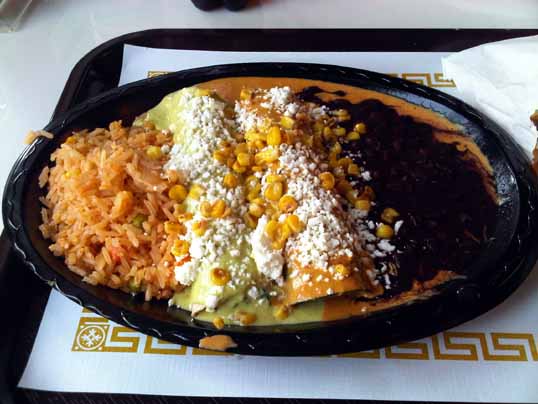
Tex-Mex – Two enchiladas, rice and black beans.

Oblique Strategy: Look closely at the most embarrassing details and amplify them

I don’t eat Tex-Mex food very often. I’ve lived in Texas so long I’m, well… kinda over it. The only time I eat Tex-Mex is when someone is in from out of town. My son is here for the Dallas Marathon this weekend and he wanted some – so we go.

Every neighborhood in Dallas has its own Tex-Mex spot (and its Pho place, and its Barbeque joint, and its greasy burger dive…) and in ours it’s Amigos. I don’t know if Tex-Mex can be called “comfort food” because you can be pretty uncomfortable if you eat too much of it.

One big knock on Tex-Mex is that it isn’t authentic Mexican food. Well, of course it isn’t. Have you ever even been to Mexico? It’s a big, diverse place – there’s no reason that food from the high Sonoran desert would even resemble the seafood from the Yucatan. Mexico’s culinary style and history is more like France’s – very complex and diverse.

Tex-Mex is a regional American cuisine… which happens to be inspired by some of the cooking that came across the Rio Grande.

You can tell you are eating Tex-Mex by the ingredients – stuff that isn’t (or wasn’t) very common in Mexico. These ingredients are: beef, yellow cheese (like cheddar), wheat flour, black beans, canned vegetables (especially tomatoes), and cumin.

Cumin – the main and essential ingredient in Chili Powder – is an interesting example. It’s not a traditional Mexican spice – it’s Indian. Canary Islanders were brought to San Antonio by the Spanish to try to expand the colonization of Texas. The Canary Islanders brought with them a Berber flavor signature — Moroccan food. There was a lot of cumin, garlic and chili, and those flavors, which are really dominant in chili con carne, became the flavor signature of Tex-Mex. It’s very different from Mexican food. Food Critic Diana Kennedy is prone to say that Tex-Mex includes way too much cumin. But if you compare it to Arab food, you suddenly understand where that flavor signature comes from.

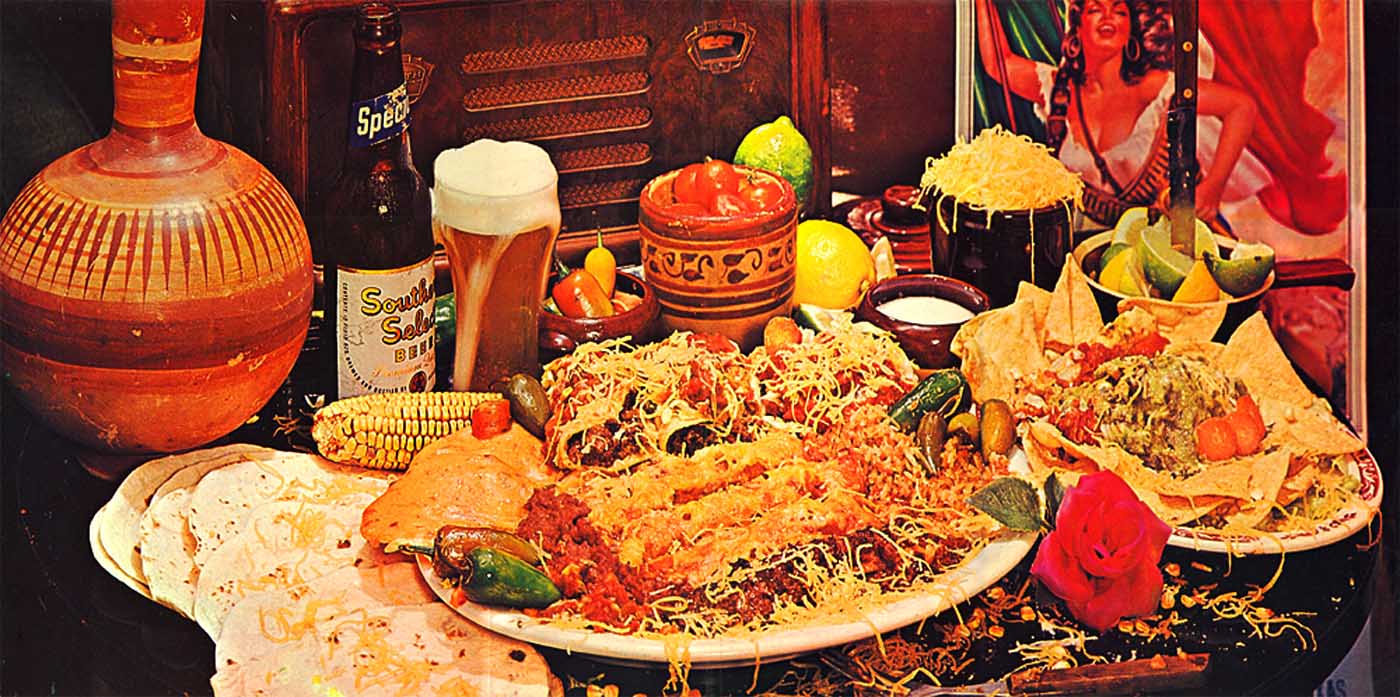
The greatest epic Tex-Mex feast ever photographed. From the gatefold of the ZZ Top, Tres Hombres album
(click to enlarge)

ESSENTIAL TEX-MEX FOODS

NACHOS

Nachos might’ve been invented in Mexico by Ignacio “Nacho” Anaya, but it was only because a bunch of Texan ladies flocked to his restaurant after-hours and asked for a snack. The versions you see around the country today, frequently doused with molten, yellow cheese, are very American.

CHILI CON CARNE

Considered by many to be the quintessential Tex-Mex dish, this tomatoey stew of ground or cubed beef, beans (if you’re not a tried-and-true Texan), spices, chili peppers, and other accoutrements is very much a gringo invention, created by Texan settlers out of widely available ingredients. Actually, it’s based on Northern Native American recipes. Not Mexican.

FAJITAS

Derived from the Spanish word “faja” — meaning “strip” (which refers to the cut of beef they used) — fajitas are wholly a US creation (first mentioned in print in 1971) inspired and informed by the ingredients of Mexico, but not usually found in that country.

PRETTY MUCH ANY “MEXICAN” RESTAURANT FOOD IN AMERICA

Queso dip, chimichangas, the enchilada as we know it… you name it, it’s been Americanized. But that’s not to say that it isn’t still delicious.

THREE CITIES, THREE HISTORIES

When you look at the modern history of Tex-Mex, you get completely different stories from Dallas, Houston, and San Antonio. Each one, of course, claims to be the place where Tex-Mex was invented, perfected, and popularized. They are all three right, and all three wrong.

San Antonio is the closest city to the border and the area that contributed the “Mex” part of the cuisine. It also added the “Combination Plate” to the menu.
An Illustrated History of Tex-Mex

How chili queens from San Antonio and the rise of the combo plate shaped Mexican food’s evolution across the border.

The cuisine grew out of the Rio Grande Valley but came into its own in San Antonio. “In the 1870s, chili queens in San Antonio started becoming nationally and internationally famous. That’s when Tex-Mex started getting on the map of Americans in earnest. From then on, every decade has had a monument to Tex-Mex.”

Tracing the History of Tex-Mex

The growing fame of the chili queens helped San Antonio establish its enduring reputation as the capital of Tex-Mex cuisine.

Dallas seems to be the birthplace of the kings of Tex-Mex restaurant empires. Tex-Mex is primarily a restaurant cuisine, seldom made at home. Everyone in Dallas knows El Fenix, El Chico, and, more recently Mi Concina.

History of El Fenix

Miguel Martinez opened the first Mexican restaurant in Dallas, in 1918. When he opens “Martinez Café” (now El Fenix) he offers only Anglo-American dishes. He develops a new style integrating Mexican flare and offers these dishes to guests, asking for their feedback. Their input was instrumental in perfecting his culinary experimentation and Tex-Mex was born.

The Family Who Sold Tex-Mex to America

In 1928, Adelaida “Mama” Cuellar opened Cuellar’s Cafe in Kaufman. Four of her sons moved to Dallas in 1940 and opened the first El Chico. These two families laid the foundation for Dallas’ flavor profile.

The Elevation of Tex-Mex, Mico Rodriguez

Lard-laden combination plates changed forever once Mico Rodriguez and his partners opened the first Mi Cocina in the Preston Forest Shopping Center in 1991. Rodriguez refined the Tex-Mex experience by using quality ingredients such as expensive cheddar cheese and fresh jalapeños and cilantro.

Houston has an equal claim, including Ninfa’s and the development of the fajita.
The Houston Version of Things:
A six part series – a different history of Tex-Mex…

Pralines and Pushcarts
Combination Plates
Mama’s Got a Brand-new Bag
The Authenticity Myth
The French Connection
Brave Nuevo World