Golden Boy

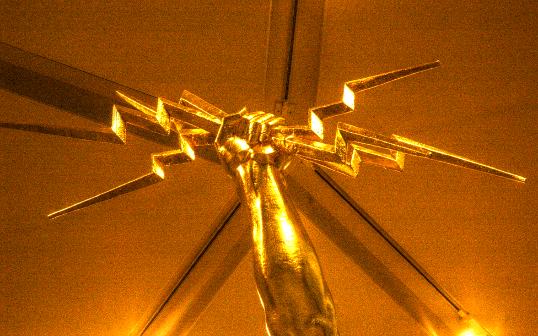
In 1914 the American Telephone and Telegraph company commissioned Evelyn Beatrice Longman to create a sculpture named The Genius of Electricity for their new headquarters at 195 Broadway in New York City. The final design was a massive winged nude male figure clutching lightning bolts in one hand and a coil of high-voltage cable wound around his body held in the other.The sculpture was completed in 1916 and hoisted to a pyramid constructed on the top of the building.

It was twenty four feet in height and was cast in bronze and covered with gold leaf. It weighed over sixteen tons. The statue towered over lower Manhattan until 1984. During the 1930’s the name of the statue was changed to The Spirit of Communications – although most people knew it by its nickname, Golden Boy. In 1984 AT&T moved up the island into the famous postmodern building designed by Philip Johnson. There was no perch on the roof, but the massive lobby contained the statue with no problem.

I visited New York about this time and remember seeking out the AT&T building as I walked the streets. Its architecture was still new and exciting. I remember the building, but I don’t think I actually entered the lobby. Now, I wish I had – I wonder if I would have remembered a huge naked gold statue standing there.

The next decades were turbulent times for the telecommunications industry and for Golden Boy. The AT&T building was sold and became the Sony Building. Golden Boy went across the Hudson and for years was displayed at two different locations in New Jersey. AT&T, of course, was carved up by the Federal Government – broken down into the baby bells.

One of these, Southwestern Bell, grew until in 2005 it swallowed its parent and became the new AT&T. Soon, the headquarters ended up in downtown Dallas, in the Whitacre Tower. Finally, in 2009, Golden Boy followed suit and was installed in the lobby of the building.

I stumbled across this history… I don’t know where. I have a book that lists notable Dallas sculptures but it was published prior to Golden Boy’s cross-country journey. Once I learned he was there, I had to go see him.

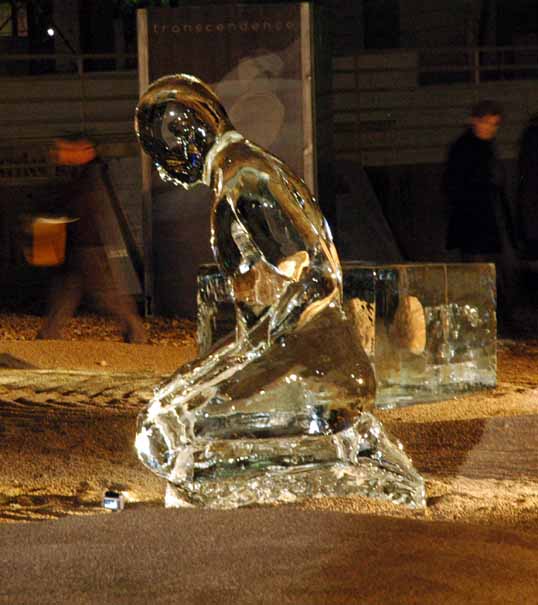
After I took at look at some melting ice (a sculptural form far more fleeting than bronze and gold leaf); I took a ride on a streetcar, then hoofed it across downtown to the AT&T headquarters.

I looked a little scruffy with my cheap jacket and bag of camera stuff – but garnered no more than a glance from the guard at the huge round desk at the entrance as I circled around taking pictures. The statue dominates the lobby – there is even a really nice curved couch behind the sculpture where you can sit down, relax and stare up at his golden ass. Yes, by the way, he is completely nude and, more or less, anatomically correct.

I had arrived near the end of the day and the lobby was dotted with serious-looking men in expensive suits shuffling on their tailored overcoats for the cold trip home at the end of the workday. The lobby is lined with cellular stores that open outward onto the street. These were full of folks looking for Christmas presents – for themselves or others.

It’s a modern, clean space – the almost-century old statue looks great but maybe a little out of place. Maybe he should be up on top of the building after all. He could spend his days staring across the street to the roof of the Magnolia Hotel down at that other Dallas iconic rooftop sculpture – the Pegasus.
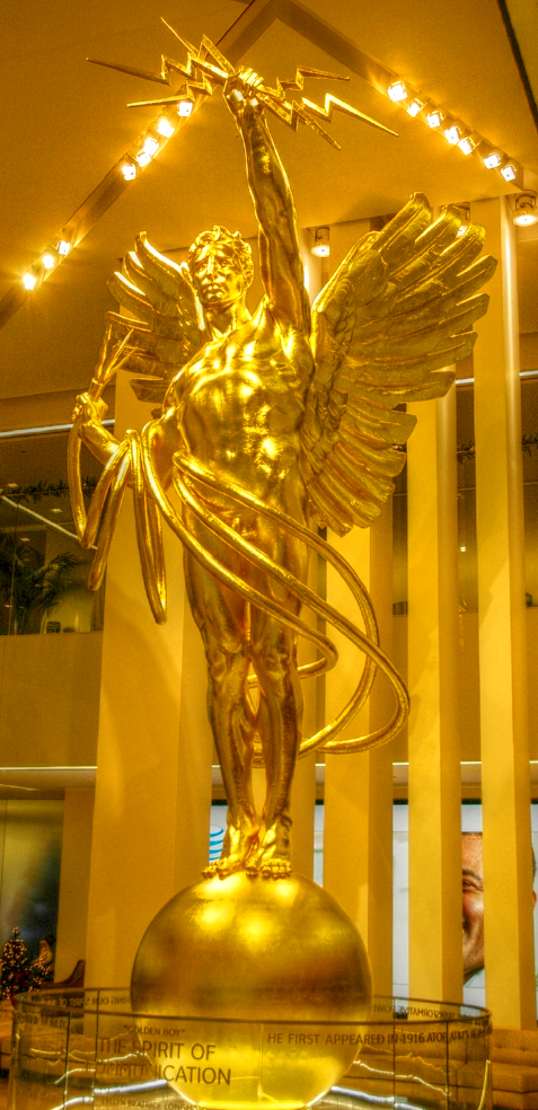
Golden Boy - in all his glory

It is a beautiful statue... but somehow - he doesn't look too happy. I think he wants to be outside.

The view of the statue from AT&T Plaza through the entryway.
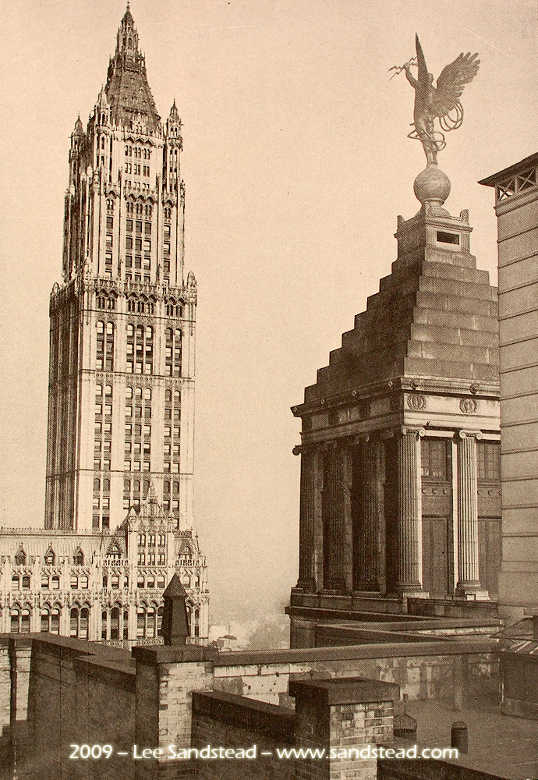
The statue on his perch at 195 Broadway. Photo by Lee Sandstead.

There is another famous statue in the distance. Photograph from Lee Sandstread
Ice Melts in the Sun

It was cold today… especially cold for Dallas. Barely above freezing with a whipping north wind. I thought about staying in, but I wondered how Transcendence was doing, how the ice sculptures were holding up. I didn’t go see them yesterday and there were a couple other things I wanted to do downtown (like eat some Kimchee Fries from the food trucks in the Arts District) so I went to catch a DART train.

As always, the southbound train was leaving as I climbed the stairs to the platform. It would be twenty minutes before another southbound came along, the platform at the station I had chosen was elevated and the wind was biting and miserable.

So I grabbed a Northbound Train. It was more comfortable sitting in a heated car than knocking about the wind-swept concrete platform. I looked at the schedule, examined the time between stops, did a little hard calculation and was able to exit only two minutes before the next southbound came along.

Back at Transcendence…

Unveiling

First Day

Second Day

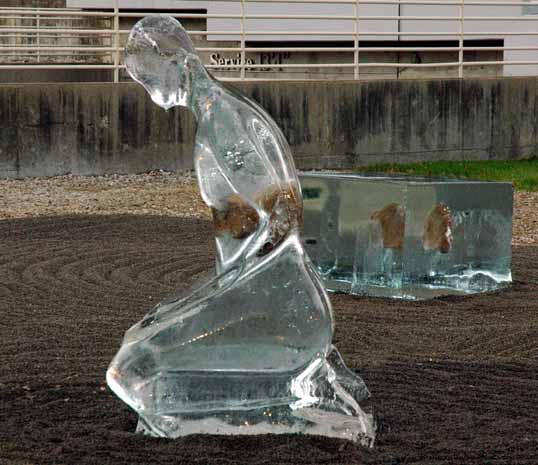
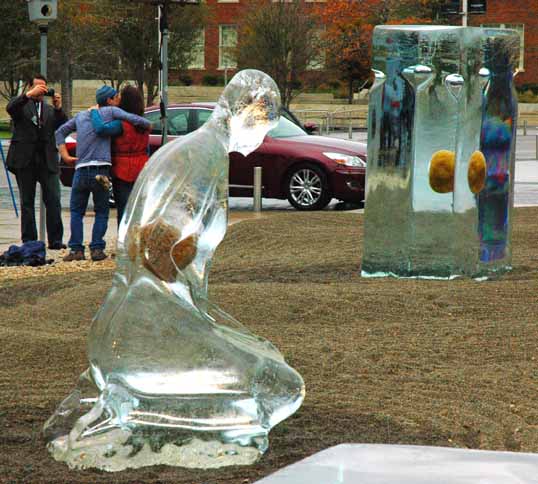
I found that the first rock had fallen. The more upright figure had given up his whole torso and his stone had dropped to the gravel alongside what was left of his legs. The other human still had his rocky heart inside his torso – but barely. He had melted through to the stone on both sides and there was a visible gap at the top. It would only be a matter of time before his fell.

The rectangular blocks were holding up better. They were full of faults and cracks now, their once crystal clear complexion now a white tracing of opalescent pearl – beautifully glowing when the sun peeked out. The rock inside the largest block was almost invisible now.

There was a professional photographer down there with a big expensive camera. He had been coming down every day. We talked about how long the big block would last.

“It depends on the temperature,” he said.

“Of course, but that big block might last another week – if it stays this cold.”

“Ah, but the ice melts in the sun, no matter how cold it is.”

Every time the sun would emerge from the clouds he would yell at me, “See! See!” and wave his arms.

He’s right… but I still think that big block will be here for a bit.

Ice Melts in the Rain

Help me, I'm melting!

It was a cold (well, cold for Dallas) wet and miserably gray day. Storms all night and rolling bands of rain driven down from a dark sky all day. A perfect fall day to huddle inside… maybe read a little, eat the last of the leftovers, maybe watch some football on TV, maybe do nothing at all. And that’s what I did.

But there was one burr under my blanket. I wanted to see what the ice sculptures were doing in downtown Dallas. I had seen Transendence at its unveiling, one day later, and now… what was it up to? It had been raining constantly and I knew that fresh water from the sky would melt the ice quickly, so I had no choice but to head out and drive down there.

The roads were wet, the visibility was poor, and, of course, everybody else was driving like bats out of hell – so the drive was stressful enough. I pulled up and parked illegally right next to the installation (there was nobody, and I mean nobody around). Luckily, there was a bit of a break in the weather – only a cold spitting windy miserable drizzle.

The first thing I noticed was that they had put out some hand-lettered signs all around the place that said, “Keep Off Gravel (Art Exhibit).” No shit, Sherlock. If those had been out there that first night, would all the drunken idiots have trampled all over the place? Whatever. For the first time, there were no tracks at all across the raked gravel. Never underestimate the power of a hand-lettered sign. The Sharpie reigns supreme.
The human figures were melted into unrecognizable shapes. Their heads were gone, arms mere suggestions, their stone hearts seemed poised to plunge from their bodies to the gravel below.

I know that is what they are supposed to do, it is their purpose – but it is still a little sad to see the beautiful things come to such an end.

The rectangular blocks, on the other hand, are fairing a lot better. They have shrunk a little, one is tipping a bit, but are still intact. They may last quite a long time.

The flesh is feeble, weak, and transient, while the crystalline inanimate geometric mass resists the heat, the water, the slings and arrows and survives until the bitter end. It is the way of all things.

Here are three pictures of the second human figure on each of the three days. If I had thought about it, I would have carefully taken pictures from identical spots, using identical lenses, on each day… but I’m an idiot. Sorry, that would have been cool.

At the unveiling

One day later.

After a day of melting in the rain

The Next Day

It was with more than a little trepidation that I drove downtown to take a look at Shane Pennington‘s installation for TEDxSMU, Transcendence. I had left the place in shambles the night before, with drunken Christmas Hooligans tramping across the Zen garden, poking at the ice, and posing in (for them) hilarious poses with the artwork, snapping a record on their iPhones.

I was relieved to find that the Zen Garden had been restored. There were some folks out keeping an eye on the installation, and a few hardy souls were braving the spitting rain.

Everyone agreed that the thing was mesmerizing in the daylight, even with the overcast skies. I would love to see the ice in bright daylight.

I had an interesting conversation with a woman from the Dallas Center for Architecture. She had given the tour of the Arts District that Morning (the one I attended a few months ago), had discovered the sculptures, and had returned for a closer look.

She said that she had heard that one of the stones in the human forms was from the parents of a childhood friend of the artist. This friend had passed away and after the ice is melted and the artwork is closed the stone will be given back to the parents to be placed in their stone garden on their rural home as a memorial. A nice story.

I would like to return every day while the sculpture melts, if possible. That may be difficult, but I know I can make it a few more times. I have no idea how long it will take before it is all gone. The biggest change from last night were in the human forms – their heads and faces were noticeably smaller and had lost all detail.

A wonderful thing. The only aspect it lacks… if this were my installation I would definitely put in a webcam.

This photo was shot through the large monolith of ice, and you can see a human form beyond.

Piedras en el Hielo

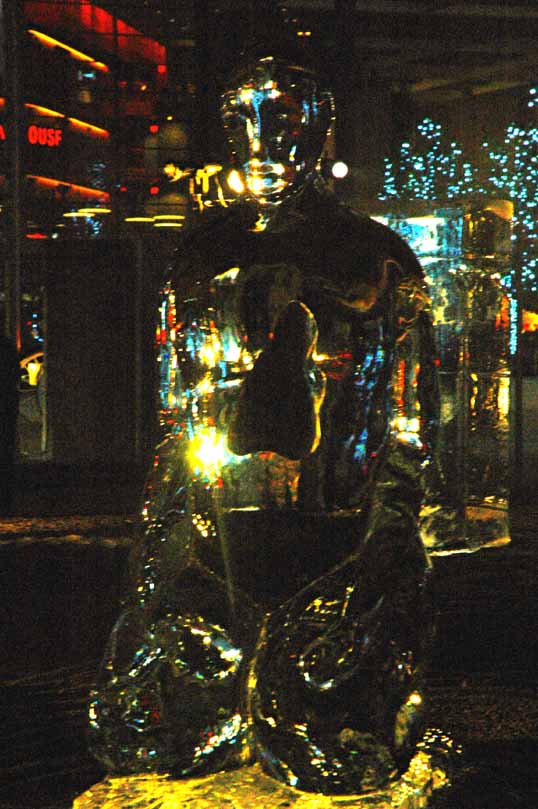
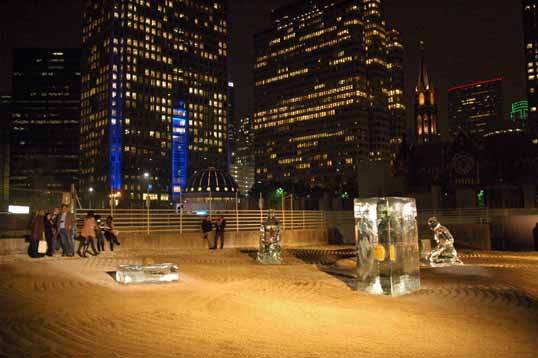
I was terribly tired after work – futzed and dutzed around too much and was late getting to the Arts District downtown. Luckily, I caught a train quickly and made it only a few minutes after the unveiling. I would have liked to see it opened up, displayed, unveiled… whatever… but still, walking up on it in the dark, seeing the crowd, the bright lights reflecting off the ice was excellent enough.

In a little gritty disused space on the corner of a parking garage across the street from the Wyly Theater a local artist, Shane Pennington, had hauled in some gravel and raked out a temporary Zen Garden. The beautiful kicker is that the stones were embedded in giant sculptures made of ice. The idea was that as the ice melted, the stones would drop into their proper place in the garden. The work was called Transcendence.

The crowd was awed and impressed. At first, there were a lot of men in suits (apparently sponsors) and serious looking folks wearing ID tags. It was hard to take photographs – it was dark overall and the light glancing off and refracting through the ice looked fantastic – but didn’t surrender to a static recording. Still most folks hauled out their phones and snapped something. There were some professional photographers out with heavy tripods and huge lenses. Most folks walked around and around, but a few clots of people developed along a concrete wall, simply standing there and staring.

There was a big Christmas celebration going on, so it didn’t take long for families to start drifting over. The kids, of course, were mesmerized. Their parents would try to speak to them about what they were seeing, but the kids ignored their words. I heard one mother extolling her toddler to look at the, “piedras en el hielo.”

I left the sculpture and wandered the area for a few hours – ate at a food truck, heard some jazz, and stumbled across a unique and wonderful troop of Aztec dancers rehearsing down by the Cathedral Guadalupe. It wasn’t really very late, but I felt like heading home so I decided to stop by the ice sculptures one last time before I hiked to the train station.

How long does it take ice to melt? Big blocks like this take a long time. I remember when I was a kid there was a stupid game show and part of one episode was the contestants were given a huge block of ice, matches, towels, and such – they were going to get paid by how much ice they could melt in a half-hour, plus they made bets on how much would melt. It was shocking how little ice melted – only a couple of pounds. Large hunks like those sculptures might last days.

I loved watching the water drip off the noses of the two human forms, but drops won’t get it done very fast.

But I was horrified when I reached Transcendence. Earlier, everyone had moved around the installation in an orderly fashion, respecting the waves of raked gravel that made up the Zen Garden. Now, however, there was a different group there. They were younger, louder, and drunk. Most had plastic cups of wine teetering in their hands, hauled up to their giggling faces, while they trod willy nilly all over the place.

They were walking all over the gravel – the carefully sculpted shapes long trod into nothing. They were posing with the sculptures, licking the people, pretending to hug them, or worse. I saw one guy kicking at the blocks.

It was disgusting. They had no idea what the artwork was about. Unless I’m wrong – maybe the artwork was about how people would fail to respect the garden, in retrospect, it was to be expected. To these upper-class-twits the sculpture was about their own crass amusement.

I couldn’t stand the scene, so I walked away as quickly as I could.

Ignatius J. Reilly

 When a true genius appears, you can know him by this sign: that all the dunces are in a confederacy against him.

—-Jonathan Swift

Ignatius J. Reilly

Ignatius J. Reilly

“My life is a rather grim one. One day I shall perhaps describe it to you in great detail.”

—- John Kennedy Toole, A Confederacy of Dunces

When Lee first decided to go to Tulane I became reinterested in everything New Orleans. I had always been interested… how can you not be? I had visited and worked there and in the surrounding swamps, and always thought of it as an amazingly unique city – the culture, location and architecture making it a special place – a city that will find a place in your heart if you have to courage to let it.

I have felt that way for decades, and still feel that way, stronger than ever – nothing has ever happened to change my mind.

So I started to read anything New Orleans that I could lay my hands on. There is a lot, by the way. One book I picked up right away – one that is often referred to as the quintessential New Orleans novel, is A Confederacy of Dunces, by John Kennedy Toole.

The book has a sad and amazing publishing history. The author, a graduate of Tulane, wrote A Confederacy of Dunces after a stint in the army but could never convince a publisher of its merit. Partly due to his failure as a novelist he fought depression and paranoia and killed himself at the age of 31.

He would have been long forgotten except that his mother found a smeared carbon of the manuscript and started fighting to get publishers to look at it. She kept pestering author Walker Percy (who wrote The Moviegoer, another classic novel of New Orleans – I read it right before A Confederacy of Dunces) – then an instructor at Loyola University – until he read it, mostly to get her to leave him alone. He wrote:

“…the lady was persistent, and it somehow came to pass that she stood in my office handing me the hefty manuscript. There was no getting out of it; only one hope remained—that I could read a few pages and that they would be bad enough for me, in good conscience, to read no farther. Usually I can do just that. Indeed the first paragraph often suffices. My only fear was that this one might not be bad enough, or might be just good enough, so that I would have to keep reading.

In this case I read on. And on. First with the sinking feeling that it was not bad enough to quit, then with a prickle of interest, then a growing excitement, and finally an incredulity: surely it was not possible that it was so good.”

The novel was published by LSU press eleven years after the author’s suicide and won the Pulitzer Prize in 1981.

The book is a touching picaresque comedy – memorable for its outrageous and colorful characters. Of course, the city of New Orleans is a main character – possibly the most outrageous and colorful. The protagonist is Ignatius J. Reilly, a large lumpin monstrosity that is convinced, probably accurately, that he does not belong in the twentieth century. He stumbles through his beloved city (he has only left New Orleans once – on an abortive bus trip to Baton Rouge, which he remembers with horror) like a bull through a china shop, leaving a wake of confusion and consternation – somehow coming out alive and intact – though barely.

Ignatius J. Reilly is not easy to like. He is pompous, self-important, lazy, slovenly… pretty much an all-around loser. You can’t help but love him, though. He is all of us, really. We simply don’t have the courage to admit it.

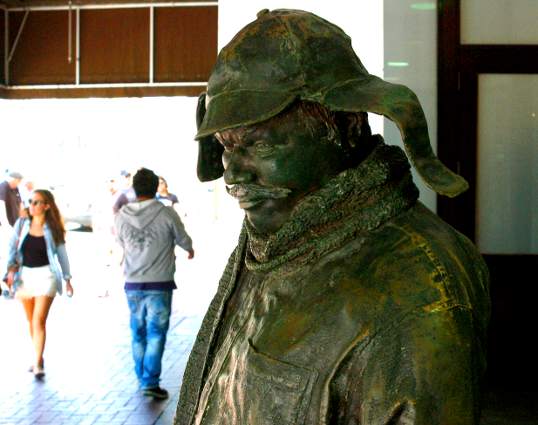
At any rate, I read that there was a statue of Ignatius J. Reilly on Canal Street in New Orleans. In the opening scene of the novel he is standing on Canal underneath the clock outside the D.H. Holmes department store holding a sack and waiting for his mother. The store is long gone, but the building is occupied by the New Orleans Chateau Bourbon Hotel. They found and replaced the clock and put up a life-sized bronze statue under it.

I had to find the statue. It wasn’t hard. The Saint Charles streetcar let me off across Canal and there he was, stupid floppy hat and all. Thousands of people walk by every day on their way to work or around the corner to the attractions of Bourbon Street… not many notice him.

So I salute you Ignatius J. Reilly, forever wearing a bad hat, and worse fashion, standing there with your shopping bag, waiting for your mother to come out of an extinct department store. She will never show, but still, you look like you know things the rest of us will never dream about.

Under the Clock

Under the Clock

“I am at this moment writing a lengthy indictment against our century. When my brain begins to reel from my literary labors, I make an occasional cheese dip.”

—- John Kennedy Toole, A Confederacy of Dunces

Cameras, Cameras, and More Cameras

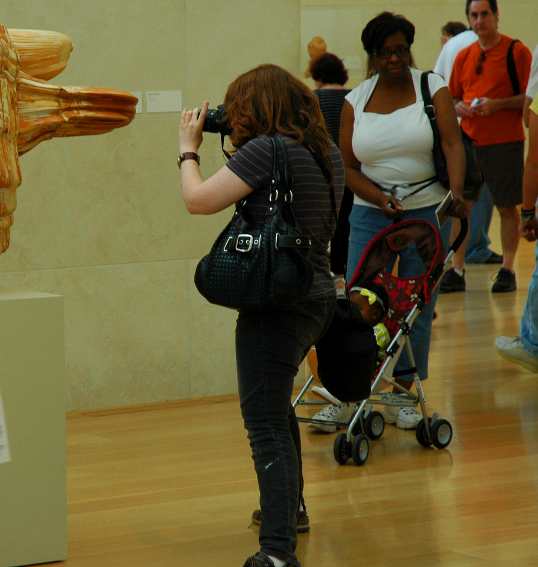
A couple more photographs I took at the Nasher at the Tony Cragg exhibition.

If you wonder what she is taking a picture of… it is this:

I’m Walking Here

More photographs from the Nasher.

Children and Calder (Trois Bollards)

A pair of Giacometti, in front of a window.


———————————————————————————————————

Another new Video from Lana Del Rey


Large Horse by Duchamp-Villon

Horse by Raymond Duchamp-Villon

I like it when I have a membership in a museum or I can get in free – because then I don’t feel like I have to see the whole thing. I can concentrate.

What I like to do is to have one favorite thing. One work of art. I like to go to that on a bee-line and stare at it, walk around it, try to understand and possess it completely. You can’t do that if you go wandering through the galleries like a tourist hurrying to catch his bus outside. You have to be selective and patient.

When the Dallas Museum of Art first opened it was free. I was working only about a block away and I would walk over for a few minutes at lunch whenever I could. My favorite sculpture was Max Bill’s Rhythm in Space. I would walk into the sculpture garden and stare at that piece of carved curved granite. It meant something to me. This can’t be put into words, but it was an idea of motion, beauty, and the timelessness of stone. The hard, unyielding granite had been shaped into something graceful and light. The sculpture looked a little like a face from the front, but was reduced to precise geometric principles. The eyes and mouth appeared to be perfect circles – but only from a certain viewpoint. There is also a complex symmetry in the design…. So on and….

That’s what I saw.

It’s gone now. I don’t know where.

For a long time, my favorite sculpture was Tending (Blue) – but it’s gone now too. Well, it’s still there… but.

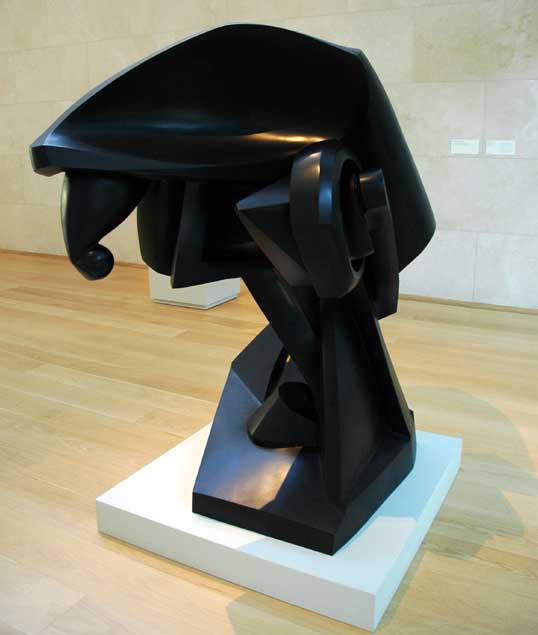
So now I’ve fallen in love with Large Horse, by Raymond Duchamp-Villon (the brother of Marcel Duchamp and Jacques Villon). It’s right up front, by a glass wall, at the Nasher.

I like to stare at it, walk around it. I’ve taken some pictures of it. I would like to take some more.

To me, it’s clear that it is a statue of a horse – but that horse has been morphed into a complex machine, full of pushrods, pistons, and gears. It has an impressive, solid bulk, but feels like it is about to propel itself out through the glass and speed down the street in a blur, smelling of ozone and oil.

It is cast in very dark bronze – almost black. It swallows a lot of the light, but what does escape is subdued by the power and mass of the horse. It shines with dark energy.

The sculptor was a cavalry doctor in World War I and must have had a close relationship, knowledge, and a deep connection with his horses. He chose this animal to convert into a cubist bronze. He was able to preserve the essential horseness of the shape while implying the obsolescence of the animal – overtaken by the more powerful, rugged, and easily controlled energy of machines.

Duchamp-Villon died too young. He contracted typhoid fever during the war. He died before he finished this sculpture. All he left was the finished small scale model. After his death, his famous brother, Marcel Duchamp (Nude Descending a Staircase) finished the job and had the sculpture cast in full-sized bronze.

Thanks.

.Large Horse by Raymond Duchamp-Villon

.

.Large Horse by Raymond Duchamp-Villon

.

Large Horse, by Raymond Duchamp-Villon

Shooting in the Galleries

I decided to go downtown on Saturday for the first day of the Arts District’s Art in October celebration. The night before, I struggled to get to sleep, and didn’t get up as early as I wanted – but soldiered on anyway.

When I arrived at the DART station and was buying my ticket at the kiosk I looked up to see my train go by. They are scheduled every twenty minutes on weekends so I knew I would have to wait a while. No problem, it was a beautiful day and I settled down on a little seat on the deserted train platform and started to read my Kindle application on my Blackberry.

The Richardson Library now has Kindle books available for loan. I haven’t mastered the method yet, but I had managed to get a book of Billy Collins‘ poetry (“Ballistics”) to appear on the tiny screen – so that is good.

At a break between poems, I looked down and noticed a laptop bag right beside me, leaning up against my little seat. I looked around, nobody… so I unzipped the bag a bit and peered inside. There was a top-end laptop with accessories, including a really nice USB camera, folders of papers, and a VISA card stuck into a side pocket. I zipped it back up and sat there, trying to think of what to do.

A train going the other way pulled into the station and the doors opened wide right in front of me. I expected some panicked commuter to tumble out and yell, “Thank God it’s still here!” and grab his laptop case. It would be easy to get on the train and leave your case behind, but surely you would realize it was missing by the next stop. It would be easy to hop off and grab the next train back the other way.

Nothing.

I sat there for a second and stared at the gaping door in the train. I would love to have a nice high-end laptop like the one in the bag – among physical possessions that is the only thing I can really think of (now that I have my camera back). It would be so easy to simply stand up with the bag and get on that train. The platform was still empty.

I could actually see myself doing this – lifting the case and entering the train with a sigh, as if I was having to go to work on a Saturday. It would be the perfect crime.

A lot of people… maybe even most people (but not you, dear reader, surely) would not even consider this stealing. They would consider it a “found” laptop and they simply lucky. I wonder about people like that. What does the world look like to them? I guess they think of all the stuff that has been stolen from them and that the world owes them one now and then. I guess they have a piece of their head missing, the one that imagines the pain and suffering of someone else that has lost their valuables – in the case of a personal laptop, lost a big chunk of their life. Morality aside, a laptop case like that – with all the critical data in it – is a lot more valuable to the person losing it than to the person stealing it.

The train doors closed and it sped off.

Now what to do? My train would be there soon and I would have to make a decision. Obviously, until my train came, all I had to do was sit next to the case. Any thief would assume it was mine, only the owner would walk up and claim it. But my train would be the next one – nobody will arrive before then. Should I look in the case again, try to find a cellphone number? Should I take it with me and hope to locate the owner later? The easy thing to do would be to simply leave it where it sat and be done with it – but isn’t that about the same as stealing? I wouldn’t get to keep it but I would be abandoning it to a heartless and uncertain world – it would surely end in grief and while I would not be directly responsible and would not be aware of its fate, by inaction I would set the wheels in motion.

Luckily, I didn’t have to make the choice. I looked up and a Hispanic woman and a DART ticket official were walking up from the tunnel (the Arapaho train station is separated from the rest of the world by a wide, busy street – you have to go under it in a long pedestrian tunnel to reach the platform). The official asked me if the case was mine. She began to carefully probe the case, weary of terrorism (something that had not occurred to me until then). I didn’t mention that I had already opened it up. She moved the zipper and inch and saw the laptop within.

The woman that had made the report said the case had been there for a while, “At least five trains,” she said. She and I talked about how odd it was that nobody came back for the case. The official was making a report on her radio. I asked her if there was a lost-and-found and she said, “Yes, but I’m not allowed to do anything, I have to call for the transit police to pick it up.”

At that moment my train pulled up and I was gone.

On the train I went back to reading the Billy Collins poems on my Blackberry. The poems are short and I could pretty much digest one between each train stop.

One of them, “August in Paris” in typical Collins style, spoke of the poet watching a painter in France and standing behind the painter, taking notes, while he worked. He then made the jump to the reader, and how this readers can’t watch him work but he thinks about who they are.

He says, “there is only the sound of your breathing/and every so often, the turning of a page.”

I thought about this… how times had changed. There isn’t the sound of my breathing, but the clacking rails and the tumult of a crowded commuter train cabin. There is no turning of pages… only the silent movement of my thumb across the tiny black Blackberry trackpad and a new dinky screenfull of luminescent text appears.

Dining area at the Dallas Museum of Art. Glass by Dale Chihuly.

Nasher – Tony Cragg

Everyone is taking pictures, not everyone likes it.

The one person not taking photographs was sketching

At the Nasher

Ceiling of the Nasher


One of my favorite Bang Bang videos will not allow imbedding.

Shame.

Watch it on Youtube.