Tony Cragg

It was only two weeks ago but it feels like a thousand years. I walked out of the sodden night rain soaked miasma through the glass doors and was smacked in the face with the bracing cold dry air conditioning. It felt like being slapped by mechanized civilization. After catching my breath I stood as straight as I could, gathered together whatever tatters of pride I had left – like collecting strips of tissue in a gale – and looked around.

The walls of Italian Travertine never felt more cave-like, the glass planes at each end were black as a well. The wooden floor was polished to suggest a muted simulacrum of the world above. The works were arranged carefully about the space – curves alien and familiar mixed and cast by an expert hand.

I knew nothing of Tony Cragg – the artist – although he is so very well-known and famous. He has had a long and varied career with shapes and accumulations and paintings and piles of things and sketches and whatnot. His stuff was scattered all around inside and out, up and down, filling every nook and cubbyhole with some precious object.

But I was drawn by siren call to this gallery, to these monumental curves.

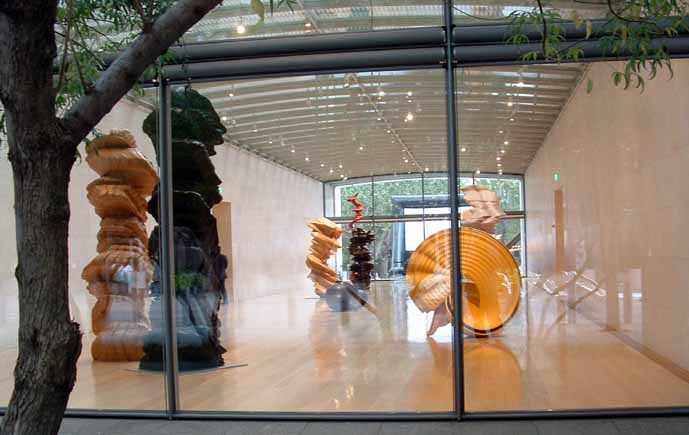
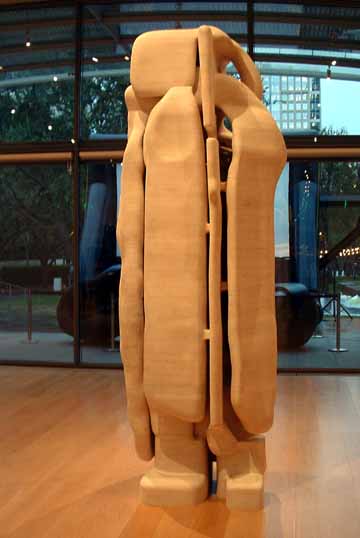
Tall and White. This was named Lost in Thought and it was my favorite. It looks like it is ready to start shambling across the floor. If I was a billionaire I would buy this and put it in my room so I could stick my hands inside and learn its secrets. Or maybe make it into a really big lamp.

People walked among the statues, looking up and down. I looked at the other guests. They were as interesting as the sculptures – but every bit as unreachable. Ghosts of moveable artworks. Made of meat.

My good camera was broken and the pictures are bad. It was too dark.

Some of the work had hidden faces. Some faces were not so hidden.

This one is called Mental Landscape. The label said it was made of Jesmonite. I had to look that up to see what it was.

Both of these two are called Ever After. One is made of wood and the other of bronze.

A view from earlier, from outside, looking in. The sculpture in the foreground is called Tree. It’s made of wood.


The End of Tending (Blue)

My favorite sculpture at the Nasher Sculpture Center has always been Tending (Blue) by James Turrell.

When the Nasher first opened, I went down there with Lee. I wrote a journal entry that was later reworked into a magazine article and published in Richardson Living.

In 2004 I wrote:

My favorite piece might have been the installation Tending (Blue) by James Turrell. We walked into a little opening lit by odd, shifting colors into the wall at the north end of the garden. The passage made a right turn and opened into a small room lined with dark stone benches. The walls on the upper half were featureless and smooth. A gray skylight lighted the whole chamber. The effect was strange and very peaceful. I liked it a lot.

Lee and I left the chamber and walked back up the garden and inside the building. We wandered downstairs and into the auditorium where a film was showing. It told the story of Raymond Nasher and his late wife, how they started out building Northpark Mall, acquired a fortune, and then became premiere collectors of modern sculpture. Mr. Nasher talked about his life, his wife, and his passion for the new sculpture center. The film then showed the construction of the center, how a handful of visionary architects and a few thousand men in hard hats converted a grimy downtown parking lot (I’ve parked there many times, put my quarters or dollar bills into a rusty numbered slot) into a thing of great value and beauty. They talked a lot of how it will be there forever. The film was fun and interesting – it really helped me appreciate the place.

On opening day Raymond Nasher said, “I put Patsy (his wife, the collector, who had passed away a couple years before) in charge of the weather today, and, as you can see, it’s beautiful.

One thing was odd, though. On the part of the film that covered opening day, Nasher and Turrell themselves went into the Tending (Blue) chamber that Lee and I had walked out of only minutes before. The benefactor and the artist sat on the benches and looked around. The skylight rectangle in the ceiling wasn’t gray like we saw it, but a deep cerulean blue.

“What’s up with that?” I asked.

“Let’s go back and check it out,” Lee said.

We hiked back down and entered the chamber again. The skylight was still gray. Something didn’t look right, though. I stood under it, looking up, trying to figure out what I was seeing and how it could change colors so dramatically. I was halfway convinced that it was a rectangle of light projected on the ceiling by some hidden apparatus (the upper walls are washed in subtle changing color from hidden computer controlled LED’s) when I was suddenly struck between the eyes with a big, cold drop of water. I wiped my face in surprise and looked down at some small pools of water at my feet.

“That’s weird, Lee,” I said, “I can’t believe it, but this roof is leaking.”

I looked back up, trying to find the telltale discoloration of a water leak, when, with a sudden shock, I realized what the hell I was actually looking at. That wasn’t a skylight, that wasn’t a projected rectangle at all, it was simply a big hole in the ceiling. I was looking directly at the sky. Once my eyes and my brain were in sync I could see the subtle variation of the clouds passing by overhead. The edges of the hole must have been cut back like razors – there was no visible frame around the opening, simply a featureless rectangle of light. It was amazing.

That’s why the rectangle looked blue in the film – it was a cloudless day. Now I want to go back. I want to go at sunset… I want to figure out how to go at dawn. The city sky at night… will it be brown? I want to sit in there during a rainstorm. I especially want to go there on that rarest of Texas days, a snowstorm.

Tending (blue)

Lee standing in Tending (blue) in 2004.

Over the years I have gone down to sit in Tending (blue) as often as I could. It’s the most relaxing place in the world. Sunsets are incredible – the hole in the ceiling changed into unearthly, amazing colors.

Tending (blue)

The opening in the ceiling of Tending (Blue). A photograph does not do justice.

When I went back there with Lee not long ago, it was closed. This last Friday, I went back and it was still closed. I wondered what the problem was… does it need maintenance?

I did a web search and found the bad news. The skyscape has been ruined by a high-rise condominium tower going up next door. The building sticks up into the field of view of the installation – ruining the effect. The artist has requested the room be closed off until he can come and look at it. There is no timetable for this to happen.

They’ll have to move it… or give up. I am so disappointed and upset. I loved Tending (Blue). It was the best place in Dallas to watch a sunset. I never was able to visit it during a snowstorm, like I was hoping to.

Life itself is suddenly a lot less colorful.

A pole-sitting sculpture in front of a new Condo Tower going up.

The condominium tower going up next to the Nasher that has destroyed Tending (Blue).
Then and Now at the Nasher Sculpture Center

Some time long ago – I think it was the early spring of 2004 – Lee and I went down to the newly-constructed Nasher Sculpture Center in the still nascent Arts District of Dallas. I took some pictures of him, and wrote it up into my journal, The Daily Epiphany, at the time. It was popular enough that I re-wrote it into a magazine article and it was published in a local magazine, Richardson Living,  (I’ll dig up what I wrote and put it up here when I get some time). The folks at the Nasher liked it so much they sent me some free tickets.

Now, about seven years later, Lee and I went down there again and I took some more pictures. Like most museums the artworks move around quite a bit – so nothing was exactly the same. Lee has, of course, grown a bit, and my camera is different. The trees in the Nasher garden have grown a lot. In 2004, the place felt like a finely tended garden – now it’s more like a forest glade.

It was hot as a humid blowtorch today, and the light wasn’t very good, so the pictures aren’t great. I wanted to go early in the morning, but the house was full of sleeping college age boys, nobody slept much last night, and it took some doing to get myself enthused and then roust them up and out the door.

Night (La Nuit) by Aristide Maillol

Night (La Nuit) by Aristide Maillol

This is Lee sitting on a wall in front of Night (La Nuit) by Aristide Maillol.

Lee sitting by Night, 2004

Lee sitting by Night, 2004

Seven years ago, the sculpture was out in the grassy garden area.

Eve, by Rodin

Eve, by Rodin

Eve, by Auguste Rodin

Eve, by Rodin, 2004

Eve, by Rodin, 2004

Bronze Crowd, by Magdalena Abakanowicz

Bronze Crowd, by Magdalena Abakanowicz

Bronze Crowd, by Magdalena Abakanowicz

Bronze Crowd, by Magdalena Abakanowicz - 2004

Bronze Crowd, by Magdalena Abakanowicz - 2004

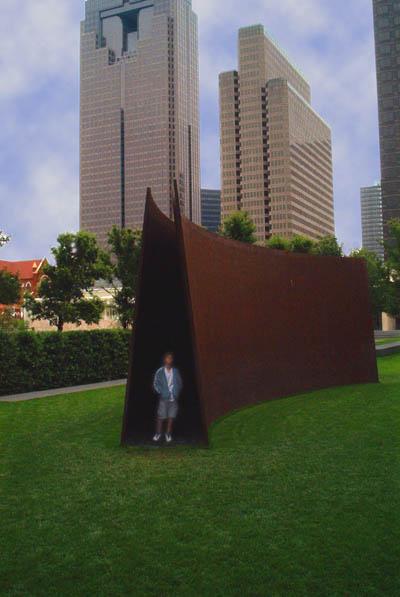
Richard Serra - My Curves are Not Mad

Richard Serra - My Curves are Not Mad

One sculpture that is still in the same place is Richard Serra’s My Curves Are Not Mad.  That’s not surprising – it weighs fifty tons or so and I read somewhere that they had to do some serious work on the foundation when the museum was built. I did this by memory, but it looks like I stood in the exact spot I did seven years ago. You can really see how much the trees have grown.

My Curves are Not Mad - Richard Serra, 2004

My Curves are Not Mad - Richard Serra, 2004

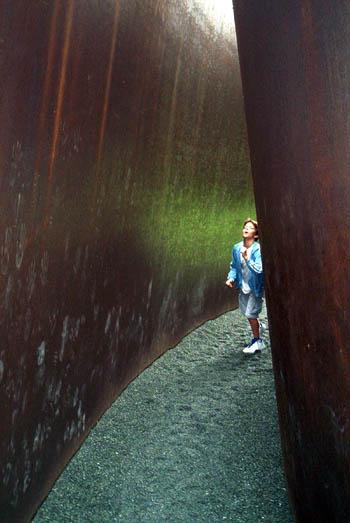
Inside My Curves are Not Mad - 2004

Inside My Curves are Not Mad - 2004

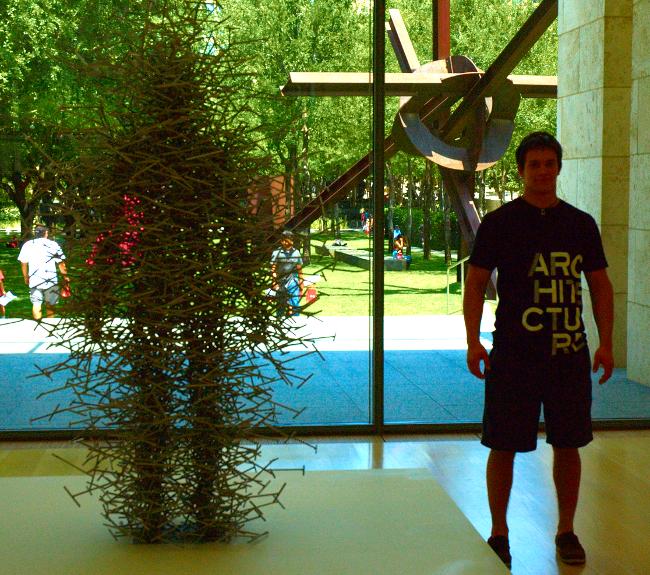
Quantum Cloud XX (tornado) by Antony Gormley

Quantum Cloud XX (tornado) by Antony Gormley

Quantum Cloud XX (tornado) by Antony Gormley used to be down at the bottom of the garden. I liked it there, it looked like a ghost emerging from the shrubbery. It’s always been one of my favorite pieces and I still like it. Actually, today I was glad it had been moved into the air conditioning.

Untitled (Sprawling Octopus Man), by Thomas Houseago

Untitled (Sprawling Octopus Man), by Thomas Houseago

Untitled (Sprawling Octopus Man), by Thomas Houseago, is part of a temporary exhibit, called Satuesque.

Hammering Man, by Jonathan Borofsky

Hammering Man, by Jonathan Borofsky

Everyone that has lived in Dallas for a long time remembers Hammering Man, by Jonathan Borofsky, because it used to grace Raymond Nasher’s shopping mall, Northpark. I love it that he was allowed to stay in the city.

Ozymandias

ozzy by chancew1
ozzy, a photo by chancew1 on Flickr.

And on the pedestal these words appear:
`My name is Ozymandias, King of Kings:
Look on my works, ye mighty, and despair!’
Nothing beside remains. Round the decay
Of that colossal wreck, boundless and bare,
The lone and level sands stretch far away”

Percy Bysshe Shelley – Ozymandias

I have always had a soft spot for abandoned sculpture. Something about the idea of an expensive, large, conceived, funded, designed, constructed, dedicated, photographed, and ballyhooed public work of art forgotten, gone to seed, abandoned – yet still there for all to see – stirs something primeval, prevalent, and tragic in my heart and pen.

For a decade or so in the boom times of the waning years of the last century, there was a luxuriant development in North Dallas near the intersection of Highway 75 and the LBJ 635 Interstate loop called Park Central. It rose up on the land of a long-abandoned WWII airbase – yes, really – I discovered that the beloved Olla Podrida was a re-purposed aircraft hanger. There was an outdoor concert venue that everyone remembers and a spate of modern office towers scrambling toward the sky.

It also boasted a serious outdoor sculpture collection. I actually remember breathless news stories when the newest hunk of abstract steel rose into the summer heat. It was all pretty darn cool.

Then the economy cycled one of its many downturns (don’t remember which one) and it all went to crap.

The concert venue closed, the buildings began to gain coats of peeling paint and discolored concrete as everything expensive moved north to the far exburgs and Park Central was pretty much forgotten. Especially the sculptures. They do not bring in very much income in tough times. The artworks quickly disappeared, swallowed up by parking lots. I don’t know where they went. Were they sold off for scrap metal?

They went quickly, except for one. For a decade a lone piece of artwork stood stoutly in a weedy field, right off the interstate. A dark, twisted monolith – I almost expected to see primitive apes waving jawbones at each other around it. Literally, a million people drove by it every day – but I think I was the only one to notice it still standing there. I drove down one day to look for a plaque or some indication of what it was or who the artist was, but could find nothing, even though I worked up a good sweat and fed a thousand mosquitoes digging around in the scrub prickles trying to find some information.

The sculpture disappeared a couple years ago – swallowed up by the parking lot of a brand-spanking-new megachurch. I don’t know where it went. I suppose it was broken down and crushed into a landfill somewhere.

I wonder if I’m the only one that misses it.

Walking Tall

walking_tall by chancew1
walking_tall, a photo by chancew1 on Flickr.

Another HDR picture of the “Walking Tall” version of the “Travelling Man” series of sculptures down in Deep Ellum here in Dallas.

I had a little accident taking these photos. One of his feet is on a bit of an elevated platform – it looks like a green disk. Do you see it?

I didn’t.

Stepped off and backwards – did protect my camera, though, as I tumbled into some gravel.

You can see one of the new DART stations across the street. I should have waited until a train was going by. Sometime, I’ll go do that.