Amigos Pottery

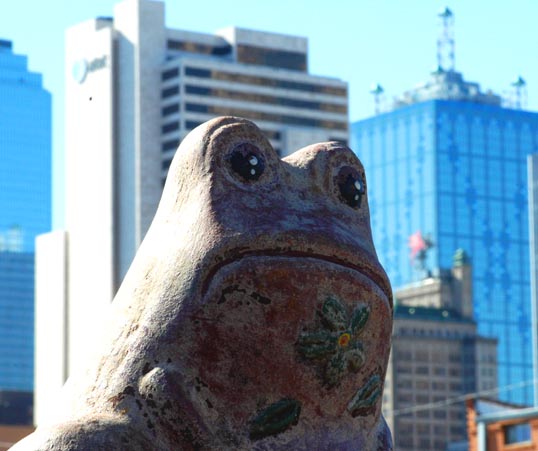
Off to the side of the Dallas Farmer’s Market is a store that I am very familiar with. It sits on a sharp corner and has a tin-roofed building and high rows of steel shelving outside. It’s a Mexican import extravaganza called Amigos Pottery. They have a factory in Mexico and produce a bewildering array of artwork and such – pottery, statuary, chimeneas, wall hangings, welded steel, fountains, and mixed combinations of all of these.

Long ago I bought a chimenea there – I’ve bought some planters, and we’ve purchased a bunch of decorative stuff over the years. Today, my friend and I wandered around with our cameras – shooting in the cramped aisles full of… all sorts of stuff.

Big digital SLRs always attract attention and a guy working there asked me for copies of my photos for his website.

I’ll send him an email as soon as I can find what I did with his business card.


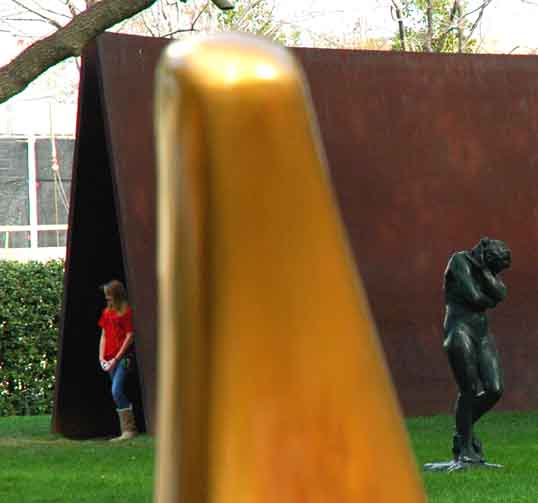
Three shot from one spot, resting my feet by the Henry Moore

Working Model for Three Piece No. 3: Vertebrae, by Henry Moore

My Curves Are Not Mad, by Richard Serra

Eve, by Auguste Rodin

There’s a nice stone bench behind the Henry Moore sculpture in the Nasher Sculpture Garden, where you can take a load off of your feet and look out at all the folks wandering around. It’s one of my favorite spots.

Peek a Boo

(click to enlarge)

“My Curves Are Not Mad” by Richard Serra

“Squares with Two Circles (Monolith)” by Barbara Hepworth

“Eve” by Auguste Rodin

“Little Johnny the Troublemaker” by Mrs. Smith

Quantum Cloud XX (tornado)

“There is also the story about Tyrone Slothrop, who was sent into the Zone to be present as his own assembly–perhaps heavily paranoid voices whisper, ‘his time’s assembly’–and there ought to be a punchline to it, but there isn’t. The plan went wrong. He is being broken down instead and being scattered. His cards have been laid down, Celtic style, in the order suggested by Mr. A.E. Waite, laid out and read, but they are the cards of a tanker and feeb: they point only to a long and scuffling future, to mediocrity…-to no clear happiness or redeeming cataclysm.”

― Thomas Pynchon, Gravity’s Rainbow

PAGE 738

The Bacchae

eyes that run like leaping fire - Elliott Hundley

You have a glib tongue, as though in your right mind, Yet in your words there is no real sense.

Wretched man, how ignorant you are of what you are saying! Before you were out of your mind-but now you are raving mad.
—-Euripides, The Bacchae

A while back, this guy, Euripides, wrote this play, The Bacchae.

It’s a story of Dionysus, a vain, jealous and vengeful god and the horrible revenge he exacts on mere mortals that refuse to worship him. It’s a story of Pentheus, the vain, stuck-up, and arrogant king who wants order, lawfulness, and absolute attention to his iron rule. It’s a story of women running wild in the woods, ecstatic with passion, blinded by lust and wine. It’s a tale of voyeurism, with the victims pulling the spy down and tearing him limb from limb. It’s the story of a mother returning triumphantly home carrying the disembodied head of her own son under her arm thinking it to be a hunting trophy.

The play was considered too grotesque to be seriously studied until Nietzsche wrote in praise of the genre. Now, of course, the flamboyant themes, aberrant scenes, and bizarre excesses are the cat’s meow, and the play has become fashionable, especially as an opera, where the outlandish aspects fit in well with the dramatic chorus.

The great theme of The Bacchae is a fascinating and important one. It is the constant, eternal struggle between freedom and control. Can an organized, rational society survive if it allows the irrational passions of the human heart to exist and express themselves? How can it survive if it does not? Where is the line to be drawn? What is the healthy limits to ecstatic pleasure? Are there any? The two forces: authority and freedom, rational and irrational, the head and the heart, duty and joy, moderation and excess, wisdom and instinct, self-control and human passion, restraint and release – are forever locked together wrestling in a death-grip struggle, each unable to defeat the other because, without its opposite, neither can survive.

Recently, the Nasher Museum in the Dallas Arts District crated up the Tony Cragg exhibition and sent it back to where it came from. I really enjoyed this one and was sad to see it go. It was replaced by a group of sculptures called The Bacchae by Elliott Hundley, a young Los Angeles based sculptor. I saw some photographs of the work and was disappointed. It looked junky, simple, and nothing special.

I was wrong.

Photographs can not do justice.

I took the DART train down to the Nasher on a Target First Saturday event, where I could stroll in and out and take it all in at my leisure. I was stunned. The stars of the show are the large flat assemblages that take up huge swaths of museum wall space. These are incredibly complex masses of kaleidoscopic images, from found objects to cut out photographs, from comic-book word balloons to paragraphs of newspaper-ransom-note-cut-outs – all suspended in various ways in front of giant billboard-like images. The closer you look, the more detail jumps out. You could spend a year in front of a single one of these and not be able to tease out all the passion and information contained within.

More traditional 3-D sculptural works occupy the center of the space and I found these interesting and well-done, but I, like everyone else in the crowded room was drawn back, again and again, to stand right against the little foot-ropes holding the mob back, and stare at the square inch of work that was right in front of my eyes until I could look at each little paper figure impaled on a wire pin or read the little quotes or try to decipher the galaxy of little objects that are presented sticking out from the wall.

The artist calls these “bulletin boards” and I can see why. They are enormous collections of a universe of detail and, like a lot of art, change tremendously with perspective and distance. Standing away (or looking at a photograph) you can see a landscape of large images partially obscured by clouds of smaller details. Once you approach, these details become apparent and you stare at them. If you want to get even closer, on certain works the artist provides magnifying glasses attached to a matrix of wooden sticks and you can peer through into an even smaller, almost microscopic world, of printers dots splayed across the mounted magazine advertisements and ink-jet printed paper objects.

As I looked I could listen to the comments of the other patrons around me – especially the children. This was a free admission with family activities day so there were a lot of kids. They were, of course, instantly drawn to the collages and it was a struggle for their parents to keep them from touching anything. The little ones would comment constantly. “Oh, that’s gross!” was a common reaction, said in that kid way that doesn’t necessarily mean that they didn’t think it was cool. A few parents would try to explain, in that condescending “I have brought my spawn to the art museum now I must get them to understand how important this is and how great a parent I am” tone and attitude but their voices would trail off, overwhelmed by the sheer mass of stuff that was stuck up on the wall in front of them.

Now, writing this, I want to go back and look at it all again. I want to try and break some of it down and see if I can relate it to the Euripides play now that I know a little more about it. I know I will. I can see a few hours stolen here and there to waste standing against that low rope staring at all that stuff stuck to all those pins.

detail from the LIghtning's Bride - Elliott Hundley

Elliott Hundley: The Bacchae

Review: ‘Elliott Hundley: The Bacchae’ at the Nasher

Art Review: Is Elliott Hundley’s Work More Suited For A Tim Burton Film Than the Nasher?

Sparknotes: The Bacchae

Elliott Hundley The Bacchae Exhibit at Nasher Sculpture Center

Contemporary Art (1) – Elliot Hundley

elliott hundley
Eccentric Flint

When I go to a local museum – one that I visit on a regular basis – I’ll usually pick out one piece of art, go to it, and study it for as long as I can.

Plus, there are pieces that I always go to and… it feels like checking in – or paying a visit to an old friend. I don’t know why certain works resonate with me… and I try not to think about it. I like ’em, and that is something I want to be good enough.

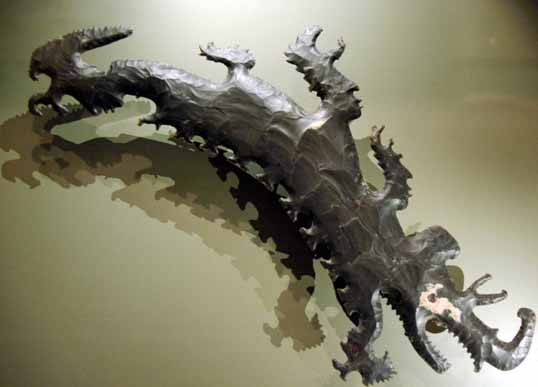
At the Dallas Museum of Art, one piece that I have always loved, one that I keep going back to ever since I first saw it decades ago, is an eccentric Mayan ceremonial flint knife.

Mayan Flint Knife from the Dallas Museum of Art

From the museum card:

Eccentric flint depicting a crocodile canoe with passengers.

 Mexico or Guatemala: southern Maya lowlands, Maya culture

Late Classic period, c. A.D. 600-900

This sacred blade shows a moment in the Fourth Creation of the world on August 13, 3114 B.C. The blade is shaped as a monstrous crocodile canoe; water flowers decorate its belly as it sinks down into the dark waters of the spirit world. In the canoe is the soul sacrificed First Father accompanied by two attendants, who may be embodiments of his parents. The canoe represents the Milky Way, pivoting in the night sky from east-west to north-south. The Maya saw this pivoting as the sinking of the canoe and the raising of the precious maize tree. When the canoe sank, First Father was miraculously reborn as Maize, the sustenance and flesh of humanity.

Because it represents this mythic act, this blade was probably an especially powerful talisman of a living king, who became the reincarnation of First Father as he held the blade. The blade itself, bundled in textiles, was probably carried by the king into battle as the focus for his spiritual energies and as his tactical inspiration. The flinty stone connoted lighting to the Maya and was called by the same name as the bright but dangerous bolts of light that accompany life-sustaining rain.


There is a brutal beauty about this flint. I can picture the Mayan king going into bloody battle with this ceremonial knife gripped in his fist.

Teaching packet on the Mayan Flint

Wikipedia – Eccentric Flint

Ganesha, Lord of Obstacles

Ganesha, Lord of Obstacles. From the Crow Collection of Asian Art

Ganesha, Lord of Obstacles, Lord of Beginnings
India, 10th Century
Stone
Clever Ganesha

Ganesha and his half brother Skanda were promised a boon by their parents, Shiva and Parvati. The prize would go to the one who returned first from circling the universe. Skanda, a keen warrior, geared up for his voyage and took off with great speed. Ganesha fortified hmself with a modaka, his favorite sweet, and respectfully circumambulated his parents. Long before Skanda returned, Ganesha was awarded the prize.

Adapted from the Siva Purana, trans. Paul Courtright


Sculptures at the Crow Collection of Asian Art

A couple of photographs I took the last time I was at the Crow Collection of Asian Art in the Dallas Arts District.


Grazing in the River Bottoms

(click to enlarge)

HDR photograph taken in Trammell Crow Park in the river bottoms, Dallas.

This is the spot where, years ago, Lee and I came down to do some sketching in the river bottoms. We walked to the levee in the background of this picture to draw the downtown skyline. Lee was a bit distracted, but I managed to sell my drawing to a local magazine – so all was not lost. It took me a while to get this picture – it’s not the most savory area and a young couple were drinking heavily and stumbling around between the cows and getting in the shot. Since this HDR is a three shot combination – I needed stationary subjects – like the concrete cows.

As I was leaving, I was lugging my camera and tripod back to the parking area when a group of three – an older photographer (walking with a cane), his assistant (carrying a folding reflector and a camera), and a model (wearing a long dress, but wrapped in a large thick shawl – it was cold) walked the other way. They were obviously going to get the last bit of light as the sun set. The man said Hi in a nice conspiratorial way, making me think I was actually also a photographer, instead of simply an idiot with a tripod.

I thought they were going to head to the cow sculptures, but they walked right out into the open area…. I’m not sure what sort of shot they were working on.

I sort of wanted to sit in my car and watch them work – I like watching fashion shoots – but I had things to do… so off I went.

A Week and a Day

Saturday – It’s been eight days since I saw the art installation Transcendence downtown. The ice sculptures have been melting all this time.

First Night

Next Day

The Day After That

A couple days after that

I had to see what has happened in the meantime. Would the ice be completely melted? Would the installation still be there?

I drove down and parked down the street. It was still there, the gravel was still raked, and there was a lot of ice left in the two big blocks. The taller block had fallen over and broken in two, but the large horizontal block was not noticeably smaller.

The two human forms were nothing other than small irregular pieces of ice. The stone from one of them was missing. I remembered the story the woman from the Dallas Center for Architecture had told me.

She said that she had heard that one of the stones in the human forms was from the parents of a childhood friend of the artist. This friend had passed away and after the ice is melted and the artwork is closed the stone will be given back to the parents to be placed in their stone garden on their rural home as a memorial. A nice story.

Maybe that one stone is now in a garden on the Oklahoma border. I’d like to think so.

While I was taking pictures I could hear a lot of noise – a metal grinding sound with a series of loud clacks – coming from behind a wall surrounding an unfinished building next door. I realized that some kids were skateboarding over there. After a few minutes a couple boards came flying over the wall and then their owners scampered through a gap in a fence after.

“What is this?” they asked, “Is that ice?”

I explained that it was an art work, that there had been large sculptures of ice that have been melting for a week. They had never heard of a Zen rock garden, so I explained as best as I could. They seemed to think it was cool.

“I’m glad we didn’t walk around in there,” one of them said.

So am I.

The two human form sculptures, what is left of them

A reminder of what one of these looked like at the unveiling

The large upright block fell over - you can see the light-colored gravel it rested on.

What it looked like at the unveiling

A group of women walked by after leaving the Opera House.