Iguanas on my Roof

A sketch of the Casino at Montelimar, Nicaragua - once Somoza's beach house.

A sketch of the Casino at Montelimar, Nicaragua – once Somoza’s beach house.

I stumbled across a wonderfully interesting book this weekend; Iguanas on my Roof Funny, Sad, and Scary OVERSEAS ADVENTURES of a Foreign Service Family in Third-World Countries during the Vietnam War and Watergate Era. I found it on its Facebook Page and then bought a copy from Amazon for my Kindle.

Say what you want about e-books… but to learn about a publication from the web while riding on a commuter train, have it in my hand seconds later, and instantly start reading it – that’s something amazing.

The book is a slim, simple, heartfelt family memoir written by Nancy Stone, the mother of five. I went to high school with two of her kids in Managua, Nicaragua. One son was my age, a grade below me and in a lot of my classes, and a daughter was my little brother’s age. We all ran around a lot together my senior year (I graduated and left for Kansas University in 1974).

I immediately recognized the title – we had iguanas on our roof. I remember when we first moved to Nicaragua trying to sleep with some tremendous racket overhead. I crept outside and leaned a ladder up to the wall, climbing up to find out what it was. There were a half-dozen huge iguanas and an equal number of cats all chasing each other around on the corrugated galvanized roofing. I couldn’t tell who was chasing who – but it was a mess. After I learned what it was up there – it was easy to ignore the cacophony and sleep.

Although I knew the kids well, I don’t recall ever even meeting their parents and I certainly never knew their story. We were military and they were embassy – that didn’t matter to the young’uns, but there was a difference. Their father, Al Stone, was a railroad brakeman in the late fifties when he was inspired by the harrowing plight of hordes of desperate Mexican immigrants fleeing a drought to try and do something. He spent years in education and effort until he was able to go to work for the Department of State and the USAID program.

So the big family was off on a tour of the disasters of the third world. From living in the Philippines while Al was in Vietnam, to Lagos, to Washington DC, to Managua after the 1972 earthquake (where they crossed paths with your humble narrator), the book describes the shocking, the strange, the scary, and the silly of a long, often difficult trip.

I’ve always said that living in the third world is months of boredom punctuated by moments of sheer terror.

Most of what was in the book was familiar to me, even the sections from the Philippines and Nigeria. There are certain stock scenes common to life in any poverty-cursed tropical place. Every incident brought back memories of similar episodes and adventures from my own youth.

The crest from the American Nicaraguan School

The crest from the American Nicaraguan School

What was most interesting was seeing these recognizable installments from a different point of view. The book is told by an adult – a person where everything is new and strange. Nancy Stone was from California – thrust by fate, love, and dedication into a bizarre world of giant insects, bad infrastructure, iffy transport, dangerous and incomprehensible societies, and odd food. It was all so… foreign. Cultural and work protocols, manners, and etiquette were consummate challenges. But it all comes to an end. The final chapter is titled, “We Went Back Home.”

Where is home? I don’t understand the concept. People talk to me about being “homesick” – I have no idea what they are talking about.

You see, It felt differently to go through a journey like that as a kid. When you are young… it is simply how things are. You don’t know any better.

A few paragraphs of the story were written by the kids I knew – familiar voices I understand.

For me, for example, the place and time where I had the most trouble adapting was when I went to college in the states. My nickname for a couple years was “Banana Boat” – as in, “Bill, you’re an American like the rest of us, but you act like you just fell off a banana boat.” I was so happy to find four students from Barcelona that I could relate to – though I was bothered by their lispy Spanish and the incredible amounts of wine they drank.

I realize that the youngsters were able to assimilate into the local culture in a way the adults couldn’t even imagine. To this day, I’m ashamed of my terrible Spanish – but I learned that if I simply kept my mouth shut I could move around at will without anyone knowing I was an American. As a matter of fact – nobody would notice me at all. I could become invisible. That’s an amazing thing to be able to do in a place like that.

That even affects the memories I try to hang onto in my incipient dotage. For example, there are a lot of anecdotes like those in the book that I am willing to let go as they fade into the misty cobwebs of my crumbling brain. What I hang onto desperately are some of the ethereal emotions of youth, the colors of the country, and the smells of the culture.

For example (full disclosure – I’ve been writing notes about this recently for a short story I’m working on) there is the smell of the third world. It’s a smell of pork grease and wood fires – of sour sweat and homemade soap, of heat and desperation. A few years ago I walked out onto the deck of a ship as it cruised into Montego Bay at dawn. A fisherman in a tiny wooden skiff was off the port bow and I watched him untangle his nets. As the salmon glow of the sun, still hidden behind the mountains, filled the sky we moved into a thin cobalt mist of the morning cooking fires wafting offshore and there was that third world smell. I had forgotten… but it all came back in a rush.

That is what I am desperate to hold on to.

So, I any of y’all are curious enough to read about what it was like, over there, back then, go to Amazon, load up your ereader or wait for the bound paper, whatever. It’s worth your money and your time, trust me. Thanks for doing the work, Mrs. Stone, for collecting the memories, writing them down, and sending them out into the world.

It’s late, so late. I think I’ll pour a little Flor de Caña (I was so happy when that became available in Dallas), get my writing in, and call it a day.

The land of lakes, volcanoes, and sun. A painting I bought on my last trip to Nicaragua.
The land of lakes, volcanoes, and sun. A painting I bought on my last trip to Nicaragua.

Invisible Cities

Cities & Desire 5

From there, after six days and seven nights, you arrive at Zobeide, the white city, well exposed to the moon, with streets wound about themselves as in a skein. They tell this tale of its foundation: men of various nations had an identical dream. They saw a woman running at night through an unknown city; she was seen from behind, with long hair, and she was naked. They dreamed of pursuing her. As they twisted and turned, each of them lost her. After the dream, they set out in search of that city; they never found it, but they found one another; they decided to build a city like the one in the dream. In laying out the streets, each followed the course of his pursuit; at the spot where they had lost the fugitive’s trail, they arranged spaces and walls differently from the dream, so she would be unable to escape again.

This was the city of Zobeide, where they settled, waiting for that scene to be repeated one night. None of them, asleep or awake, ever saw the woman again. The city’s streets were streets where they went to work every day, with no link any more to the dreamed chase. Which, for that matter, had long been forgotten.

New men arrived from other lands, having had a dream like theirs, and in the city of Zobeide, they recognized something from the streets of the dream, and they changed the positions of arcades and stairways to resemble more closely the path of the pursued woman and so, at the spot where she had vanished, there would remain no avenue of escape.

The first to arrive could not understand what drew these people to Zobeide, this ugly city, this trap.

—-Invisible Cities, Italo Calvino

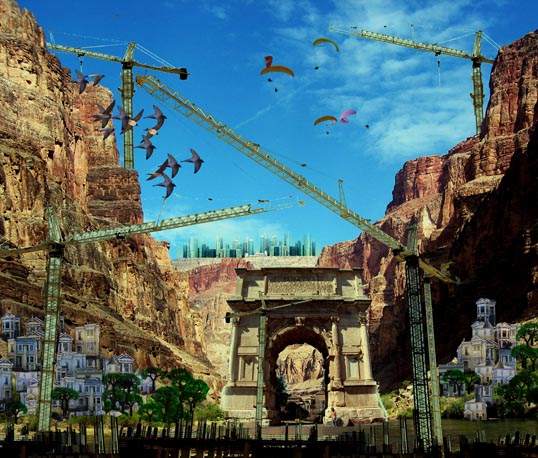
Invisible City - Gateway to Arcturus

Invisible City – Gateway to Arcturus

Thin Cities 5

If you choose to believe me, good. Now I will tell how Octavia, the spider-web city, is made. There is a precipice between two steep mountains: the city is over the void, bound to the two crests with ropes and chains and catwalks. You walk on the little wooden ties, careful not to set your foot in the open spaces, or you cling to the hempen strands. Below there is nothing for hundreds and hundreds of feet: a few clouds glide past; farther down you can glimpse the chasm’s bed.

This is the foundation of the city: a net which serves as passage and as support. All the rest, instead of rising up, is hung below: rope ladders, hammocks, houses made like sacks, clothes hangers, terraces like gondolas, skins of water, gas jets, spits, baskets on strings, dumb-waiters, showers, trapezes and rings for children’s games, cable cars, chandeliers, pots with trailing plants.

Suspended over the abyss, the life of Octavia’s inhabitants is less uncertain than in other cities. They know the net will last only so long.

—-Invisible Cities, Italo Calvino

For a month, starting on June 1, I read a short story every day and wrote a journal entry about them. For me at least, (I don’t know about how it was for you) it was a fun, interesting, and educational experience and exercise. One thing I learned is how wide the world of short fiction is – how varied and variable, diverse and divisive the styles, techniques, and artistry.

So I vowed to continue reading widely… and that brought me to a book by Italo Calvino – Invisible Cities (PDF). Technically, it’s a novel – a short novel. However, it is made up of a long series of very short sketches, each one describing a different, fantastic city – fifty-five in total. These are framed by an outer story, where Marco Polo is talking to Kublai Khan and telling the tales, thereby describing the cities he has visited.

Kublai Khan does not necessarily believe everything Marco Polo says when he describes the cities visited on his expeditions, but the emperor of the Tartars does continue listening to the young Venetian with greater attention and curiosity than he shows any other messenger or explorer of his. In the lives of emperors there is a moment which follows pride in the boundless extension of the territories we have conquered, and the melancholy and relief of knowing we shall soon give up any thought of knowing and understanding them.
—-Invisible Cities, Italo Calvino

The descriptions can be read individually, in relation to each other, and to the deep philosophical questions raised by the framing story.

It is short and easy to read, yet complex – with hidden aspects and dimensions that have to be teased out. It is so full of unique and interesting ideas that it slowed my reading down… I’d devour a half page and then have to rest to let the concepts and thoughts born by the text stop vibrating and resonating inside my head, let it all calm down, before I could read some more.

The book shows a lot of influence of Jorge Luis Borges… and is one book that is referred to as Borgesian. It is full of self-referential conundrums, mysterious contradictions, and postmodern enigmas.

I have to be careful about what I am reading when I write, because my reading is such an influence on what I write. I put up an entry containing something I wrote, Free Breakfast, while reading Invisible Cities a few days ago.

I would love to write like Italo Calvino… though nobody would read it. His fiction is a lot of fun, but it isn’t, for example, something that will ever be as popular as, say Harry Potter.

Now that I think about it… wouldn’t that be cool? A postmodern, Borgesian Harry Potter.

It could explore the duality of Harry Potter’s life. He lives in a cupboard, ignored, miserable, and hopeless for part of the year, then spends the rest in a world of Magic… where he is the chosen one. Which life is the real one… which is the real Harry Potter? Could the dire tragic life of poor Orphan Harry be so demoralizing that it drives him crazy? – Is the whole magical world of Hogwarts born from Harry’s desperation – an imaginary world where he gains unthinkable power and importance – where he becomes the chosen warrior in a war against the ultimate evil?

And what about Voldemort? He shatters his soul into a handful of pieces and stores each one in a Horcrux. He achieves immortality, at the price of a broken soul. Do these items then become Voldemort? How can a soul exist without consciousness? The potential for paradox and existential exploration are endless.

Even something as simple as the paintings…. Dead people make an appearance in the moving, talking paintings of Hogwarts. Is this a form of limited immortality? Do the paintings know they are dead? Are they sad? Are there moving and talking paintings with subjects that were never alive? Why not? If so… what are their memories? Do the dead paintings sleep? Do they dream of the living?

That would be a book worth reading… if someone had the skill to pull it off.

Hidden Cities 1

In Olinda, if you go out with a magnifying glass and hunt carefully, you may find somewhere a point no bigger than the head of a pin which, if you look at it slightly enlarged, reveals within itself the roofs, the antennas, the skylights, the gardens, the pools, the streamers across the streets, the kiosks in the squares, the horse-racing track. That point does not remain there: a year later you will find it the size of half a lemon, then as large as a mushroom, then a soup plate. And then it becomes a full-size city, enclosed within the earlier city: a new city that forces its way ahead in the earlier city and presses its way toward the outside.

Olinda is certainly not the only city that grows in concentric circles, like tree trunks which each year add one more ring. But in other cities there remains, in the center, the old narrow girlde of the walls from which the withered spires rise, the towers, the tiled roofs, the domes, while the new quarters sprawl around them like a loosened belt. Not Olinda: the old walls expand bearing the old quarters with them, enlarged but maintaining their proportions an a broader horizon at the edges of the city; they surround the slightly newer quarters, which also grew up on the margins and became thinner to make room for still more recent ones pressing from inside; and so, on and on, to the heart of the city, a totally new Olinda which, in its reduced dimensions retains the features and the flow of lymph of the first Olinda and of all the Olindas that have blossomed one from the other; and within this innermost circle there are always blossoming–though it is hard to discern them–the next Olinda and those that will grow after it.

—-Invisible Cities, Italo Calvino

The Hunger Games and Battle Royale – Compare and Contrast

I have not been watching enough television… no, no, no, that’s not right. I’ve been watching too much television (isn’t watching any television too much television?) – what I mean is that my television watching has been too unfocused. I waste my meager allotment of precious time with sports or my obsession with How It’s Made/How do They Do That/Modern Marvels (por ejemplo – do you have any idea how much work goes into making a tennis ball?). I want to stop that and start working my way down my Netflix Queue – especially the twisted obscure crap that feeds my imagination.

In that regard, I watched too similar (yet completely different) films that I’ve been meaning to check out. I finally came around and caught The Hunger Games on Netflix, and then, last night, stayed up too late and watched a wild and controversial Japanese film from a decade ago called Battle Royale.

I had not read the books from The Hunger Games and now, I’m know I won’t. I had heard a lot of good things and, sure enough, The Hunger Games was a well-acted, slick, excellent production of a popular story and it was a serious disappointment to me. It was simply too Young Adult for my tastes.

Then there is Battle Royale. People say that Battle Royale is the inspiration for The Hunger Games – though the Suzanne Collins claims to have never read the book or seen the film. The overall concept is similar – a group of teenagers trapped in an isolated area and forced to fight each other to the death.

However, there are more differences than similarities. The Hunger Games is a carefully calibrated teen vehicle where the most horrific aspects of the godawful situation are concealed and glossed over – making a tale which is unsavory on the surface palatable for the masses. Battle Royale, on the other hand, pulls no punches. It is an unfettered tsunami of death… a tornado of gore, terror, and raw emotion. It is deeply disturbing. The ultra-violence makes A Clockwork Orange look like Barney.

Both films have political overtones. The Hunger Games concentrates on class warfare in an Occupy Wall Street inspired tale of the wealthy versus the poor – the monied, powerful elite oppressing and suppressing the unwashed, starving masses. Battle Royale has a more subtle, complex take. It is, first of all, a conflict of generations. The young people are out of control – it starts with a student stabbing his teacher – and the older generation decides to take revenge.

It is the story of a traditionalist society unraveling, of personal vendetta and obsession, of child abuse and the sins of the fathers’ hoisted on the young. Above all, it is about the Zero Sum Game and the idea that none of us, really, gets out of this alive.

The Hunger Games is modeled after television reality shows, while Battle Royale takes the form of an adolescent fever-spawned nightmare.

The Hunger Games has beautiful model-like specimens of perfection running around in a well-lit carefully manicured park-like setting, while Battle Royale is gritty, dark and more than a little rough around the edges. Instead of a shiny bow and arrow, the contestants in Battle Royale are each given a random weapon – some useful, some not. Some get submachine guns while the hero gets the lid from a cooking pot.

Model-like appearance of the contestants from The Hunger Games

Model-like appearance of the contestants from The Hunger Games

The class from Battle Royale

The class from Battle Royale

The Hunger Games contestants are carefully selected and trained, while in Battle Royale a class of forty students (half girls and boys) are gassed while on a school trip and thrown together on an island with no preparation other than a cute, silly instructional video. That means they all know each other well beforehand – and the usual alliances, crushes, and hatreds of the young come forward as a matter of life and death.

The Hunger Games is broadcast as an entertainment for a worldwide audience… like the ultimate Roman Gladiatorial Extravaganza. It is a spectacle for and about the media. On the other hand, the Battle Royale itself is not even televised. The authorities seem to stage the Battle Royale mostly because… well, because they can.

One interesting section of Battle Royale is when the members of the school’s Cheerleading squad are shown hiding out in the luminous whitewashed lighthouse. They are organized, have set up a watch schedule, a kitchen, an infirmary, and have settled into what appears to be a polite, happy, domesticated, and insulated clique. They are shown cooking and carefully cleaning – wiping down the tables before a meal. However the horror of their situation is running right under the surface and all it takes is a plate of spaghetti eaten by the wrong person to set everything off. Minutes later, they have all slaughtered each other – with the last survivor throwing herself off the lighthouse into the rocks below. One exclaims while dying, “I at least thought I’d live until tomorrow.”

Don't mess with the Cheerleaders

Don’t mess with the Cheerleaders

In a movie with an ensemble cast like this it is fun to try and spot actors you’ve seen elsewhere. Sure enough, playing Takako Chigusa (Girl #13) in Battle Royale is Chiaki Kuriyama who played Gogo Yubari in Tarantino’s Kill Bill Volume 1. I’ve always thought that the fight to the death between Gogo and Beatrix Kiddo is the best fight scene in pretty much any movie. It’s no coincidence; Quentin Tarantino is a fan of Battle Royale and based Gogo on Chigusa. I kept expecting Chigusa to pull a chain with a spiked ball on the end out of her weapons bag.

Takako Chigusa  (Girl #13)  from Battle Royale - in this one, she gets to wear the yellow jumpsuit

Takako Chigusa (Girl #13) from Battle Royale – in this one, she gets to wear the yellow jumpsuit

The same actress as Gogo Yubari in Tarantino’s Kill Bill Volume 1

The same actress as Gogo Yubari in Tarantino’s Kill Bill Volume 1

Now, the important question… what to watch next? I haven’t decided but I have it narrowed down to two that I have on DVR – Sharknado or La Traviata. They’re sort of the same thing… aren’t they? La Traviata is basically Sharknado plus tuberculosis.

Ready Player One

Old School Video game inspired graffiti, Deep Ellum, Dallas, Texas

Old School Video game inspired graffiti, Deep Ellum, Dallas, Texas

I was looking through the READ (that’s as “red” not “reed”) folder on my Kindle and also in my Goodreads list at the books I’ve cranked through recently. After some thought I decided to give a bit of opinion on some of them… in case you might be interested (or interested in avoiding them).

Picking books to read is always a difficult and tricky proposition. I am not a particularly fast reader (especially now that my eyes and brain are getting old and worn out) so to commit to a novel is an investment of a good bit of precious time. That said, I do love the feeling of perusing a list on the Kindle or a shelf of paper and deciding which tome to dive into next.

One feature that is always attractive are those books that have a movie deal done. I always like the read the book first (the book is always better, isn’t it?) and that way, when the film is flickering there in the dark, I can go if I want to – rather than giving the pathetic excuse, “I’m sorry, but I don’t want to see that until I get a ’round2 reading the novel.” Sad.

But sometimes it leads me down a good path. If some Hollywood Icon is ready to plop down a few million dollars on a story… doesn’t that mean it might be good? Of course not, but it’s a nice thought.

So somehow I stumbled across a story about a book called Ready Player One by Ernest Cline and the fact that it is about to be filmed. I’m not now and have never been a gamer, but was looking for some lightish fiction – something fun and not too straining – and this one seemed to fit the bill. Plus, it was on sale.

And it was what it promised. A fast moving story – more than a little on the predictable side, but I did care about the characters… and that’s the important part.
I’m late to the party on this book, so bear with me – also, I don’t like to put spoilers in my reviews, so everything I write about will be obvious in the first few pages.

Ready Player One is set in a world that is similar to The Matrix. War and Pollution have pretty much destroyed the planet and the survivors spend most of their time in a virtual world, hooked up to a powerful computer network, living out artificial lives that are usually more pleasant and interesting than their real ones. It is different from The Matrix in that this is voluntary and everyone knows what is going on… though the border between real and virtual does get a little hazy now and then.

One unanswered question is that how much is the dystopian future caused by the presence of this virtual world – in other words… if everyone didn’t have this escape would they get off their butts and make the earth a better place to live?

Within this virtual world the founder of the network has created a fiendishly difficult game – a puzzle – a scavenger hunt – and the first person to solve the riddle through to the end will gain the most valuable prize imaginable – the complete ownership and control of the virtual system. He or she will become a living god.

The plot proceeds from this premise… pretty much in the way you think it does. My biggest complaint is the basic story – which is a classic teenaged fantasy fulfillment tale. I also wasn’t bowled over by the gaming elements of the story… it’s simply not my thing.

What I really did enjoy were the puzzle elements themselves. The game master was only a little younger than me and he based all the games, clues, and Easter Eggs in the virtual world on 1980’s pop culture trivia. A lot of fun and a lot of guilty memories for me.

So, if you are looking for a fun and exciting read, not too deep in philosophy or moral paradox, and steeped in Brat Pack Movie, New Age Music, and early computing trivia… then this is your man.

Now I’m ready for the film.

game2

As Flies to Wanton Boys

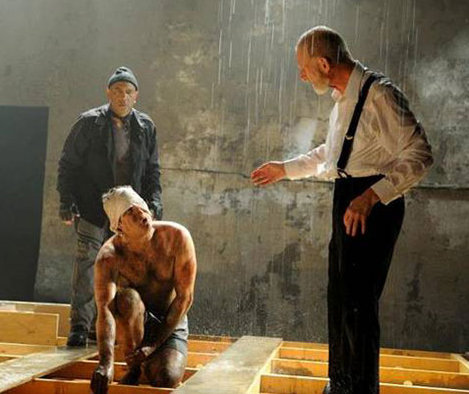
King Lear, Dallas Theater Center, Wyly Theater

King Lear, Dallas Theater Center, Wyly Theater

“As flies to wanton boys are we to the gods. They kill us for their sport.”
—- Shakespeare, King Lear

As I’ve said before – I was excited to watch the fantastic new venues go up in the Dallas Arts District. I especially was fascinated by the Wyly theater. Designed by Pritzker Prize winner Rem Koolhaas and associates it was a unique building, resembling nothing more than a Borg Cube. I distinctly remember thinking that it was such a cool place that it was a shame I could never afford to see a production there.

The Wyly Theater.

The Wyly Theater.

“When we are born we cry that we are come
To this great stage of fools.”

I was wrong. It is quite easy to find affordable tickets to most of the productions. Especially on “Pay What You Can Night.” Most productions have one performance (actually, you might call it a dress rehearsal – but it’s the full thing) that they sell the tickets for whatever the audience wants to pay.

These can sell out quickly, of course. But I have the site bookmarked and the dates on my calendar, and I can jump in there and buy them quick. We have seen The Tempest on a cheap day and The Elaborate Entrance of Chad Deity on a Pay What You Can night.

I snagged two tickets to King Lear on Pay What You Can Night. I won’t say what I could pay… right now, it’s not very much, I’m afraid.

“Through tattered clothes small vices do appear.
Robes and furred gowns hide all. Plate sin with gold,
And the strong lance of justice hurtless breaks.”

Candy couldn’t go, though, and I ended up going by myself. On Friday morning I thought about bailing, things were so complicated. I didn’t have a car, would have to ride my bicycle in the cold to work, and then get to the theater. Thursday night I rolled all the possibilities in my head, where to ride, where to lock up my bike, what to take, all the timing.

“I am tied to the stake, and I must stand the course.”

I decided to give it a go when the day turned out to be sunny and warmer than I expected and I actually enjoyed my commute to work. Afterwards, I had to ride around to a couple DART stations looking for an open bike locker – I didn’t want to leave my road bike locked up outside for fear of finding it relieved of vital parts.

“We are not the first
Who with best meaning have incurred the worst.'”

I have only seen King Lear once. Decades ago, I took Lee to see a production outside at the Dallas Shakespeare Festival – I’m not sure of the year, but I guess he was ten or so. Lear is such a dark and complex work, I worried that he would be bored – but there was enough sword fighting and action that he was enthralled, even if he didn’t really understand what was going on. In the infamous eye-gouging scene, an actor actually threw two grapes on the stage and then stomped on them. Lee perked up.

“Hey, what just happened?” he asked.

“Oh, nothing, Lee.” A father has to lie a little now and then.

“I want that glib and oily art
To speak and purpose not; since what I well intend,
I’ll do’t before I speak.”

He especially liked the army scenes where they had a large crowd (probably every stagehand and a lot of local volunteers) moving through the trees around the outdoor venue with lamps and rattling swords. It was pretty impressive – he was a tiny bit afraid… just the right amount. He used to really love going to the Shakespeare plays and I wish I could have done more. We were so busy.

Lee, at the Dallas Shakespeare Festival's production of Hamlet, a few years ago.

Lee, at the Dallas Shakespeare Festival’s production of Hamlet, a few years ago.

“How sharper than a serpent’s tooth it is
To have a thankless child!”

So, on Friday, I rode the DART train downtown and walked to the Wyly for the performance.

It started out with a very spare stage – a wooden wall, a door, a heavy chair, and a candelabra. I noticed before the performance a couple of stagehands on hands and knees, carefully wiping the stage down, as if they were worried about bits of slippery water.

“Time shall unfold what plaited cunning hides.”

The play started very formal and stiff. The actors stood arranged around the seated king in symmetric positions and delivered their lines. It was all very good, but not very exciting. King Lear is an avalanche of a play; it delivers its punches full-bore – heavy and hard. It doesn’t fuck around.

Still, to entertain a modern audience, you need something more than a static composition, no matter how talented. You need a gimmick, something to entertain the masses. I worried that they had decided to go all old-school, plain, simple, and it was starting to get a little boring. I thought it might be a long night of interesting but not very passionate storytelling.

I was wrong.

“Oh, that way madness lies; let me shun that.”

When I think of King Lear, I don’t usually think of the play itself… or even a film of the play. I think of Ran – the incredibly powerful film by Kurosawa. I saw it in a theater when it first came out and it affected me as much as any film ever did. Based on Lear, set in samurai-era Japan, it captures the tragedy and hopelessness of Lear in an amazing, colorful… Kurosawa style. A work of genius.

“Have more than thou showest,
Speak less than thou knowest,
Lend less than thou owest.”

Still, to this day, when I watch Lear, the back of my mind flashes to the battles and pathos of Ran. It is engraved there forever… I’m afraid.

“This is the excellent foppery of the world, that,
when we are sick in fortune,–often the surfeit
of our own behavior,–we make guilty of our
disasters the sun, the moon, and the stars: as
if we were villains by necessity; fools by
heavenly compulsion; knaves, thieves, and
treachers, by spherical predominance; drunkards,
liars, and adulterers, by an enforced obedience of
planetary influence; and all that we are evil in,
by a divine thrusting on: an admirable evasion
of whoremaster man, to lay his goatish
disposition to the charge of a star!”

Then, suddenly, about a quarter way through, the formal stylized play ended. As Lear was thrown into the storm of madness the wooden walls that formed the back of the stage fell forward into a tumbledown confusion, huge doors swung down from above and a gigantic torrent of water waterfalled down (sort of Flashdance style – on steroids) onto the King.

And all Hell broke loose.

The rain comes down and madness conquers all.

The rain comes down and madness conquers all.

“Blow, winds, and crack your cheeks! rage! blow!
You cataracts and hurricanoes, spout
Till you have drenched our steeples, drowned the cocks!
You sulphurous and thought-executing fires,
Vaunt-couriers to oak-cleaving thunderbolts,
Singe my white head! And thou, all-shaking thunder,
Strike flat the thick rotundity o’ the world!
Crack nature’s moulds, all germens spill at once
That make ingrateful man!”

The formality gone, torn to the four winds, the rest of the play was a tsunami of a powerful madness, a foil for the Kings insanity and despair. The fourth wall was broken, with actors fighting in the aisles and lightning screaming through the theater. I noticed that even the sound effects added to the disconcerting craziness – every time the King’s mind took a turn for the worst, a crackling buzz came from hidden speakers above the seats – a subtle effect that enforced the impression of insanity and doom.

“Rumble thy bellyful! Spit, fire! Spout, rain!
Nor rain, wind, thunder, fire, are my daughters:
I tax not you, you elements, with unkindness;
I never gave you kingdom, called you children,
You owe me no subscription: then, let fall
Your horrible pleasure; here I stand, your slave,
A poor, infirm, weak, and despised old man.”

And then, the tragedy. As the inevitable doom unfolds, the tragic events set in motion by the Lear’s egocentric arrogance in the first scene come to their conclusion, the horror sets in.

“The worst is not,
So long as we can say, ‘This is the worst.”

This is a play written four hundred years ago by a mysterious man living in a world that is so different than ours. I always wonder what Shakespeare would think, seeing his work performed in a place such as the Wyly theater – which is essentially a huge theater machine, a reconfigurable, hydraulic, giant metallic cube, able to morph into whatever shape is needed. It is thick with electrical wiring; looking up you can see wireless routers laced with tangles of blue Ethernet cables blinking yellow and green in the darkness. Shakespeare would shake with fear at this mechanism which has swallowed his actors and audience whole.

“Come not between the dragon and his wrath.”

Still, it is his words. The same words he must have scratched out with a quill on thick paper four centuries ago. It is a miracle that they are still so effective after all this time… and space.

“Who is it that can tell me who I am?”

Those of us in the audience must know what to expect. It is a tragedy. There is a warning on the sign out in the lobby that the play contains nudity. This story is not going to end well. Everyone is going to die.

“He’s mad that trusts in the tameness of a wolf, a horse’s health, a boy’s love, or a whore’s oath.”

But we have all been spoiled… softened and weakened by Hollywood Films and Television Productions that must have happy endings. The hero will be rescued at the end, despite all odds, and the villain will get his just comeuppance, after he repents and is forgiven. The performance will end with sweet music, with the hero kissing the girl, while a Technicolor sunset flares behind the closing credits.

Shakespeare plays with us. He always adds a little tiny bit of hope – the soldier is dispatched to stop the execution, the poison doesn’t seem to work at first, the bad guy seems to realize the folly of his ways. It is a ruse.

We should know better, but we don’t. When doom descends, we are shocked, shocked even though we knew it was coming, shocked even though we have seen this before, shocked even though we know this is how the world works.

“Poor naked wretches, wheresoe’er you are,
That bide the pelting of this pitiless storm,
How shall your houseless heads and unfed sides,
Your looped and windowed raggedness, defend you
From seasons such as these?”

So stunned we sit there. Then we realize what we have seen. A work of genius.

“The weight of this sad time we must obey;
Speak what we feel, not what we ought to say.
The oldest hath borne most: we that are young
Shall never see so much, nor live so long.”

So now I have set a mark on my calendar for February 1. That’s when the Pay What You Can tickets go on sale for Red – a play about the artist Mark Rothko. If you want to go, contact me and I’ll see if I can get an extra ticket or two.

Cloud Atlas

“Our lives are not our own, from womb to tomb we are bound to others, past and present. And by each crime and every kindness, we birth our future.”—- Cloud Atlas, Sonmi 451

Near where I work, across the highway, there’s this neighborhood that’s really run down. Tucked into the NorthWest corner of the gigantic High Five interchange, there are a few square miles of apartments that are nowhere to be wandering late at night.

When they were built – I imagine in the late 1970’s – they must have been nice… full of young folks hanging around the pools, new wave music pumping out the sliding glass doors, Coors Beer and big hair everywhere. When I moved to Dallas in 1981, a lot of my friends lived in an area just like that, a few miles to the south, around Park Lane and 75. A lot like right now the economy was horrible everywhere in the country except Texas, and young folks were streaming from everywhere to get work. The difference was that interest rates were in the double digits and nobody could buy a house, so the apartment complexes were teeming with these ambitious newcomers. It was an exciting time to live in Dallas.

Within a short few years however, the interest rates dropped and all these people could suddenly buy themselves a house in the exploding northern suburbs. At the same time a new interpretation of federal law made it illegal to have a “singles apartment complex.” Rents fell below the cost of maintenance and these apartments across the city fell… and fell fast. Within a few years it was crack city. Nobody seemed to care, there was plenty of land to the north, but to me – it marked the passing of something special.

As the apartments fell into disrepair the surrounding commercial district fell too, though more slowly. There was a nice multiplex movie theater right across the highway from my work that hung on until a couple years ago – until it too went under and has been sitting vacant.

Now, though, there are stirrings of revitalization, spates of rezoning, threats of demolition of the more neglected properties, contentious City Council Meetings, rumors of big money beginning to move. And suddenly, the movie theater is renovated in an amazingly short time and reopens as a Studio Movie Grill.

I’ve been prattling on about the cycle of a neighborhood that you don’t care about because I’m thinking about the first film I saw in that Studio Movie Grill, a film unstuck in time, a movie about decay, about cycles and revitalization, about evil crimes and disaster, about friendship and love… I went down this weekend and saw Cloud Atlas.

I was eagerly awaiting this movie. The book, Cloud Atlas, was… is… arguably the best thing I’ve read. It is massive, subtle, complex, and with a unique structure. I clearly remember reading the thing and thinking, “Well, there will never be a movie done of this thing, it could never be done.” I was wrong.

You see the book consists of six separate stories – far apart in time, and in tone. They are arranged from the oldest, set onboard a sailing vessel in the South Pacific in the nineteenth century, and progress through time until the sixth one occurs in the far dystopian future. There is no transition between stories -each one ends suddenly, unexpectedly, literally in the middle of sentences and the text then jumps to the next, where the previous story appears as a work of fiction. After the far future story ends(it is the only tale told in one piece) the book winds back down, finishing the tales, one by one, until it ends where it began. The structure looks like this:

  1. The Pacific Journal of Adam Ewing
  2. Letters from Zedelghem
  3. Half-Lives: The First Luisa Rey Mystery
  4. The Ghastly Ordeal of Timothy Cavendish
  5. An Orison of Sonmi-451
  6. Sloosha’s Crossin’ an’ Ev’rythin’ After
  7. An Orison of Sonmi-451
  8. The Ghastly Ordeal of Timothy Cavendish
  9. Half-Lives: The First Luisa Rey Mystery
  10. Letters from Zedelghem
  11. The Pacific Journal of Adam Ewing

How do you do this in film? I had no idea. I waited for the movie to come out and decided to see it, on opening weekend at the new Studio Grill across from where I work. Ordinarily, I would go to one of the art-house cinemas… but we want to support the place.

I have to say that I enjoyed the Studio Movie Grill. The seat rows are set wide apart, and each seat has a swiveling table built into it. There is something enjoyably decadent about having a nice draft of wheat beer while a waitress brings you some grilled chicken during the opening trailers. It’s not cheap – but I think I’ll go back. They are building an Alamo Draft House near where we live – that sounds even better.

The film – at first I was taken aback. They solved the problem of the complex structure of the book by making it more complex. Abandoning the orderly stair-like nested structure of the book, the movie jumps willy-nilly from story to story… seemingly at random.

Soon enough, though, I realized the jumps were not random. They were stringing the scenes together by theme. This emphasizes the connections between the stories, the eternal ideas across time, and that works in a fast, visual medium. The fact that the movie jumps across such a wide swath of space-time helps in that it is never a problem to figure out where you are.

I don’t know how confusing all this is to someone that hasn’t read the book… but I don’t think you will have a problem. Of course, you could save yourself the trouble by reading the damn thing. Really, read it.

What didn’t work? Well, first, the language. It’s hard to follow sometimes, really tough to figure out what the hell they are talking about. They should have used only a taste of how the characters actually spoke… and then slipped back to contemporary English. The same handful of actors play multiple roles – and that is generally cool. The only problem is that having certain characters jump across racial lines was a bit awkward – some of the makeup is too obvious and distracting. Now, I do have to say that Hugo Weaving makes an imposing and effective evil Nurse Noakes. The credits show all the characters the major actors play (watch for one of Hugh Grant’s performances – you will not recognize him).

The connections between the stories are much more obvious in the movie than the book. Even little things – all the stories (except maybe for one) – at a moment of extreme tension and risk to the heroes – have someone smashed over the head of the bad guy unexpectedly by an off-camera rescuer. Watch for a blue glass button – it ties together the first and last stories.

So did I like it? I loved it. Not everyone will (it doesn’t look like it’s doing well at the box office). It’s a difficult movie, very long (almost three hours – which went by quickly for me), extremely ambitious – obviously an attempt to make a big-budget, big-star, big-time art house film. It’s surprisingly violent and relies a lot on its special effects. It requires work on the part of the viewer, and a lot of people don’t like that.

But in the end, I gave a damn about the characters – and that’s the important thing. The movie is different from the book – less subtle, more flashy – but in the end that’s actually a good thing. Instead of one, we have two… or more accurately, instead of six, we have twelve great stories.

Melancholia

I usually struggle when writing about film to find something useful to write about without giving too much of the movie away. I have stopped watching or reading film reviews (before I see a film) at all – they all take the surprise away. I want to be stunned, if possible.

No such problem with Melancholia – the movie itself tells you the ending in the first few minutes. The director has said he doesn’t want there to be any suspense. He wants everyone to know how the movie ends. It ends with the destruction of the earth.

Since I don’t read film reviews any more I had never heard of Melancholia, even though I have been a semi-fan of the controversial and provocative director Lars von Trier for many years. It came on cable with an irresistible summary – “A woman’s troubled relationship with her sister is complicated by the appearance of a mysterious planet on a collision course with earth.” How could anyone resist a film like that?

The movie is divided into two chapters – each one named after one of the sisters. The first is “Justine” – and it concerns the events surrounding Justine’s (played by Kirsten Dunst) wedding reception. It’s a fancy, expensive affair, paid for by her sister’s fabulously wealthy brother-in-law John (Keifer Sutherland), and put together by a strange wedding planner (Udo Keir – he keeps walking by with his hand in front of his face to keep from looking at the bride – she has ruined “his wedding”). There’s the incredibly bitter mother (Charlotte Rampling), the asshole boss (Stellan Skarsgård), and plenty of other colorful characters.

The driving force, however, is Justine’s depression. She is crippled by melancholia to the extent that she often can’t even move. Lars von Trier has said that the movie was inspired by his own bouts with depression which make it impossible for him to work. Justine tries to put on a happy face at her own wedding celebration and to appreciate her husband, but it’s all hopeless. She is doomed.

Kirsten Dunst gives an amazing performance of a woman destroyed by depression, drowning in sadness so deep it can’t be swept away. It is painful to watch, but feels true to life – she helps us understand how she feels and how hopeless it all is.

The second chapter is titled “Claire” and the focus shifts to Justine’s sister as the mysterious planet, ironically named Melancholia appears and skims by the earth. Claire is played by Charlotte Gainsbourg, the daughter of Jane Birkin and Serge Gainsbourg – and has already had a long influential career in film, music, and fashion. As the doom earth is about to suffer become more and more obvious the roles of Claire and Justine become reversed.

The ultimate irony of Melancholia is that suffering from crippling depression makes you surprisingly equipped to deal with the end of the world.

So that’s the story of the film. Depressed woman finds out that reality is even worse than what she feared and then everybody dies.

Obviously, this isn’t a tale for everybody. At times it is maddeningly slow, and the lack of hope takes away the suspense that usually feeds a moviegoer’s hunger for entertainment. However, there is a strange beauty in doom, especially cinematic doom, and once the curtain comes down our little blue planet is still spinning out there. There really isn’t a giant killer planet lurking on the other side of the sun and we can take a little joy out of that.

I was surprisingly buoyed by Justine’s struggle (and Dunst’s performance) and her doom will, ultimately, be shared by us all – it’s only a matter of timing. She was able to muster up a little dignity at the end, and that might be enough.


A Visit From the Goon Squad

Again, it was time to decide on the next book for me to read. At one time, that meant perusing the bookshelves in my home – when we lived in Mesquite our entire hallway was lined with shelves chock-a-block with tomes (that’s been reduced to one small and two full-sized bookcases… and they are only half full – mostly non-fiction reference). Now it is a ritual of clicking through the collections in my Kindle… preferably sitting at my laptop, looking up information on each possibility. As the thread of my life is shortening my choice in reading is becoming more selective – there isn’t enough time. When I was young I would finish a book no matter how much I detested or was bored by it. Now, if it isn’t grabbing me, I hit the REMOVE FROM DEVICE selection.

I have had Jennifer Egan’s  “A Visit From the Goon Squad” for some time – having picked it out from a recommended reading list somewhere. It was something I was sure to like; a novel of tightly connected short stories that won the Pulitzer Prize and many other awards. It had to be good.

However, I had been putting it off. After thinking about it, I’ve realized that it was because I hated the title. “A Visit From the Good Squad” had very negative associations in my noggin’ – though I’m not sure what they were. My mistake was in taking the phrase “Goon Squad” literally – the book does not (in the book the “Goon” is time itself – the central metaphor for the story). I knew nothing about the details of the book (I’ve been trying to avoid plot summaries of books and films – life is a bit more exciting that way) and the title left a bad taste in my mouth.

As I was researching my choice in next-to-read I discovered that HBO is making a cable series out of the book. That was good enough for me. I clicked it into my “READING” collection and dug in.

It didn’t take long for me to realize that (a) the book is very, very good… and (b) the stories are connected in a complex web of space, time, and human connections. I was not going to be able to keep track of everything without help. So I dug out a Staples Bagaase Composition Book (one of the great inventions of all time) and three fountain pens (turquoise, gold-brown, and purple – to help keep different threads separate) and took notes as I read. I wrote down each character, their age, the year (as best as I could figure) and all the connections between them.

By the end of the book I had about twelve pages of concise notes. Not all the possibilities worked out – but I can’t imagine enjoying the stories as much as I did without this effort. It was kind of fun to sit there annotating as I read… sort of like being back in school again.

About halfway through I thought that I probably wasn’t the first person that had this need to outline “A Visit From the Goon Squad” and a quick web search revealed that I wasn’t. Two resources were particularly useful – a detailed timeline of the interlocked stories of the most important dozen characters, and a wonderful 3-D construct, an Interactive Character Map of the denizens of the novel and their relationships with each other. With these resources at my disposal my note-taking became redundant but I forged ahead – a little sloppier – and did discover a couple of connections not noted in the online references.

Having gone into this book from “How to Live Safely in a Science Fictional Universe” I was relieved to find a more conventional narrative – one with real people and settings. Still, there are a few postmodern touches – especially in the fact that one chapter is told in PowerPoint.

I cared deeply about the characters and wanted to see them happy – which is a good thing, if not always (or even very often) possible. After all, time is a goon, and we are all due our visit from the goon squad.

How to Live Safely in a Science Fictional Universe

 “Desire is suffering. A simple equation, and a nice catchphrase. But flipped around, it is more troubling: suffering is desire.”

—- Charles Yu, “How to Live Safely in a Science Fictional Universe”

I was looking for something fun and not too heavy to read so I paged through the books I’d bought (mostly during Amazon sales) for my Kindle and settled the cursor over “How to Live Safely in a Science Fictional Universe” by Charles Yu – clicking it into my “READING” folder.

It’s an odd, postmodern bit of strangeness. You know, right away, when you find out that the protagonist’s name is Charles Yu, the same as the author. You suspect that the protagonist claims to have written the book that you are reading… and you would be right… sort of.

Yu (the protagonist) works as a time machine repairman. For the last ten years he has lived in his own time machine, a TM-31 Recreational Time Travel Device. Though there isn’t any extra space in the thing, he does have two companions – TAMMY, his love interest – an attractive bit of programming, and Ed, his non-existent, ontologically valid dog.

He works in Minor Universe 31 (not a coincidence that it has the same model number as his machine) – which is a pretty grim stretch of time-space continuum. It is broken, never really finished, and cobbled together from New York and Los Angeles scrunched together, with half of Tokyo thrown in for leavening.

Protagonist Yu gets himself in a real jam. He returns to his time machine after it gets some needed maintenance and sees himself climbing out of it. He panics, shoots himself, then jumps into the time machine and escapes into the past.

He is now stuck in a time loop. His only hope is to write a book that will tell his future self how to escape from the trap. The book that he is writing is “How to Live Safely in a Science Fictional Universe,” and you are reading it.

There are, obviously, many twists and turns of space and time and many turns of phrase and twists of fate. Physics enters into it too. And hypertext.

The book has links in it – including a link to a YouTube video on the famous Libet experiment on free will.

So I don’t know if I really decided to read this book… or simply went along with the flow when I discovered that I had already moved it into my READING folder on my Kindle – then fooled myself into believing that I had chosen it – and now am lying to y’all about deciding…. or something like that.

So, all well and good. Food for thought. But, the big question is, do you give a damn?

And the answer is, surprisingly, yes. The beating heart of the book is the relationship between Charles Yu and his father. I can say with pretty strong confidence that the grip of emotion is present in both the author and his eponymous protagonist. The story is the search for his father, who has also become lost in time, and an examination of the father and son’s life together. This is the meat of the story. There are a few passages that will rip your heart out… and that is the reason to read the book.

The science fictional pyrotechnics are just added dessert.

 “I don’t miss him anymore. Most of the time, anyway. I want to. I wish I could but unfortunately, it’s true: time does heal. It will do so whether you like it or not, and there’s nothing anyone can do about it. If you’re not careful, time will take away everything that ever hurt you, everything you have lost, and replace it with knowledge. Time is a machine: it will convert your pain into experience… It will force you to move on and you will not have a choice in the matter.”

—- Charles Yu, “How to Live Safely in a Science Fictional Universe”

Oh, and this book sure feels unstageable and unfilmable… but it’s been adapted into a one-man play and Chris Columbus has optioned it for a film.

“There must be some kind of internal time distortion effect in here, because when I look at myself in the little mirror above my sink, what I see is my father’s face, my face turning into his. I am beginning to feel how the man looked, especially how he looked on those nights he came home so tired he couldn’t even make it through dinner without nodding off, sitting there with his bowl of soup cooling in front of him, a rich pork-and-winter-melon-saturated broth that, moment by moment, was losing – or giving up – its tiny quantum of heat into the vast average temperature of the universe.”

—- Charles Yu, “How to Live Safely in a Science Fictional Universe “

Never Let Me Go

After slogging through the seven Harry Potter tomes I wanted to read something completely different – so I decided to read the novel, “Never Let Me Go,” by Kazuo Ishiguro, the author best known for “Remains of the Day.” It was one of Time Magazine’s Top 100 novels of all time.

It is a subtle story, told in three parts. The first is set in Hailsham, a boarding school in England. The story is told as a memory by Kathy and concentrates on her and two other children at the school, Tommy and Ruth. The three are followed through the short time they stay together after they leave school and then their fate as adults.

I’m not sure how to describe the genre of the novel. It is usually described as a Dystopian Science Fiction Novel – or even as a “Sci-fi Thriller” – but that does the story short shrift. It is not set in a distant future, but in an alternate recent past, one shaped by fictional postwar scientific advances that are by no means beyond probability or comprehension to readers of today. I won’t discuss exactly what these are in order to not spoil the novel, in case you want to read it (and you should). If you want to know, you can read here.

But it is not a typical Science Fiction novel. It is told in Kathy’s voice, and is full of her concerns. She concentrates on the small, everyday interactions between her and the people that she loves, while the terrible truths lie sleeping, just off screen, ready to wake at any moment. She knows, but does not know. As one of the teachers at Hailsham says, “You are told, but not told.”

In the end it is a romance. Kathy loves… but she doesn’t have enough time.

Neither do any of us.


Now, after finishing, I realize that, even though my intention was to read something completely different than Harry Potter, there are a lot of similarities. The style and intent are opposites – Never Let Me Go is an elegiac postmodern literary tour-de-force while the Harry Potter books are, for all their sound and fury, children’s stories.

Yet they both start in exclusive British boarding schools for very special children. There isn’t much difference, really, between Hailsham and Hogwarts. The students are cut off from normal society – hidden from and shunned by ordinary people. The theme of children trying to find their way without parents is central to both, as are the issues of fate, duty, and sacrifice.

Both feature childhood love triangles – in Never Let Me Go it is two girls and a boy – and the difficulties of navigating the riptides of love as the three move from being children to adults.

Oh, and finally, both have been made into films… though not very many people saw the cinematic version of Never Let Me Go. I picked it up from the library and it is good – though without Kathy’s hopeful voice narrating things it is terribly sad. Somehow, actually seeing the awful fate that awaits these doomed children from Hailsham is so much harder to take.


The title of the book and film is from a song on a cassette tape that Kathy picks up at a school swap meet. For the film, they had to come up with the actual music of the fictional Judy Bridgewater.

These two songs have nothing to do with the book or film… but I like them anyway.

http://youtu.be/ryBizxEO924

NEVER LET ME GO Featurette – Working Together

Official Trailer (possible spoilers)