Home by Hovercraft

It was time for another Setlist on the Green in Klyde Warren Park – I had been to the first and second ones last season, and the one last week was rained out (though the weather didn’t seem so bad to me). I really have enjoyed these, so I rode the DART train downtown after work and bought myself a sushi roll from a food truck, a beer from the beer trailer, and sat down with my camera down front, ready to rock.

What’s cool about the Setlist on the Green is that, with six different folks playing only a half hour each, you get a variety of styles and attitudes – and if there is one that does not fit your fancy, well, wait a minute and there will be another one. The park is a unique gorgeous urban setting, – even if the stage area and the restaurant site next door seems to be in a perpetual state of construction.

TreyChick at Setlist on the Green

TreyChick at Setlist on the Green

The festivities started with TreyChick (Trey Pendergrass and Natalie Young) who brought a nice sense of humor to their performance. They also were the first band I’ve ever seen using iPads for setlist and lyric sheets. I made a note of one of their lyrics – “I”m not good enough to love you, only good enough to fix your car.” I know that feeling.

Then Luna Matto, Johnny Beuford, and Becky Middleton (from Ishi) did their sets – and they were really cool. As each performer performed and the evening went on, the sun setting, the clouds skidding by overhead between the skyscrapers like oil paints smeared on the sky, behind the stage the distant cars on the busy road shooting down into the buried highway under the park, the crowd slowly growing… it was a great time.
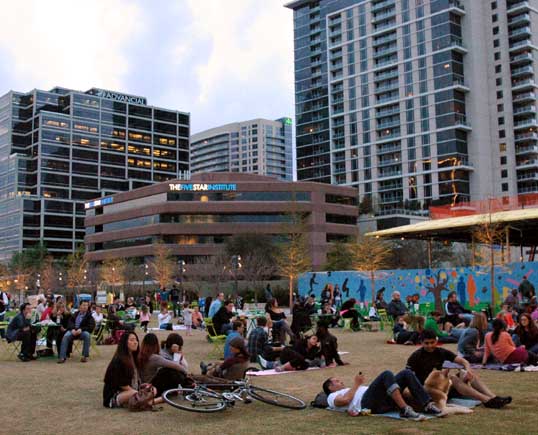
The crowd slowly grows in Klyde Warren Park.

The crowd slowly grows in Klyde Warren Park.

But, I have to admit, almost everyone, me included, were there to hear the last performer, Home by Hovercraft.

First of all… what a damn cool name for a band. I remember, back in the early days of the world (1981) sitting down with another music fanboy and systematically deciding on the best band names. We even made a bracket and voted and such. In the end, he had Talking Heads as the best band name – and I agreed, though I thought The Teardrop Explodes was a hair better. This was thirty years before I had heard of Home by Hovercraft… which would give those titans of the time a run for the money.

Second, there is a lot of buzz about this band and I wanted to see them in the worst way. When the news of something hot and new reaches me, the least cool and hip person on the planet, you know it must be worthwhile.

Home by Hovercraft is greatness. The first thing that strikes you is the instrumentation. The lead singer plays a tarnished euphonium when he isn’t singing. The backup singer (his wife) plays keyboards plus there’s another singer with a mandolin or harmonica. Tonight they added a cello player. There’s a drummer on a kit, but he is assisted in the rhythm section by an Irish Dancer (the lead singer’s sister), stomping out beats on a hunk of basketball court hardwood. When she isn’t dancing, she plays a small glockenspiel.

Home by Hovercraft

Home by Hovercraft

Lead Singer with Euphonium

Lead Singer with Euphonium

Drums and Mandolin

Drums and Mandolin

Irish Dancing Rhythm Section

Irish Dancing Rhythm Section

Keyboards

Keyboards

Home by Hovercraft

Home by Hovercraft

Despite the odd instruments, this isn’t a novelty band. They are very tight and extremely talented. The vocals are strong and unique.

I have no idea what genre their music falls into (other than that awful moniker, “indie,” which means nothing)… I guess it can be best described as sounding like Home by Hovercraft.

Home by Hovercraft has a strong theatrical background which comes through on stage – they are very entertaining and confident up there. They have done a musical On the Eve which will be produced by Theater Three later on this year. I have got to see that. I think a lot of the music on their album Are We Chameleons? (I downloaded it from Amazon) is from the musical.

They will be performing at the Deep Ellum Arts Festival (Sunday, April 7, 12:30PM) – we’re going there anyway so Candy can see the pet parade and I can buy a little head in a little wooden box. Looking forward to it.

Next week’s Setlist on the Green will be classical performers… which should be something interesting.

Free Rothko

I am very happy now that the Dallas Museum of Art has instituted free general admission to its public galleries. There is a qualitative difference when paying ten bucks to get into a museum as there is when it is gratis. It you shell out the bucks, you feel you have an obligation to get your money’s worth – to see and do and cram as much as possible into the experience. You are under pressure to enjoy yourself. With free admission you can wander in and out and have a relaxed and interested time.

When the museum first opened in downtown (moving from Fair Park) in 1983 I was working in the old (now long blown up to make room for the First Baptist Church’s Parking Garage) Cotton Exchange building, only a couple blocks from the museum. What I loved to do was to carve out an hour or so, maybe over lunch, maybe before I went home, and simply go to the museum and look at one single work of art. I’d plan it out ahead of time, choose a painting or sculpture, and then go stare at the crazy thing, and nothing else, for an hour. It was an amazing way to get to know a work – a lot different than a casual stroll through a gallery.

That’s not something you can do with a ten buck admission price.

So we were down there and I was interested in looking at the Rothko piece, Orange, Red and Red. I really enjoyed the play Red at the Wyly in February and wanted to see one of his paintings in the flesh, so to speak. During the play, the actors playing Rothko and his assistant actually splashed paint, the undercolor, covering a huge canvas. The people producing the play worked hard on getting the details right and partnered with the DMA – which made me thirst to lay my eyes on the real deal.

The problem was, I didn’t know where the Rothko was. It might have been up on the third level with the American paintings, but I didn’t see it there – it was too modern and abstract for that gallery anyway.

Later, we walked into a modern gallery off the Ross Avenue side of the museum and I thought for sure it would be in there – it fit in. But I couldn’t spot the thing so I walked up to a guard.

“Excuse me,” I asked, “Do you know where the Rothko is?”

“The Ronco?” he said.

“No, the Rothko… It’s a painting by Mark Rothko, they did a play… it’s an important… He was a painter in New York in like the fifties and sixties.”

The guard looked at me with a blank, confused look. “Maybe it’s in the American section.”

“I looked there and didn’t see it, but maybe I missed it.”

“Oh, and these paintings down here, in this gallery, they are all by female artists.”

He gave me a big, proud smile… he had found something he knew that I didn’t. I thanked him for his help and as I turned I looked over his shoulder and there, right there, behind and past him and out the entrance to the gallery, hanging on the wall of the big main spine corridor, was the Rothko. I couldn’t miss it.

So I took some time and stood there, not an hour… but at least a few minutes and looked at it. I could imagine the artist throwing down those rectangular fields of color and then staring at the work as it progressed… just like the guy in the play did.

It was pretty cool. And it was free.

Mark Rothko, Orange, Red and Red, Dallas Museum of Art

Mark Rothko, Orange, Red and Red, Dallas Museum of Art

Sound of Schoolkids

The other weekend we had another Writing Marathon. We met in Klyde Warren Park and walked across to the Dallas Museum of Art. The idea was to use the paintings as inspiration.

I’ve done that in the past… writing some fiction while sitting and looking at works of art. So I did it again – started a piece of fiction using objects and themes from a handful of painting that spoke to me that day. After pages of furious scribbling I came to a stopping place, the well had run dry.

So I switched to a bit of non-fiction, writing about what I saw, felt, and heard right then… as a little bit of writerly palette cleaning, a way to keep the pen moving, and to help remember the day.

This is what I’ve typed up out of my Moleskine:

There is a sound of a group of schoolkids moving through the gallery. The chatter, the echoing around the corners, the occasional squeak of a plastic sole scraped across polished wood.

An art museum is a place designed for the eyes, but it is a unique sound collection. Close your eyes and listen for the ping of the elevator door, a distant infant cry echoing through the labyrinth, a close jingle of keys.

The guards have rubber soled leather working shoes – silent as death and strong enough to stand in all day. I imagine their feet are sore and tired when they go home at the end of their shift.
Close your eyes and you can still feel the power of the art. There is so much time trapped in the layers of oil and pigment, drowned in the waves of brushmarks.

Open your eyes and look at the color. That blue robe is over four hundred years old – still as bright as the day it was layered down.

Nicolas Mignard  French 1606-1668 - The Shepherd Faustulus Bringing Romulus and Remus to His Wife - 1654

Nicolas Mignard, French 1606-1668 – The Shepherd Faustulus Bringing Romulus and Remus to His Wife – 1654 (detail)

Stand in front and extend your hand (not too close!) and feel yourself standing in the spot and position of the artist – though he had no electric light, no air conditioning. Next to the painting, on a little card, is a plaque with a number… Five Hundred (let’s say).

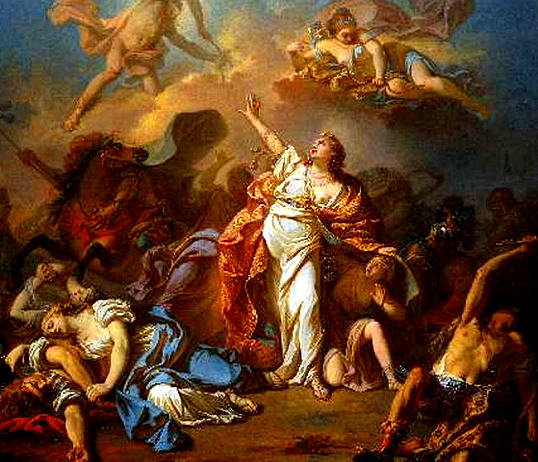
Jacques-Louis David, French, 1748-1825, Apollo and Diana Attacking the Children of Niobe, 1772

Jacques-Louis David, French, 1748-1825, Apollo and Diana Attacking the Children of Niobe, 1772

Pull out your phone, go to the indicated website (the museum has free WiFi, of course) and type in the number. (The museum posts this web address, dma.mobi – that contains so much information in a mobile interface… this is truly the best of all possible worlds). There, in your palm, appears a portrait of the artist – the tiny tinny speakers (forgot your earbuds again, didn’t you) speaks to you – a famous art historian lectures on those ancient times.

The glowing screen in your palm now changes every few seconds with a new image – a series of paintings by the same artist. This is too much. You can’t help but wonder what those ancient geniuses with their candles and oil paints would think of the tiny glowing screens. Sufficiently advanced technology is indistinguishable from magic.

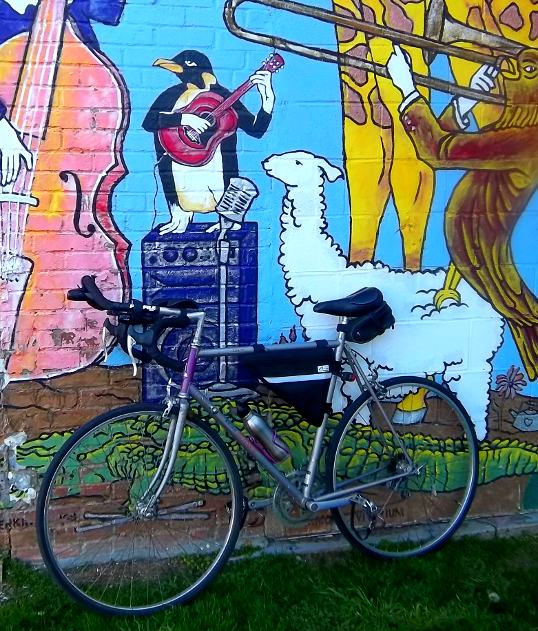
Harmonic Vivarium and Raleigh Technium

Art by Judith Lea Perkins – Deep Ellum, Dallas, Texas

harmonic_vivarium1

harmonic_vivarium2

Judith Lea Perkins by alexandra olivia, on Flickr

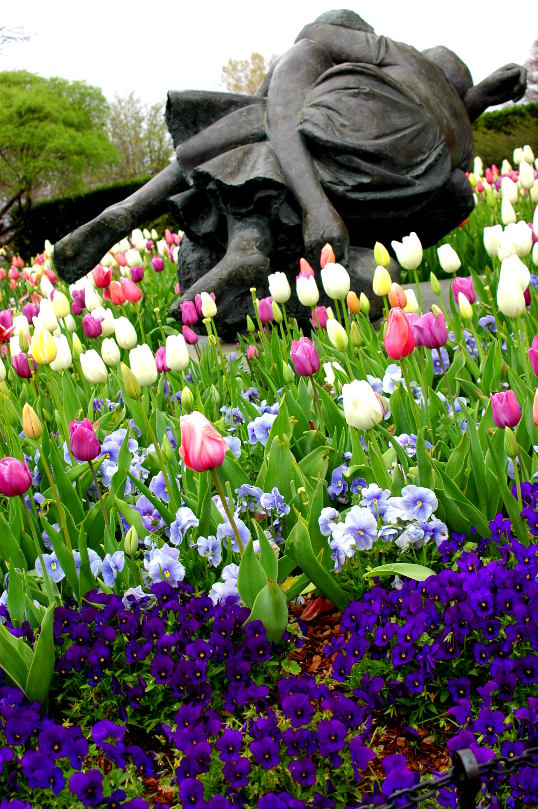
Kissing in the Tulips

blooms5

Dallas Blooms, Dallas Arboretum

blooms6

I posted an entry with pictures of this sculpture before – The Kiss.

The vegetation around it looked a lot different in July.

kiss1_1

Digitalis

Dallas Blooms, Dallas Arboretum

The Foxglove now in crimson tresses rich
Depends, whose freckled bells to insect tribe
Afford a canopy of velvet bliss.

—-Wordsworth

digit3

A chemical extract from foxglove, digitalis, is both a famous deadly poison and a precious remedy for heart disease. The difference, like everything else in life, is timing and dosage.

In digitalis the gap between poison and remedy is very, very small.

digit1

How did it get its name?

According to the 19th-century book, English Botany, Or, Coloured Figures of British Plants:

Dr. Prior, whose authority is great in the origin of popular names, says “It seems probably that the name was in the first place, foxes’ glew, or music, in reference to the favourite instrument of an earlier time, a ring of bells hung on an arched support, the tintinnabulum”… we cannot quite agree with Dr. Prior for it seems quite probable that the shape of the flowers suggested the idea of a glove, and that associated with the name of the botanist Fuchs, who first gave it a botanical name, may have been easily corrupted into foxglove. It happens, moreover, the name foxglove is a very ancient one and exists in a list of plants as old as the time of Edward III. The “folks” of our ancestors were the fairies and nothing is more likely than that the pretty coloured bells of the plant would be designated “folksgloves,” afterwards, “foxglove.” In Wales it is declared to be a favourite lurking-place of the fairies, who are said to occasion a snapping sound when children, holding one end of the digitalis bell, suddenly strike the other on the hand to hear the clap of fairy thunder, with which the indignant fairy makes her escape from her injured retreat. In south of Scotland it is called “bloody fingers” more northward, “deadman’s bells” whilst in Wales it is known as “fairy-folks-fingers” or “lambs-tongue-leaves”

digit2

The Scottish doctor William Withering, while working as a physician in the 18th Century, had one of his patients come to him with a very bad heart condition and since Withering had no effective treatment for him, thought he was going to die. The patient went instead to a local gypsy, took a secret herbal remedy – and survived and improved. When the doctor found out he searched out the gypsy. The herbal remedy was made from a variety of things, but the active ingredient was the purple foxglove, digitalis purpurea.

Withering tried out various formulations of digitalis plant extracts on hundreds patients, and found that the dried, powdered leaf worked with amazing and successful results. He introduced its use officially in 1785.

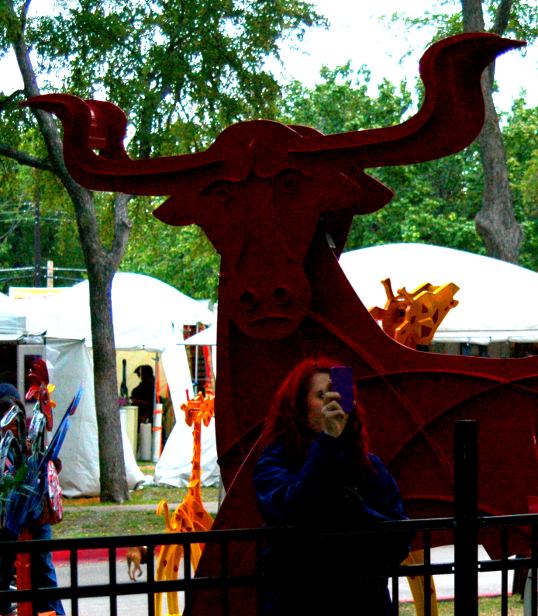
Painted Steel Menagerie

Cottonwood Art Festival, Richardson, Texas

The tree which moves some to tears of joy is in the eyes of others only a green thing that stands in the way. Some see nature all ridicule and deformity… and some scarce see nature at all. But to the eyes of the man of imagination, nature is imagination itself.

—-William Blake

Spider

“There are spiders living comfortably in my house while the wind howls outside. They aren’t bothering anybody. If I were a fly, I’d have second thoughts, but I’m not, so I don’t.”
― Richard Brautigan, The Tokyo-Montana Express

Louise Bourgeois, Spider

The Sydney and Walda Besthoff Sculpture Garden, New Orleans Museum of Art

spide_w
(Click for full size version on Flickr)

“Spider venom comes in many forms. It can often take a long while to discover the full effects of the bite. Naturalists have pondered this for years: there are spiders whose bite can cause the place bitten to rot and to die, sometimes more than a year after it was bitten. As to why spiders do this, the answer is simple. It’s because spiders think this is funny, and they don’t want you ever to forget them.”
― Neil Gaiman, Anansi Boys

“There was less than I’d expected in the rainy-day fund that Mom had kept in the bottom of an underwear drawer in a panty hose egg labeled ‘DEAD SPIDERS.’ As if I hadn’t always known it was there. As if I wouldn’t want to look at dead spiders.”
― Adam Rex