There are some really cool places in the Bishop Arts District. One of them is The Soda Gallery. It’s the place where you can hang out… and it gives the phrase “pop art” a new double meaning.
It’s a little art gallery and it’s a soda shop… it’s both.
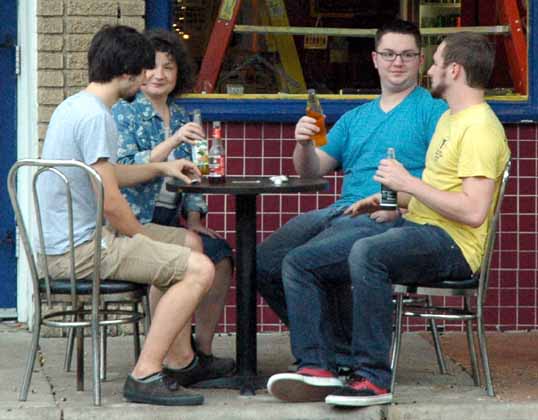
So you can go inside and make a selection from their extensive collection of soft drinks – 30 kinds of root beer, Dublin Doctor Pepper, Nesbitt’s, Ramune (the Japanese stuff with the marble), and so on and so forth. They have a nice little table out on the sidewalk and I watched some groups buying sodas and sitting there drinking them. What a nice idea! I am so down on alcohol right now – it’s cool to find another option for social interaction other than booze or coffee.
And inside they do have art displayed on the walls. They had some really good stuff – screenprints of superheroes or comic book panels and other examples of local pop art.
I wish this place was in my neighborhood – but I’ll go visit when I can.
On the Soda Gallery’s website they have some examples of interesting soft drink ads… here’s some for your enjoyment.
Nesbitt’s Orange, from the 70’s. There is a lot of Robert Crumb psychedelic stuff going on here.
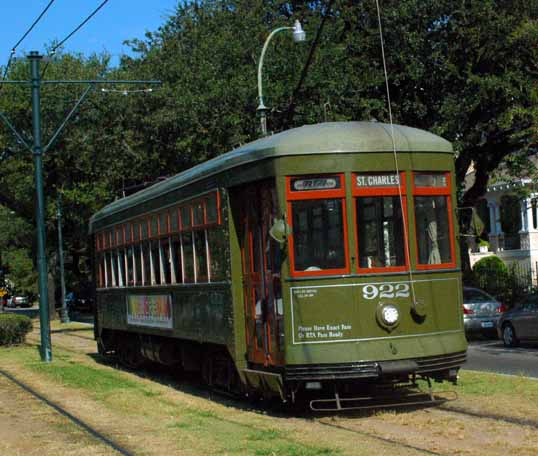
The grandest ride in America was the St. Charles streetcar. You could catch the old green-painted, lumbering iron car under the colonade in front of the Pearl and for pocket change travel on the neutral ground down arguably the most beautiful street in the western world. The canopy of live oaks over the neutral ground created a green-gold tunnel as far as the eye could see. On the corners, black men sold ice cream and sno’balls from carts with parasols on them, and in the winter the pink and maroon neon on the Katz & Besthoff drugstores glowed like electrified smoke inside the fog.
—– from The Tin Roof Blowdown By James Lee Burke
The St. Charles streecar in New Orleans is one of my favorite things in the whole world. If you have never ridden it, put it on your bucket list. Now.
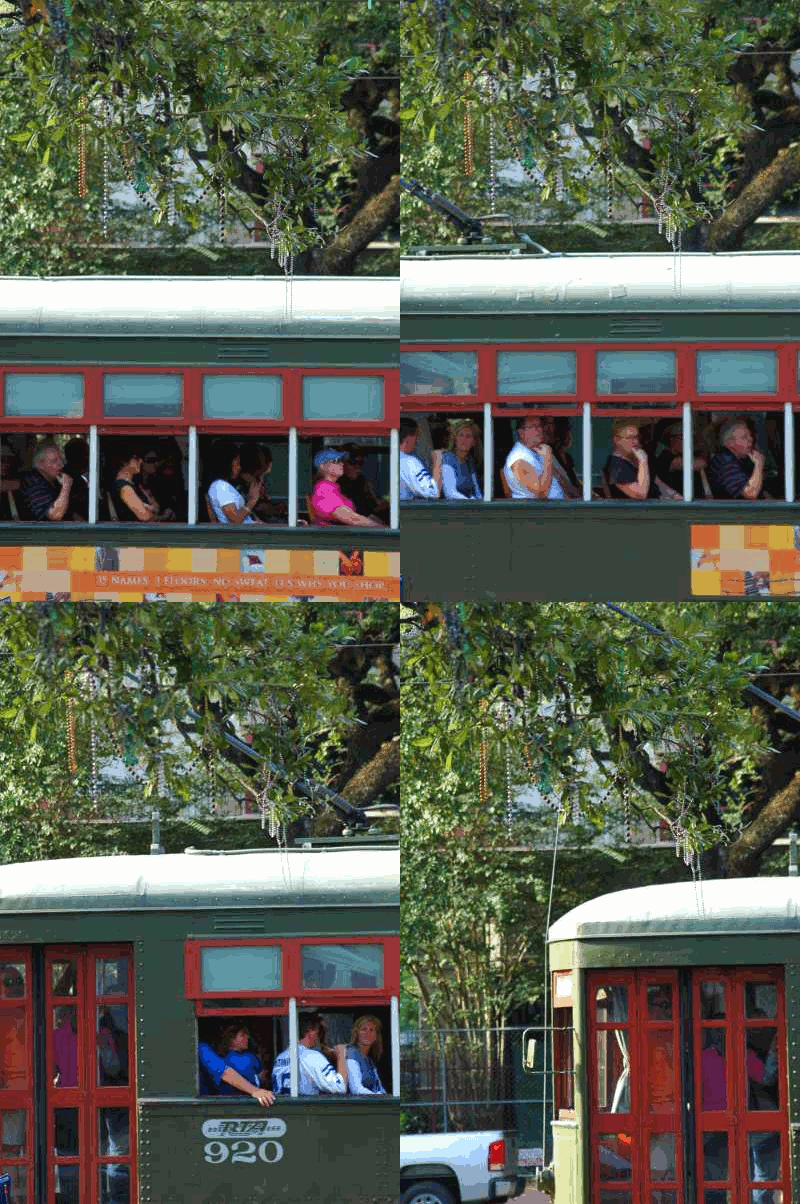
The best time to ride the streetcar is at sunset on a hot late summer evening. The windows open and the breeze from the motion sweeps the sweltering afternoon away as the purple sky darkens beyond the southern mansions and ancient oaks. You sit on the wooden seats jostling as the machine tumbles down the neutral ground. The lights flicker mysteriously and each new section of track is greeted with a flash of lightning, a clacking cacophony, and a whiff of ozone from under the wheels.
The streetcar becomes a time machine… no… not that… it is a timeless machine. The streetcar is exactly as it was ages ago, the floods, Katrina, countless Krewes from countless parades gone except for the risible plastic beads hanging from the trees, the mansions, the music, the food… all are distilled into a parallel pair of rails and high voltage overhead that lumber from the edge of the French Quarter way out past Tulane and Audubon park.
The streetcar is not only a tourist attraction – you share your ride with office drones from downtown banks, lawyers from big firms, and dishwashers nodding off after a long day – the heartbeat of a city brought cheek-to-jowl together. It isn’t very fast – waiting for riders making change at the old-fashioned boxes, drivers bracing themselves to swing heavy levers, stopping at lights while the cross traffic fights out of the way. You can almost walk this fast. But you get there and the getting is everything.
When we are in town we usually stay in a bed and breakfast on St. Charles not far from Tulane and when I wake up in the morning I always like to lay in bed and listen for the streetcars. When you ride them they are all jangling and jump but somehow, from outside, they are smoother, slick steel wheels and sliding commutator sparking along. A bell at the intersections if the cars don’t move fast enough.
Like all of New Orleans, it’s hard to figure out why there aren’t more fatalities along the route, with the traffic, walkers, runners all thrown together with few signs and fewer rules. But they get along, somehow. They always do.
Inside the St. Charles Streetcar
One of my favorite spots is this unassuming little coffee shop at St. Charles and St. Andrews. I like to sit out front, sip my coffee, and watch the streetcars go by.
When you visit New Orleans for the first time, you can’t help but notice the cemeteries. Because the city is built on a swamp below sea level, you can’t bury anything underground. The cemeteries consist of cities of elaborate above ground crypts and mausoleums instead of grids of tombstones.
Right in the middle of the Garden District, one block off the St. Charles streetcar line is Lafayette Cemetery #1. It was established in 1833, when that part of the city was called Lafayette. I had wanted to take a tour of the cemetery but I wasn’t able to get away until Sunday – and the cemetery was closed on Sunday.
Something to do on my the next trip.
The Lafayette Cemetery #1 was closed, but I still could take pictures from the gate.
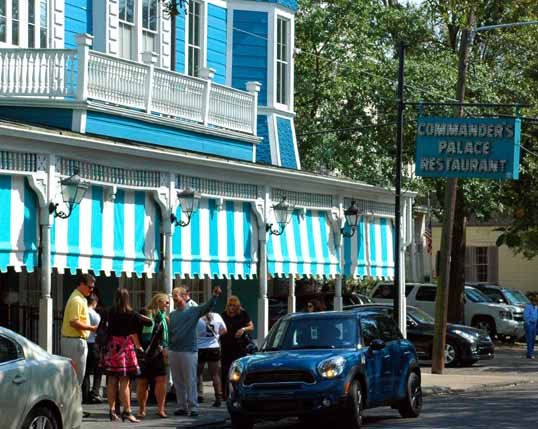
Across the street from the cemetery is Commander’s Palace, one of New Orleans’ best and most famous restaurants.
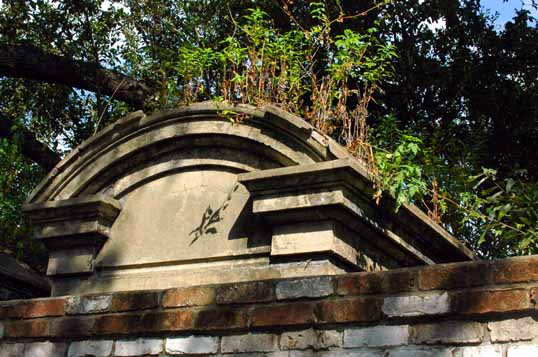
Ferns grow from the ancient wall around the cemetery across the street from Commander’s Palace.
The crypts are elaborate and showing their age. You can see how the legends of ghosts and supernatural come from places like this.
The elaborate vegetation-covered tombs stick up over the wall surrounding the cemetery.
In art – in the life worth living – there is always a struggle between beauty and functionality. I love finding examples that combine the two.
In the Lower Garden District – St. Andrews and Chestnut – Someone is using a beautiful old wrought iron balcony to store a couple of kayaks. I’m not sure why, but I really like that.
Everywhere else, the space between the two lanes of traffic on a divided road is called the median. In New Orleans it is called the Neutral Ground. The legend is that it is called this because in the early days when the French lived in the Quarter and the Americans lived in what is now downtown and beyond they would meet in the wide median of Canal Street (named because there was going to be a canal built there – that is why the street and median is so wide – but it never was built) to resolve their differences.
Now, all medians in the city are referred to as the “neutral ground.” This is especially important during Mardi Gras, where a lot of people watch the parades from the neutral ground. If you are waiting for a certain person in a Krewe they will tell you if they are on the street side or neutral ground side.
Along Canal Street, Saint Charles (where this picture was taken) and Carrollton Avenue, the streetcars run in the neutral ground. I’ve got some pictures of the Saint Charles Streetcar (one of my favorite things in the world) that I’ll be putting up here. The Saint Charles neutral ground is a wonderful and popular place to go running in New Orleans.
It’s hard to take pictures in Jackson Square – the walls are all covered in Artworks for sale with signs asking for no photographs. You have to angle yourself so they don’t appear. I took these two photos at the same time I shot the photo shoot in Pirate Alley – I’d turn one way to get the guy playing the fiddle, then turn and take a picture of the photo shoot.
The kids at Tulane are so lucky (in many different ways) – and I’m not sure they realize it fully. Can you imagine going to college in that city? Being young and having that much history, music, and soul around you all the time would be an unbelievable experience.
All I had was bad disco.
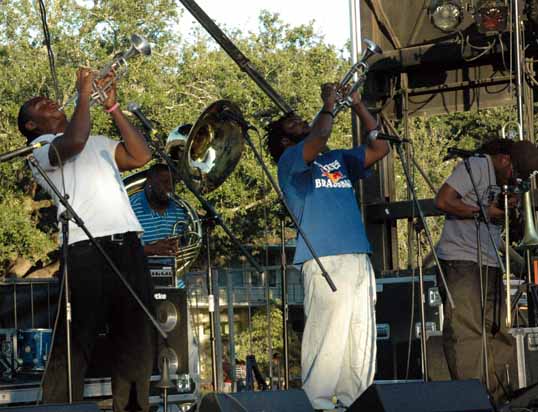
After driving to New Orleans we were able to catch some of the homecoming festivities on campus. The Stooges Brass Band was set up on the Quad in back of the student center – though most of the kids seemed more interested in lining up for some free food.
The Stooges Brass Band
The Stooges Brass Band
The Stooges Brass Band
I really liked The Stooges and wanted to stick around for the next act, Big Sam’s Funky Nation, but Lee had to work. He has a very important job. He works the door at The Boot. He said he was scheduled to work happy hour. We asked how long that was and he said, “Six to Ten.”
Great Music, Great Food, a Great City, and a four hour long happy hour.
Lee working the door at The Boot. You can see his face on the right of the pipe sticking up.
It was a big Friday Evening Happy Hour Homecoming crowd at The Boot. Lee says it's always like that.
It was such a nice day to be walking around the French Quarter. Not much more than a block down Royal Street from the Nola Jitterbugs was another band playing in the street. These folks were playing the real thing, the traditional New Orleans Jazz. It was Doreen Ketchens and her band, Doreen’s Jazz New Orleans. They were very good.












 Bill Chance