Faulkner House Books

When I’m lucky enough to visit New Orleans I try to avoid the more obvious tourist traps. I see nothing special about the bitter Joe and greasy dough at Cafe Du Monde, rarely set foot on Bourbon Street, and try to walk out of the Quarter (or at least skirt the edges) whenever possible. Still, there is cool stuff even in the heart of touristland.

One special little spot is Pirate’s Alley. It’s a narrow passage that runs alongside the St. Louis Cathedral, connecting Jackson Square with Royal Street. History drips onto the cobblestones like Spanish Moss from an iron balcony.

Usually I like to aimlessly drift through and see what there is to see. There is usually something interesting. Once, I stumbled across a fashion shoot in the alley.

Fashion Shoot in Pirate's Alley (click to enlarge)

Fashion Shoot in Pirate’s Alley (click to enlarge)

On our last trip – I walked down Decatur from Canal, headed for Pirate’s Alley. This time I was going somewhere in particular – an unusual state for me in the Big Easy. I had realized that I had never visited Faulkner House Books – a tiny bookstore located in the alley.

What makes this store so famous is that it occupies an apartment on the lower floor where William Faulkner once lived. There, in that very space, he hammered out his first novel Soldier’s Pay, begining the transition from unknown poet to Nobel prize winning novelist.

So I crossed Jackson Square – ignoring the thick crowd of artists, musicians, tourists, and fortunetellers – strolled down the alley past the Absinthe House and pushed the doors open to the bookstore.

It’s a small place – not hard to imagine it as a tiny apartment for a young, struggling writer. It’s packed with bookcases, every inch of wall covered, plus a collection of free-standing cases.

“Can I help you?” a woman asked.

“Umm, I’m just looking.”

“Well, the rare and first editions are around the corner, and ask me if you need anything.”

I glanced and saw a well-dressed elderly gentleman delicately thumbing through the case. The woman walked over to him and began to talk about the history of each volume he was examining. I heard him talking about which editions he already had in his collection and what holes he was trying to fill.

Those books were obviously not in my price range so I moved back toward the entrance and began to peruse the ordinary mass market offerings – after all, I had to buy something. I considered picking up a Faulkner novel but decided instead on Same Place, Same Things, a book of short stories by Tim Gautreaux. A South Louisiana writer, I had read another collection of his, Welding With Children, and really liked it.

We had talked about Tim Gautreaux while walking around on our New Orleans Writing Marathon the day before. I had discovered that he had written a story, Waiting for the Evening News, (contained in the book I chose) based on a train derailment in Livingston, Louisiana in 1982. I wanted to read that story because I had worked that train derailment when I was a consultant to the Emergency Response Division of the EPA.

Paperback in hand, I waited while the other man paid for his purchases – two beautiful, large books. His bill came to just under a thousand dollars. After he left, I handed my little trade sale paperback to the woman.

“Sorry, my purchase isn’t quite as big as his,” I said.

She ignored this. “This is very good work, have you read him before?”

I said I had and told her a quick version of the story of the derailment. She smiled and rang me up.

The entrance to Faulkner House Books

The entrance to Faulkner House Books

faulkner2

Right after I took a photo of the plaque, this guy did the same thing.

Right after I took a photo of the plaque, this guy did the same thing.

He and his wife never went in the store - he just moved along, not even taking his eye out of the viewfinder.

He and his wife never went in the store – he just moved along, not even taking his eye out of the viewfinder.

An old video of the train derailment at Livingston. I worked there for a couple weeks – providing technical assistance and taking samples to help determine when the residents could return home. I’m in the video, though unrecognizable, at about the nine minute mark.

Source Figure

“The reason why I know the Blue Dog is important today, really, is because it relates to so many kids. If you relate something to the children, then you know you’re on something that’s sincere, that’s truth, that’s truth that’ll never die.”
—- George Rodrigue

source

Source Figure, by Robert Graham, and We Stand Together, by George Rodrigue

The Sydney and Walda Besthoff Sculpture Garden, New Orleans Museum of Art

Robert Graham’s bronze, Source Figure, (Graham was well-known as Angelica Huston’s husband until his death)

– in front of We Stand Together… one of George Rodrigue’s  Blue Dogs.

Technium Rex

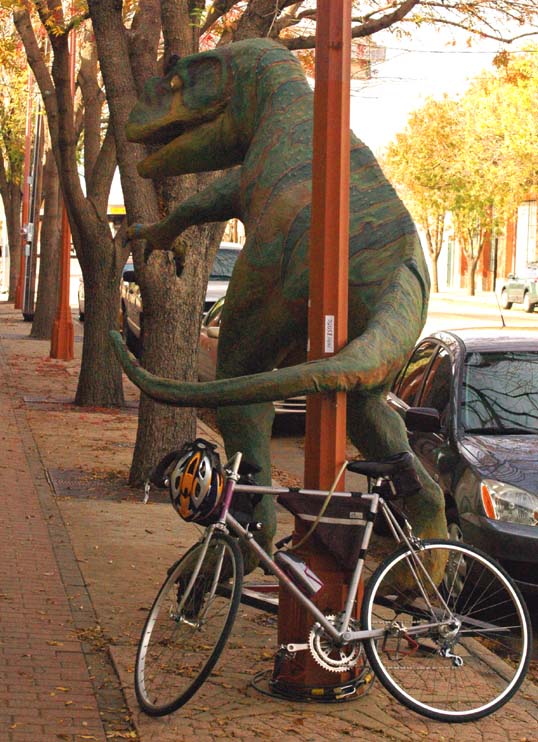
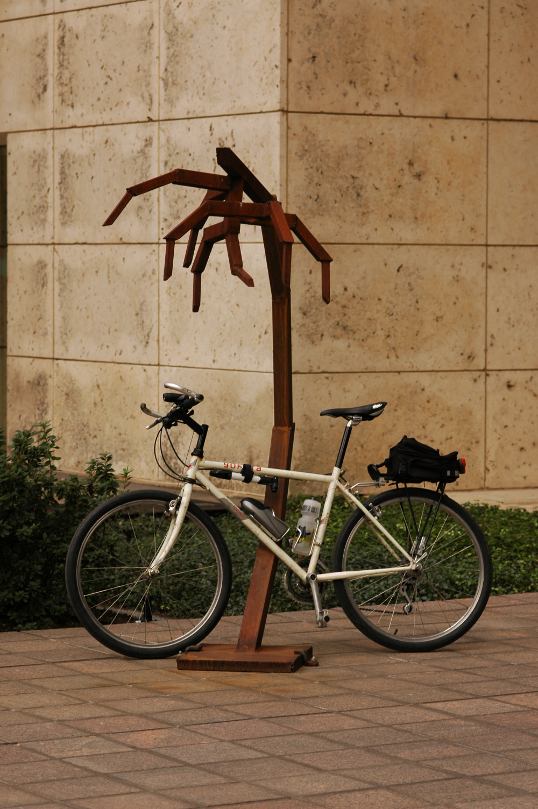
I love exploring the city by bicycle. Here’s my old Raleigh Technium locked up and guarded by the TRex in Exposition Park, Dallas.

My bicycle locked up to the TRex in Exposition Park, Dallas, Texas

My bicycle locked up to the TRex in Exposition Park, Dallas, Texas

Taken during the Deep Ellum Holiday Boutique Shop & Ride.

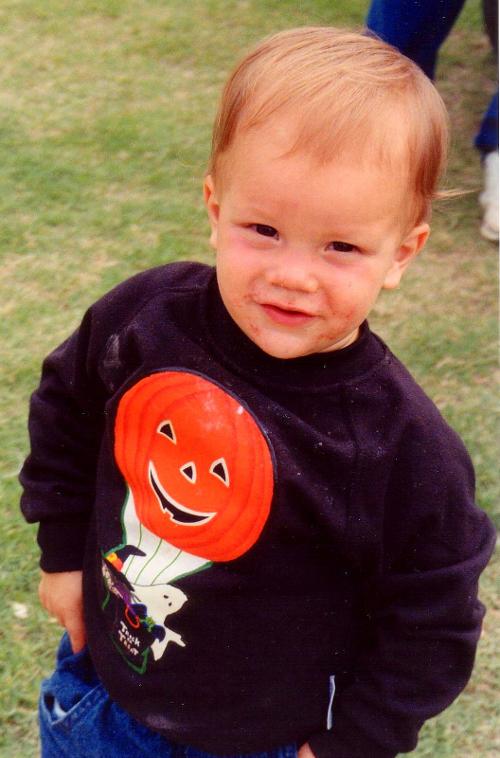
Then and Now, Lee on Halloween

My youngest son, Lee, on Halloween, then, Mesquite, Texas

lee_then

Now, Halloween, French Quarter, New Orleans, Louisiana

lee_now

lee_now1

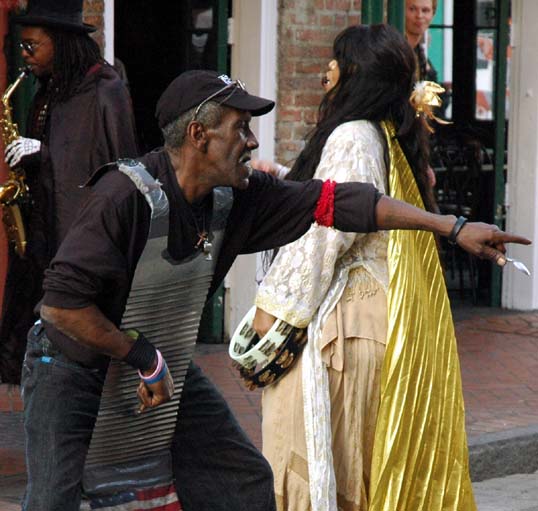
Washboard on Decatur Street

French Quarter, New Orleans

washboard2

washboard1

washboard

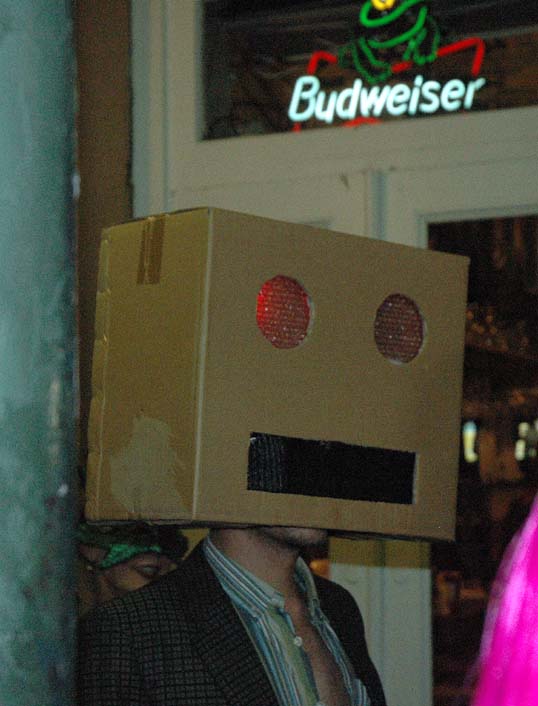
The Rise of the Robots

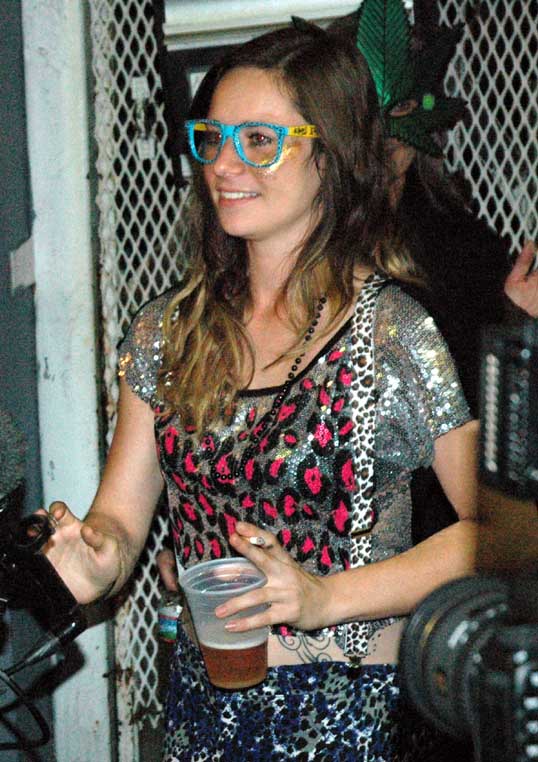
French Quarter, New Orleans, Halloween

robots1

robots2

robots3

Mysterious Hieroglyphics

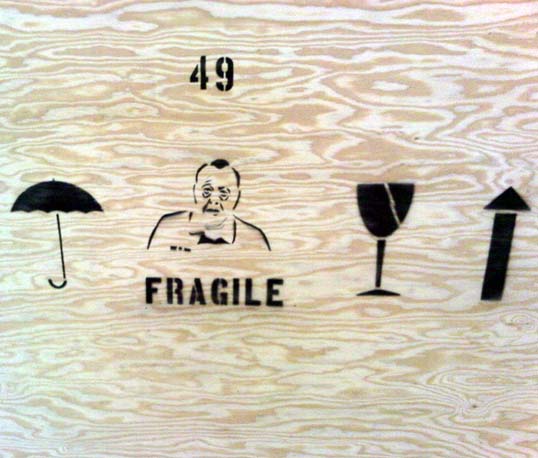
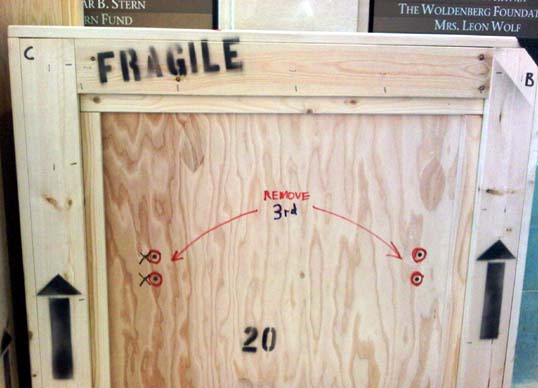
In a hallway in the New Orleans Museum of Art I saw a pile of wooden crates. Obviously a new exhibit on its way in – the plywood was stenciled with a set of transportation-related symbols.

mystery1

OK, there’s the “this end up” symbol – the “do not let this get wet” symbol – a “Fragile” symbol – but what’s up with the stencil of the guy? Does it mean, “May contain Winston Churchill”? Does it mean, “Dangerous Bags Under Eyes”? “Please notify the butler”? “The old man may be constipated”?

OK, I’m not stupid, I can figure out that the stencil probably means that the crate contains art. Still, who picked that symbol? Why is it important that everybody knows it contains art? Who is that guy anyway?

The museum has some great art – but I sort of enjoyed the hieroglyphics on the packing crates as much as anything.

If I had to guess, I’d think that the crates had at least part of an exhibit called “Lifelike” in them.

mystery2

mystery


mystery3

Three Bicycling Stories

A Photograph Doesn’t Do Justice 

I like taking photographs, though it is ultimately a frustrating and futile exercise. I see an image in my mind and I want to commit it to pixels, but I never can. What ends up on the screen is a poor echo, a warped ghost, of what was in my head. Still, I keep trying.

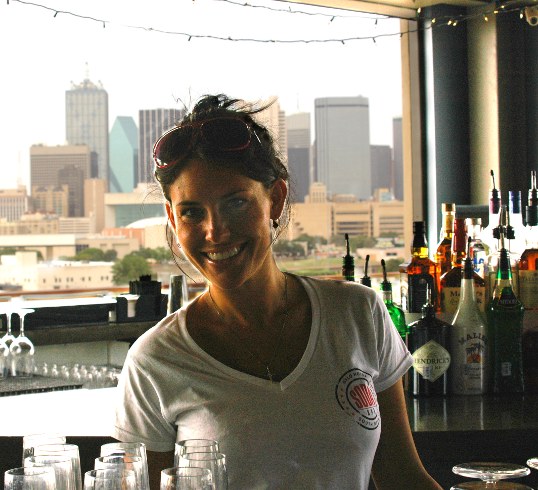
This woman, a bartender at the NYLO Southside, asked Candy, "Is your husband a professional photographer?"Candy answered, "He thinks he is."

This woman, a bartender at the NYLO Southside, asked Candy, “Is your husband a professional photographer?”
Candy answered, “He thinks he is.”

Sometimes, there are images, real images that appear in the eye, of such subtle and ephemeral beauty that a camera can never come close to capturing.

The other morning I was riding my bike to work. I had left before dawn and was moving west on Summit Drive just after Grove Road. It’s a quiet little residential street, perfect for bike riding. Going West, it’s a slight downhill, just right – steep enough to coast but not so much to require brakes – a nice little rest in the middle of my commute.

Behind me, the sun was breaking the horizon, the orange globe peeking out throwing a sudden bright warm light down the street. All along the street were thousands of black birds (grackles, I think) covering the yards, wires, and trees.

The birds did not like me or my bike. Maybe my flashing headlight helped spook them, but they all took off and began to fly away from me. As I moved down the street a massive wave of birds formed in front of me, a cacophony of squawking and flapping wings as they fled in formation.

It was like a giant, solid, noisy, black moving thing, this wave of birds, contrasted with the bare trees and piles of autumn leaves, all bathed in the coral light from the sunrise. A living shape, a rolling cloud, lasting only a few seconds until I reached the turn at the bottom of the hill when they scattered, the wave dissolving into the dawn air, the flock dissipating as quickly as it formed.

As surely as this scene could never be photographed… too evanescent and ethereal for a lens – words fail me. Trust me, it was beautiful – I smiled all the way to work and even for a few minutes in the land of the cubicals until the daily grind ground the moment out.

Still, it is there, in my memory. I’ve never been much of a morning person, but sometimes it’s nice to get up in time to see what the rising sun brings.

My First Fall 

At my age, I’m really afraid of bicycle accidents. I’m a lot more brittle than I used to be and I don’t heal as fast. Still, I ride slowly and carefully and hadn’t fallen for a long, long time.

Until now.

I was going West on Spring Valley (not far from the story above). There is a rail line that bisects my city north to south and is a surprising barrier to cycling – there are only a couple places where it can be crossed and none of them are very safe. The Spring Valley crossing is one of the best – open, wide, and not too much traffic.

Between the rails there are these rubber pads to fill in the gaps for the cars that cross. Unfortunately, the pads had a gap between them… not too much, maybe an inch. The gap, unfortunately  runs parallel to the curb – along the direction of travel. On a bike, cracks or gaps running across your path are a mere bump, but cracks running in the same direction your are – are a disaster.

I am starting to rebuild my commuter bike – an old mountain bike – so I am riding my road bike around town. The road bike has narrow tires. Narrow enough to fit right into the gap between the thick rubber mats.

So I wasn’t looking closely enough and my tire dropped into the gap. It immediately grabbed the rubber and stopped. Instant endo – a nasty crash where your forward momentum throws you over your front handlebars.

I felt the tire drop and grab so I had a split second to prepare myself. I was able to drop a shoulder and roll when I hit, so I wasn’t hurt. I was worried about my bike, but other than a broken toe clip and a missing bar end plug, not a scratch. Luckily, there weren’t any cars behind me, or that might have been a fatal crash.

All’s well that ends well. Hopefully, I’ll have another run of good luck.

It’s frustrating though. I’m sure the city thinks that railroad crossing is fine and doesn’t need any work even though it contains a hidden disaster to anyone riding a bike through there. I don’t have any choice, I’ll have to ride over the crossing at least twice a day when I’m riding to work and most other rides – it’s the only good way to get the the southwest part of town from where I live. I’ll have to be careful and not forget what happened – look out for that gap.

Of course, flying over the handlebars isn’t something you forget anytime soon.
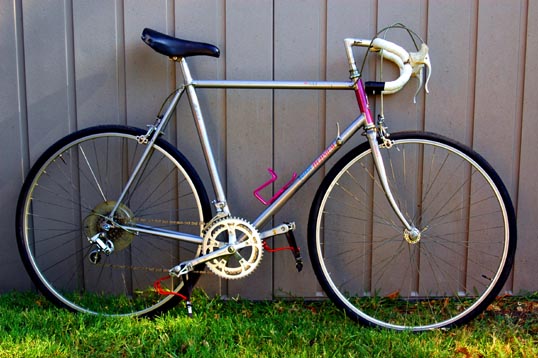
My road bike - an ancient Raleigh Technium.

My road bike – an ancient Raleigh Technium.

My commuter bicycle - I'm now taking it apart for a rebuild.

My commuter bicycle – I’m now taking it apart for a rebuild.

Riding in the Rain 

My goal for 2013 is three thousand miles on my bicycle. Not too hard, that’s only a bit under ten miles per day (my work commute is ten miles round trip). Still, it will require consistent riding, under less than ideal conditions. Texas winters are cold, spring is wet, and summers… well, they can be fatal.

Rain was predicted for today, but when I woke up in the morning, I checked out the internet weather and the radar maps and it looked like I had a couple hours before the thunderstorms arrived. So I decided to get going and get in twenty miles or so. Never trust anything you read on the ‘net.

The fog was thick as I headed out and withing a couple miles it started to mist and sprinkle. It was fairly warm, so the light rain actually felt nice. I decided to ignore the weather and kept heading out on the route I had in mind.

Over the next few miles the rain slowly increased. Still, it wasn’t too bad and I kept going. Once you are soaked… you can’t get any wetter, so I didn’t want to give up. My phone rang and it was Candy, offering to pick me up, but I said I was doing fine. By this time I was around Galatyn Parkway along Highway 75 and I wanted to go north into Spring Creek and the trails up there.

Then the sky opened up.

I’ve been thinking about rigging my commuter bike for riding in the rain and reading up about bicycle fenders. One article I read had this nice quote:

I’ve cycled through thunderstorms in the U.S. Midwest and Texas and even a typhoon or two in Tokyo. For the Californians on the list, fill a bucket with water, toss in a tray of ice cubes (for the hail) and have a friend throw the contents on you — that approximates about half a second of a typical Midwestern spring storm.

That’s what it felt like – someone dumping a five gallon bucket of iced water on my head twice a second. It’s true that once you are soaked, more water doesn’t make you wetter… but I couldn’t even see. Luckily, a few feet up ahead the trail scooted underneath Highway 75, so I was able to take shelter until the tempest subsided.

It was amazing, waiting there, dripping, under the highway, watching the trickle of a creek rising quickly to become a raging torrent. I was safe on the elevated trail, leaning up against a guardrail halfway between the stream and the roadway above. The various drainpipes associated with the highway all began spewing vast cascades of roaring water, some falling in brown cataracts and others splashing against trees and logs into great sprays of foam. I never noticed, but the roadway is drilled with a pattern of drainage holes and all these began to spew a grid of falling fountains from the bridge far above.

The scene was unexpected and beautiful and it made me laugh to look at my private spectacular water display.

The rain was falling so hard I knew it couldn’t last too long and once the storm subsided to a mere rainstorm I bundled up my wet clothes and headed home. I couldn’t ride the trail all the way because the low-water crossings along Duck Creek were submerged. The waterfowl were all lined up along their swollen eponymous waterway watching the flotsam and jetsam closely, picking out any edible particle that came floating by.

I did manage to get my twenty miles in, and all my stuff is hanging in the house trying to dry out. I’m not sure if I’ll go out in a thunderstorm like that again… but it was kind of fun.

Brakes

At a recent Vintage Bicycle Show I was fascinated by all the geriatric brake technology on display.

For example, I have been interested in the Flying Pigeon Bicycle from China, though I don’t know if I’d actually want to own one. They are, after all, the most popular single means of mechanical transport in history. When I read about them, I was especially interested in the rod brakes – very simple and reliable. They use a series of levers and rods to pull a pair of brake shoes into the inside of the rim. At the show, I saw a bike with rod brakes (not a Flying Pigeon).

Phillips Bicycle with rod brakes.

Phillips Bicycle with rod brakes.

It’s a Phillips. I talked to the guy that had bought it and restored it about the brakes. Another guy said, “If you think about it, a rod brake isn’t that much different, you replace the wire with a rod.”

I don’t know about that. I asked the owner how well they stopped. His reply was a classic, “Well, they stop well enough… when you consider you can’t get going very fast on this thing anyway. You have to be careful… really careful, if you find yourself going downhill.

Across the aisle was an even older and cruder technology.

brakes2

brakes3

The rod brakes on this bike push a rubber block right down onto the tire. I certainly wouldn’t want to be caught going too fast on that bad boy. Cool bike, though. Love the generator.

Finally, there was a bike with a Campagnolo Delta Brakeset.

Campagnolo Delta Brake

Campagnolo Delta Brake

I’ve always loved these. They are heavy, complicated, and don’t work very well… but what a work of art.


One fun story from the show. While I was standing around a guy came in with a vintage Raleigh – about the same age as my 1974 Super Course that I bought my freshman year in college. He was restoring the bike and was about half done – it was rideable, but still looked pretty ragged. I told him the story of how I lost that beloved bike.

“I lived in a third story apartment,” I told him. “I never thought about it, but I left it out on my balcony unlocked. Somebody stole it. It must have been a tree trimmer, working in the neighborhood with a ladder, and he yanked it off my balcony.”

“That’s how I got this bike,” he said to me.

“What, did you steal it off a balcony?”

“No, I saw this guy, he was a landscaping guy, riding this bike. It was in terrible shape, the bar tape was falling off, the paint peeling, but I recognized it as a vintage Raleigh. I asked him if he’d sell it to me. He said, ‘I can’t sell you my bike, it’s the only way I have to get to work.’ So I told him, ‘Tell you what, we’ll get in my car and I’ll drive you to Wal-Mart and you can pick out any bike you want. I take your beat up old bike and I’ll buy you a brand new Wal-Mart bike.’ He said it was a deal and that’s how I bought the Raleigh.”

I loved that story.


Now that I’ve decided I can’t afford a new bicycle I am concentrating on making do with what I’ve got.

I’m lucky in that my Raleigh Technium is old enough (1986 or so) to be vintage and therefore, semi-cool, it is not old enough that I need to keep it stock. So I took it apart and rebuilt it.

You would think that the parts that I would have to upgrade would be the drivetrain – new super gears and integrated shifters and whiz bang shit like that – but that’s not what I did. Old friction shifters and ancient freewheels still work pretty darn well. Dallas is flat, I don’t have to shift very often. What I did upgrade – the place where technology has improved – is brakes.

My Raleigh had old single pivot sidepulls (my even older Raleigh Supercourse from 1974 had center-pulls) and stopping was not a reliable thing. Riding in an urban area – you need to stop. Stop or die. Plus, the cables were rusting and I never liked the awkward cables looping up from the brake levers.

So I bought some new long-reach dual pivot sidepulls from Nashbar, some nice used aero levers from Ebay, and a set of high quality, high tech brake cables. I tore the bike apart, repacked everything that had grease in it, tightened everything down tight, and put the new brake system in. The Technium routes the rear brake cable inside the tubing, and that was a pain… a lot of fishing for cables, but I finished it up and now it rides like a dream. Well, except the engine, of course.

So, now I turn to rebuilding my commuter bike – the creaky old Yokota Mountain bike I bought used at a pawn shop around 1990. The rear shifter won’t shift down any more, so I needed new shift levers – so I bought new ones, and I bought new integrated brake levers too – so I bought new brakes. I’m replacing the old-school cantilever brakes with more modern V-brakes. All this I picked up from fire sales on various places, so I didn’t pay too much money for any of it.

Now, next, I’ll strip the bike down, then paint it (I’m thinking a dark English racing green) – and put all the new stuff on.

That’s the ticket.

http://vimeo.com/26504393#