The Weird and Wicked World of the Singing Cowboy

One of the surprisingly few times that I regret being poor is when I think about how I can’t afford to support artists or collect works of art as much as I would like… – especially local work.

Because of that, whenever an opportunity presents itself for me to pick up something affordable – well, it’s a good thing. For a long time, I have been a fan of Kettle Art in Deep Ellum and the artists they support. So I read about an annual event they put on For the Love of Kettle – I jumped all over it. It’s a fundraiser for the gallery. Participating artists donate a small work which are sold off for 50 dollars each – with the funds going to support the gallery. It is billed as a “competitive shopping event.”

I can come up with fifty bucks. I can pack a sack lunch for a couple of weeks.

On Facebook, over three hundred people has said they were going, but there were only going to be a hundred and fifty works of art. Looking through the selections on the website, I realized that there was going to be a feeding frenzy on this stuff when the doors opened, so I went down there an hour and a quarter early and stood in line. There were only a half dozen folks there when I arrived, but the line stretched out down the block, getting longer by the minute.

Most of the people in the front part of the line were participating artists – it was fun talking to them. Also, a lot of people said that this sale was popular not only for the price, but for the small size of the art. So many said they had art they couldn’t put out because they were out of wall space.

These were my kind of people.

Looking into the windows of the Kettle Gallery, waiting for the show to start.

Looking into the windows of the Kettle Gallery, waiting for the show to start.

Everybody peered through the windows at the art on the walls. The rules of the sale were distributed on little slips of paprer. You had to get the number (printed on the wall beside the painting) of the piece you wanted and then register with the volunteers. You wouldn’t necessarily know if someone had already bought the one you chose until you get to the desk. Later, your name would be called at the cashier station and you would pay. Then, you take your receipt to another desk to get your purchase. These careful rules were necessary to handle the surge of people desperate to buy something.

One woman said she fought somebody for a painting a couple years ago. Wouldn’t that be cool? I’d love to have a painting hanging in my hall that I could boast I punched someone for… maybe a splotch of dried blood on the back for proof.

We all talked about the art we could see from the sidewalk and the works that were in the back room. The cry went out, “One Minute!” and everyone tensed. I began to get nervous – this was going to be a lot of pressure to find and purchase the exact right painting under these competitive conditions. I had a three by five card in my had and a pen at the ready.

The door swung open and we rushed in. I went to a spot I had chosen from outside and started to look at the art up close. Knowing I didn’t have much time, I wrote numbers down on the card – paintings I liked in order… 26, 28, 30, 7, 136. Surely one of those five would be available. The line at the volunteer table was quickly growing so I jumped in. Within three more minutes the line reached the length of the gallery behind me.

A man was standing in line right in front of me. An out-of-breath woman came up and lifted up her phone. They had gone in with a plan. He had grabbed a spot in line while she ran up and down the walls taking shots of the paintings (with their associated numbers) with her phone. Now, the two of them were going over the artworks and deciding which one(s) they wanted to buy.

After a few minutes (I was the twentieth in line) it was my turn. Number 26, my first choice, was available. It was a work I had noticed on the website… and it had looked even better in person.
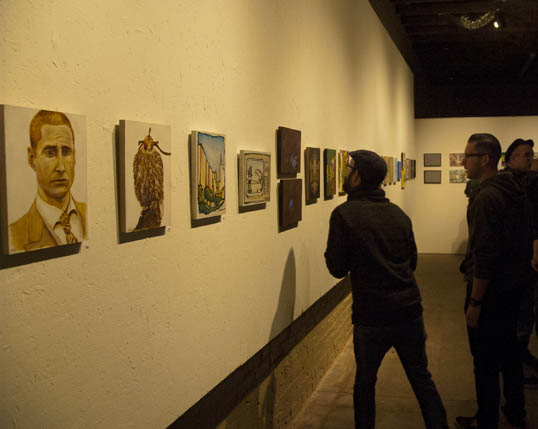
For the Love of Kettle Looking at the art

For the Love of Kettle
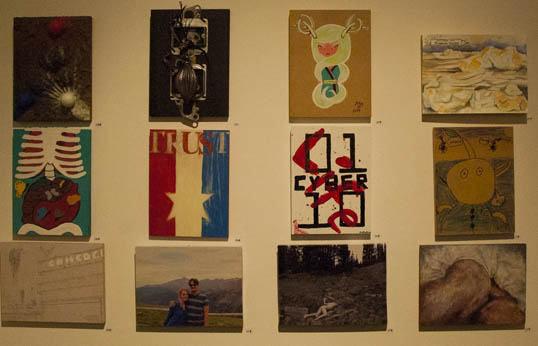
Looking at the art

For the Love of Kettle

For the Love of Kettle

For the Love of Kettle

For the Love of Kettle

Now, finally, I had time to leisurely push through the crowd and take a careful look at all of the hundred fifty works. They were all good. I thought that they could have sold them at random and I would have been happy – there were no more than two or three that I actually didn’t like. Still, I was pleased with what I chose.

The crowd was thick and happy. A lot of artists were there and some folks were taking pictures with the artists posing next to the artwork they had bought. That’s pretty cool.

A lot of people crowded into the gallery.

A lot of people crowded into the gallery.

They called my name and I went to pay. Since I was one of the first I had a discount and only paid forty two dollars. I milled around talking to people about what they had chosen, until the paintings were starting to disappear and I turned in my receipt and picked up my artwork.

A row of paintings. I chose the one in the middle.

A row of paintings. I chose the one in the middle.

Clay Stinnett painting on the wall at Kettle Gallery.

Clay Stinnett painting on the wall at Kettle Gallery.

On my way to the door, someone looked at my artwork and said, “Oh, you’ve got the Clay Stinnett,” then he read the text off the front – “Tumbling Tumbleweeds.”

The Weird and Wicked World of the Singing Cowboy by Clay Stinnett

The Weird and Wicked World of the Singing Cowboy
by Clay Stinnett

The title, written on the back, is The Weird and Wicked World of the Singing Cowboy. I really like it.

Clay Stinnett Tumblr
Clay Stinnett’s Honky Tonk Mind
Clay Stinnett Is Painting A Collection of Big Tex On Fire Pictures
Art We Like: Clay Stinnett at Smoke and Mirrors

I’m definitely going back next year… and I’ll be there early and near the front of the line.

Red and White

(click to enlarge)

(click to enlarge)

The aliens of Altair Six developed an interstellar drive – but it required such immense amounts of energy that the probe sent through the time/space vortex could be no larger than a mote of dust and the temporal rift so unstable that only one blurry image could be sent back.

They had established Earth as a good candidate for life and the high priests had blessed the probe (they had long ago abandoned the difference between science and religion – both relied on faith) and were confident that if life existed on the distant rock, it would show up in the image.

They were right. The single image returned showed an ordered collection of what were undoubtedly life forms. But exactly what were they looking at? Why were the individuals on one side all bedecked in bright white, while the others shone blazing red?

The debate raged on Altair Six. The accepted theory is one of racism – the photo showed a border with the white-lighted denizens restricted on one side, the red on the other. There is obviously no mixing of the two races – the apartheid is complete.

Others believed the dichotomy was age-based. Noting that the white creatures shone brighter than the red, the theory was advanced that the red were larval forms, while the white were full-grown. It was thought that they were separated to keep the developed individuals from eating the fry.

One controversial idea, put forth by Professor Yo’rin Cake of the University of Vultur Volans that the objects in the image aren’t actually life forms, but some sort of dwelling. The color of the lighting, red or white, is merely a marker to help delineate different neighborhoods.

This was dismissed by the learned councils out of hand. It was considered impossible to have that many dwellings in the image without capturing any of the life forms themselves.

Still, the debate between these and many other factions, some completely ridiculous, others more studied and mainstream, continued and only grew in intensity and cacophony. In an attempt to find an answer to this question an enormous portion of Altair Six’s economy was dedicated to building a huge power facility and a corresponding time/space vortex generator. The plans were laid to send a larger probe with a better camera and more sensors to finally answer the mysteries of the rock called Earth.

Unfortunately, their reach exceeded their grasp and the interstellar probe complex broke down and exploded. It was a terrible planet-wide disaster and set the society back by millennia. They were reduced to a level of advancement only slightly higher than ours.

It’s a Slam Dunk

“Basketball is an intricate, high-speed game filled with split-second, spontaneous decisions. But that spontaneity is possible only when everyone first engages in hours of highly repetitive and structured practice–perfecting their shooting, dribbling, and passing and running plays over and over again–and agrees to play a carefully defined role on the court. . . . spontaneity isn’t random.”

― Malcolm Gladwell

Irving Arts Center
Irving, Texas

George Tobolowsky (Dallas, TX)
It’s a Slam Dunk (2007)
Welded Steel

In the background is Fountain Columns by Jesús Bautista Moroles

George Tobolowsky (Dallas, TX) It's a Slam Dunk (2007) (click to enlarge)

George Tobolowsky (Dallas, TX)
It’s a Slam Dunk (2007)
(click to enlarge)

“I am more than just a Serious basketball fan. I am a life-long Addict. I was addicted from birth, in fact, because I was born in Kentucky.”
― Hunter S. Thompson

George Tobolowsky (Dallas, TX) It's a Slam Dunk (2007) (click to enlarge)

George Tobolowsky (Dallas, TX)
It’s a Slam Dunk (2007)
(click to enlarge)

“We old athletes carry the disfigurements and markings of contests remembered only by us and no one else. Nothing is more lost than a forgotten game.”
― Pat Conroy

George Tobolowsky (Dallas, TX) It's a Slam Dunk (2007)

George Tobolowsky (Dallas, TX)
It’s a Slam Dunk (2007)

“And I would be the first to admit that probably, in a lot of press conferences over the time that I have been in coaching, indulging my own sense of humor at press conferences has not been greatly to my benefit.”
― Robert Montgomery Knight

When I first graduated from college I took a job in a small city isolated out on the windswept Great Plains, only a few miles from the little town my family was from. I didn’t know anybody in town and there wasn’t all that much to do anyway so I thought I’d take a class at the local junior college. It was funny, I had trouble enrolling (I had to get permission from a dean) because, even though I had four years at university, my high school transcripts were unavailable, lost in the revolution.

I had never been able to take psychology – the classes often filled up, with preference given to students in the major, plus it was impossible to fit a class in around my extensive laboratory courses. So I enrolled in Psych 101 at the junior college.

It was shocking how easy the class was, especially after coming through four years of chemistry, math, and physics. I barely had to study and I don’t think I missed a single question on a single exam. Yet the other student constantly complained about the amount of work assigned and the difficulty of the tests. It was like high school. I remember thinking that if at university anyone would dare (and none ever did) complain, the professor would have simply pointed to the door.

The instructor, however, was excellent. A very old man, he taught an interesting class and dealt with the whining with more patience than I thought possible… or necessary.

One day he came up to me before class and asked me a question.

“Your last name, did you have a father from around here.”

“Yes, my dad is from a small town nearby.”

“Did he play basketball?”

“Yes.”

“I remember being the referee when your father played in high school. I had never seen an athlete like that. He was the best basketball player I ever reffed.”

“You’re kidding. You remember him after all this time?”

“Yes, it was quite a game. I remember I fouled him out of the game near the end.”

The next weekend I told this story to my father.

“He’s lying,” my father said, “I never fouled out of a game.”

Travelers

“Don’t be amazed if you see my eyes always wandering. In fact, this is my way of reading, and it is only in this way that reading proves fruitful to me. If a book truly interests me, I cannot follow it for more than a few lines before my mind, having seized on a thought that the text suggests to it, or a feeling, or a question, or an image, goes off on a tangent and springs from thought to thought, from image to image, in an itinerary of reasonings and fantasies that I feel the need to pursue to the end, moving away from the book until I have lost sight of it. The stimulus of reading is indispensable to me, and of meaty reading, even if, of every book, I manage to read no more than a few pages. But those few pages already enclose for me whole universes, which I can never exhaust.”
― Italo Calvino, If on a Winter’s Night a Traveler

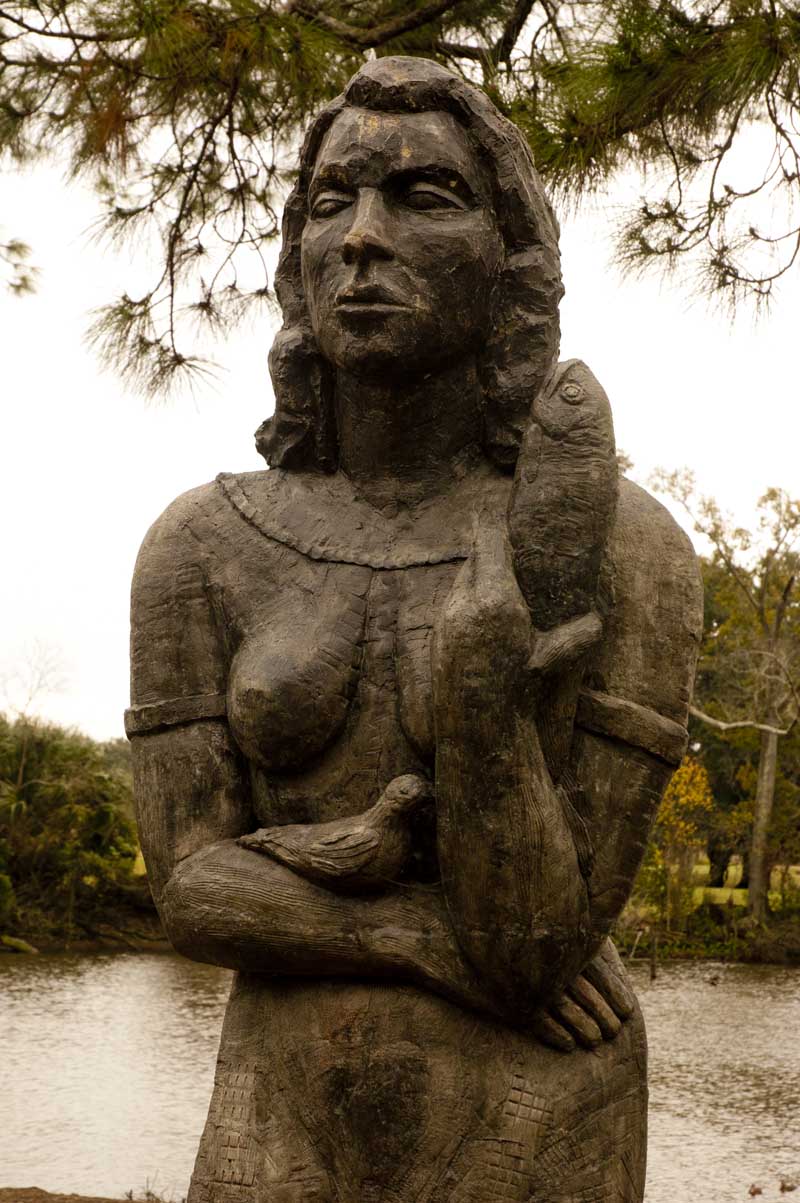
Travelers
Deborah Masters
Sculpture for New Orleans
Audubon Park
New Orleans, Louisiana

Travelers  Deborah Masters Audubon Park, New Orleans (click to enlarge)

Travelers
Deborah Masters
Audubon Park, New Orleans
(click to enlarge)

If we find poetry in the service station and motel, if we are drawn to the airport or train carriage, it is perhaps because, in spite of their architectural compromises and discomforts, in spite of their garish colours and harsh lighting, we implicitly feel that these isolated places offer us a material setting for an alternative to the selfish ease, the habits and confinement of the ordinary, rooted world.”
― Alain de Botton, The Art of Travel

Travelers  Deborah Masters Audubon Park, New Orleans (click to enlarge)

Travelers
Deborah Masters
Audubon Park, New Orleans
(click to enlarge)

“What is that feeling when you’re driving away from people and they recede on the plain till you see their specks dispersing? – it’s the too-huge world vaulting us, and it’s good-bye. But we lean forward to the next crazy venture beneath the skies.”
― Jack Kerouac, On the Road

Zigzag Moderne Art Deco

Last weekend I went on a bike ride in Fort Worth with some friends (will get a trip report written, I promise). We loaded up our bikes, rode the DART train to downtown Dallas and then took the TRE train to Forth Worth.

Our rail destination was the T&P Station south of downtown Fort Worth. This is a recently restored historic building built in 1931 as a beautiful example of Zigzag Moderne Art Deco (what a cool name!) architecture.

I love Art Deco – and there are some great examples in the Metroplex. The best known are the buildings, murals, and sculptures (here, here, here, and here) of Fair Park in Dallas

But the old ticket lobby of the T&P is a beautiful concentrated example of Art Deco excess and beauty. It’s a big room lost in time, available for wedding rentals, and dripping with history. You can almost feel the millions of travelers moving through on their way to the trains. Today, there were only some guys with their bicycles looking around… but at least it is still there, waiting for the next chapter.

Abstract Art Deco design in the T&P Waiting Room ceiling, modified in Adobe Illustrator. (click to enlarge)

Abstract Art Deco design in the T&P Waiting Room ceiling, modified in Adobe Illustrator.
(click to enlarge)

T&P Waiting Room, Fort Worth, Texas (click to enlarge)

T&P Waiting Room, Fort Worth, Texas
(click to enlarge)

Art Deco ventilation screen, T&P Waiting Room, Fort Worth, Texas

Art Deco ventilation screen, T&P Waiting Room, Fort Worth, Texas

T&P Waiting Room, Fort Worth, Texas (click to enlarge)

T&P Waiting Room, Fort Worth, Texas
(click to enlarge)

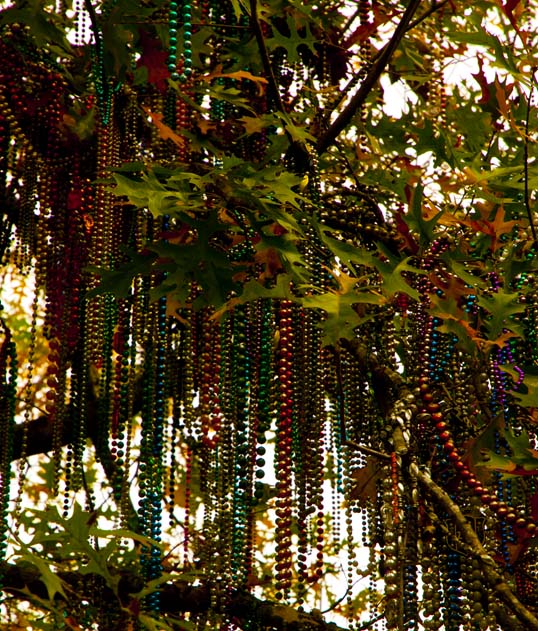
Bead Tree

“To encapsulate the notion of Mardi Gras as nothing more than a big drunk is to take the simple and stupid way out, and I, for one, am getting tired of staying stuck on simple and stupid.

Mardi Gras is not a parade. Mardi Gras is not girls flashing on French Quarter balconies. Mardi Gras is not an alcoholic binge.

Mardi Gras is bars and restaurants changing out all the CD’s in their jukeboxes to Professor Longhair and the Neville Brothers, and it is annual front-porch crawfish boils hours before the parades so your stomach and attitude reach a state of grace, and it is returning to the same street corner, year after year, and standing next to the same people, year after year–people whose names you may or may not even know but you’ve watched their kids grow up in this public tableau and when they’re not there, you wonder: Where are those guys this year?

It is dressing your dog in a stupid costume and cheering when the marching bands go crazy and clapping and saluting the military bands when they crisply snap to.

Now that part, more than ever.

It’s mad piano professors converging on our city from all over the world and banging the 88’s until dawn and laughing at the hairy-shouldered men in dresses too tight and stalking the Indians under Claiborne overpass and thrilling the years you find them and lamenting the years you don’t and promising yourself you will next year.

It’s wearing frightful color combination in public and rolling your eyes at the guy in your office who–like clockwork, year after year–denies that he got the baby in the king cake and now someone else has to pony up the ten bucks for the next one.

Mardi Gras is the love of life. It is the harmonic convergence of our food, our music, our creativity, our eccentricity, our neighborhoods, and our joy of living. All at once.”
― Chris Rose, 1 Dead in Attic

Bead Tree, Gibson Quad, Tulane, New Orleans, Louisiana

Bead Tree, Gibson Quad, Tulane, New Orleans, Louisiana

“I dust a bit…in addition, I am at the moment writing a lengthy indictment against our century. When my brain begins to reel from my literary labors, I make an occasional cheese dip.
~Ignatius J. Reilly
― John Kennedy Toole, A Confederacy of Dunces

Bead Tree, Gibson Quad, Tulane, New Orleans, Louisiana

Bead Tree, Gibson Quad, Tulane, New Orleans, Louisiana

“Leaving New Orleans also frightened me considerably. Outside of the city limits the heart of darkness, the true wasteland begins.”
― John Kennedy Toole, A Confederacy of Dunces

What I learned this week, January 17, 2014


A Janitor Secretly Worked On This For 7 Years. No One Knew Til Now… And It’s Baffling Everyone.


6 Harsh Truths That Will Make You a Better Person


14 Photography Project Ideas


Sci-fi writer Isaac Asimov predicted the world of 2014 in 1964: here’s what he got wrong


The Serious Eats Guide to Ramen Styles

Baritone

Used to tell Ma sometimes
When I see them riding blinds
Gonna make me a home out in the wind
In the wind, Lord in the wind
Make me a home out in the wind

I don’t like it in the wind
Wanna go back home again
But I can’t go home thisaway
Thisaway, Lord Lord Lord
And I can’t go home thisaway

I was young when I left home
And I been out rambling ‘round
And I never wrote a letter to my home
To my home, Lord Lord Lord
And I never wrote a letter to my home
—-Bob Dylan, I Was Young When I Left Home

My little bike ride through the Tulane campus was bittersweet. It was fun but I was filled with a melancholy nostalgia. Lee has graduated – this might be my last visit… or at least it will be the last visit with any connection or significance. I remembered visiting five years ago for parent’s weekend, walking the sidewalks on the guided tour, imagining what it would be like to study at such a beautiful place in such an amazing city.

This last visit – I almost felt more connection than with my own campus… that was long ago and I was just a kid, anyway. Nobody knows the terrible lucidity of nostalgia at a young age – it only comes with the onslaught of incipient dotage.

Baritone
Mia Westerlund Roosen
Tulane Campus
New Orleans, Louisiana

Baritone Mia Westerlund Roosen Tulane Campus, New Orleans (click to enlarge)

Baritone
Mia Westerlund Roosen
Tulane Campus, New Orleans
(click to enlarge)

“The Greek word for “return” is nostos. Algos means “suffering.” So nostalgia is the suffering caused by an unappeased yearning to return.”
― Milan Kundera, Ignorance

River Bottom Bicycle Route

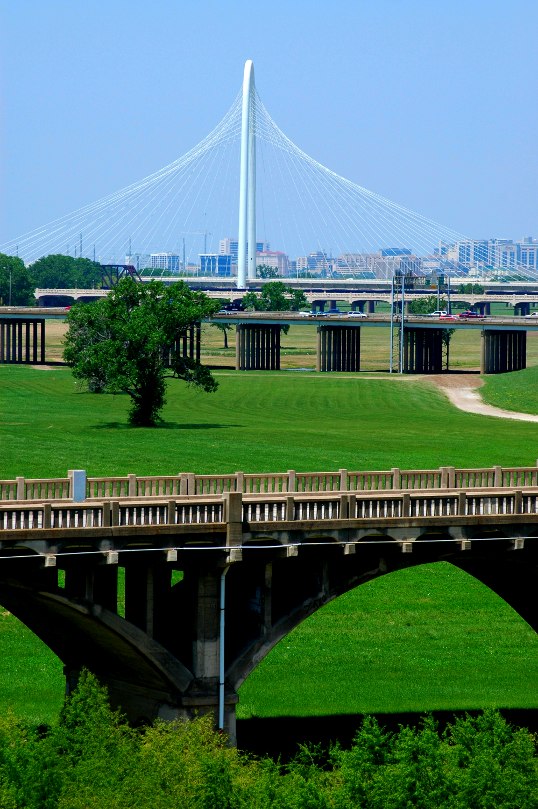
View from the high point of the Jefferson Viaduct Cycletrack, Trinity River, Dallas, Texas

View from the high point of the Jefferson Viaduct Cycletrack, Trinity River, Dallas, Texas

I have been struggling with a nasty something – maybe nothing more than a stubborn cold – since Christmas or so. I took a look at my notes (the good thing about obscessive journaling – I have notes going back decades) and realized I always get sick on the days between Christmas and New Year. Maybe it’s an allergy to not going to work.

At any rate, since I have been unable to breathe (that oxygen addiction – a nasty habit) and the weather outside has been frightful I haven’t been riding my bike. I really miss it. Yesterday, I was able to get out and ride around the neighborhood. Though I was obviously out of shape and unused to the saddle, it was fun. So today I decided to take a longer ride.

A while back, I went to the Nasher for a lecture on Nasher Xchange – an ambitious art installation that involves ten varied works all across the city. During the lecture, the artists and organizers repeatedly emphasized the size of Dallas, how it is all spread out, and how much driving is involved in getting to all of the sites of the exhibition. One inspiration for the Nasher Xchange is the Skulptur Projekte Münster – which is held every ten years. Munster is so much more compact that Dallas, however, and they talked about how much different it is to have a similar exhibition in a car-based city like Dallas.

This is all true, of course – but I take exception to the whole car thing. By combining a bicycle with the DART train, you can move all over the city – a little slower, of course, but in a more interesting way – without a car.

So I decided to visit the Nasher Xchange sites without use of a car. Some of them are not really permanent, so it may not work out, but eight at least are doable. The thing will end February 16 – so it’s time to get crackin’.

I’ve been to three so far. I’ll write blogs about them when I’m done. I’ve been thinking about dear sunset by Ugo Rondinone and how best to visit it by bicycle. It’s a multicolored wooden pier jutting out into Fishtrap Lake, in West Dallas. There is no train station nearby, so a substantial bike ride will be needed.

Another thing in my “Things to do” list for 2014 is to organize a bicycle ride. An idea turned over in my head – organize a bike ride from the 8th and Corinth DART station, down the Santa Fe Trestle Trail and then north along the gravel roads in the Trinity River Bottoms to Hampton Road, on to Fishtrap Lake, and then back. It’s a six and a half mile route, one way, thirteen miles total. Not too far for a recreational ride.

Trinity River, Dallas, Texas (click to enlarge)

Trinity River, Dallas, Texas
(click to enlarge)

The only thing was, I was not familiar with the route at all. There’s a lot of construction down there, and I wasn’t sure of the condition of those roads – would they be muddy? Too rough?

So I decided to do the ride today. And it was a blast. The roads are bumpy in some places (they are actually paved in a few) but nothing a fat tire bike couldn’t get through. The route is, of course, flat, and the scenery is pretty impressive. If you’ve never been in the Trinity River Bottoms, it’s a surreal mixture of vast open floodplain with giant city skyscrapers looming up on the horizon.

Trinity River Bottoms (click to enlarge)

Trinity River Bottoms
(click to enlarge)

The only negative was that it was very, very windy down there. Thirty mile per hour southerly winds made it a struggle going one way (though I barely had to pedal going the other). I was pretty worn out by the end. But that’s… well, if not rare… not an everyday condition.

So I think I’ll go ahead and set a date, start the thing in motion. Next weekend is already spoken for, but I’ll see if I can find a Saturday in there sometime.

Hope the weather is good.

My commuter bike along the gravel road in the Trinity River Bottoms (click to enlarge)

My commuter bike along the gravel road in the Trinity River Bottoms
(click to enlarge)

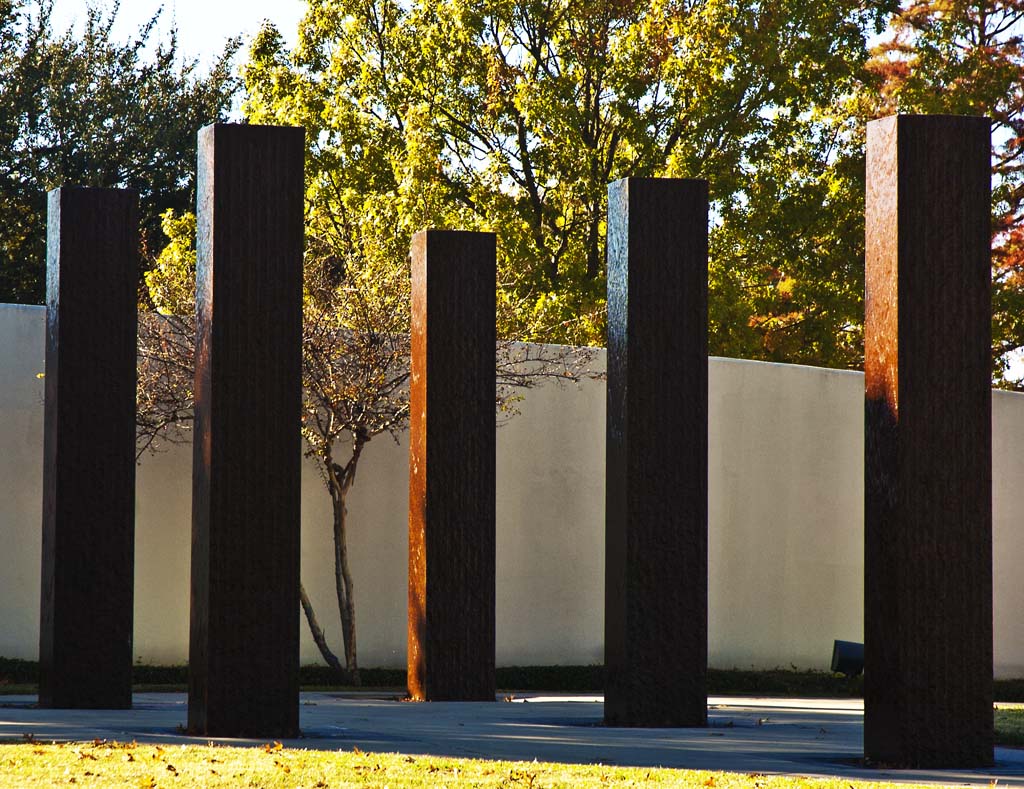
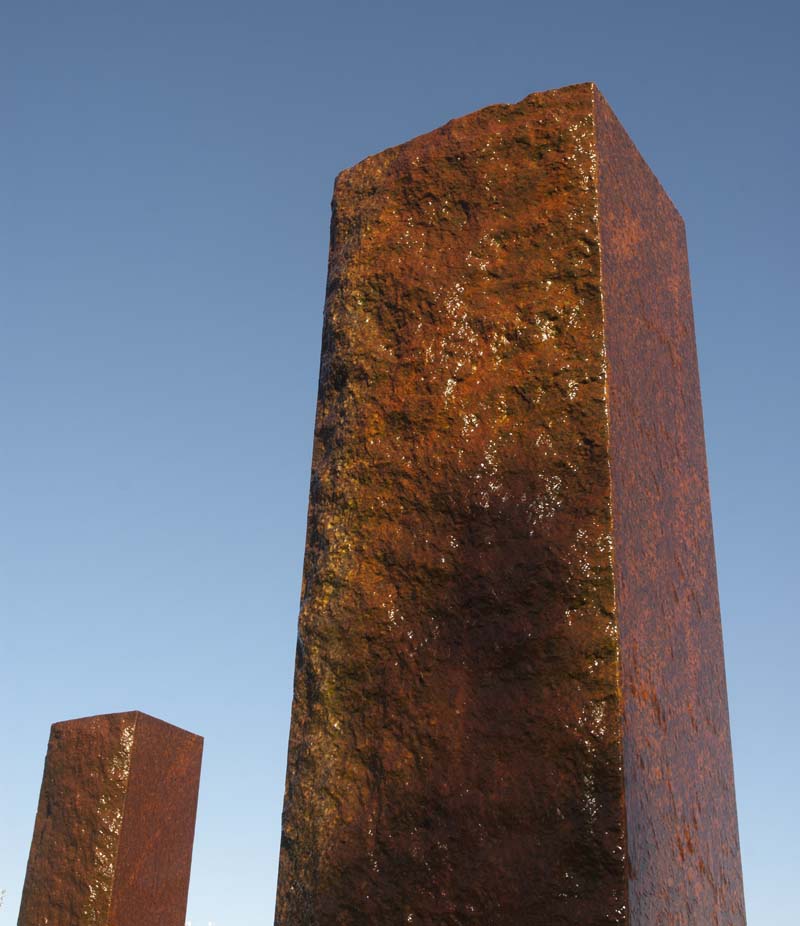
Fountain Columns

Irving Arts Center, Irving, Texas

Jesús Bautista Moroles
Fountain Columns, 1998
Dakota Mahogany Granite

Jesús Bautista Moroles Fountain Columns (click to enlarge)

Jesús Bautista Moroles
Fountain Columns
(click to enlarge)

“Elmore Leonard’s Ten Rules of Writing

1. Never open a book with weather.
2. Avoid prologues.
3. Never use a verb other than “said” to carry dialogue.
4. Never use an adverb to modify the verb “said”…he admonished gravely.
5. Keep your exclamation points under control. You are allowed no more than two or three per 100,000 words of prose.
6. Never use the words “suddenly” or “all hell broke loose.”
7. Use regional dialect, patois, sparingly.
8. Avoid detailed descriptions of characters.
9. Don’t go into great detail describing places and things.
10. Try to leave out the part that readers tend to skip.

My most important rule is one that sums up the 10.

If it sounds like writing, I rewrite it.”
― Elmore Leonard

Jesús Bautista Moroles Fountain Columns (click to enlarge)

Jesús Bautista Moroles
Fountain Columns
(click to enlarge)