Street View

To relieve some stress with some mindless web surfing I sat down with Google Maps and looked at StreetView of places I’ve lived in the past.

It’s a bit of a nostalgic treat, but more of a sad thing – so many places look run down now.

I have no illusions about this being interesting to anybody else – but here are a few places I’ve lived.

First, as an adult… or at least on my own… not surprisingly, most places I’ve lived since leaving home are available:

My dorm in college – It was a brave new world back then.

Hey, look at all these bike racks. We didn’t have those when I was in school. We only had a couple of the old ladder-style. I kept my 1974 Raleigh Supercourse (Reynolds 451 tubing, Brooks saddle stock) in my room. One night someone, obviously an organized and professional criminal crew, came by and stole all the bikes out front in one sweep.

My last two years in school I lived in this apartment fourplex. Tennessee street in Lawrence is one of the coolest streets I remember – but I lived in the most uncool little brown apartment. Hey, I didn’t have to look at it.

When I graduated and found my first job, I rented the top floor of this old building. I had my own entrance, the one you see on Google, and stairs went right up from there to my door. It was a nice place to live – an old halfway house for alcoholics, it had two bathrooms including a great old iron clawfoot tub in one.

After living there, I bought this house – the first house I owned. It was a tiny little crackerbox, but I liked it. I’m glad to see it looking so good, though it hasn’t grown any bigger.

When I moved to Dallas, I lived in this old complex on the M streets, right off Greenville Avenue. It was a great place to be young and broke.

Over the years I actually sub-rented two different units in this condo building. Possibly the best thing was its access to White Rock Lake – I did a lot of bicycle riding back in the day.

When we were married we bought this little house in Casa View ( technically Casa View heights). It was in terrible shape when we bought it – a real fixer-upper. It had a fantastic pecan tree in the backyard. Nick was born when we lived there.

Unfortunately, the school district there wasn’t very good, so we moved south a little way into Mesquite. Lee was born when we lived in this house. We lived there a long time – I planted those trees in the front yard.

When you are young you should plant all the trees you can – it’s something you can look at over the years, even if you don’t live there anymore. I wrote about the oak I planted in the back yard and how you can see it now.
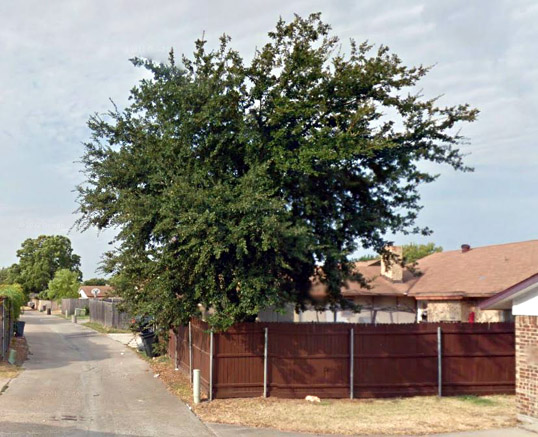
Live Oak in back of the house I used to live in.

Live Oak in back of the house I used to live in.

Now, looking back further, there aren’t very many street views of houses I lived in when I was a kid. Most Army bases don’t have street view and the other countries I lived in don’t have them either.

There is this sideways view of one house when I was in first and third grade. Not a very good angle – it was an amazing house.

When I was in fifth grade we rented this house while my father was in Vietnam.

And a couple years later we fixed this house up – it hasn’t aged very well since.

I’m not sure any of us do.

Baritone

Used to tell Ma sometimes
When I see them riding blinds
Gonna make me a home out in the wind
In the wind, Lord in the wind
Make me a home out in the wind

I don’t like it in the wind
Wanna go back home again
But I can’t go home thisaway
Thisaway, Lord Lord Lord
And I can’t go home thisaway

I was young when I left home
And I been out rambling ‘round
And I never wrote a letter to my home
To my home, Lord Lord Lord
And I never wrote a letter to my home
—-Bob Dylan, I Was Young When I Left Home

My little bike ride through the Tulane campus was bittersweet. It was fun but I was filled with a melancholy nostalgia. Lee has graduated – this might be my last visit… or at least it will be the last visit with any connection or significance. I remembered visiting five years ago for parent’s weekend, walking the sidewalks on the guided tour, imagining what it would be like to study at such a beautiful place in such an amazing city.

This last visit – I almost felt more connection than with my own campus… that was long ago and I was just a kid, anyway. Nobody knows the terrible lucidity of nostalgia at a young age – it only comes with the onslaught of incipient dotage.

Baritone
Mia Westerlund Roosen
Tulane Campus
New Orleans, Louisiana

Baritone Mia Westerlund Roosen Tulane Campus, New Orleans (click to enlarge)

Baritone
Mia Westerlund Roosen
Tulane Campus, New Orleans
(click to enlarge)

“The Greek word for “return” is nostos. Algos means “suffering.” So nostalgia is the suffering caused by an unappeased yearning to return.”
― Milan Kundera, Ignorance

Sunday Snippet – Forklift Rodeo

Randall Zaphtig took his daughter Penelope by the hand and led her from the car. They were on a long roadtrip from his ex-wife’s (Penelope’s mother) funeral back to his home in Oklahoma. He had decided not to fly, thinking that the drive would give him time to get reacquainted with his daughter before introducing her to his new wife – her new mother – for the first time. The trip was turning out to be quiet and even more awkward than he had been afraid it would be. He was prepared for tears, but not for the withdrawn, silent, robot-like waif that his daughter had become.

On a whim, Randall left the Interstate at the New Calebtown exit. He turned off almost by habit – he had lived in New Calebtown for his first three years out of school and had worked in the Caleb Brother’s hat factory there as a production engineer.

For some reason, unknown even to him, he had a strong desire to show her the factory he had once worked in. He drove to the plant parking lot by reflex memory but when they both climbed out of the car he saw that the building was no more. All that was left was the cracked parking lot, with mean looking weeds starting to poke up through the fault lines in the asphalt.

Still he took Penelope’s hand and together they walked across to the broken lines of concrete footings that outlined where the factory used to be. Looking down at the parking lot next to that he saw peeling, faded, yet still visible orange lines stenciled in and over the almost invisible now yellow parking demarcations and a strong, long forgotten memory came flooding back, causing him to stumble a little.

The orange lines were from the forklift rodeo. The men in the shipping department took great pride in their ability to move undamaged product out of the door quickly and a great part of that was their ability to drive their forklifts. These were country boys and men, farmers, that had grown up driving trucks and farm equipment not long after they had shed their diapers. Industrial and agricultural machines were in their blood – hydraulic fluid, lubricating grease, and diesel fuel moved under their skin. Driving a forklift at the plant was nothing more than a further fulfilling of their destiny.

The highpoint of their year was the forklift rodeo. There were local, county, and finally State competitions and it was a sad year when somebody from Caleb Brother’s did not place high in the State Finals. A handful had won the competition over the decades and their trophies were displayed proudly in a glass case at the entrance to the office row.

A young hotshot out of college – Randall was expected to referee the factory rodeo. The orange lines were painted on the lot to the exact specifications of the annual contest. They were supplemented by piles of wooden pallets in strategically placed locations to form an obstacle course the contestants were expected to navigate with the heavy trucks, moving forward and backward, fast and slow, picking up, moving and dropping loads according to strict rules and regulations.

Randall had to stand on the dock over the aisle where a contestant would enter with a pallet on his forks, drop the pallet, back out, then turn around, re-inter and retrieve the pallet. He had a checksheet where he would note the proper use of the horn, back-up signal, and whether the driver would turn his head and look for oncoming traffic. He would note the angle of the forks when picking up or lowering, and the height of the forks when moving naked.

There were dozens of details that had to be adhered to and Randall used his checklist to grade the contestants. They would argue later over over whether their heads had turned or if they had looked closely enough or moved too fast backing out. In order to be victorious in the contests, there had to be practice and Randall was assigned to help out with this an hour a day for the month leading up to the Rodeo.

He hated standing out there for hours in the heat watching those men riding the smoke-belching machines, making little tick marks on his forms, and having to argue over every little detail. The men would rib him, especially teasing him endlessly over the fact that he couldn’t do what they did every day. It was humiliating.

Now, decades later, he wondered what happened to those men when the plant closed down. They all had families – sometimes three generations had worked there. Men like that had few options. There wasn’t anything else in New Calebtown for them. Randall had no idea how their families could survive.

He was pulled out of his sad reverie by his daughter. She had been walking along the cracks in the pavement and looking at the harsh spiny nettles that were fighting their way up. A few of them were blooming and she had carefully pulled the flowers off of the sharp stems.

“Here, Daddy, for you,” Penelope said, handing him the bunch of surprisingly colorful blossoms. He held them to his face and was surprised at how sweet they smelled.

“Come on, let’s go,” he said to his little girl, “We’ve still got a ways to go.”

Scopitone

The last few weeks, whenever I would sit down at the computer – dipping my toes in the very shallow edge of the warm and wild sea of the internet – looking for youtube videos of old and tacky musical performances – I kept coming across the word “Scopitone.” A lot of musical chintz, commercial pop from the early sixties, especially stuff from Europe…

Some of the best (and worst) of it had the word Scopitone floating above the tawdry grin and shabby outfits, grainy film-transfer, inane and incongruous background singers, and abysmal dance routines. I assumed that Scopitone was a brand, or a record label, or something else rooted in the second-rate musical world of the time. I was right about that, I guess, but it wasn’t until a few days ago that I stumbled across what Scopitone actually is.

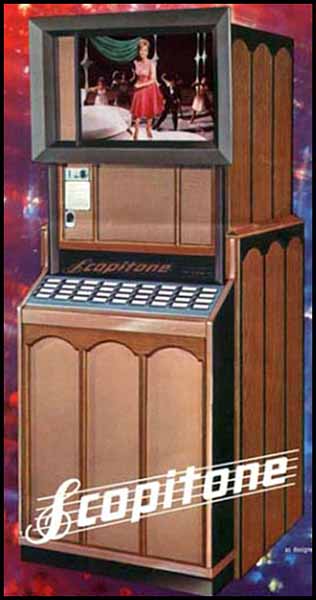
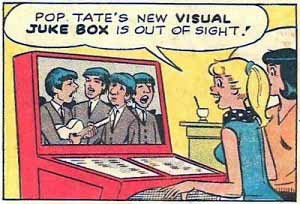
It is a machine. A musical video jukebox of the time. MTV for the sixties. An Ipod of the day, the size of a refrigerator.

A Scopitone Machine

A Scopitone is a way to pay to view sixteen millimeter films of the stars of the day. The short musical films were stored on reels inside the complex mechanism and delivered up for view on a dark, dim, blurry screen atop the contraption while the sounds, carried on an innovative magnetic track beside the filmstrip, bellowed out of tinny, static-filled speakers.

The Scopitone was developed in France after World War II. The story is that two French engineers built the prototype projector from a 16mm aerial spy camera and used other leftover war equipment for the mechanism. It was very complex and wasn’t perfected until the late 1950’s. I can’t imagine the difficulty of building a mechanism to automatically thread and rewind a pile of 16mm film reels, all in a portable machine the size of a refrigerator.

The interior mechanism of a Scopitone

The machines were mostly placed in loud, noisy, crowded bars full of desperate drunken young men. That is why so many feature skimpy outfits on skinny starlets, shimmying whatever it is that they’ve got for the three minutes or so the song spends wearing itself out.

A classic Scopitone – Neil Sedaka with Showgirls. (Is Miss June Barbara Eden?)

I love the idea of these whirring, clanking, clumsy mechanical marvels competing for spare change with the stale pretzels on the bar. What pitiful echoes of sophomoric erotic thoughts would course through the alcohol-fueled young minds while viewing something like this:

The only thing stranger that the short success of the Scopitone is the fact that these films are still around today. You can buy DVDs. There are blogs dedicated to them. I can go online, type Scopitone into the youtube search field and my screen fills with a list of hundreds of these ancient artifacts. Is it stranger that they are available… or that I actually like to look at them, or even write about them.

Oh well. It is what it is.

This is actually a great song. But why are they singing to a bear?

This one is straight from a burlesque show… and I remember the Dean Martin James Bond spoof of the same name. Did the song come first?

Have to have one with dancers wearing fringed bikinis.

This is the most heartfelt song I’ve ever seen that involved women in bikinis playing skee-ball. “Hey Kids! Play with Peppy”

Always had a soft spot for instrumental “twist” music.

Most of the Scopitone music is obscure and second-rate – but this is one of the best songs of all time… and an interesting visual of the time

And of course, Bang Bang