Sunday Snippet – The Red Tail

A quick first draft I hammered out on a break from work. There may be something here, but I’m not sure what.

Walter ran through the corn. It was higher than his head and he knew he was invisible. The stalks stood thick, but there was room to run between the rows. He realized he still had the gun in his hand and that it was slowing him down, affecting his gait. He raised the gun to his face and realized that it was giving off a burned smell and that the barrel was hot.

He threw the gun away into the corn.

He wanted to start running again, but Walter had lost his way. The high corn hid him but made it impossible to see where he was going. The noon sun was directly overhead and he realized he didn’t even know what direction he had come from.

So he just ran.


When he was a child, Walter Skopsky’s father gave him a gift. He didn’t know it at the time but that moment was to shape the rest of his life. His father was a struggling alcoholic insurance underwriter and was hunched over his desk balancing the family’s meager bank accounts late one evening – trying to finish so he could reach for his second bottle. Walter was out of paper for his school work and was pestering his father for a sheet or two when the old man reached into a drawer and fell upon a pad of graph paper. He threw it and told his son to leave him alone for the rest of the night.

Walter still remembers the cool, green color of the pad, the thick blue and fine red lines crisscrossing in a grid of such heavenly precision – the repeating pattern of the axis implying an infinite steadiness and surety reaching out past the edges of the sheets into infinity to the left and right, back from the past and forward into the future.

It was the most beautiful thing Walter had ever seen.

A shy, nervous, and delicate boy, Walter took refuge in his graph paper. Once he committed something to the Cartesian Predictability on the single plane he felt he had the world under his control.

He was terrified of the long drives his family would take every holiday to West Virgina – to spend time with his mother’s large, diffuse and complex, intertwined family. The visit was a blur of loud and unpleasant confusion to Walter, but the drive up there and back was horrifying. Walter did not have access to accurate statistics on driving fatalities, but he watched the evening news and read the paper. He knew that a lot of people were meeting a gruesome end on the roads. Walter made guesses as to the percentages of deaths per thousand miles of driving and would graph the family voyage along with his estimate of his odds of dying in a fiery crash.

During the trip he would look from the back seat of the car over his father’s shoulder at the odometer and would then retreat and mark their progress on his graph and reduce his estimate of fatality until, pulling into the weed-infested gravel driveway of his aunt’s doublewide, the two lines would move to zero and he could breath easier until it was time for the trip back.

As the years went by Walter became increasingly unsatisfied with his simple linear graphs. The world was getting too complicated. That was when, on a whim, he fished the teacher’s guide to a set of standardized progress tests given out to his entire grade level out of a classroom trash can. He slipped the guide into his notebook and surreptitiously sneaked it home like it was a set of state secrets. That night he removed the clear cellophane from the unread thin pamphlet and devoured it cover to cover. There, he discovered, for the first time, the concept of the bell curve.

The simple curve resonated with Walter and he felt, finally, that he had learned a concept that explained the world to him. At first the librarian dismissed him, but he kept bugging the woman until she led him to an introductory statistics textbook that had a long chapter on the normal distribution. The mathematics were above him, but Walter began to understand the curve itself in its graphical form, with the large number of “normal” points arranged around the center and the two, rare, special, “tails” extended out to either side.

Walter copied the curve onto an entire pad of graph paper and then began to fill in the areas with highlight markers, so he could still see the lines underneath. He used the most common yellow markers on the vast territory of the center hump of the curve. The top one percent of the tail, he colored green and the bottom one, he colored red.

He stared at that upper green tail and swore he would always be in there, no matter what it took. If he couldn’t make it there – he would move on. He entered into a long period of studying. He would graph his test scores and his mid-semester and final grades – making sure he was in that top one percent. Anything less would be represented by a big blotch in that vast yellow mediocrity of the curve and Walter would be up late at night, sweating in his bed, and staring at that mark of self shame.

In English class one day, they read Robert Frost’s “The Road Not Taken” and Walter wrote a long heart-felt essay about how the two roads led to the left and right areas of his beloved bell curve, and the “Road Less Traveled” led to the right-handed, green tail. He even stapled one of his beloved graphs to the back of the paper, carefully labeled with sections of the poem. He let slip a rare grin of self-satisfaction as he handed in his paper, sure that the teacher would be impressed by his understanding of the relationship between statistics and literature.

Walter was mortified when the paper was returned with a “C-” and the notations, “Well written, but does not make sense,” and, “Does not follow instructions.” Tears welled up in his eyes as he made a mark slightly to the left of center in the vast hated yellow land of the bell curve.

He kept staring at that graph… as time and again he kept ending up in that yellow center. It was horribly frustrating and he became more and more discouraged. Walter needed to be there in that green tail – the top one percent. But, try as hard as he could, he kept falling short. Slowly, inevitably, he began to think about the other end of the graph, the red end. The bottom one percent. What would life be like down there?

It was about that time that Walter’s father fell asleep in his car in the garage with the engine running. There was a lot of talk about whether he had done himself in or had simply made another drunken mistake… his last one. Walter didn’t think it made much difference either way.

In the confusion after his father’s death Walter was able to sneak into his parent’s bedroom and find the black plastic case hidden under the shoe stand. Walter’s father had proudly taught his son how to use the snub nose revolver and the two of them had spent some time out in the country, target shooting at whiskey bottles stuck between strands of barbed wire.

The gun was the only possession of his father’s that Walter cared about. He was able to keep it hidden away under his mattress. Nobody ever payed much attention to his room and after his mother disappeared and he was sent to live with his aunt in West Virginia nobody payed any attention to him at all.

Walter had grown into a tall, lanky, quiet youth. He wasn’t too quick, but he was fast, and he had some stamina. At first, he did well in math, which made his teachers like him and the other kids stay even further away.

He was still making his graphs, and his bell curves, but he had stopped coloring in the green tail on the right hand side. His mind began thinking more and more about the red end to the left and began to rejoice as his marks were drifting lower and lower, moving in that direction.

Finally, one summer he decided to take the plunge. He began thinking more and more about a little gas station out on the highway. A dirt road ran to the east from his aunt’s trailer and was separated from the gas station by a wide, flat, corn field. He was tall, fast, and though it was wide he knew he could run across that field in less than five minutes.

A girl from his high school worked out there on the weekends. Her parents owned the place. She was a senior and a cheerleader and everybody knew who she was though Walter was sure she had no idea who he was.

All Walter had to do was wait until the corn had grown higher than his head.


He didn’t know where he was going, but Walter still ran through the corn. His pockets were stuffed with cash which seemed heavier than it should have been.

Walter realized that this must be what it felt like to be down in the red tail of the bell curve. Lost, running, desperate. This wasn’t what he expected but he wasn’t sure if it was what he wanted. He did know that now he was there, down in the red tail, that he was there for good.

Got Pupusa?

It was Thursday and time for the second of the Patio Sessions down at Sammons Park in front of the Winspear Opera House. Last week I took a lot of photographs (here, here, and here) and didn’t feel like doing that again. Viewing life through a viewfinder is not the best way to see things.

I did take my camera, just in case, but I loaded my Kindle, Moleskine, and selected a vacuum filler Parker “51” with a fine nib and Parker Quink black ink (my best note-taking combination – the “51” has an amazingly smooth fine nib, perfect for the Moleskine) and decided ahead of time I’d get something to eat from a food truck, commandeer a table, and relax – read and write a little.

I left work and caught the DART train downtown from the station near my office. The weather was cloudy and windy, but overall not too bad for Texas. I was happy when I saw they had a food truck that, not only had I never eaten at before – but it was also one I had wanted to check out. I was glad I at least brought my camera… have to get photos of food trucks.

It was Dos Paisano’s – a fairly new truck that promised Salvadorian fare. I’m a big fan because it is food that is similar to what I ate in High School in Nicaragua (I love banana-wrapped tamals)… plus pupusas.

Jacob Metcalf opened with a mellow acoustic set. The sound system is such that the music can be heard clearly from anywhere under the massive Winspear sunscreen so I went ahead and bought a pupusa plate and a bottle of water and settled down on a table, listening to the music and reading, just as I had planned. The food was very good. Now I need to track that truck down and try their plantains, yucca, and tamals.

The second musical act was The O’s – a neo-country duo singing upbeat folksy music using a banjo, a slide guitar, a foot pounded bass drum, and a bit of a goofy-corny sense of humor. I enjoyed them a lot though they had to deal with the pealing church bells, just like last week.

The crowd was quite a bit bigger than last week and the concert was sort of impaired by a large group of little kids that kept running around the reflecting pool, yelling and splashing. I know I shouldn’t complain – my kids were as big a pain as anyone’s – but I know how it works. To a parent there is nothing as attractive as their own children and nothing as amusing as their antics. You could see the proud mothers and fathers smiling broadly at the edges of the reflecting pool, out for an evening with their blankets, plastic wine glasses, and massive strollers. What is tough to do is to constantly remind yourself that not everybody thinks the way you do – as a matter of fact, nobody else thinks your kids are cute. You’re the only ones.

The Patio Sessions are not too long, at seven thirty everything was over. I gathered up my stuff and caught the train back home.

I have been working through this huge ebook of noir short stories, The Best American Noir of the Century. I kept reading on the train, coursing through a fascinating bit of fiction by Harlan Ellison called Mefisto in Onyx. Even with Ellison’s occasional overwrought chunk of prose here and there it’s a crackerjack story and sucked me in enough to have me look up and realize I had gone a stop too far. I had to get off the train and wait for another southbound to get me back to where my car was. I don’t like waiting around on a dark train station platform that I’m not familiar with… but there was some illumination from a streetlight and at least I was able to finish the harrowing story.

And it was very good.

The Dos Paisano's Salvadorian/Mexican fusion food truck. Look for it in your neighborhood.

Got Pupusa?

Ordering food from the Dos Paisano's Truck.

My pupusa order with a lot of red and (spicy) green sauce.

Also in the photo is my Kindle and its custom made case.

The top half of the Dos Paisano's Menu.

The bottom half of the menu. I'm going to have to go back.

I like that this song mentions Tietze Park – a Dallas sort of place. My bus drove by there on the way to work for years. I would look for its signature bent over tree  (I think it’s a “kneeling” bois d’ arc )every day. It was voted the best place to break up in the city. There’s even a song about it  by the band Elkhart- video performed at the Belmont, of course.

The amazing view of Downtown Dallas from the Belmont.

What I learned this week, September, 29, 2011

Russell Blake – On Editing

The ease with which the self-publishing platforms now enable aspiring writers to upload their work is mind-boggling. The only thing standing between you and being on Amazon are a few mouse clicks. Gone is virtually the entire delivery system that defined the traditional publishing business for generations. Trees don’t need to be sawed down, trucks don’t need to go to and from warehouses filled with freshly printed books, stores don’t need to occupy valuable space that could house another Starbucks or fast food joint. It’s a brave new world we’re writing in; the old rules are dead and the sky’s the limit.

(read the whole thing)


I have this continuing fascination with Food Trucks. One of the interesting aspects is the battle with City Hall and the struggle for permitting and permission. You would think that you could drive where you wanted and sell sandwiches. Nope.

Even when the city likes something, it sets up barriers. And charges fees.

Dallas City Hall Likes Food Trucks


Why does the Good Life End?

by Victor David Hansen

Redistribution of wealth rather than emphasis on its creation is surely a symptom of aging societies.


What Should I Do with the Cables, CDs, and Accessories that Come with My Gadgets?

Great Ideas, from Lifehacker


My camera is fixed! If you need repairs or other work on your digital cameras – I highly recommend Archinal Camera Repair. It is located in an old storefront in old Downtown Richardson.

It isn’t cheap – repairing complex electronics and delicate mechanical devices never is – but they do good work and are pleasant to deal with.

Archinal Camera Repair on Beltline Road in Downtown Richardson


from The Telegraph
 
  • Red Harvest by Dashiell Hammett
  • The Postman Always Rings Twice by James M Cain
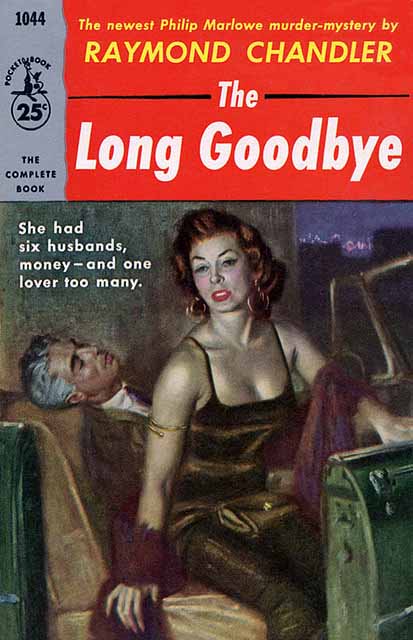
  • The Long Goodby by Raymond Chandler
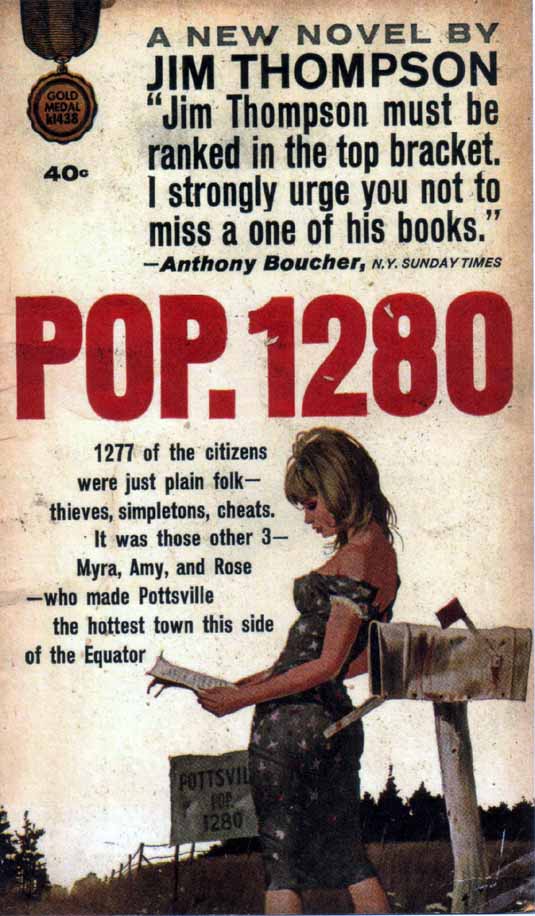
  • Pop. 1280 by Jim Thompson
  • Give Us a Kiss by Daniel Woodrell

Do you remember this song from “Kill Bill”? It was originally done by Cher, and was written by Sonny Bono.

The Lookout

When everything is as confused as I am right now, something as simple as a Netflix disc queue becomes a source of mystery as the red mailers arrive with unknown contents. I tear open the paper and see the Tyvek envelope with its circular burden and read the little label. I have no idea why this has been sent to me – no memory of searching and adding – though I must have done it.

Tonight was “Lookout” – the great plains noir starring Joseph Gordon-Levitt as a night janitor in a bank. He suffers from dain bramage – sort of Memento light.

I didn’t really want to watch it all that much – I have plenty else to do. But I can’t send it back unwatched (that is something not to be done – a modern day sin) and I need to clear my queue so I can get my next disc. This weekend, I ordered The Rocky Horror Picture Show and moved it to the top of the queue. This is not for me, of course. I have seen Rocky Horror… maybe a hundred times. I have never seen it on video – I’m sure it’s pretty crappy on the small screen, it has to been seen in a crowded midnight theater. I’ve seen the live stage play twice- which is the best way to see the thing.

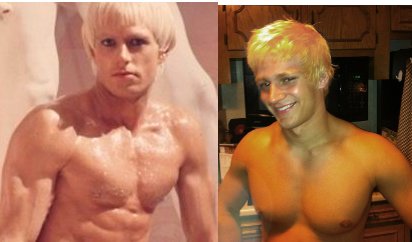
I ordered it for Lee. He has decided that blondes have more fun, and has bleached his hair. It started out sort of a ruddy gold, but with some work he has it at platinum now.

Several people have told him he looks like Frankenfurter’s Monster, Rocky, from the eponymous musical horror picture show extravaganza. He’s never seen it and asked me what was up, so I’ve ordered it.

Rocky and Lee

Rocky and Lee

I don’t know… do you think there’s a resemblance here?

At any rate, on to The Lookout. After all the weird crap I’ve been seeing lately, it was nice to see a well-done, professionally made, predictable noir thriller.

I remember when I was a youngster and living in Kansas we used to, every now and then, drive out, way out in the country after midnight along the arrow-straight sand roads between the wheat fields with our lights out. These roads are gridded out every mile from there to hell and back. You could speed up until you could feel the tires starting to float on the sand the tiniest bit. The drive would then be as smooth as fresh asphalt.

The thing was, once you turned the lights out your eyes would get used to the dark and you could see everything clearly by moonlight. The colors were gone, everything was a ghostly blue, a silent timeless featureless landscape screaming by.

We could see good enough to see if there was a combine stalled in the road, I guarantee it.

It was cool… except for one thing. I always had the fear, though the odds against it were astronomical, that someone might be doing the same thing, coming in the other direction.

The best-laid schemes

The best-laid schemes o’ mice an’ men
Gang aft agley,
—-To a Mouse, Robert Burns


Furnace

Furnace

I had great plans for the weekend. I even wrote them down – a two page list in one of my Staples Bagasse Composition Books I carry with me always. Two pages! Who the hell am I kidding?

Well, of the projects I wanted to complete, I finished… hmmm… let me count… none.

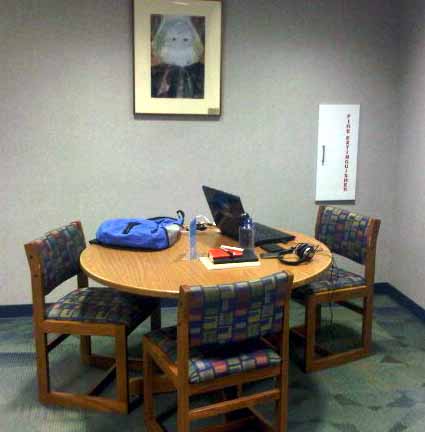
On Sunday, around noon or so, I was trying to decide whether to go to the library and write (I have a certain table at the Richardson Library I like to work at – the library is open from two to six, which is a nice constrained four hour writing time – it’s shocking how fast the time flies) or to go for a bicycle ride. I decided to kill two birds with one stone and ride my bike to the library.

Table

My favorite table at the Richardson Library.

I made my preparations – packing my Alphasmart Neo (don’t want to ride my bike with my laptop), pens, notebooks, water bottles, clean shirt, towel, and such and sundry stuffins. I put my backpack on and went out into the blast furnace of the garage to get my bike. The front tire was flat.

I stood out in the sun behind the house, found the telltale little white spot where the thorn had penetrated, took everything apart (nasty little thorn, really), patched the tube, put it together, and pumped everything back up.

Maybe a half an hour. I was drenched in sweat.

I had calculated that I would be able to get to the library in the awful heat by moving quickly. The time I spent fixing the tire was too much, though. I rode about a mile and decided it was too risky. The temperature, the sun beating down, the still air… it was all going toxic. By the time I made it home I was beginning to get a little dizzy.

I am too old and way too out of shape for this. All I wanted to do was veg out in a dark cave of conditioned air. The bit of overheated exertion wore me to the bone. At that point I wasn’t even up to driving to the library. I rested a bit, went to eat with the family, and at sunset walked down to Lee’s last softball game. Once the sun is down, it’s a lot more bearable. I think the solar radiation beating down is worse than the superheated air.

I’ve complained about the heat already. And it wasn’t even bad back then, not like now. It’s always hot here in the summer, of course, but this is getting ridiculous. It wears everyone out – it is so hard to get anything done.

Deadlier than the Male

Deadlier than the Male

The only thing I accomplished was to read another bit of Pulp Fiction I had queued up. This one was Deadlier than the Male, by James Gunn. No, this isn’t James Gunn, the science fiction professor that teaches at my alma mater (yes, I took a class from him, but that’s a whole ‘nother story). This James Gunn seems to have not written another novel. Nobody seems to know anything about him. The book was made into a film in 1947 called Born to Kill – which I’ll try to find.

Born to Kill

Born to Kill

It’s an odd, crazy book. I wouldn’t say it was a good book, but it was something. The language is simple, but arresting. The first line – ”Helen Brent had the best-looking legs at the inquest,” pretty much sets the scene. Most noir pulps have a small number of characters, but in this one, every chapter introduces somebody new. They keep arriving faster than they are killed off… until near the end. With each fresh character the story splits until the plot is like a big twisted knot of desperation and evil, stretching from Fresno to Frisco. I had a bit of trouble keeping track of who was who, and a few of the participants seem to simply disappear from the book once their utility wears thin, but the book was short and the story tumbled forward picking up flotsam and jetsam from the sewer of human malice until it all crashed down into the last few pages.

Since I wasn’t up for anything useful I was able to get through the book in one day. Now, I have some more pulp noir stuff in my reading list, but I need to find something different, maybe even something a little uplifting. After reading this one… I feel sort of dirty.

Heat
Heat
 

Lana Del Rey

I have a new favorite song, Video Games by Lana Del Rey.

Good Stuff. Really good stuff. The song has a lilting laconic hook to it which, coupled with the heartfelt, provocative lyrics make it irresistable. The lush orchestral arrangement adds a bit of nostalgic contrast that is very welcome.

Love the video too. I wonder what game the exploding Eiffel Tower at the begining is from?

Another one of her songs, Kinda Outta Luck, is different, more of a pop gangster bit of fluff with fun edgy lyrics – Is it wrong wrong that I think it’s kinda fun when I hit you in the back of the head with a gun?

Love the Film Noir stuff in the video.

The only problem is I can’t figure out how to buy any of her music (either under Lana Del Rey or Lizzy Grant). She had an album out at one time, but I can’t find it. All I have so far are the youtube videos.

For now, that’ll do. I’ve been working on a time management thing called the Pomodoro Technique. I’ll write more about it some time later, but the basic premise is you use a kitchen timer to work for twenty five minutes, then take a five minute break. I keep a list of favorite youtube music videos to watch in my little mini breaks – and Video Games has moved to the top of the list.

That’s a nice break offsite when I’m writing (that’s where the Pomodoro thing is working best for me) but it doesn’t cut it at work work. The whole break thing is not something that’s easy to pull off. There’s an old Dilbert Cartoon where he is told, “Job satisfaction is the same as stealing time from the company.” You have to at least appear to be slaving away at all times or else you are not earning your wage, and in this best of all possible worlds, that is not acceptable. There are starving kids in Africa that would love to have your job.

In one of her interviews, Lizzy Grant refers to herself as a “Gangster Nancy Sinatra.” In honor of that, here’s a real Nancy Sinatra video – another one I watch sometimes during my Pomodoro breaks.

This is her first television appearance, on Jools Holland.

And another new version of Video Games

From the same venue, Blue Jeans


New Orleans Noir

No place as pretty and sad as New Orleans. Depending on if the sun’s shining or not. You ever notice that? Sun’s out, ain’t no prettier place on earth. No place more … resplendent. But gray and gloomy, cloudy, rainy, this town is so shabby, dreary, and downright depressing, makes you wanna take morphine and die.

—– From the short story Marigny Triangle by Eric Overmyer from the collection New Orleans Noir

Since my son Lee enrolled at Tulane I have been reading material set in New Orleans as much as possible. Confederacy of Dunces, Across Magazine Street, The Awakening, The Moviegoer, the Dave Robicheaux series, Zeitoun…. And there are plenty more to go.

I just finished a book of short stories set in The Big Easy – New Orleans Noir. As the title suggests, it is a book of hardboiled crime fiction. Eighteen different stories from eighteen different authors: Thomas Adcock, Ace Atkins, Patty Friedmann, David Fulmer, Barbara Hambly, Greg Herren, Laura Lippman, Tim McLoughlin, James Nolan, Ted O’Brien, Eric Overmyer, Jeri Cain Rossi, Maureen Tan, Jervey Tervalon, Olympia Vernon, Christine Wiltz, Kalamu Ya Salaam, and Julie Smith. This is one book in a series of noir collections, each one set in a different city. I haven’t read any of the others… and I’m not so sure… what city can be more Noir than New Orleans?

The book is divided into two parts – pre and post Katrina. The earlier stories are all over the place: time, tone, setting, genre. Some have a bit of horror thrown in – the excellent “Pony Girl” by Laura Lippman, for example. Post Katrina – well, they focus in on a horror of an entirely different sort. Not so much the rising water but the breakdown in society that can ensue after a disaster like that. I remember the Nicaraguan Earthquake in ’72 – it was that breakdown that was even more frightening than the tumbling masonry.

New Orleans is a city of neighborhoods. Each story is set in a different part of the city: Uptown, French Quarter, Bywater, Faubourg Marigny… with a map in the front to keep you oriented.

As you might expect from a collection with eighteen authors, the stories are a bit uneven. Still, the good outweigh the bad by a large margin. Ones that especially resonated with me?

The Lippman “Pony Girl” – short, visual, horrific. Really good.

All I Could Do Was Cry, from the Lower Ninth Ward… by Kalamu Ya Salaam – heartbreaking.

… Now that I look over the table of contents, there is really only one that I didn’t like. I’ll have to reread that one… maybe I missed something.

I’ll have to single out one of the post-Katrina stories, the one by Julie Smith, the woman that put the collection together. Her story, Loot, was a little uneven in pacing, I would like to have seen it written out longer… but the basic story, of the friendship between a lawyer and her housekeeper, was wonderful and felt real.

Don’t take my word for it, read the story here.

Now I have to decide what to read next. I have to be careful what I read because the style and attitude of what I’m reading has such a huge impact on what I write.

Let’s see… I bought a Kindle Book, I Wish, from Wren Emerson and I want to finish that. But I never read only one book at a time, I have a handful of non-fiction library books and a half-dozen in my “Current Reading” collection on my Kindle.

I did read a short story, “Child’s Play” by Alice Munro this afternoon. She is so good, her stories so perfect and jewel-like, they make my heart ache. Nobody does it like she does.

We can all dream

Ok, since I’m thinking about New Orleans, how about a little Big Easy Jazz, OK?

Sunday Snippet – Rufus Amalgam Loved his Bluetooth, Part 2

Time for another silly bit of throw-away fiction. A week ago I put up part one of Rufus Amalgam Loved his Bluetooth based on a character idea from Peggy’s Blog. If you haven’t read Part One, go read it here first. Here is Part 2.

“Rufus!” Sandy was so loud in his Bluetooth headset that Rufus had to pull it out of his ear and hold it out or he would be deafened. Sandy’s voice sounded tinny and distant like that, which suited Rufus just fine.

“Damn it Rufus! You need to get your ass down here and take care of that Sylvester dude. He’s in my apartment and he won’t leave.”

“And this is my problem, why?”

“It’s your problem because you set the whole thing up. Now you get down here right now and help me throw the guy out or I’m gonna start making some calls. And you won’t like who I call or what I am going to say.”

“Ok, Ok, calm down. Now, you said that the Radio guy is in your apartment? Where exactly is he? What’s he doing?”

“He’s on my couch. Asleep. Has been since this afternoon. I can’t get him to budge.”

“Ok, Ok, Sandy. Don’t get your panties in a wad. I’ll be right down. Won’t be any big deal.”

Rufus stood up and walked out of the Starbucks, glaring at the table of women that had been eyeing him all night. As the front door closed, he thought he could hear a smattering of applause filtering out through the narrowing crack of the glass door. “You all can go to Hell!” Rufus yelled back at the coffee shop as he walked quickly to his primer-colored Ford Taurus.

He headed directly for the car door, his eyes focused on the latch. Rufus didn’t like to look at the long, winding rusty dent that buckled along the entire driver’s side. He knew there was a shorter, but deeper puncture wound on the passenger’s. The trunk was held down with a piece of wire, and there was even a wide dent on the bottom of the car where he had driven up over a parking barricade in a drunken stupor.

Reaching the door, he didn’t need a key, the lock had been drilled out months ago. The ignition cylinder spun freely and with a turn and a few seconds of sputtering and coughing, the engine came to life, idling roughly.

The yellow “low gas” light stared him in the face, mirroring the “Check Engine” symbol on the other side of the dash. He did some mental calculations and decided he could make it to Sandy’s place, though he’d be on fumes once he arrived there.

He was glad that Sandy needed his help and as he started out down the road, began to plan his angle. He needed somewhere to stay and he thought he remembered Sandy’s place as having a good, working, air conditioner. That Sylvester Radio guy was a skinny little runt and he’d have no problem rousting him out the door. If he did it in an assertive, manly way, then Sandy was sure to show some appreciation.

Maybe he could get a little more out of the deal than just a place to crash. Rufus started to imagine Sandy’s face full of gratitude, her eyelashes batting. The fantasy became more and more involved, more and more pleasant, a nice warm spot in his mind and gut, until he sprinted up the two flights of stairs to Sandy’s apartment and rapped confidently on the door.

Rufus’s fantasy left immediately when Sandy opened the front door. She stood there, her dirty blonde hair sticking in all directions, her face smeared with mascara, and wearing old torn cutoff blue jean shorts, a dirty T-shirt, and mismatched Crocs on her feet.

“I am so glad you are here,” Sandy said “he’s not moving at all.”

“Well, don’t you worry your…  little head over this bum. I’ll just pitch him out and then we’ll talk.”

Rufus strode to the couch where he saw Sylvester’s head sticking out from under a ratty quilt. He bent over and gave the quilt a yank. It came up quickly – flying into the air.

“Okay Radio! It is time to.. Oh geez! Damn it Sandy! The guy is naked.”

Rufus had to reach in the air to grab the quilt and push it down back over Sylvester Radio as quickly as he could. The image of those skinny hairless limbs and sunken chest would not leave his mind even after he shook his head violently.

“Why didn’t you tell me he was naked!”

“Sorry, I forgot.”

“You forgot? I don’t even want to think about…”

He didn’t want to finish the sentence. It was best to get things going fast, so Rufus leaned over and grabbed Sylvester’s shoulder and started shaking as hard as he could. At the same time he started yelling to wake the dude up. Rufus wanted to get him out as soon as possible.

“Oh Christ Sandy, he’s stiff as a board.”

“What are you talking about?”

“I think the guy is dead!” Rufus jumped back in disgust as quickly as he could. He stood in the middle of the living room shaking and staring at the quilt with the tuft of wild dark hair sticking out of one end and a pair of grubby feet with overgrown, yellow toenails out the other.

“Are you sure?”

“Yes I’m sure. He’s as stiff as a board… as dead as a doorknob. What did you do to him?”

Sandy said nothing. She simply stared at Rufus and he was horrified when he thought he saw a small grin flash across her face for a second.

“Where’s your phone? We need to call the cops.”

“Oh no,” Sandy said. “No cops. No cops! I’m on probation you know. This will send me back to the big house for sure. And I’m telling you I’m not going back there because you sent me some scrawny pervert with a weak heart.”

“Well then what do you suppose we’re going to do?”

So Sandy told him what they were going to do. It bothered Rufus when she came up with a plan so quickly. He suddenly had the thought that Sandy might have known Radio’s condition before she even called him at the Starbucks. He even wondered when that quilt had been placed over the corpse. The first step, Sandy told him, was to wedge the dead guy off the couch onto the floor while keeping him wrapped up in the blanket.

Rufus looked around for something to use; he did not want to touch the body. All he could find was a toilet plunger leaning against the end of the couch. He didn’t even want to think why it was there. He grabbed the wooden handle and used it to wrench the corpse off the couch. Thankfully, it landed in the quilt, and the blanket settled draped all around it. He took two corners and Sandy took two and after checking the front stairs they dragged the body out the door and down the two flights as quickly as they could. Luckily no curious bystanders showed up.

“Okay, where’s your car,” Sandy said.

“My car? Tanks dry as a bone, coasted here on fumes. We’ll have to use yours.”

Sandy shook her head in disgust and clumped around the corner. Rufus heard the whine of a small engine and a tiny Smart car appeared.

“What is that? Is that a toy? How are we going to fit in there with him?”

“You should have thought about that before you came here with no gas.”

“I know. I have an idea. I’ll wait here and you can drive with him in the passenger seat.”

“No way! I am not going to do this alone. You sit in the passenger seat and hold him on your lap.”

And that was how they drove. Sylvester Radio’s head was covered with the blanket and sticking out the passenger window at an angle. His corpse was too stiff to sit down and Rufus held the body with his eyes scrunched shut. They drove to a spot Sarah knew about where a rough gravel road crossed an old railroad spur and dipped down into a thick grove of scrubby trees.

“I don’t even want to think about why you know about this spot,” Rufus said.

“It is lucky that I do.”

They opened the door and slid the body on the quilt down to a thick weedy patch and pulled the blanket while the body rolled away into the darkness.

“I don’t know,” Rufus said “it doesn’t seem right to leave him like that. Should we cover him?”

“That’s my quilt. I’m not going to leave it here for the police to find. God knows what kind of DNA is in there. Don’t worry. They’ll think he’s just some dead naked junkie. He’ll never be missed.”

As they were driving away Sarah asked Rufus to open the glove box. Inside was a wallet and keys. Rufus instinctively checked the wallet.

“There’s no cash, no credit cards. I’ve already pulled them,” Sarah said. “I want you to check his driver’s license and give me the address.”

“What for?”

“We’re going to his place. Those are his keys. I want to see what’s there, I want to look…”

“Come on Sarah, we are not burglars”

“You can’t be a burglar to a dead man.”

Rufus recognized the address, he had been there before. It was a small brick duplex not far from the University. They parked a half block away and walked along the darkened sidewalk. As they approached the door with Sarah holding the keys they jumped as a voice called out from the darkness of the next door entryway.

“Are you two friends of Sylvester’s?”

“Uhhh,” the same confused sound came out of both their throats as they started to slink away from the unexpected interruption.

A spindly old woman suddenly moved from the darkness into the blue light from an overhead street lamp.

“It’s good to see that Sylvester has some friends, some young friends.”

“Yes,” Sarah said, thinking quickly, “we are Sylvester’s friends, we’re here to check on him.”

“Good,” the old woman said, “Sylvester needs someone to check on him, especially with his, well, you know, his disease and all.”

“Disease?” Both Sarah and Rufus spoke at the same time.

“Yes, don’t you know? That’s why I stayed up waiting for him. He has this nervous disorder. When he gets too excited. His whole nervous system – his brain and spine – his muscles – they freeze up stiff as a board. Catatonic. You would swear he was dead. Sometimes he won’t wake up for hours. Scares me to death to think that something bad might happen to him. You don’t think… Has something bad…?”

Rufus and Sarah stared at each other.

“No, no,” Sarah said “nothing bad… but, you know, we had better be going.”

“Yes yes,” Rufus replied, “we had better be going right now.”