“Come with uncle,” I said, “and hear all proper. Hear angel trumpets and devil trombones. You are invited.”
—-Alex, A Clockwork Orange
Mardi Gras
Deep Ellum
Dallas, Texas

Deep Ellum
Dallas, Texas
(click to enlarge)
“Come with uncle,” I said, “and hear all proper. Hear angel trumpets and devil trombones. You are invited.”
—-Alex, A Clockwork Orange
Mardi Gras
Deep Ellum
Dallas, Texas
Deep Ellum
Dallas, Texas
(click to enlarge)
Plaza of the Americas
Dallas, Texas

During the week, after work, I am so tired. All I can think of is getting home and falling into bed. The whole world feels dim and tilted – sloping toward the land of nod.
This is not a good thing – I don’t want to sleep my life away. I try and figure out something to do after work every day. I’m not always successful – but that doesn’t mean I can’t keep trying.
So I saw that tonight was an Art History lecture at Kettle Art in Deep Ellum (this is the gallery where I bought my bargain painting a month ago). Painter and educator Justin Clumpner was giving a talk in BYOB Art History:
Justin Clumpner’s titillating presentation on this-thing-we-call-art kicks off the final weekend of “Love, Death, + The Desert”. Join us tomorrow night at 7 for the first installment of Justin’s behind-the-scenes glimpse into the strange and mysterious world of art through the ages.
That sounded like fun – so I decided to go.
I’ve always had a soft spot for Art History. I took a year of it in college, as a break from my chemistry classes (and in a vain attempt to meet women). It turned out to be a revelation.
My instructor was an interesting person. On the first day of class he said, “We are supposed to go from ancient art to the present, but we are going to stop at 1860, because there hasn’t been anything worthwhile done since.” He lived in a world of his own – a world filled exclusively with the art of yesteryear. He talked about the Roman Colosseum and how it had canvas shades that would extend out over the audience. He asked, “Those astro-dome things nowadays have that too, don’t they?” The man had no idea what a modern sports stadium was.
But he was able to teach. I was fascinated by how, with a little instruction and after looking at thousands of projected 35mm slides from a rotating carousel in a darkened room (these were the days before powerpoint – and possibly better for it) – I could look at a totally unknown painting and tell who had painted it and in what year, give or take a few.
My biggest problem is that I would have four hours of chemistry lab before the art history class. I had to make a difficult left brain-right brain switch in only a few minutes of walking across campus. I remember looking at a slide of a beautiful Byzantine Mosaic and all I could think of was, “What pigment did they use to get that blue?”
One day I left my lab, walked to art history, ate lunch, studied on campus for a few hours, then walked the two miles to my apartment. I started cooking dinner when my roommates came home. They stared at me and said, “Bill, what the hell is that on your face?” I realized I still had my big heavy laboratory goggles on. I was so used to them I forgot to take them off and still felt normal. I can’t believe nobody had said anything to me yet that day – I must have looked like an idiot.
Today, after work, I caught the Red DART line downtown and then transferred to the Green to get to Deep Ellum. The Transit Gods smiled on me and I didn’t have a wait – so I arrived early. The talk was billed as BYOB and I wish I had gone to pick up a growler of local beer – but I settled for a little metal flask loaded with a few draughts of precious Ron Flor de Cana.

The Altamira Bison
The talk was really interesting. Of course, it could only be a quick overview, from cave paintings of forty thousand years ago to post-modernism in one hour is a tough and fast voyage – but Justin Clumpner is a high school art teacher and knows how to bring an audience along with him.
He said he wanted to make the BYOB Art History Talks a regular thing, maybe once a month. I hope so – it will be cool to hear him talk about some themes and topics in a more detailed, comprehensive way. If you want to give it a shot, like Kettle Art and watch their feed – I’ll see ya there.
Maybe I’ll be able to get a growler of beer to bring. Some fresh local beer and an art history lecture… that’s a good way to spend a work night. Better than collapsing at home.
“The aim is to balance the terror of being alive with the wonder of being alive.”
― Carlos Castaneda
“The stars are reflected from within the black water in the cistern. I find comfort in the omen I glean from this: light in the darkness, truth when it seems there is none.”
― Alice Hoffman, The Dovekeepers
David McCullough, Dallas
Quanta: Celtic Spirit Catcher
2000, Acrylic, F6 Cement, Foam, Wire
Frisco, Texas
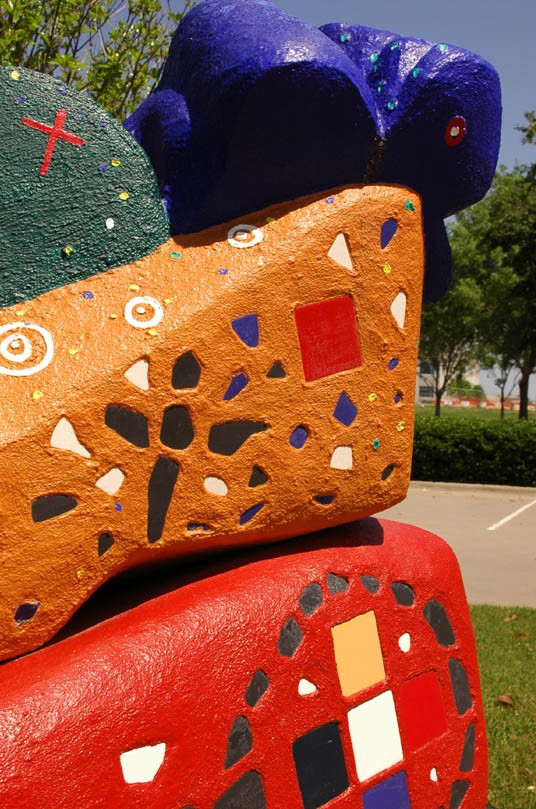
David McCullough, Dallas
Quanta: Celtic Spirit Catcher

David McCullough, Dallas
Quanta: Celtic Spirit Catcher
There is art where you least expect it. There is beauty in the most mundane.
The scenes you see every day, the dreary landscape of grinding drudgery is too often not seen. Take a look.
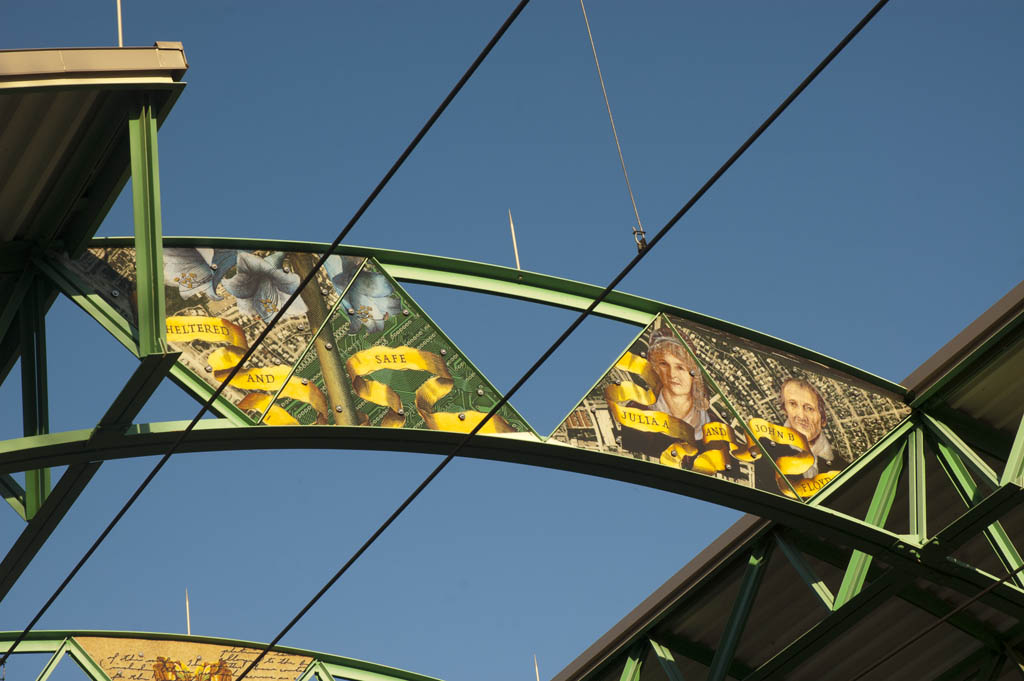
LBJ/Central Station – DART Red Line
LBJ/Central Station, providing easy access to Texas Instruments’ main campus, links nature and technology with cast stone columns with circuit board designs imbedded as insets. Built on the historic John B. Floyd farm acreage, the station also features a trellis gateway to the station platform. Station design team artist Frances Merritt-Thompson also produced the translucent panels in the overhead truss openings depicting images of the area.

DART LBJ/Central Station
Frances Merritt-Thompson
(click to enlarge)

Circuit Board Details in support columns
DART LBJ/Central Station
Frances Merritt-Thompson
(click to enlarge)
DART LBJ/Central Station
Frances Merritt-Thompson
(click to enlarge)
Other entries/photos from DART Stations:
Carrollton Collages
Plaza of the Americas, DART Station at Night
Gateway
Bike Lids
Next Stop
Dart Sunset
“I understood that fate could not be eluded forever; it came on leathery wings, swooping through the darkness like the bats in the orchards.”
― Alice Hoffman, The Dovekeepers
Zeke: It’s a twister! It’s a twister!
—The Wizard of Oz
Art Shirer, Dallas
The Wiz, 2001, Steel, Paint
Frisco, Texas
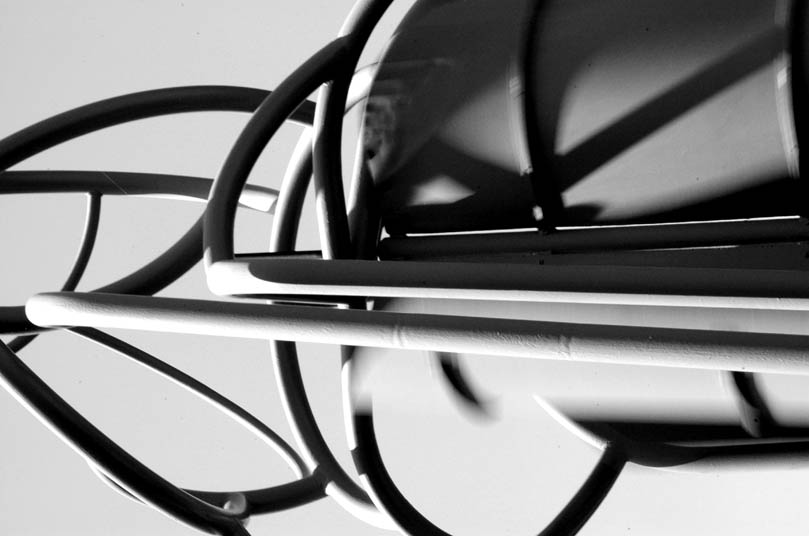
Art Shirer, Dallas
The Wiz
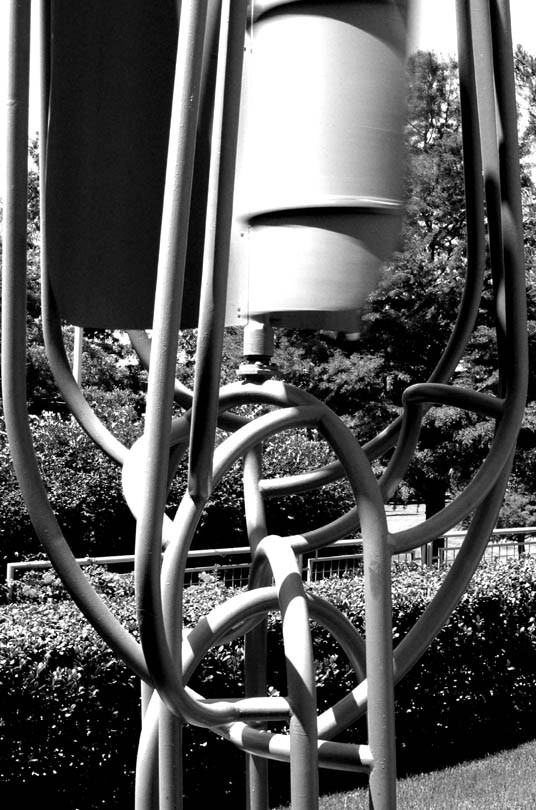
Art Shirer, Dallas
The Wiz
“Even as a small child, I understood that woman had secrets, and that some of these were only to be told to daughters. In this way we were bound together for eternity.”
― Alice Hoffman, The Dovekeepers
Michelle O’Michael, Houston
La Mujer Roja
2000, Steel, paint
Frisco, Texas

Michelle O’Michael, Houston
La Mujer Roja
(click to enlarge)
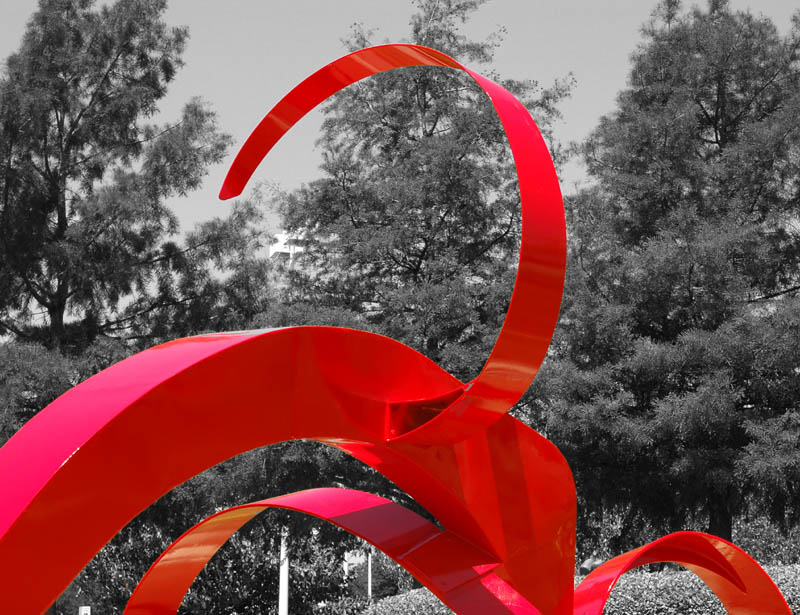
Michelle O’Michael, Houston
La Mujer Roja
(click to enlarge)

The Wyly Theater in the Dallas Arts District
The Dallas Theater Center has this thing, these “pay what you can” nights. These are opening performances where you can get a ticket for whatever you want. These are great for me, because I couldn’t afford to go to the Wyly otherwise.
So far, I’ve seen King Lear, The Tempest, Red, and The Elaborate Entrance of Chad Deity, at the Wyly and enjoyed the hell out of every one. This time it was the premiere of The Fortress of Solitude – a new musical adapted from the bestselling book by Johnathan Lethem. The show will run here in Dallas and then move onto New York.
I have never read the book, so I knew nothing of the story. There was nothing on the web about the musical – which isn’t surprising, because this is the premiere. That was actually sort of exciting – other than workshops and previews and such, this was the first time anyone had seen The Fortress of Solitude.
My son Lee is in town after graduation, staying for a few days before going back to New Orleans to work. We took the DART train downtown and walked over to the Wyly. Before the curtain came up, Lee asked, “Where is the orchestra pit?” I said there wasn’t one and I guessed they would use tape. Once the play started, however, a screen rose to show the musicians up on a scaffold above most of the action. There was a conductor down in front, facing a blank wall, directing into a small video camera – and her image was displayed on several carefully placed screens for the musicians and singers.
The musical was crackerjack. I imagine the source material isn’t the most obvious place to pull song and dance – and that made the story a lot more subtle and complex that the usual “girl meets boy” plot. The songs were great, especially when they were used to give a sense of time passing from the 1970’s to the turn of the century – from rock to soul to folk to rap to punk and finally, even a little Talking Heads thrown in.
It was a good time.
Our original seats were up on the third balcony (all good – there isn’t a bad seat in the Wyly) but a numbering mess-up had us move down into the orchestra level. I noticed a man sitting next to Lee holding a small notepad and scribbling all through the first act. During intermission I looked through the program and realized that the man was Daniel Aukin (I think), who conceived and directed the play. It must have been exciting for him to see his creation in front of a full audience for the first time.
Later, after the ovation died down, he asked Lee, “Well, how did you guys like it?” Lee said it was awesome. And it was.
Now, the next play is Sherlock Holmes and pay what you can tickets will be sold on April 21. Get in quick, they go fast.

This is Real


(click to enlarge)
from the Oregon Bicycle Transportation Alliance

Dealey Plaza, Dallas, Texas
(click to enlarge)

A sketch of the Casino at Montelimar, Nicaragua – once Somoza’s beach house.
I stumbled across a wonderfully interesting book this weekend; Iguanas on my Roof – Funny, Sad, and Scary OVERSEAS ADVENTURES of a Foreign Service Family in Third-World Countries during the Vietnam War and Watergate Era. I found it on its Facebook Page and then bought a copy from Amazon for my Kindle.
Say what you want about e-books… but to learn about a publication from the web while riding on a commuter train, have it in my hand seconds later, and instantly start reading it – that’s something amazing.
The book is a slim, simple, heartfelt family memoir written by Nancy Stone, the mother of five. I went to high school with two of her kids in Managua, Nicaragua. One son was my age, a grade below me and in a lot of my classes, and a daughter was my little brother’s age. We all ran around a lot together my senior year (I graduated and left for Kansas University in 1974).
I immediately recognized the title – we had iguanas on our roof. I remember when we first moved to Nicaragua trying to sleep with some tremendous racket overhead. I crept outside and leaned a ladder up to the wall, climbing up to find out what it was. There were a half-dozen huge iguanas and an equal number of cats all chasing each other around on the corrugated galvanized roofing. I couldn’t tell who was chasing who – but it was a mess. After I learned what it was up there – it was easy to ignore the cacophony and sleep.
Although I knew the kids well, I don’t recall ever even meeting their parents and I certainly never knew their story. We were military and they were embassy – that didn’t matter to the young’uns, but there was a difference. Their father, Al Stone, was a railroad brakeman in the late fifties when he was inspired by the harrowing plight of hordes of desperate Mexican immigrants fleeing a drought to try and do something. He spent years in education and effort until he was able to go to work for the Department of State and the USAID program.
So the big family was off on a tour of the disasters of the third world. From living in the Philippines while Al was in Vietnam, to Lagos, to Washington DC, to Managua after the 1972 earthquake (where they crossed paths with your humble narrator), the book describes the shocking, the strange, the scary, and the silly of a long, often difficult trip.
I’ve always said that living in the third world is months of boredom punctuated by moments of sheer terror.
Most of what was in the book was familiar to me, even the sections from the Philippines and Nigeria. There are certain stock scenes common to life in any poverty-cursed tropical place. Every incident brought back memories of similar episodes and adventures from my own youth.
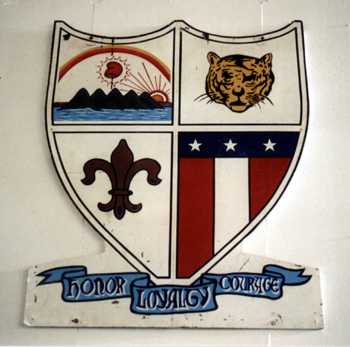
The crest from the American Nicaraguan School
What was most interesting was seeing these recognizable installments from a different point of view. The book is told by an adult – a person where everything is new and strange. Nancy Stone was from California – thrust by fate, love, and dedication into a bizarre world of giant insects, bad infrastructure, iffy transport, dangerous and incomprehensible societies, and odd food. It was all so… foreign. Cultural and work protocols, manners, and etiquette were consummate challenges. But it all comes to an end. The final chapter is titled, “We Went Back Home.”
Where is home? I don’t understand the concept. People talk to me about being “homesick” – I have no idea what they are talking about.
You see, It felt differently to go through a journey like that as a kid. When you are young… it is simply how things are. You don’t know any better.
A few paragraphs of the story were written by the kids I knew – familiar voices I understand.
For me, for example, the place and time where I had the most trouble adapting was when I went to college in the states. My nickname for a couple years was “Banana Boat” – as in, “Bill, you’re an American like the rest of us, but you act like you just fell off a banana boat.” I was so happy to find four students from Barcelona that I could relate to – though I was bothered by their lispy Spanish and the incredible amounts of wine they drank.
I realize that the youngsters were able to assimilate into the local culture in a way the adults couldn’t even imagine. To this day, I’m ashamed of my terrible Spanish – but I learned that if I simply kept my mouth shut I could move around at will without anyone knowing I was an American. As a matter of fact – nobody would notice me at all. I could become invisible. That’s an amazing thing to be able to do in a place like that.
That even affects the memories I try to hang onto in my incipient dotage. For example, there are a lot of anecdotes like those in the book that I am willing to let go as they fade into the misty cobwebs of my crumbling brain. What I hang onto desperately are some of the ethereal emotions of youth, the colors of the country, and the smells of the culture.
For example (full disclosure – I’ve been writing notes about this recently for a short story I’m working on) there is the smell of the third world. It’s a smell of pork grease and wood fires – of sour sweat and homemade soap, of heat and desperation. A few years ago I walked out onto the deck of a ship as it cruised into Montego Bay at dawn. A fisherman in a tiny wooden skiff was off the port bow and I watched him untangle his nets. As the salmon glow of the sun, still hidden behind the mountains, filled the sky we moved into a thin cobalt mist of the morning cooking fires wafting offshore and there was that third world smell. I had forgotten… but it all came back in a rush.
That is what I am desperate to hold on to.
So, I any of y’all are curious enough to read about what it was like, over there, back then, go to Amazon, load up your ereader or wait for the bound paper, whatever. It’s worth your money and your time, trust me. Thanks for doing the work, Mrs. Stone, for collecting the memories, writing them down, and sending them out into the world.
It’s late, so late. I think I’ll pour a little Flor de Caña (I was so happy when that became available in Dallas), get my writing in, and call it a day.

The land of lakes, volcanoes, and sun. A painting I bought on my last trip to Nicaragua.
 Bill Chance