Everybody told me, “Don’t go to Kaboom Town – it’s too crowded and the traffic is too bad.”
But you see, on a bicycle, you can sort of run around the traffic and the ride organizers had arranged to have a party on the third floor of a parking garage not too far from the show. It was a fundraiser for a French club or something – and for a reasonable donation there would be food and beverage. Sounded like a plan.
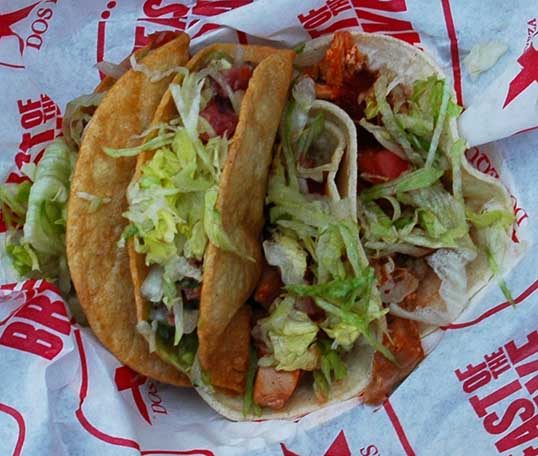
Everybody met up at a local taco place, gathered together, and rode off through the neighborhoods. It was a slow ride – and an easy five miles or so. The party was fun and the fireworks were pretty impressive.
There was an acrobatic airshow from Addison airport highlighted by someone going up after dark in an ultralight covered in fireworks and shooting roman candles off into the air. The only way that could have been better is if they had a group of them shooting at each other. Maybe next year.
The ride back in the dark was a little hairy with all the impatient traffic. There isn’t much you can do other than ride in a group and take a lane. Someone yelled at us – which is a little aggravating – I’m sure we slowed him up a good seven seconds in his driving rush (after sitting stopped in traffic for an hour) home. I guess it can’t really be a real bike ride unless someone yells at you.
Bikes lining up at Torchy’s Tacos – ready for the ride to Kaboom Town.
“A human being is a part of the whole called by us universe, a part limited in time and space. He experiences himself, his thoughts and feeling as something separated from the rest, a kind of optical delusion of his consciousness. This delusion is a kind of prison for us, restricting us to our personal desires and to affection for a few persons nearest to us. Our task must be to free ourselves from this prison by widening our circle of compassion to embrace all living creatures and the whole of nature in its beauty.”
― Albert Einstein
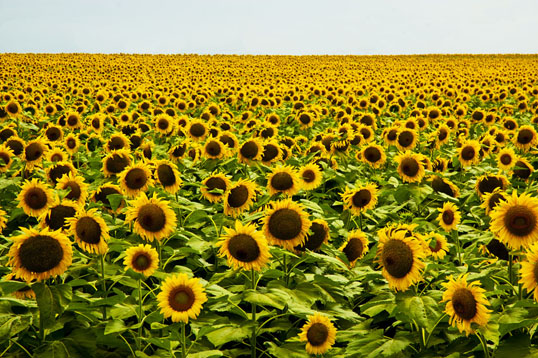
I have been working too much – working through the weekends. But the other day I happened to be off. A friend of mine from Austin had posted some amazing photographs of fields of sunflowers taken somewhere between here and there. She posted on Facebook that she was driving up to get some more shots and I was able to drop what I was doing and go there.
These were taken along Interstate 35 south of Dallas, near the little town of Forreston, exit mile 391. The fields bloom in June – and I ‘m not sure how long they will be there. They were starting to wither in the heat – so I suppose they will be harvested soon.
My friend had the foresight to bring a stepladder, which was necessary for the wide shots. The sunflowers are taller than you expect, over six feet high.
They are an amazing sight – photographs don’t do justice. There was a constant clot of cars that stopped along the Interstate to gawk at the flowers and stop and grab photos. I’ve got some more, I’ll post them in a few days.
What may this mean.
That thou, dead corpse, again, in complete steel,
Revisit’st thus the glimpses of the moon.
Making night hideous ; and we, fools of nature,
So horridly to shake our disposition,
With thoughts beyond the reaches of our souls?
Say, why is this?
—-Shakespeare, Hamlet
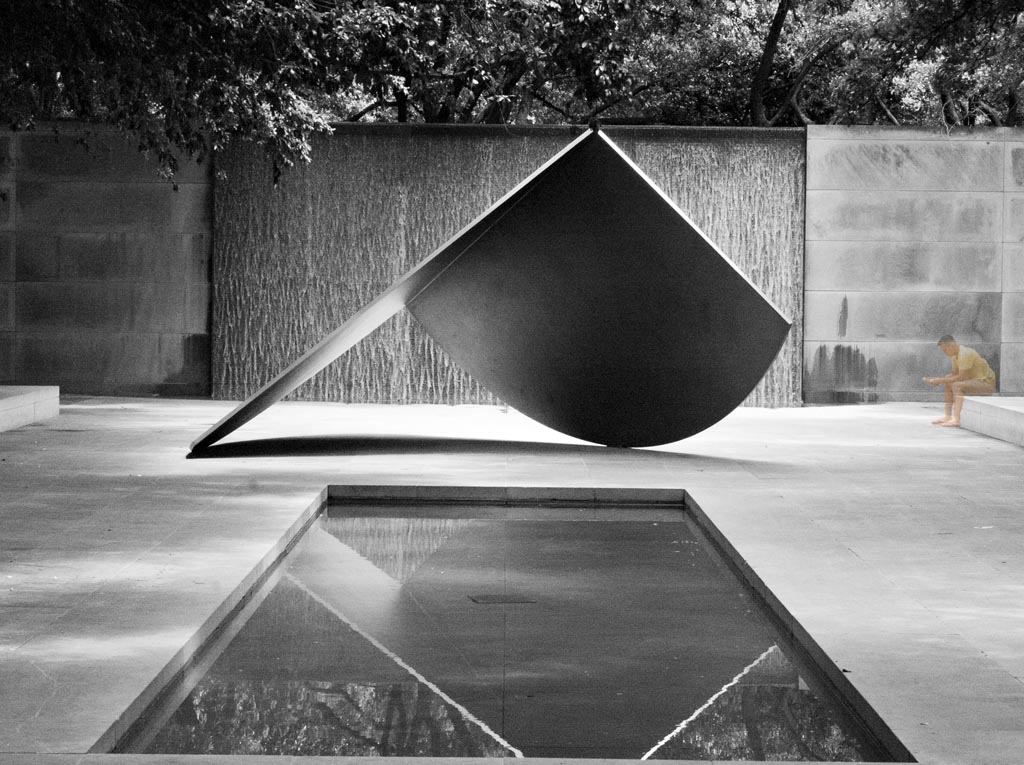
Dallas Museum of Art, Dallas, Texas Untitled, Ellsworth Kelly (click to enlarge)
Have you ever dreamed of leisurely peddling on your bike without having to subconsciously worry about traffic? Ever wanted to walk down the middle lane of a typically busy street to get to Klyde Warren Park? Well, your dream will become a reality this Memorial Day!
Uptown Ciclovia (if you don’t know about it yet, Ciclo-what should catch you up to speed) is a car-free experience that will connect the Katy Trail to Klyde Warren Park via Cedar Springs Road on May 26th. By closing the street to automobiles, people may enjoy the street however they so choose- run, walk, bike, skip, hop, dance, roller-skate, etc. The best part? There will be no cars to get in your way. I repeat- there will be NO cars! Have you ever been on a Dallas street and without seeing cars? Exactly.
I am really looking forward to this.
The last Dallas Cyclovia was a couple of years ago on the causeway over the Trinity River. It was a lot of fun and this one looks even better. A Cyclovia in Uptown will be cool.
We need to rethink our urban areas. They need to be redesigned around a new set of values, one that doesn’t seek to accommodate bikers and pedestrians within an auto-dominated environment but instead does the opposite: accommodates automobiles in an environment dominated by people. It is people that create value. It is people that build wealth. It is in prioritizing their needs – whether on foot, on a bike or in a wheelchair – that we will begin to change the financial health of our cities and truly make them strong towns.
A new report from the Institute for Policy Studies looks at the salaries of top administrators at many of the public universities around the country and draws some very interesting conclusions that any graduates of these schools with high debt loads will not be surprised to know. The most fundamental of these is that high pay of university presidents goes hand in hand with lower pay for faculty members and higher student debt on average.
Bike lane merging with right turn lane at Beltline road.
It is possible, even probable, experts say, because of the way Americans have designed their streets for hundreds of years — essentially viewing pedestrian fatalities as the cost of doing business, as the collateral damage of speed and progress.
“Traditionally we build assuming that drivers and pedestrians will do the right thing even though we know that humans are flawed,” says Claes Tingvall, the director of Traffic Safety for the Swedish Transport Administration, in an interview with Yahoo News. “You don’t design an elevator or an airplane or a nuclear power station on the assumption that everyone will do the right thing. You design it assuming they will make mistakes, and build in ways that withstand and minimize error.”
For nearly 20 years, Sweden has been building on that latter assumption, rethinking and revamping its transportation system, both the philosophy and the nuts and bolts. They call this 1997 legislation Vision Zero — meaning the goal is to reach zero pedestrian deaths in all of Sweden — and under the program people are valued over cars, safety over efficiency. Streets have been narrowed; speed limits have been lowered. Above all, the Swedes have declared an end to the argument over whether safety violations should be punished or prevented. Voting for problem solving over finger pointing, they view collisions as warnings that some fix — a differently timed light, a better lit intersection — is needed.
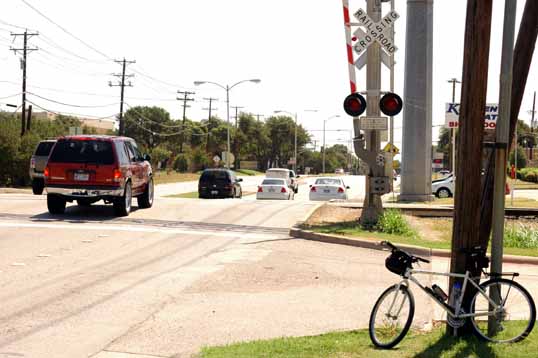
Reading about this terrible tragedy made me think of the near misses I’ve had lately. They all were in the same situation that killed that poor boy. Crossing in a crosswalk with a green light and the little walk light is a death trap for a pedestrian or a cyclist. The problem is that the left-turning cars are not looking in the crosswalk – they are looking at the oncoming traffic. They say to themselves, “I can make this turn if I hurry up!” – step on the accelerator and turn into people in the crosswalk.
One cause is the poor design of intersections. The root cause is people driving too fast. Both can be solved with better road design, but it takes a paridigm shift – one that I think can only occur in someone that is walking and/or biking a lot in the city.
A terrible string of fatal bike crashes in the Tampa area in late 2011 and early 2012 left the local bike community reeling.
As they shared each awful tragedy with us, we too felt frustrated and powerless. We also realized how little we really knew about the circumstances of serious crashes between bikes and cars, and how woefully inadequate (and late) the available data was at the national level.
For a 12-month period, we set about the grim task of tracking and documenting every fatal traffic crash involving a bicyclist captured by relevant internet search terms. We also wanted to offer a place to remember the victims and raise the hope that their deaths would at least inform efforts to prevent such tragedies in the future.
Believe it or not biking does not have to be a full-fledged cardio workout every time you go for a ride. In fact, a lot of countries seem to be on to something that many of us in the States have yet to fully embrace, the idea of a “slow ride.”
My whole idea of cycling is to ride as slowly as possible (and still get to where I need/want to be). Unfortunately, a lot of this is the fact that the engine on my bicycle is old and worn out. I like riding slowly, but I do miss having the options.















 Bill Chance