“The worse the country, the more tortured it is by water and wind, the more broken and carved, the more it attracts fossil hunters, who depend on the planet to open itself to us. We can only scratch away at what natural forces have brought to the surface.”
― Jack Horner, How to Build a Dinosaur: Extinction Doesn’t Have to Be Forever
Spring Creek, Garland, Texas
The bicycle bones are exposed yet slowly sinking into the muck along the flowing creek. Like a fossil from the recent explosion of eighteen thousand dockless shared rentals the bright yellow steel attests to the (possibly) well-intentioned insanity that swept suddenly then faded even faster. No mastodon skeleton could be a better representative of the once-swarming extinct than this pile of tattered metal.
“We die a little every day and by degrees we’re reborn into different men, older men in the same clothes, with the same scars.”
― Mark Lawrence, King of Thorns
But in the last few days I have been getting comments on my Birth II blog post. The sculptor’s son messaged me to say his father was retired from sculpting and teaching after losing his studio and work in hurricane Katrina, but was still alive and doing well. That was cool
And then I received a message from a representative from the University Crossing Public Improvement District. The sculpture had been donated to the district, and is being restored. “It’s planned to be placed behind The Highland Hotel at the base of the Mockingbird bridge here in Dallas.”
I was at work and pretty much everyone filed out into the parking lot to watch them fly over – wearing our surgical masks and staying six feet apart from each other.
They were over in a few seconds. I had brought my camera and snapped a few photos – though I have friends that were, say, downtown, and took much better pictures of the jets against the towering crystal skyscrapers. Still, I raised my camera and shot – something doesn’t really happen unless you have a photo of it.
The Blue Angels over my work parking lot.
The Blue Angels over my work parking lot turning with smoke.
“Why do people have to be this lonely? What’s the point of it all? Millions of people in this world, all of them yearning, looking to others to satisfy them, yet isolating themselves. Why? Was the earth put here just to nourish human loneliness?”
― Haruki Murakami, Sputnik Sweetheart
Footprints and Bike Tracks in thin mud on concrete path, Trinity River Bottoms, Dallas, Texas
I included this Youtube video of George Saunders and some writing tips.
The first question is “What is your favorite short story?” and he answered “The Overcoat” by Nikolai Gogol. He said, “It’s funny and sad and I think it’s the way that God actually thinks of us if he in fact does.”
Like “The Nose” – “The Overcoat” is written in an older style – more telling than showing – but it is as genius, funny, and shattering as Saunders says it is. I had read “The Overcoat” before – long ago – but didn’t remember all the details… only the sadness and feeling of helplessness. Reading it again it was even more heartbreaking, knowing what was going to happen to the hopeless protagonist.
The next question on the interview is “Best piece of writing advice?”.
He replies that a mentor Tobias Wolff told him, “Don’t lose the magic.” Great advice.
I am a huge fan of Tobias Wolff – if you ask me Wolff’s story “In The Garden Of The North American Martyrs” is my favorite short story (or at least one of them) and one of the best ever written.
I’ve used a couple of online Tobias Wolff stories for my stories of the day before:
On both of those entries I wrote about my favorite Tobias Wolff story:
I remember one time, years ago, he was giving a talk at the Dallas Museum of Art as part of the Arts & Letters Live series. Well, I’m poor and can’t afford the full price ticket to these lectures, but, for a lower price, you can attend and sit in an auditorium off to the side where the lecture is beamed in on a screen. I was sitting there, waiting with a few other people (the main room was packed) when I looked up and there was Tobias Wolff, walking between the rows talking to us. He said he didn’t think it was fair that we had to sit in the other room and had arranged for an extra row of seats to be installed down across the front. We all marched into the big room and saw the live lecture, right up on the first row, thanks to the author.
It was really cool and thoughtful of him – and I’ll never forget it.
“My soul is a black maelstrom, a great madness spinning about a vacuum, the swirling of a vast ocean around a hole in the void, and in the waters, more like whirlwinds than waters, float images of all I ever saw or heard in the world: houses, faces, books, boxes, snatches of music and fragments of voices, all caught up in a sinister, bottomless whirlpool.”
― Fernando Pessoa, The Book of Disquiet
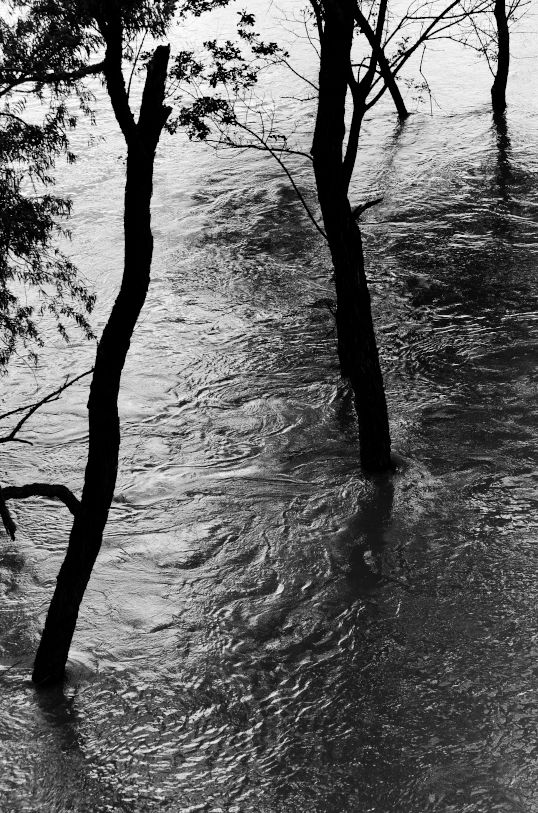
Old photo of the Trinity River in flood stage, Dallas, Texas
“What’s really important here,” I whispered loudly to myself,”is not the big things other people have thought up, but the small things you, yourself have”
― Haruki Murakami, Sputnik Sweetheart
“Why is geometry often described as “”cold” and “”dry?” One reason lies in its inability to describe the shape of a cloud, a mountain, a coastline, or a tree. Clouds are not spheres, mountains are not cones, coastlines are not circles, and bark is not smooth, nor does lightning travel in a straight line.”
― Benoît B. Mandelbrot, The Fractal Geometry of Nature










 Bill Chance