Bike Texas Margaret Hunt Hill Bridge Ride

When the plans for Santiago Calatrava’s Margaret Hunt Hill bridge were finalized a lot of folks were disappointed that it did not include pedestrian or bicycle lanes. We were promised that a crossing would be provided on the proximate Continental Bridge, which was being converted to a park. There is no other good way to cross the Trinity in that part of town without an internal-combustion engine. The final designs still don’t have the promised through-lanes – but it will open in June, we’ll see how it works out.

At any rate, there is a powerful urge to cross the bridge without a car. It is an impressive, imposing, work of art – and you don’t get a good look from a speeding vehicle. There was a big celebration on opening day, where people were allowed to walk across, but I was out of town and missed it.

Finally, last Saturday, after two years, they had another event planned – the All Out Trinity Festival and I would be able to ride my bike across the bridge. I wanted to get down there right when the ramps opened, but Notting Hill was on TV – so I had to watch the end again.

I packed up my commuter bike and rode down to the Arapaho DART station. As usual, the train was pulling out just as I arrived on the platform, so I had to wait for the next one.

I was later than planned, but the timing worked out as I met a couple of friends riding through Downtown Dallas on the way to the bridge. We fought our way up the steep entry ramps onto the bridge itself.

It was a real thrill to ride on the bridge. Everybody was on the Westbound lanes – across the divider the Eastbound traffic still roared by. The pavement would vibrate like a monstrous guitar string whenever a big truck would rattle past.

There were a lot of events planned and I wasn’t sure what I wanted to do, but a group from Bike Texas gathered together for a ride through West Dallas – that sounded like a plan.

Bike Texas Group on the Margaret Hunt Hill Bridge, Dallas, Texas (click for larger version on Flickr)

Bike Texas Group on the Margaret Hunt Hill Bridge, Dallas, Texas
(click for larger version on Flickr)
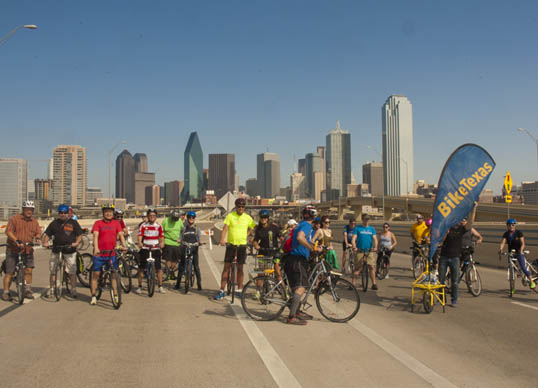
Bike Texas group on the bridge, with the Dallas skyline in the background. (click for full size version on Flickr)

Bike Texas group on the bridge, with the Dallas skyline in the background.
(click for full size version on Flickr)

Margaret Hunt Hill Bridge, Dallas, Texas (click for larger version on Flickr)

Margaret Hunt Hill Bridge, Dallas, Texas
(click for larger version on Flickr)

We headed West on Singleton. After a couple miles we passed Fish Trap Lake on the right – where I had ridden a couple months ago to visit the rainbow-colored pier, Dear Sunset, by Ugo Rondinone. The chromatic jetty was part of the Nasher XChange installation – now that the project has ended I wonder how long the pier will remain. It was good to see it still in place. People were out on the pier, so maybe they have even cleaned the bird shit off the wood.

dear sunset Ugo Rondinone West Dallas, Texas (click to enlarge)

dear sunset
Ugo Rondinone
West Dallas, Texas
(click to enlarge)

We rode down another mile and turned up to Tipton Park, where there is a new trail and pedestrian bridge.

Bike Texas ride at the Pedestrian Bridge in Tipton Park, West Dallas, Texas (click for full sized version on Flickr)

Bike Texas ride at the Pedestrian Bridge in Tipton Park, West Dallas, Texas
(click for full sized version on Flickr)

Pedestrian bridge, Tipton Park, Dallas, Texas (click for full sized version on Flickr)

Pedestrian bridge, Tipton Park, Dallas, Texas
(click for full sized version on Flickr)

Pedestrian bridge, Tipton Park, Dallas, Texas (click for full-sized version on Flickr)

Pedestrian bridge, Tipton Park, Dallas, Texas
(click for full-sized version on Flickr)

Riding back to the bridge, I was struck by the reaction of the people in the neighborhood. They acted like they had never seen a bicycle before – excited and astounded; some laughed, some clapped, some merely stared.

We arrived back in time for beers at Four Corners Brewery. The only thing better than a fresh local brew is one earned. I had an Oatmeal Stout and their IPA – both excellent. While we were standing around chatting, a thick column of smoke appeared to the south. Fire trucks were dispatched and the black soon turned to gray, then disappeared. Today, I found out that the fire was in a new construction across the street from the Belmont Hotel. Luckily, nobody was hurt.

The entertainment continued as we watched the police arrest a belligerent drunken woman that was stumbling down the street. She fought mightily, but in vain as they strapped her in the back of a cruiser and hauled her to the clink.

It was getting late, the sun had set, and until the Continental Bridge opens, Trinity Groves is a tough place from which to reach a DART station. I decided to ride down into the Trinity River bottoms and go a few miles south to the Corinth station, next to the Santa Fe Trestle Trail. This is the same route I took to visit the Dear Sunset Pier.

I certainly don’t recommend riding alone in the river bottoms at night – but it worked out for me. My lights were adequate to find my way in the pitch wilderness, while the multicolored jeweled towers of Downtown Dallas reached skyward off to the east. The day’s route was a fifteen mile bike ride (plus the four miles from my home to the DART station) with a lot of time spent hanging out and around with a lot of cool people – a good day.

It had been warm, on the edge of hot, a good eighty degrees – but as I rode home from the station I felt the wind switch around to the north and the temperature begin to drop. In twelve hours the temperature would be around twenty degrees and the ground covered in a healthy layer of tiny balls of ice. Springtime in Texas.


Skipping Rope in the River Bottoms

After I left the Trans.lation Market in Vickery Meadow I took the DART train across the Trinity River. As we were crossing I saw a large group of bicyclists going past on the Santa Fe Trestle Trail. It was the Ye Olden Tymes Vintagey Retro Ride & Picnic – I had hoped to get down there before them, but I wasn’t all that very late.

As I rode down from the train station all the walkers coming the other way said, “They’re a long ways ahead of you.” All of them, really.
“I’ll catch up, don’t worry,” I replied.

And I did. It was a lot of fun.

Skipping rope at Ye Olden Tymes Vintagey Retro Ride & Picnic. (click to enlarge)

Skipping rope at Ye Olden Tymes Vintagey Retro Ride & Picnic.
(click to enlarge)

Black & Blue: A Cultural Oasis in the Hills, Nasher XChange, Entry Eight of Ten

Previously in the Nasher XChange series:

  1. Flock in Space, Nasher XChange, Entry One of Ten
  2. X , Nasher XChange, Entry Two of Ten
  3. Fountainhead , Nasher XChange, Entry Three of Ten
  4. Moore to the Point, Nasher XChange, Entry Four of Ten
  5. Buried House, Nasher XChange, Entry Five of Ten
  6. dear sunset, Nasher XChange, Entry Six of Ten
  7. Music (Everything I know I learned the day my son was born), Nasher XChange, Entry Seven of Ten

I had a cycling route picked out from the Audubon Center to Paul Quinn College, where the next Nasher XChange installation was located. It involved a trail through the Great Trinity Forest across the Trinity River. I was a little nervous about that – the green lines were clear enough on the Google Maps Cycling Layer, but I wasn’t sure the trails were finished or even if they went exactly where the map said they did. Documentation on trails when they are finished is light and unreliable and I was going to be alone and a long way from home.

…Shouldn’t have worried – the route through the forest was a beautiful ride. New, smooth, level trail, gentle winding, and that feeling that, in only a few feet, you have left a giant city for some remote wooded wilderness. Of my entire ride that day, this is the part I will return to. There are more trails under construction – hopefully there will eventually be a complete complex that can be used for recreation and transportation.

The forest was, of course bare, the sky leaden and gray – but the promise of green spring isn’t very far away. There will be a narrow sliver of time between when the vegetation comes alive yet before the killer summer heat slams home. I’ll have to plan a trip in that window – maybe a picnic somewhere. On this day I had it all to myself and it’s hard to imagine other people down in that isolated forest – but maybe someday.

As I emerged from the trail system onto Simpson Stewart Road I began to see some familiar landmarks. I was surprised at how far south I had ridden. Off to the side was an incongruous mountain rising from the tabletop flat river bottom lands – a treeless smooth, undulating highland beginning to cast a long shadow over the winter afternoon. This is the McCommas Bluff Landfill – a gigantic pile used to dispose of the city’s detritus – a massive hidden cache of flotsam and jetsam.

Then I rode past a building, the city’s Eco Park structure. I had been there several times for meetings or educational events – and had always looked at the abandoned roads stretching out into the floodplain and wondered about riding a bike there. I was surprised to find myself coming the other way.

At that point I arrived back into civilization… and road traffic. There was a nasty steep hill leading up to the entrance to Paul Quinn College and the next stop on the Nasher XChange tour – Vicki Meek’s Black & Blue: Cultural Oasis in the Hills. The exhibition is a series of artworks posted around as signs that illustrate the history of Bishop College – a historic educational institution that sat on the site.

I was exhausted from the hill climb and running late, so I wasn’t able to take the time or energy to find all of the exhibit or to give it proper thrift – but I could feel the history, the promise, and the difficulties that an institution like Bishop College offers or offered and faces or faced.

I still had miles to go, another XChange site to visit – and after that a train station to find and two trains to take home. I was getting tired and slowing down more and more. Nothing to do but keep pedaling.

Vicki Meek, Black & Blue: A Cultural Oasis in the Hills

Vicki Meek, Black & Blue: A Cultural Oasis in the Hills

Vicki Meek, Black & Blue: A Cultural Oasis in the Hills

Vicki Meek, Black & Blue: A Cultural Oasis in the Hills

From the Nasher Website:

DALLAS, Texas (August 16, 2013) – The Nasher Sculpture Center is pleased to reveal the plans for a newly commissioned work by artist Vicki Meek that will be located on the campus of Paul Quinn College. The work is one of ten commissions for the Nasher’s 10th anniversary, city-wide exhibition Nasher XChange, which will be on view October 19, 2013 through February 16, 2014.

Entitled Black & Blue, Cultural Oasis in the Hills, Vicki Meek plans to celebrate Bishop College’s role in the intellectual and cultural life of Dallas through a series of historical markers commemorating important people and moments from the college, and which will also include an interactive web component and video interviews. Bishop College was a historically black college founded in Marshall, Texas in 1881 that moved to southern Dallas in 1961 and closed in 1988. The campus is now occupied by Paul Quinn College.

To develop her project, Vicki Meek is working with former Bishop College faculty and alumni, and members of the Highland Hills and Singing Hills neighborhoods around the school. Bishop College played a significant role in the development of academic and cultural life in Dallas, giving birth to important cultural institutions such as the African American Museum and the Dallas Black Dance Theatre.

She describes the motivation behind her work as a desire, “to reclaim African American history, restore our collective memory and illuminate critical issues affecting the Black community through visual communication.”

Meek, a native of Philadelphia, PA, is a nationally-recognized artist residing in Dallas, Texas. Trained as a sculptor, she has focused on installation art for the past 25 years that asks for direct engagement from the viewer in an effort to foster dialogue on often difficult subject matter. Meek’s work is in the permanent collections of the African American Museum in Dallas, The Museum of Fine Arts in Houston and Norwalk Community College in Norwalk, Connecticut. She was awarded three public art commissions with the Dallas Area Rapid Transit Art Program and was co-project artist on the largest public art project in Dallas, the Dallas Convention Center Public Art Project. In addition, Meek is an independent curator and writes cultural criticism for her blog, Art & Racenotes. Meek is currently the Manager of the South Dallas Cultural Center and serves as Chair of the Board of Directors for National Performance Network.

What I learned this week, February 14, 2013

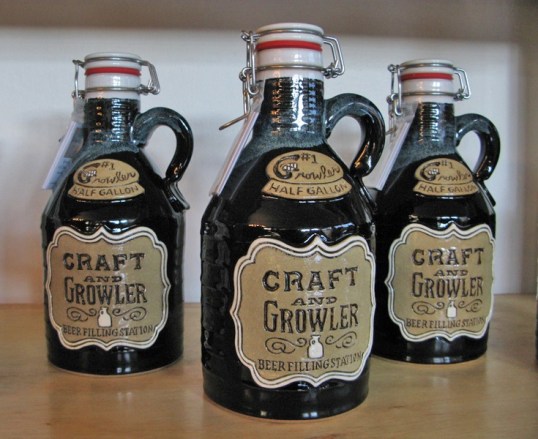
craft_growler

10 Gorgeous Growlers

A pint of beer is delicious, but not as delicious as four pints…poured into a massive bottle…that you can take with you. I’m talking growlers, people—everybody’s favorite Big Boy Traveler. We’ve rounded up 10 of the sleekest, prettiest, downright sexiest growlers on the market. These aren’t just growlers, these are conversation starters, party starters, and veritable works of art. It’s okay to drool.

In my opinion, the most gorgeous growler is one I have in my hand, with cold Lakewood Temptress, Peticolas Velvet Hammer, or even Revolver Blood and Honey filling it.


Four reasons US business leaders want to import Danish-style cycling

At long last, cycling is being supported by American business – not out of environmentalism but because it’s delivering profit


Harry Potter and the Half-Crazed Bureaucracy

From 2006, an excellent piece from the Michigan Law Review.

Abstract:

This Essay examines what the Harry Potter series (and particularly the most recent book, The Half-Blood Prince) tells us about government and bureaucracy. There are two short answers. The first is that Rowling presents a government (The Ministry of Magic) that is 100% bureaucracy. There is no discernable executive or legislative branch, and no elections. There is a modified judicial function, but it appears to be completely dominated by the bureaucracy, and certainly does not serve as an independent check on governmental excess.

Second, government is controlled by and for the benefit of the self-interested bureaucrat. The most cold-blooded public choice theorist could not present a bleaker portrait of a government captured by special interests and motivated solely by a desire to increase bureaucratic power and influence. Consider this partial list of government activities: a) torturing children for lying; b) utilizing a prison designed and staffed specifically to suck all life and hope out of the inmates; c) placing citizens in that prison without a hearing; d) allows the death penalty without a trial; e) allowing the powerful, rich or famous to control policy and practice; f) selective prosecution (the powerful go unpunished and the unpopular face trumped-up charges); g) conducting criminal trials without independent defense counsel; h) using truth serum to force confessions; i) maintaining constant surveillance over all citizens; j) allowing no elections whatsoever and no democratic lawmaking process; k) controlling the press.

This partial list of activities brings home just how bleak Rowling’s portrait of government is. The critique is even more devastating because the governmental actors and actions in the book look and feel so authentic and familiar. Cornelius Fudge, the original Minister of Magic, perfectly fits our notion of a bumbling politician just trying to hang onto his job. Delores Umbridge is the classic small-minded bureaucrat who only cares about rules, discipline, and her own power. Rufus Scrimgeour is a George Bush-like war leader, inspiring confidence through his steely resolve. The Ministry itself is made up of various sub-ministries with goofy names (e.g., The Goblin Liaison Office or the Ludicrous Patents Office) enforcing silly sounding regulations (e.g., The Decree for the Treatment of Non-Wizard Part-Humans or The Decree for the Reasonable Restriction of Underage Sorcery). These descriptions of government jibe with our own sarcastic views of bureaucracy and bureaucrats: bureaucrats tend to be amusing characters that propagate and enforce laws of limited utility with unwieldy names. When you combine the light-hearted satire with the above list of government activities, however, Rowling’s critique of government becomes substantially darker and more powerful.

full essay available for download


One-month countdown for Snuffer’s to reopen at original Lower Greenville locale

Snuffer’s on Lower Greenville is the first place I went to when I first visited Dallas in 1980. It had only been open for a year. A couple years later I moved into an apartment on the same block – it became our go-to place. I’m glad it’s re-opening on the original location and not too bothered by it being in a new building (the old one was spectacularly uncomfortable) but I will miss going and sitting in the same booth I remembered from 34 years earlier.


8 new acoustic songs to start out your day


What are the chances that a particle collider’s strangelets will destroy the Earth?

“Johnson and Baram are concerned that these changes might increase the possibility that the collider will generate strangelets, hypothetical particles consisting of up, down, and strange quarks. Some hypotheses suggest that strangelet production could ignite a chain reaction converting everything into strange matter.” Leading to the Earth becoming “an inert hyperdense sphere about one hundred metres across.”

Great… and I thought I had enough to worry about.


An Art Deco Airplane!

Buggatti 100P (click to enlarge)

Buggatti 100P
(click to enlarge)

LE RÊVE BLEU – IL SOGNO BLU – THE BLUE DREAM
Our MISSION is to build and fly a replica of the Bugatti 100P, the most elegant and technologically-advanced airplane of its time

Our VISION is to recreate – and share with others – the brief period in the late 1930s when Ettore Bugatti and Louis de Monge collaborated to create this singularly unique airplane

Our VALUES include a commitment to honoring the memory of those who designed and built this plane

Buried House, Nasher XChange, Entry Five of Ten

Previously in the Nasher XChange series:

  1. Flock in Space, Nasher XChange, Entry One of Ten
  2. X , Nasher XChange, Entry Two of Ten
  3. Fountainhead , Nasher XChange, Entry Three of Ten
  4. Moore to the Point, Nasher XChange, Entry Four of Ten

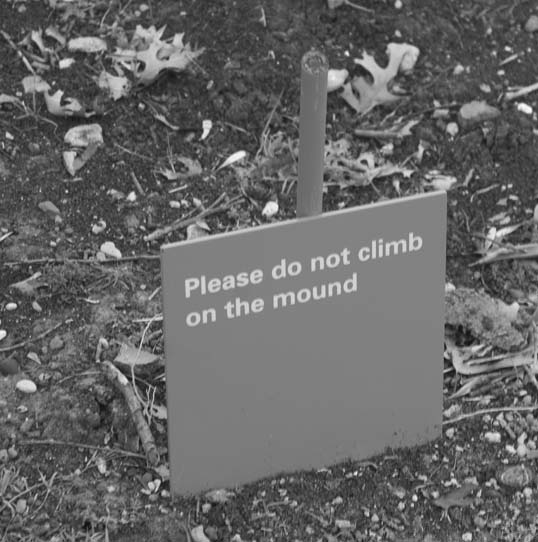
Lara Almarcegui
Buried House
2226 Exeter Ave.
Oak Cliff Gardens

I began to feel old, out of shape, and drained as I worked my way north from Paul Quinn College to the third and final Nasher XChange exhibition on my bike ride through South Dallas. It was only a 12.5 mile ride – but these were tough miles. The last half of the route was hilly, the road was rough, and I had to stop every block, fighting my way through the traffic.

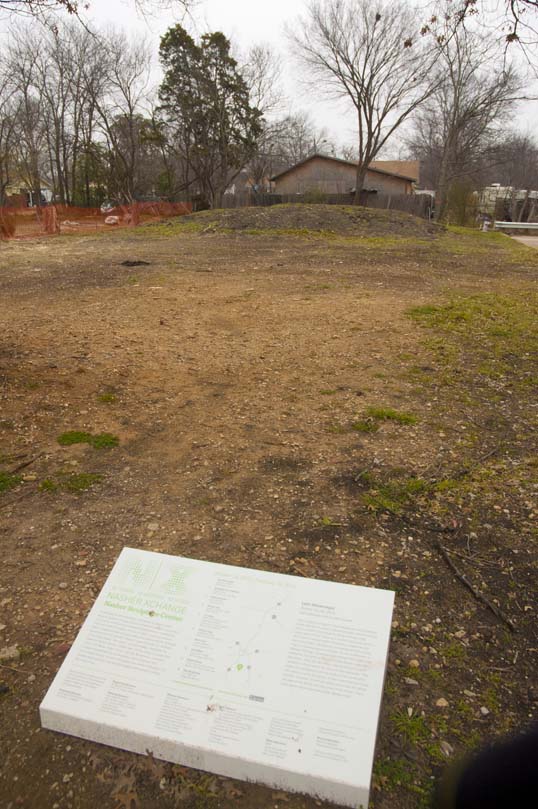
But once I rode up to Lara Almarcegui’s Buried House, I realized that here, more than any of the other sites, really begged to be seen by bicycle. I simply can’t imagine what it would be like to drive up to the now-vacant lot in an SUV, step out for a minute or two, then pile back in and drive home. It wouldn’t be the same… you would miss the point.

The work is meaningless without experiencing the surrounding neighborhood.

It is a tough part of town. The streets and sidewalks are in bad repair, cracked and heaving. Trash pickup is spotty at best. The modest homes are a varied melange – a torn up shack here, a burned hulk there, but there are also well-cared, decorated homes that are obviously a great source of pride to an unassuming owner.

And there were plenty of other vacant lots – most littered with junk and sprinkled with empty bottles.

You don’t see the details from a car… but you do from a tired, slow-moving bicycle.

Ironically, this is the second blog entry this February where I found myself taking a photo of a vacant lot. The other one, Arcady, was in the most tony enclave of Highland Park. That neighborhood is the polar opposite of the rugged Oak Cliff Gardens district where Buried House is located.

Destruction, renewal, the inevitable ultimate victory of chaos and entropy… rich and poor, our fate is already written.

After I left the site I had a a short ride on neighborhood streets until I reached the DART Kiest Station and after a short wait, caught the Blue Line downtown, where I switched to the Red line to Richardson and home.

Lara Almarcegui Buried House

Lara Almarcegui
Buried House

From the Nasher Website:

Buried House
2226 Exeter Ave.
Oak Cliff Gardens

The buried remains of a house offer an opportunity for reflection on the transition
and rebirth of one of Dallas’s oldest neighborhoods: Oak Cliff Gardens.
Almarcegui’s project for Nasher XChange, entitled Buried House, involves working with Dallas Area Habitat for Humanity on a house in Southeast Dallas already slated for demolition. After the demolition is finished, the artist will bury the house’s remains on the property, creating a sort of memorial site that nonetheless retains the building’s actual substance and provides a “free space” for reflection on the neighborhood’s past, present and future.

Almarcegui is working in Oak Cliff Gardens, a neighborhood in East Oak Cliff, with a history almost as old as Dallas itself. Near the site of the first stop for stagecoaches headed out of Dallas for Central Texas, the area surrounding the intersection at Lancaster and Ann Arbor roads became the small town of Lisbon, which was in turn annexed by the city in 1929.

Today, Oak Cliff Gardens is a neighborhood in transition. Many derelict, often vacant, homes will undergo renovations, thanks to the help of organizations such as Habitat for Humanity. These “wastelands” in the neighborhood embody a significant historical moment of possibility when anything might happen. Almarcegui hopes to draw attention to this area and make people in Dallas aware of its rich and varied character, before it is changed forever.

From Google Maps Streetview - what the house looked like before the demolition.

From Google Maps Streetview – what the house looked like before the demolition.

buried3

Lara Almarcegui Buried House

Lara Almarcegui
Buried House

Label Text:

Lara Almarcegui
Buried House, 2013
Demolished and buried house

Born in Spain and based in The Netherlands, Lara Almarcegui brings attention to places most people pass without noticing, such as derelict, abandoned buildings and seemingly vacant plots of land.
Working in environments and places in the midst of transformation, Almarcegui researches and documents them, developing unconventional and creative ways of drawing attention to them. As her contribution to Nasher XChange, Almarceguui has worked with Dallas Area Habitat for Humanity to locate a house already slated for demolition. After the demolition, she buried the house’s remains on the property. As the artist has explained, “This project is a sculptural work that is about the construction that used to stand, the history of the house and how it was erected. However it’s not just about the house, but about the past of the terrain and the future of the terrain. It is a work about construction and urban development.”

Moore to the Point, Nasher XChange, Entry Four of Ten

Previously in the Nasher XChange series:

  1. Flock in Space, Nasher XChange, Entry One of Ten
  2. X , Nasher XChange, Entry Two of Ten
  3. Fountainhead , Nasher XChange, Entry Three of Ten

Rachel Harrison
Moore to the point
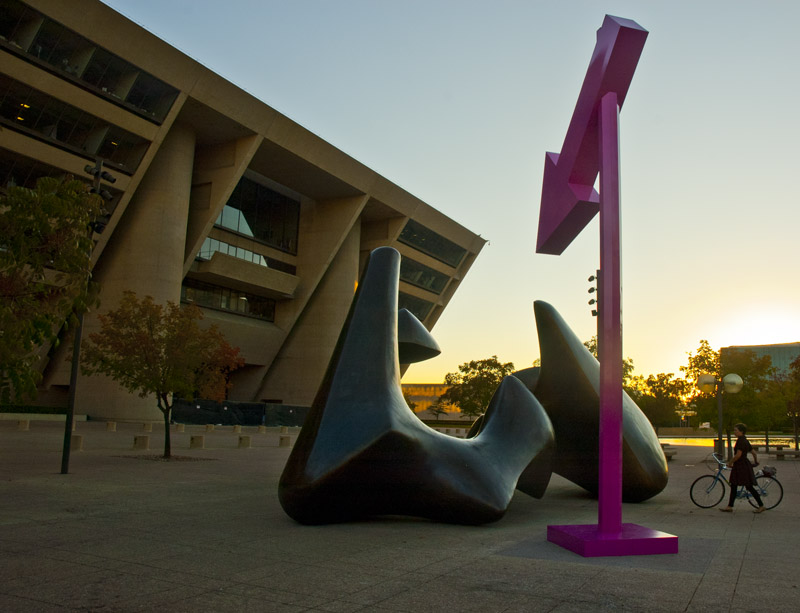
Dallas City Hall, Dallas, Texas

Ever since I first moved to Dallas in 1982, I was fascinated by the Plaza in front of Dallas City Hall. It seemed so modern, so stark, so big city. As a public space, as the years went by, everyone realized it was not all that successful – that it was too sterile and artificial and people didn’t like hanging out there. Still, it always amazed me.

There was that sculpture too, that famous piece, The Dallas Piece, by Henry Moore.

The funny thing is… the first time I saw Dallas City Hall Plaza and the Henry Moore sculpture, it was in an obscure PBS made for TV film of an Ursula K. Le Guin novel – The Lathe of Heaven. It was shown once on the little screen before disappearing for decades (now it has arisen from the dead… it is even available on Youtube). I happened to catch it and it made a huge impression on me. Enough that there was a real thrill in visiting the Dallas locations.

Now, when she was looking at the site for the Nasher XChange, looking at The Dallas Piece, Rachel Harrison noted that the sculpture had a fence, a barricade, around it. That bothered her, a work of art like that should be exposed and available, not locked up.

Henry Moore's Dallas Piece, barricaded for the Turkey Trot.

Henry Moore’s Dallas Piece, barricaded for the Turkey Trot.

I had seen the fence… when I saw it the thing had been erected for the massive crowds that throng the place for the Turkey Trot run. The rest of the time, it isn’t there.

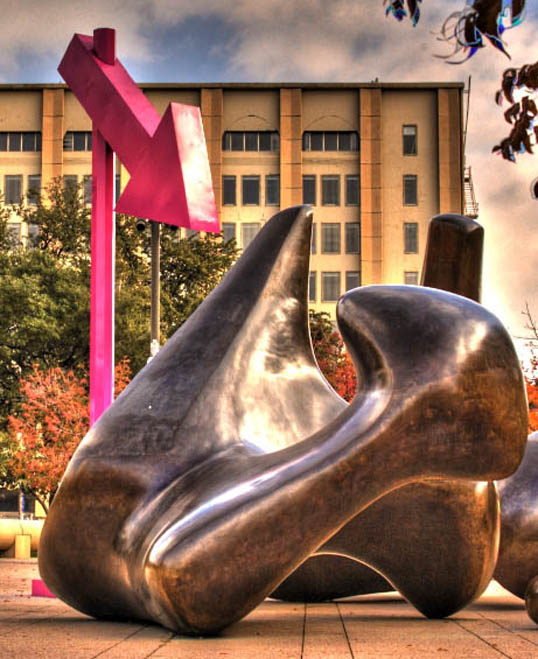
Still, she has a point… and the point is what she built.

This was a very easy sculpture to get to. We rode over to City Hall Plaza right after hearing the lecture at the Nasher. I rode on to the Hyatt Regency then, catching the Red DART line back home.

Rachel Harrison Moore to the point Dallas City Hall, Dallas, Texas (click to enlarge)

Rachel Harrison
Moore to the point
Dallas City Hall, Dallas, Texas

Amanda Popken, in front of Moore to the point (click to enlarge)

Amanda Popken, in front of Moore to the point
(click to enlarge)

Rachel Harrison Moore to the point Dallas City Hall, Dallas, Texas

Rachel Harrison
Moore to the point
Dallas City Hall, Dallas, Texas
(click to enlarge)

From the Nasher Website:

Rachel Harrison
New York, New York
Moore to the point
1500 Marilla St.
City Hall Plaza
A giant arrow pointing to Henry Moore’s sculpture, Three Forms Vertebrae (The Dallas Piece), calls attention not only to the work but to the conditions that frame our encounters with works of art.
For Nasher XChange, Harrison has fabricated a giant pink arrow to be installed in City Hall Plaza in downtown Dallas. The arrow points to an existing sculpture at the site, Henry Moore’s sculpture, The Dallas Piece. Harrison’s project grew out of a recent visit to Dallas City Hall during which she was surprised to see Moore’s outdoor sculpture encircled by metal barricades. For Harrison, the barricades recalled the metal stanchions now commonly found surrounding sculptures in museums, a feature Harrison has sometimes referred to in her own work.
Although the barricades have been removed, most visitors still walk around the sculpture, rather than moving through it as Moore had intended. Harrison’s giant arrow calls attention not only to Moore’s often-overlooked piece but to the conditions that frame our encounters with works of art.

Rachel Harrison Moore to the point City Hall Plaza (click to enlarge)

Rachel Harrison
Moore to the point
City Hall Plaza

Rachel Harrison Moore to the point City Hall Plaza (click to enlarge)

Rachel Harrison
Moore to the point
City Hall Plaza
(click to enlarge)

Rachel Harrison Moore to the point City Hall Plaza (click to enlarge)

Rachel Harrison
Moore to the point
City Hall Plaza
(click to enlarge)

X , Nasher XChange, Entry Two of Ten

Previously in the Nasher XChange series:
Flock in Space, Nasher XChange, Entry One of Ten

Out of the wide variety of the Nasher XChange art exhibition the sculpture/work that is closest to where I live is X, a sculpture done by Liz Larner on the University of Texas at Dallas (UTD) campus. It’s ten easy bicycle miles, with a trail the whole way. On cold and wet Sunday morning, I bundled up and rode up there – forgetting my map, so I had to wander the campus a bit until I found the sculpture.

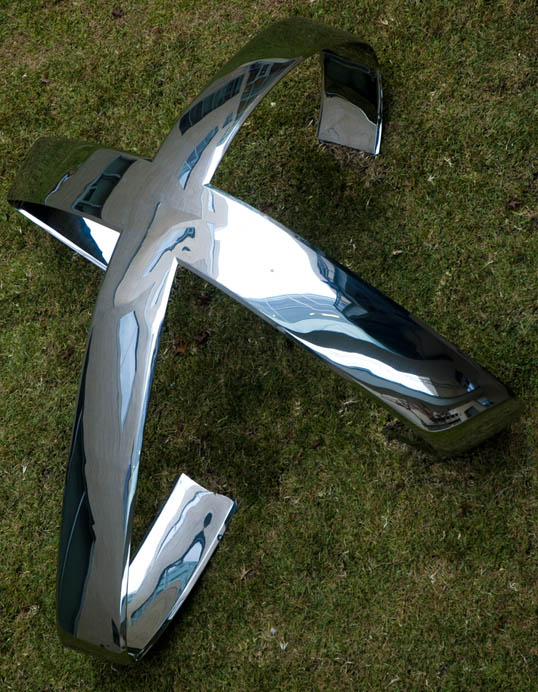
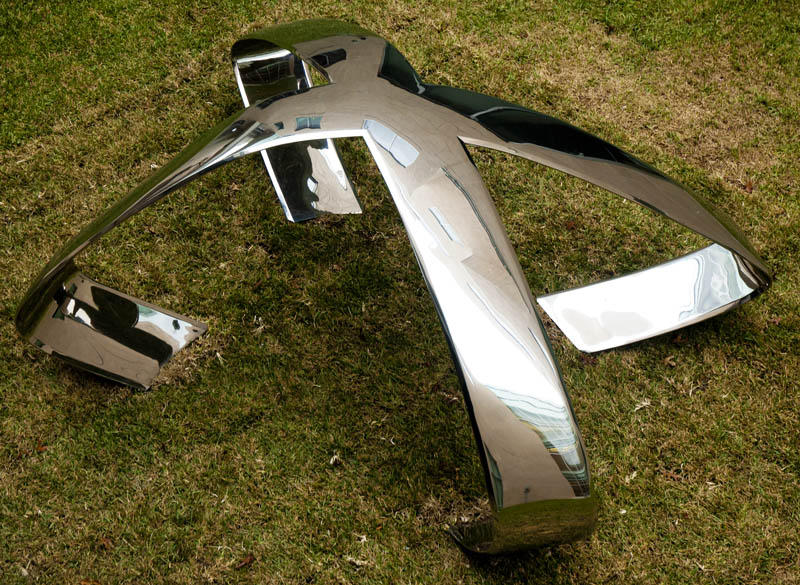
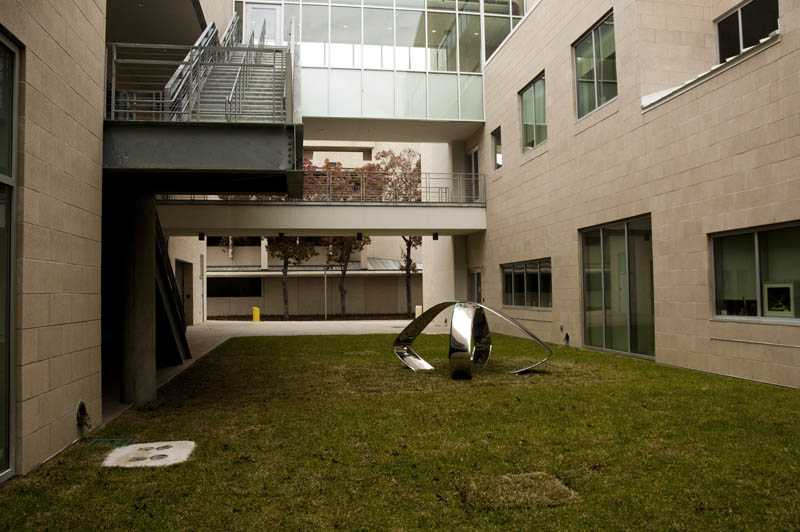
There are actually two versions. A preliminary wooden version sits inside a lobby of the new arts and science building while a polished metal version sits in a deep, narrow grass-covered atrium outside. It’s a surprisingly isolated location – I can’t imagine too many people visiting it there, unless you count the students walking by overhead along some exterior corridors.

In some ways I like the wooden, temporary version better. It seems warmer and more organic – a nice contrast to the abstract mathematical variable qualities of the X.

Liz Larner X,  UTD, Richardson, Texas

Liz Larner
X,
UTD, Richardson, Texas

Liz Larner X,  UTD, Richardson, Texas (click to enlarge)

Liz Larner
X,
UTD, Richardson, Texas
(click to enlarge)

From the Nasher Website:

Liz Larner
Los Angeles, California
X
800 W. Campbell Rd.
University of Texas at Dallas
Edith O’Donnell Arts and Technology Building

Two sculptures elegantly symbolize the intersection of art and technology.

Liz Larner is a Los Angeles-based artist whose work has been characterized by a sustained examination into the nature of sculpture. For Nasher XChange, Larner has created two sculptures for the new Edith O’Donnell Arts and Technology Building as a symbol for the exchange of ideas between these disciplines. Arts and Technology is a new interdisciplinary curriculum at UT Dallas that fosters collaboration at the intersection of the arts and humanities with science and engineering, and is a partnership between the Erik Jonsson School of Engineering and Computer Science and the School of Arts and Humanities.

The innovative X-shape of the sculptures, described by the artist as continuing her “investigation into the open form and the use of line to create volume,” has been developed over several years and could not have been realized without the use of digital modeling technology.

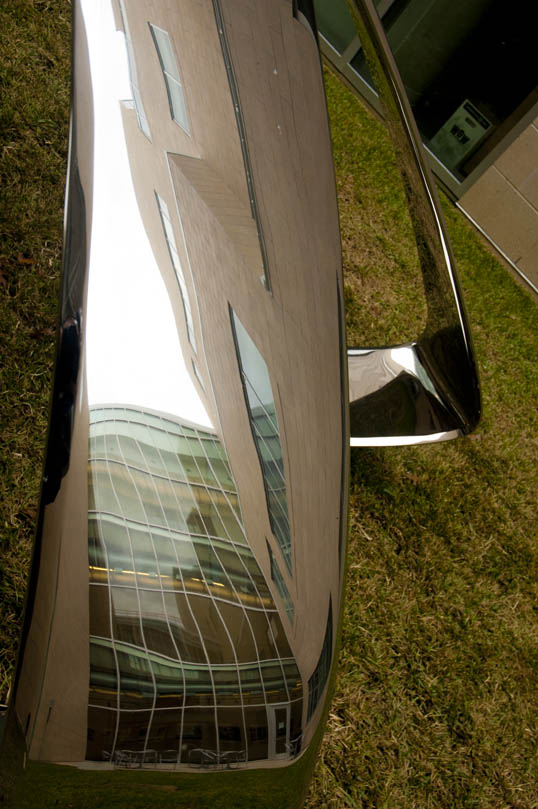
Larner’s experience working both with and without technology intrigued faculty at UT Dallas, and made this pairing a natural fit as the program progresses through its first year. A wood version of the sculpture, on view inside the building, embodies the intersection of traditional sculpture media and new technology. The stainless steel version, being made for the outdoor courtyard, evokes the futuristic and technological, providing a fleeting succession of colors and flashes of light and shadow reflecting the activities and experiences of the building’s occupants and visitors.

Liz Larner X,  UTD, Richardson, Texas (click to enlarge)

Liz Larner
X,
UTD, Richardson, Texas
(click to enlarge)

Liz Larner X,  UTD, Richardson, Texas (click to enlarge)

Liz Larner
X,
UTD, Richardson, Texas
(click to enlarge)

Liz Larner X,  UTD, Richardson, Texas

Liz Larner
X,
UTD, Richardson, Texas

From the Label Text:
Liz Larner
X, 2013
Stainless steel
Courtesy of the artist and Regen Projects, Los Angeles

Los Angeles-based artist Liz Larner engages some of the most intrinsic issues of sculpture, such as the relation of line and mass, or of volume and density, yet she does so in unexpected ways, in a range of materials and techniques. For Nasher XChange, Larner has created two sculptures for the new Edith O’Donnell Arts and Technology Building that can be seen as figures enacting the exchange of ideas between these disciplines. The X-shape of the sculptures, described by the artist as continuing “my investigation into the open form and the use of line to create volume,” has developed over several years and could not have been realized without Larner’s use of digital modeling technology. A wood version of the sculpture, on view inside the building, embodies the intersection of traditional sculpture media and new technology. A stainless steel version, seen here, evokes the futuristic and technological, providing a fleeting succession of colors and flashes of light and shadow reflecting the activities and experiences of the building’s occupants and visitors.

Liz Larner X,  UTD, Richardson, Texas Indoor, Wooden Version (click to enlarge)

Liz Larner
X,
UTD, Richardson, Texas
Indoor, Wooden Version
(click to enlarge)

My Raleigh Technium road bike reflected in the window outside X,  UTD, Richardson, Texas

My Raleigh Technium road bike reflected in the window outside
X,
UTD, Richardson, Texas

Flock in Space, Nasher XChange, Entry One of Ten

In October, I went to a lecture at the Nasher Sculpture Center about the Nasher XChange – a fascinating exhibition of ten varied artistic works spread out across Dallas. Listening to the speakers – one subject they kept coming back to again and again is how big the city is, how spread out the sites of the XChange are, and how much driving they have had to do on this project. They kept talking about Dallas as a “car oriented city” and the way the city seems to consist completely of massive freeways and parking lots.

The lecture was entertaining and interesting and I agree, mostly, with the speakers. However, this is not how it has to be. If you never get out of your car then the city does seem to consist of freeways and parking lots.

It is huge and spread out – but I have learned that if you have a DART train pass and a bicycle, you can get anywhere. I made the decision, right then and there, to visit all ten Nasher Xchange sites without using a car. I immediately took a look at the map and began plotting my routes.

The weather has been nasty this winter which has really cut into my bike riding – plus I’ve been sick a lot (Cedar Fever, actually) so I didn’t get out as fast as I wanted to. As of this weekend, I had been to (or seen) six. There were still three sites in South Dallas that were still on my list.

I worked out a route – take the Red DART line from Richardson to Downtown Dallas, then the Green Line to the Buckner Station. Then I could ride to the sculpture Flock in Space at the Trinity River Audubon Center, then a trail through the Great Trinity Forest on to Black & Blue Cultural Oasis in the Hills at Paul Quinn College. At that point I would turn north and ride through the neighborhoods to the third Nasher exhibit – Buried House. Then catch the DART Blue Line at the Kiest Station – transfer to the Red Line downtows and back home. The biking distance was 12.5 miles – not too far.

But this was a part of the city that I was not familiar with at all. I wasn’t too comfortable with my route; sometimes it’s hard to decide how bad traffic is based on Google Maps – but you have to do the best you can do.

The weather today was not too good, cold with a little spitting rain, but there’s a cold front blowing in and it’s not going to get better soon. The Nasher XChange Exhibition ends soon. So it was now or never.

The only problem I had getting from the train station to the first exhibit – at the Trinity River Audubon Center was the fact that the neighborhood had a lot of folks with pit bulls running loose. I can usually outrun a dog on my bike, but it’s not a lot of fun.

I’m going to have to go back to the Audubon Center again – with nicer weather and more time. The bike trails are really nice. The sculpture was very cool. But I had somewhere to get to so I snapped a few pictures and set out again.

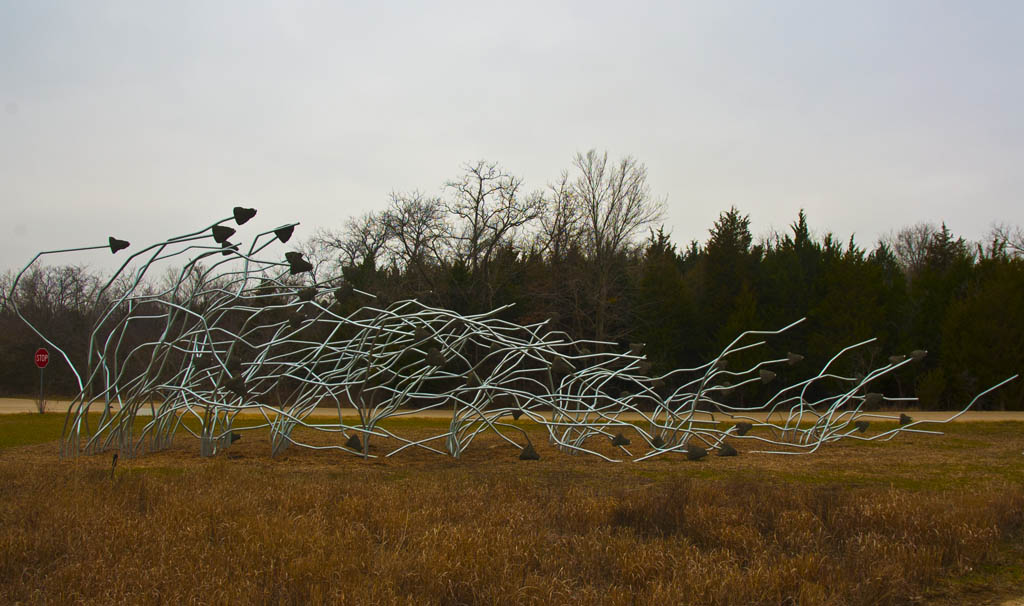
Flock in Space, Ruben Ochoa Trinity River Audubon Center, Dallas, Texas (click to enlarge)

Flock in Space, Ruben Ochoa
Trinity River Audubon Center, Dallas, Texas
(click to enlarge)

Flock in Space, Ruben Ochoa Trinity River Audubon Center, Dallas, Texas (click to enlarge)

Flock in Space, Ruben Ochoa
Trinity River Audubon Center, Dallas, Texas
(click to enlarge)

From the Label Text:

Ruben Ochoa
Flock in Space, 2013
Concrete and steel

Ruben Ochoa is a Los Angeles-based artist who has created a unique body of work that transforms common materials into breathtaking sculptures. For his Nasher Xchange commission. Ochoa has responded to the origins of the rinity River Audubon Center – now a beautiful nature preserve at the edge of the largest urban hardwood forest in the United States – as an illegal dump site in Southeast Dallas. Ochoa has installed a group of concrete and steel sculptures derived from post footings in chain link fences. In conversation with Brancusi’s iconic sculpture Bird in Space, Ochoa envisions his installation as man-made forms morphing into organic movement, reminiscent of a flock of birds. By evoking the site’s change from urban dumping ground to place of scenic beauty, Ochoa’s work reflects the malleability and resiliency of nature.

My commuter bike in front of Flock in Space, Ruben Ochoa Trinity River Audubon Center, Dallas, Texas (click to enlarge)

My commuter bike in front of Flock in Space, Ruben Ochoa
Trinity River Audubon Center, Dallas, Texas
(click to enlarge)

Flock in Space, Ruben Ochoa Trinity River Audubon Center, Dallas, Texas (click to enlarge)

Flock in Space, Ruben Ochoa
Trinity River Audubon Center, Dallas, Texas
(click to enlarge)

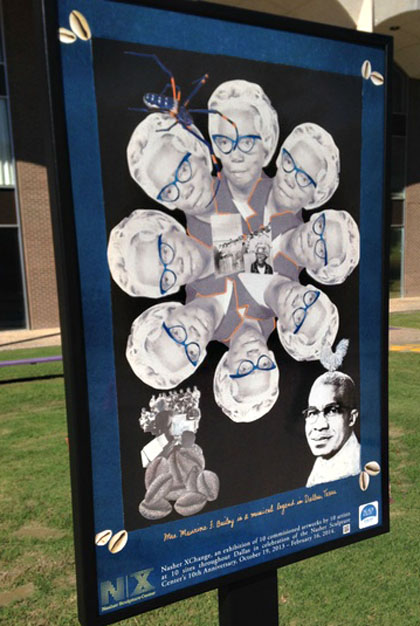
Decorated Dumpsters

Why is the dumpster decorated? Who is that in the photo?

Design District Dallas, Texas

Design District
Dallas, Texas
(click to enlarge)

Art is where you find it.

You will never see stuff like this from a car (is that a good thing? maybe) – you are moving too fast and, hopefully, looking where you are going. On a bicycle you move slow (but, unlike walking, you can cover quite a bit of area) enough to see around, to notice things, and to stop and smell the dumpsters whenever you feel like it.

If you look on google maps street view, the dumpsters are there, but they aren’t decorated.

It’s right around the corner from the Faded Sign from the other day.

BTW, that Faded Sign – it wasn’t hard to figure out – it actually says, “Grandale Galleries”

Design District, Dallas, Texas (click to enlarge)

Grandale
(click to enlarge)

Galleries

Galleries

Grandale Galleries Warehouse is a recently defunct discount furniture store… as best as I can figure out.

Seventh Street Bridge

She’s driving home Sunday morning, with the
heat turned up, the windows rolled down
to the edge.
And yesterday, snowed for the first time.
Now no one’s on the Willis Avenue Bridge.

Used to be a hard merge.

—-Willis Avenue Bridge, David Berkeley

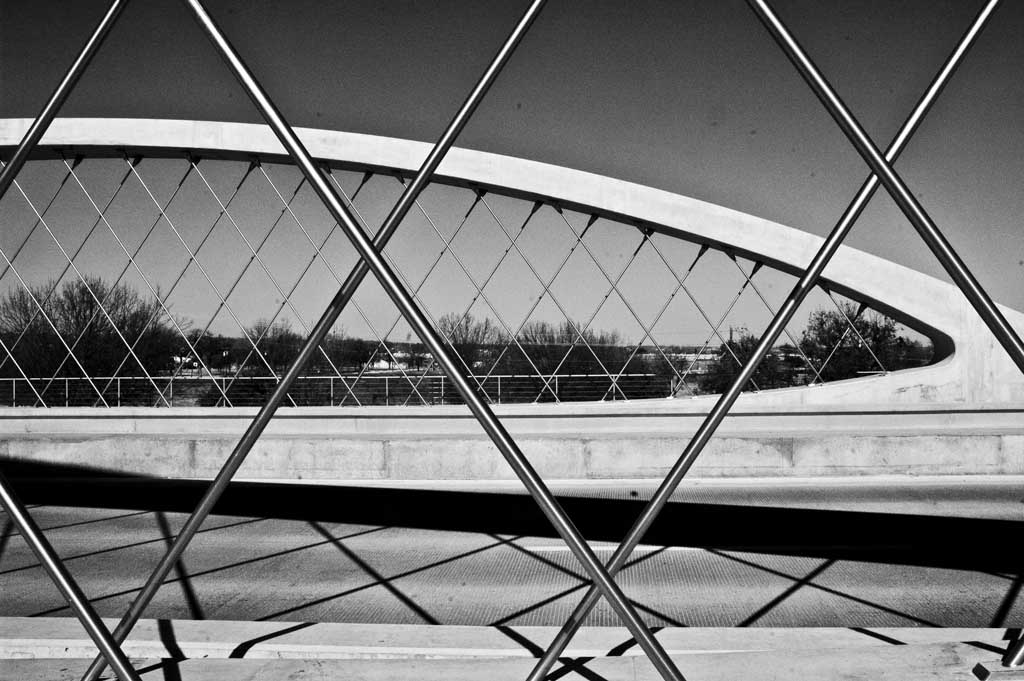
On our bike ride in Fort Worth last weekend, we made the point of riding across the new Seventh Street Bridge. It was pretty cool.

Seventh Street Bridge Fort Worth, Texas (click to enlarge)

Seventh Street Bridge
Fort Worth, Texas
(click to enlarge)

Seventh Street Bridge Fort Worth, Texas (click to enlarge)

Seventh Street Bridge
Fort Worth, Texas
(click to enlarge)

One really cool thing about the bridge is the bike lane.