Snøhetta Pavilion

As I was working my way through South Dallas on my bicycle exploring three of the Nasher XChange sites – between Flock in Space and Black & Blue: A Cultural Oasis in the Hills – I took a look at the GPS on my phone to make sure I wasn’t lost. I realized that I wasn’t far from something I wanted to visit. Even though I was behind schedule and getting tired I would be passing close enough to make a side trip.

So I did.

I turned off of Bonnie View Road into a neighborhood until I reached College Park. Past some guys playing basketball I found what I was looking for – a new park pavilion designed by the Oslo-New York firm Snøhetta. A review of the structure had shown up in the Dallas paper and aroundgathering some architectural praise.

It looked pretty interesting, enough for me to visit.

Snøhetta Pavillion, College Park, Dallas, Texas (click to enlarge)

Snøhetta Pavillion, College Park, Dallas, Texas
(click to enlarge)

Picnic Tables and Grills, Snøhetta Pavillion, Dallas, Texas (click to enlarge)

Picnic Tables and Grills, Snøhetta Pavillion, Dallas, Texas
(click to enlarge)

I couldn’t stay long, but it was pretty cool in person. An ingenious design – unusual, yet in harmony with the site. Striking, yet useful. It seems to have been economical to build and designed to last a long time.

The picnic tables and outdoor grills were an unexpected treat – I loved the design of these. I didn’t think there was much you could do with public picnic tables – but these were unique and cool.

Later, at home, I did some web research and found a publication that extolls the virtues of the Pavilions in Dallas parks – listing a whole slew of them.

Now that I’ve finished with the Nasher XChange, maybe that’s something I can cycle through town and look at. Picnic Pavilions are pretty pedestrian objects and I have to say I haven’t noticed them for a long time.

But isn’t that the point? To try and ride around my own city and notice things that everyone usually ignores?

Maybe so.

Arcady

“In the beginning, God created the earth, and he looked upon it in his cosmic loneliness.

And God said, “Let Us make living creatures out of mud, so the mud can see what We have done.” And God created every living creature that now moveth, and one was man. Mud as man alone could speak. God leaned close to mud as man sat, looked around, and spoke. “What is the purpose of all this?” he asked politely.

“Everything must have a purpose?” asked God.

“Certainly,” said man.

“Then I leave it to you to think of one for all this,” said God.

And He went away.”
― Kurt Vonnegut, Cat’s Cradle

4320 Arcady, Highland Park, Texas - a few months ago

4320 Arcady, Highland Park, Texas – a few months ago

Candy and I sometimes like to go to estate sales. Midweek we receive emails with lists of various sales throughout the city and, if I have time, I’ll go through the list, looking for interesting sales.

I don’t go to the sales so much to buy anything other than the occasional art object (I have enough useless crap already) – I go for the stories. You see, an estate sale – especially one where the owner has passed away after a long and interesting life – is a mirror into the past. It’s a museum displaying a person’s… a complete stranger’s entire collection of heart-ache and the thousand natural shocks that flesh is heir to. These timeless treasures are arranged and papertagged with a string and a price so the slouching horde can shuffle through, pawing at the lot.

It’s an afternoon’s entertainment.

A few months ago, I was clicking through the emails, looking at the collections of photos, trying to find something a little more curious and compelling than the ordinary run-of-the-mill when a certain address caught my eye.

4320 Arcady

I knew where Arcady street was. That’s the heart of the most expensive neighborhood in the most expensive town in the Metroplex – Highland Park. That’s where the rich and famous cavort in their multi-million dollar mansions. Plus, it is mostly old money – the rarefied world of the bloated upscale opulent set – a world I will never see, a life I will never lead. Maybe a glimpse.

I printed a map.

When we arrived, the place was not quite what I expected. The house was beautiful, an old Mediterranean Style two story with a red tile roof. And it was old. For Dallas, it was very old. It was like stepping back into a time machine.

There wasn’t much for sale and that was ancient and worn out. Still, I loved the old house, loved the high ceilings, loved the original windows – opened by metal hand-cranks with cracked ropes leading to sash weights inside the walls, loved the tiny white hexagonal tile in the bathrooms and kitchen (sometimes called “Dallas Tile”) loved the formal staircase, loved the deep wood of the floors… I even loved the thick old dust that coated everything like a blanket of compressed time. I wanted to find out more, so I headed to the huge bookcase that lined one wall of the living room.

There were University of Texas Yearbooks from 1942 and 1943. There were a couple of scrapbooks filled with old cartoons clipped from magazines in the 1950’s along with jokes written in a careful, elegant script (the kind everyone used to write in). Now, I wish I had bought the scrapbooks, but I put them back. Nothing else gave a clue.

I went out to the garage to talk to the person putting on the sale. He said, “The house has already been sold, I heard it was for three million. After this sale, it’s going to be torn down. The buyer is going to put up a new house on the lot.”

That made me sad. I looked down the street at the rows of fake Gothic mansions – all intended to look like English Manor homes shrunk down a little and plopped down right next to each other in the blistering heat of Texas. They all looked the same.

Now, I understand a little. The Arcady house had a tiny kitchen, and only a couple of miniscule bathrooms. That would never do. But it could be saved… a cleverly designed addition… a modern attached kitchen….

No, it would never work. People that live on Arcady street in Highland Park don’t understand uniqueness or preservation. It is an exclusive club they desperately want to join and to fit in you have to live in the proper house.

At home I did some searching. I found that the property had been bought by a builder and he had a replacement already designed by an architect named Wilson Fuqua. Ok.

I also found out who had lived in the house. It was a woman named Catherine Duls. Her father was a well-known Harvard educated attorney named William H Duls. I believe he built the house and moved his family there when his daughter was three. She lived there her entire life until she passed away at the age of 89.

Catherine played tennis at the University of Texas and worked at the SMU law library. Her friends called her Kitty. In her obituary, someone wrote, “ I loved her beautiful voice and Southern drawl, her gorgeous hair and complexion, and her fabulous sense of humor. She was complicated, intelligent, and wise. I appreciated her so very much. She will truly be missed.”

The other day, I had some work not too far away and because the traffic was lighter than I thought, arrived early enough to take a short detour down Arcady.

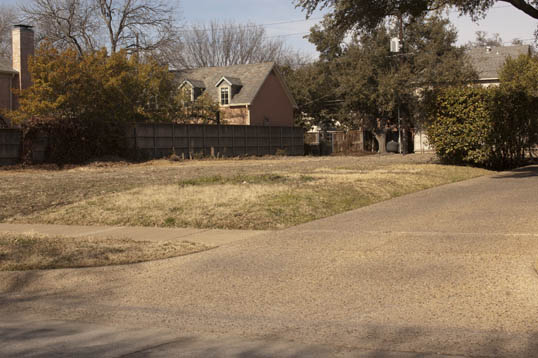
The house is now a vacant lot.

4320 Arcady, now

4320 Arcady, now

Seventh Street Bridge

She’s driving home Sunday morning, with the
heat turned up, the windows rolled down
to the edge.
And yesterday, snowed for the first time.
Now no one’s on the Willis Avenue Bridge.

Used to be a hard merge.

—-Willis Avenue Bridge, David Berkeley

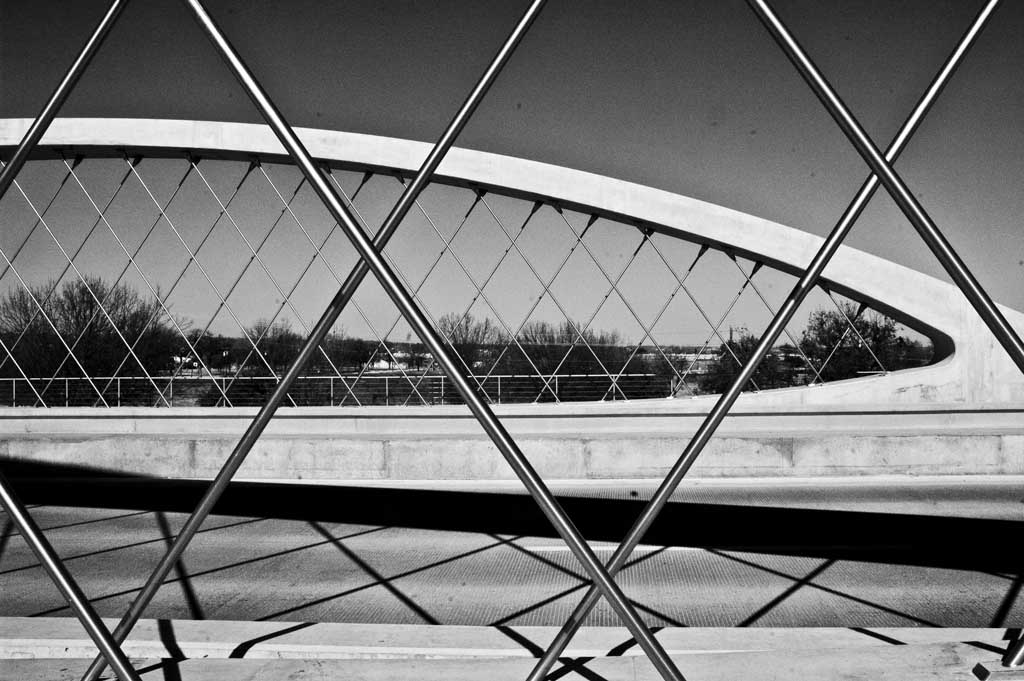
On our bike ride in Fort Worth last weekend, we made the point of riding across the new Seventh Street Bridge. It was pretty cool.

Seventh Street Bridge Fort Worth, Texas (click to enlarge)

Seventh Street Bridge
Fort Worth, Texas
(click to enlarge)

Seventh Street Bridge Fort Worth, Texas (click to enlarge)

Seventh Street Bridge
Fort Worth, Texas
(click to enlarge)

One really cool thing about the bridge is the bike lane.

Zigzag Moderne Art Deco

Last weekend I went on a bike ride in Fort Worth with some friends (will get a trip report written, I promise). We loaded up our bikes, rode the DART train to downtown Dallas and then took the TRE train to Forth Worth.

Our rail destination was the T&P Station south of downtown Fort Worth. This is a recently restored historic building built in 1931 as a beautiful example of Zigzag Moderne Art Deco (what a cool name!) architecture.

I love Art Deco – and there are some great examples in the Metroplex. The best known are the buildings, murals, and sculptures (here, here, here, and here) of Fair Park in Dallas

But the old ticket lobby of the T&P is a beautiful concentrated example of Art Deco excess and beauty. It’s a big room lost in time, available for wedding rentals, and dripping with history. You can almost feel the millions of travelers moving through on their way to the trains. Today, there were only some guys with their bicycles looking around… but at least it is still there, waiting for the next chapter.

Abstract Art Deco design in the T&P Waiting Room ceiling, modified in Adobe Illustrator. (click to enlarge)

Abstract Art Deco design in the T&P Waiting Room ceiling, modified in Adobe Illustrator.
(click to enlarge)

T&P Waiting Room, Fort Worth, Texas (click to enlarge)

T&P Waiting Room, Fort Worth, Texas
(click to enlarge)

Art Deco ventilation screen, T&P Waiting Room, Fort Worth, Texas

Art Deco ventilation screen, T&P Waiting Room, Fort Worth, Texas

T&P Waiting Room, Fort Worth, Texas (click to enlarge)

T&P Waiting Room, Fort Worth, Texas
(click to enlarge)

The Scene – Waiting for a Train

The Bank of America Plaza Building (the giant green thing) reflected in the mirrored sides of the Dallas Hyatt Regency. Taken from the Union Station DART platform while I was waiting on a train home from the Tweed Ride.

Bank of America Tower reflected in the Hyatt Regency, Dallas, Texas

Bank of America Tower reflected in the Hyatt Regency, Dallas, Texas
(click to enlarge)

Skyscraper and Clouds

“What about guns with sensors in the handles that could detect if you were angry, and if you were, they wouldn’t fire, even if you were a police officer?

What about skyscrapers made with moving parts, so they could rearrange themselves when they had to, and even open holes in their middles for planes to fly through?”

― Jonathan Safran Foer, Extremely Loud and Incredibly Close

Downtown Dallas, Texas

Downtown Dallas, Texas

“Aren’t the clouds beautiful? They look like big balls of cotton… I could just lie here all day, and watch them drift by… If you use your imagination, you can see lots of things in the cloud formations… What do you think you see, Linus?”

“Well, those clouds up there look like the map of the British Honduras on the Caribbean… That cloud up there looks a little like the profile of Thomas Eakins, the famous painter and sculptor… And that group of clouds over there gives me the impression of the stoning of Stephen… I can see the apostle Paul standing there to one side…”

“Uh huh… That’s very good… What do you see in the clouds, Charlie Brown?”

“Well, I was going to say I saw a ducky and a horsie, but I changed my mind!”

― Charles M. Schulz, The Complete Peanuts

Bridge and Jail

Another night, long exposure, a different zoom from the same spot, the abandoned parking garage, I shot from earlier. The white and red bars are the cars going by on the Interstate – smeared out in time. The buildings are part of the Dallas jail complex with the Calatrava designed Margaret Hunt Hill bridge in the background.

Dallas Jail complex with the Margaret Hunt Hill bridge in the background. (click to enlarge)

Dallas Jail complex with the Margaret Hunt Hill bridge in the background.
(click to enlarge)

The crossing between the parking lot you see and the building to the right is what I call, “the saddest spot in the world.” When you drive by there early in the morning on the weekends you see a crowd of families crossing from the lot to get in to bail their loved ones out of jail.

I’ve never been in there, but when I was younger I would occasionally get a desperate call to go down there and bail somebody out. After paying the clerk and waiting around for everything to process they would shuffle out. On the way to the car I would ask, “Well, what is is like in there?”

Nobody ever answered.


The jail complex is the Lew Sterrett Justice Center.

We all know how nasty the reviews on Yelp can be – but Lew Sterrett gets some intersting press there.

From Yelp:

I had a delightful time at Lew. The industrial vibe of the accommodations, combined with the summer camp atmosphere among the guests, somehow managed to be both sophisticated and good old-fashioned fun. The noise level was high, like the best hipster restaurants. And the complementary proctological exam was a nice surprise. Big D, little A, double L, A, YES!

this guy had something to say:

Wow this is the crappiest place on earth. I have been here twice(last time was November 06, and I would like to say the accomodations were dirty, dingy and downright disgusting. The staff seem like former Walmart employees or even criminals themselves(not to say that all inmates are convicted criminals because they are not). One word of advice…as soon as you get in, grab the nearest toilet paper roll(they are like gold in here) eat a couple of bologna sandwhiches, drink some fake cool aid, and live for the moment because you never know what the hell is about to happen around or too you.