A Month of Short Stories 2014, Day 3 – Regret

A year ago, for the month of June, I wrote about an online short story each day for the month. It seemed like a good idea at the time. My blog readership fell precipitously and nobody seemed to give a damn about what I was doing – which was a surprising amount of work.

Because of this result, I’m going to do it again this year.

Today’s story, for day three – is Regret, by Kate Chopin.

Read it online, here:
Regret

I read Kate Chopin’s best known work – the novel The Awakening in college, like most people do. It left a strong impression on me – both the story itself, and the strong character of its doomed protagonist.

I must not have been paying too much attention, however. In my defence, I was studying chemistry and literature and didn’t have enough time to do my reading all proper in between the marathon laboratory stints.

You see, the thing is, if you would have asked me about The Awakening I would have told you it was a European story, a French story, and the beach where so much takes place must have been on the Riviera somewhere.

What was I thinking? How could I have been so mistaken? A quick read, and a foggy memory, I guess.

As an adult, I reread The Awakening and realized that it wasn’t European at all – it took place in New Orleans – and the beach was Belle Isle. Now, I suppose in some way I wasn’t too far off – New Orleans is the most European of American cities – the French Influence is hard to miss.

But still….

Now today’s story, Regret… there is no doubt where this is taking place. Nowhere else will you find names like: Mamzelle Aurlie, Ti Nomme, little Lodie, Marcline and Marclette.

In a short story there is plot, and setting (this one has a little plot and an implied setting) and there is characterization. The reward of Regret is in its characterization.

It’s tough to find room in a work this brief for a protagonist to learn and to change – but Chopin pulls it off.

Not only does the protagonist learn and change… but she realizes that it is all in vain, that it is too late.

Isn’t it always?

She turned into the house. There was much work awaiting her, for the children had left a sad disorder behind them; but she did not at once set about the task of righting it. Mamzelle Aurlie seated herself beside the table. She gave one slow glance through the room, into which the evening shadows were creeping and deepening around her solitary figure. She let her head fall down upon her bended arm, and began to cry. Oh, but she cried! Not softly, as women often do. She cried like a man, with sobs that seemed to tear her very soul. She did not notice Ponto licking her hand.

A Month of Short Stories 2014, Day 2 – On the Gull’s Road

A year ago, for the month of June, I wrote about an online short story each day for the month. It seemed like a good idea at the time. My blog readership fell precipitously and nobody seemed to give a damn about what I was doing – which was a surprising amount of work.

Because of this result, I’m going to do it again this year.

For the second entry in this month’s list of short stories, on this second day of June, I give you a classic chestnut by Willa Cather, On the Gull’s Road.

Read the story online here:
On the Gull’s Road

I know people that read a lot of Cather. I haven’t read that much.

I always think of her as a Nebraska writer (though I know she lived most of her life in New York) and primarily as a chronicler of life on the plains.

This story couldn’t be further from that. It’s a story of doomed young love on a ship leaving Italy.

One thing that jumps out is her wonderful ability to describe life on a ship. I’ve been on cruises – and the whole deal is so much different that what a sea voyage from Italy in that time must have been – but I recognize the scene and the unique unfettered feel that riding the waves leaves behind.

The sun had disappeared over the high ridge behind the city, and the stone pines stood black and flat against the fires of the afterglow. The lilac haze that hung over the long, lazy slopes of Vesuvius warmed with golden light, and films of blue vapor began to float down toward Baiae. The sky, the sea, and the city between them turned a shimmering violet, fading grayer as the lights began to glow like luminous pearls along the water-front, — the necklace of an irreclaimable queen. Behind me I heard a low exclamation; a slight, stifled sound, but it seemed the perfect vocalization of that weariness with which we at last let go of beauty, after we have held it until the senses are darkened. When I turned to her again, she seemed to have fallen asleep.

Of course, the oddest thing about the story is the ambiguous sex of the narrator – who falls in love with the doomed, married Mrs. Ebbling. Reading it, I assumed the narrator was a man (…anticipating a consular appointment…) but on careful examination it seems that this little fact is deliberately blurred. The narrator’s name is never mentioned and is never referred to by any pronoun that would give their sex away.

This ambiguity adds a layer of unreal mystery to the love between the two young people. It reinforces the melancholy, the feeling of loss, of regret, and of nostalgia that permeates the story.

There is a lot more here than a simple shipboard infatuation.

“Don’t say that. When I leave you day after tomorrow, I shall have given you all my life. I can’t tell you how, but it is true. There is something in each of us that does not belong to the family or to society, not even to ourselves. Sometimes it is given in marriage, and sometimes it is given in love, but oftener it is never given at all. We have nothing to do with giving or withholding it. It is a wild thing that sings in us once and flies away and never comes back, and mine has flown to you. When one loves like that, it is enough, somehow. The other things can go if they must. That is why I can live without you, and die without you.”

A Month of Short Stories 2014, Day 1 – A Lack of Order in the Floating Object Room

A year ago, for the month of June, I wrote about an online short story each day for the month. It seemed like a good idea at the time. My blog readership fell precipitously and nobody seemed to give a damn about what I was doing – which was a surprising amount of work.

Because of this result, I’m going to do it again this year.

Today, the first of June, I present a nice, brief, short story by George Saunders, A Lack of Order in the Floating Object Room. It’s available online, here:

A Lack of Order in the Floating Object Room

Go ahead and read it – won’t take too long.

I have become a fan of George Saunders in the last few years. One of his stories, Sea Oak, was read and written about in the aforementioned June of 2013. More recently I wrote about the book, Tenth of December – his most recent tome of short fiction. I have checked his book Pastoralia out from the local library and it is next on my reading list.

His stories are full of tragedy and absurd humor. They dwell on the corporate influence on our lives today and take the soulless void of daily life – and stretch it to the extreme. Below this surface, though, lies the innermost desires and passions of the human heart struggling to rise through the thick layers of bullshit to be seen in the light of day.

Or something like that.

Today’s piece, A Lack of Order in the Floating Object Room is of the type. It’s typical Saunders fare. As a matter of fact, it is prototypical.

What made the work interesting, is an introduction by author Tobias Wolff. Tobias Wolff is another of my favorite writers – his story Hunters in the Snow was also in my list of last year’s June subjects. I hear him speak at the Dallas Museum of Art once – his lecture on a classic poem (Two roads diverged…) has affected my views on literature ever since I heard it.

Read the introduction here:

Genius: an Introduction to George Saunders’ “A Lack of Order in the Floating Object Room”

It turns out that Tobias Wolff picked A Lack of Order in the Floating Object Room out of the slush pile back in 1986 and gave George Saunders a fellowship that jump-started his writing career. In the years since Saunders has emerged as one of the most important writers of our day.

It’s always interesting to learn what twist of fate has enabled someone to rise from the vast pool of striving mediocrity into the rarefied air of success and fame.

That’s all it takes – the ability to craft something that will grip an uber-talented man like Wolff and make an impression strong enough for him to remember the moment of reading the story almost thirty years later.

That’s all it takes.

I opt for the Juarez at the Hollo-Chick Haus. It’s a South of the Border Taste Riot. A Hollo-Chick is a kind of chicken conglomerate, the size of a football and hollowed out. You can have whatever you want in there, croutons or sweet-and-sour pork or a light salad even. The Juarez is the one filled with sour cream and refried beans and some little sliced black things. I opt for extra sauce packets.

Always opt for extra sauce packets.

Tenth of December

Almost a year ago, for the month of June, I read and wrote about a short story every day, for the entire month. I’m collecting online stories again this year (already close to the requisite thirty) – though I haven’t decided whether to do the same thing again.

Any suggestions or feedback would be greatly appreciated. Si o No.

On Day 7 of last year I read and wrote about the story Sea Oak, by George Saunders. It made me want to read more. I have just finished a long, interesting, but somewhat repetitive tome and wanted something shorter and lighter. So I picked up a book of George Saunders short stories in a digital loan from my library. It was the collection Tenth of December – and has been almost universally praised, often listed as one of the best books of last year.

And it did not disappoint.

First of all, though, the negative. George Saunders has a great skill – an innovative way – with words. Sometimes it feels as if he is showing off. Unusual forms, unexpected voices, mannered style – it’s all here and may be layered a little thick. I can see why the jaded literati have are so enamored – he can be challenging. In a few places I wanted to tell him to simply get on with it.

But, still, the stories had heart. The true judge of a work is whether or not you care about the characters and in these stories you do. They will break you in unexpected places and in an unanticipated fashion.

Back to the style. One technique that he uses to devastating effect is to tell a story from several points of view – from characters that are about to intersect in surprising ways. He uses this technique to illustrate how completely different the world is seen by different people. He exposes the little lies everyone tells themselves… simply to get through the day.

The first story in the collection uses this technique in triplicate. A popular girl, an unpopular boy, and a meter reader with bad intentions all tell their own stories in their own voices, observing each other under harrowing circumstances. A delicate structure, but one of great strength.

Another story – this one available online from the New Yorker, Puppy – uses the same technique for two women. They observe and are observed by each other and both found lacking – though they both are doing the best they can.

The title story – also available online, Tenth of December – has a young boy living in a fantasy world inside his head and an older man with a big problem intersecting on a freezing mountainside. Each has no idea of the others plight but are able to arrive at an understanding in the end.

Arguably the oddest, and possible the most powerful story, the The Semplica-Girl DiariesRead it here, too, courtesy of the New Yorker – is written as a diary from a father to future generations. The jarring language and constant use of abbreviations makes it a hard read (I was halfway through before I figured out what “SG” meant) but by the end you realize it is worth the effort. A devastating comment on consumer culture, international capitalism, and exploitation of third world workers – all disguised as a diary of a father trying to have a nice birthday party for his little girl.

So, there are three stories you can read online. If you like them, get the book – it’s worth it.
And those are three more stories I can’t use for my month of short stories in June, if I decide to do that.

Don’t worry, there are more where those came from.

Red and White

(click to enlarge)

(click to enlarge)

The aliens of Altair Six developed an interstellar drive – but it required such immense amounts of energy that the probe sent through the time/space vortex could be no larger than a mote of dust and the temporal rift so unstable that only one blurry image could be sent back.

They had established Earth as a good candidate for life and the high priests had blessed the probe (they had long ago abandoned the difference between science and religion – both relied on faith) and were confident that if life existed on the distant rock, it would show up in the image.

They were right. The single image returned showed an ordered collection of what were undoubtedly life forms. But exactly what were they looking at? Why were the individuals on one side all bedecked in bright white, while the others shone blazing red?

The debate raged on Altair Six. The accepted theory is one of racism – the photo showed a border with the white-lighted denizens restricted on one side, the red on the other. There is obviously no mixing of the two races – the apartheid is complete.

Others believed the dichotomy was age-based. Noting that the white creatures shone brighter than the red, the theory was advanced that the red were larval forms, while the white were full-grown. It was thought that they were separated to keep the developed individuals from eating the fry.

One controversial idea, put forth by Professor Yo’rin Cake of the University of Vultur Volans that the objects in the image aren’t actually life forms, but some sort of dwelling. The color of the lighting, red or white, is merely a marker to help delineate different neighborhoods.

This was dismissed by the learned councils out of hand. It was considered impossible to have that many dwellings in the image without capturing any of the life forms themselves.

Still, the debate between these and many other factions, some completely ridiculous, others more studied and mainstream, continued and only grew in intensity and cacophony. In an attempt to find an answer to this question an enormous portion of Altair Six’s economy was dedicated to building a huge power facility and a corresponding time/space vortex generator. The plans were laid to send a larger probe with a better camera and more sensors to finally answer the mysteries of the rock called Earth.

Unfortunately, their reach exceeded their grasp and the interstellar probe complex broke down and exploded. It was a terrible planet-wide disaster and set the society back by millennia. They were reduced to a level of advancement only slightly higher than ours.

Sunday Snippet – A Thousand Unnatural Shocks

Here’s a little thing I wrote the other day. It’s not very good – I know I won’t use it in my book. So I’ll put it up here for your amusement and ridicule.

The germ of the idea for this came from two places. One, a piece of fiction I read more than thirty years ago – One Ordinary Day, With Peanuts, by Shirley Jackson. The story left an impression on me and I always wanted to write something in a similar vein.

The other inspiration came from a book I stumbled across. I won’t mention the name – but it was a popular new-agey book of spirituality and such. I found it stumbling upon a blog written by a person that lived by its tenets. One chapter of the book recommended an experiment. It said that you should give the world forty eight hours to do something wonderful for you. It said that if you opened your mind, within two days the universe would prove to you that it was dominated by a beneficent force that would give you a sign, some unexpected positive event, to prove that it existed.

Well, this isn’t my usual cup of tea – but I was attracted to the scientific aspect. Also, forty eight hours is such a short period of time. I decided to give it a shot. And I did it right, I wrote down a commitment on a piece of paper, I was positive about the whole thing, I was optimistic. I can say I was even excited and curious about what boon the universe was going to deliver to me in the next couple of days.

I think you know what happened next. Almost immediately I had such bad luck – nothing I couldn’t deal with – but again and again unexpected disasters – frustrating, expensive, uncomfortable stuff kept coming at me from every direction. The few good things that occurred over those two days were the inevitable, expected result of hard work that I had done previously – not the unexpected wonder the book promised.

So the book failed for me. You could say that nothing happened that I couldn’t deal with – that things could have been worse… but that’s not what the book promised.

I guess the only good thing that came out of this disastrous two days is the idea for a story… even if it isn’t a very good one.

A Thousand Unnatural Shocks

by Bill Chance

Buford knew it was going to be a bad day but he didn’t think it would be this bad.

When he woke up it was cloudy and he couldn’t tell what time it was. His wife was nowhere to be found and the alarm clock was flashing twelves. By the time he dressed, the thunderstorm that had cut the power while he slept kicked in again and he ran through the rain to find his front left tire flat. Buford had to stretch out in the dirty cold water in the gutter to slip the jack underneath and was soaked by the time he had the tire changed.

At work, his badge didn’t operate the rotary door and he had to stand in the cold drizzle while the security guard called human resources. He knew something especially awful was happening when the HR woman had the guard escort him to an obscure conference room after letting him in. On the table was a cardboard box with all the personal stuff from his cubicle.

Apparently, they had found the irregularities in his petty cash account.

On the way home, someone turned left in front of him and made him swerve. He hit a light pole with his right fender. Buford was able to back out and continue on, but a cop gave him a ticket a block farther for his broken headlight and expired inspection sticker.

Back home, he discovered that the dog had pulled over the trash can and spread garbage throughout the house. The dog also fished out and ate last night’s leftovers and vomited them up on the couch. After cleaning the mess as best he could he put his dirty, wet clothes into the washing machine. On the rinse cycle, the hot water hose burst, flooding the utility room and kitchen and scalding Buford as he had to use a big wrench and wedge his foot against the wall to get the leverage he needed to shut off the balky valve.

Deciding he had better not try and do anything else for the rest of the day, Buford turned on the television and settled in his easy chair to watch television. He was admiring the vase of fresh flowers his wife had placed above the set when the dog chased the cat into the living room. The cat leaped on top of the television, knocking the vase over. The water spilled and trickled into the circuitry. With a sharp spark and a bang, it went dark. A column of rancid smoke rose from the back, a breaker tripped and the room went dark.

Buford did not dare budge; he sat there in the gloom, motionless, until Camille, his wife, came home.

————————————

He heard the keys jangling merrily in the lock.

“Why is it so dark in here?” Camille asked as she walked briskly through the room.

“Blown breaker.”

“Well, I’ll reset it then.” Buford cringed and he heard the click and the lights came on, expecting a fire or explosion. But it was his wife, after all, that threw the switch, so nothing bad happened.

“How was your day, dear?” she asked. “Not too horrible, I hope?”

“Worse than ever,” he replied. “For one thing, I lost my job.”

“No worries.” Camille answered. “I bought a lottery ticket on the way out this morning. Ten grand scratch-off winner.” She tossed a thick envelope on the coffee table. “If we need more, I’ll buy another.”

“So your day was good?” asked Buford.

“Of course it was; you know the drill.”

Camille reached into her pocket and removed a small object. It was a crude statue, made from some mottled mudstone, of a distorted human figure of extreme ugliness. The troll-like character was leering into space and holding a large, crimson, translucent jewel – clutching it with both arms wrapped around the gleaming gem like its life depended on it. Camille carefully placed the sculpture onto a sturdy wooden stand on the mantelpiece. Though diminutive and unattractive, it had a quality about it that commanded attention. Both Buford and Camille, husband and wife, stood for a minute or two, as they did most days when the charm was replaced back in its place, and thought about the day they had acquired it.

They were on the Mayan Coast of Mexico, on a bargain package vacation Camille had won at a company bingo game. Their cut-rate guide had been drinking and became lost; then his rattle-trap jeep broke down in an isolated village. The pair ventured out through the thick air – sweating so much in the tropical heat that it was painful.

“I can’t believe you got us into this,” Buford said to Camille, his voice thick with reproach and misery.

“Hey, all I did was win a contest. You are the one that jumped on it. You’re too cheap to pay for a trip on your own.Don’t blame this on me.”

They continued to snipe at each other as they walked down the muddy street between ragged huts made of crude sticks, reeds, and rusty corrugated steel. The village was strangely devoid of the usual beggars and con-men and they kept walking hoping to find some establishment that looked like it might have clean ice. They were ready to give up anything for something cold to drink when a strange old man approached them and spoke in almost perfect English.

“Ah, we don’t get so many tourists in our little town.”

“Well, you’re a long way off the beaten track,” Buford said to the man as his wife glared.

“That’s true, not so many are as lucky as you.”

“I wouldn’t say we were lucky. Not at all.”

The old man stared at them for a minute, and then continued.

“Well, I have something here for you, and I guarantee that your luck is going to change.”

Now that he thought about it, Buford realized that the old man didn’t say their luck would change for the better, only that it would change. And he had not been lying.

The old man offered up the little statue, the strange charm. Buford wanted to walk away, but Camille took the charm in her hand and stared into its jewel. From that point, they had no choice, she had to have it. The price was not too high and Buford peeled some bills off the roll he kept hidden in a pocket sewn into his waistband.

But the old man wasn’t finished. He talked about the charm and how it would bring good luck to whoever carried it.

“But, there’s a catch,” he said.

“Isn’t there always,” replied Buford. He was doubtful, but there was something about that ugly little statue that commanded interest. “This isn’t some sort of Monkey’s Paw or anything, is it?”

“No not at all.” Buford was surprised the old man knew the reference. “It works, but you have to remember that the amount of luck in the world is finite. The charm gives out good luck, but it takes it from other places, usually nearby.”

And that is how it worked. It didn’t take long to figure out that whichever one of them would carry the charm would have fantastic things happen to them. But it would always be at the expense of the second. The better that one did, the worse the other.

They tried switching every day, but that was too ragged… the bad luck would overtake the good. They had settled on three days. Camille would get it for three days, placing it in the stand on the mantle every night (they were afraid what the charm might do while they slept) and then Buford would get it for the same length of time.

It worked out for a while, but now everything seemed to be spinning out of control. The charm was working better and better, but the downsides were getting worse and worse.

————————————

“Why do you get the charm tomorrow?” asked Buford. “It isn’t fair. It was horrible today.”

“You need to do what I do, dear. When you have the charm, I stay in bed all day. Not too much bad can happen that way.”

“You know I can’t do that. I can’t lie still all day; I have to do something… anything. I’ll go crazy otherwise… what’s the use of the thing if you have to spend half your life in bed…. I think I should have it…. I really need it tomorrow.”

“Now, you know that’s not what we agreed on.”

“But it’s not fair!”

“Come on dear, “ Camille said, ending the discussion, “It’s time for bed. Don’t be so upset, tomorrow’s another day.”

————————————

At three in the morning, after hours of tossing and turning and being awakened from a restless half-sleep by Camille’s incessant snoring, Buford gave up, climbed out of bed and walked into the living room. There he looked at the charm on the mantelpiece and how it seemed to glow with a faint unearthly aura in the moonlight.

“There is no way I can get through another day like today,” Buford said to himself.

He knew he needed all the advantages he could get so he took the charm down and slipped it into his pocket. Then he opened the small metal safe at the bottom of the hall closet and carefully loaded the handgun. Holding it out in front, he returned to the bedroom and the uneven drone of Camille’s snores.

“I’m sorry dear, but this is not going to be your lucky day,” he said to his wife’s sleeping form as he raised the weapon.

Sunday Snippet – Free Breakfast

I have to be careful what I read while I’m writing. The style and feeling of what I’m reading tends to seep into, drown, and dominate what I put on paper.

Last week I plowed through Invisible Cities, by Italo Calvino. I’ll write about that book… maybe the day after tomorrow. But in the meantime… this is what happened.

Richardson2

Richardson2

Free Breakfast

Thelma bent and reached under the seat in front of her, pulled out her briefcase, and opened it on the meal-table which folded down from the seat back. Arranged in neat, alphabetical folders was information on a hundred cities that she had visited, either for work or for pleasure alone.

Anchorage, Birmingham, Cairo, Dallas… on and on. She was assiduous about collecting what would be useful on a return trip: lists of restaurants, business cards of important contacts, tourist magazines taken from hotel rooms – and would file these upon her return home. Thelma was especially fond of the compact maps that the rental car agencies would give out – she found these to be carefully designed for maximum help. They were the exact size and scale to get a renter around a city without any superfluous information or ornamentation.

She thumbed through the folders, one by one, allowing the memories of the previous visits to flood over her, hoping to jar loose a recollection of her present destination. She remembered getting a phone call in the middle of the night ordering her to go to the airport before dawn and getting on a flight, but she couldn’t remember where. All she remembered is thinking at the time that not only was that a city she had never been to, she had never even heard of it before that moment. It was odd that there was a city unknown to her (human geography had always been a passion)… but there it was. She couldn’t even remember getting on the plane, but assumed the ticket had been pre-purchased by her company… the way they always were.

Her memory was so bad because she was so tired. She had not had a good night’s sleep in weeks. Her nightmares had become so severe that her doctor said she was suffering the symptoms of Post Traumatic Stress Disorder – caused by the terrible subconscious memories of the nightmares – yet she could actually remember nothing from the dreams except vague impressions of deep, cold water, things moving in darkness, and breaking pipes. Awakened by the nightmares in her bed, she would lie in terror – confused about exactly where she was and even who she was. It was mid-summer but she would shiver with bone-deep cold, rising up from within.

The folders did not succeed in giving her a clue to her destination, so she closed the case and placed it back by her feet. She looked at the man sitting in the seat next to her – perhaps she could ask him their common destination. He was a large man, dressed formally, with an oddly-shaped beard, reading a book. Looking at the pages, all she could make out were squiggly lines in some unfamiliar alphabet. He probably didn’t even speak English – and how could she possibly ask a total stranger a question as stupid as, “Excuse me, do you know where this plane is going?”

Frustrated, she let out a sigh and tried to relax. Quicker that she imagined was possible, she slumped sideways against the reading man and fell asleep. For the first time in weeks she did not have a nightmare. She dreamed she was in a large green meadow, surrounded by steep, granite, rugged mountains capped with bits of snow. The meltwater coursed across the meadow in a hundred swift streams and as she walked up to a watercourse and began to step into it her foot began to rise up and she stepped again and again, higher and higher, as if on a rising stairway of air.

Soon, in her dream, Thelma was floating and then flying, rising and moving. She could see the patterns of the little streams in the meadow far below which, instead of joining into a larger river, meandered in a random pattern, sometimes joining together, sometimes splitting apart, so that the same configuration filled the entire area and it was impossible to determine where the water entered and where it left.

She rose higher and moved closer to the ragged vertical walls of rock until she could clearly see the small remaining nubs of snow and ice which were melting in the summer sun. Still higher, she began to look closer to see what was on the other side of the mountains… some sort of shape was emerging from the haze of distance.

But at this point she woke up. She felt refreshed from her first undisturbed sleep, but had to wipe a bit of spittle that had formed on her lips and she saw that it had stained the sleeve of the man sitting next to her. She turned to apologize but saw that he was still immersed in his reading and was paying no attention to her. She became aware of a noise and realized that the flight crew was making an announcement.

“We are now pulling up to the gate and will turn off the seatbelt sign as soon as the doors open. Will all passengers continuing on to Chicago, Paris, and Tokyo please remain seated while everyone debarking disembarks. We will only be on the ground for a short time. Thank you for your attention.”
Thelma frowned. She had missed the announcement of their location… but she was sure her stop was the first one on the flight, so at the ding of the bell, she collected her briefcase, rose, and retrieved her carryon bag from the overhead bin. She was the only person that left the plane.

The airport was crowded. Thelma could only see a few feet sideways through the surging sea of passengers. They did not seem to be the usual airport denizens – businessmen, families on holiday, students with backpacks – the mob wore tattered, wrinkled, out-of-style clothing – and had a thin, desperate, hungry look about them. Although there were men, women, and children of all ages and races, they did not seem to be in any family groupings – they all seemed to be struggling to get to their various destinations alone. The few that were carrying luggage had crude bags or parcels wrapped in dirty cloth.

Looking up above the crowd, Thelma realized that the airport looked exactly like every other airport – beams of steel or wood arched overhead, supporting a corrugated roof of light blue or cream metal. Large windows let in an orange light of either sunset or sunrise. Signs hung down with directions printed in several languages, none of which Thelma understood, and also included simple iconic drawings of mysterious objects. Finally, she spotted one sign that seemed to sport a sort of crude suitcase and an arrow beneath the puzzling lines of text – so she pushed her way in that location to get her checked luggage. She thought she remembered checking bags.

In complete contrast to the main concourse, the baggage claim area was deserted. A thin layer of dust covered the floor and Thelma could see her footprints as she walked across. A half-dozen huge metal belts emerged from openings in the wall that were covered with finger-shaped strips of rubberized cloth. These were all motionless and festooned with cobwebs. In some corners a hint of rust was beginning to appear on the machinery.

However, in the center of the room, there sat two bags, one large and one a bit smaller. They looked familiar to Thelma and she realized they were the same style and almost the same color as the carryon she held. She tried to check to make sure but the paper ID tags had been torn off.

Still, she collected the bags, attaching her carryon to the top of the smaller, and extending the handles, she lumbered out toward the twilit line of windows and glass doors. The automatic portal hissed open at her approach and she pulled her bags out to the curb. The thick humid air and oppressive heat struck her like a blow as she emerged from the cool air-conditioned terminal.

The orange light from earlier must have been sunset because it was now getting to be quite dark. She was happy to see, right in front of her, a large van parked along the curb. Large red symbols of some unknown language blazed across its side, but beneath, in smaller black block letters, were the welcome words “AIRPORT SHUTTLE”.

A man in a dark blue uniform and a jaunty cap stood beside the door and smiled at her. She stared at him – he looked familiar.

When Thelma was twelve, her parents had taken her on a driving trip across the continent, ending in New York. They had crossed the Mississippi on a huge bridge made up of silver steel beams and then had stopped in a tall Holiday Inn right on the Memphis riverbank. As they were checking in, she kept staring at the family in line in front of her. Outside she had seen the family which had already pulled up in a station wagon that was facing in the opposite direction. The father was untying a large valise from the rack on the roof. Thelma imagined that they were going on the same trip, coast to coast, but the other way, from East to West. There was a young boy about her age and something about him had drawn her to gawk. In her own way, she had fallen instantly in love with this boy.

Her family only stayed there for a day before they continued their journey, but everywhere Thelma went, to eat in the hotel restaurant, to swim in the pool, down the hall to fetch some ice from the machine, she would see the boy, sometimes close… sometimes at a distance, and her heart would ache. She never spoke to him and the boy never seemed to even notice her, but the day and the boy were etched deep into her head and heart forever.

Thelma realized that this man waiting at the Rental Car Van looked exactly like she imagined that boy would now. This could be him grown up. But what could she say? It would be silly to ask if he had been in a Holiday Inn with his parents decades earlier. And what if it was him? They had never spoken to each other.

“May I have your bags please,” he said with a sparkling smile.

She stood mute while he climbed into the van, carefully placing her bags on a tubular rack.

“And your purse, Ma’am?”

Thelma didn’t even think about how odd this request was as she handed him her handbag. Another flash of smile and he turned and climbed into the driver’s seat. She let out a soft sigh and began to follow but as she stepped forward the folding glass door of the van snapped shut an inch in front of her nose.

Shocked, Thelma staggered back a few steps as the van screeched its tires, sped away from the curb, and went careening down the street, disappearing around a concrete wall. Thelma felt panic welling up, she was now stranded in a strange city – she didn’t even know its name – without clothes, without ID, without money, without a credit card. She turned and retreated to the doors that she had emerged from, but found them locked.

At that moment, all the lights in the terminal went out. Thelma realized how late it was and how dark it had become. Still, who ever heard of an airport closing like that? What about the crowds trapped inside? She stood there for a long time, waiting for someone to come along or for something to happen, but no one did, and nothing occurred. The only thing she could do is start walking. In the distance, beyond the wall where the van had sped away, she could see the blue glow of streetlights.

She walked along the sidewalk as the road curved away from the airport. The way was well lighted by the ring-shaped streetlamps suspended high above on metal poles. She felt herself sweating through her clothes but made good time walking along the sidewalk. After a bit the sidewalk split away from the road and became a separate, paved trail. Thelma wasn’t sure about following it, but the road crossed a dark, swampy-looking patch on a bridge that had no walkway, so she had no choice.

The path entered a thick wooded area and curved first to the left, then to the right, and the streetlights were far enough distant so that the only thing visible was the bright concrete between the trees. The path became rougher and then the paving gave out until all that was left was a narrow, sandy lane. Thelma struggled along as best she could in the dark. The branches tore at her clothes and snipped at her face, thorny weeds underfoot sliced at her ankles.

Thelma decided she couldn’t go any farther and turned around to retreat. The path improved slightly but then began to go wild again and she realized she had made a wrong turn. Fighting back panic, she could think of nothing except to sit down in the soft sand along the widest patch of trail she could find.

She sat curled up, hugging her ankles and sobbed. The crying wore her out and she slowly gave up, stretched out in the warm sand, and fell asleep. She found herself in the same dream as she had on the plane, walking through the mountain meadow. As she approached a stream she began floating upward again, and looked ahead eagerly toward the rim of the surrounding mountains, hoping to get farther this time… and she was able to.

As she soared over the snowfields of the mountains she felt herself drifting lower on the other side, moving gently through waves of warm rising air. As she moved downward through the mist a shape began to form on the ground below. She saw long straight stretches of pale pavement, all emerging from a large building made of a complex series of giant halls. As the mist fell away she realized it was an airport and, though she had never seen it, it was the airport she had just left. As she drifted closer she saw the spot where the van had left her and the curving road away.

As Thelma’s dreamself passed high over the airport she saw a huge sign at the spot the largest road came up to the terminal. Though it was in an alphabet strange to her as she looked the symbols began to feel familiar and in her dream she realized the sign spelled out “Nepenthium International Airport.” That was the name of the city, Nepenthium.

The scene dissolved and she woke feeling the hot morning sun on her cheek. Aching, she gathered and pulled herself erect. Thelma was ravenous and thirsty, her clothes were torn and patches of sand stuck to her skin. Still, the peaceful sleep and pleasant dream had done her a world of good and she felt new hope welling up.

Looking around in the light of the rising sun she saw there was a barbed wire fence only a few feet into the woods on one side of the sandy path. There seemed to be light and space on the other side. She pushed her way through the tree branches and began to struggle over the wire. A barb jabbed her thigh. Fabric caught on the wire and she felt her clothing tear, but she pulled her way over. With a final rip as a hefty piece of cloth was left behind she fell clear and found herself on a strip of cool grass. She stood up and realized she had lost a shoe in the exertion to get over the wire. She kicked off the other and started moving barefoot. A trickle of blood ran down one leg.

The grass lined a road and on the other side was a large building. She waited for a gap in the passing cars and crossed the road. The building was undoubtedly a hotel and, although again the symbols on the sign were strange, she recognized a familiar logo of an international chain. Under the sign was a lettering board with black plastic letters lined up on a white glowing background.

The top line was a grouping of symbols, but underneath that was an English translation. It said, “Free Breakfast.”

Beyond the sign was a concrete apron in front of what must be the registration desk. Parked on the apron was the van from the airport. Thelma limped towards it, despite her torn clothing and desperate appearance.

Next to the van was the driver, standing there with the same bright smile. He had her luggage in a neat pile next to him. As she approached his grin expanded even wider and he reached his hand out and handed over her purse.

Tuesday Snippet – The Fatted Calf

Prodigal Son, Thomas Hart Benton, Dallas Museum of Art

Prodigal Son, Thomas Hart Benton, Dallas Museum of Art

The Fatted Calf
(First Scene of a Short Story)

It had been a decade since Sam had rented a car. He always had his assistant arrange for a limousine. Those days were gone – long gone.

At the rental counter the first three credit cards were rejected but the fourth went through and after a short, polite argument he was allowed a subcompact car. Red-faced he took the vehicle out onto the old highway – the one he remembered from his childhood – now gone over to cracked asphalt and weeds creeping over the edges. He blared the radio and tore down the rough road with the windows down – looking across the bright green bristles of spring wheat at the lines of huge trucks on the newer Interstate – parallel – a mile distant.

He remembered his mother driving him to the airport twenty years earlier – his small bag packed. His mother teared and resigned – her wet eyes locked on the road ahead. His father was plowing the east forty. Sam could see the cloud of brown dust raised by the steel blades slicing and turning the dry soil. He watched the distant tractor stop – the dust cloud blowing past and leaving the huge machine alone and tiny in the distance. Sam had to imagine his father watching the pickup flying by on the road clear past the end of the field carrying his son away.

The hamlet was closer to the city than Sam had remembered and he drove down the main street before heading out to the family farm. Everything was so familiar – nothing had changed in the two decades – except it all seemed smaller somehow. Smaller and quieter – the streets deserted and more than a few windows boarded up or taped over with paper.

It was like driving through a miniature model of his childhood memories – perfect in detail, yet missing something essential – a soulless reproduction.
This strange living mutation of what he remembered frightened him. He accelerated, squealing his tires in the dust that leaked in thin waves onto the streets, and turned off the paved highway at the edge of town. He drove down the familiar washboarding sanded country lane – the hedgerows on each mile section taller than he remembered or often taken out altogether, leaving a gap like a missing tooth.

As he approached the farm he felt his heart beating like a fluttering bird – his breath coming with some difficulty.

At first he didn’t recognize the place. The weeds had grown high across the yard – once kept cropped short by a small herd of sheep – now gone riot. The familiar barn to the left of the drive was gone. Sam looked closer and saw the expanse of scorched earth where the wood and stored hay must have burned. The encroaching weeds were greener and taller here – fertilized by the ash.

The house – always a clean white wash – was speckled with a gray peeling – revealing the weathered old wood underneath. The windows, which Sam remembered as bright rectangles showing his mother’s colorful handmade curtains were now bare shadow pits adorned only with crystal scythes – shards of shattered windowglass.

Although it was obvious that the place was uninhabitable, for some reason Sam took his suitcase – no larger than the one he had left with two decades ago – out of the trunk after he climbed out of the tiny car.

For a long time, he stood in the remaining bit of sandy road, trying not to touch the invading weeds, with his hand on his jaw, trying to comprehend. Off to the side, behind a few strands of rusted barbed wire, was the skeleton of a cow, now bleached by the sun to a bright white. He wondered if this was the calf he had left behind –the one he had been getting up before dawn to feed. It wasn’t of course – those onerous chores were twenty years in the past – that calf was hamburger long, long ago.

The skeleton seemed to pull Sam out of his reverie and, looking past the house, he saw a structure still intact. It was the old windmill. Green vines climbed the four metal struts that supported the structure, but the zinc-coated blades were still creaking, spinning in the breeze.

Sam pushed his way through the weeds and found the path that ran from the kitchen to the windmill. The well below was too shallow – the water too contaminated and salty for humans to drink, but the cows and sheep seemed to like it fine. A series of troughs, now twisted and junked, ran from the pump attached to the mill to a half dozen watering stations that the farm animals could use.

It had another use, though. The farm was too far out for city utilities, and potable water was precious. Halfway up the tower was a tank that could be filled by the windmill, and underneath that a compartment, about the size and shape of a phone booth, was constructed of galvanized steel. A big old-fashioned shower head hung below the tank like a drooping sunflower.
Sam had hated going out to the windmill and taking his shower before school – especially in the winter. It was humiliating even when it wasn’t brutally uncomfortable.

Staring at the mechanism now, Sam was oddly drawn to it. He reached out and yanked a few stray vines out of the way and then pulled the familiar lever. Sam jumped back when the pump arm let out a huge metallic groan, but it started to move again and he heard rumbling and the telltale splash of water starting to fill the tank. As if on cue, the breeze picked up and the blades began turning faster.

Sam looked around at the vast expanse of nothing, nobody. It was silent except for the clicks and hissing of insects moving through the weeds. The sun was directly overhead and the day had turned hot – Sam felt the streams of sweat trickling across his face.

As the tank filled, Sam pulled off his suit and hung his clothes on the old hooks that ran up the windmill strut. As he waited for the tank to top off he stood naked, leaning back in the sun. As a child, he was always shy and would dash from the house with a towel held firmly, but now he didn’t care. There was nobody within miles anyway.

He reached out and pulled on the rusty handle that opened the valve to the shower head. At first there was only a hiss, then some lumps of old mud-dauber wasp nest tumbled out, followed by little more than a thin rusty trickle. It did not take long for the pipes to clean themselves and the stream gained in strength and clarity. Soon the water was pure and strong, and Sam stepped into the shower, ducking his head into the cold liquid, sparkling in the sunlight.

Sound of Schoolkids

The other weekend we had another Writing Marathon. We met in Klyde Warren Park and walked across to the Dallas Museum of Art. The idea was to use the paintings as inspiration.

I’ve done that in the past… writing some fiction while sitting and looking at works of art. So I did it again – started a piece of fiction using objects and themes from a handful of painting that spoke to me that day. After pages of furious scribbling I came to a stopping place, the well had run dry.

So I switched to a bit of non-fiction, writing about what I saw, felt, and heard right then… as a little bit of writerly palette cleaning, a way to keep the pen moving, and to help remember the day.

This is what I’ve typed up out of my Moleskine:

There is a sound of a group of schoolkids moving through the gallery. The chatter, the echoing around the corners, the occasional squeak of a plastic sole scraped across polished wood.

An art museum is a place designed for the eyes, but it is a unique sound collection. Close your eyes and listen for the ping of the elevator door, a distant infant cry echoing through the labyrinth, a close jingle of keys.

The guards have rubber soled leather working shoes – silent as death and strong enough to stand in all day. I imagine their feet are sore and tired when they go home at the end of their shift.
Close your eyes and you can still feel the power of the art. There is so much time trapped in the layers of oil and pigment, drowned in the waves of brushmarks.

Open your eyes and look at the color. That blue robe is over four hundred years old – still as bright as the day it was layered down.

Nicolas Mignard  French 1606-1668 - The Shepherd Faustulus Bringing Romulus and Remus to His Wife - 1654

Nicolas Mignard, French 1606-1668 – The Shepherd Faustulus Bringing Romulus and Remus to His Wife – 1654 (detail)

Stand in front and extend your hand (not too close!) and feel yourself standing in the spot and position of the artist – though he had no electric light, no air conditioning. Next to the painting, on a little card, is a plaque with a number… Five Hundred (let’s say).

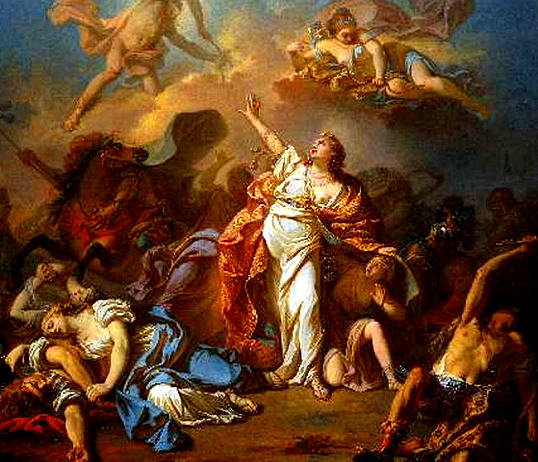
Jacques-Louis David, French, 1748-1825, Apollo and Diana Attacking the Children of Niobe, 1772

Jacques-Louis David, French, 1748-1825, Apollo and Diana Attacking the Children of Niobe, 1772

Pull out your phone, go to the indicated website (the museum has free WiFi, of course) and type in the number. (The museum posts this web address, dma.mobi – that contains so much information in a mobile interface… this is truly the best of all possible worlds). There, in your palm, appears a portrait of the artist – the tiny tinny speakers (forgot your earbuds again, didn’t you) speaks to you – a famous art historian lectures on those ancient times.

The glowing screen in your palm now changes every few seconds with a new image – a series of paintings by the same artist. This is too much. You can’t help but wonder what those ancient geniuses with their candles and oil paints would think of the tiny glowing screens. Sufficiently advanced technology is indistinguishable from magic.

Sunday Snippet – New Orleans Writing Marathon

On the morning after Halloween Candy went down to the restaurant in the St. Vincent’s Guest House for breakfast and when I joined her she introduced me to someone she had met at the counter. It was Brant Osborn, an English Teacher from Slidell.

He was at St. Vincent’s for a Writing Marathon organized and sponsored by the Southeastern Louisiana Writing Project. The idea was that a group of about twenty writers would break into groups, either stay at the guest house or walk around the Lower Garden District for the day, stopping and writing as the mood struck them. Periodically, folks would read what they had written – hopefully providing ideas, inspiration and motivation for each other.

He asked me if I wanted to go.

I ran up to my room and grabbed my Moleskine and Varsity Disposable Fountain Pen.

The entire group (mostly English teachers and a few intruders like myself) started in the common room at the guest house, wrote a little and then we took off. There were five of us in my group, myself, Richard Louth (the organizer of the writing marathons), George, and Roman.

We walked down Magazine street, hitting a coffee shop, then po-boys for lunch, a side trip to a park, and then a beer at a table outside a neighborhood bar. We’d write and read at each stop. At the end we met back at St. Vincent’s for a celebration and reading, until darkness fell completely.

Most folks wrote little essays or short works inspired by St. Vincent’s, the history of New Orleans, or the other folks in the writing group. I, as is my wont, struggled to squeeze out some fiction. I didn’t have any of my writing prompt or idea collections with me. The only things I had was the inspiration of the St. Vincent’s hostel, some bits of story the other guys would tell, and a quote from a singer on Frenchman Street the night before, “Folks from small towns get arrested in the big city, folks from the big city get arrested in small towns.”

So I spent a whole day walking around Magazine Street in New Orleans with a group of like-minded folks, writing and reading. It was, for me, a perfect day. I want to publicly thank Richard Louth for putting together this program and for Brant Osborn for inviting me.

It was so much fun that now I want to do a writing marathon in Dallas. I’ve been thinking about it and am putting together a page on my blog to organize my thoughts. Go over to that page and take a look, feel free to leave comments or suggestions. The more the merrier.

So what did I write? Here it is, copied pretty much verbatim from my Moleskine. It’s about a third of a short story… and I’m working on where to take it from here.

Parasol

Chapter 1 Svetlana (I)

Svetlana dragged her backpack up the rickety wooden stairs through a heavy wrought iron gate. A fat man with an eyepatch sat behind a tall desk with paint peeling off the front.

She worried about her English – she had studied for over a decade and always dreamed of this – but now was the first time she actually spoke a complete sentence. She could feel her accent rolling in her mouth like a hot walnut.

The man with the eyepatch didn’t even look up. He flipped a set of keys in front of Svetlana and handed her a half-sheet of paper – cut unevenly with a set of numbered rules. It was handtyped and xeroxed, with a tattoo of hand-written corrections. The top line said, “Rules are non-negotiable – you will be thrown out of the hostel.

The one-eyed man finally spoke, still without looking up. “Down that hall – men on the left, you are on the right.”

Svetlana dragged her pack down the hall. The thin, worn carpet and painted walls were stained with water leaking from somewhere above. Strangely, the passage was lined with fine bronze sculptures of nude men and women – out of place in the worn and tattered building.

She reached the women’s dormitory and pushed the door open.

A quick feeling of panic rose in her throat as she looked down the center of a double row of bunk beds constructed of two by four beams nailed in a grid. In the Ukraine, she had her own wing with a personal servant. She had never slept in a room shared with strangers.

Chapter 2, Russell (I)

Russell never thought, never in a million years, that he could be thrown in jail for pissing on the side of a building. At home, you can pee wherever you want – it is a God-given right. He was no more than a block down the street from the bar when he realized he had forgotten to use the bathroom before he left. There was an unlit alley and he ducked in. He was admiring the patterns of oblique shadow the streetlights made on the rough brick when he noticed the blue and red flashing lights mixed in with the yellowish streetlight.

Just when he broke out into a grin at the interplay of colors and shapes he felt a rough hand on his shoulder.

Russell jumped a bit at the voice yelling in his ear, “Well, now, look who’s going to jail tonight.”

His arms were pulled back and he felt the cold steel click around his wrists.

“Shit, son, you ain’t even zipped up,” the unseen voice said. “Now, don’t you piss on me or I’ll crack your damn head.”

He felt his hands released and as soon as he brought them forward and fixed his pants he was shoved forward. His hand came up to catch himself from falling, his palms against the uneven wall. Boots pushed his feet apart.

Strong hands moved down his sides and between his legs, and finally slid his wallet out of his back pocket.

Chapter 3 Svetlana (II)

She looked down the room and saw a woman with spiked hair and a piercing through the side of her nose rummaging through a pile of plastic grocery sacks. She looked up. Svetlana thought she saw a tiny colorful flickering on the woman’s face.

“Which bed should I take?” Svetlana asked. The woman looked at her for what seemed like a long time then gestured at a lower bunk three beds down from where she was crouched.

“This one honey, it’s right under mine. Throw your pack on the bunk, but don’t leave it there when you’re gone. They got too many thieves ’round here.”

The woman glanced down at the bags at her feet and Svetlana saw a guilty look flash over her face. It didn’t stay there long. Svetlana threw her pack onto the lower bunk the woman had gestured at and then stood at the foot of the bed, stiffly, waiting to see what would happen next.

For most of her life Svetlana had dreamed of this moment – she had escaped. She was halfway around the world, but this was no dream. She realized, for the first time, that she had not actually thought past this very second, and was at a complete loss of what to do now. The panic rose and settled like a hard knot in her chest. She felt paralyzed – her mind blank. She stared at the woman, afraid the two of them would be standing like that forever.

The woman broke the impasse by moving quickly toward her – almost at a run – turning at the last instant in front of the flinching Svetlana and jumping up onto the top bunk. The woman was so close to Svetlana that she could see that her nose piercing was a tiny skull. Inside, a small LED was blinking – making the skull’s eyes flash bright red.

“You’re not from around here, are ya,” the woman said.

“No, the Ukraine. Is my accent that bad?”

“Nah, everybody’s got an accent here.”

“Your nose piercing?”

“Oh yeah, cool, huh. I make these and sell ’em on the corner. People love ’em. Changing the battery’s a bitch though. You want one? I’ll give you a discount.”

“I’m afraid I don’t have a piercing there.”

“Oh, no problema,” the woman said, fingering a large safety pin laced into a leather bracelet on her wrist. “Don’t have to go through your nose anyway. I’ve got a double skull – red and blue – can put that one through a nipple.”

Svetlana started to shake a little, and the knot under her breastbone grew and hardened.

“Not now, I’m sorry. Just off the plane and I’m still,… what do you say? Still on Ukraine time?”

‘Jetlagged.”

“Jet – Lagged,” Svetlana repeated slowly.

“Shit Ukraine,” the woman said, “I’m Joanna.”

“Svetlana.”

“OK Ukraine, whatever. You look like you need a beer. Grab your bag, let’s go.”

Chapter 4 Russell (II)

The concrete pallet had no mattress and the jailhouse orange coveralls were thin so Russell wasn’t really asleep when the noise outside the cell snapped his eyes open. Two huge deputies were dragging a man down the corridor towards the cell. He was wearing a once-whitish suite, covered in thin blue lines – now stained with blood and at least one other substance. The man looked exhausted and one eye was swollen almost shut but he still heaved and wiggled against the thick arms that restrained him.

The two deputies tossed him against a wall where he gathered himself erect and began the useless task of trying to smooth the countless deep wrinkles out of his suit. One deputy turned and began to work the lock on the cell door while the other kept facing the man in the suit.

“Gentlemen, “ the man in the suit began to talk in a surprisingly clear, steady, and controlled voice. “I do not stand to be treated like this. You should know that, not only am I an attorney, I am a member of the New York bar.”

The guard facing the man did not say a thing but gave a sharp shrug of his shoulder and a heavy telescoping rod shot down from his hand about the length of his forearm. At the end of the rod was a small but mean looking black sphere.

The man in the suit said, “Ahhhh,” but before a complete word could form the guard raised the extended truncheon and began wailing away at the man in the suit. His arm moved like a piston while the rod whistled through the air landing on the man with a sickening wet thud. Russell noticed the man had the presence of mind to cover his good eye with both hands and to turn and curl to present the smallest target. Russell had the feeling that this wasn’t the first time he had been beaten.

Russell guessed than swinging a heavy club like that was hard work and within a minute the guard stopped, bent over with his hands on his knees and breathing hard. He caught his breath and asked his partner, “Do you want a go at him, Hubert?”

“Naw, I got my licks in when we picked him up. I got a bottle in my locker, lets drop him here and grab a quick snort.”

They grabbed the man and attempted to throw him into the cell but somehow, he resisted enough to stand and walk through the cell door on his own volition. It shut with a metal clang and the two guards left without a backwards glance.

“They didn’t put you in a jail jumpsuit,” Russell said.

“No they did not,” the man said with a bit of pride in his voice, “That, my friend, is the source of the disagreement I had with those two apes back there. As you see, I’m still wearing my seersucker, and that I won that argument.”

Russell thought that was a definition of the word, “won,” that he had not ever heard before.

“How did you get here from New York?”

“Oh, I’m not really from New York. I was born and raised less than three miles from this very hoosegow. I only said I was from New York to impress those dimwitted thugs back there.”

“Now,” Russell said, “I’m just a country kid, but if I sat up all night thinking of saying something that would guarantee I got a bad beating in here, I don’t think I could do any better than telling them I was a New York lawyer.”

The man went on as if Russell hadn’t said a thing. “Now friend, I am an attorney… or at least I was. The state bar did not take too kindly… and over-reacted to – a trivial incident involving a real estate loan and the District Attorney’s niece. My present plans, however, do include, when they come to fruition, the reinstatement of my lawyerly license.”

“I don’t see how getting beat up in jail is going to help you get your license back,” Russell said. “Oh, and I’m Russell and I guess I’m pleased to meet you.”

The man seemed to think for a minute before giving up his name. “Jameson P. Samuel, at your service, but you can call me Jim.”

Chapter 5 Svetlana (III)

Joana ordered, “Two beers, whatever IPA you’ve got on tap please, and a coffee.”

“”What coffee you want?” the Bartender/Barista asked.

“I like my coffee like I like my women, dark, bitter, and Nicaraguan.” Joana turned to Svetlana, “No offense intended, Ukraine.”

Svetlana had no idea how to react to this but luckily one of her English lessons had covered what to say when someone said, “No offense.”

“None taken,” she replied.

The two women grabbed their drinks and settled into a booth at the end of the bar. Svetlana noticed everyone staring at someone in the booth across from them. She followed their gaze and saw a man in a stained white suit that looked like it had been slept in for a week. Half his face was swollen terribly. He was sipping a Bloody Mary with the paper umbrella stills ticking out of it and was talking loudly to a young man with ruffled hair – nursing a coffee in a foam cup.