The Soda Gallery

There are some really cool places in the Bishop Arts District. One of them is The Soda Gallery. It’s the place where you can hang out… and it gives the phrase “pop art” a new double meaning.

It’s a little art gallery and it’s a soda shop… it’s both.

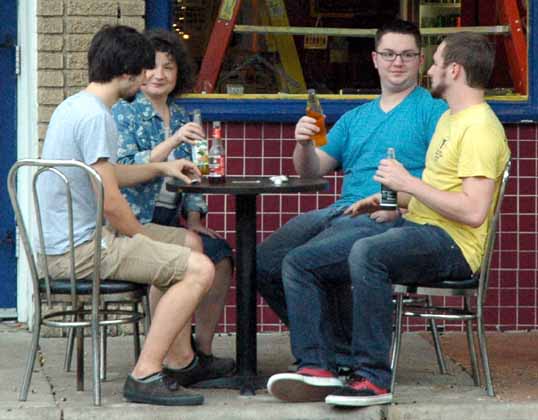
So you can go inside and make a selection from their extensive collection of soft drinks – 30 kinds of root beer, Dublin Doctor Pepper, Nesbitt’s, Ramune (the Japanese stuff with the marble), and so on and so forth. They have a nice little table out on the sidewalk and I watched some groups buying sodas and sitting there drinking them. What a nice idea! I am so down on alcohol right now – it’s cool to find another option for social interaction other than booze or coffee.

And inside they do have art displayed on the walls. They had some really good stuff – screenprints of superheroes or comic book panels and other examples of local pop art.

I wish this place was in my neighborhood – but I’ll go visit when I can.

On the Soda Gallery’s website they have some examples of interesting soft drink ads… here’s some for your enjoyment.

Nesbitt’s Orange, from the 70’s. There is a lot of Robert Crumb psychedelic stuff going on here.

Japanese Fanta Commercial

It’ll Tickle Yer Innards!

What I learned this week, November 18, 2011


Are you worried about the Mysterious Structures in the Chinese Desert?

Fear no more, there is a simple explanation.


Do you need writing motivation? Do you like Kittens?

Here it is – Written?Kitten!


On of the essential techniques of art is to be able to reduce complex reality to its bare essential truth. Minimalism.

A master of this is the artist Gregoire Guillemin. I really love some of his work.

Take a look at this – famous people reduced to their bare minimum. How many can you identify? The groups are especially fun.

Here’s some more, divided up, some identified. I wish I could do that.


Why Does McDonald’s Keep Bringing McRib Back?

I have never ordered or eaten a McRib in my life. I don’t think this article is going to change my mind. I especially like this paragraph:

McDonald’s relationship with the pork industry goes back to the McRib’s conception. In 1972, Roger Mandingo, a University of Nebraska professor, received a grant from the National Pork Producer’s council to develop a technology that bound small “umarketable parts of the animal” into a formation that looked more appetizing. In other words, he figured out how to mold tripe, heart or stomach bits into something that looked like a choice cut of meat. Let’s say, the ribs.

MMMM, sounds like some gosh darn good eatin’

What’s the McRib made of, anyway?


The 10 Types of Writers’ Block (and How to Overcome Them)

  1. You can’t come up with an idea.
  2. You have a ton of ideas but can’t commit to any of them, and they all peter out.
  3. You have an outline but you can’t get through this one part of it.
  4. You’re stuck in the middle and have no idea what happens next.
  5. You have a terrible feeling your story took a wrong turn a hundred pages back, and you only just hit a dead end.
  6. You’re bored with all these characters, they won’t do anything.
  7. You keep imagining all the reasons people are going to say your story sucks, and it paralyzes you.
  8. You can’t think of the right words for what you’re trying to convey in this one paragraph.
  9. You had this incredibly cool story in your head, and now you’re turning it into words on a screen and it’s suddenly dumb.
  10. You’re revising your work, and you can’t see your way past all those blocks of text you already wrote.

I think the blonde dancer is Terri Garr.


What I learned this week, November 11, 2011

Looking around the shelves at a used book store I came across a copy of 500 Essential Cult Books. I’m casting around for something to read right at this moment.

I didn’t buy the book, but I did sit down with it, some index cards, and a Parker 21 that I carry, and sat down at a table to go through most of the 500.

My first impression is that I was shocked at how many of the books I had already read… somewhere around half. The books were divided into categories and some I had read almost all of the selection.

At any rate, I filled a couple cards with books that I had not read and that looked interesting. Some I already have in my library or Kindle, most I do not. Here’s the list, in no particular order:

  • Generation X – Douglas Coupland
  • Nausea – Jean Paul Sartre
  • Been Down so Long it Looks Like Up to Me – Richard Farina
  • Cathedral – Raymond Chandler
  • A Feast of Snakes – Harry Crews
  • Perfume – Patrick Suskind
  • The Sheltering Sky – Paul Bowles
  • VOX – Nicholson Baker
  • The Wasp Factory – Ian Banks
  • We Need to Talk About Kevin – Lionel Shriver
  • Almost Transparent Blue – Ryu Murakami
  • Bad Behavior – Mary Gaitskill
  • Cocaine Nights – J. G. Ballard
  • The Ginger Man – J. P. Donleavy
  • Atomised – Hichael Houellebecq
  • Young Adam – Alexander Trocchi
  • Wonderland Avenue – Danny Sugarman
  • A Hero of Our Time – Mikhail Lemontov
  • How Late it Was, How Late – James Kelman
  • Of Love and Hunger – Julian Maclaren-Ross
  • D. B. C. Pierre – Vernon God Little
  • Nelson Algren – A Walk on the Wild Side

I’ve been reading a lot about the “Bubble in Higher Education.” One of the interesting articles in that vein is called, Where Have All the Chemists Gone?   It links to a New York Times article – Why Science Majors Change Their Minds (It’s Just So Darn Hard)

You can read both of these articles and decide what you think about it on your own, but it does bring back an experience of my own, one I’ve talked about ad nauseum – but still…. I think I’ll write it down here. This is something that happened almost forty years ago… so maybe the trends identified in the articles aren’t so new after all.

I remember my first freshman chemistry class at the generic big Midwestern public university. It was held in a large old gothic auditorium (since burned down) where they played the basketball games back in the twenties and thirties. The professor walked out on the first day and said, “This is Chemistry 301, Introduction to Chemistry for Chemistry Majors. You should only take this class if you are going to get a major in Chemistry. There are three hundred and fifty students in this class. We graduate about forty chemists a semester. You need to do the math. If you don’t think you can make it through this class, drop as soon as you can to minimize the damage to your academic career.”

I was stunned when about a dozen kids walked out at that point. How low must their self-esteem be to give up at that point (or maybe they realized they were in the wrong classroom). The first exam took over half the class. The mid-term dropped half of those that were still left. At the end of the semester the class was well under a hundred. The really bad thing was that, three years later, Physical Chemistry took a third of those that had made it that far (I still believe that P-Chem is one of the absolute evils in the world – I know if any other chemists are reading this – I just gave you a nightmare).

A few years ago I was at a meeting of the American Chemical Society in Arlington (I remember there were three Nobel Prize Winners at the dinner) and the the topic was improving chemistry education. I was talking to a professor afterward about how to increase the enrolment of chemists and he said, “Actually, in my experience, most of the student that can be chemists, are chemists… what we need is to increase the understanding of some of the basic tenets in the non-chemist population.” This was a guy that should know what he was talking about.

Oh, and the article talks about how grades are lower in STEM classes than in, say, business or liberal arts. No shit. My goal in chemistry was to graduate, that was it (I consider my bare C- in P-Chem I and II to be one of the greatest accomplishments in my life. I managed to pass two semesters in a subject where I had absolutely no idea what the hell was going on at all). In the decades since, I don’t think I have ever had anyone ask me my GPA. I have hired a few chemists in my day and if I ever had a job applicant with a 4.0 and a major in chemistry (In reality I never have seen or heard of such a thing) I would not hire them. To get a 4.0 in a chemistry curriculum you would either have to be too smart to be in the same world as I am, or some sort of mutant that could not relate to ordinary human beings in any meaningful way.


Another list of “Must Eat At” places in New Orleans.

New Orleans – A Foodie’s Paradise

  • Gumbo at the Gumbo Shop
  • Crawfish Etouffee at Chartres House Café
  • Jambalaya at Coop’s Place
  • Red Beans and Rice at Joey K.’s
  • Muffulettas at Central Grocery Co.
  • Beignets at Café Du Monde
  • Bananas Foster at Brennan’s
  • King Cakes at Sucre
  • Po’ Boys at Parkway Bakery & Tavern

I’ve been to six of the nine… though some were a long time ago. I wrote about Joey K’s the other day. Last year I set out to find the best Shrimp Po-Boy in New Orleans, and Parkway was the best, IMHO.


How to make pancakes from scratch

Wallet Pancakes

Why imitation syrup is better than the real thing

How to make the best diner pancakes in america


a new word for our time
ineptocracy


Man, I would love to snag a 2011 Rangers World Championship Cap. I wonder what impoverished tropical hell hole I’d have to go to so I could buy one of some poor dude’s head.

Where does World Series Runners-Up Gear Go?


A few more Scopitones. Starting to scrape the bottom of the barrel.

I used to Love the Tijuana Brass, back in the day. This song and Scopitone is not why.

Great Hair… terrible rock and roll.

There have been some very good versions of Telstar over the years. This is not one of them. Plus odd and wildly inappropriate footage.

Petula Clark… one of the greats. There was “Downtown”, “I Know a Place”, “My Love”, “Colour My World”, “A Sign of the Times”,  and “Don’t Sleep in the Subway.”

Oh…. and this:

And, last but least… The absolute worst:


What I learned this week, November 4, 2011

Maybe I should take this list and try to get through it  before I die (probably right before). So far, before reading the article, I’ve been to five (that I can remember).

The 15 Spots for the Best Drunk Food In New Orleans


I’m sorry…. but this is simply too stoopid to pass up:

Something has exploded in a spectacular fashion on Uranus


Sometimes I look ahead and read a book because there is a movie coming out at some future date made from the book. Thus it is with Hunter Thompson’s The Rum Diary.

I enjoyed the book more than it deserved. That whole Caribbean Ex-Pat wasting away in Margaritaville, almost getting killed by the government dictator’s thugs thing is very attractive to me. Probably better read (and written about) than lived.

The movie is out now and it looks good. At least to me.

It is interesting that this is the second time Johnny Depp has played Hunter S. Thompson in a film. I always thought that Fear and Loathing in Las Vegas was unfilmable… and the film proved me right. This one should be very different.


Here’s Why No One Reads Your Blog

  • You’re Boring
  • You’re a Waffler
  • You’re not a Controversialist


How Blogging Taught Me to Be a Writer

  • Discipline: writing on a schedule
  • Discipline: writing even when you don’t feel like writing
  • First drafts don’t have to be perfect
  • In fact, it’s okay to write first drafts that are so bad they end up in the trash
  • I’ve learned to hone in on the details and connections in daily life so I can write about them
  • I know how crucial it is to let a piece rest
  • I’ve also learned that sometimes good enough has to be good enough
  • A career in writing involves mandatory, non-writing activity
  • Sometimes a blog post launches into the internet … and nobody cares
  • The best part: every one of the above lessons has carried over into other forms of writing


What I learned this week, October 28, 2011

Five Mistakes You’re Making With Your Scrambled Eggs

1. “Don’t be wimpy with your eggs. Whisk well and be vigorous about it–you want to add air and volume for fluffy eggs. And whisk the eggs right before adding to pan; don’t whisk and let mixture sit (it deflates).” –Kay Chun, Deputy Food Editor

2. “Don’t add milk, cream, or water to the eggs. People think it will keep the eggs creamy while cooking, but in fact, the eggs and added liquid will separate during the cooking process creating wet, overcooked eggs. Stir in some creme fraiche after the eggs are off the heat if you want them creamy.” –Mary-Frances Heck, Associate Food Editor

3. “Don’t use high heat. It’s all about patience to achieve the soft curd. Whether you want small curd (stirring often) or large curd (stirring less), you need to scramble eggs over medium-low heat, pulling the pan off the heat if it gets too hot, until they set to desired doneness.” –Hunter Lewis, Food Editor

4. “Don’t overcook them! Take them off the heat a little while before you think they are done. The carryover heat will keep cooking them for a minute or so. Also: Use a cast-iron or a nonstick skillet. If you don’t, there will be a rotten clean-up job in your future.” –Janet McCracken, Deputy Food Editor

And last but not least, ditch that fork! Scramble your eggs with a heat-proof spatula, a flat-topped wooden spoon, or for the perfect curd, chopsticks.


7 Phrases NEVER to Use at Work (or Anywhere Else)

  1. When
  2. Someday
  3. Willpower
  4. Want/Wish/Hope
  5. Not Good Enough
  6. I Don’t Have The Time
  7. It’s Not The Right Time

6 Steps to Reduce Stress

  1. Exercise
  2. Meditation
  3. Take a Break
  4. Go Outside
  5. Take Deep Breaths
  6. Plan a Vacation

The song isn’t too bad, and the guy has a fantastic voice – but I have never seen dancing more out-of-step-and-time with the song in my life. Ahh, the Scopitone World.


Nobody does it better than Malcolm Gladwell.

I enjoyed this talk and Malcolm Gladwell is so entertaining and informative. Even in a case like this, when his conclusions are completely and absolutely wrong.

For example – the Norden Bombsight. He makes the point that it could not actually drop a bomb into a pickle barrel and that in actual use, it was not very accurate, had a lot of shortcomings, and was negatively affected by weather and wind.

So what.

It did not live up to its hype. Nothing does. It had a lot of unforeseen problems. Everything does.

The important thing is that during World War II the entire free world was in an existential struggle with the forces of fascism and a large contributor to victory was the destruction of German industry wrought by the American bombing forces… using the Norden Bombsight.

The fact is that the Norden bombsite succeeded in its purpose – helping to save the free world. Everything else is just noise – interesting noise… educational noise, even important noise – but noise nonetheless.

Then we come to the drones in Afghanistan. He claims that even with a 95% kill rate the drones make them hate us so much that IED device attacks on US soldiers go up. Exactly where is that connection? Again, we are in an existential struggle against an enemy as evil as we faced in WWII, if not as powerful.

The purpose of the drones is to prevent an organized attack like we saw on 911 – and so far, so good. Everything else is noise. You can criticize the drone attacks as immoral, illegal, or too expensive – but to say they aren’t successful… there’s scant evidence for that. Or at least Gladwell doesn’t present it.

When you listen to (or read) someone as entertaining as Malcolm Gladwell you have to be careful to watch the point of view he is working from. Look for the logical leaps that are glossed over by glibness – like a skilled three-card-monte player, he’ll get you looking one way and slide the card somewhere else.

Sure do like to listen to him, though.


Some guy would like to show you the pictures he took on his last dive trip to the Caymans… but he can’t find his camera.

Balmorhea

I recently discovered this band, Balmorhea… Their music is fantastic, it reminds me of Lucovico Einaudi – and they are named after one of my favorite places in West Texas.

When we first visited Balmorhea, it was like the start of this video – we were crossing the blasted desert looking at the red tornados of dust devils. Suddenly, there was a dive shop, and then the incredible pool of San Solomon Springs.

I wrote in July of 2000:

We drove the Interstate to Pecos and then turned south towards the distant blue wiggly line of the Davis Mountains. Watching the mountains grow, we drove through the most isolated and blasted looking territory yet. Nick and Lee were delighted by the enormous dust devils that the sun spawned across the desiccated fields. Looking like brick-red tornadoes these wandered across the flatlands. We drove through one and it was powerful enough to worry me about the trailer pulling behind, but it only gave the van a good shove and didn’t cause any real problems.

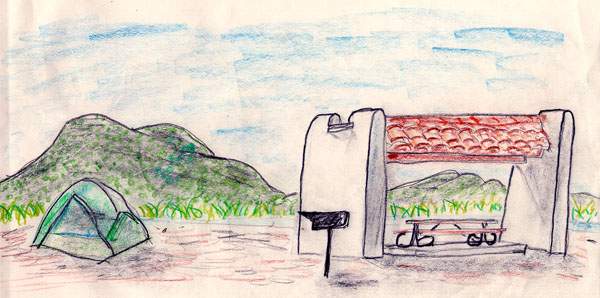
It was an easy drive and by mid-afternoon we arrived at Balmorhea. The park there is an oasis in the desert edged up against the foothills of the Davis Mountains. The rain that falls in the highlands percolates down and emerges from an artesian spring, cold and clear. Back in the thirties, the government took the wild spring and built a gigantic Y-shaped concrete swimming pool. The parks boasts the swimming pool, a nice little hotel, a recently constructed desert wetlands – the San Solomon springs Cienega (labor supplied by the Texas Department of Corrections) that provides habitat for two endangered species of tiny fish( the Comanche Springs Pupfish and the Pecos Gambusa), and a loop of nice little campsites each with its own quaint little fake-adobe shelter.

A quick sketch I made of the Balmorhea campsite.

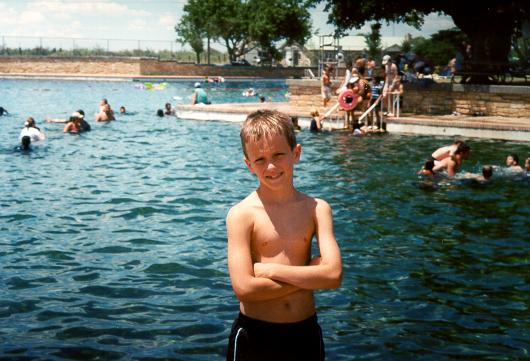
Nick at Balmorhea, in July of 2000

Nick jumps off at Balmorhea, eleven years ago.

I had one of the most frightening experiences of my life the next day at that pool in Balmorhea.

From my journal, July 3, 2000:

We came back down to Balmorhea in the late afternoon and decided to go swimming. We talked to Lee about his fear of the fish in the pool and, as I suspected, it was mostly that he was tired and hungry yesterday. Some rest and some food and he was ready to hit the water.

He didn’t really do any swimming. What he preferred to do was to put on his goggles and stretch across his inflatable inner tube and let me swim and pull the tube around the big pool. He’d take a deep breath and stick his head into the water and look at the bottom. The pool is very large and there was a lot to look at. He would have requests like, “Swim me over to that end,” or “let’s go out to the deep part,” and I’d oblige. He’d plunge his face and come up with a report of what he saw: a school of fish, or some rocks, or a turtle, or a place where some kids had inscribed their names into the algae growing on the bottom.

After the crowded holiday that day before, only a handful of swimmers and some scuba divers were there. As I pulled Lee around Nick dove off the high board and swam until it was his turn. Lee wrapped in a towel and walked back to the campsite. Nicholas put on his goggles and I started swimming him around on his tube. We went into the deep end to try and spot the place where the copious flow of water erupted in a bed of white bubbling sand.

We came up against the stairs on the far side. I was getting tired and cold, the spring water is very chilly, it was late, I’d been swimming a long time and it was taking its toll. I asked Nick if we should walk back, around the pool or swim across. We did have his inner tube – I felt confident we could make it across one more time. We decided to swim. It was a mistake.

Nick looped his goggles around one shoulder and took hold of one side of the tube while I grabbed the other and we started to swim. Not too far from the side, but at the deepest part, maybe thirty feet deep, Nick called out, “Oh, oh, there go my goggles.” In retrospect I should have let them sink; but I took a big gulp of air and took off underwater, diving as deep and as quickly as I could. Maybe twenty feet down I saw a sinking orange blur, frog-kicked over to the goggles and grabbed them. Then I swam back up to the surface.

When you start reaching well into your forties, like I am, there is a fundamental change in the relationship between you and your body. What has been a good friend over the years, a partner, something you are… well, attached to – suddenly turns traitor. Abilities you have taken for granted for decades disappear. No one tells you about this. As a youth I could swim underwater with the ease and comfort of walking across a field. I took this for granted, the ability to hold my breath, come up for air and refresh myself. I discovered tired, and cold, and old, and fat… this is no longer true.

When I came up and handed Nicholas his goggles and put one hand on the inner tube and started kicking and swimming I realized that I was not going to be able to catch my breath. It came on with awful speed. No matter how hard I tried, my breathing became more and more labored, shallower, moving my arms and legs in the cold spring water was becoming extremely difficult.

It was horrifying.

With amazing clarity of thought, I knew I was not going to drown. I did have that inner tube for a float, even though I was rapidly becoming so weak I could barely hold on to it. There were some scuba divers in the pool that had finished diving and were sitting on the steps talking over the day’s sights and I knew I could call to them and they would haul me out of the pool. I came within a hair’s breadth of doing that.

The main fear I had was I thought I might be having a heart attack. I had never felt like this before. There was no pain, but I simply could not breathe, I could not get enough oxygen into my body to keep my arms and legs moving.

I don’t know what Nicholas thought, holding on to the other side of the inner tube, my son’s face only a few inches from mine. I must have scared him a little because I know I was flopping more than I should, trying to hook my arm into the tube and was unable to get it done. I didn’t want to frighten him unnecessarily so I kept my rising fears to myself.

Slowly, we continued to move across the wide pool, and finally I was able to reach down with a toe and touch the bottom. That didn’t help as much as you’d think because I was too weak to stand in the water and the energy used to hop and get my face above water made my breathing more impossible. Finally, the floor became shallower and shallower and before I knew it I was on the steps.

I released the tube and the brisk wind blew it away. “Could somebody get that please,” I asked, and a scuba diver caught it with a couple strong sure strokes and brought it back to me.

I didn’t have to sit beside the pool for very long before I felt fine. The fear and panic quickly drained away and left me with a slight elation even though I was still a little tired. I told Nicholas to take his towel and walk back to the popup at the campsite, I’d catch up in a minute.

Looking back on it now, I realize what I was feeling, in addition to simple exhaustion, was hypothermia. The spring water was cold and I had been in it for hours. There had been no pain, but I had felt a thin sliver away from death.

Walking slowly back to the camp, enjoying the last purple glow of the set sun, following the channels that the water followed as it coursed out of the pool, roaring down the irrigation ditches on out of the park, I felt fine. But the memory of those minutes of fear, the feeling of helplessness and drowning, are still with me. I had never felt like that before and I don’t look forward to feeling like that again.

What I learned this week, October 21, 2011

16 Tips to Simplify Your Life (and Increase Your Productivity)

from Tom.Basson

  1. Turn off all technology for 60 minutes a day
  2. Don’t check your email first thing in the morning.
  3. Start your day with exercise.
  4. Be obedient to the sabbath!
  5. Learn to say no.
  6. Plan your week ahead.
  7. Don’t answer your phone every time it rings.
  8. Get up early.
  9. Go to bed early.
  10. Eat a big healthy breakfast.
  11. Clean out your closets. Get rid of things you never wear or don’t use anymore.
  12. Stop watching TV.
  13.  Make sure you plan a decent holiday break once a year.
  14. Learn to protect your time.
  15. Do your banking online.
  16. Use Evernote.

Building Three-Dimensional Characters

  • Spine
  • Supporting Trait
  • Fatal Flaw
  • Shadow

I may be a loser and an idiot, but at least I’m not like this:

Family calls 911 when they get lost in a corn maze.

Isn’t that the point of a maize maze? Aren’t you supposed to get lost? I went to one once, with two kids, and it was a little disconcerting – but I was also aware that at any time I could walk through the corn if I had to.


OK, I hate Martha Stewart as much as you do… actually I hate her more, because I actually have a reason to be pissed at her. If you ask me nice, some day I’ll tell you about it.

In the meantime, she may be a nasty little piece of work, but she does know how to:

Make the perfect Macaroni and Cheese


Uncertainty, Innovation, and the Alchemy of Fear

  • Single Task
  • Exercise Your Brain
  • Reframe
  • Pulse and Pause
  • Drop Certainty Anchors

One of Lee’s friends told us about a pet that I had never heard about. Micro-Pigs.

video

Seems like a good idea, I suppose…. Isn’t that where Bacon Bits come from?


Energy, Focus, and Courage

“The energy of the mind is the essence of life.”

—-Aristotle

“Goals provide the energy source that powers our lives. One of the best ways we can get the most from the energy we have is to focus it. That is what goals can do for us; concentrate our energy.”

—-Denis Waitley

I don’t have a belief problem, I have a focusing weakness. I focus on what’s loudest instead of what feels best.

—-Abraham-Hicks

Focus on where you want to go, not on what you fear.

—-Anthony Robbins

For man’s greatest actions are performed in minor struggles. Life, misfortune, isolation, abandonment and poverty are battlefields which have their heroes – obscure heroes who are at times greater than illustrious heroes.

—-Victor Hugo

I must not fear.
Fear is the mind-killer.
Fear is the little-death that brings total obliteration.
I will face my fear.
I will permit it to pass over me and through me.
And when it has gone past I will turn the inner eye to see its path.
Where the fear has gone there will be nothing.
Only I will remain.

—- Dune, Frank Herbert

Energy, focus, and courage.

I have a giant frightening project and deadline coming up at work. It has me scrambling. Even though the weather has been beautiful outside, as rarely beautiful as it ever is here in Texas, I have been cooped up in my office cube wishing I was somewhere or someone else.

As I fight my way toward the finish three words keep coming up in my mind. These three words, the more I think about it, are what I need — are what I’m looking for. The three words are

  • Energy
  • Focus
  • Courage.

Energy, Focus, Courage. I’m not sure where the words came from – they didn’t really pop into my mind… it’s more like they grew there, like from little imaginary seeds. I have been thinking about these three words, repeating them to myself like a mantra, until I think I’m beginning to have an idea what they mean.

I have come to the point where I think they all three mean the same thing… no, that’s not it… obviously the words don’t mean the same thing. What I mean is that the three words represent a view of something larger, or more complex, or crystalline – something that a single word can’t describe. That thing, that unnamed thing, is what I am trying to understand – but I don’t have the tools to view it directly. I can only see its shadow – a shadow that looks different when viewed by a light that shines in a different direction.

The shadow, from three different directions, spells out energy, focus, and courage.

Energy is power, power from exercise, cardiovascular and strength. Energy is passion, both the wild random volcanic passion of youth and the desperate focused passion of age, tempered by the terrible knowledge that time is running out. Energy needs its opposites – sleep and rest – to recharge. Without rest there is no energy. Energy is clear clean powerful and focused.

Focus is organization, planning. I think of Steven Covey and his four quadrants, of the important but not urgent.This is focus from a satellite, the view from far above and far away. Then there is getting things done, the minute by minute management of a day. Life itself can be thought of as a string of seconds (an average life is, what? 2,207,520,000 seconds long, a little over two billion), every one a tiny decision, “what do I do now?” Add these up and you have your life. Focus is a laser pointer. Focus is like a lens that takes the light from the sun and burns a little brilliant dot onto the sidewalk.

Focus is saying “no.” Focus is priorities. Focus is saying “yes.” Focus is making a choice. Making a choice takes courage.

Courage is not the opposite of fear, like most people think. Without fear there is no courage. The brave must face their fear, swallow it, feel it, and keep on doing what they need to do. Fear is that gnawing in your gut. Courage is looking at the point of no return and stepping right into it.

There is that moment when you have faced your fear, ignored your doubts, and stepped ahead. That moment when everything is set in motion, but nothing has moved yet. You have bought your ticket, opened your mouth and started to speak (the heads are all turning toward you), taken that step, dialed that number, hit send, swung the bat, released the Kraken, or whatever it is that you chose to do… that calm feeling of excitement – the sudden extermination of fear (how can you be afraid now, now that nothing can be done, now that your fate is decided) – that is the moment of pure courage, of focus, of energy.

That is the moment that life is lived in.

But Jeez, I sure have a lot of work to do.
What I learned this week, October 14, 2011

I’ve been a big fan of Lana Del Rey for a while now. It looks like she might be on her way. This is her first television appearance, on Jools Holland.


25 Insights on Becoming a Better Writer


Creating Fictional Characters—Part 4: Fleshing Out Characters with Tags, Traits, and Relationships


Sometimes the Polls are Right

We Built This City” Named “Worst Song of the 1980s

2. Europe – “The Final Countdown”

3. Chris de Burg – “Lady in Red”

4. Wham! — “Wake Me Up (Before You Go Go)”

5. Men Without Hats — “The Safety Dance”

6. Falco — “Rock Me Amadeus”

7. Bobby McFerrin — “Don’t Worry Be Happy”

8. Toni Basil — “Mickey”

9. Taco — “Puttin’ On the Ritz”

10. Rick Astley — “Never Gonna Give You Up”

I can’t argue with this list… I will say that I loved two of these songs at one time. I won’t tell you which two.

Even if you don’t think it’s the worst song – you have to agree that this is the worst video.

Grace Slick had fallen a long way from the days of  “White Rabbit.”


Things you think work but actually don’t.

  • The Elevator “Close Doors” Button
  • “HD” TV
  • Walk Signal Buttons
  • Butt-Toning Shoes
  • Office Thermostats


Some Scopitones

A modern version of the same song


https://ted.com/talks/view/id/548

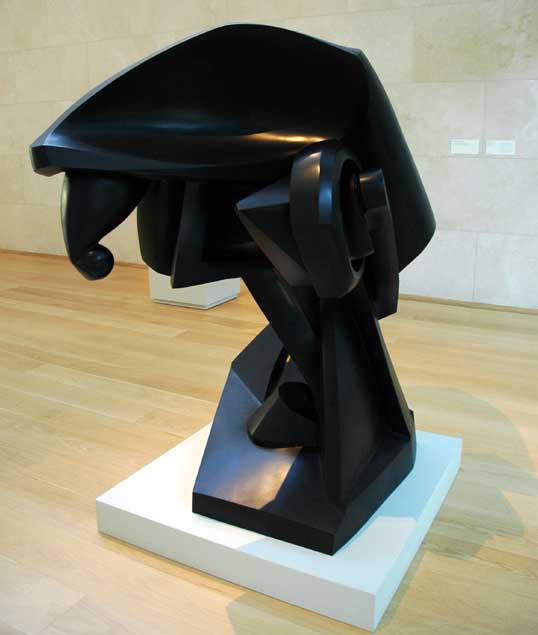
Large Horse by Duchamp-Villon

Horse by Raymond Duchamp-Villon

I like it when I have a membership in a museum or I can get in free – because then I don’t feel like I have to see the whole thing. I can concentrate.

What I like to do is to have one favorite thing. One work of art. I like to go to that on a bee-line and stare at it, walk around it, try to understand and possess it completely. You can’t do that if you go wandering through the galleries like a tourist hurrying to catch his bus outside. You have to be selective and patient.

When the Dallas Museum of Art first opened it was free. I was working only about a block away and I would walk over for a few minutes at lunch whenever I could. My favorite sculpture was Max Bill’s Rhythm in Space. I would walk into the sculpture garden and stare at that piece of carved curved granite. It meant something to me. This can’t be put into words, but it was an idea of motion, beauty, and the timelessness of stone. The hard, unyielding granite had been shaped into something graceful and light. The sculpture looked a little like a face from the front, but was reduced to precise geometric principles. The eyes and mouth appeared to be perfect circles – but only from a certain viewpoint. There is also a complex symmetry in the design…. So on and….

That’s what I saw.

It’s gone now. I don’t know where.

For a long time, my favorite sculpture was Tending (Blue) – but it’s gone now too. Well, it’s still there… but.

So now I’ve fallen in love with Large Horse, by Raymond Duchamp-Villon (the brother of Marcel Duchamp and Jacques Villon). It’s right up front, by a glass wall, at the Nasher.

I like to stare at it, walk around it. I’ve taken some pictures of it. I would like to take some more.

To me, it’s clear that it is a statue of a horse – but that horse has been morphed into a complex machine, full of pushrods, pistons, and gears. It has an impressive, solid bulk, but feels like it is about to propel itself out through the glass and speed down the street in a blur, smelling of ozone and oil.

It is cast in very dark bronze – almost black. It swallows a lot of the light, but what does escape is subdued by the power and mass of the horse. It shines with dark energy.

The sculptor was a cavalry doctor in World War I and must have had a close relationship, knowledge, and a deep connection with his horses. He chose this animal to convert into a cubist bronze. He was able to preserve the essential horseness of the shape while implying the obsolescence of the animal – overtaken by the more powerful, rugged, and easily controlled energy of machines.

Duchamp-Villon died too young. He contracted typhoid fever during the war. He died before he finished this sculpture. All he left was the finished small scale model. After his death, his famous brother, Marcel Duchamp (Nude Descending a Staircase) finished the job and had the sculpture cast in full-sized bronze.

Thanks.

.Large Horse by Raymond Duchamp-Villon

.

.Large Horse by Raymond Duchamp-Villon

.

Large Horse, by Raymond Duchamp-Villon