What I learned this week, January 24, 2014

I’m not a big fan of internet memes – but there is one that I have been getting a kick out of. It’s the products on Amazon that have interesting, funny, and fake product reviews written about them.

First, there was the Hutzler 571 Banana Slicer,, next Uranium Ore, the Tuscan Whole Milk, 1 gal, 128 fl. oz., and then the AutoExec Wheelmate Steering Wheel Attachable Work Surface Tray.

But there is nothing even close to the 5-Pound Bag of Haribo Sugar-Free Gummy Bears. Yikes!

haribo

The people writing those little stories of personal horror are genius.


Who Goes Nazi?

A fascinating article from 1941 that muses on the characteristics that make someone susceptible to evil. It’s interesting both in the subject matter and in the different way that magazine articles are written.

It’s fun—a macabre sort of fun—this parlor game of “Who Goes Nazi?” And it simplifies things—asking the question in regard to specific personalities.

Kind, good, happy, gentlemanly, secure people never go Nazi. They may be the gentle philosopher whose name is in the Blue Book, or Bill from City College to whom democracy gave a chance to design airplanes—you’ll never make Nazis out of them. But the frustrated and humiliated intellectual, the rich and scared speculator, the spoiled son, the labor tyrant, the fellow who has achieved success by smelling out the wind of success—they would all go Nazi in a crisis.

Believe me, nice people don’t go Nazi. Their race, color, creed, or social condition is not the criterion. It is something in them.

Those who haven’t anything in them to tell them what they like and what they don’t-whether it is breeding, or happiness, or wisdom, or a code, however old-fashioned or however modern, go Nazi. It’s an amusing game. Try it at the next big party you go to.


BUILDING A PERMANENT BETTER BLOCK

One of the major issues we’re faced with across the United States is zoning and ordinance laws that prevent the type of smart, dense development that was once created around the world before the advent of large “master development” centric planning (ie. 1 owner, 1 massive block). So the question is, how do we rapidly create places again, built by communities, for communities, using limited funds?


I’ve been reading odd free books from Project Gutenberg.

And here’s a good little guide.


From Joyhacks

How to Achieve All Your 2014 Goals


THE PEN IS MIGHTIER THAN THE PHONE: A CASE FOR WRITING THINGS OUT
WRITING THINGS DOWN, WITH YOUR ACTUAL HANDS, IS JUST PLAIN BETTER AT GETTING YOU TO REMEMBER AND EXECUTE GOOD IDEAS. HERE’S WHY.


There is No Shortage of History When it Comes to Velveeta

In the event of a full-blown Velveeta shortage, here’s a little history to ease your pain.


http://vimeo.com/32292198

What I learned this week, January 17, 2014


A Janitor Secretly Worked On This For 7 Years. No One Knew Til Now… And It’s Baffling Everyone.


6 Harsh Truths That Will Make You a Better Person


14 Photography Project Ideas


Sci-fi writer Isaac Asimov predicted the world of 2014 in 1964: here’s what he got wrong


The Serious Eats Guide to Ramen Styles

Pikachu runs the Turkey Trot

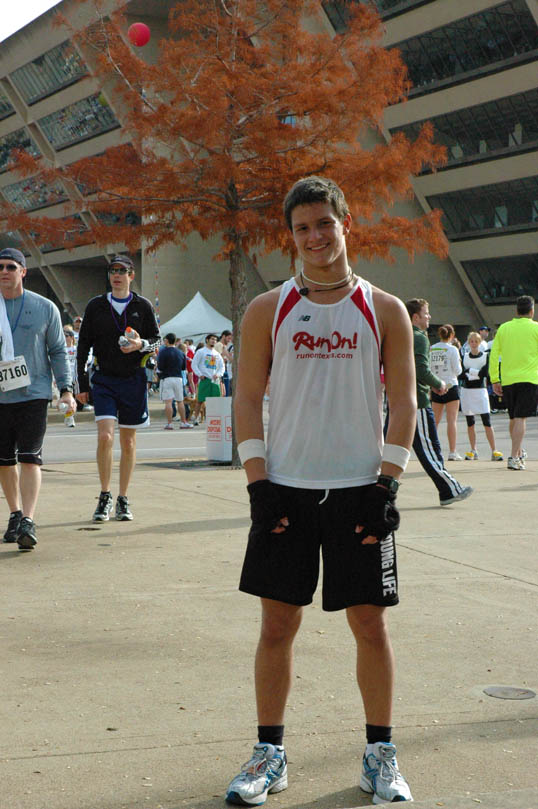
For years now our family tradition has been for our sons to run the Turkey Trot in downtown Dallas on Thanksgiving morning.

cityhall

This is Nick and Lee after the race ten years ago, in 2003, Dallas City Hall in the background – not a very good photograph, sorry.

Photos of Lee running in 2008:

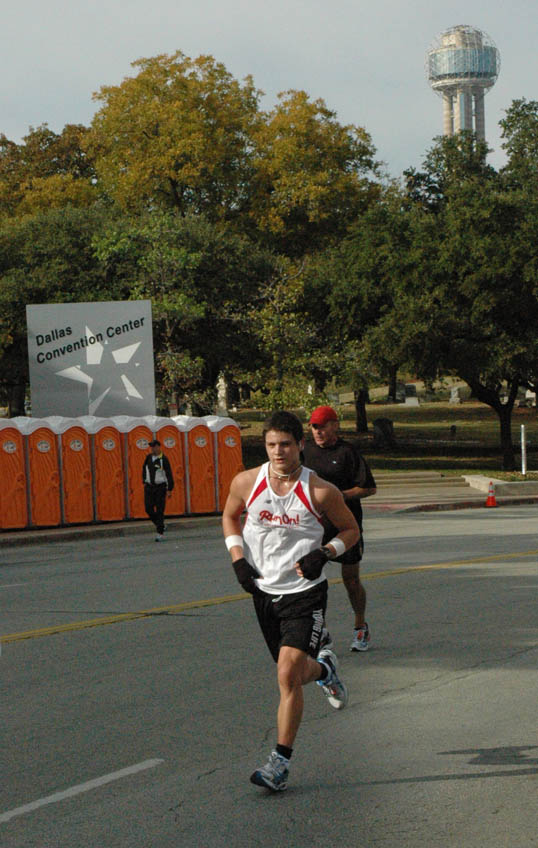
Lee at the Turkey Trot, Downtown Dallas, 2008

Lee in front of the same tree five years later, at the Turkey Trot, Downtown Dallas, 2008

I always wait for the kids at this tough uphill spot, right before the finish.

I always wait for the kids at this tough uphill spot, right before the finish.

I wrote blog entries, with lots of photos, on the run in 2011 and 2012.

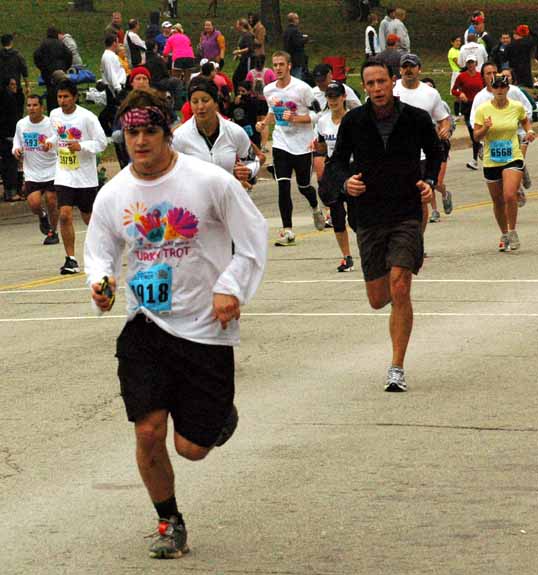
Near the end of the eight mile race, there is a steep hill to torture the runners. I always wait there to see my kids run by. Here is Lee a hundred yards from the finish.

Near the end of the eight mile race, there is a steep hill to torture the runners. I always wait there to see my kids run by. Here is Lee a hundred yards from the finish.

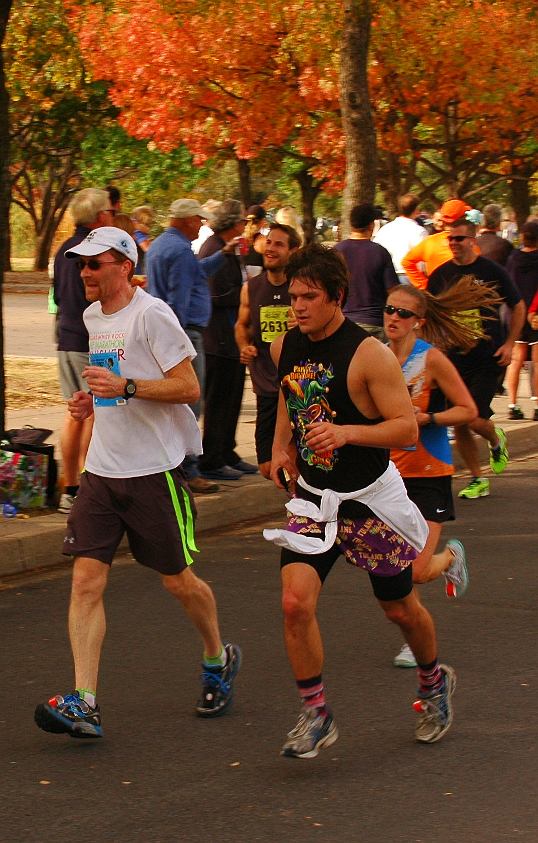
Lee near the finish of the eight mile course. Mardi Gras shirt and Tulane Boxers - worn on the outside.

Lee near the finish of the eight mile course. Mardi Gras shirt and Tulane Boxers – worn on the outside.

This year, Lee flew in from New Orleans (he’s finished up his last semester at Tulane now) for Thanksgiving and ran the Turkey Trot again (Nick was in New York with friends).

He said with finals, work, and graduation job hunting he didn’t have time to train, so he was going to take his time this year and not try and run too fast. For some reason he ran in a Pikachu costume. He said that slowed him down even more, because people (especially kids) wanted him to stop and get their photo with him.

Lee said that he really enjoyed himself, not trying for such a fast time. It wasn’t all that slow, anyway.

Pikachu

Pikachu

Running up that hill at the end.

Running up that hill at the end.

You can see the same sign that was there in 2008.

You can see the same sign that was there in 2008.

Pikachu, goofing around.

Pikachu, goofing around.

Bourbon Barrel Temptress

The ice storm was more than a full day past and I hadn’t left the house except for a short visit to the yard. But it was time to go, time to get out, time to visit the world… at least a little bit. It was time to go to the Lakewood Brewery for a sample of the 2013 Bourbon Barrel Temptress.

Their Temptress, a darker than night Milk Stout beer is one of my favorite things in the whole world. Take that concentrated deliciousness and let it age in an oak barrel that used to hold some fine whiskey and you have made a very good thing better. Today was the day they would open some of those casks.

My Toyota was still incapacitated, covered in a thick carapace of ice. I carefully poured a carafe of warm water along the door edge until I was able to get it open. Almost an hour of running the defroster and chipping away at the thick glazing and it was clear and I hit the road.

The streets were slick, but everyone was suffering from a temporary bought of sanity and were creeping along. I live only a couple of miles from the Brewery, so I made it without any real problem – except for having to walk across the skating rink of a parking lot.

And the Bourbon Barrel Temptress – was it worth the trip? Of course it was.

The Bourbon Barrel Temptress, on a Bourbon Barrel

The Bourbon Barrel Temptress, on a Bourbon Barrel

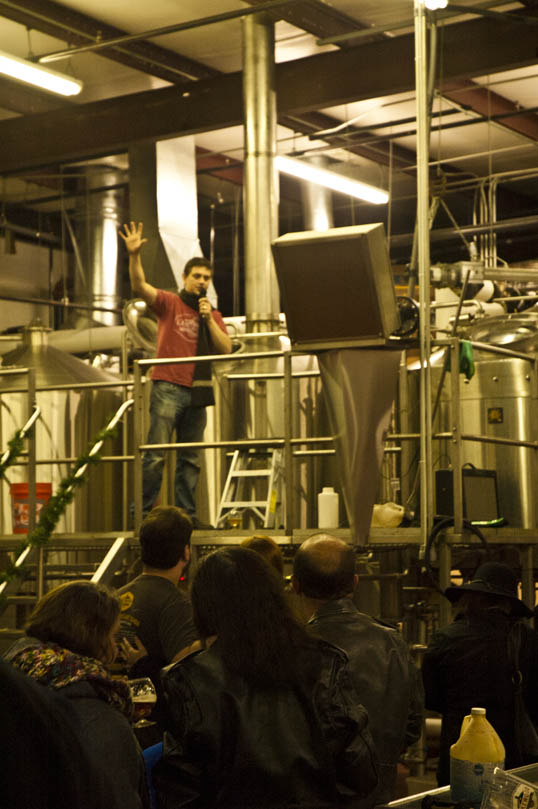
Lakewood Brewery tour - how they make the stuff.

Lakewood Brewery tour – how they make the stuff.

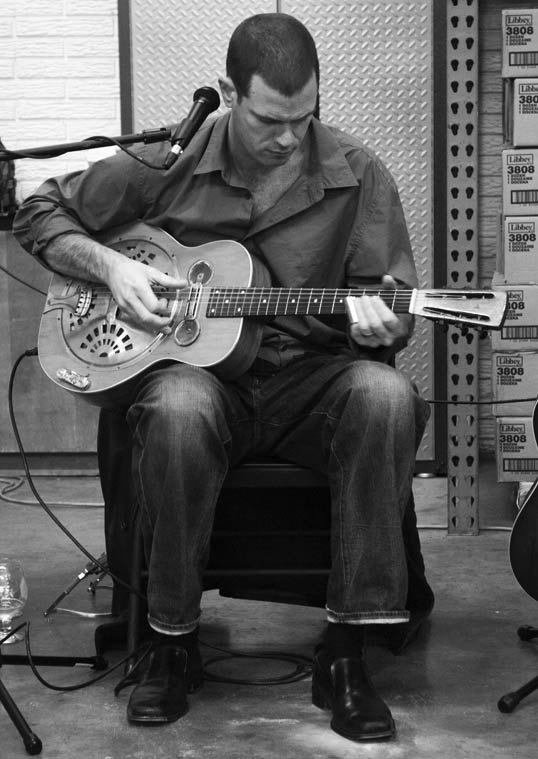
Music at the Brewery Tour

Music at the Brewery Tour

(click to enlarge)

(click to enlarge)

What I learned this week, December 07, 2013

The 10 most crucial books of the year.


The 20 Best Craft Breweries of 2013


What do you call a machine that hangs out with musicians?


100 Notable books of 2013 – From the New York Times, edited (reduced down) by me.

FICTION & POETRY

THE ACCURSED. By Joyce Carol Oates. (Ecco/HarperCollins, $27.99.) Oates’s extravagantly horrifying, funny and prolix postmodern Gothic novel purports to be the definitive account of a curse that infected bucolic Princeton, N.J., in 1905 and 1906.

BLEEDING EDGE. By Thomas Pynchon. (Penguin Press, $28.95.) Airliners crash not only into the twin towers but into a shaggy-dog tale involving a fraud investigator and a white-collar outlaw in this vital, audacious novel.

THE CIRCLE. By Dave Eggers. (Knopf/McSweeney’s, $27.95.) In a disturbing not-too-distant future, human existence flows through the portal of a company that gives Eggers’s novel its title.

CLAIRE OF THE SEA LIGHT. By Edwidge Danticat. (Knopf, $25.95.) Danticat’s novel is less about a Haitian girl who disappears on her birthday than about the heart of a magical seaside village.

THE COLOR MASTER: Stories. By Aimee Bender. (Doubleday, $25.95.) Physical objects help Bender’s characters grasp an overwhelming world.

THE DINNER. By Herman Koch. Translated by Sam Garrett. (Hogarth, $24.) In this clever, dark Dutch novel, two couples dine out under the cloud of a terrible crime committed by their teenage sons.

DIRTY LOVE. By Andre Dubus III. (Norton, $25.95.) Four linked stories expose their characters’ bottomless needs and stubborn weaknesses.

DISSIDENT GARDENS. By Jonathan Lethem. (Doubleday, $27.95.) Spanning 80 years and three generations, Lethem’s novel realistically portrays an enchanted — or disenchanted — garden of American leftists in Queens.

DOCTOR SLEEP. By Stephen King. (Scribner, $30.) Now grown up, Danny, the boy with psycho-intuitive powers in “The Shining,” helps another threatened magic child in a novel that shares the virtues of King’s best work.

DUPLEX. By Kathryn Davis. (Graywolf, $24.) A schoolteacher takes an unusual lover in this astonishing, double-hinged novel set in a fantastical suburbia.

THE FLAMETHROWERS. By Rachel Kushner. (Scribner, $26.99.) In Kushner’s frequently dazzling second novel, an impressionable artist navigates the volatile worlds of New York and Rome in the 1970s.

THE GOLDFINCH. By Donna Tartt. (Little, Brown, $30.) The “Goldfinch” of the title of Tartt’s smartly written Dickensian novel is a painting smuggled through the early years of a boy’s life — his prize, his guilt and his burden.

THE GOOD LORD BIRD. By James McBride. (Riverhead, $27.95.) McBride’s romp of a novel, the 2013 National Book Award winner, is narrated by a freed slave boy who passes as a girl. It’s a risky portrait of the radical abolitionist John Brown in which irreverence becomes a new form of ­homage.

A GUIDE TO BEING BORN: Stories. By Ramona Ausubel. (Riverhead, $26.95.) Ausubel’s fantastical collection traces a cycle of transformation: from love to conception to gestation to birth.

I WANT TO SHOW YOU MORE: Stories. By Jamie Quatro. (Grove, $24.) Quatro’s strange, thrilling and disarmingly honest first collection draws from a pool of resonant themes (Christianity, marital infidelity, cancer, running) in agile ­recombinations.

MADDADDAM. By Margaret Atwood. (Nan A. Talese/Doubleday, $27.95.) The survivors of “Oryx and Crake” and “The Year of the Flood” await a final showdown, in a trilogy’s concluding entry.

METAPHYSICAL DOG. By Frank Bidart. (Farrar, Straus & Giroux, $24.) To immerse oneself in these poems is to enter a crowd of unusual characters: artistic geniuses, violent misfits, dramatic self-accusers (including the poet himself).

THE SON. By Philipp Meyer. (Ecco/Harper­Collins, $27.99.) Members of a Texas clan grope their way from the ordeals of the frontier to celebrity culture’s absurdities in this masterly multigenerational saga.

THE SOUND OF THINGS FALLING. By Juan Gabriel Vásquez. Translated by Anne McLean. (Riverhead, $27.95.) This gripping Colombian novel, built on the country’s tragic history with the drug trade, meditates on love, fate and death.

TENTH OF DECEMBER: Stories. By George Saunders. (Random House, $26.) Saunders’s relentless humor and beatific generosity of spirit keep his highly moral tales from succumbing to life’s darker aspects.

WANT NOT. By Jonathan Miles. (Houghton Miff­lin Harcourt, $26.) Linking disparate characters and story threads, Miles’s novel explores varieties of waste and decay in a consumer world.

NONFICTION

THE AMERICAN WAY OF POVERTY: How the Other Half Still Lives. By Sasha Abramsky. (Nation Books, $26.99.) This ambitious study, based on Abramsky’s travels around the country meeting the poor, both describes and prescribes.

THE CANCER CHRONICLES: Unlocking Medicine’s Deepest Mystery. By George Johnson. (Knopf, $27.95.) Johnson’s fascinating look at cancer reveals certain profound truths about life itself.

ECSTATIC NATION: Confidence, Crisis, and Compromise, 1848-1877. By Brenda Wine­apple. (Harper, $35.) A masterly Civil War-era history, full of foiled schemes, misfired plans and less-than-happy ­endings.

THE FARAWAY NEARBY. By Rebecca Solnit. (Viking, $25.95.) Digressive essays, loosely about storytelling, reflect a difficult year in Solnit’s life.

FIVE DAYS AT MEMORIAL: Life and Death in a Storm-Ravaged Hospital. By Sheri Fink. (Crown, $27.) The case of a surgeon suspected of euthanizing patients during the Katrina disaster.

THE GUNS AT LAST LIGHT: The War in Western Europe, 1944-1945. By Rick Atkinson. (Holt, $40.) The final volume of Atkinson’s monumental war trilogy shows that the road to Berlin was far from smooth.

THE RIDDLE OF THE LABYRINTH: The Quest to Crack an Ancient Code. By Margalit Fox. (Ecco/HarperCollins, $27.99.)Focusing on an unheralded but heroic Brooklyn classics professor, Fox turns the decipherment of Linear B into a detective story.

THE SKIES BELONG TO US: Love and Terror in the Golden Age of Hijacking. By Brendan I. Koer­ner. (Crown, $26.) Refusing to make ’60s avatars of the unlikely couple behind a 1972 skyjacking, Koerner finds a deeper truth about the nature of extremism.

THE SLEEPWALKERS: How Europe Went to War in 1914. By Christopher Clark. (Harper, $29.99.) A Cambridge professor offers a thoroughly comprehensible account of the polarization of a continent, without fixing guilt on one leader or nation.

THOSE ANGRY DAYS: Roosevelt, Lindbergh, and America’s Fight Over World War II, 1939-1941. By Lynne Olson. (Random House, $30.) The savage political dispute between Roosevelt and the isolationist movement, presented in spellbinding detail.

TO SAVE EVERYTHING, CLICK HERE: The Folly of Technological Solutionism. By Evgeny Morozov. (PublicAffairs, $28.99.) Digital-age transparency may threaten the spirit of democracy, Morozov warns.

THE UNWINDING: An Inner History of the New America. By George Packer. (Farrar, Straus & Giroux, $27.) With a nod to John Dos Passos, Packer offers a gripping narrative survey of today’s hard times; the 2013 National Book Award winner for nonfiction.


Mentally Strong People: The 13 Things They Avoid


5 Jobs with the Worst Bosses

Between Candy and I, we have three of the five covered.


Inside the Box

People don’t actually like creativity.

Majestic Parking

“‘He thinks you need a lobotomy. He told me you’re obsessed by car parks.’”
—-J.G. Ballard, Super-Cannes

parking

“An immense peace seemed to preside over the shabby concrete and untended grass. The glass curtain-walling of the terminal buildings and the multi-storey car-parks behind them belonged to an enchanted domain.”
—-J.G. Ballard, Crash

“At the time he had found himself wishing that Catherine were with him — she would have liked the ziggurat hotels and apartment houses, and the vast, empty parking lots laid down by the planners years before any tourist would arrive to park their cars, like a city abandoned In advance of itself.”
—-J.G. Ballard, Concrete Island

“Wilder pressed on. “I know Charlotte has reservations about life here — the trouble with these places is that they’re not designed for children. The only open space turns out to be someone else’s car-park.”
—-J.G. Ballard, High-Rise

“The town centre consisted of little more than a supermarket and shopping mall, a multi-storey car-park and filling station. Shepperton, known to me only for its film studios, seemed to be the everywhere of suburbia, the paradigm of nowhere.”
—-J.G. Ballard, The Unlimited Dream Company

“The street lamps shone down on the empty car parks, yet there were no cars or people about, no one was playing the countless slot-machines in the stores and arcades.”
—-J.G. Ballard, Hello America

“Two vehicles occupied opposite corners of the car-park, breaking that companionable rule by which drivers arriving at an empty car-park place themselves alongside each other.”
—-J.G. Ballard, The Kindness of Women

“Acres of car parks stretched around me, areas for airline crews, security personnel, business travellers, an almost planetary expanse of waiting vehicles. They sat patiently in the caged pens as their drivers circled the world. Days lost for ever would expire until they dismounted from the courtesy buses and reclaimed their cars.”
—-J.G. Ballard, Millennium People

“I had left the Jensen in the multi-storey car park that dominated the town, a massive concrete edifice of ten canted floors more mysterious in its way than the Minotaur’s labyrinth at Knossos — where, a little perversely, my wife suggested we should spend our honeymoon.”
—-J.G. Ballard, Kingdom Come

“Thousands of inverted buildings hung from street level — car parks, underground cinemas, sub-basements and sub-sub-basements — which now provided tolerable shelter, sealed off from the ravaging wind by the collapsing structures above.”
—-J.G. Ballard, The Wind from Nowhere

“Already, without touching her, he knew intimately the repertory of her body, its anthology of junctions. His eyes turned to the multi-storey car park beside the apartment blocks above the beach. Its inclined floors contained an operating formula for their passage through consciousness.”
—-J.G. Ballard, The Atrocity Exhibition

What I learned this week, November 29, 2013

This internet thing is amazing. I woke up this morning and decided I wanted to watch a video where Björk opens up an old CRT-based television and explains how it work. And here it is:

It is obvious that Björk lives in her own world – and I wish I was in there with her.

This is what it looks like. Look at this. This looks like a city. Like a little model of a city. The houses, which are here, and streets. This is maybe an elevator to go up there. And here are all the wires. These wires, they really take care of all the electrons when they come through there. They take care that they are powerful enough to get all the way through to here. I read that in a Danish book. This morning.

This beautiful television has put me, like I said before, in all sorts of situations. I remember being very scared because an Icelandic poet told me that not like in cinemas, where the thing that throws the picture from it just sends light on the screen, but this is different. This is millions and millions of little screens that send light, some sort of electric light, I’m not really sure. But because there are so many of them, and in fact you are watching very many things when you are watching TV. Your head is very busy all the time to calculate and put it all together into one picture. And then because you’re so busy doing that, you don’t watch very carefully what the program you are watching is really about. So you become hypnotized. So all that’s on TV, it just goes directly into your brain and you stop judging it’s right or not.

You just swallow and swallow. This is what an Icelandic poet told me. And I became so scared to television that I always got headaches when I watched it. Then, later on, when I got my Danish book on television, I stopped being afraid because I read the truth, the scientifical truth and it was much better.

You shouldn’t let poets lie to you.

—-Björk

You shouldn’t let poets lie to you — words to live by.

Unfortunately, because of what I do for a living, I happen to know that when she reached in and touched the back of that tube – she came amazingly close to killing herself.


What determines your success is “What pain do you want to sustain?”


Money Quote:

“Yeah, if you’re a normal person why would you want to engage in the mud battles that are going on with, basically psychopathic people who are… people who are involved in politics are, by definition – going back to Reich, Wilhelm Reich, are emotional cripples of some sort that are working out their psychosis on the public at large.”

Another one:

“In its death throes, the mega-state is going to make a lot of mess  and it’s going to be hard to navigate… it’s gonna just… the externalities of that are going to be difficult to navigate through.”


Your Brain on Poverty: Why Poor People Seem to Make Bad Decisions
And why their “bad” decisions might be more rational than you’d think.

From “Why I Make Terrible Decisions,” a comment on Gawker by a person in poverty.

I make a lot of poor financial decisions. None of them matter, in the long term. I will never not be poor, so what does it matter if I don’t pay a thing and a half this week instead of just one thing? It’s not like the sacrifice will result in improved circumstances; the thing holding me back isn’t that I blow five bucks at Wendy’s. It’s that now that I have proven that I am a Poor Person that is all that I am or ever will be. It is not worth it to me to live a bleak life devoid of small pleasures so that one day I can make a single large purchase. I will never have large pleasures to hold on to. There’s a certain pull to live what bits of life you can while there’s money in your pocket, because no matter how responsible you are you will be broke in three days anyway. When you never have enough money it ceases to have meaning. I imagine having a lot of it is the same thing.

Poverty is bleak and cuts off your long-term brain. It’s why you see people with four different babydaddies instead of one. You grab a bit of connection wherever you can to survive. You have no idea how strong the pull to feel worthwhile is. It’s more basic than food. You go to these people who make you feel lovely for an hour that one time, and that’s all you get. You’re probably not compatible with them for anything long-term, but right this minute they can make you feel powerful and valuable. It does not matter what will happen in a month. Whatever happens in a month is probably going to be just about as indifferent as whatever happened today or last week. None of it matters. We don’t plan long-term because if we do we’ll just get our hearts broken. It’s best not to hope. You just take what you can get as you spot it.


How To Make Your Own Hot Pockets


Healthcare.gov and the Gulf Between Planning and Reality

Money Quote:

Back in the mid-1990s, I did a lot of web work for traditional media. That often meant figuring out what the client was already doing on the web, and how it was going, so I’d find the techies in the company, and ask them what they were doing, and how it was going. Then I’d tell management what I’d learned. This always struck me as a waste of my time and their money; I was like an overpaid bike messenger, moving information from one part of the firm to another. I didn’t understand the job I was doing until one meeting at a magazine company.

The thing that made this meeting unusual was that one of their programmers had been invited to attend, so management could outline their web strategy to him. After the executives thanked me for explaining what I’d learned from log files given me by their own employees just days before, the programmer leaned forward and said “You know, we have all that information downstairs, but nobody’s ever asked us for it.”

I remember thinking “Oh, finally!” I figured the executives would be relieved this information was in-house, delighted that their own people were on it, maybe even mad at me for charging an exorbitant markup on local knowledge. Then I saw the look on their faces as they considered the programmer’s offer. The look wasn’t delight, or even relief, but contempt. The situation suddenly came clear: I was getting paid to save management from the distasteful act of listening to their own employees.


Step-By-Step Ceviche Recipe Shows Anyone Can Do It

I didn’t try ceviche for a very long time because it was before I learned to love sushi and I didn’t like the idea of eating raw fish. Until one day on a whim, I decided to try making some. You guys — it’s not raw fish.

Through the magical powers of the acid in lime juice, the fish is “cooked” through. Ok, it’s not cook-cooked, but the texture is firm and not at all raw. So don’t be afraid of ceviche! Gather up some simple ingredients and make some with me.

Bonus: It’s incredibly healthy and in my humble opinion, a perfect diet food.


The Lost Excitement, Pathos, and Beauty of the Railroad Timetable
An elegy for the paper symbol of the mechanical age, an Object Lesson

(click to enlarge)

(click to enlarge)

What I learned this week, November 22, 2013


5 city bikes that roll you through town in style
The latest in steel-framed, fender-clad, and leather-saddled bikes at a variety of price points.

Some of the ones that caught my eye:

Shinola Runwell

Purefix Bourbon

Public V7

If I could afford a new bike – this is what I would buy right now:
Xootr Swift


I love reading (and writing) short stories. Apparently, I’m not alone.

2013: The Year of the Short Story


In Dallas, a deafening slurping noise as the town goes crazy for Asian noodles


I’m going to have to go visit Sulphur Springs and use the public restrooms.


The Ten Sexiest Riffs in Music


You’ve probably already seen this – but it is the coolest music video I’ve ever seen. Be sure and check out all the channels.

Bob Dylan – Like a Rolling Stone – Official Video

For some reason, I really like “The Price is Right” channel… maybe it’s just Drew Carey lip-syncing Dylan.


A cow-orker is retiring at the end of the year (an awful lot are) and he stopped by my office for my help on getting his replacement up and going. I asked the innocent question, “Do you have any plans for retirement.”

He got all excited and launched into a long lecture on kayak fishing and, especially, about the particular kayak he is getting ready to buy – the Hobie Mirage Pro Angler 14. I have to admit – the thing is pretty cool.

The most amazing (to me) feature are the foot powered propulsion fins. Two flexible extensions underwater are moved by pedals to propel the kayak forward. Pretty cool… but not cheap.

The Perverse Lucidity of Nostalgia

“In her final years she would still recall the trip that, with the perverse lucidity of nostalgia, became more and more recent in her memory.”
― Gabriel Garcí­a Márquez, Love in the Time of Cholera

When I was a little kid I, because I was an army brat, saw a lot of movies. A lot of movies. You could see them on base for a quarter. A quarter was worth more then than it is now, but it was still pretty cheap. I thought everybody went to movies all the time for a quarter. It was a shock when I started college and realized that not all movies started with a playing of the Star Spangled Banner (like all films on military bases did – no matter where you moved, the movies would start the same way, with the same film behind the music).

In my isolation, what I didn’t realize is that these films were at least a year old. They were the equivalent of a lower-tier dollar theater today. The other thing is that I didn’t realize how bad some of these films were.

And as a movie-loving child, I didn’t realize how bad these films were, even after I saw them.

And, like a curse, I still remember so many of these films. I forget my ATM PIN number with regularity but hundreds of movies still well up from the stratified thick mists of memory up to a half-century fossilized now – still clear and sharp. But I remember them not as I am now, but as I was then. I recollect them as a wide-eyed child, sitting in the dark, in amazement and wonder at the flickering images on the screen.

Given the time, not surprisingly, a lot of them are of the cheap, second-rate, third-tier, science fiction, monster-riddled, space opera genre. In those days I thought The Green Slime was the greatest piece of art the world had ever seen. I remember enthusiastically hauling all my friends back the next day for an encore showing.

However, even within this fallow soil of vast film awfulness, a few jewels would fall. For example, I remember First Spaceship on Venus – an amazingly odd East German – Polish film adapted from a Stanislav Lem novel. How this came to be featured on American Military bases during the height of the cold war is a mystery. I was excited a few years ago when I was able to get a copy from Netlix. Now, the thing is readily available on the internet and, although dated, is still an effective piece of entertainment. I always liked the look of the rocket.

Movie Poster for First Spaceship on Venus (Silent Star) - I remember the excitement of seeing this poster, even though I was probably six years old at the time.

Movie Poster for First Spaceship on Venus (Silent Star) – I remember the excitement of seeing this poster, even though I was probably six years old at the time.

Then, a few years ago, something came along to through those old memories back into my face. Mystery Science Theater 3000. If you don’t already know, the idea behind MST3K is that an ordinary everyman is trapped by evil scientists on a space station and forced to watch horrible old movies. He builds a few robot sidekicks to help pass the time and this motley crew are shown sitting there in silhouette, throwing up witty insults while the execrable cinema offerings are running across the screen.

My kids always said I should be on that show because of my bad habit of insulting the television to its face.

What the problem was, is that a lot of those films from my childhood showed up on MST3K – and, instead of the glorious examples of moving picture shows they were revealed for the celluloid crap they really were. I suffered from a terrible rejection of the beloved icons of my childhood.

Even First Spaceship on Venus showed up there. What a sacrilege.

I was reminded about this humiliation last night when Paste Magazine published a list of The Ten Most Unwatchable Films Featured on MST3K. I didn’t realize it has been 25 years since the show started… time flies. One good thing is that a lot of these are now available on Youtube – if you have a lot of time to waste.

Of the ten Paste Magazine reviled films – these are so bad they are in a world of their own and I only remember one of them from my childhood.

I won’t tell you which.

I will own up to one film, though. There was one movie I was that, although I didn’t remember the title, I did recall many scenes… the beautiful french temptress turning into a horrible monster with glowing green eyes, the dragon, and most of all, the spinning yellow spiral that burned the brave knights to death. I had always wondered what movie that was – and then, one day, I saw a bit of MST3K and there it was… The Magic Sword.

And now it’s out there on the internet and I can watch it whenever I want to.

You know, it isn’t as good as I remembered it… but it isn’t really all that bad.

MST3K Version

Unmessed-with Version

First Spaceship on Venus (more accurately known as Silent Star)

Afternoon Cocktails at the Nasher

Cyclists at the Nasher (click to enlarge)

Cyclists at the Nasher
(click to enlarge)

Sunday was the fourth day in a row that I did the same thing – left my house on my bicycle and bought a ticket on the DART train for downtown Dallas.
Thursday-Patio Sessions with the Dallas String Quartet (and bonus dancers)
Friday-Aurora
Saturday-Community Beer Company Swap Meet (and more)

Today the good folks at Dallas Cycle Style had organized a ride to the Afternoon Cocktails at the Nasher. The sculpture center downtown has installed new bike racks out front and in honor of the cyclists would be holding a happy hour for the folks with pedals and two wheels.

As always, I futzed and dutzed and spent too much time packing my bike and getting ready. Still, I had a few minutes to spare as I rode up to the Arapaho train station. Unfortunately, it was a beautiful day… and the last day of the State Fair of Texas… and only one ticket machine was working. I have bought a thousand tickets from those machines – I know what buttons to push by heart and know that a credit card is the quickest way to go. Unfortunately, the folks in line ahead of me (damn rookies) had no clue. I stood stoically in line, clutching my already-out method of payment, while they fumbled and bumbled with the confusing buttons and hard-to-see screen. I kept hearing, “OK, push that and we’ll start over again” and other such time-wasting phrases.

So the God of mass transit strikes again and as I rode up the ramp to the platform, my Red Train was pulling out. I had to wait for the next, which was an orange line, which meant I had to ride a bit farther to get to Oak Cliff, which meant I would probably be late, which meant I had to haul ass and sweat like a pig to try and get where I was going in time.

Which I did. We met up in Bishop Arts with enough time for me to catch my breath and then ride across the Jefferson Viaduct back into downtown in amazingly beautiful weather. There is nothing better than that.

At the Nasher, we attended a lecture on the ten sculptures that have gone up around the city in the exhibition called Nasher Xchange. It was very cool – I am going to have to work on riding my bike to each of these over the next few months.

Riding my bike to the sculptures is appropriate. The panel constantly referred to Dallas as a giant car-choked metropolis – which isn’t untrue… but it isn’t the whole story. You can get around the city without a car… you have to simply want to do it.

There was a lot going on at the museum. It is the Nasher’s ten year anniversary. I couldn’t help but think of the excitement when the museum first arrived.

It hadn’t been open very long when I took Lee down there and shot some photographs of him with the sculptures. Then we went back six years later and took the shots again. I’ve put these up before, but I wanted to see them again.

Eve, by Rodin, 2004

Eve, by Rodin, 2004

Eve, by Rodin

Eve, by Rodin, 2011

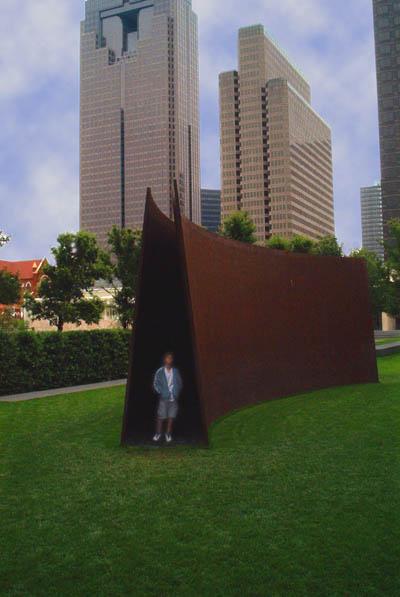
My Curves are Not Mad - Richard Serra, 2004

My Curves are Not Mad – Richard Serra, 2004

Richard Serra - My Curves are Not Mad

Richard Serra – My Curves are Not Mad – 2011
Look at how much the trees in the garden have grown.

Lee sitting by Night, 2004

Lee sitting by Night, 2004

Night (La Nuit)

Night (La Nuit) – 2011 (they had moved the sculpture)

Tending (blue)

Lee standing in Tending (blue) in 2004.

The opening in the ceiling if the installation Tending (blue). A photograph does not do justice.

The opening in the ceiling if the installation Tending (blue). A photograph does not do justice.

It’s sad that the sculpture/installation Tending(Blue) by James Turrell is gone – closed off because of the condo tower next door. It was always one of my favorite spots in the city and is sorely missed.

The sun began to set quickly so we took off across downtown. I knew the train would be crowded with folks coming back from the State Fair so I boarded at the Union Station, hanging my bike up on the little hook and sitting back behind it. I had the car to myself through downtown but, sure enough, at the Pearl/Arts District Station the crowd coming from the fair (via the Green Line) packed their way onto the train. About a third of the folks couldn’t get on.

I sat there, steadying my bike against the surge of the crowd. I was pinned and couldn’t even give up my seat. One woman, leaning against my bicycle, was obviously very drunk and exhausted and came close to collapsing – only the press of the thick crowd kept her upright all the way to her stop.

It was a relief to get off the train and pump my pedals the last few miles to my house. A very good day.

I have an early meeting at work on Monday, so I’ll drive my car in. That’s a good idea – but it seems like a shame.

What a great looking bunch of folks.

What a great looking bunch of folks.
(click to enlarge)