On the way to the restrooms, down in the cool, dim Basement (where the deadly burning rays of the Museum Tower cannot reach) of the Nasher Sculpture Center is a room with three oddly disturbing sculptures. This is the first installation at the Nasher by a local artist. His name is Erick Swenson, and he makes strange meticulous tableaux out of resin, most involving animals in some stage of death or decomposition. They are arrestingly realistic and strangely surreal at the same time.
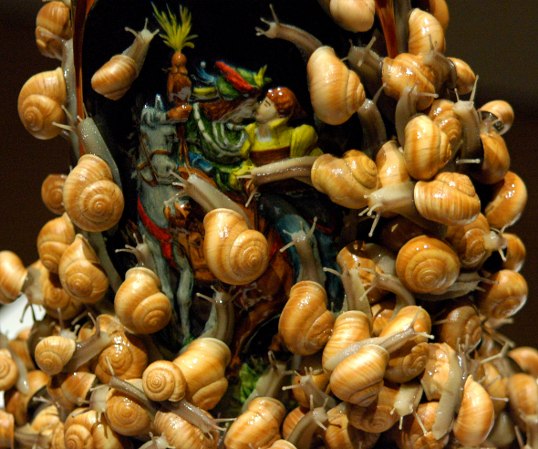
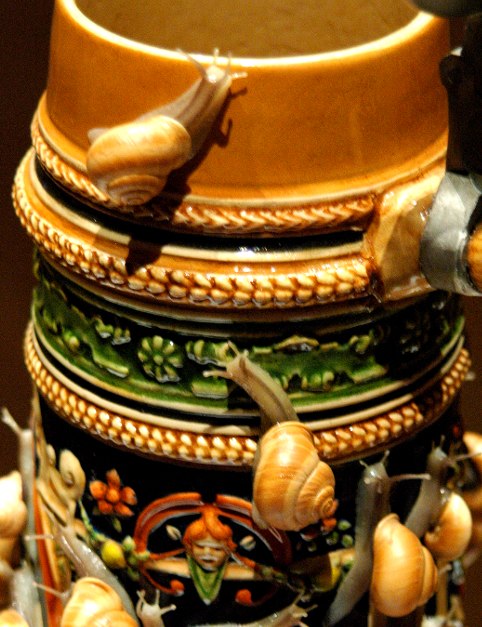
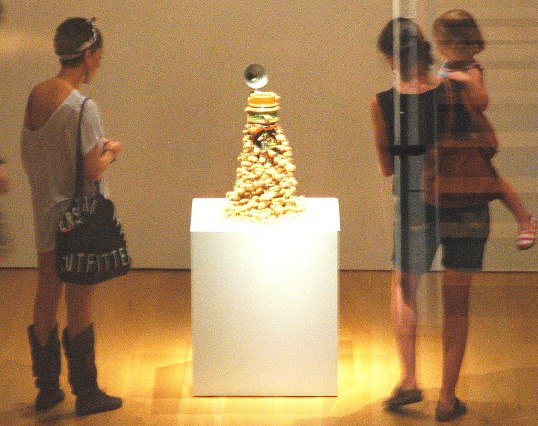
You can trap and kill snails and slugs in your garden with beer. This sculpture is called Schwärmerei – a German import to English that means something like fanatical enthusiasm, or the deadly insanity of the crowd (a word that could be fine-tuned and well-understood in Germany).
He says, “This is a static object. I’m asking you to look at this for more than three seconds. That’s hard to do sometimes. People just blow through stuff, you know. So it’s leaving things sort of enigmatic and open-ended.”
I granted his wish, staying and staring, then photographing the Stein ‘N Snails. Other than the obvious metaphorical underpinning, it was a gorgeous and highly skilled work of craftsmanship. I can see it as an advertising piece for a new chain of eateries called the Brewpub Escargot.
Unfortunately, I don’t posses a macro lens or decent flash lighting so the photos do not do due justice. For a good picture of a snail go here. So I suppose y’all will have to go down to the Nasher and see for yourself. By the way, the third sculpture, the one hidden from the squeamish public behind the little wall, is a doozy… you are forewarned.
Most folks were spending more than three seconds at the sculpture.
Candy and I have developed a habit of going to Estate Sales in the Metroplex. We have signed up for a couple of email lists and on Wednesday or so get a list of all the sponsored sales that are going on. I go through the lists and pick out any sales that look interesting – then work out a driving route. I have to fight my hoarder tendencies and rarely buy anything, but simply driving around and looking is an entertainment and education in itself.
After a while, most of these sales look the same, but we are getting pretty good at picking out the interesting and unique ones from the descriptions and photographs that are sent out. Last weekend was very busy so I didn’t think I’d go to any sales, but I had a few minutes in the middle of the week and cranked through the photographs on the website.
On one house, in the background, down one hallway, there were some pictures on the wall. One of them looked like a mola.
On the north side of the Isthmus of Panama are a string of islands, The San Blas Archipelago (now called the Comarca Kuna Yala). That is where the majority of the Kuna people live. They are an indigenous tribe that after a long struggle are given some autonomy by the government and still try to cling to their traditional ways. The Kuna are most well known for the colorful cloth artworks they produce as part of their clothing.
These are called molas, and are gorgeous primitive geometric based designs, painstakingly constructed from layers of cloth in reverse applique – where the designs are cut out of the overlaying layers of cloth and sewed back, revealing the colors underneath.
I love these things. We have a few of them that I have inherited back from the time I was a kid and we lived in Panama.
I saw the mola on the wall in the photograph, but it looked silly and poorly made, and I was very busy. Candy called me at work, “Did you see what was on the wall on that one picture.”
“Yeah, it was a mola, wasn’t it.”
“That is the estate sale in Richardson.”
“Really? I was tired and in a hurry… I didn’t make the connection.”
I pulled up the website and Googlemaps and realized that the estate sale with the mola was right on the way home from work. It was a simple deal to stop by and take a look. I walked in and pushed my way into the hall.
I thought the mola was beautiful. The web photo was at an angle and the colors were wrong – making it look bad. In person it was really nice. It was well framed (we have had some framed – it’s not cheap to have that kind of work done) – I really wanted it.
The only problem is that it was priced at thirty five dollars. That’s a fair price… but it’s more than I wanted to pay (or had). So I walked out.
Candy and I talked… most of these Estate Sales drop the price on the last day, so she decided to go out on Saturday when the sale opened and see if the mola was still there. Saturday morning, I went my way and she went to the sale. I called her on my cell and she said it was there and everything was half off. So we bought the mola for seventeen dollars and fifty cents.
Also, she was looking in a bedroom and found another tiny mola… only two inches square, for a couple dollars.
I try not to get too tied up in material possessions, but I really like the mola and am glad to have it hanging on our wall.
The night before we went down to the Deep Ellum Festival of the Arts, Music, Food, and Bad Tattoos, I pulled a little wad of bills out of a hiding spot and carefully counted. This was what was left of my stash of savings that I had scraped together and held aside for non-essential purchases. I was glad when I found out I had enough to buy another sculpture from an artist that haunts the Deep Ellum Festival, David Pound of twentyheads.com.
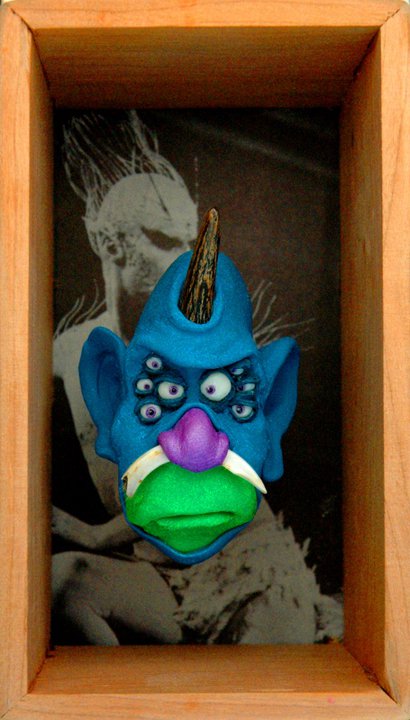
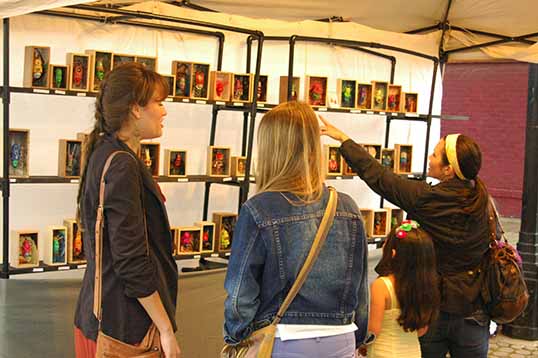
He makes little monster heads in wooden boxes out of sculpey polymer clay and found objects. I’m a big fan. He always brings a big inventory to Dallas and it’s hard to choose only one.
I found his booth right after we arrived and I gave everything a once over, then left to think about my decision. We walked down to the other side of the festival and as we were coming back I could see a huge Texas violent spring thunderstorm rising up on the west side of the gleaming towers of downtown. I knew that time was suddenly short so I walked quickly back down to David’s booth to make up my mind.
They all look so cool. Some have backgrounds I especially like, some have more interesting found objects (I particularly liked one with a roadkill rat’s desiccated hand sticking up from his head – I asked about preservation and David said, “A couple days in the sun and it’s like jerky”) and others have facial expressions I like.
I narrowed it down to two – then picked one named “Burrow.” I liked his earth tones, electronic parts, and snarky expression.
Burrow
Now “Burrow” sits on a shelf next to his buddy that I bought last year, “Persuasion.”
Persuation
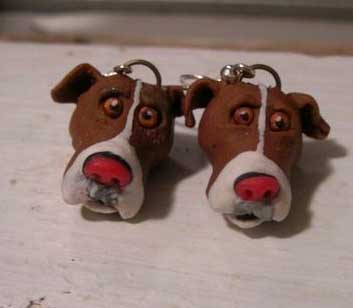
Last year, for mother’s day, I had David Pound make a pair of earrings for Candy. For the commission, I sent him a photo of our dog, Rusty, and he made her earrings to match.
Earrings I had David Pound make for Candy for Mother's Day last year.
They do look like Rusty
Customers at the Deep Ellum Art Festival looking over David Pound's inventory of little monster heads in boxes.
Every year, in the spring, Dallas is host to the three day Deep Ellum Art Festival. We try to go every year. I like to refer to it as the Deep Ellum Festival of the Arts, Music, Food, and Bad Tattoos.
I wasn’t able to get down there on Friday or Saturday, but managed to carve out a couple hours around noon on Sunday. The sky started to spit on the ride down and the clouds off to the west were looking ominous, so I had to scurry through the throng a little faster than usual.
There were a lot of artists there – more than usual. I was a little disappointed, though. Usually the Deep Ellum Festival of the Arts, Music, Food, and Bad Tattoos has a healthy selection of oddball, interesting, and edgy art for sale – but it seems to have been taken over by the usual selection of folks that haunt springtime festivals all across the heartland. There is one sculptor that I look for and he was there with his usual flair (tomorrow’s entry) but otherwise, there wasn’t much to catch my eye for sale.
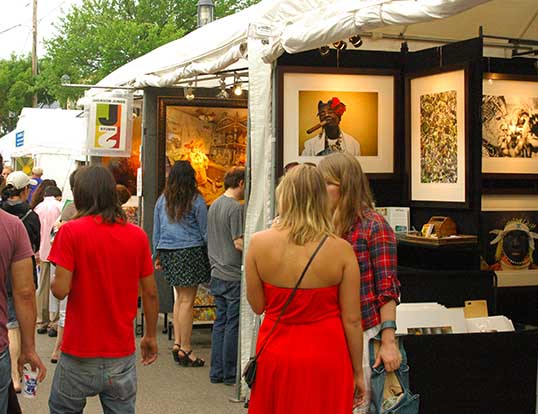
Now, as far as the folks walking around, that was another story. That was fun.
The festival stretches in a double line of canvas booths lining Main Street for about a mile. It is now growing down a handful of side streets too.
One nice thing about an arts festival is the chance to meet and talk to the artists themselves.
A wide variety of stuff is for sale.
There is a lot of food at the ends - Por Ejemplo - the King of Candy Apples
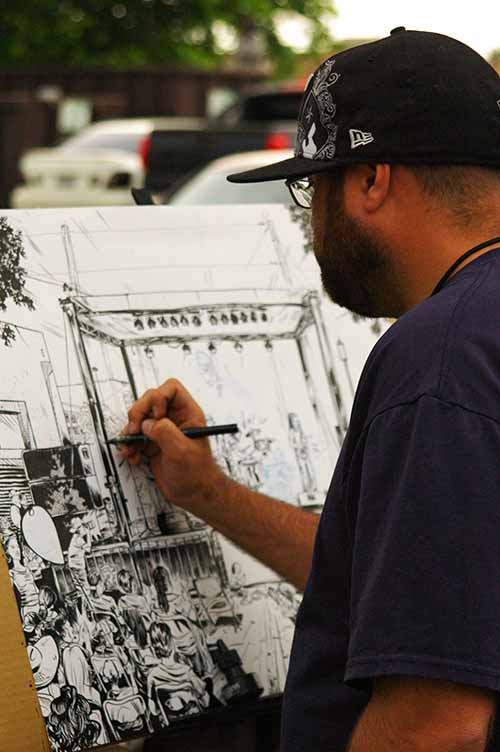
At each end of the main drag were large stages. This guy was drawing a band - though they had already finished.
Plenty of hipster doofuses to keep things lively.
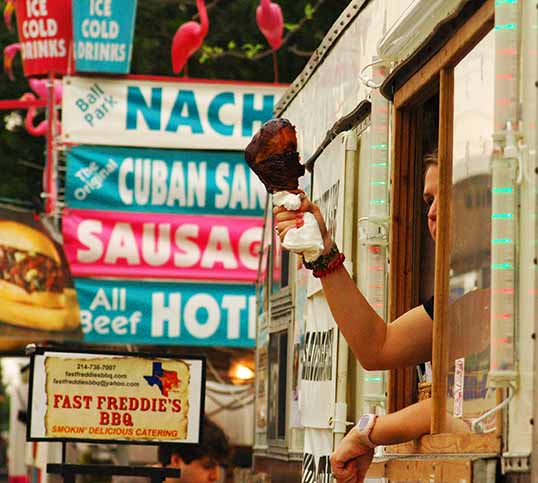
This woman was waving a turkey leg out of her food trailer. When someone came up to buy one, she said, "Let me get you a fresh one hon, this is my demo model, I've been waving it out this window for hours."
A guy eating a turkey leg being stalked by a woman in a "Reality is a Prison" shirt.
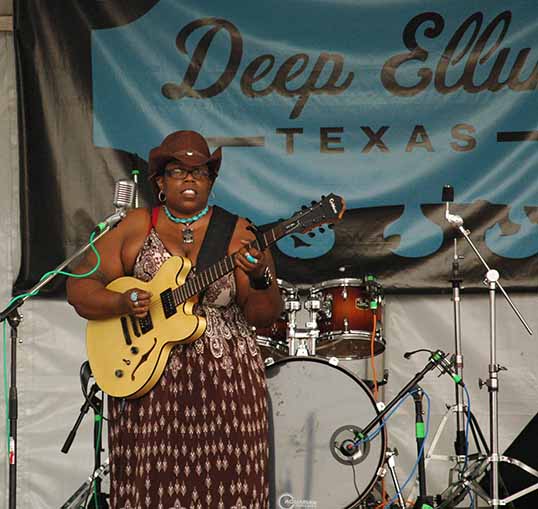
Smaller musical stages were set up out on the end of the side streets.
An artist and his creation.
I really liked these little sculptures... but you'd have to by all of them to get the same effect.
One of the goals of creating the Dallas Arts District, of which the Nasher is a linchpin, was to attract the high-end buzz of the wealthy clientele that enjoy throwing their millions around in order to wallow in the coolness of timeless art. These folks are hard to pry away from the coasts or the ancient alleyways of Europe but a roadfull of expensive venues and billions of dollars of paintings and sculptures was the lure. And so they come. The first habitat for these rare birds is the shiny new Museum Tower, reaching skyward from an odd oval of property where a Woodall Rogers Freeway ramp arced up and around.
Now I have no problem with that. I’m not a wealthy person and will never be. I have to beg and save just to buy a pen, for example. Most of the art scene I enjoy comes on Free Thursdays and Half-Price weekend and such as that, when the upper crust retreats and allows the hoi polloi to enter and tread their hallowed halls. I depend on the charity or at least the indifference of the wealthy patrons – I exist on their scraps – like a roach under the cabinets I scurry out when they aren’t looking for any crumbs that might be left behind.
So if someone wants to build a tower and charge millions of dollars for a two bedroom apartment – so be it. I applaud their industry, toast their imagination, and do not begrudge them their profits. If they want to call their property The Museum Tower – in order to capitalize on its location right next to the Nasher, fine. If they want to charge an extra million dollars per unit simply so the residents can use the museum garden as their side yard – complete with landscaping and a billion in modern sculpture – great. There is plenty of room and if you don’t mind standing next to me, I don’t mind standing next to you.
But don’t forget what side of the bread you’re putting the butter on. Without the museum there is no Museum Tower. Without the arts, there is no Arts District. Do not roast the goose that lays the golden eggs.
It started out with Tending (blue). The high rise stuck it’s ugly head right up into the viewport of James Turrell’s skyspace sculpture, my favorite spot at the Nasher and the best place to watch the sunset in the Metroplex. But, I’ve written about that before. (go read it)
An oversight, perhaps… pretty damn sloppy, though, if you ask me. You spend that much money on a building, make that much profit, can’t you figure out ahead of time that it’s going to ruin a great work of art? Or do you realize it and simply not say anything until it’s too late. Turrell can fix it, maybe, but when? He’s got other things to do.
And now, it’s happened again. And it’s a lot more serious this time.
They have put the mirrored cladding on the building and it is reflecting so much extra sunlight into the building at the Nasher that they are having to install shades simply to allow the newest sculptures in the room. Sunlight destroys art – but is necessary for art and the Nasher has always been very proud of it’s carefully engineered sunscreen roof. The architect spent a lot of time and effort designing a structure that allowed light for viewing in while blocking the damaging direct rays of the Texas sun. It was a brilliant triumph of design and construction and made for a world-famous light and airy museum that was a strong point of pride for the entire city.
It was a brilliant triumph until a few weeks ago when someone installed a giant mirror reaching five hundred feet into the sky right next door that shot laser beams of killer sunlight into the Nasher from an entirely unexpected direction.
Nobody ever clicks on links, so here’s the skinny from the Dallas Morning News:
Officials at the Nasher Sculpture Center say that reflective glass recently installed on the exterior of Museum Tower, its new, 42-story neighbor in the Arts District, is compromising its indoor galleries, destroying its outdoor garden and threatening its future as a Dallas landmark.
Now under construction at the corner of Olive Street and Woodall Rodgers Freeway, Museum Tower heralds its proximity to the “tranquil garden” of the Nasher as a prime selling point for its residential units, which cost between $1 million and $5.4 million.
This makes me so angry I could spit. There is a city code that says, “A person shall not conduct a use that has a visible source of illumination that produces glare of direct illumination across a property line of an intensity that creates a nuisance or detracts from the use or enjoyment of the adjacent property.” For years I have had city inspectors quote much more obscure bits of code than this and made places I work do all sorts of crazy stuff.
But then again, the places I have worked have only employed thousands of ordinary people. They haven’t been home to a handful folks that can afford five million dollar apartments. They haven’t been owned by the Dallas Police and Fire Pension System (that’s who bought the tower).
When the Nasher was built, there was an agreement with Raymond Nasher, part of the covenant that helped him agree to build the museum and give his personal collection to the people of Dallas that stated the building next door would be a maximum of 21 stories and have a maximum reflectivity of 15. Now it is 42 stories with a reflectivity of 44.
So here we have a story of corporate greed and hidden scandal. Men like Raymond Nasher are no more. I notice that mere months after he passed away – a new LA based architect was brought in to fuck things up and the tower doubled in size and reflectivity, causing all these problems -, about the time the City Pension System decided to make its purchase. I guess they knew then the city would not put up a fight. Mary Suhm, the Dallas City Manager says, “It’s not something we have jurisdiction over.” Well, she certainly knows which side of her bread is buttered.
Meanwhile, the art continues to bake and the goose that lays the golden egg is cooked. At least they are using green solar energy to do it.
The condominium tower going up next to the Nasher that is ruining Tending (blue).
You have a glib tongue, as though in your right mind, Yet in your words there is no real sense.
Wretched man, how ignorant you are of what you are saying! Before you were out of your mind-but now you are raving mad.
—-Euripides, The Bacchae
A while back, this guy, Euripides, wrote this play, The Bacchae.
It’s a story of Dionysus, a vain, jealous and vengeful god and the horrible revenge he exacts on mere mortals that refuse to worship him. It’s a story of Pentheus, the vain, stuck-up, and arrogant king who wants order, lawfulness, and absolute attention to his iron rule. It’s a story of women running wild in the woods, ecstatic with passion, blinded by lust and wine. It’s a tale of voyeurism, with the victims pulling the spy down and tearing him limb from limb. It’s the story of a mother returning triumphantly home carrying the disembodied head of her own son under her arm thinking it to be a hunting trophy.
The play was considered too grotesque to be seriously studied until Nietzsche wrote in praise of the genre. Now, of course, the flamboyant themes, aberrant scenes, and bizarre excesses are the cat’s meow, and the play has become fashionable, especially as an opera, where the outlandish aspects fit in well with the dramatic chorus.
The great theme of The Bacchae is a fascinating and important one. It is the constant, eternal struggle between freedom and control. Can an organized, rational society survive if it allows the irrational passions of the human heart to exist and express themselves? How can it survive if it does not? Where is the line to be drawn? What is the healthy limits to ecstatic pleasure? Are there any? The two forces: authority and freedom, rational and irrational, the head and the heart, duty and joy, moderation and excess, wisdom and instinct, self-control and human passion, restraint and release – are forever locked together wrestling in a death-grip struggle, each unable to defeat the other because, without its opposite, neither can survive.
Recently, the Nasher Museum in the Dallas Arts District crated up the Tony Cragg exhibition and sent it back to where it came from. I really enjoyed this one and was sad to see it go. It was replaced by a group of sculptures called The Bacchae by Elliott Hundley, a young Los Angeles based sculptor. I saw some photographs of the work and was disappointed. It looked junky, simple, and nothing special.
I was wrong.
Photographs can not do justice.
I took the DART train down to the Nasher on a Target First Saturday event, where I could stroll in and out and take it all in at my leisure. I was stunned. The stars of the show are the large flat assemblages that take up huge swaths of museum wall space. These are incredibly complex masses of kaleidoscopic images, from found objects to cut out photographs, from comic-book word balloons to paragraphs of newspaper-ransom-note-cut-outs – all suspended in various ways in front of giant billboard-like images. The closer you look, the more detail jumps out. You could spend a year in front of a single one of these and not be able to tease out all the passion and information contained within.
More traditional 3-D sculptural works occupy the center of the space and I found these interesting and well-done, but I, like everyone else in the crowded room was drawn back, again and again, to stand right against the little foot-ropes holding the mob back, and stare at the square inch of work that was right in front of my eyes until I could look at each little paper figure impaled on a wire pin or read the little quotes or try to decipher the galaxy of little objects that are presented sticking out from the wall.
The artist calls these “bulletin boards” and I can see why. They are enormous collections of a universe of detail and, like a lot of art, change tremendously with perspective and distance. Standing away (or looking at a photograph) you can see a landscape of large images partially obscured by clouds of smaller details. Once you approach, these details become apparent and you stare at them. If you want to get even closer, on certain works the artist provides magnifying glasses attached to a matrix of wooden sticks and you can peer through into an even smaller, almost microscopic world, of printers dots splayed across the mounted magazine advertisements and ink-jet printed paper objects.
As I looked I could listen to the comments of the other patrons around me – especially the children. This was a free admission with family activities day so there were a lot of kids. They were, of course, instantly drawn to the collages and it was a struggle for their parents to keep them from touching anything. The little ones would comment constantly. “Oh, that’s gross!” was a common reaction, said in that kid way that doesn’t necessarily mean that they didn’t think it was cool. A few parents would try to explain, in that condescending “I have brought my spawn to the art museum now I must get them to understand how important this is and how great a parent I am” tone and attitude but their voices would trail off, overwhelmed by the sheer mass of stuff that was stuck up on the wall in front of them.
Now, writing this, I want to go back and look at it all again. I want to try and break some of it down and see if I can relate it to the Euripides play now that I know a little more about it. I know I will. I can see a few hours stolen here and there to waste standing against that low rope staring at all that stuff stuck to all those pins.
detail from the LIghtning's Bride - Elliott Hundley
I remember when the Dallas Museum of Art was constructed (its building – the first edifice in the Arts District, before that it was in Fair Park) – I was working in the now long-imploded Cotton Exchange building right next door. In those salad days, the museum was free and almost empty. I would go over at lunch, eat from a sack and look at my favorite sculpture – Rhythm in Space (now gone, I don’t know where) in the garden and then stroll past the Stake Hitch (gone too, sadly, controversially, and inexplicably) to see what was up.
That was a long time ago.
A few days back, looking ahead, I found information on the festivities in the Dallas Arts District on Friday Night. This was their Late Nights at The Museum where the place would be open until Midnight with all sort of activities scheduled. It was also the birthday of the museum and also, outside, the Crow Musuem of Asian Art would be celebrating Chinese New Year.
My intention was to leave from work and get down there at about six. I was exhausted, however, and went home for a quick power nap and a bite to eat (I ate at home to save money, there would be food trucks in the district) before I caught the train downtown.
I was glad that I had wolfed down that sandwich – sure enough, there were eight trucks in a double line along Flora Street, but they were engulfed in a massive crowd. The lines to get some vittles stretched out hundreds of yards.
The crowds mobbing the eight food trucks along Flora Street in the Arts District.
I continued on down the street to the Crow. There was a dragon dancing in the middle of the street but I could not even see it through the massive throng of spectators. It looked cool, but I decided I would flee from this crowd by retreating into the Dallas Museum of Art.
That didn’t work. The museum was even more packed that the street outside. Everyone coming through the door was immediately directed into a long line to purchase admission tickets. Everybody (except me) was dressed to the nines. The The Fashion World of Jean Paul Gaultier: From the Sidewalk to the Catwalk is the exhibition that has all the town talking and everyone had dragged out their best fashions. There were two tall beautiful women wearing short metallic dresses in line behind me and we talked about a Lady Gaga lookalike contestant (there was going to be a contest later) that slowly tottered by. Her massive platforms made for difficult walking across the glass-smooth and rock-hard polished granite floors.
Before long, a young man in an expensive Italian suit walked up and gathered the women and their extensive entourage from the queue behind me and whisked them off. He had some sort of connections and was able to bypass the waiting. The line did move quickly and before long I had paid my ten dollars and received a little purple cardboard square that went around my wrist on an elastic band.
I fought my way through the thick and fashionable crowd to the restaurant area at the North End. The Dallas Museum o fArt is not set up to handle large crowds very well. There was a stage set up and a Madonna impersonator with two dancers were gyrating around, but it was almost impossible to see anything. A few folks had arrived earlier and taken possession of the few tables and were holding their turf like a Roman legion. The museum guards were rushing around making sure nobody leaned on a balcony edge or stood on a stairway, making it impossible for anyone else to get a glimpse of what was going on.
I have been to the museum hundreds of times, so I knew of a hidden little slit window up on the top floor that looked down onto the festivities. I walked up there and watched for a while.
The Madonna Show
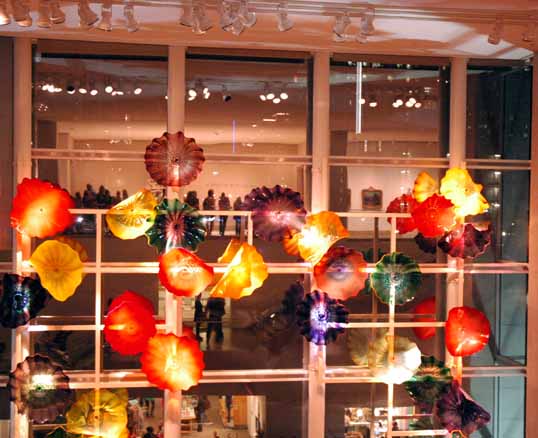
Gawkers reflected in the windows behind the Chihuly glass flowers.
The Gaga lookalike contestants parade around in front of the judges. This is the best view I could get, from the little slit window high above.
For a couple of hours I walked the galleries. Back amongst the paintings, it was fairly empty, actually. The massive crowds were concentrated out in the main hall -where folks waited to get into the Gautier exhibition or simply milled around aimlessly.
The crowds in the central hall of the Dallas Museum of Art.
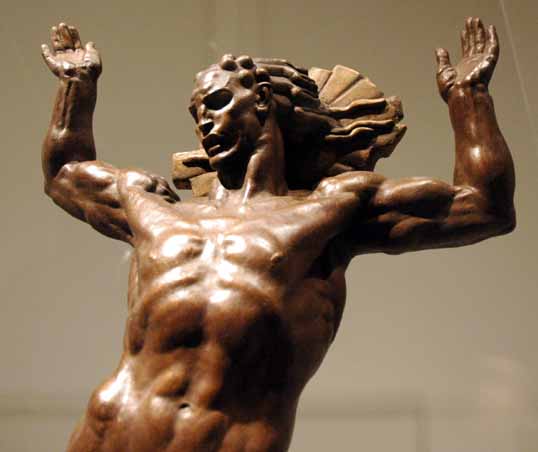
I wonder what this guy was thinking... "Wow, there are too many people here! I give up!" or, more likley, "Hey! Quit staring at my penis!"
I always criticize Dallas for not having a culture or a scene of its own. Now, with the rise of the Dallas Arts District and the explosion of people actually living there (Uptown, Downtown, the Cedars) there is a chance for something exciting to develop. Of course, that means I give up the experience I used to love – of being there almost by myself, of the feeling that all this was built just for me. It means fighting the crowds, which I don’t like. Of course, I can always find someplace else.
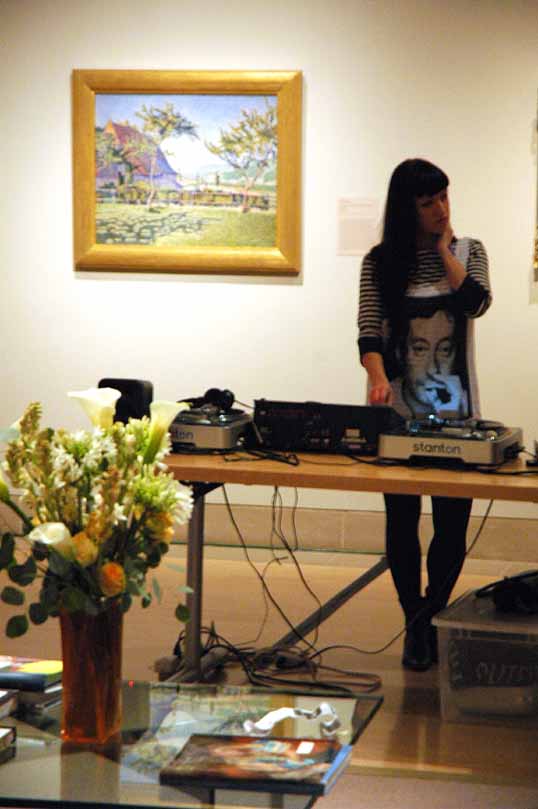
At ten I fought back into the festivities to listen to Brave Combo (another blog entry). Then I retreated back into the European Painting Galleries. Earlier, I had noticed a sign promoting a late night DJ back there promising, “Stroll through the galleries while listening to retro and punk French music spun by – DJ Wild in the Streets.” Oh that sounded like a plan.
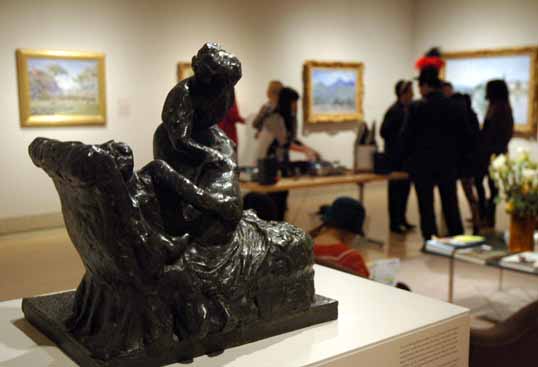
In the foreground, The Masseuse, by Edgar Degas. In the background, DJ Wild in the Streets.
The DJ and her entourage.
DJ Wild in the Streets
And it was very nice. I was tired by then and it was very relaxing to look at the Impressionist paintings while the DJ spun her disks. It wasn’t too loud and there weren’t too many people and I liked it a lot.
At midnight I hoofed it back to the train station at Pearl before it turned into a pumpkin. A couple was having an amazingly loud an angry argument – I heard her yell, “His name is Maurice… OK! OK!.” and the response, “I don’t give a fuck what his name is!” I moved on down the platform and considered calling 911 before they came to blows. There were no police at the station, even though there was a deadly shooting there only a couple days ago. Before I did anything, my train pulled up and off I went.
I almost nodded off on the ride home – but at one point a couple of folks standing at the front showed each other their Museum of Art purple wrist entrance things, and I, and the rest of the train car, raised our arms and showed them ours.
When I go to a local museum – one that I visit on a regular basis – I’ll usually pick out one piece of art, go to it, and study it for as long as I can.
Plus, there are pieces that I always go to and… it feels like checking in – or paying a visit to an old friend. I don’t know why certain works resonate with me… and I try not to think about it. I like ’em, and that is something I want to be good enough.
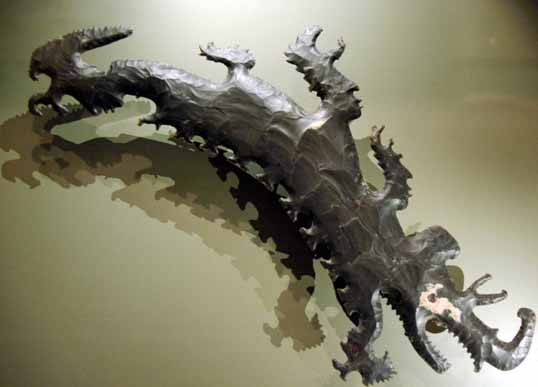
At the Dallas Museum of Art, one piece that I have always loved, one that I keep going back to ever since I first saw it decades ago, is an eccentric Mayan ceremonial flint knife.
Mayan Flint Knife from the Dallas Museum of Art
From the museum card:
Eccentric flint depicting a crocodile canoe with passengers.
Mexico or Guatemala: southern Maya lowlands, Maya culture
Late Classic period, c. A.D. 600-900
This sacred blade shows a moment in the Fourth Creation of the world on August 13, 3114 B.C. The blade is shaped as a monstrous crocodile canoe; water flowers decorate its belly as it sinks down into the dark waters of the spirit world. In the canoe is the soul sacrificed First Father accompanied by two attendants, who may be embodiments of his parents. The canoe represents the Milky Way, pivoting in the night sky from east-west to north-south. The Maya saw this pivoting as the sinking of the canoe and the raising of the precious maize tree. When the canoe sank, First Father was miraculously reborn as Maize, the sustenance and flesh of humanity.
Because it represents this mythic act, this blade was probably an especially powerful talisman of a living king, who became the reincarnation of First Father as he held the blade. The blade itself, bundled in textiles, was probably carried by the king into battle as the focus for his spiritual energies and as his tactical inspiration. The flinty stone connoted lighting to the Maya and was called by the same name as the bright but dangerous bolts of light that accompany life-sustaining rain.
There is a brutal beauty about this flint. I can picture the Mayan king going into bloody battle with this ceremonial knife gripped in his fist.















 Bill Chance