“This is what I say: I’ve got good news and bad news.
The good news is, you don’t have to worry, you can’t change the past.
The bad news is, you don’t have to worry, no matter how hard you try, you can’t change the past.
The universe just doesn’t put up with that. We aren’t important enough. No one is. Even in our own lives. We’re not strong enough, willful enough, skilled enough in chronodiegetic manipulation to be able to just accidentally change the entire course of anything, even ourselves.” ― Charles Yu, How to Live Safely in a Science Fictional Universe
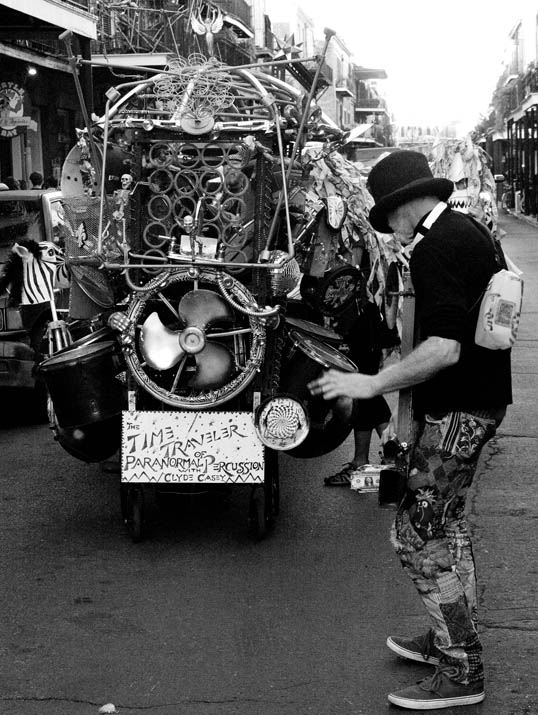
The Time Traveler of Paranormal Percussion, with Clyde Casey
New Orleans, Louisiana
If you could go into the future – maybe only a few hours – can you have your cake and eat it too?
“My work is a ‘concrete’ of that which preceded language and which language is all about… to make a ‘talisman,’ to render myself proof from whatever I feel could interfere with the continuation of my personality and volition.
—-Michael Sandle
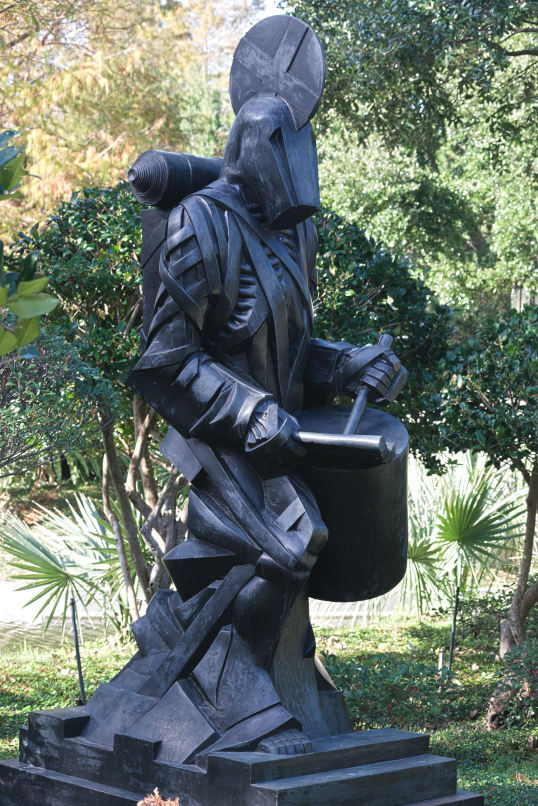
The Drummer, Michael Sandle, Sydney and Walda Besthoff Sculpture Garden
This is one of my favorite sculptures. I have written about… and photographed it seven years ago. The sculpture is exactly the same, of course, but the vegetation around it has grown considerably.
“The secret of life is to have a task, something you devote your entire life to, something you bring everything to, every minute of the day for the rest of your life. And the most important thing is, it must be something you cannot possibly do.” ― Henry Moore
Reclining Mother and Child, Henry Moore, Sydney and Walda Besthoff Sculpture Garden
Right at the entrance to the Sydney and Walda Besthoff Sculpture Garden in New Orleans is this sculpture by Henry Moore.
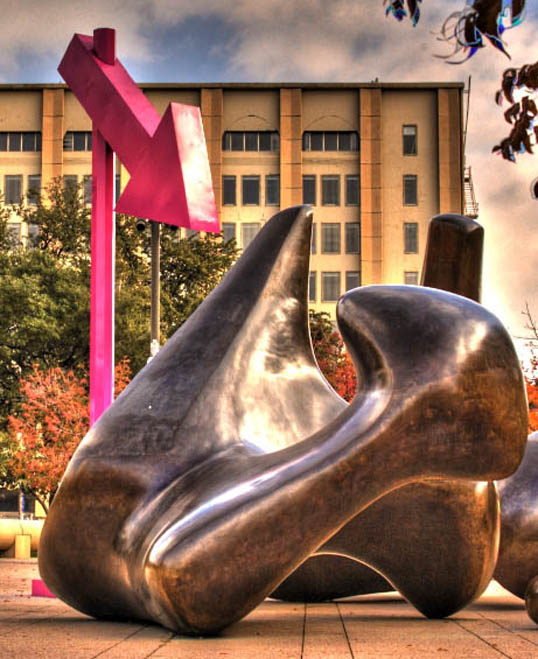
I like to compare it to another, more abstract, Henry Moore sculptures… one of my favorites here in Dallas, The Dallas Piece, in front of City Hall.
Henry Moore’s Dallas Piece, barricaded for the Turkey Trot.
During the art event Nasher XChange, a pink arrow was added by Rachel Harrison, who called it Moore to the Point. It was pretty cool, and only temporary.
Rachel Harrison, Moore to the Point, City Hall Plaza (click to enlarge)Amanda Popken, in front of Moore to the Point (click to enlarge)
There is also a small version, a model, of the sculpture at the Nasher. A polished coppery gold, I like to take blurred photos of people walking past it.
Nasher Sculpture Center, Dallas, TexasNasher Sculpture Center
Dallas, Texas
“Well, I always know what I want. And when you know what you want–you go toward it. Sometimes you go very fast, and sometimes only an inch a year. Perhaps you feel happier when you go fast. I don’t know. I’ve forgotten the difference long ago, because it really doesn’t matter, so long as you move.”
― Ayn Rand, We the Living
Striding Figure (Rome I), Thomas Houseago, Sydney and Walda Besthoff Sculpture Garden
“If I am forced to use a sword in combat, I just swing it around like a baseball bat while screaming, at the top of my lungs: “There can be only one!” Which, if done correctly, is surprisingly effective.”
― Sterling Archer, How to Archer: The Ultimate Guide to Espionage and Style and Women and Also Cocktails Ever Written
Diana, Augustus Saint-Gaudens, Sydney and Walda Besthoff Sculpture Garden
You killed Komoko, Smith, and sooner or later you’re gonna go up for it. Not because you killed him, because I think in a town like this, you can get away with it. But because you didn’t have guts enough to do it alone. You put your trust in guys like this – and Hector here – not the most dependable of God’s creatures. And one of these days, they’re gonna catch on that you’re playin’ ’em for a sap. And then what are ya gonna do? Peel ’em off, one by one? And in the meantime, one of ’em’s gonna crack and when they do, you’re gonna go down – but hard. ‘Cause they got somethin’ on ya, Smith. Something to use when the goin’ gets tough. And it’s gettin’ tougher every minute.
—-Bad Day at Black Rock
Bad Day at Black Rock (1955 Poster)
Does everybody nowdays do this “television hierarchy” thing? TVs used to be a major purchase – only a little less expensive than a car – and would last for years. I remember my grandfather had one of the first remote control televisions. It had a little handheld box with tuning forks in it. You would mash a button and it would hit a fork, sending out an ultrasonic sound, and the TV would hear it. Volume up and down, channel up and down, TV off, and mute. He used the mute the most – hated listening to commercials. He used to want a TV with a coin slot in the back so he could pay for shows instead of watching commercials. This wasn’t so long ago – I remember this shit. The modern galaxy of entertainment with streaming and all would blow his mind.
But back to what I was saying…. Televisions are now so inexpensive and the technology is leaping ahead, we are buying new TVs every year. And there is a hierarchy. The newest, biggest one goes into the living room, the next biggest and newest goes in the bedroom, and the third – the smallest and oldest (yet still only two years old and pretty damn big and good) goes in my office in front of my exercise bike.
So I was hooking up that TV and adding all the proper streaming services and wanted to test The Criterion Channel (my favorite) – so I shot through the menu fast and random and selected Bad Day at Black Rock – for no real reason, just as a test.
It turned out to be crackerjack and I ended up watching the whole thing.
Bad Day at Black Rock stars Spencer Tracy as a mysterious on-armed man getting off a train at a town so isolated and forlorn the train doesn’t even stop there unless it’s a special request. Black Rock seems to have only nine people or so left, and only one of them is a woman (though that woman is a young Anne Francis – which counts for a lot. I remember her from Forbidden Planet – so I guess she has experience in being the only woman in a forlorn spot). Spencer Tracy is on a mysterious mission and the townsfolk have a terrible, mysterious secret, and I won’t do any spoilers.
The film is billed as a Western and it is set in the West, right after WWII, but it is more of a Noir Thriller. Though it does have the Western theme of good guys and bad guys and the plot requires every one to choose their sides and work up the courage to stick.
Everybody is in this movie. I mentioned Spencer Tracy and Anne Francis… plus Robert Ryan, Dean Jagger, Walter Brennan, Lee Marvin, and Ernest Borgnine. Tracy was nominated for a Best Actor Oscar for the role but lost out to Ernest Borgnine, also in this film, for his role in Marty.
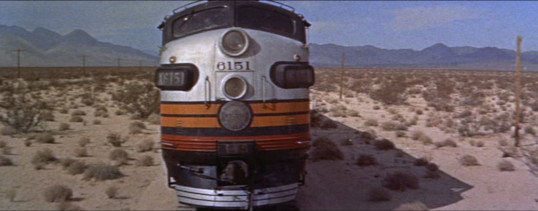
The first shots of the movie are of a train hurtling across a vast, empty desert. The original plan was for a shot of the train moving fast, directly at the camera. But it was too dangerous to fly a helicopter in front of an approaching train. The stunt pilot had the solution. He filmed the train as it backed away. Then they reversed and sped up the film – for the perfect opening shot.
“I feel I stand in a desert with my hands outstretched, and you are raining down upon me.” ― Patricia Highsmith, The Price of Salt
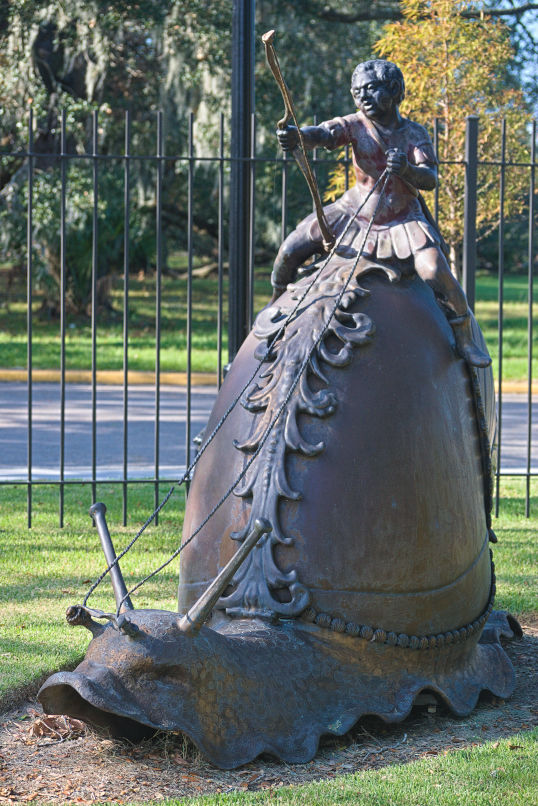
History of the Conquest, Hank Willis Thomas, Sydney and Walda Besthoff Sculpture Garden History of the Conquest, Hank Willis Thomas, Sydney and Walda Besthoff Sculpture Garden
I enjoyed this sculpture in particular because… well, for one it is funny and cute and a little different. But I loved it because it is a giant snail.
Titanic gastropods have interested me ever since I read that short story, Quest for the “Blank Claverengi” as a child. I’m not alone. Years ago I discovered the story was written by Patricia Highsmith and finding several copies, I wrote about it. Since then, quite a few people have contacted me to say they shared the childhood terror of giant man-eating snails.
Illustration by Jean L. Huens for the Saturday Evening Post. Done for the short story “The Snails,” by Patricia Highsmith.
And now here is a sculpture of a giant snail. With a warrior riding on the back. That’s an angle I never thought of – an army of archers riding into battle, slowly, on the backs of huge armored gastropods. A compelling image – if not a very effective battle strategy.
“I felt my lungs inflate with the onrush of scenery—air, mountains, trees, people. I thought, “This is what it is to be happy.”
― Sylvia Plath, The Bell Jar
Massu II, Johan Creten … in background: The Sun, Ugo Rondinone, Sydney and Walda Besthoff Sculpture GardenThe Sun, Ugo Rondinone. Sydney and Walda Besthoff Sculpture Garden
“The really important kind of freedom involves attention, and awareness, and discipline, and effort, and being able truly to care about other people and to sacrifice for them, over and over, in myriad petty little unsexy ways, every day.”
― David Foster Wallace, This Is Water: Some Thoughts, Delivered on a Significant Occasion, about Living a Compassionate Life
Sacrifice III, Lipchitz, Jacques, Sydney and Walda Besthoff Sculpture Garden
Sacrifice III is one of my favorite sculptures – I have seen it in several places and in different versions.
After his escape from France in 1941, Lipchitz frequently turned to images of ancient Jewish sacrificial ceremonies, rooted in his heritage. Sacrifice III, modeled in 1949 and cast in bronze in 1957, was the final work in the series. The first treatment was a small clay sketch of 1925.
Lipchitz returned to the theme in 1943, and in 1946 began the series of drawings, clay studies, and finished sculptures that led directly to the final version of Sacrifice III. The theme of ritual sacrifice was catalyzed by the fate of the Jews during World War II.
Lipchitz remarked in an interview with Frederick S. Wight in 1961 that he depicted “a certain kind of ritual which we perform on a certain occasion. We are charging some kind of cock with all our sins, and we are offering this animal full of our sins for expiation.”
The 1943 image of this ritual was made “during the darkest moment of Hitler… I charged the animal…with all our sins and I prayed, it is like a real prayer, and afterward I had to sacrifice the cock.” The final sculpture is solemn, laden with the tragedy of the Holocaust.
I went ahead and did some research on this sculpture – primarily to figure out why it depicts Abraham sacrificing a rooster rather than his son, Isaac. In doing this I discovered that the great and famous painter, Modigliani, had done a portrait of Jacques Lipchitz and his wife, Berthe.
I can’t imagine how cool it would be to have a Modigliani portrait of myself.
Amedeo Modigliani. Jacques and Berthe Lipchitz. 1916. Oil on canvas, 81.3 x 54.3 cm. Art Institute of Chicago.
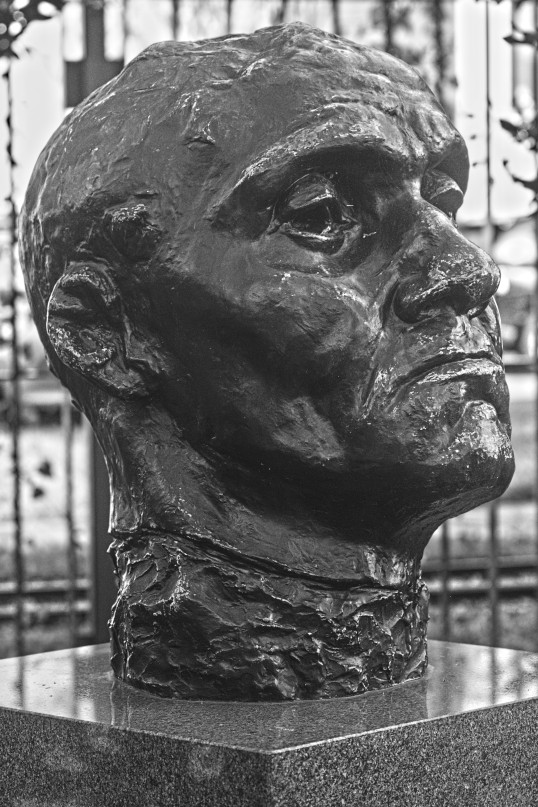
“The artist must create a spark before he can make a fire and before art is born, the artist must be ready to be consumed by the fire of his own creation.”
― Auguste Rodin
Monumental Head of Jean d’Aire (from The Burghers of Calais), Auguste Rodin, Sydney and Walda Besthoff Sculpture Garden






 Bill Chance