Bob Woodruff and Oak Point

The horrible heat that has gripped North Texas for months now finally broke this week. My intention is to, for as long as the weather is bearable, try to go for a bike ride every day- or at least as often as possible.

On Saturday, the weather was nice and I had a little time to spare in the morning. I thought for a bit, and decided to drive my car with my bike in the trunk up to one of my favorite spots, Bob Woodruff Park in Plano and go for a ride. I parked at the south part of the park, put my bicycle together, did a little light maintenance, and took off.

That section of the park, south of Park Boulevard, is a beautiful grove of thick trees nestled in a curve of creekbed. I have enjoyed going there for decades – something about the dappled light coming down through the branches is so relaxing….

Bob Woodruff Park

I love this spot in Plano's Bob Woodruff Park - a perfect grove of trees.

One time, years ago, I wrote about the place:

 There are few things as beautiful as dappled sunlight meandering down through a grove of trees.

I simply couldn’t take it any more today and had to get away, so after hitting the old todo list as hard as I could from seven to eleven I took half a day of vacation and booted out of work. I drove to a park and found a little nook in the creeky woods to spread a blanket for awhile. The weather was perfect, a cloudy morning burning away to a sunny afternoon.

The illusion of being out of the city was alarming and wonderful. Despite being smack-dab in the middle of the booming northern suburbs I barely saw a soul, heard almost no sound. I ate some fruit; the pinapple was the best I’ve ever tasted.

A woodpecker rat-a-tat-tatted overhead. One oak amazed me with its huge size. It must be almost two hundred years old.

There are few things as beautiful as dappled sunlight meandering down through a grove of trees.

I checked the date… October 15, 1998 – almost thirteen years ago. It seemed warm that day, hard to believe it was October. The grove of trees hasn’t changed, though. Today it was a lot more crowded – everyone is out and about in the sudden, surprising nice weather.
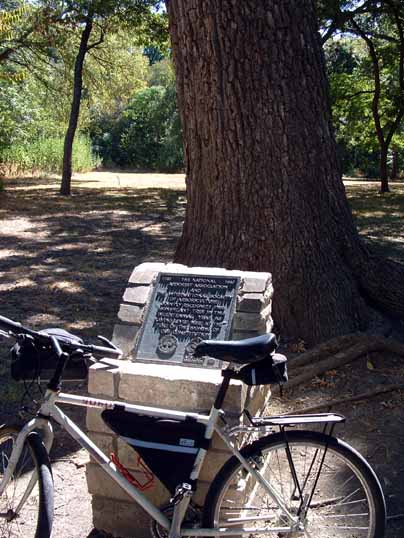
Bicentennial Tree

The plaque at the base of the Plano Bicentennial Burr Oak.

There are some big trees there. One is the Plano Bicentennial Oak (renamed  the Plano Quincentennial Bur Oak – it was older than they thought). It has a plaque mounted on a concrete stand that says:

 1767 – 1987

The National Arborist Association and the international society of arboriculture jointly recognize this significant tree in this bicentennial year as having lived here at the time of the signing of our constitution.

I could have hung out in the dappled sunlight all day – but I wanted some exercise, so I pedalled out. From looking at Google maps I had seen that a whole new park had been added to the north of Bob Woodruff – it was called the Oak Point Park and Nature Preserve and it has a complex of concrete trails webbed across it.

The new park was a blast. I spent the rest of the morning exploring and trying to cover all the trails, even the Santa Fe trail that branched out into the neighborhoods to the west.

What surprised me was that there were some hills to ride up. In the northern corners of the park trails branched out and coursed up some hills. I had forgotten how much I enjoyed riding hills – the burning legs, thumping heart, and empty lungs – it reminds you that you are alive.

Oak Point Nature Preserve

From this picture you would think I was out in the country somewhere, cruising the Great Plains, rather than in the heart of the urban, tony suburb of Plano, Texas. Look how dry the grass is... you can see how the fires in Texas are happening. Most of the trail winds around the ponds and creek bottom woods in the background.

The weather was nice, though the drought has left the lakes drying up, the trees stressed, and the grass as yellow as hay. There were a lot of people out – couples, families, a couple of crowds that looked like whole neighborhoods. Everyone was friendly, everyone said Hi as they passed on the trail.

Entrance

The entrance to Oak Point Nature Preserve on the North Side. This is actually at the top of a little hill.

I rode almost twelve miles on the trails and visited most of the area.

A good day.

What I learned this week, September, 9, 2011

I have gathered a garland of other men’s flowers, and nothing is mine but the cord that binds them.

—-Montaigne


An economic crisis is nature’s revenge on those who make and those who accept false promises; it is a holocaust of lies when the dross is burned away and only what is real and true remains. Think of cotton candy melting and charring in the flame of a blowtorch; that is what is happening to the secure retirements that “caring” blue politicians and “committed” blue union leaders promised gullible state workers.

—- from Rhode Island Pension System Collapsing – by Walter Russell Mead (read the whole thing)

I seem to be linking to Walter Russell Mead a lot.


How Bikes Could Transform Dallas

Constructing a city for the car alone shackles all to the burdens of car ownership and maintenance costs. In a city with a poverty rate of 23 percent and household transportation costs approaching 25 percent of income, fewer and fewer can afford to participate in the local economy, getting from point A to point B, without a miserable two-hour DART bus commute. Without choice in the transportation network, Sun Belt cities will go the way of the Rust Belt. A monoculture of transportation follows a monoculture of the very industry that produced it into collapse. Nobody thought Detroit would collapse when it was dubbed the Paris of the West. Paris, however, is alive and well. And so is bicycling in that world-class city.

—-From D MagazineBicyclist


The Shortlist for the 2011 Man Booker Prize is out:

The six books, selected from the longlist of 13, are:

Julian Barnes The Sense of an Ending (Jonathan Cape – Random House)

Carol Birch Jamrach’s Menagerie (Canongate Books)

Patrick deWitt The Sisters Brothers (Granta)

Esi Edugyan Half Blood Blues (Serpent’s Tail)

Stephen Kelman Pigeon English (Bloomsbury)

A.D. Miller Snowdrops (Atlantic)

I have not read any of these. Have to take a good look (don’t think I can read all of them in time). Any recomendations?


You don’t have to know what it is that you are eating in order to have a delicious meal.


Writing Tips for the Week

Eight Secrets Which Writers Won’t Tell You

by Ali

  • Secret #1: Writing is Hard
  • Secret #2: We All Struggle With Procrastination
  • Secret #3: We Put Ourselves Into Our Work
  • Secret #4: First Drafts are Always Crap
  • Secret #5: Each Piece Exists in a State of Flux – and it’s Never “Finished”
  • Secret #6: We Do it Because We’re Obsessed
  • Secret #7: Money does matter
  • Secret #8: We All Struggle With Self-Doubt

I had forgotten how much I enjoy a good, steep hill.


Even a titan like Starbucks is struggling in this difficult economy.

Yet, the little Vietnamese Coffee Shops in San Jose are thriving.

What could be the difference?

The Alchemist

“Don’t forget that everything you deal with is only one thing and nothing else. And don’t forget the language of omens. And, above all, don’t forget to follow your destiny through to its conclusion.”

—- Paulo Coelho, The Alchemist

Working cranking through my reading list – on a race with death – so many books, so little time – I queued up Paulo Coelho‘s The Alchemist. It’s a famous book, and has been recommended. I was happy to see that it was a slim volume – all the better for getting there in time.

You can say that the omens instructed me to read the book. I never cross the omens if it is at all possible.

The book is in the form of a fable… actually, it is a fable. It bears a strong resemblance to “The Man Who Became Rich through a Dream” from 1001 Nights (a folktale of Aarne-Thompson-Uther type 1645).

Is this a bad thing? I don’t think so. There are a lot of folk tales out there – any story told has been told before. I need to work on a list of these archetypal tales – I wonder how many can be updated into the big, evil city? Can I kill people in them?

I was of two minds reading the Alchemist. It’s a simple tale and I wanted more. But maybe that was simply my prejudice – I wasn’t expecting a fable, so I wasn’t satisfied with a fable.

But I’ve been to the desert and I know how it talks to you. I’ve never seen the pyramids but I can imagine what they would look like towering over the dunes by moonlight.

Now that I’m done, though, and moving on – I’m glad I read the thing. I’m not sure if I learned that much… I’ve heard it before. I wonder about the people that say, “This book will change your life,” – I guess that depends on what your life was before… but if a tale of symbols, omens, and following your own special destiny is a new and revolutionary concept for you … good luck with all that.

I wonder if an Alchemist has to learn Physical Alchemy? I’m a regular chemist, and p-chem almost killed me.

Oh, one more thing… even if it is a fable, it is one hell of a well-written one.

So, what do the omens tell me to read next…. maybe some nice, crude, violent crime noir. Something where some people die, people that don’t deserve it – people that follow their destiny to its conclusion… usually in some dark cold alley somewhere.

The Debt (2007)

I saw the trailers for the new movie “The Debt” and wanted to see it. After I saw this review, I really wanted to see it:

The movie has Helen Mirren in it, so it has to be good.

…. Movie Trivia Question…. What movie does Helen Miren’s character (one of my favorites) say, “Anall Nathrach – Uthvas Bethuud -Dothiel Tienve,” or something like that? (who knows how that is spelled?) If you don’t know the answer to this one, shame on you.

The only problem is that I don’t get to the theater much anymore – we’ll see what I can do.

But, in the meantime, Peggy found out that there is an earlier version of “The Debt” – It is an Israeli production done in 2007. I wanted to see it, see it before I go to the recent one.

So I checked Netflix… no luck. Not in the libraries… not even on Amazon… the disk doesn’t seem to be available in a North American version (though that will probably change soon, with the remake out).

So, when you can’t get something anywhere else… you go to the getting place. I did, and I got it. Had to go back for the subtitles.

If the remake is half as good as the original, it is a great movie. A movie that makes you think… and a tense little thriller to boot.

I’m not sure how faithful the remake is to the Israeli original – but from the trailers it looks pretty darn faithful. The scar on Helen Mirren’s face is more pronounced than in the original (I like the subtlety here, actually) but it’s in the same spot.

I wonder if the actual method of capturing the Nazi (I’m not giving anything away here) in the remake is the same as the original? It’s… umm… original and very harrowing. I don’t know if they will have the courage to put a scene like that in a mainstream Hollywood production. I’ll have to see….

Ooops. I just rewatched the review above carefully. It is the same. What do you know. This truly is the best of all possible worlds.

So you go see it… the original or the new one… whatever. Think about it.

Cool People Live Here

Urban Reserve

Entrance to the Urban Reserve

When I was riding down the Cottonwood Trail to the White Rock Creek Trail, there was a little neighborhood I wanted to visit on my bike. It’s called the Urban Reserve, and it’s one street lined with custom homes “designed by a select group of regionally and nationally recognized architects.”,

Dallas is such an ugly city… both naturally (it is flat as a pancake, and far from the coast) and man-made (despite the great architecture downtown, most of the metroplex are cookie-cutter suburban developments thrown thoughtlessly across the prairie). So it’s pretty cool to see somebody doing something like this.

I discovered this spot driving around when Nick played basketball at a private school next to the Urban Reserve. The southern end of the street has a little strip of concrete that connects to the White Rock Creek Trail.

Water

Some of the homes have water as a design feature. Unfortunately, that doesn't work well with the horrible drought conditions. If Frank Lloyd Wright did the work, it could be called "Stagnentwater." Architecture humor.

Since I found it, I’ve been trying to get Lee to go with me down there and look at the homes. He’s studying architecture at Tulane and I thought he’d be interested in something like that in his own city. Despite my best wheedling and pleading, he never was able to carve out enough time to go with me, and he’s back at school, so I’m pedaling around by myself.

See-Through House

Not all the planned and designed homes are built yet. Do you want to live in the "See-Through House"?

X-acto House

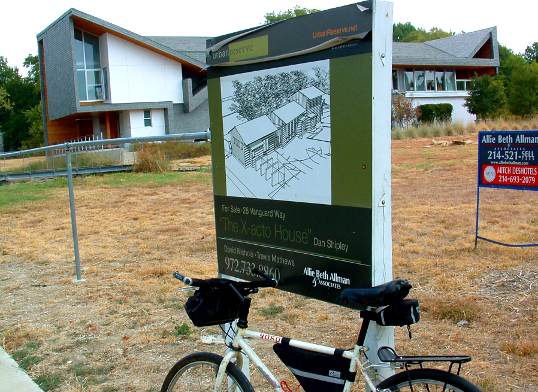
How about the "X-acto House"?

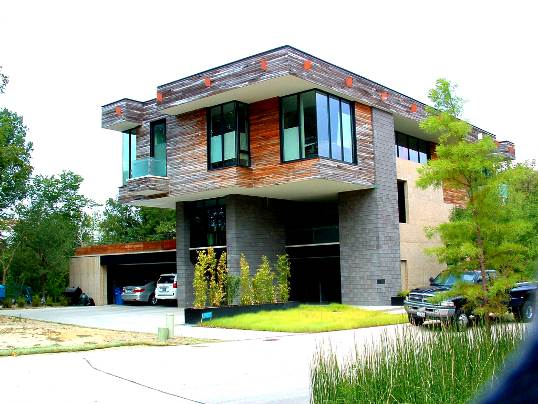
Home

The architecture is billed as “modern.” A lot of the homes are of the contemporary boxy style – Personally, I’d like to see more variety.

Now, why would people pay the extra money to live in a place like this?

See the little blue sign against the dark wall in front of the house in the picture above? Look closely.

Cool People Live Here

This is what is says. “Cool People Live Here. please do not disturb.” This is it, really, isn’t it? Buy one of these houses, and be one of the Cool People.

Would I like to do that? You bet your life. I’ve always wanted to be one of the Cool People. If I could afford one of these houses, I’d do it.

Wouldn’t you?

Bicyclist

I wasn't the only lonely bicyclist.

Cottonwood Trail

I remember in the mid eighties when the White Rock Creek trail was built here in Dallas. The city was installing a new massive water line along the creek and they decided to construct a concrete trail along the top of the pipe. This was a new idea at the time – the trail was too narrow and poorly designed in many parts – but it was wonderful. I lived near the lake and after work I would ride my bike to the lake, around it on the White Rock Lake Trail, then up and back on the creek trail – a total of about twenty five miles – almost every day.

I was young and in good shape and the ride was a blast. I still remember the thrill of flying across the city without the worry of being hit broadside by a pickup truck. I loved riding after work because I could speed past the packed up and stopped rush-hour commuters on their crowded freeways. It was the best of times.

Since then I’ve been an advocate for hike and bike trails – and the city has come a long way. Now, I’m more of a spectator than anything else… but I do what I can.

For years I have been following the building of the Cottonwood Trail – a hike and bike trail that runs from Richardson down under the High Five Interchange at Highway 75 and LBJ 635, then south through Hamilton Park until it connects up with the White Rock Creek Trail. This is an important connector trail, enabling bicycle commuters to pierce a large part of the DFW metroplex by connecting long existing trails through areas of heavy traffic that are otherwise impassible by bicycle or on foot.

I attended a lot of meetings when the High Five was being constructed, because it was affecting the commute to work of thousands of employees at my work site. During the presentations of the enormous, expensive, and complicated plans for ramps, frontage roads, and levels of access I noticed a thin green line snaking down along the creekbed in the maps and diagrams. The legend said the green line was a “hike and bike” trail.

In true government fashion, when I would ask about the green line, they would stare at the diagram and say, “I have no idea what that is, we’ll check it out and get back to you.” I never heard from anyone. I had to wait years until the thing was finished and then park my car and walk down there.

Sure enough, beneath the massive construction, there was a hike and bike trail. A beautiful trail, wide, landscaped, lit, and carefully designed and built to all the newest specifications. There was only one problem with this trail. It went nowhere. It dead ended at each end of the massive interchange – truly a road to nowhere. They weren’t able to get the cities that bordered the interchange to commit to connect up with the trail.

For years this strip of pavement was the best homeless shelter you could imagine. I would visit it every now and then and the number of tents, campfires, and piles of sleeping bags near the broken-out lighting fixtures in the shelter underneath the ramps grew and grew.

Finally, the wheels of progress turned and after half a decade or so the trail began to reach out from either end of the High Five. Videos – Going South, and Going North.  I checked up on the progress, encouraged that the trail finally gave a safe bicycle route to the campus where I work.

There was one piece missing, though. The final little bit that connected the trail with the White Rock Creek Trail (the main spine of the trail system that runs through this part of Dallas – the one I enjoyed so much a quarter century ago) was missing. They were taking forever to finish the thing.

Now it is done. And today I had a couple hours to pack up my bicycle and try to ride along the thing.

I packed my crappy old bicycle into the trunk of my car and drove down to the Forest Lane DART station to hop on the final part of the trail. I bought this bike used for ninety dollars almost twenty years ago, so it’s not surprising that I’m having some trouble with it.

The engine, of course, is the worst. It’s old, worn out, and generally gone to shit, but I’m stuck with that. Otherwise, the seat is breaking apart and the derailleurs don’t shift very well any more. I did some work on the front shift levers, moving the adjustment knob to try and get the shifting to improve, but it didn’t seem to help.

I hopped on and headed off. The heat is a little less toxic than it has been, though it is still horribly dry here. Right away I was having trouble. It was a struggle to pedal and my legs were aching and my breathing a chore. I was beginning to feel a little spark of panic – it wasn’t supposed to be this hard.

Then I realized that I had been turning the wrong adjustment knob when I was working on the front derailleur. I had been tightening the front brake by mistake, and it was dragging the bike to a stop.

Fixing that helped a lot – though for the rest of the day I was panicked and tired.

At any rate, I had a good time. The little bit of trail seemed anti-climatic after all the years of anticipation, but that’s that. I wish the thing was there when I was riding all those years ago… or, really, I wish that I could ride like that again.

Old End

This is where the Cottonwood Trail ended the last time I rode it. This is in Hamilton Park, just south of the High Five Interchange.

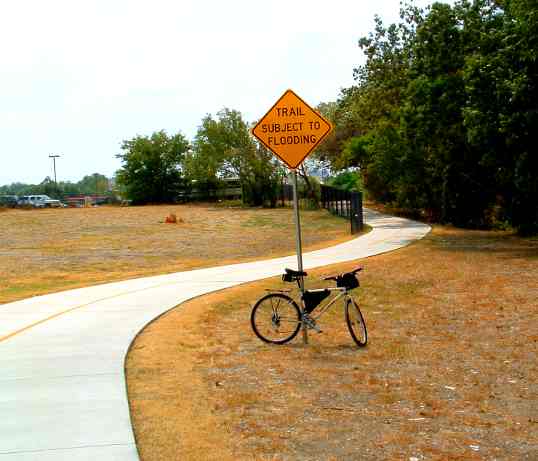
Now

Here is the same spot now. Those "Trail Subject to Flooding" signs are everywhere, though I can't imagine a drop of water right now.

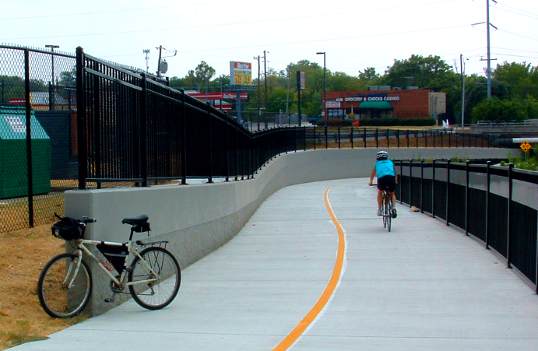
A little farther.

A little farther down the trail, where it crosses under Forest Lane. One reason the construction took so long is that there was a lot of work involved in this road crossing and the creek bridge.

Forest Lane DART station

The entry to the trail at the Forest Lane DART station.

Bicycle Lockers

Cool looking bicycle lockers at the DART station.

Creek Bridge

The bridge over Cottonwood Creek. Another "Trail Subject to Flooding" sign. Wishful thinking. I don't know where the trickle of water still in the creek comes from.

Rest Area

The trail runs through some thick woods between the train line and the creek south of Forest Lane. There is a nice rest area built there. This homeless guy was sitting in the rest area, reading and writing in his notebook. We talked about the weather and I helped him find a lost sock.

White Rock Creek

The southern terminus of the Cottonwood Creek trail, where it connects with the White Rock Creek Trail. The DART train is crossing White Rock Creek over the trail.

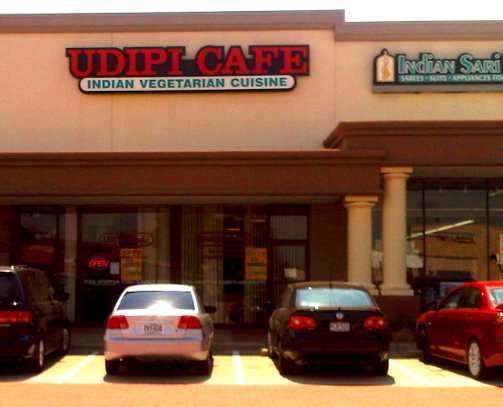
Udipi Cafe

Udipi Cafe

Udipi Cafe

Last weekend I enjoyed trying out the lunch buffets at the bookended Asian vegetarian restaurants in my neighborhood, Suma Veggie Cafe, and the Veggie Garden. I’m compiling a list of family-owned restaurants near my home and the countries and cultures their cuisines represent – it’s a daunting task. I wanted to keep this going this weekend.

A friend suggested, “You might also try the vegetarian Indian restaurant a couple doors down from Party City at 75 and Beltline.” She was referring to the Udipi Cafe, one of several Indian restaurants in the newly remodeled Richardson Heights Shopping Center. Today, at lunch, I decided to give it a try.

Like so many small family-owned spots, it is small and unassuming, but clean and cheerful. The place was full, mostly with families, with a few couples and a couple big tables of young people.

I know very little… nothing really about Indian Food in general. The Udipi Cafe is advertised as “Note that Udipi offers SOUTH Indian cuisine which is different from the commonly found North Indian cuisine.” – which means I know less than nothing. It’s vegetarian South Indian cuisine, which adds another layer of mystery for me.

The buffet was labeled, which didn’t help at all – except I love the look of the words – Poori, Aloo Paratha, Udipi Iddly, Moong Dosai, Uthappam, Aloo Gobi… How can anything with names this cool not be delicious?

At the buffet, I was confused. There were regular plates in a pile, but most folks were eating from these big shiny metal cafeteria style plates with raised areas for different foods. Also, there were all these little metal cups. What do I put in the cup? What is permissible to mix together? What do I keep separate in the areas of the plate? What is OK to soak up with the bread?

I made the mistake of sitting with my back to the buffet. It was nice to watch the big family groups and the young people (I wondered if any of them new Nick or Lee), but in a new place like this, it’s usually a good idea to watch the experts getting their food – learn how it’s done.

All good, though. I just piled it all up and it was all delicious. The Indian spices were more complex than some I’ve had and I really liked it. I especially enjoyed the curried chick peas – Chana Masala (I think), the Jackfruit Curry (I looked at the generous chunk of Jackfruit on my fork, thought about whether caution should be in order, and decided to simply plunge on in), and some sort of a a spicy pineapple something.

They brought a plate of Dosa to my table. These are crepes – mine were probably Masala Dosa – filled with potatoes and onions. Really good but really filling.

It was fun, it was good… I want to go back, but my list of places to go is growing faster than I can cross them off.

Superdrome

I remember when the Superdrome was built, thirteen years ago. There were some interesting news articles about it.

The thing was up in Frisco, which, back then, was some small town way up north of the city. It didn’t take long for the Metroplex, which has been vomiting new developments out north across the cotton fields for decades, to swallow Frisco and now it’s another tony suburb between Plano and McKinney.

There was a time that I was a good bike rider. A very good bike rider. That was a long, long time ago. I never did learn to/get to ride on a track. Some friends of mine in college did, though I have no idea where the velodrome was, now that I think about it. I remember when one of them had his track bike go out of control on the steep slopes of Mount Oread – no brakes, no freewheel – and he had to steer across a lawn and into a hedge to stop.

I was old and fat before the Superdrome was built, though I still wanted to go out and see it. A friend from work rides there and he used to always bug me to take Lee up to the track and let him try it out. I was worried about letting Lee see the track. I knew he would love it and we couldn’t afford another expensive sport.

That’s not really true. I wanted to let Lee give it a shot, but there wasn’t enough time.

Now, after all these years, now that it’s far too late, I was able to drive out there after work and watch some races.

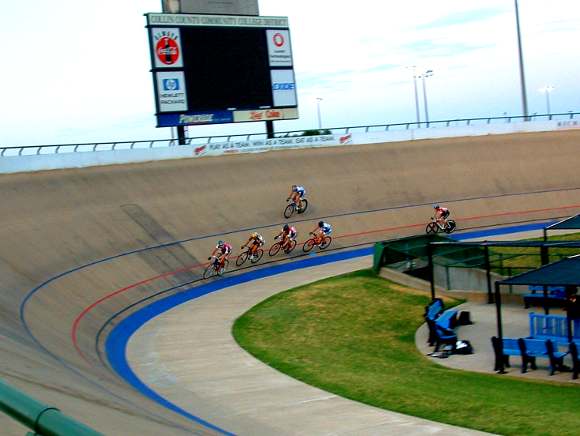
I wanted to take some pictures, but my good camera is still broken and I don’t have the money to get it fixed. I had to settle for a few quick snaps. It didn’t take long for the sun to set and the bikes to get faster and all that I had were blurs on the track.

The most startling thing about a velodrome, the first time you see one, is how steep the banked curves are. It looks suicidal to go up there on a bicycle. In the races, though, you see how the riders use the bank to control their speed, to slow for a second without losing momentum – they pick their speed back up when then roll back down the slope.

Superdrome

The ends of the oval track are high banked curves.

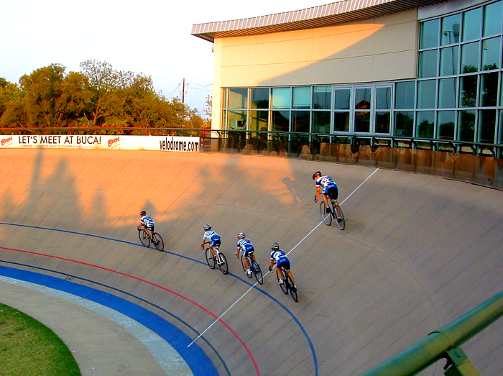
There are several division of riders: juniors, masters, Categories 1-4, women… they even took a break to let a toddler pedal around on a bike with training wheels (the announcer said, “250 meters is a long way to go when your legs are that short – this is a track, no coasting!”) – and they were all fun to watch.

Superdrome

The junior riders were the first ones out on the track.

Superdrome

While one class is racing, the next group warms up on the infield.

There were enough races to get a feel for how it goes, for the different types of race, and for the different classes of rider. I was the only true spectator there – everybody else was either riding or there to watch a family member.

I enjoyed going out there and will go back. I have no idea why it took me so long to get out there, even though it is a long, gas-guzzling drive from my house during a Friday rush hour. It was fun to watch, but I would give anything to be able to ride on those slopes, and it’s never going to happen now.

What I learned this week, September 2, 2011

Amy Tan on Creativity


I have been around the block a few times – I have lived long enough to have ridden the economic roller coaster in its up and downs. I’ve been telling folks that the last few years have felt a lot like the Jimmy Carter “malaise” stagflation of 1981.

There are a lot of parallels, and everything fades in memory, especially the worst things, but man, this one is nasty. I keep meeting people, hearing things, and reading more and more about this sort of situation:

“I don’t think anybody realized you had to recreate yourself out of the box,” Wiedemer says, noting that she has a BS in Finance and a dozen years of experience in the financial services industry. “If I had it to do over I wouldn’t climb the ladder in corporate America… Whenever I was unemployed in the past it was never for more than a couple weeks.”

Damn This Recession! – The rise of the unemployees


I added a long TED talk to my blog post on Douglas Adams. If you are a fan of him or of The Hitchiker’s Guide to the Galaxy, go take a look. Don’t forget your towel.


There have been a lot of theories about the cause(s) of the drastic drop in the crime rate over the last few decades. There is certainly more than one explanation. The popular book, Freakonomics, attributes a lot of the drop in crime to the rising abortion rate. Obviously, our increased prison population and more police on the street had a part.

One idea that I always had is the fact that lead was removed from gasoline at the time. This resulted in a dramatic reduction in lead levels, especially in young people, especially in urban areas. Elevated lead levels are associated with aggressive behavior and other mental problems.

I have been criticised for this view; someone told me, “Only a man would think of something like that,” which I thought was pretty idiotic. My personal response was, “Only a person with access to environmental lead data, who had done blood level testing in elevated lead exposure situations (after the Livingston Train Derailment in 1982), and who had done research into how elevated blood lead levels lead to changes in behavior, would think of something like that.”

Finally, I actually found an article that also mentions this theory:

There may also be a medical reason for the crime decline. For decades, doctors have known that children with lots of lead in their blood are much more likely to be aggressive, violent, and delinquent. In 1974, the Environmental Protection Agency required oil companies to stop putting lead in gasoline. At the same time, lead in paint was banned for any new home (though old buildings still have lead paint, which children can absorb). Tests have shown that the amount of lead in Americans’ blood fell by four-fifths between 1975 and 1991. A 2000 study by economist Rick Nevin suggested that the reduction in gasoline lead produced more than half of the decline in violent crime during the nineties. A later study by Nevin claimed that this also happened in other nations. Another economist, Jessica Wolpaw Reyes, has made the same argument. (One oddity about this fascinating claim has yet to be explained: why the reduction related to lead-free blood included only violent crime, not property offenses.)

From Crime and the Great Recession by James Q. Wilson, in City Journal


No matter how bad I am, I’ll never be as bad as this:


Writing Tips for the Week

How to Stay Motivated

Condensed from Colombia University Graduate School of Arts and Sciences

1. Set a daily writing goal.

2. Schedule your writing as early as possible in the day. If you fear or dislike writing, then once it’s done, you experience a tremendous sense of relief that you have the rest of the day to do everything else you must do…without having to think about your writing.

3. Think ahead and plan backwards.

4. Work with deadlines.

5. There is no writing, only re-writing, Lamott (1994) says, “Get it down, so you can clean it up.” Shaw (1993) says, “There is no such thing as good writing. There is only good rewriting.” If it helps to motivate you, you do not need to write a final draft, or even a good draft. You write today what you must so that you can produce good writing when you edit.

6. Reward progress.

7. Motivate (and comfort) yourself with stories of other good writers (and how they suffer, too).

8. Read others’ acknowledgments.

9. And here’s another good motivational strategy: Donate $5 to your favorite U.S. presidential candidate’s opponent for each day you do not write.


Do you ever watch the Discovery Channel’s Dirty Jobs?

I have had the experience of actually doing a job, at the exact location, that was on the show (it wasn’t a bad job at all – and it certainly wasn’t “dirty”).

Salt Mine – Outside

Yes, I used to work there.

At a quick glance – “Dirty Jobs” is just another cheapy, throwaway, cable pseudo-reality series that gives you a few chuckles and a shock or two – barely enough to keep your hand off of the remote control and certainly not enough to justify wasting that precious sliver of time that it takes to watch the thing.

But maybe there’s something else going on here. Maybe you can learn something.

Take a look at this TED talk (yes, all of it) – the host certainly has learned something

Did you think you would get a lecture from the Dirty Jobs guy on Anagnorisis and Peripeteia? With the added instructional lecture on how to bite off a pair of sheep balls?

Stay tuned my friends, you might learn something.

High-Rise

“Later, as he sat on his balcony eating the dog, Dr Robert Laing reflected on the unusual events that had taken place within this huge apartment building during the previous three months.”

—- Opening Line, High-Rise, by J. G. Ballard

It’s getting tough to decide on the next book to read. While I was considering the options I came across a few interesting articles comparing and contrasting the fiction of the late J. G. Ballard and the recent London riots.

I have been a fan of Ballard’s work for decades. It didn’t take me long to decide to dive in, especially when I discovered a copy of one of his classic works, one that I had never read, High-Rise.

About forty years ago, Ballard wrote three hyper-real novels about the relationships between society, technology, urban life, disaster, sex, and the monsters of the id. I have already read the excellent, interesting, and underrated Concrete Island and the infamous Crash. So I decided to complete the hat trick.

There are three minor characters and also the hero of High-Rise. The point of view circulates among Dr. Robert Laing, a medical school instructor that seems to be fleeing from the responsibilities of being a real doctor – Richard Wilder, a maker of documentaries that becomes overly attached to his video camera, and Anthony Royal, an architect that lives in a luxurious penthouse apartment.

These three live in a single forty-story condominium tower. It’s a brand-new building, part of a series of skyscrapers going up in a half-built complex on the outskirts of London. The three characters are representatives of the three classes in the building… that map out to their height above the ground. Wilder is from the second floor, where the lower classes live – although in this case they aren’t actually poor – they are made up of airline pilots, stewardesses, and television workers – wealthy enough all in any other setting. The middle part of the building, the largest section, from the shopping mall on the 10th floor up to about the swimming pool on the 35th and are represented by Laing- all professionals and respected members of the city at large.

Only the super-wealthy business tycoons occupy the top floors. At the very apex is Royal, who is credited with designing the building, though in reality, he only did the children’s playground on the roof and a few elevator lobbies.

The hero, the true protagonist is the building itself. It has a life and evil all its own… you can almost hear it speaking.

Pretty quickly, it becomes obvious that all is not right in this brave new world. There are obvious frictions between the three classes which spill out when the children of the lower floors try to use the swimming pool on the upper levels. The real trouble begins with parties. The innocent hedonism quickly becomes out of control, with plenty of illicit sex and bottles being thrown from balconies.

The three classes start out going to war with each other, complete with raiding parties and running battles over which group controls the important resources, such as the elevators and the garbage chutes. This is no Marxian polemic, however, and the three groups quickly lose their cohesion until it’s floor against floor, then small groups of apartments, then… well… let’s just say, things don’t end well.

Which, of course, is how I like it. I really enjoyed the book.

Ballard writes about such horrific descents into evil and madness with an almost geometric precision and symmetry. The building is designed just so, the cars are parked in a careful order, the balconies are arranged so everyone can see into everybody else’s’ business… once you think about it, the horrific events are not only understandable, they are inevitable.

It’s the sort of thing someone that had spent his childhood in a Japanese prisoner of war camp might have written.

A film is being made of the book, done by the director that made Cube – an interesting horror film with the best idea for efficient use of a simple filming set ever made.

He seems to be doing the film with the tower set in the middle of an ocean. I’m not sure if that is a good choice – one of the most interesting aspects of the novel is how, as things became worse and worse in the high rise, the residents became more and more insular, until they became, by choice, completely cut-off from the outside world. Also, in the book, there are more high-rises going up. Laing watches the one in front of his apartment being finished and then occupied. Near the end, he sees power going off in several floors over there – it is implied that the same horror that has infected his tower is spreading to the next. Set the building out in the ocean and you lose these details.

But… little concern. I’ll still go see the thing. I doubt if they can come up with a way to give it a happy ending. At least I hope not.