Is Reading a Waste of Time?

Digging around in the archives of my old online journal... I found this entry from June 28, 2002. When I put it out in public – a lot of people had a strong opinion on this question – nobody thought that reading was a waste of time.  Despite this public consensus,  I still haven’t answered the question to my own satisfaction.

For example, despite the fact I’m a third of the way through a Hemingway novel, I haven’t had the time to pick up my Kindle in the last three days.

Nick reading Harry Potter.

Nick reading Harry Potter. Is this the first one?


There’s a kind of comfort in returning at the end of the day to the same people and watching them enter their lives more deeply.

—-Tobias Wolfe, on the novel

I came across this quote… about novels. After reading and thinking about it I realized how true it was.

For the last few months I’ve been reading collections of short stories or slim novellas, exclusively. Time has been very short. Plus, I’m working on a handful of stories myself – trying to get them ready to send off – and wanted to read the form and keep my mind and pen open to the myriad possibilities.

I felt the urge to bite into something more substantial, so I scanned my case of recently purchased, but unread, tomes and pulled out The Corrections, by Jonathan Franzen. I’m not interested in the media hoo-ha concerning this book and the author’s relationship with Oprah Winfry. I read some glowing reviews, though, so I thought it might be worth the read.

I’m maybe two-thirds through and the book is good. It started better than it is right now – Franzen seems to be repeating themes and situations, plus the center section feels a little padded – but it is well-written, with compelling characters. You can’t ask for much more.

What has taken me off guard is how much I’m enjoying reading the book. I catch myself looking forward to getting home, getting my stuff done, spending some time with Nick and Lee, getting in my daily writing, then settling down with the book (if I’m not too exhausted to stay awake). It feels like a deserved reward at the end of a long day.

It feels like a second life. I never thought about how the characters in a full-blown novel come, over the time it takes to get through the book, to occupy your imagination, your life of the mind. They become imaginary friends, shadow family members – unreal characters that, because they exist only within your own personal gray matter, share an odd intimacy with you.

The best thing is that, because they are only shadows of text and imagination, they are harmless. This second family can be as colorful as they want to be without causing problems in the real world. The more outrageous, dysfunctional, and insane, the better.

You can have flawed, unfaithful, even evil friends and relatives – with all the amusement that entails – but without them showing up at all hours to call in an old favor and demand you hide them from the police/mob/irate former lovers.

I used to buy books based on bulk. I’d dig through the used bookstores looking for massive tomes at low prices – sort of a cost per page value basis. I guess I was thinking about how much enjoyment – maximizing the time would I get from each book.

Over the years, I moved away from this philosophy of reading as my life became busier and busier and my time on earth becomes shorter and shorter.

I know a lot of successful people, type “A” personalities that are always rushing around getting things done, making lots of money, or fighting back the entropy that constantly attacks their living spaces. Most of them don’t read much. They view reading as a useless, frivolous, and wasteful activity.

Is reading a waste of time? It doesn’t accomplish anything. I consider watching television a waste of time (though I do watch too much, of course) – how is reading any different? How about going to films? Is that a waste? How is that different than TV?

If reading is a waste of time why do we work so hard to get our kids to do it? Fret so much when they would rather play with their friends – interact with real people rather than stick their solitary nose in a book?

Is reading a waste of time?

Are fish sticks considered seafood?
The Lookout

When everything is as confused as I am right now, something as simple as a Netflix disc queue becomes a source of mystery as the red mailers arrive with unknown contents. I tear open the paper and see the Tyvek envelope with its circular burden and read the little label. I have no idea why this has been sent to me – no memory of searching and adding – though I must have done it.

Tonight was “Lookout” – the great plains noir starring Joseph Gordon-Levitt as a night janitor in a bank. He suffers from dain bramage – sort of Memento light.

I didn’t really want to watch it all that much – I have plenty else to do. But I can’t send it back unwatched (that is something not to be done – a modern day sin) and I need to clear my queue so I can get my next disc. This weekend, I ordered The Rocky Horror Picture Show and moved it to the top of the queue. This is not for me, of course. I have seen Rocky Horror… maybe a hundred times. I have never seen it on video – I’m sure it’s pretty crappy on the small screen, it has to been seen in a crowded midnight theater. I’ve seen the live stage play twice- which is the best way to see the thing.

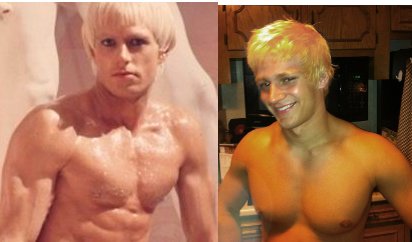
I ordered it for Lee. He has decided that blondes have more fun, and has bleached his hair. It started out sort of a ruddy gold, but with some work he has it at platinum now.

Several people have told him he looks like Frankenfurter’s Monster, Rocky, from the eponymous musical horror picture show extravaganza. He’s never seen it and asked me what was up, so I’ve ordered it.

Rocky and Lee

Rocky and Lee

I don’t know… do you think there’s a resemblance here?

At any rate, on to The Lookout. After all the weird crap I’ve been seeing lately, it was nice to see a well-done, professionally made, predictable noir thriller.

I remember when I was a youngster and living in Kansas we used to, every now and then, drive out, way out in the country after midnight along the arrow-straight sand roads between the wheat fields with our lights out. These roads are gridded out every mile from there to hell and back. You could speed up until you could feel the tires starting to float on the sand the tiniest bit. The drive would then be as smooth as fresh asphalt.

The thing was, once you turned the lights out your eyes would get used to the dark and you could see everything clearly by moonlight. The colors were gone, everything was a ghostly blue, a silent timeless featureless landscape screaming by.

We could see good enough to see if there was a combine stalled in the road, I guarantee it.

It was cool… except for one thing. I always had the fear, though the odds against it were astronomical, that someone might be doing the same thing, coming in the other direction.

Cooking Pasta like Risotto

The other day I came across an expensive pot and a technique for making pasta that I had not heard of. You cook the pasta like risotto – sautéing it in a little olive oil and then adding liquid slowly, which it adsorbs as it cooks. The oil combines with the starch in the cooking water to make a thickened sauce, and the pasta adsorbs the flavors as it cooks. A quick, one pot meal, no hot boiling pasta water to throw away.

Learn here:

I can’t afford an Alain Ducasse pot, but I dug out a medium sized dutch oven.

I didn’t want to risk any expensive ingredients, so I made do with what we had on hand. The other day, Candy and I were waiting for Microcenter to open so we could look at netbooks and to kill time, we moseyed over to a Mexican Grocery store nearby. I bought a little packet of Mexican wagon wheel pasta – they have a whole slew of little shapes, all semolina pasta (high semolina content is important to keep the pasta from getting soggy), for thirty cents a bag. I also bought some Mexican cheese to go with it, and a can of chipotles.

I figured I’d use the technique of cooking pasta like risotto, but with a south-of-the-border twist. When looking at cooking stuff, it’s the techniques that you want to learn, not the recipes.

So I threw a little splash of olive oil into the dutch oven and cooked up some onion and garlic in it. For flavor I chopped in a chipotle pepper and its adobo sauce from the can. Be careful with this, I know from experience a small amount of chipotle adds a big kick. I dumped in the package of pasta and cooked it a bit. Then, in went a can of tomato sauce.

Pasta

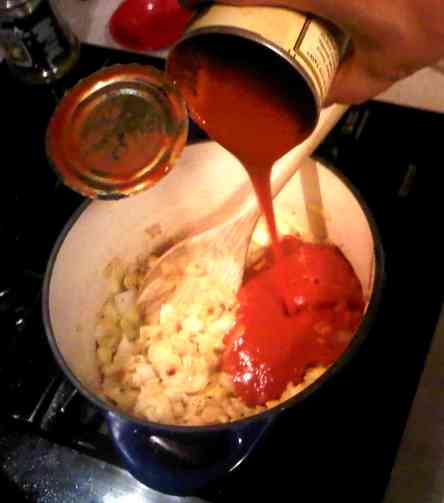
I pour a can of tomato sauce over the pasta, garlic, one chipote pepper (only one!) and onions that I have been cooking in olive oil in a medium dutch oven.

I cooked this for twenty minutes, slowly adding water as needed. I ended up adding right at two tomato sauce cans full of water. Stir it constantly, add it slowly, and be careful. If you don’t add enough water, it will burn on the bottom. If you add too much, the pasta will get mushy. This seems hard, but if you pay attention, it’s a piece of cake.

Water

Add the water slowly, not too much, and don't stop stirring. It stuck a bit while I was taking this picture.

Right at the end of the twenty minutes I added some vegetables. One article suggested broccoli, and that would be good, but I have this big ol’ bag of frozen peas, carrots, and beans mixed… so I dumped about a cup and a half in. The article stresses out about how long to cook the broccoli – if I had been using fresh vegetables I would steam them a bit ahead of time and dump them in at the end – no problem. Since these were frozen, all I had to do is let them warm up.

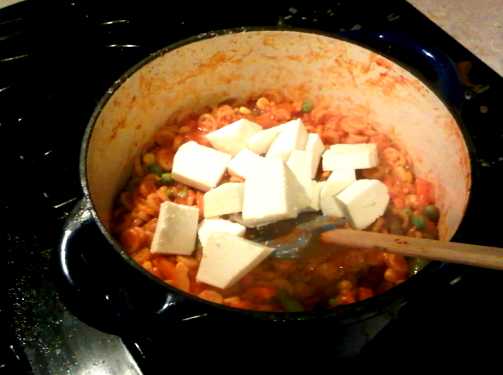
Then, in with the cheese. I had bought the wrong kind of Mexican cheese and it didn’t melt. So I left the chunks in for protein and added some shredded mozzarella. That seems kind of a weird mixture, but it was delicious.

Cheese

In goes the cheese, Unfortunately I bought the wrong kind of Mexican cheese and it didn't melt. No problem, I pulled out some shredded mozzarella and it was all good.

To serve, you plop the dutch oven down on the table on a trivet, and dig in. It’s sort of a one-pot meal, but a salad is nice along side.

Done

Ready to serve. It tasted a lot better than it looks in this picture. The pasta was just right and adsorbs the flavor of the chipotle (only one!), the garlic, and the tomato sauce.

So now I have a new technique for cooking pasta. The only downside is that you have to stand there stirring while it cooks, but it’s only twenty minutes. Pasta sauce is almost as much trouble by itself, and this way there’s no boiling water.

I like it.

My 99 Cent Manifesto

Press

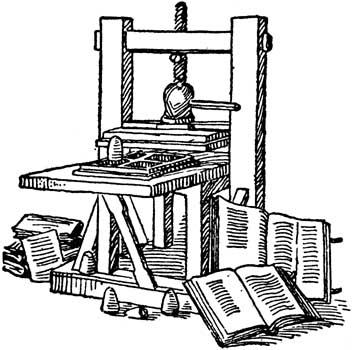
Press

I am in the home stretch of finishing up the editing and conversion of my book of short stories that I will put out as a Kindle ebook. I’ve been in the stretch run for a while. I’m struggling now with the cover… but mostly I struggle with the fear that putting something out there generates. Nothing to do but plug ahead as best as I can.

I have been thinking a lot about price points – about what I’ll charge for my book when I get it out.

First of all, isn’t it amazing that I’m even getting to decide this? Unpublished, unknown, talentless, loser writers didn’t used to have input on these decisions. The publisher decides.

But publishing, as we know it, is dead. It doesn’t know it yet – though it has a strong suspicion.

The Publishing Industry. I hate it when groups like Publishing call themselves an Industry. (Music Industry, Movie Industry, Television Industry) I’ve worked in Industry and Publishing is not an Industry (Book Printing is an Industry, but you have to go to China to find it). Industry isn’t art – it isn’t creative (not in the usual sense of creativity) Industry is a world of huge heavy smelly machines – a world of maintenance and statistics – it’s a world of hardhats, steel toed shoes, and flame resistant uniforms.

When a group like Publishers call themselves an Industry… they are dead. They have killed themselves. It is only a matter of time. The only thing left is momentum.

Underwood Typewriter

Underwood Typewriter

So I get to write whatever crap I feel like. And you get to read it. That’s not Industry – that’s the future. The question I have left is, “How Much Do I Charge.”

That’s a tough question. The head swims. To decide, the only way is to break it down, make a few options and choose between them. Eliminate the bottom choices, one by one. OK, that works.

The price points of ebooks don’t take long to figure out. They are:

  •  Really Expensive
  • Ten Bucks
  • Two Ninety Nine
  • Ninety Nine Cents
  • Free

The top choice, Really Expensive, is easy to eliminate. I’m nobody. I’m not selling a textbook or legal reference full of knowledge that is extremely valuable to an extremely small group. So, Really Expensive is out.

trs80

TRS80

Now, we are down to the affordable options. Why not free? This is my first ebook – all I’m really interested in is getting it out there. The idea is to get as many readers as possible, and then try and keep them. I have more books (already have enough short stories for another volume, and a novel is not inconceivable – I have a killer first sentence) in the pipeline, and a free teaser would help me spread the word.

Free is tempting, but I don’t think I’ll go that way. There is a question of value. A book is a relationship between an author and a reader. That relationship should/must have some value for it to be real and useful. Free is throwing propaganda leaflets from a bomber’s bay, free is a blog, free is a mimeographed sheet stapled to a telephone pole. These are all good things, important things, but that’s not what I want this time around.

What I want is terribly nebulous but it I feel it has to involve a transfer of value for it to truly occur.

That leaves ten, two ninety nine, and ninety nine cents.

Ten is tempting. That’s what I think an ebook should cost. That’s what I am happy paying for an established author, for something I’m pretty sure I’ll like. For the hours of enjoyment that a good book gives, ten dollars is a fantastic bargain. It even provides a nice return for the author.

But ten dollars is still a lot of money. Especially in this day of terrible tribulations and looming financial collapse a ten dollar purchase is a tough call (or at least it should be). I’m not established, I’m no sure thing, I’m not very good.

Ten dollars is too much.

Now we are down to two options. Two ninety-nine. Or ninety-nine cents.

Two ninety-nine is a great option. That’s the price (more or less) that Amazon kicks the author’s royalty up to 70 percent. My return on a book sold at that point is twice what it would be at only a few cents less. It’s not a lot of money. I feel sure that this is what I’ll charge for my second book, if I live that long.

Three bucks – a hamburger… a drink at happy hour in a bar… a bag of chips… or so. It is an odd amount of money… sort of in between.

Still, two ninety-nine… that’s not an impulse purchase. You have to think about it. It might not be much of a thought, but it is one.

And ninety-nine cents? What’s that? That’s nothing. Click on that link and it’s yours. Don’t even think about it. If it turns out to be crap – so what? You’re only out ninety-nine cents. Less than a dollar. You won’t miss a dollar. You can’t hardly buy anything with a dollar anymore.

Ninety-nine cents. The more I think about it, the more I like it. It’s something, it’s a transfer of value, but otherwise… it’s like a gift from me to you.

It’s like a cheap lottery ticket. Maybe it will be good, maybe not. But if it hits, you’ve got a lot of entertainment for not a lot of money. If it misses, so what? There is even the enjoyment of the momentary fantasy that you’ve found a bargain, something cool that nobody else has. That’s worth ninety-nine cents, right?

Kindle

Call Me Ishmael

I have always loved Kafka. His writing has been a huge influence on how I live my life (God help me). During his life, he published almost nothing. When he died, his final request was to have all his work destroyed (thank goodness, Max Brod decided to ignore his good friend’s dying wish). If Kafka was living in today’s times would he be pumping out ninety-nine cent ebooks? I like to think so. Would anyone be reading them? Probably not.

So there it is. Ninety-nine cents.

I like it.

Stay tuned.

Bicycle Rack

One of my main personal goals right now is to be able to commute to work on my bicycle a couple of days each week. I don’t live all that far (though there is a big evil city in between here and there) so it shouldn’t be such a big deal – but to me, it feels like it is.

I started riding on the trails by my house. Then I realized that they now reached out in the direction of my work. I found a route that would get me there without, hopefully, getting me killed.

My head was filling with progress until I had a setback – the heat here is deadly this summer; it’s making outdoor activities impossible.

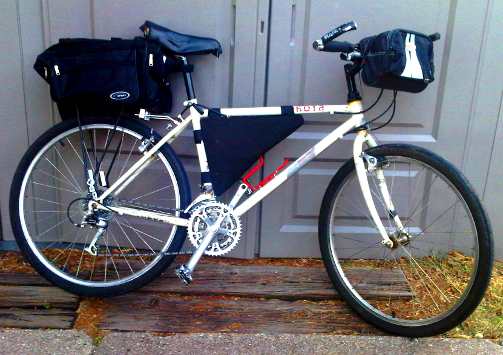
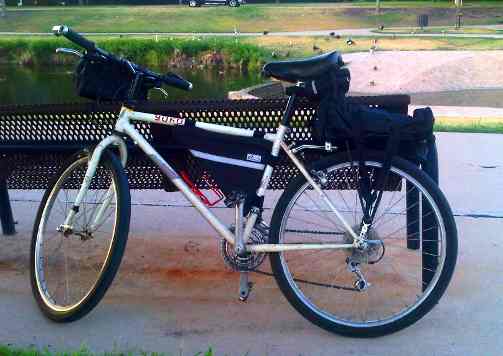
Still, I plan ahead. Planning is, after all, a lot easier than doing. I’m thinking about logistics – what I must carry with me during a bicycle commute. I realized that if I’m going to ride to work I’m going to have to carry a change of clothes plus a towel and various sundries so I don’t sit in a pool of my own sweat all day. My crappy old cheap bicycle (I bought it at a pawn shop for ninety dollars more than fifteen years ago) is ugly with bags already (handlebar bag for phone, wallet, camera, keys, water and such – frame bag for lock, chain, and pump – and seat bag for repair kit) but even with that I didn’t have any place for a clothes bag.

I needed a rack. I used to have one on the bike but I took it off for some reason years ago and it is long lost. So I went to Bike Nashbar and bought one of their cheap, generic bicycle racks.

Rack

Bike Nashbar rack mounted on the back of my bicycle.

It went on easily. Doesn’t look too bad, considering.

But now I needed a bag. I could buy an expensive trunk, or a pair of even more expensive panniers, but I’m too poor for that… or at least too cheap. I did an Internet search for DIY bike bags and found more stuff that I could handle… all the way from 2×2 wooden mounting apparatus, to complex sewing instructions for pannier production. A lot of ideas were… sort of silly, but a few of the instructions seemed really helpful, and I’ll probably work my way towards some of these ideas.

But for now, as I am wont to do, I went cheap and I went simple. I stopped by Big Lots and bought a nine dollar gym bag and a set of little bungee cords for a buck fifty. I took the shoulder strap off of the gym bag and used its mounting points to bungee the bag to the rack.

Pack

The gym bag bungeed onto the bicycle rack. This was less than successful.

And off I went. I made it a good, solid twenty feet until I felt something jam into my rear spokes. The bag had slid off sideways and fallen over. I should know better – it is always stability that gives problems, not strength.

I thought about giving up. I was tired and hot. But I had packed extra bungee cords and I used them to attach the handle straps on the bag to the sides of the rack. And that worked. I went for a little four mile ride and the bag didn’t budge a bit.

Pack Straps

This works, but it looks stupid. Though not as stupid as when I'm actually riding the thing.

It sure looks awful, though. I’ll do some thinking, work on a more elegant way to attach the thing. At least I know now what the parameters are and that it will at least work.

But who am I kidding – it isn’t the rack or the bag on my bicycle that’s the problem. It’s the engine. It’s old, crappy, and wore out. That’s what needs to be worked on and worked over. That’s what makes the simple act of riding a bicycle to my work feel like Sisyphus and his rock.


Surfing around the web at random, I found this song and video I had seen when it first came out a couple years ago. I had forgotten how wicked cool this was. Love it.

http://vimeo.com/5020497

First Saturday Sale

Customers

A wide variety of customers listen to a sales pitch at the First Saturday Computer flea market in Dallas.

Candy’s laptop is hosed and we need to get her back into the digital world. She is thinking about an iPad or a new laptop, but in the meantime, Lee has decided not to take his desktop computer back to school with him. It’s a Frankenstein machine I built for him years ago, carefully assembling it from pieces as they went on sale at Fry’s or MicroCenter. It’s now about half a decade out of date, but it’s still functional, chugging along as always. It’ll work fine for surfing the web or doing some light word processing. He has a nice monitor that he’ll take with him, so all we need is a new monitor and we’ll be good to go.

I know I can get a cheap used monitor at the First Saturday Sale. And today is the first Saturday in August.

The First Saturday Sale used to be a big deal. It started out in 1969, in the pre-digital days, as ham radio aficionados would gather in the vacant lots on the east end of downtown Dallas and trade tubes and microphones and whatever passed for electronic equipment back in the day.

With the rise of the personal computer, digital technology entered the picture, and the popularity of this high tech swap meet/flea market grew until in the 1990s it reached the stage where hundreds of vendors and up to forty thousand customers would descend upon the cracked asphalt. Rows upon rows of vendor tables would stretch over about a square mile of real estate with crowds milling between, staring at memory chips, picking through piles of used software, or feeling hard drives, wondering if they would work or not.

I remember needing to buy a replacement drive, and picking up three of them for less than a tenth of what a new one would be. I asked the guy if they worked and he said, “I have no idea, I pulled a thousand of these out of a corporate job and don’t have time to test them.” I figured at least one of the three would be good – two were.

I used to enjoy going down there during the salad days. Actually, I would seldom actually buy anything, but to walk up and down the crowded rows gawking at the stuff was fantastic entertainment. I remember once a guy had about a half-dozen high powered industrial lasers for sale out of the back of his pickup truck. The vendors were wildly diverse, everything from legitimate computer stores picking up a little extra business to people that were obviously spending the week dumpster-diving and dumping their crap in a big pile with a cardboard sign that said, “Everything One Dollar.”

The only people making big money probably were the folks that ran a breakfast sausage truck feeding all the hungry bargain hunters. I remember salivating at the smell of the cooking sausage as the sweet smoke crawled down the aisles between the vendor tables, pushed by the yellow light of the rising sun. The sale was officially Saturday morning, but to get the hottest deals you had to get there at one or two AM. The whole thing was pretty much over by noon. Candy went down there with me once to score some deals on used music CDs and said, “I have never seen so many nerds in one place in my entire life.”

It was a blast, and like all good things, it didn’t last. The rate of change in computer equipment accelerated to the point that used stuff wasn’t good for anything. The prices for hardware kept dropping until it was cheaper to buy something new. And software migrated into two camps – extremely expensive (and the First Saturday Sale has always been crawling with the authorities looking for bootleg software – there were some spectacular arrests) and free – neither category does well at a flea-market. The vacant lots of the east part of downtown were torn up and replaced by the billion dollar development of the Dallas Arts District and the humble computer sale was pushed west under the Woodall Rogers Freeway Overpass.

It’s still there. Even though it is only a vague shadow of its former self, bargains can still be had at the sale. I have had good luck buying headphones, networking gear, wireless keyboards, small obscure components, and especially, flat screen monitors.

monitors

There were several vendors with tables full of used flat screen monitors.

So down we went. We didn’t want to deal with the heat so we left as early as I could haul myself out of bed – about seven in the morning (it was still plenty hot, though the rumbling overpass overhead provides some well-needed shade) and everything was in full swing. Years ago, it would take an hour to walk from one end to the other, but now it is so compact that within ten minutes we had bought a nice used Dell flat screen monitor for forty bucks. We walked around a bit more and Candy bought a beat up old tool box for next to nothing, but I didn’t see anything else that caught my eye.

Working

It's a lot of work sometimes to get this old crap up and functioning.

There are still bargains. I you need a computer, you can buy a useful desktop for a hundred dollars or so. These are obviously corporate units that have been replaced and refurbished – they should work fine. There are still vendors selling top-quality stuff at a discount and there is still a big area where it looks like someone dumped a huge pile of random junk – if you are brave enough you can dig through this and find a jewel – something that you never knew you couldn’t live without.

Instead of a breakfast sausage truck there is a taco truck, and they seemed to be making the most money. But it is nice to know that there are still enough die-hard nerds to keep the sale alive, if barely.

Geezers

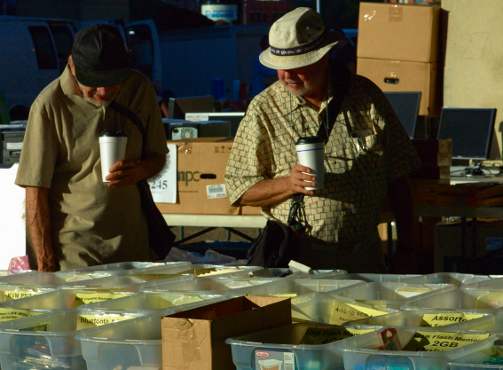
A couple of experience computer bargain hunters work their way through the many bins of parts. Coffee helps.

What I learned this week – August 5, 2011

I’ve been fighting through some nasty bouts of writer’s block and finding help where I can.

How to Overcome Writer’s Block

By SUSANNAH BRESLIN

From Forbes Magazine

Stuck on what to write?

Try something different.

The only way to beat writer’s block is to write your way through it.

TIP #1: Write anything.

A decade ago, a friend of mine told me I had to stop writing short stories and write a novel. I’ve spent the last 10 years trying to do just that. I’ve had agents, finished drafts I decided I didn’t like, and given up on more than one occasion.

TIP #2: Forget everything else.

A few years ago, based on the first 30 pages of my novel, I was signed by a big Hollywood talent agency. That led to me pitching an HBO drama sort of based on my novel to Mark Wahlberg’s production partner and ended not long after that.

Eventually, I decided to forget agents, publishers, and pretty much every dream I ever had related to the novel other than making it into something I liked.

TIP #3: Never give up.

I finished that draft earlier this year, but then I got stuck in the revisions.

One problem with writing is that it is a solitary act.

Also, writing a novel is a marathon, and I am a sprinter.

TIP #4: Do what scares you.

In order to deal with my rewriter’s block, I decided to revise my novel in public. This requires a daily act of bravery. Every day, I post a revised section of my novel on a blog I set up to do just that. (The blog is here. The novel starts here.)

TIP #5: Write what you know.

My novel is about a federal agent looking for a missing adult film star. (This is what I know.)

As far as overcoming a block, this is what’s working for me.


The battle over our constitutional protections has now reached the point where our god-given right to hang huge plastic bull testicles from our trailer hitches is being threatened.

Truck Nutz Hooters

Truck Nutz Hooters

From Fox News

On July 5, Virginia Tice, 65, from Bonneau, S.C. pulled her pickup truck into a local gas station with red, fake testicles dangling from the trailer hitch. The town’s police chief, Franco Fuda, pulled up and asked her to remove the plastic testicles.

When she refused, he wrote her a $445 ticket saying that she violated South Carolina’s obscene bumper sticker law.

David Hudson, a First Amendment attorney and scholar, says laws banning these types of decals, emblems or bumper stickers are problematic, but often someone just hasn’t challenged them.

Hudson believes Tice and her lawyer can make a good case the South Carolina law is “unconstitutionally vague and unconstitutionally broad, and it violates the First Amendment.”

Hudson detailed many cases where law enforcement officials cited individuals for the content of their bumper stickers, and in the majority of those cases, a judge tossed them out because “the First Amendment protects a great deal of offensive expression.”

Hudson also cites the Supreme Court’s opinion that “the government may not prohibit the expression of an idea simply because society finds the idea itself offensive or disagreeable.”

Read More

I’m not too happy this case is going to court … it is sure to result in a hung jury.

Here in Dallas, the question has been asked and answered.


I learned that there is a way to cook pasta that looks really good and really easy. Unfortunately, it takes a pot that I can’t afford.

Alain Ducasse - Pasta Pot

Alain Ducasse - Pasta Pot, by Alessi

From the New York Times:

Alain Ducasse and the designer Patrick Jouin have created a pasta pot for Alessi that perfectly shows off Mr. Ducasse’s pasta-cooking method.

First the pot: it is slope-sided stainless steel with a mirror finish. The well-balanced cast aluminum handle stays fairly cool and serves as a nesting place for the melamine spoon that fits it. The flat lid has a steam vent, and the set comes with a melamine trivet for stove-to-table service. A recipe booklet is included. It is $238 at the Alessi store in SoHo at 130 Greene Street (Prince Street) and at the new store that opened two weeks ago at 30 East 60th Street.

Now for the pasta: Mr. Ducasse said he learned this all-in-one technique from traditional olive oil makers in the Ligurian region of Italy. Instead of boiling pasta, making a sauce and combining them, he sautés aromatics, including garlic and onion, in the pot, stirs in the pasta, then slowly adds stock, so the pasta absorbs the liquid and softens. It is an effective method, like making a risotto, that takes about 20 minutes for delicious results. The starch in the pasta, which is not discarded in boiling water, thickens the stock, making a lush sauce. The process is for short macaroni cuts like penne, not spaghetti.

——–

But there is hope, my friends. I think I can make this recipe in a Dutch Oven. Man, looking at this is making me hungry.


More Pasta Information. From Malcolm Gladwell, the genius, via the TED network (which is chock-a-block with interesting lectures and… stuff, thanks, Carrie).

Malcolm Gladwell on Spaghetti Sauce

To a worm in horseradish, the world is horseradish.


I think I know what’s wrong. We’re all stuck in an Army Ant Death Spiral.

A gecko in the watering can.

gecko by chancew1
gecko, a photo by chancew1 on Flickr.

The terrible heat continues…. It’s always hot here in the summer, of course, but this is crazy. When I left work today, going out into the parking lot, it literally felt like I was walking into an open oven door.

At any rate, I took this picture a few years ago… it looks cool and relaxing somehow.

——————————————————————————————————————————-

Oh, and here’s some music from a band I really like… and you have never heard of. They are called “My Favorite” – I have no idea where I first heard their stuff, but I really liked it. They broke up in 2005, I don’t know anything about what’s happened to their members since. They did have some fans.

Music never really goes away though, does it.

I was so tired I could barely sneer

A few months ago I had a phrase get stuck in my head – “I was so tired I could barely sneer.” To get it out I had to sit down and write something from it.

Sneer

I was so tired I could barely sneer

I was so tired I could barely sneer; let alone lean back and kick that worthless loser in the balls – which is what I wanted to do.

“What’chew drinkin’ ma’am.” he said. “On me,” he said.

I turned away from the loser to face directly at the bartender and asked, “What do you have in Single Malt?”

“Scotch?”

“What else?”

“Glenfiddich, Glenlivet, Glenrothes…”

“You like the Glens,” I said.

The Bartender continued without hesitation. “Glengoyne, Speyside, Knockando, Cragganmore, Dallas Dhu, Loch Lomond, and Glenturret.”

“No Balmorhea?” I said. I always like to have an ace in the hole, something I knew he wouldn’t stock. There is no Balmorhea Single Malt Scotch. Balmorhea is a little town in West Texas.

“No, sorry ma’am. I’ll ask our distributor if he carries it next time I place an order.”

“You do that,” I said and gave him my favorite derisive squint. Have to always keep one up on the help. “In that case I’ll have a Glenrothes, neat, and put it on his tab.” I gestured at the mirror above the bar but when I looked, the guy was gone.

“Oh…,” I said.

“On his tab,” the bartender repeated, and reached for the bottle. I glanced at the shelf, at the bottle he was grabbing, to make sure the bartender wasn’t trying to rip me off and noticed a long glass case mounted under the shelf. On the outside it said, “IN CASE OF EMERGENCY, BREAK GLASS.” Inside the case was a baseball bat… but… the funniest thing… the little knob on the end was gone and the thin part, where you grab, was sharpened into a point.

“And I’ll have a Bloody Mary,” a voice behind me said. Surprised, I spun and the guy was back again.

“Of course you will,” said the bartender, “On your tab?”

“Yes, please.”

The loser didn’t say anything more; he simply stared at me while the bartender poured the tomato juice. He was tall, skinny to the point of being gaunt, graying hair, dressed like he had bought tacky clothes from the sixties – plaid pants and a striped collarless blazer, a mix of every color never seen in nature. He looked like he thought he was the king of polyester. They looked stale, a little wrinkled, like they had been slept in. I imagined those clothes hanging on racks at Goodwill for fifty years, until this idiot comes in and, “Has to have that outfit.”

The bartender reached out to hand him his drink and he took it right in front of my face. The guy had long fingernails, but at least they were carefully sculpted and clean. The skin on his hands and on his face was impossibly pale, almost translucent, like you could almost see the blood vessels pulsing underneath, but his lips were bright red, I thought he might even be wearing lipstick. Uggh!

Thank God, though, the only thing the guy said was, “Enjoy your drink,” and, before I had a chance to decide whether to say thank you or not, he turned and disappeared into the murk at the back of the bar.

Like I said, I was exhausted, so I was glad to get to sit there and try and enjoy my drink.

“Wow,” I said, “Who was that guy?”

“A regular.”

“Never seen him in here before.”

“He always comes in late.”

I nodded. That’s why I had never seen the loser – I was at the bar a lot later than usual. At the most I stopped by for a simple tip on the way home; I liked to watch the sunset from my treadmill on the balcony. But the board meeting today had run long. It was worth it. The idiot bastards. I had to smile; I couldn’t help myself. I had been working the angles for months setting everything up and it had gone down, well, without a hitch.

“Long day?” the bartender asked.

“Oh, yeah. I’m beat.”

“That’s funny, you look a bit like the cat that ate the canary.”

“You have no idea,” I said. Damn Bartenders. They notice everything. Time to retreat, don’t want him to get the upper hand.

“Little girl’s room?”

“Down the long hall at the back, last door on the right.”

Of course I knew where the bathroom was. I don’t know why I asked. Maybe I wanted a way to let him know where I was going without saying it aloud.

When I came out of the can I noticed a shape blocking the hallway. It was tough to see; it was dark back there, and very smoky. Cramped. I didn’t like it one bit.

“Did you like your single malt?”

Oh, Christ. It was the loser. I felt a bit of panic – he had me trapped back there. But as I approached he moved to the side and pushed himself up against the wall to let me pass. He was so thin, he seemed almost to disappear into the paneling.

“Did you like your bloody Mary?” I asked back, with as much derision as I could. He only chuckled a bit.

“It was alright,” he said. “For starters.”

What the hell did he mean by that? I pushed past him, angling to the side, facing that lime green shiny fabric when I felt a hand on my shoulder, stopping me. His touch was bitter cold – at the time I thought he must have been holding an iced drink. The loser bent close. For a second I thought the bastard was going to try and kiss me. I was way too worn out for that kind of crap.

But of course he didn’t. He held me with preternatural strength, bent my head back, and pushed his long sharp teeth into the arteries in my neck.

—————————————————————————-

“And that’s how it began. In a bar exactly like this one. I’m not tired any more.”

“What about the board meetings?” the bartender asked. I looked at him, looked at his lonely reflection in the bar mirror. He kept a sharpened, polished pine two by four sitting beside the gin.

“Oh, I had to quit my job, not a lot of that kind of work goes on at night. I took up consulting. I can set my own hours.”

“Would you like another bloody Mary?” he asked.

“No, thanks, I had better push off. It’s getting late and I think I’ve a taste for something a bit more flavorful now.”

The Idea Pomodoro

For a while now I have been working on using the Pomodoro Technique to improve the amount of work I can get done in a period of time, help control stress, and reduce procrastination.

The basic idea of the Pomodoro Technique is to break a workday up into set units of time using a simple kitchen timer or equivalent:

1. Choose a task to be accomplished

2. Set the Pomodoro to 25 minutes (the Pomodoro is the timer)

3. Work on the task until the Pomodoro rings, then put a check on your sheet of paper

4. Take a short break (5 minutes is OK)

5. Every 4 Pomodoros take a longer break

The real benefit of the technique comes when you get in the habit of examining the Pomodoros and see what you were able to accomplish. You can set up a feedback loop where you see what you are getting done, improve your implementation of the technique, apply the improvement, and then see how it works.

I have a way to go before I am a master of the technique. The most vexing difficulty is managing interruptions. But I’ll keep experimenting and plugging away.

What I want to talk about today is the idea of a Specialty Pomodoro. This is a Pomodoro sized and timed chunk of time… 25 minutes, that are set up and used for a specific purpose, rather than simply trying to peel stuff of off the daily todo list.

There might, for example, be a Brainstorm Pomodoro, where a problem has presented itself and you sit there for one Pomodoro and pump out and write down as many possible or harebrained solutions as you can, with no self-editing until the timer has dinged. There might be a Writing Pomodoro – obviously used to pump out text. Or maybe a Plot Point Pomodoro where possible plot points are generated, or a Character Pomodoro… or a Character Name Pomodoro, or a Setting Pomodoro – the list can grow very quickly.

I have come up with a concept of what I call an Idea Pomodoro – which is where I sit down with a Staples Bagasse Composition Book, start the timer going, and simply write down what I want to do, as quickly and with as little thought as possible, until I get the ding.

The purpose of this is to clear my head. There is that feeling of too many ideas bouncing around, too many plans, too little time. This helps clear everything out so I can get back to work. Once an idea is in the book, it is safe, I won’t lose it, it won’t float off to be stolen and used by somebody else. Of course, I have always carried 3×5 cards or a notebook to record sudden ideas, and that’s a good thing (they can be transferred into the Pomodoro) but I found it wasn’t enough. Doing this for a full, intense, Pomodoro feels like a spring cleaning in my brain.

Pomodoro

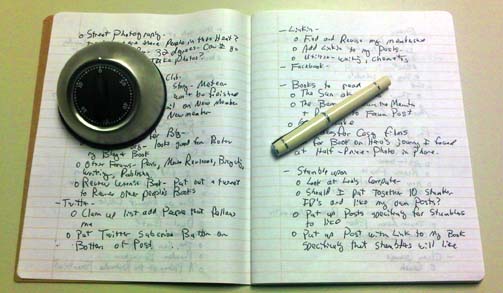
An Idea Pomodoro - timer, pen, composition book.

My Pomodoro timer is a metal kitchen timer – it feels more substantial and accurate that the tomoto-shaped ones so many people use. I do recommend using the physical timer rather than a computer program – the ticking of the timer seems important and having a real object in the place of a string of bits adds a certain gravitas. The paper in the composition book is thin and you can see the ink on the back side through the paper. Sometimes I use both sides, sometimes I don’t. It doesn’t seem to be important one way or the other. That’s a Pilot Prera fountain pen in the picture.

I like to use the composition book instead of a lined form because I can keep going as long as I need, keeping the limit being time, rather than space. I do find that I can easily fill four or five pages of stuff. Also, I can keep my “book of ideas” with me – all in one place, so I can look at them later and evaluate, act, or discard as need be.

I do use a little code for a hierarchy. Big, top-level ideas are marked with a tick “-“. Smaller, sub-ideas under the big one are marked with an “o”. If I have to go to a third level, I use a hand-drawn asterisk… which doesn’t happen very often.

Later, after my five-minute break or even days later, I can look over the ideas and start building projects or to-do lists. Of course, a lot of the ideas are too ambitious, or too much work, or just plain stupid – and have to be discarded. But that’s cool; I have written it down and can come back to it in the future if the situation changes.

How often do I do an Idea Pomodoro? As often as I need to. It is a spring cleaning of my brain so I do one whenever things begin to feel cluttered. When I find myself jumping from idea to idea and having trouble settling down I know it’s time to carve out the half-hour (including the five minute break) and dump the excess brain dust bunnies out onto a piece of paper.

Does this seem anal – too much work, too much navel gazing? Much ado about nothing? It really isn’t. Once you’ve set everything up it works smoothly and without very much attention. You do get like Pavlov’s dog – the ticking of the timer becomes associated with doing the work.

Speaking of which… there’s the ding. Time for me to take a little break.

Talk to ya later.