A deadline is, simply put, optimism in its most ass-kicking form.
—-Chris Baty, No Plot? No Problem! A Low-Stress, High-Velocity Guide To Writing A Novel In 30 Days
My android tablet and portable keyboard, I stopped my bike ride on the Bridge Park over the Trinity River to get some writing done.
I’ve seriously tried NanoWriMo three times – succeeding once. The two times I failed I wrote myself into a corner – my plot had nowhere to go. The one year I won, I picked a novel that couldn’t move into a corner – it was an old man in a beach house during a hurricane, with the water rising. He would think about his life in a series of reminiscences as death approached. That way, I could always find something to write.
The crazy thing is that on the last day of November, at about eleven PM, my Microsoft Word Document had me at about 50,007 words, so I uploaded the thing to the Nano website. However, its “official” word counter had me about thirty words short. No big deal, right?, I had forty five minutes to write thirty words.
It’s impossible to explain why, but those were the hardest thirty words I have ever bled out. I crossed 50K with three minutes to spare.
So this year…. I’m looking at my schedule trying to find a couple hours a day. One thing is this blog. For the duration I’ll post my daily word count, a photo from the past, and a paragraph of what I had written that day. I don’t want to upload the entire day’s work because it is a shitty first draft and nobody wants to read those. I should be able to carve out a paragraph of interest, though. A simple blog entry like that will save me some time every day that I can use for writing.
If anyone is in the Richardson/Dallas area and wants to set up a writing time, contact me at bill.chance57(at)gmail.com. I’m also thinking about setting up a Writing Marathon for at least one day (maybe the Farmer’s Market?), if that sounds interesting to anyone (if not, I can do it alone).
“You simply sit down at the typewriter, open your veins, and bleed.”
—-Walter Wellesley “Red” Smith (and many others)
Our kitchen cabinets are filled with pint beer glasses emblazoned with local breweries – souvenirs of the visits to many brewery tours and keep-the-glass sampling events.
Deep Ellum Brewing Company – Dallas Blonde
One of these was a little too close to the edge of the kitchen counter when my son’s Lab was looking up there scouring for leftovers and knocked one off – breaking it on the floor – shattering the vessel into a thousand slivery shards. The first nine hundred and ninety are easy to sweep up. The last ten are invisible, sharp and hard, hard to find.
Last night as I walked barefoot through the kitchen to my room, intending to sit down and write for my hour… I found one.
There is an interesting pain profile as a sliver of glass pushes through the thick callus on the bottom of a foot into the tender, live flesh, muscle, and sinew beneath. I doesn’t hurt much… until it does. I hopped on one foot to a countertop and leaned while I searched for the glass. It’s transparent, crystalline and invisible, of course, so I had to feel for it, then pull it out. I glanced at the splinter before throwing it in the trash. It was longer than usual and was red-tipped – but I didn’t think much about it.
I suffer from a form of graphomania and, while most people complain of writer’s block, if I don’t get a solid hour of writing in each day it’s hard for me to go to sleep (writing something good… now, that’s another question – one for another day).
I sat down at my desk and lost myself, writing for an hour or so. I saved my work, and decided it was time to walk back and go to bed. But as I tried to stand up, I realized that my foot was stuck firmly to the floor. That was confusing and unsettling, why couldn’t I lift my foot up from the painted concrete – I was floored. Looking down into the murk under my desk I saw that my foot was centered in a dark-colored disk of some glue-like material that was intent on keeping it there. I had already forgotten what had happened only an hour before – so I guessed I had spilled some fruit drink or something and it had dried into a sticky trap.
So I redoubled my efforts and with a viscous pop my foot came up. It wasn’t until a few minutes later I remembered the glass sliver and realized my foot had been stuck to the floor by a pool of drying blood. I hadn’t moved my foot for over an hour, plenty of time to bleed, coagulate, and adhere.
Not much I could do, so I went to sleep. Today, I found dark crimson crescents of blood scattered throughout the house – I didn’t realize how much I walked around last night.
Time to get out the mop.
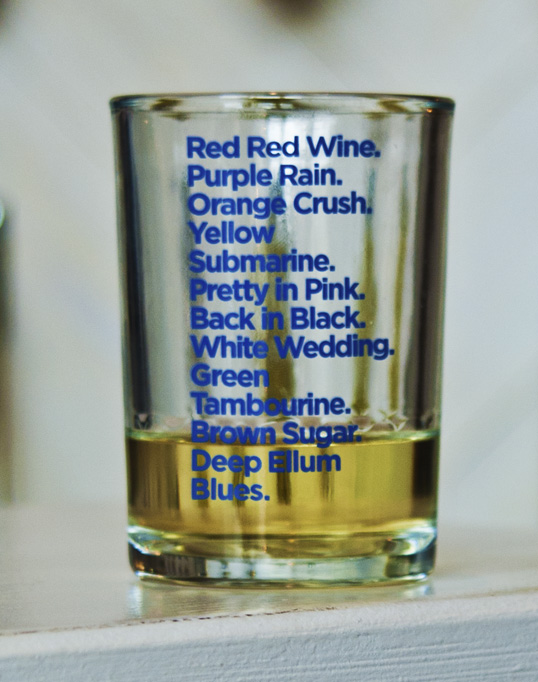
Glass from Wine Walk Deep Ellum Dallas, Texas
Lakewood Brewing Company, French Quarter Temptress, Special Glass, Brewed, Fort Worth, Texas
“Poetry is much more important than the truth, and, if you don’t believe that, try using the two methods to get laid.”
― Mark Forsyth, The Etymologicon: A Circular Stroll through the Hidden Connections of the English Language
“A poet is not somebody who has great thoughts. That is the menial duty of the philosopher. A poet is somebody who expresses his thoughts, however commonplace they may be, exquisitely. That is the one and only difference between the poet and everybody else.”
― Mark Forsyth, The Elements of Eloquence: How to Turn the Perfect English Phrase
The Window at Molly’s, the street (Decatur) unusually quiet, with notebook, vintage Esterbrook pen, and Molly’s frozen Irish Coffee
“Shakespeare was not a genius. He was, without the distant shadow of doubt, the most wonderful writer who ever breathed. But not a genius. No angels handed him his lines, no fairies proofread for him. Instead, he learnt techniques, he learnt tricks, and he learnt them well.”
― Mark Forsyth, The Elements of Eloquence: How to Turn the Perfect English Phrase
I picked up a book at the library – I picked it up by mistake because I was looking for books by John Forsyth (and there weren’t any). I picked up The Elements of Eloquence: Secrets of the Perfect Turn of Phrase by Mark Forsyth. I’m not sure why I stacked it on the checkout kiosk – but it turned out to be crackerjack – I really enjoyed it. The book is simple – forty chapters – each one dedicated to one rhetorical figure, discussing its use in literature, classic and profane, with an emphasis on Shakespeare. The chapter titles are intimidating, mostly Greek terms: Alliteration, Polyptoton, Antithesis, Merism, Blazon, Synaesthesia, Aposiopesis, Hyperbaton, Anadiplosis, Hypotaxis and Parataxis, – are the first few. Sounds like fun, doesn’t it?
Well, it is. Forsyth is a witty (sometimes too witty) writer that makes these ancient Greek mouthfuls entertaining and elucidating. As a writer – it’s like being given a bag of weapons that you can use to slay an unsuspecting reader. Most of these are things that are known to anyone that has spent too much time on the wrong end of a pen or with their nose between the book covers… but listing them, explaining them, exampling them, giving them names, gives them power and makes them easier to pull out of the wordsmith’s quiver and load into his quill.
If you are interested in words, get the book.
Now, once I have discovered something like this, and read it carefully (taking tens of pages of notes) – I can’t stop there. I have to go down the rabbit hole.
Forsyth has a handful of other books for me to read. I suspect I have more books to read than I have time left on this earth, but what the hell. He has a TED talk, and a handful of articles across the web.
And he has a blog.
It’s called Inky Fool – and has a lot of cool stuff in it.
It is an official list of dirty words. It is much more extensive than the only list of broadcast dirty words I had seen before:
So they made a list. The actual list is ten pages long. And this is the Quick Refnerece Guide. It says in the introduction that a lot of older people don’t understand a lot of the new obscenities. It’s also a British list – and some of these haven’t made much inroads in Texas – I don’t think… of course, I’m old and don’t understand a lot of the new obscenities.
There’s Minger and Munter… there’s Nonce and Slapper – good thing I read the list, never knew these were offensive. The short section on Offensive Gestures wasn’t anything new to me. There’s a section on words offensive to old people… Coffin Dodger, FOP, and Old bag. Not bad… I kinda like Coffin Dodger. Could be a good online alias – say CoffinDodger31415.
Not surprising that the Discriminatory language section takes up the biggest part of the list. I’m sure it’s growing exponentially – both in number of words and in categories. Pretty soon this is going to swallow the language whole.
Now I have to tear myself away, dig out of the rabbit hole, and get some work around the house done. Later, I’m sure.
“John Ronald Reuel Tolkien wrote his first story aged seven. It was about a “green great dragon.” He showed it to his mother who told him that you absolutely couldn’t have a green great dragon, and that it had to be a great green one instead. Tolkien was so disheartened that he never wrote another story for years.
The reason for Tolkien’s mistake, since you ask, is that adjectives in English absolutely have to be in this order: opinion-size-age-shape-colour-origin-material-purpose Noun. So you can have a lovely little old rectangular green French silver whittling knife. But if you mess with that word order in the slightest you’ll sound like a maniac. It’s an odd thing that every English speaker uses that list, but almost none of us could write it out. And as size comes before colour, green great dragons can’t exist.”
― Mark Forsyth, The Elements of Eloquence: How to Turn the Perfect English Phrase
Writing in my Moleskine Journal outside the Mojo Lounge, Decatur Street, French Quarter, New Orleans
“Above all, I hope I have dispelled the bleak and imbecilic idea that the aim of writing is to express yourself clearly in plain, simple English using as few words as possible. This is a fiction, a fib, a fallacy, a fantasy, and a falsehood. To write for mere utility is as foolish as to dress for mere utility. … Clothes and language can be things of beauty, I would no more write without art because I didn’t need to than I would wander outdoors naked just because it was warm enough.”
― Mark Forsyth, The Elements of Eloquence: How to Turn the Perfect English Phrase
What are you buying when you get on a roller coaster? Not risk… but the illusion of risk. Being hurled to the edge of danger but knowing that you’ll never have to cross it. … Think of Alaska as one big theme park.”
—- Limbo (movie), John Sayles
I particularly enjoyed the artwork hanging on the walls. On our trip across the river to Algiers, we discussed a dark painting that I remembered. You couldn’t see much – only a snow capped mountain line and maybe a bit of an orange glow. When we returned for the evening, I took a photo of the painting with my phone and was surprised to see that there was more visible in the picture than there was in real life. There was a row of mountains and a small boat in the foreground that you could not see with the naked eye. I was particularly taken by that subtle orange glow behind some trees on the right hand side.
Enhanced photo of a painting in the hallway of the Beauregard-Keyes house, New Orleans
The staff from the Beuregard-Keyes House said that the painter and even the date of this particular canvas was unknown. I talked to the others that had been at Algiers with me and realized I had the wrong artwork – they had been discussing a nearby painting of Venice at night by George Loring Brown.
That didn’t matter to me, I still was fascinated by the dark line of snowcapped mountains and still water. The next day at a nearby breakfast place I decided to write a flash fiction based on the painting (changing the mountains into volcanic peaks for dramatic effect). Inspired by one of my favorite films, Limbo (see it at your risk, I loved the film but the others in the theater stood up and cursed the screen at the end – Christopher Null said, “I can forgive many things. But using some hackneyed, whacked-out, screwed-up non-ending on a movie is unforgivable. I walked a half-mile in the rain and sat through two hours of typical, plodding Sayles melodrama to get cheated by a complete and total copout finale.” – He is completely wrong, the movie ended the only way it could….), left the ending… somewhat unresolved.
The darkness was so all-encompassing it felt as thick and liquid as the saltwater they dipped their paddles in. The four canoes and single small skiff moved in a rough line. Sam could almost see the skiff ahead – more of an impression than actual vision – rowed by the four on board – its sails useless in the dead calm night.
Beyond, the unseen moon hidden by an invisible line of cliffs to the right illuminated the snow capped upper slopes of the volcano. Its torn cone glowing in the sky – visible, but selfish with its cold light.
The paddles and oars clumped up and down the line, with an occasional weak splash. The men were all too exhausted with effort, fear, and lack of sleep to work efficiently and the sound of wood striking gunwale or skipping off the water at the wrong angle was a surprise to these skilled seagoing men – but they were so numb – the embarrassment passed.
They worked in silence. Sam wondered if the other men’s minds were silently exploding within – as his felt. The humidity thickened the darkness. The only breeze was provided by their paddling – the heat was broken every now and then by invisible lenses of cool air that fell down the slopes from the snowfields miles above. They passed through a bank of sour sulfur mist from the fumaroles along the shore. The paddling increased to move through that foulness as quickly as possible.
Sam saw something new – coming to life out of the ink. At first it was barely visible – a dark dull rust-colored patch ahead, quickly heating into a dark but distinct orange glow.
It was a bit to the right of the skiff, along the shoreline. Sam realized this was their destination, their camp. There was a line of dunes and behind them a swampy area before the land rose quickly up the mountain. They had pitched camp atop a series of grassy hummocks above the brown stagnant drainage, but still protected by the dunes from being seen from the sea.
At first the glow heartened Sam and the others as their rowing increased a little more in pace. They were almost back. Sam thought of a bit of a rest – of a stout drink around the campfire before they had to start the hard work of unloading the rifles and ammo boxes from the canoes and the skiff. Sam even thought beyond that, of crawling into his tent for sleep. That seemed the end, he couldn’t get his mind past the imaginary sensation of letting himself falling limp and snapping his eyes shut.
But as they approached at a frustrating pace, weighted down by all that steel until the tiny waves lapped at the gunwales, the orange glow began to grow and spread.
Soon, it was all-encompassing. They could even see yellow licks of flame flicking over the tops of the dunes. Long tongues of red light reached up the sides of the mountain above, moving and interspersed with long ominous purple moving shadows.
Shouts, curses, and desperate cries peppered up and down the line of little boats. Sam kept silent though, and continued to paddle with desperate hopeless effort. They all did, still moving straight into the growing conflagration.
They had nowhere else to go.
Sam thought, “I am mortal. We are all going to die… but when? Is it going to be tonight?”
“Life is a bucket of shit with a barbed wire handle.”
― Jim Thompson
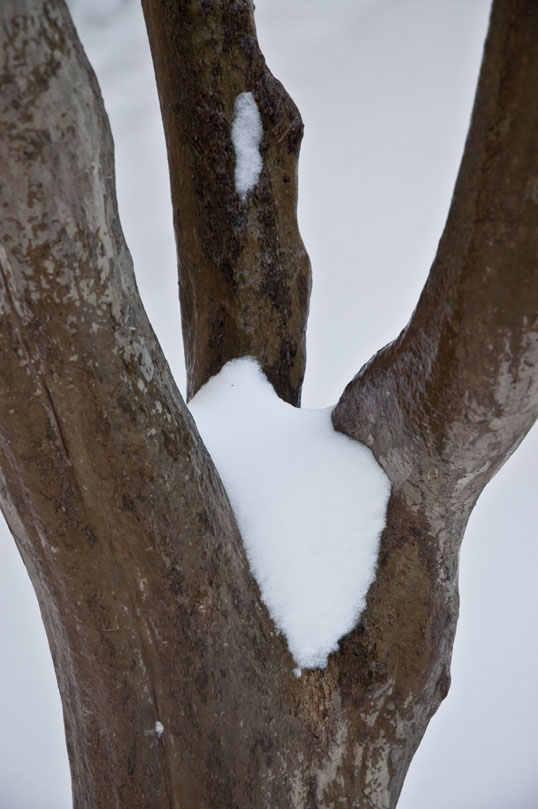
Crepe Myrtle trunk in the snow
I read a lot of short stories. I read A LOT of short stories. In most cases I read pretty much a short story a day. I like to read them, I don’t have much time for long novels, and I like to write them.I have learned that it is best that I read what I am writing.
Over time, I have spent months where I review and online short story each day –
Instead of doing an entire month, I think I’ll put up stories I enjoy one at a time.
There is a fantastic independent publishing house, Akashic Books. From their website:
Akashic Books is a Brooklyn-based independent company dedicated to publishing urban literary fiction and political nonfiction by authors who are either ignored by the mainstream, or who have no interest in working within the ever-consolidating ranks of the major corporate publishers.
In particular, I enjoy their Noir series – each book consisting of a group of savage short stories based in a particular city. I have written about their Noir books based on the two cities I am most familiar with: Dallas Noir and New Orleans Noir.
Today I have a free online short story put out by Akashic Books. It’s a warped little romantic tale about how a relationship handles a snowstorm on I70 in Colorado. The flash fiction piece is a lot of fun – though it seems to have one obvious little error (Isn’t it nights in WHITE satin?).
Like the city-themed Noir books, fiction, especially thrillers or horror, is always more fun when it is set somewhere that you are familiar with. I am somewhat familiar with I70 through the mountains, Loveland Pass and Ski Basin, the scenic route off the Interstate to A Basin, and the feeling of snow whiteout conditions.
I remember jockeying down that stretch of highway in a blinding blizzard with a tiny Datsun jockying with a string of monstrous snowplows going 80 miles an hour inches off my bumper and looking bigger than the surrounding Rocky Mountains.
Whew! just the memory makes me feel frozen and sweaty at the same time.
So take a few minutes to go read the story and while you are there – check out Akashic Books and their other offerings. They deserve our support.
“Just as the Mediterranean separated France from the country Algiers, so did the Mississippi separate New Orleans proper from Algiers Point. The neighborhood had a strange mix. It looked seedier and more laid-back all at the same time. Many artists lived on the peninsula, with greenery everywhere and the most beautiful and exotic plants. The French influence was heavy in Algiers, as if the air above the water had carried as much ambience as it could across to the little neighborhood. There were more dilapidated buildings in the community, but Jackson and Buddy passed homes with completely manicured properties, too, and wild ferns growing out of baskets on the porches, as if they were a part of the architecture. Many of the buildings had rich, ornamental detail, wood trim hand-carved by craftsmen and artisans years ago. The community almost had the look of an ailing beach town on some forgotten coast.”
― Hunter Murphy, Imogene in New Orleans
Every year during the New Orleans Writing Marathon I make a point of crossing the Mississippi River on the Algiers Ferry. This year a group of poets decided to walk through the French Quarter and make the crossing. I’m no poet, but the rules aren’t too strict, so I tagged along.
I love riding the Ferry, though I have done it more than a few times. The Algiers Ferry moves cars, pedestrians, and cyclists from the dock at the foot of Canal Street across to the town of Algiers on the West Bank. Even though you are going from the Eastern half United States to the West, due to the twisting river the boat actually goes sort of in another direction. There is something about crossing the Mississippi, though I always think of the ferry as the spot where John Goodman’s character committed suicide in the series Treme. If you’ve ever seen the film Déjà Vu this is the ferry the terrorists attack.
The day was incredibly hot and humid and we maneuvered our route to the ferry to use as much shade as possible. The trip across is two dollars, cash only, no change – I always take a stack of ones and quarters with me when I go to New Orleans for the ferry and the streetcar.
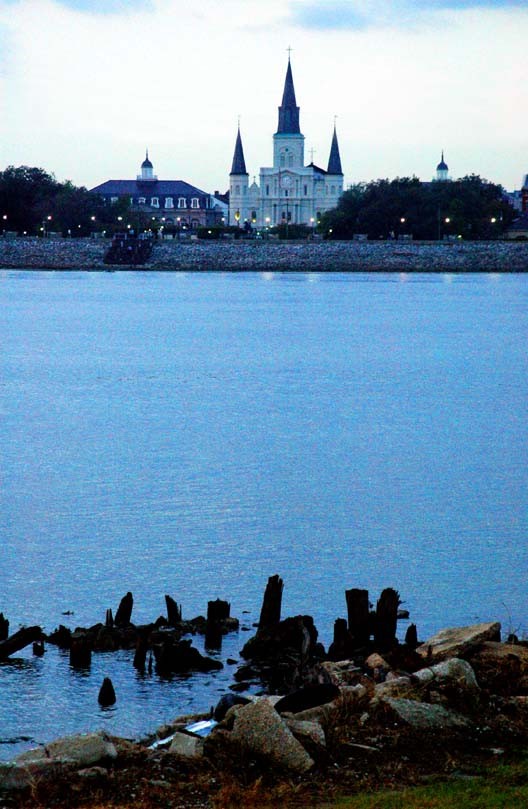
Saint Louis Cathedral from across the Mississippi River at Algiers Point
Two women and a dog In the middle of the river on the Algiers Ferry.
On the Algiers side we went to a trio of spots to write. First was breakfast at Tout de Suite Cafe, which was very good. Right next door was the excellent cafe/coffee shop Two Birds, One Stone – they had a back room full of pinball machines and big tables, a perfect place to write. The young owners were very accommodating to our group – I want to visit again and recommend you do too. I wrote snippets of text at both, then we walked on to Congregation Coffee Roasters for a third stop. I decided to churn out a poem, since that was what everybody else was doing.
Rented Furniture
A worshipped monolith
made of translucent plastic
red and stained
a machine of fire and water
A cylinder, a totem
raised on a dias of wood
life that needs washing
escape and revelation
We didn’t make the payments
and they took the furniture
when we were gone
and returned to find
an empty room, with
only a bong on a wooden
wire spool table
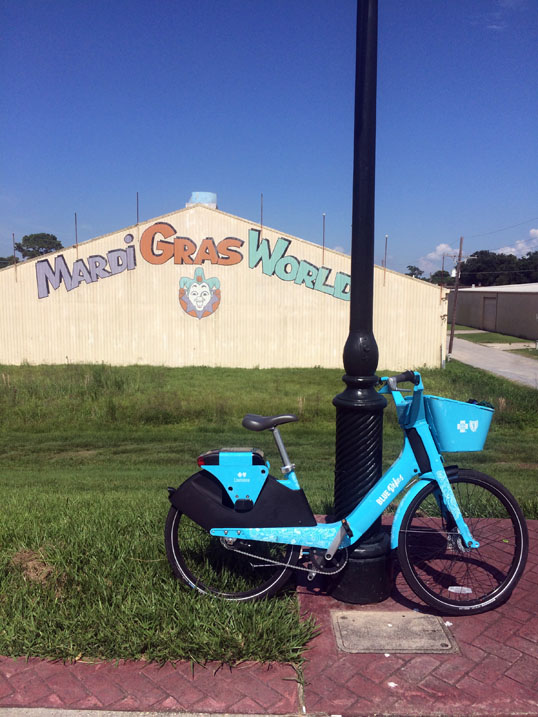
The New Orleans bike share bikes are built like a tank, and as heavy as one – but the city is flat so that doesn’t cause too much of a problem. It took me a minute to find the control and downshift so I could climb onto the Levee and the swept handlebars took some getting used to. But soon enough I had it all in control and was moving down the smooth levee trail.
I rode south (or more exactly, downriver – the Mississippi curves) for a few miles, down past the Naval station. It was fun – the view of the river and giant ships and barges on one side – the picturesque streets of Algiers on the other. The path sort of petered out and I rode back, past the ferry station and upriver to the giant double bridge… the Crescent City Connector. That was about seven miles and about all I felt up to, so I rode back to the ferry and parked my rented bike.
It was a lot of fun, but there was one problem. It was so hot. It was like riding through a blast furnace. There was no breeze at all – no cooling relief coming off of the river. The top of the Levee is very exposed, not a bit of shade. The burning sun, the boiling air, and the famous New Orleans summer humidity made for a sweaty, exhausting ride.
I was so worn out that when I made it back across the river I was lazy and took a streetcar through the French Quarter (still had a dollar bill and a quarter) back to where we were meeting. A long day, a hot day, but a nice time.
“On the prow of the wagon, in an attempt to attract business among the Quarterites, Ignatius taped a sheet of Big Chief paper on which he had printed in crayon: TWELVE INCHES (12) OF PARADISE. So far no one had responded to its message.”
― John Kennedy Toole, A Confederacy of Dunces
Saint Louis Cathedral, Jackson Square, French Quarter, New Orleans
I’m getting packed, getting ready to drive to New Orleans for a week of this year’s Writing Marathon.
“Anyone whose goal is ‘something higher’ must expect someday to suffer vertigo. What is vertigo? Fear of falling? No, Vertigo is something other than fear of falling. It is the voice of the emptiness below us which tempts and lures us, it is the desire to fall, against which, terrified, we defend ourselves.”
― Milan Kundera, The Unbearable Lightness of Being
Crystal Beach, Bolivar Peninsula, Texas
Now, here is is, the first day of a spanking new year. And I have these goals for 2018 – I’ve worked hard on these… and the main three are:
Read 100 books
Write 50 Short Stories
Ride 3000 miles on my bike.
Since this is only the beginning, I didn’t want to get behind right at the start. So I cheated on the reading a hundred books – and jumped the gun by starting two weeks early. I’m up to six so far… which is good. I’ve already written one short story – so I’m OK there.
But I am stuck in a beach house with no bicycle and freezing cold… incredible wind… what we used to call a blue norther. I had planned on a little flexibility on my goal – knowing that I get sick over the winter and need other means to keep up with my goal.
At home, I have two exercise bikes – so I decided that riding one of those is worth ten miles for each hour riding. That way I can keep up if I’m forced inside.
At the beach house I thought about it and decided that, in a pinch, I can walk to make up the goal. Only in emergency situations, like now – the first day. After some thought and internet research, I decided on a three mile walk, at a brisk pace, would equal ten miles of riding. I walk at about three miles per hour, so that’s about an hour – which corresponds with riding or stationary. Also, that’s in addition to whatever I walk on a normal basis – the usual strutting around doesn’t count.
So at the end of the day, I layered on as much as I could (the temperature was below freezing and the wind was… really strong. I walked out to the beach and watched the kids fire off the last of their fireworks, then headed out down the beach. There is a little creek that emerges from the dunes and blocks off the rest of the beach from where we were and I knew that to that creek and back would get me to the three miles I needed.
I started out into the wind, pulling my hood closed so I was looking out a tiny circle at the water on the right and the dunes on the left. The moon was full, so there was plenty of light. It was very cold. But I started walking.
And it put me into the thought of all the other times over my life that I had walked on the beach, especially at night. From Panama to Nicaragua, to South Padre Island over spring break (That was a long drive from Lawrence, Kansas) to this very beach over the years with my kids growing larger and larger.
There is a rhythm of walking on the beach, in the wet sand between the surf and the loose part (in Texas it is generally allowed to drive on the beach, so, especially at night, you want to stay close to the surf), as the time and the miles go by all those old memories become telescoped in to the present day, the experience of being and moving along a border between two worlds.
It was a lot easier to walk back with the wind behind me. So now I have the equivalent of ten miles of bike riding on the first day of January. Still on track – so good, so far.
“This is the story of Isaac and his time in America, the last turning of the centuries, when the hubris of men led them to believe they could disregard even nature itself.”
― Erik Larson, Isaac’s Storm: A Man, a Time, and the Deadliest Hurricane in History
Oblique Strategy:Children -speaking -singing
When our kids were young we used to come over Thanksgiving, or over New Year, or both – to rent a beach house at Crystal Beach on the Bolivar Peninsula, just east of Galveston, Texas. In the off season you could rent an old rickety beach house for almost nothing. It was great with high maintenance kids like ours- there were only two directions they could go on the beach and nothing they could destroy. It was the best of times.
We had to stop going because in 2008 Hurricane Ike wiped the low sandy Bolivar Peninsula clean.
Now, ten years later, a lot of the beach houses have been rebuilt. Their stilts are noticeably higher now, heavier and more numerous. So we rented one for New Year’s – Lee came from New Orleans and Nick from North of Houston.
It’s great to be back, the only problem is the weather is awful – cold, rainy, and very windy.
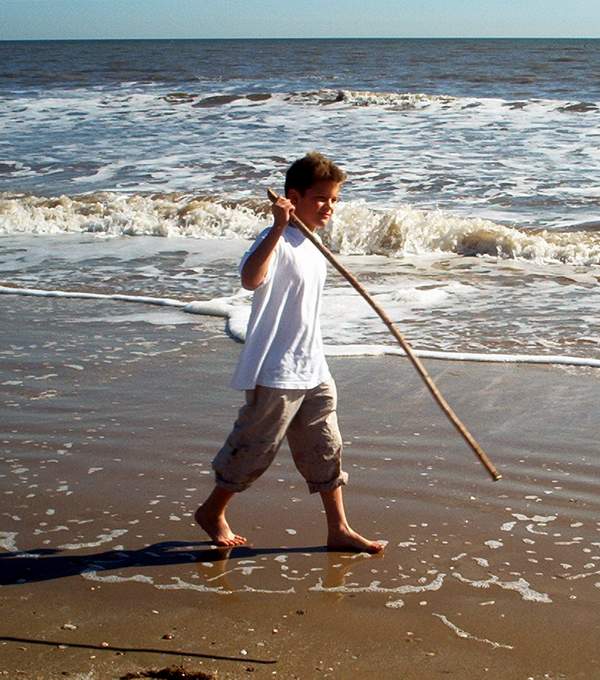
Lee walking in the surf at Crystal Beach. I checked my old blog entries – this was December 29, 2002. Fifteen years ago, almost to the day.
Lee walking in roughly the same spot, fifteen years later. There was no sun and it was very cold and windy. Same ocean, though.
“If you were different from anybody in town, you had to get out. That’s why everybody was so much alike. The way they talked, what they did, what they liked, what they hated. If somebody got to hate something and he was the right person, everybody had to hate it too, or people began to hate the ones who didn’t hate it. They used to tell us in school to think for yourself, but you couldn’t do that in the town. You had to think what your father thought all his life, and that was what everybody thought.”
― John Kennedy Toole, The Neon Bible
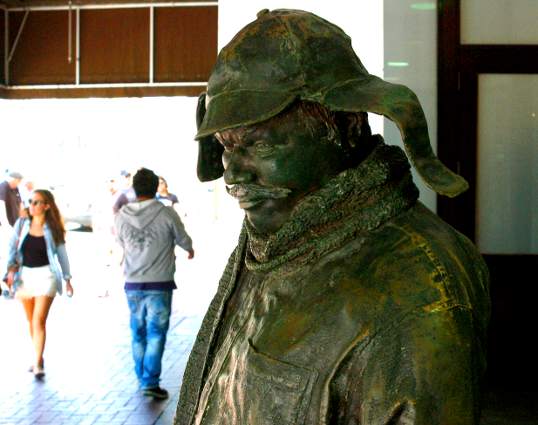
Ignatius J. Reilly, sculpture on Canal Street.
Oblique Strategy:Always first steps
Six down, ninety-four to go.
While working on my goals for 2018 I decided to set a goal of reading a hundred books in the year. Thinking about it, I decided the only way to pull this off was to read short books. I made a list of 66 short novels and wrote about it. Thinking more about it, I was excited enough to jump the gun and start the 100 books immediately.
Next up is The Neon Bible, the first, and next to last novel by John Kennedy Toole. He is the author that wrote the famous A Confederacy of Dunces and created the amazing character, Ignatius J. Reilly.
It is not as well known as Confederacy of Dunces, and the author didn’t even seem to think much of it. He said, “In 1954, when I was 16, I wrote a book called The Neon Bible, a grim, adolescent, sociological attack upon the hatreds caused by the various Calvinist religions in the South—and the fundamentalist mentality is one of the roots of what was happening in Alabama, etc. The book, of course, was bad, but I sent it off a couple of times anyway.”
So I picked up the book, with low expectations, but it had a slim page count, and I loved A Confederacy of Dunces – so I was sure it would be worth the effort and time.
And it was – not entirely successful as a novel, even as a bildungsroman, but it contains some amazing scenes and descriptions of life in a hell-hole little city in a beautiful Mississippi valley. It’s pretty observant and socially aware for something written by a sixteen year old.








 Bill Chance