A skill I learned in school – unfortunately, that was a half-century ago and it’s a skill I’ve lost. Should I work and regain it? I’m kicking up my reading and most of the books I read (fiction and non) would benefit from some marginalia.
There could be a psychopath sitting next to you right now.
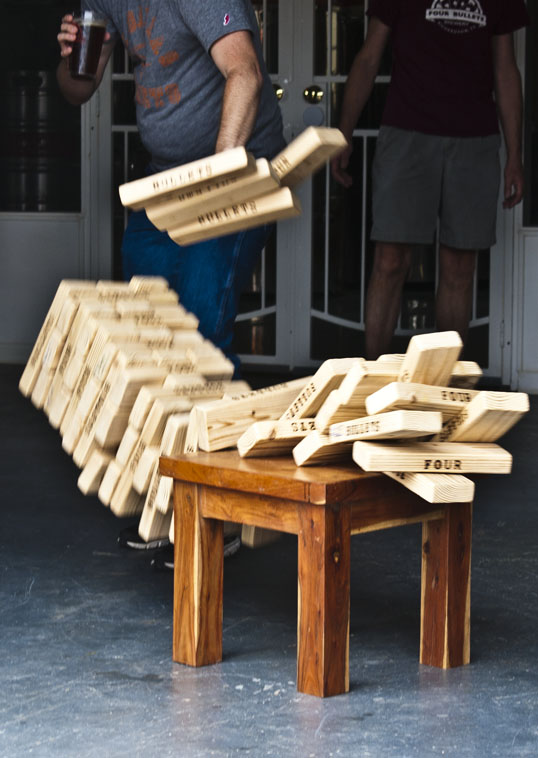
But it fell later as they tried to move another piece. Note the rare “suspended section” of blocks. I’m not sure of the physics of leaving a few behind for a handful of microseconds.
There are only two kinds of people who do not experience painful emotions. The first kind are the psychopaths. The second kind are dead. There is a false understanding or expectation that a happy life means being happy all the time. No. Learning to accept and even embrace painful emotions is an important part of a happy life. —–Tal Ben-Shahar, The Happiness Paradox
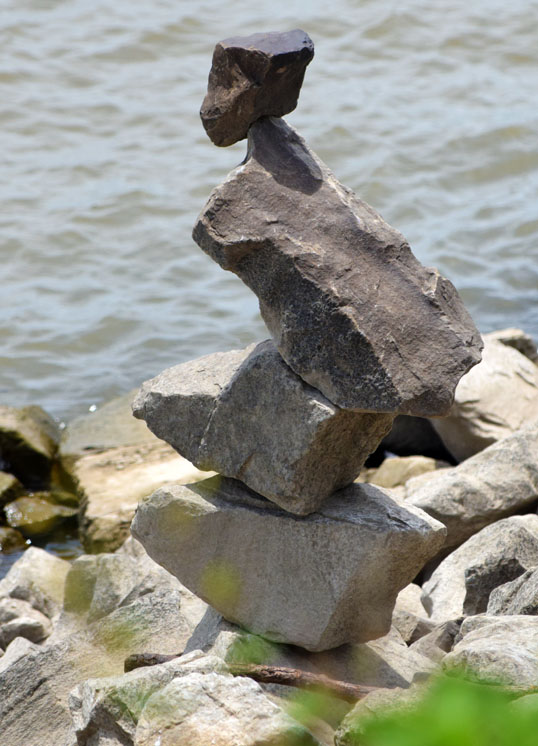
Riverbank Sculpture, Mississippi River, French Quarter, New Orleans
A growing body of research shows that the pursuit of happiness actually makes us miserable. This paradoxical finding likely results from people setting impossibly high standards, excessively monitoring their happiness, and misunderstanding what will make them truly happy. Positive psychologist Tal Ben-Shahar says that to be happier, we must find ways to pursue it indirectly while also accepting painful emotions.
Skateboarders regularly fail at their chosen activity. But that doesn’t make it a meaningless task of Sisyphean proportions
In the US talk show Comediansin Cars Getting Coffee (2012-19), the host Jerry Seinfeld remarks in a conversation with Chris Rock that ‘Those skateboard kids … are going to be all right.’ Rock expresses his agreement with Seinfeld, and they quickly move on to other topics. Their discussion about the value of skateboarding is quite brief (lasting about 20 seconds). But they agree that skateboarding provides skaters with a means of learning a life lesson. The lesson follows from the success of the skater in executing a manoeuvre after repeatedly failing (and falling). While some may nod their heads in agreement, it is worth considering whether Rock and Seinfeld are right. Does skateboarding teach a life lesson? If it does, is it a valuable lesson? Going further, why should we think that skateboarding is not, in fact, a meaningless activity that lacks any value?
“The truth will set you free. But not until it is finished with you.” ― David Foster Wallace, Infinite Jest
Renner School House desks.
I’m plugging away with my thirty pages (minimum) per day on The City and Its Uncertain Walls by Haruki Murakami. The book is interesting in that it is written in very simple and straightforward language, yet contains a wildly unusual, complex and subtle story.
On the other hand, today’s short story tells a very simple and straightforward story in a wildly unusual, complex and subtle way. It takes place in an elementary classroom (more or less) in 1960 – only a couple years before my own experience in same. There are a lot of similarities… and a lot of differences. It makes me think of what I remember… which are odd snips of memory – unrelated and seemingly random.
The story is not very short and is not all that easy to read… but take your time, keep at it – see what it brings back for you.
“What disturbs and depresses young people is the hunt for happiness on the firm assumption that it must be met with in life. From this arises constantly deluded hope and so also dissatisfaction. Deceptive images of a vague happiness hover before us in our dreams, and we search in vain for their original. Much would have been gained if, through timely advice and instruction, young people could have had eradicated from their minds the erroneous notion that the world has a great deal to offer them.” ― Arthur Schopenhauer
Never pick a fight with people who buy ink by the barrel. —-Mark Twain
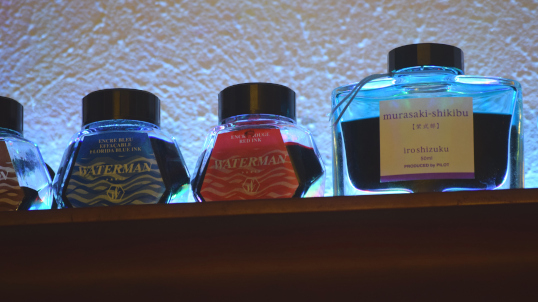
During the pandemic I was on a zoom call with my “Difficult Book Reading Club” (I was never able to work from home, my home Zoom calls were all personal) discussing… The Brothers Karamazov I think, when one of the participants, looking out through my camera said, “Bill, what the Hell is that thing on the wall behind you.” I had to think for a bit, and then realized it was my ink shelf.
I have been a fountain pen enthusiast for a long time. I have a modest collection of user-grade pens… I may write about some of them (you are forewarned). But pens are only one-third of the equation. Equally important is the paper – even something as famed as a Moleskine notebook is actually bad for fountain pen writing. Bleed-through to the opposite page and feathering are the two biggest faults.
The third part is, of course, the ink. It’s fascinating how some pens work better with some inks and the combinations may require a certain paper for optimal scribbling.
Over the last few years I have been accumulating ink with even more fervor than I have been acquiring writing instruments. Trying to think of a way to store and display my favorite go-to inks I came up with a shelf near my writing desk. The ink looked surprisingly bland there on the simple wooden shelf, so I drilled two holes in the wall, ran a USB cable behind the drywall to a power brick and stuck up an LED string behind the bottles of ink.
It came with a remote – but I have it on a permanent RGB color cycling pattern. It serves as a great nightlight too. It’s been there so long, I don’t even notice it until my pen runs dry – but I guess the constant pulsing and color-changing looks odd in the background of a Zoom call.
I don’t know how to howl. I have lost that. I might suddenly start. But no cheap scheme can save me now.
—-Rudolph Wurlitzer
Petrified Wood Gas Station,
Decatur, Texas
Hacksaw
Have you ever used a hacksaw? The harsh sound of metal rending, the hard push, vibration, thin blade, tiny hard teeth, little bits slicing through steel.
Have you ever used a circular saw? The whir of the blade, the smell of sawdust, little bits of wood glancing off of goggles, pure power.
Have you ever used a power drill? Long orange extension cord, the turn of the little key, forty-five degree gears, tightening, then turning, twisting, little spirals of wood coming out of the hole.
Do you own sawhorses? Old two by fours, turned gray by the sun, metal brackets, galvanized screws, homebuilt, leans up against the house, waiting faithfully ’til they are needed.
Have you ever used a power screwdriver? Torque, a twist into the wrist, whirring slowing into a deeper sound, Phillips bit into the screwhead, flights bite into the wood, around and down, tight, grinds to a halt.
Have you ever used a sabre saw? Razor toothed tongue jabs in and out, head shaking vibration, bite a bit, then move on.
Do you use a tape measure? Yellow stripe, black marks, little silver ear to hang on, a familiar rumble in the palm when the tape plays out, slight curve to hold horizontal for awhile, little lever on the bottom pulls the tape back in with a quick whiz.
Have you hammered a nail? Pull back, fingers hold the nail, be careful, a mistake can hurt, first tentative strike, then pull back and pow pow pow.
Have you held a square? A carpenter’s square, big hunk of steel, or a try square for things that need right angles, a combination square for forty-fives, an adjustable square for angles in-between, all are connections to geometry, to perfection, to things that fit.
Do you own a level? That little bubble in the yellow liquid, the two black lines, the tube that knows where the earth is, which way it points.
These are his days, days of building, of sweat, of sawdust on his clothes, grease spots on his legs, that odd soreness that comes from real work.
“I think computer viruses should count as life … I think it says something about human nature that the only form of life we have created so far is purely destructive. We’ve created life in our own image.” ― Stephen Hawking
Frisco, Texas
Hanging Chad
One of the tasks that Craig was assigned while he was back in his hometown for his father’s funeral was to “clean out” the old man’s computer – make sure there wasn’t anything important there. Before they threw it in the trash (although the ancient thing had cost a fortune new – it was beyond useless now).
The work was easy, nothing was password protected. Craig gave the digital collection a cursory once-over – it was obvious from the start there was nothing there that would be of any use or interest to anyone other than the now-forever-absent father.
Still, curiosity had him opening a few files, mostly plain text, just to see.
One small file was labeled mysearchterms.txt and was twenty years old.
It said:
Hanging Chad Tura Satana Monkey’s Paw Power Washer Leonid Shower Apple Pectin Bilbo Baggins Power Forward Daily Inventory Letter of Intent Echinacea and Goldenseal Temperature Sensitive Disodium Inosinate Glycol Ethers Alanna Urbach Parker Posey Anchovy Paste New Yorker Thyroid Diary Corkscrew Willow Bonded Filling Alberti Bass Oxford Comma Reverse Calenture Marfa Lights Rigid PVC
“There was only one catch and that was Catch-22, which specified that a concern for one’s safety in the face of dangers that were real and immediate was the process of a rational mind. Orr was crazy and could be grounded. All he had to do was ask; and as soon as he did, he would no longer be crazy and would have to fly more missions. Orr would be crazy to fly more missions and sane if he didn’t, but if he was sane he had to fly them. If he flew them he was crazy and didn’t have to; but if he didn’t want to he was sane and had to. Yossarian was moved very deeply by the absolute simplicity of this clause of Catch-22 and let out a respectful whistle.
“That’s some catch, that Catch-22,” he observed.
“It’s the best there is,” Doc Daneeka agreed.” ― Joseph Heller, Catch-22
M41 Walker Bulldog
Liberty Park
Plano, Texas
From my old online journal The Daily Epiphany – Wednesday, February 12, 1997
Cold, hard, rain
Rain. Cold Rain. H2O, Dihydrogen Monoxide. Two little spheres stuck on a big one, not on opposite sides, but in a V shape, lopsided. Untold numbers of little tiny 3D Mickey Mouse heads, only Avogadro knows how many. Mickey and his two little ears, sharing electrons. The uneven charge, the Mickeys want to stick together in crystalline order and sure enough, lumps of ice are falling, mixed in.
The clouds disgorge their burden, called up from where? Where did this water pick up its heat? Its half a thousand or so calories for every little gram, leaving the warm languid sea to travel on the tradewinds. Cuba? The Caymans? Key West? The water vapor rising from the tropical ocean, born aloft in Barnard cells of air, driven by the sun’s starry furnace. Riding north only to meet a frigid army of the north. Air chilled in Minnesota, maybe in Fargo, moving south. The two clash over Texas, right over my head, and the tropical steam gives its borrowed heat back to the icy northern air. The moisture congeals and falls, falls and falls.
The streets are full, flowing rivers of muddy water. To my left there’s a waterfall, a torrent of muck flooding out of a lumberyard. The sky is gray, the mud is gray, all color sucked out, washed away, flowing downstream. The water is stealing the colors, it’ll all flow down the Trinity, down to Louisiana where it’ll slink between the cypress knees, between the mangrove roots out into the gulf, back to the tropics, where the colors will be traded for warmth, for heat, for another trip on the convection express.
Leaving work, I carry my possessions protected from the deluge in a plastic bag. Two and a half boxes of Girl Scout cookies and a quart of tequila. In school I remember napping on my cot on a male section of the dormitory. “Bill, get up!” someone cried, “Go buy some Girl Scout cookies.” “Waaaa?” “Don’t ask why, go downstairs and buy some.” I stumbled down the stairs to the lobby, only to find a long, snaking line of male undergraduates. At the head of the line was the oldest, most developed Girl Scout I’d ever seen, stuffed into a uniform about three sizes too small. She was selling a lot of cookies.
Nowadays, of course, I buy them from coworkers, hawking stuff for their kids. A couple days ago a fellow chemist announced he had to go see a customer in Harlingen. “Hop over the border and get me some tequila”, I joked. Days later he came back and said, “Got your tequila!” I didn’t think he’d really do it, but five bucks for a quart of Jose Cuervo Oro, I won’t complain. So I leave work with a bottle and two and a half boxes of cookies. Why two and a half? I have no willpower.
The family goes out for dinner. We run from the van through the icy deluge. Cars dart around the dark parking lot, no safe place for a little one so Lee rides on my shoulders. “I’ll keep you dry, daddy,” he says, and cradles my head in his firm little arms, covering me up, protecting me from the wet and the cold. and the darkness.
They’re dead to us. They kill each other in the streets. They wander comatose in shopping malls. They’re paralyzed in front of televisions. Something terrible has happened that’s taken our children away. It’s too late. They’re gone.
—-from The Sweet Hereafter
Artwork in window, Waxahachie, Texas
The Emperor Has No Clothes
The meeting room is windowless, situated deep in the bowels of the workplace (it is a designated tornado shelter). Long, narrow, glossy wood meeting table. TV/VCR at one end. A computer hooked up to an overhead projector and LCD panel at the other. A scanner is connected to this PC also, this is where he comes to after hours to scan pictures. Of the most interest to him in this room is a small refrigerator, kept stocked with soft drinks. His rule – you make him sit through a meeting, he gets a Diet Dr. Pepper.
Eight men, all with identical Franklin Planners in front of them. They are going over some of next year’s plans, each looking at a sheaf of papers with projects and responsibilities listed, due dates, key items. Four pages of this. He can feel it in the air, nobody thinks they can get all this stuff done, in addition to their own daily duties. There are simply too few people and too much bullshit. Everybody thinks it, knows it, sighs almost inaudibly, but nobody says anything. That would be pointing out the emperor has no clothes.
“Past certain ages or certain wisdoms it is very difficult to look with wonder; it is best done when one is a child; after that, and if you are lucky, you will find a bridge of childhood and walk across it.” ― Truman Capote, Local Color
Tony Bones painting from the Kettle Gallery, For the Love of Kettle, Competitive Shopping Event
From my old online journal The Daily Epiphany – Sunday, November 15, 1998
Bowling alley
I spent the morning by going on into work. It is especially odd when I’m the only person at the huge factory. The parking lot empty except for my gold Taurus.
Tons and piles of paperwork I wanted to attack undisturbed, but I only chewed off a fraction of what I wanted to accomplish. Ambition and motivation were hard to find today.
Then I drove on down to meet Candy and the kids. Today was the Wildcat’s end-of-the-outdoor-season soccer party. We decided to hold it at a somewhat rundown bowling alley not too far from my work. We chose it because it was cheap.
I drive by this place often, you probably don’t. It has seen better days, the street it is on has seen better too. Displaced by newer roads it is now a backwater, a byway, only frequented by folks like myself that are constantly seeking back ways, shortcuts around the nearby railroad tracks.
The entrance to the lanes is flanked by two large plaster lions. They are often repainted in garish colors; today they were a tawny beige and shit brown. Between their outstretched paws each cradles a bowling ball, these were painted a bright blue. I rubbed one cerulean orb for luck as I passed by.
When I pushed the door open and entered the alley I was assaulted by the stench of cigarette smoke, some fresh, some echoes of ancient puffing. It didn’t take long to get used to it though, and the place was clean and well-run. And it was cheap. The neighborhood must be run down more than I thought, one feature was public surveillance cameras trained on the parking lot so you could keep an eye on your car while you bowled. The kids liked watching their friends arrive on the monitors.
Everyone seemed to have a good time. We rented four lanes for two hours. The kids played on three lanes and the adults on one. For those of you that don’t hang out in such places, there has been a big change in bowling to accommodate small children and recapture the family bowling market. There is a selection of lightweight balls for kids, with no holes in them. The kids simply heave these down the lane the best way they can. There are folding bumpers that are extended out to fill the gutters, so the kids will almost always be able to hit at least a few pins.
Lee really bowled well and had a blast. Nick did too, though he whined and griped the whole time. “I’ll never get the hang of this!” “I’ll never get a strike!” He had his premature teenager disease bad today; which is frustrating for everybody around him.
The adults had fun too. Candy bowled on one of the bumper lanes and ended up with a respectable score. For me, of course, the primary attraction of bowling is the thrill of wearing rented shoes.
We bowled, handed out trophies, ate cupcakes, the usual stuff. We found out that the team the Wildcats beat yesterday in indoor had never lost a game before.
As I was standing around I noticed a glass covered, framed letter mounted on the wall. It was from some bowling consulting firm congratulating the bowling alley owner on his modern, impressive facility. It went on gushing for several paragraphs before concluding with the sentence, “And we are confident in saying that your bowling facility is one of the top one or two percent of all bowling centers in the entire country.”
I looked closer and the yellowed letter was dated 1985.










 Bill Chance