I have been thinking about Big Bend a lot. I miss the place. I used to go there to reconnect. I need to figure out how to get back.
Sometimes you get ideas that you really like but know they are crazy and will never happen. That’s when you feel stupid.
Sometimes… not too often… you find out that your crazy idea isn’t that insane and that somebody else is trying to actually do it. That’s when you no longer feel stupid, but instead feel lazy, cowardly, and ineffectual.
That guy Guy Fieri – from that food show that shows him eating all sorts of stuff you should not eat – accomplished a rare feat. He opened a restaurant that garnered a zero star review from the New York Times (read it, it’s well written and pretty funny).
He also neglected to register the whole URL for his restaurant’s name… so somebody else did, and posted a
Shame it’s satire… wouldn’t you want to get something like:
Guy’s Big Balls – $26.95
Snuggle up to two 4-pound Rice-A-Roni crusted mozzarella balls endangered with shaved lamb and pork and blasted with Guy’s signature Cadillac Cream sauce until dripping off the plate. Served Nestled inside a tempura pickle, with a side of maximum-well-done duck skin.
Extra Wet Naps – $3.50.
Photograph by Jamie Chung for Bloomberg Businessweek
Like ketchup, sriracha is a generic term, its name coming from a port town in Thailand where the sauce supposedly was conceived. When people in America talk about sriracha, what they’re really talking about is Huy Fong’s version. It’s been name-checked on The Simpsons, is featured prominently on the Food Network, and has inspired a cottage industry of knockoffs, small-batch artisanal homages, and merchandise ranging from iPhone cases to air fresheners to lip balm to sriracha-patterned high heels.
But I think that we are looking at something even deeper than that: the Mandarinization of America.
The Chinese imperial bureaucracy was immensely powerful. Entrance was theoretically open to anyone, from any walk of society–as long as they could pass a very tough examination. The number of passes was tightly restricted to keep the bureaucracy at optimal size.
Passing the tests and becoming a “scholar official” was a ticket to a very good, very secure life. And there is something to like about a system like this . . . especially if you happen to be good at exams. Of course, once you gave the imperial bureaucracy a lot of power, and made entrance into said bureaucracy conditional on passing a tough exam, what you have is . . . a country run by people who think that being good at exams is the most important thing on earth. Sound familiar?
The people who pass these sorts of admissions tests are very clever. But they’re also, as time goes on, increasingly narrow. The way to pass a series of highly competitive exams is to focus every fiber of your being on learning what the authorities want, and giving it to them. To the extent that the “Tiger Mom” phenomenon is actually real, it’s arguably the cultural legacy of the Mandarin system.
….
In fact, I think that to some extent, the current political wars are a culture war not between social liberals and social conservatives, but between the values of the mandarin system, and the values of those who compete in the very different culture of ordinary businesses–ones outside glamor industries like tech or design.
This go-round is the Tony Award winning play Red, by John Logan. It’s a two man play based on the artist Mark Rothko, set in Rothko’s studio in 1958, during the time he is working on a group of large murals for the new Four Seasons Restaurant in the Seagram Building in New York. Rothko and his fictional assistant, Ken, work and talk about art and life. The overarching conflict between the two is the very acceptance of the commission to decorate the walls of a restaurant frequented by the wealthiest people in the world. Rothko insists it is a subversive act, that he wants to paint, “something that will ruin the appetite of every son-of-a-bitch who ever eats in that room.” Ken counters that Rothko simply wants to feed his ego with the money and fame the prestigious commission offers.
At any rate, I was going alone, and went to catch the train downtown. Since I left from work, I felt underdressed – but that was fine; the crowd for “Pay What You Can” night was motley and wearing all sorts of styles at various levels.
I was interested in the staging of Red. King Lear is still running at the Wyly in the main stage above the lobby (the Wyly is revolutionary in its stacked structure – the lobby is at the bottom, the stage area above, with the support spaces higher up). For Red, they converted the rehearsal hall on the ninth floor into an artist’s studio.
While the patrons attending Lear were entering on the right side of the Lobby, we were divided into groups and sent up elevators to the ninth floor. The tickets had no seat assignments, so the crowd wandered around the edges of the studio, finding chairs lined against the wall on low risers. After I settled in, I noticed the actor playing Rothko silently sitting in a comfortable chair in the center of the room, staring and contemplating one of his in-progress color fields. Finally, the last patron came in looking around, looking lost – I noted his clothing was curiously dated… like something out of the fifties. Suddenly I realized that this was the actor playing the assistant, he spoke to Rothko, and the play began.
The play was simple – only two characters, one set, no intermission. Very intimate – you are there in the studio with the two characters. It was more intellectual than passionate – the only real moments of raw emotion was generated by Ken talking about the death of his parents… and that felt a bit forced. Still, it was enjoyable – the character of Rothko is a grand pompous bully – and a brilliant one. Ken was more of a blank canvass where Rothko would paint with his powerful personality and stubborn ideas, but Ken’s point of view somehow kept winning out in the end.
One highlight was a long, wordless passage where Rothko and Ken together slather the dark crimson undertone on a giant canvas, both working hard, slinging heavy brushfulls of paint in different sections of the wall-sized work, their breathing hard and passionate in the small space. To Rothko his paintings are living things… and he feels responsible for and concerned about their ultimate fate.
There is a lot of talk of the art of the time. It was fascinating how Rothko boasted of how he and the abstract expressionists dethroned Picasso and Matisse (“Nobody even thinks of painting cubism anymore, it’s dead”) and how Ken feels that Pop Art is now overthrowing Rothko.
Ken namedrops Warhol, Johns, Rauschenberg, and Lichtenstein – and Rothko asks, “Lichtenstein, who’s that?”
I was happy when, in my mind I thought, “Comic Books,” and then Ken says, “Comic Books.”
There is a lot of namedropping here, and it helps to know a thing or two about a thing or two – but not so much that it gets in the way of the entertainment.
After the play we rode the elevators back down to the lobby. It was full of patrons from King Lear, which was in intermission. They were all very nattily dressed, formal, seeing and being seen in that Dallas way while we cheapskates skittered away at the edges.
Outside, the glittering canyons of the city were shining at night while torn scraps of low cloud skimmed by overhead, illuminated by the lights below. It was beautiful and a bit of a shock – while the play was going on it was easy to think you were really in a dingy art studio and forget that you were really nine stories in the air in a huge aluminum cube-theater-machine.
Down Flora Street, between the hulking rows of the Arts District public edifices stood the Dallas Museum of Art. Inside, I knew, there was a Rothko painting. I’ve seen it before – but now I want to go back and stare at it for a while, watch it pulse, see it live, think about what the artist was thinking in that dark place where it was painted.
Mark Rothko, Orange, Red and Red, Dallas Museum of Art
“As flies to wanton boys are we to the gods. They kill us for their sport.”
—- Shakespeare, King Lear
As I’ve said before – I was excited to watch the fantastic new venues go up in the Dallas Arts District. I especially was fascinated by the Wyly theater. Designed by Pritzker Prize winner Rem Koolhaas and associates it was a unique building, resembling nothing more than a Borg Cube. I distinctly remember thinking that it was such a cool place that it was a shame I could never afford to see a production there.
The Wyly Theater.
“When we are born we cry that we are come
To this great stage of fools.”
I was wrong. It is quite easy to find affordable tickets to most of the productions. Especially on “Pay What You Can Night.” Most productions have one performance (actually, you might call it a dress rehearsal – but it’s the full thing) that they sell the tickets for whatever the audience wants to pay.
These can sell out quickly, of course. But I have the site bookmarked and the dates on my calendar, and I can jump in there and buy them quick. We have seen The Tempest on a cheap day and The Elaborate Entrance of Chad Deity on a Pay What You Can night.
I snagged two tickets to King Lear on Pay What You Can Night. I won’t say what I could pay… right now, it’s not very much, I’m afraid.
“Through tattered clothes small vices do appear.
Robes and furred gowns hide all. Plate sin with gold,
And the strong lance of justice hurtless breaks.”
Candy couldn’t go, though, and I ended up going by myself. On Friday morning I thought about bailing, things were so complicated. I didn’t have a car, would have to ride my bicycle in the cold to work, and then get to the theater. Thursday night I rolled all the possibilities in my head, where to ride, where to lock up my bike, what to take, all the timing.
“I am tied to the stake, and I must stand the course.”
I decided to give it a go when the day turned out to be sunny and warmer than I expected and I actually enjoyed my commute to work. Afterwards, I had to ride around to a couple DART stations looking for an open bike locker – I didn’t want to leave my road bike locked up outside for fear of finding it relieved of vital parts.
“We are not the first
Who with best meaning have incurred the worst.'”
I have only seen King Lear once. Decades ago, I took Lee to see a production outside at the Dallas Shakespeare Festival – I’m not sure of the year, but I guess he was ten or so. Lear is such a dark and complex work, I worried that he would be bored – but there was enough sword fighting and action that he was enthralled, even if he didn’t really understand what was going on. In the infamous eye-gouging scene, an actor actually threw two grapes on the stage and then stomped on them. Lee perked up.
“Hey, what just happened?” he asked.
“Oh, nothing, Lee.” A father has to lie a little now and then.
“I want that glib and oily art
To speak and purpose not; since what I well intend,
I’ll do’t before I speak.”
He especially liked the army scenes where they had a large crowd (probably every stagehand and a lot of local volunteers) moving through the trees around the outdoor venue with lamps and rattling swords. It was pretty impressive – he was a tiny bit afraid… just the right amount. He used to really love going to the Shakespeare plays and I wish I could have done more. We were so busy.
Lee, at the Dallas Shakespeare Festival’s production of Hamlet, a few years ago.
“How sharper than a serpent’s tooth it is
To have a thankless child!”
So, on Friday, I rode the DART train downtown and walked to the Wyly for the performance.
It started out with a very spare stage – a wooden wall, a door, a heavy chair, and a candelabra. I noticed before the performance a couple of stagehands on hands and knees, carefully wiping the stage down, as if they were worried about bits of slippery water.
“Time shall unfold what plaited cunning hides.”
The play started very formal and stiff. The actors stood arranged around the seated king in symmetric positions and delivered their lines. It was all very good, but not very exciting. King Lear is an avalanche of a play; it delivers its punches full-bore – heavy and hard. It doesn’t fuck around.
Still, to entertain a modern audience, you need something more than a static composition, no matter how talented. You need a gimmick, something to entertain the masses. I worried that they had decided to go all old-school, plain, simple, and it was starting to get a little boring. I thought it might be a long night of interesting but not very passionate storytelling.
I was wrong.
“Oh, that way madness lies; let me shun that.”
When I think of King Lear, I don’t usually think of the play itself… or even a film of the play. I think of Ran – the incredibly powerful film by Kurosawa. I saw it in a theater when it first came out and it affected me as much as any film ever did. Based on Lear, set in samurai-era Japan, it captures the tragedy and hopelessness of Lear in an amazing, colorful… Kurosawa style. A work of genius.
“Have more than thou showest,
Speak less than thou knowest,
Lend less than thou owest.”
Still, to this day, when I watch Lear, the back of my mind flashes to the battles and pathos of Ran. It is engraved there forever… I’m afraid.
“This is the excellent foppery of the world, that,
when we are sick in fortune,–often the surfeit
of our own behavior,–we make guilty of our
disasters the sun, the moon, and the stars: as
if we were villains by necessity; fools by
heavenly compulsion; knaves, thieves, and
treachers, by spherical predominance; drunkards,
liars, and adulterers, by an enforced obedience of
planetary influence; and all that we are evil in,
by a divine thrusting on: an admirable evasion
of whoremaster man, to lay his goatish
disposition to the charge of a star!”
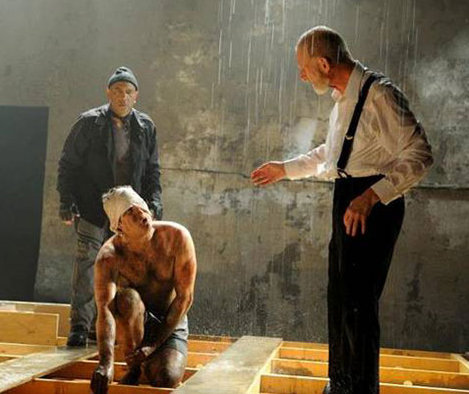
Then, suddenly, about a quarter way through, the formal stylized play ended. As Lear was thrown into the storm of madness the wooden walls that formed the back of the stage fell forward into a tumbledown confusion, huge doors swung down from above and a gigantic torrent of water waterfalled down (sort of Flashdance style – on steroids) onto the King.
And all Hell broke loose.
The rain comes down and madness conquers all.
“Blow, winds, and crack your cheeks! rage! blow!
You cataracts and hurricanoes, spout
Till you have drenched our steeples, drowned the cocks!
You sulphurous and thought-executing fires,
Vaunt-couriers to oak-cleaving thunderbolts,
Singe my white head! And thou, all-shaking thunder,
Strike flat the thick rotundity o’ the world!
Crack nature’s moulds, all germens spill at once
That make ingrateful man!”
The formality gone, torn to the four winds, the rest of the play was a tsunami of a powerful madness, a foil for the Kings insanity and despair. The fourth wall was broken, with actors fighting in the aisles and lightning screaming through the theater. I noticed that even the sound effects added to the disconcerting craziness – every time the King’s mind took a turn for the worst, a crackling buzz came from hidden speakers above the seats – a subtle effect that enforced the impression of insanity and doom.
“Rumble thy bellyful! Spit, fire! Spout, rain!
Nor rain, wind, thunder, fire, are my daughters:
I tax not you, you elements, with unkindness;
I never gave you kingdom, called you children,
You owe me no subscription: then, let fall
Your horrible pleasure; here I stand, your slave,
A poor, infirm, weak, and despised old man.”
And then, the tragedy. As the inevitable doom unfolds, the tragic events set in motion by the Lear’s egocentric arrogance in the first scene come to their conclusion, the horror sets in.
“The worst is not,
So long as we can say, ‘This is the worst.”
This is a play written four hundred years ago by a mysterious man living in a world that is so different than ours. I always wonder what Shakespeare would think, seeing his work performed in a place such as the Wyly theater – which is essentially a huge theater machine, a reconfigurable, hydraulic, giant metallic cube, able to morph into whatever shape is needed. It is thick with electrical wiring; looking up you can see wireless routers laced with tangles of blue Ethernet cables blinking yellow and green in the darkness. Shakespeare would shake with fear at this mechanism which has swallowed his actors and audience whole.
“Come not between the dragon and his wrath.”
Still, it is his words. The same words he must have scratched out with a quill on thick paper four centuries ago. It is a miracle that they are still so effective after all this time… and space.
“Who is it that can tell me who I am?”
Those of us in the audience must know what to expect. It is a tragedy. There is a warning on the sign out in the lobby that the play contains nudity. This story is not going to end well. Everyone is going to die.
“He’s mad that trusts in the tameness of a wolf, a horse’s health, a boy’s love, or a whore’s oath.”
But we have all been spoiled… softened and weakened by Hollywood Films and Television Productions that must have happy endings. The hero will be rescued at the end, despite all odds, and the villain will get his just comeuppance, after he repents and is forgiven. The performance will end with sweet music, with the hero kissing the girl, while a Technicolor sunset flares behind the closing credits.
Shakespeare plays with us. He always adds a little tiny bit of hope – the soldier is dispatched to stop the execution, the poison doesn’t seem to work at first, the bad guy seems to realize the folly of his ways. It is a ruse.
We should know better, but we don’t. When doom descends, we are shocked, shocked even though we knew it was coming, shocked even though we have seen this before, shocked even though we know this is how the world works.
“Poor naked wretches, wheresoe’er you are,
That bide the pelting of this pitiless storm,
How shall your houseless heads and unfed sides,
Your looped and windowed raggedness, defend you
From seasons such as these?”
So stunned we sit there. Then we realize what we have seen. A work of genius.
“The weight of this sad time we must obey;
Speak what we feel, not what we ought to say.
The oldest hath borne most: we that are young
Shall never see so much, nor live so long.”
So now I have set a mark on my calendar for February 1. That’s when the Pay What You Can tickets go on sale for Red – a play about the artist Mark Rothko. If you want to go, contact me and I’ll see if I can get an extra ticket or two.
When the Wyly theater was constructed I remember being excited about the building and its architecture, even more than the other venues in the Arts District. Its unique design and resemblance to a Borg Cube made it fascinating in my eyes.
But one thought I had was, “This is a cool place – but once it’s finished I’ll never be able to afford to see a play in such an expensive and opulent venue.”
Kids Splashing in front of the Wyly Theater. An HDR image I took on the opening day of the theater.
I was wrong. Sure, there are plenty of expensive seats at the shows at the Wyly, but if you play your cards right you can get in inexpensively. You can get in cheaper than a 3-D movie. We saw The Tempest there a while back for only a few measly bucks. Today, we saw a play that I had never heard of, The Elaborate Entrance of Chad Deity, for… well, for whatever I felt like paying.
The operators of the Wyly, The Dallas Theater Center, have these Pay What You Can Nights – so I logged in and bought a couple tickets. I thought for a minute about how much to pay… and ended up paying less than I should have but more than I could have. There is a thin line between cheap and poor.
At any rate, we took the DART train down to the Arts District. There was a lot going on – the Friday night late night music, food trucks, crowds, and a preview (A Glimpse) of the upcoming Aurora light and sound installation/exhibition (which I do not want to miss again this year).
We walked past the giant floating red/orange jellyfish writhing in the air outside the theater and went in to take our seats.
The play is about wrestling. I have never been a big fan of the “sport” (though it is in my blood, I guess, I’ll post something about that this weekend). The play was a blast, though.
The Wyly can best be described as a theater machine. The entire interior of the building is infinitely reconfigurable. For this play it was set up as seats surrounding a real wrestling ring, and one side would open up, the seats sliding sideways, to allow the wrestlers to enter through a cloud of smoke. High above were four giant video screens showing the wrestler’s publicity films or the output from handheld cameras showing the action in the ring or the announcing outside.
The narrator of the story is the wrestler Macedonio Guerra, known as Mace, who is a professional loser. He is so skilled that he makes the headline wrestler look good, even when he’s lousy. Wrestling has been Mace’s lifelong dream, and although he has a lot of complaints, he is quiet about them. He doesn’t want to upset the apple cart and lose whatever sliver of his dreams he is allowed to keep.
The first half of the play is a colorful, funny exposé of the funhouse mirror world of professional wresting – where money is king, and the performers are a brotherhood dedicated not to winning, but to entertaining, telling a story, and making sure nobody gets hurt.
After the intermission things get more confused and serious and Mace is inevitably faced with the need to make a choice and decide whether he will have to abandon the moral neutral ground he has been hiding in and take some sort of stand. There also is some real wrestling, which is rousing, fast, and exciting, even if it isn’t a real sport.
Every body in the hall had a hell of a good time, learned a little, and left smiling.
The cast of The Elaborate Entrance of Chad Diety
What shocked me was the number of empty seats. The performance was on a pleasant Friday evening, in the midst of an Arts District full of fun things to do, and cost, potentially, pennies. Why wasn’t every seat taken? I never understand why more folks don’t go to live theater. They pay more money than this to go to a crowded suburban googleplex to see the newest remake of some scumsucking hollywood slimebucket and eat stale popcorn while listening to teenagers’ phones going off.
This HDR picture of the top corner of the Wyly theater was taken from the same spot that I took yesterday’s photograph of the Winspear Opera House.
I have always been amazed at the strange appearance of the Wyly, of its clockwork like theater machine interior, and was very happy and impressed when I saw The Tempest there. It is surprising how inexpensive the productions are (if you are willing to go for the cheap seats – which are still pretty damn close) and I can’t believe that the shows aren’t selling out.
It’s probably the economy… and people simply don’t think of doing stuff like that. I’ll tell you, it’s hard to find folks that want to go to plays, live plays, even if they cost about what the newest 3D Googleplex Shopping Mall crap does.
I remember when each and every building in the Dallas Arts District went up – starting decades ago when I worked downtown and they built the Art Museum and I’d sit in the sculpture garden and eat my paper sack sandwich lunch (it was free back then, believe it or not). Then the Symphony hall, and the Nasher. Finally, the completion of the district with the Opera House and the Wyly theater (there is still one more theater under construction).
I love the area and hope that Dallas can make it into the vibrant urban spot they want. So far, it’s a beautiful but usually desolate destination. It hasn’t reached the tipping point where the vast population out in the suburbs think of downtown as a place to go – but the city is working on it.
One fact that I was definitely wrong on is that, as much as I loved the Wyly as architecture, I was afraid I’d never be able to actually go to the thing. It felt like a gift to the wealthy, a plaything for the rich, and the poor proles like myself, the workin stiffs, would never be able to afford to visit.
I was mistaken. I read that the Dallas Theater Center was producing The Tempest at the Wyly and I surfed over to check out the price. It cost about what a 3D movie is going for. Well, I love me some Shakespeare, so I clicked on to a Tuesday night and bought a couple tickets. I was as interested in the theater itself as the play, so I bought the cheapest seats – up in the nosebleed section.
The Wyly Theater.
The Wyly is a magnificent and unique piece of architecture. It is a theater of a revolutionary “Stacked” design – the the boxoffice and lounge, performance space, rehearsal and ancillary spaces are piled up on top of each other to give tremendous flexibility and endless possibilities for unique performances. I looks like a Borg Cube has landed in downtown Dallas and it operates like a theater “machine.”
I was excited to actually see the thing in action. Oh, and I love “The Tempest” too.
We rode the DART train downtown to the Pearl Station and walked over to the Wyly. You descend down a ramp to the main entrance which is beneath the building itself. Then you ride an elevator up to the seats. We were in the cheap seats – but they were still great. We were looking down onto the stage from a short distance away – I can’t say these were any worse than the premium seats (only a few dollars more, actually) below us.
Kids Splashing in front of the Wyly Theater. An HDR image I took on the opening day of the theater.
This was a pared-down version of The Tempest which let the skills of the actors shine through. Still, there was plenty of clever stagecraft – a terrifying plane crash in the beginning (with the rows of seats tumbling down through a hole in the floor) – a character emerging from beneath the earth through a crack in the chalky island soil, and a terrifying spirit descending from above to deliver the message of doom.
One nice touch was that the lighting would subtly change whenever a character would deliver a soliloquy or aside. It was an effective way of signaling what was going on.
All modern Shakespeare productions, especially The Tempest, are modified to some extent. At first, I thought they had simplified the language, because I understood it so much better than I usually did. After a while, I realised that the text was the same, it was simply that the acoustics are so good in the Wyly that I could hear the actors like crystal. Greatness! Oh brave new world that has such people in’t.
In my opinion, a production of The Tempest rises or falls on Ariel. Can the Actor/Actress (I’ve seen both… about 50/50) make a believable sprite? Can they be light as a breeze when needed while as powerful and terrifying as a storm? This production had a local actor that has made it on Broadway, Hunter Ryan Herdlicka … and he did a great job. They were able to use his singing voice as a powerful tool to move the drama along – too often I’ve seen the songs in The Tempest be more of a distraction than an effective part of the play.
So, I went down there to see the theater, and I was not disappointed. And I came away impressed with the production, I really enjoyed it… and after all, the play’s the thing (oops, wrong Shakespeare play).
Gentle breath of yours my sails
Must fill, or else my project fails,
Which was to please. Now I want
Spirits to enforce, art to enchant;
And my ending is despair,
Unless I be reliev’d by prayer,
Which pierces so that it assaults
Mercy itself, and frees all faults.
As you from crimes would pardon’d be,
Let your indulgence set me free.




 Bill Chance